
lovethailand home >Northeastern Travel Attractions >Surin Travel Attractions > 20 Best Places to Visit in Surin Northeastern Thai..
TL;DR: 20 Best Places to Visit in Surin Northeastern Thailand.
20 Best Places to Visit in Surin Northeastern Thailand
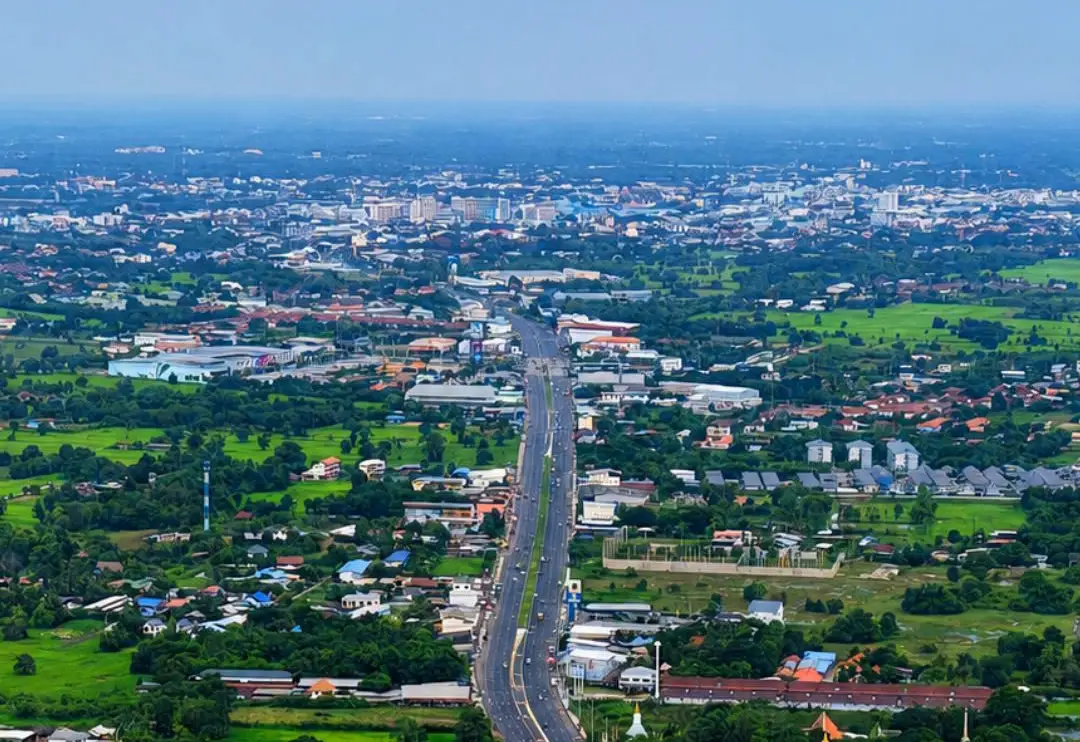
20 Best Places to Visit in Surin – Relaxing Attractions in Northeastern Thailand Surin is one of the most distinctive destinations in southern Northeastern Thailand, with a strong identity shaped by elephants, ancient Khmer civilization, silk weaving, traditional handicrafts, ethnic diversity, Buddhism, nature, and an agricultural way of life. Travellers will find centuries-old Khmer sanctuaries, revered temples, elephant communities, silk-weaving villages, handicraft centers, museums, forests, mountains, reservoirs, and rural landscapes where the traditional character of southern Isan remains clearly visible.
If this is your first visit to Surin, begin in the provincial capital with Wat Burapharam, the Phraya Surin Phakdi Si Narong Changwang (Pum) Monument, and Surin National Museum. Continue to the Elephant Study Center to learn about the relationship between people and elephants, visit communities producing gold-brocade silk and traditional handicrafts, and then follow the province’s Khmer heritage route to Prasat Sikhoraphum, Prasat Hin Ban Phluang, and Prasat Phum Pon. Complete the journey with forest parks, reservoirs, waterfalls, and other natural attractions. With 3–5 days, travellers can explore several parts of the province at a comfortable pace.
One of Surin’s defining characteristics is its long relationship between people and elephants, particularly among Kuy communities in Tha Tum District. Knowledge of elephant raising, care, and training has been passed down through generations. Ban Ta Klang and the Elephant Study Center are therefore more than tourist attractions: they are cultural learning spaces that help visitors understand how elephants are connected with local life, beliefs, rituals, and Surin’s identity.
Historically, Surin contains Khmer archaeological sites across many districts. These range from Prasat Phum Pon, one of Thailand’s oldest groups of Khmer sanctuaries, to Prasat Sikhoraphum, Prasat Hin Ban Phluang, Prasat Yai Ngao, Prasat Chom Phra, and Prasat Ban Chang Pi. Together, these monuments show that Surin once formed part of a Khmer cultural landscape in which religious centers, transportation routes, settlements, and water systems were interconnected.
Surin is also known for its remarkable ethnic diversity. Kuy communities, Thai people of Khmer descent, Lao-Isan communities, and other local groups have lived together for generations. Each has its own language, beliefs, clothing, cuisine, music, and rituals. This diversity can be seen in festivals, silk-weaving communities, silverwork, basketry, traditional dress, and everyday life.
One tradition that strongly reflects Surin’s Khmer cultural roots is Saen Don Ta, an ancestral worship ceremony practiced by Thai people of Khmer descent. Families return home to gather together and prepare food and offerings in remembrance of their ancestors. The Surin Elephant Festival, generally associated with November, is another major cultural event that reflects the relationship between elephants, local communities, and the identity of the province.
Surin’s food culture is equally distinctive, combining Kuy, Khmer, and Lao-Isan culinary traditions. Local food tends to feature the bold flavors associated with Isan cuisine, aromatic herbs, and ingredients closely connected with the agricultural environment. Common dishes include larb, koi, som tam, kaeng om, grilled chicken, fish soup, cassia-leaf curry, and seasonal dishes prepared with mushrooms, bamboo shoots, local vegetables, freshwater fish, and other regional ingredients. Travellers interested in food culture should eat at local restaurants and community markets, where cuisine reflects not only flavor but also ethnicity, farming traditions, and household life in southern Isan.
Jasmine rice is another important part of both Surin’s cuisine and local economy. The province’s plains are well suited to rice farming, and jasmine rice from southern Isan is known for its fragrance and texture. Eating it with dishes such as larb, kaeng om, freshwater fish, or spicy dipping sauces provides a direct taste of the relationship between local ingredients and everyday food culture.
Beyond savory dishes, village markets and community areas offer processed foods, traditional sweets, agricultural produce, and local products that vary from district to district. Stopping at local markets along the route adds another dimension to a Surin trip by combining food, shopping, and direct interaction with people in the community.
Surin is also nationally renowned for silk, particularly gold-brocade silk and traditional patterned textiles produced through highly complex weaving techniques. Chan Soma Gold Brocade Silk Weaving Village and Khwao Sinarin Handicraft Village are important stops for travellers who want to observe weaving techniques, learn about artisan knowledge, and purchase products directly from local communities. Silverwork and other traditional crafts further strengthen the province’s cultural identity.
For nature lovers, Surin offers more than agricultural plains. The province also contains mountains, forests, reservoirs, and conservation areas including Phanom Sawai Forest Park, Huai Saneng Reservoir, Surin Two-Needle Pine Conservation Area, Tri Khiri Waterfall, Wang Thalu, and Sirikit Forest Park. This variety makes it easy to combine history, culture, and nature without making the itinerary feel repetitive.
For efficient travel, Surin should be divided into zones: Surin city for temples, museums, monuments, and reservoirs; Tha Tum for the Elephant Study Center and Wang Thalu; Khwao Sinarin for handicrafts and silk; Sikhoraphum for Khmer sanctuaries and reservoirs; Prasat–Sangkha for archaeological sites; and Buachet–Lamduan for forests and natural attractions.
If you have only 1 day, focus on the city and nearby attractions. With 3–5 days, however, it is possible to experience Surin’s elephant heritage, Khmer civilization, silk communities, local food, and natural landscapes in much greater depth. The journey then becomes more than a series of sightseeing stops: it becomes a way of understanding southern Isan through its people, food, art, beliefs, and landscapes.
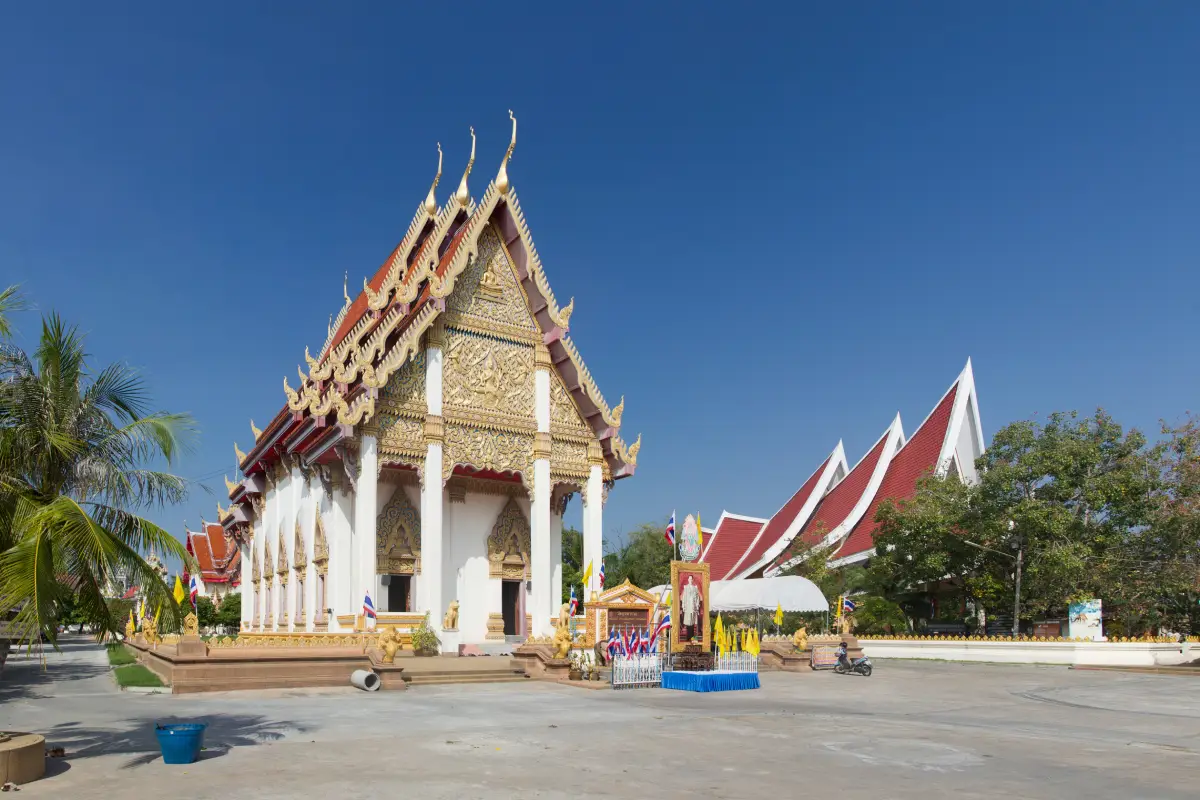
1. Wat Burapharam is an important royal temple in the heart of Surin city and one of the province’s long-established spiritual centers. The temple houses Luang Pho Phra Chi, also known as Luang Pho Praji, a sacred Buddha image deeply revered by local residents. Wat Burapharam is also closely associated with Luang Pu Dul Atulo, an important meditation master, giving the temple significance in faith, history, and Buddhist practice.
Highlights: Luang Pho Phra Chi, the historic royal temple, its association with Luang Pu Dul Atulo, the meditation and relic museum, and the atmosphere of an old urban temple that continues to play an important role in community life.
The history of Wat Burapharam dates back to the late Thonburi period and early Rattanakosin era. The temple is associated with Phraya Surin Si Narong Changwang, or Pum, the first governor of Surin. It was later elevated to the status of a third-class royal temple on February 1, 1977.
The temple’s most important sacred object is Luang Pho Phra Chi, regarded by local residents as a protective Buddha image of the city. Worshippers regularly come to pray, offer flowers, incense and candles, and apply gold leaf, especially before major life events or auspicious occasions.
Another significant area is the meditation and relic museum associated with Luang Pu Dul Atulo and the Thai Forest meditation tradition. Visitors interested in this section should contact the temple in advance because the museum area does not necessarily follow the same access conditions as the general temple grounds.
Its central location makes Wat Burapharam an ideal first stop in Surin. From here, travellers can easily continue to the Phraya Surin Phakdi Si Narong Changwang Monument, local markets, restaurants, the railway station, and other attractions in the city.
Getting There: The temple is located at 330 Chit Bamrung Road, Nai Mueang Subdistrict, Mueang Surin District. It is open daily from 08:00–17:00. Admission is free.
Map (GPS): https://www.google.com/maps/dir/?api=1&destination=14.884646,103.493181&travelmode=driving
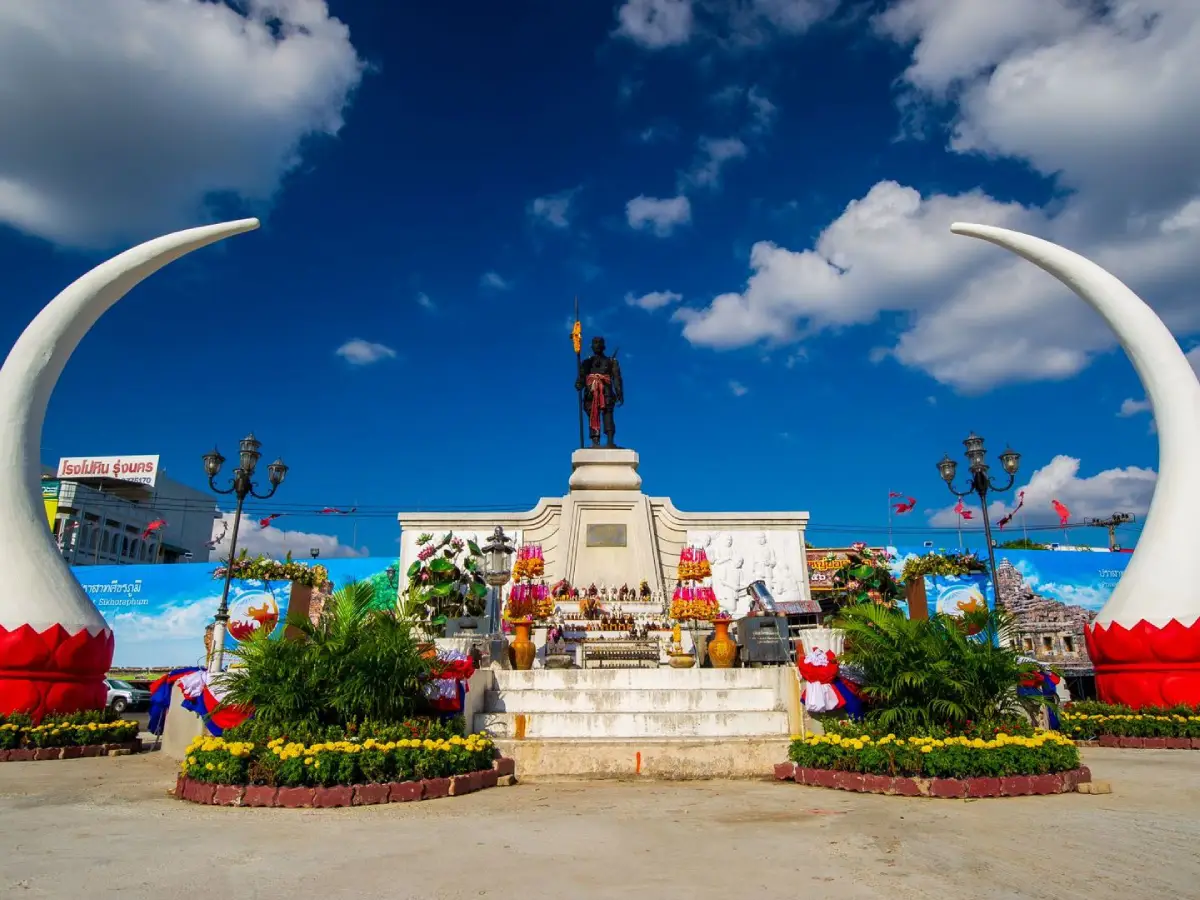
2. Phraya Surin Phakdi Si Narong Changwang (Pum) Monument is an important historical landmark near the entrance to Surin city. The monument commemorates Phraya Surin Phakdi Si Narong Changwang, also known as Chiang Pum, a Kuy leader and the first governor of Surin who played a major role in establishing the foundations of the city.
Highlights: The statue of Phraya Surin Phakdi Si Narong Changwang, a pair of elephant tusks, elements reflecting Surin’s elephant heritage, and a location within the historic urban area linking the province’s past with the modern city.
Chiang Pum was a Kuy leader highly skilled in working with elephants. He played an important role in gathering communities and developing the settlement that eventually became Surin. His relationship with elephants is therefore closely connected with the origins of Surin’s identity as Thailand’s famous “City of Elephants.”
The monument was officially opened on April 13, 1985, during the Songkran period, and subsequently became an important location for ceremonies commemorating the founder of the city.
The monument is a useful starting point for learning about Surin’s history before continuing to Wat Burapharam and Surin National Museum. Together, the 3 attractions tell the story of the province through historical figures, religion, and material evidence.
Getting There: The monument is located in Nai Mueang Subdistrict, Mueang Surin District. It is an open public area accessible daily, 24 hours a day, with no admission fee.
Map (GPS): https://www.google.com/maps/dir/?api=1&destination=14.878368,103.489594&travelmode=driving
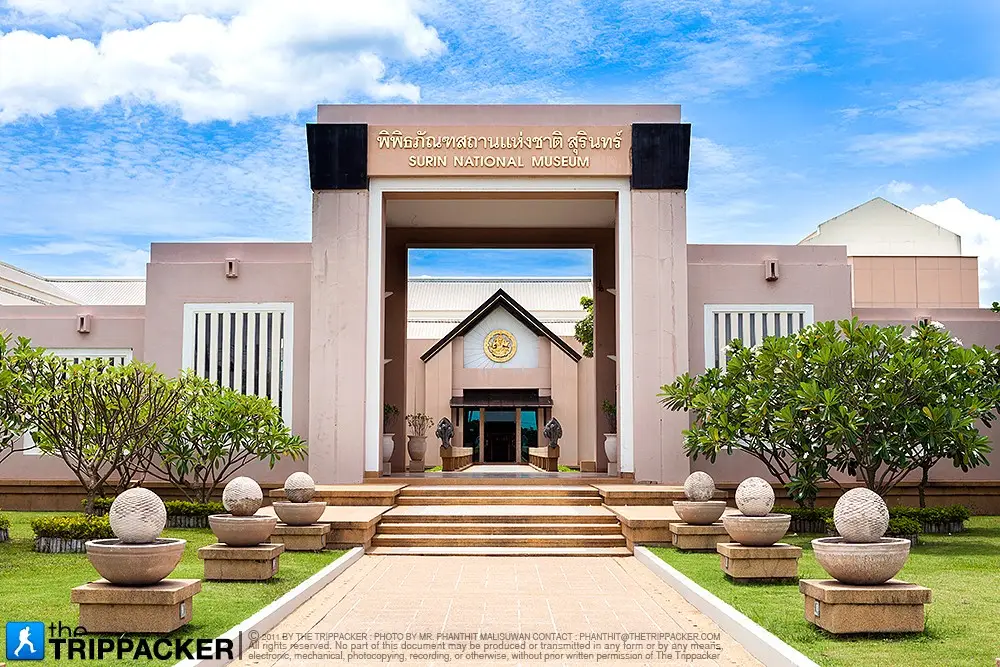
3. Surin National Museum is located in Chaniang Subdistrict, Mueang Surin District. It is one of the best places to understand the province before travelling to elephant communities, silk villages, and Khmer archaeological sites because its exhibitions cover natural history, archaeology, urban history, ethnicity, and cultural heritage.
Highlights: Archaeological evidence from Surin, Khmer civilization, Kuy, Khmer, Lao, and Thai-Khorat ethnic cultures, silk, silverwork, elephant culture, musical instruments, and the everyday life of southern Isan communities.
The archaeological section explains the development of settlements from prehistoric times through Dvaravati culture and Khmer civilization. This gives visitors useful background before exploring sites such as Prasat Sikhoraphum, Prasat Hin Ban Phluang, or Prasat Phum Pon.
The urban history section discusses the Kuy people, elephant capture and raising, the establishment of Surin, transportation development, and changes brought by the railway. The ethnographic galleries explain differences in language, clothing, rituals, and ways of life among local communities.
The museum also connects Surin’s silk, silverwork, kantrum music, and elephant traditions with the broader cultural history of the province, making it suitable for students, families, and travellers interested in cultural tourism.
Getting There: The museum is located on Surin–Prasat Road, Moo 13, Chaniang Subdistrict, Mueang Surin District. It is open Wednesday–Sunday from 09:00–16:00 and closed on Monday, Tuesday, and public holidays.
Map (GPS): https://www.google.com/maps/dir/?api=1&destination=14.848412,103.473776&travelmode=driving
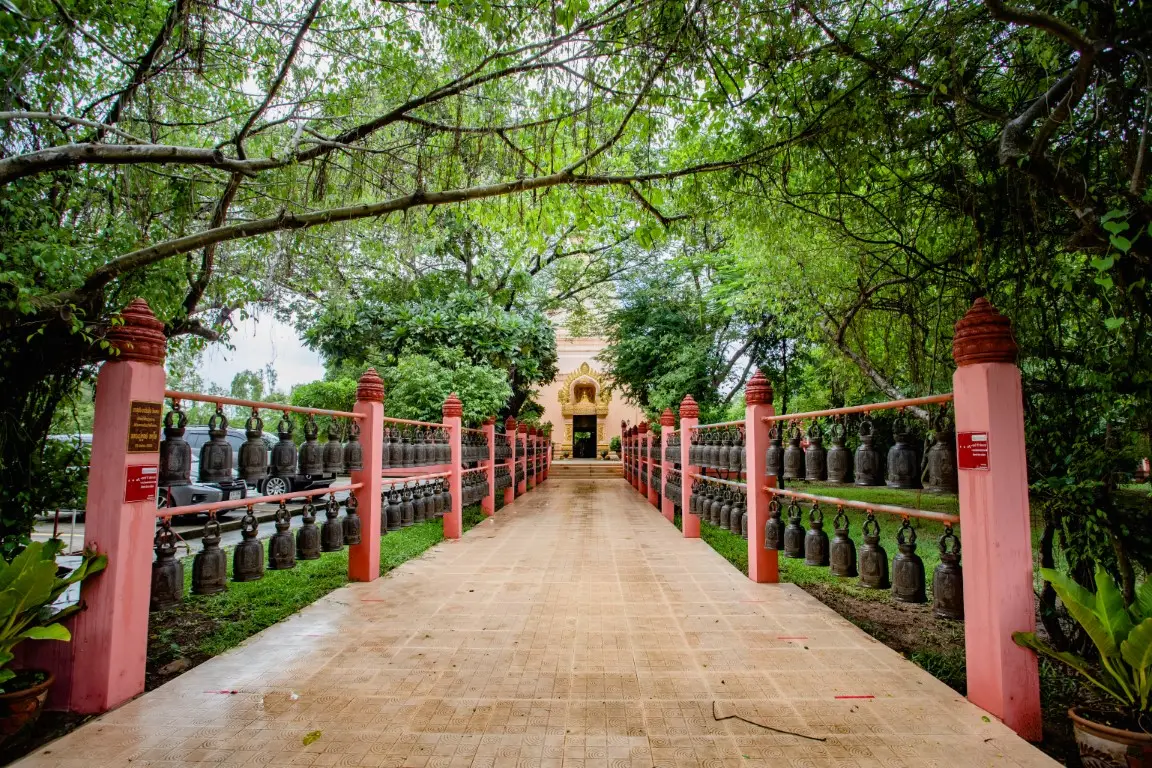
4. Phanom Sawai Forest Park is an important sacred mountain and natural attraction near Surin city. The area includes several peaks together with temples, Buddha images, chedis, a Buddha footprint, and viewpoints, creating a destination where local faith and nature are closely intertwined.
Highlights: Phra Phuttha Surin Mongkhon, a chedi on the mountain, the Buddha footprint, panoramic views over Surin’s plains, shaded forest, and the annual Phanom Sawai pilgrimage tradition.
Phanom Sawai has long been regarded as a sacred mountain by local residents. People travel to the peaks to pay respect to sacred sites, particularly during the traditional pilgrimage up Phanom Sawai, which reflects the connection among religion, community, and the surrounding landscape.
The area is suitable for both pilgrimage and recreation. Visitors reaching the higher points can see broad views over the plains below. Morning and late afternoon are generally more comfortable than midday because temperatures are lower.
During the rainy season, visitors should take care on slippery surfaces. The cooler winter months are particularly pleasant for walking around the mountain and spending more time outdoors.
Getting There: Phanom Sawai Forest Park is located in Na Bua Subdistrict, Mueang Surin District, not far from the city. It combines well with a visit to Huai Saneng Reservoir.
Map (GPS): https://www.google.com/maps/dir/?api=1&destination=14.779080,103.389222&travelmode=driving
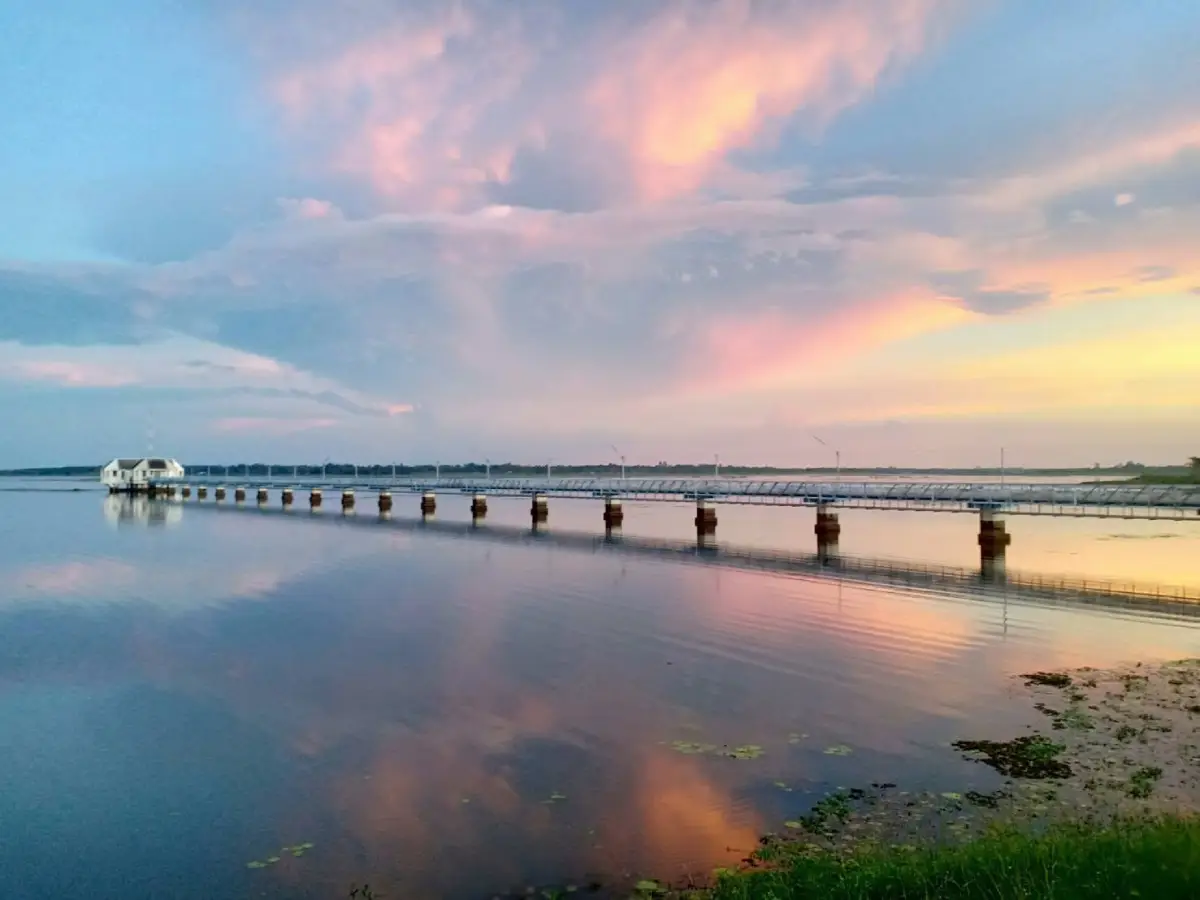
5. Huai Saneng Reservoir is an important reservoir and popular recreation area near Surin city. Its broad water surface, dam, and open landscape make it a good place to relax after visiting temples, museums, or Phanom Sawai.
Highlights: Expansive reservoir views, the dam, scenic viewpoints, sunset atmosphere, and a convenient location close to the provincial capital.
The reservoir primarily serves irrigation and water-storage functions for surrounding agricultural areas. At the same time, its open landscape has made it an important local recreation area.
Evening is particularly popular because temperatures are cooler and the sunset reflected across the water creates attractive scenery for walking and photography.
Families travelling with children should supervise them closely near the water and avoid swimming in areas not specifically designated for water activities.
Map (GPS): https://www.google.com/maps/dir/?api=1&destination=14.803416,103.500317&travelmode=driving
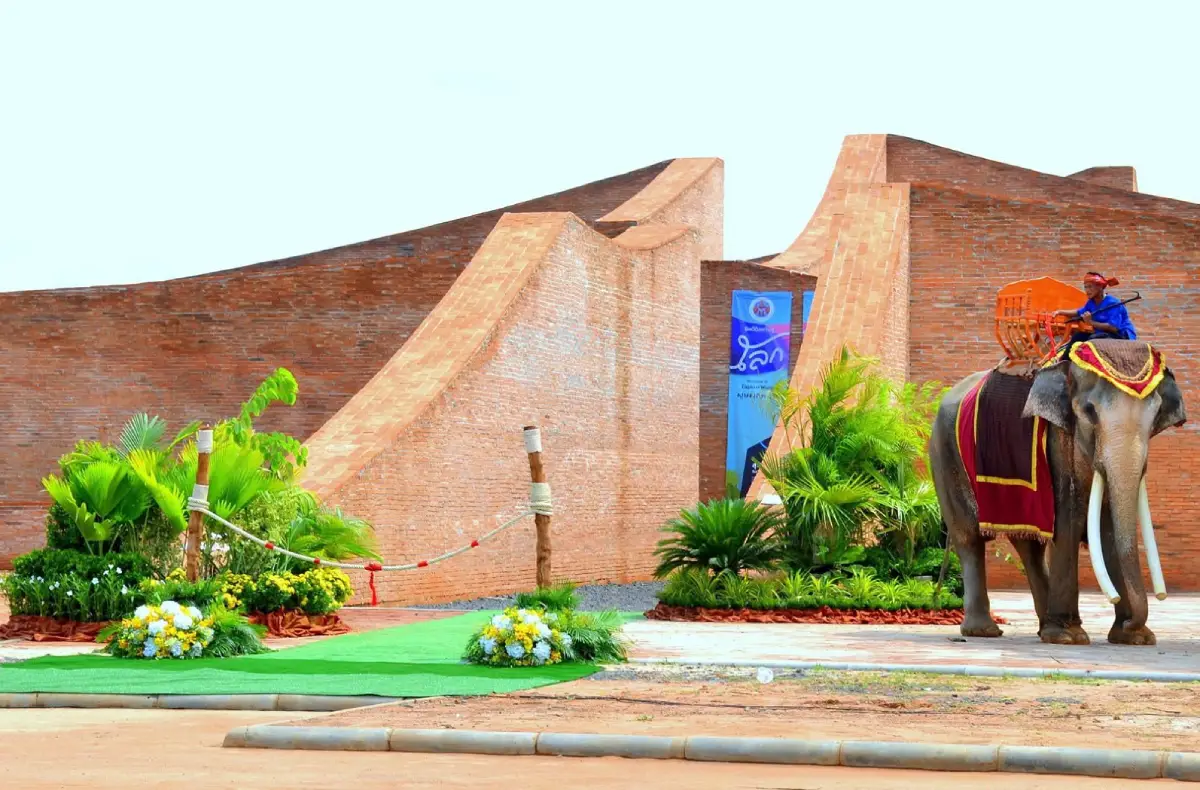
6. Elephant Study Center is located at Ban Ta Klang, Krapho Subdistrict, Tha Tum District. It is a major center for learning about elephants and the traditional way of life of Kuy communities, whose knowledge of elephant raising, care, and training has been passed down for generations. It is one of the most important places for understanding Surin’s identity as Thailand’s “City of Elephants.”
Highlights: Human-elephant relationships, Kuy culture, the history of elephant capture and care, elephant knowledge, Ban Ta Klang community life, and a route that can be combined with Wang Thalu.
What distinguishes Ban Ta Klang from conventional elephant attractions is that elephants have long been part of family and community life. Knowledge about elephants is connected with language, beliefs, rituals, animal care, and the relationship between people and the natural environment.
The Elephant Study Center presents these traditions in a more systematic way, covering the history of Surin elephants, the role of elephant specialists, and the cultural life of the surrounding Kuy community.
If time allows, continue to Wang Thalu in the same Krapho Subdistrict. The riverside landscape helps visitors understand the relationship between the elephant community and the Mun and Chi river systems.
Map (GPS): https://www.google.com/maps/dir/?api=1&destination=15.266157,103.497211&travelmode=driving
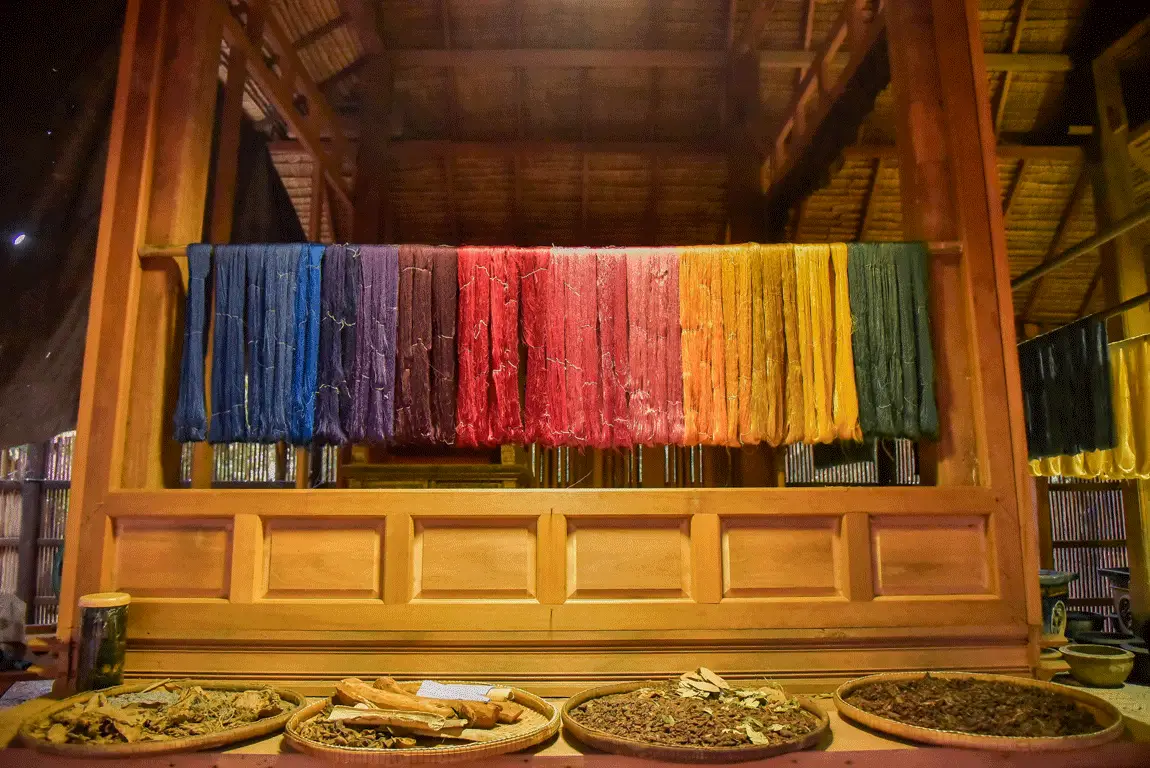
7. Chan Soma Gold Brocade Silk Weaving Village is located in the Ban Tha Sawang area of Mueang Surin District and is one of the province’s most famous silk communities. It is particularly known for gold-brocade silk produced using extremely complex weaving techniques, intricate traditional patterns, and looms with a large number of heddles.
Highlights: Traditional gold-brocade silk, large weaving looms, intricate supplementary-weft techniques, high-quality silk yarn, and the opportunity to learn directly from community artisans.
Tha Sawang silk is distinguished by the extraordinary precision required during weaving. Several artisans may work together on a large loom, and complex patterns take considerably longer to produce than ordinary silk textiles.
A visit helps travellers understand why the value of fine silk is determined not only by the raw material but also by time, knowledge, accuracy, and specialist skills passed down through generations.
Visitors interested in purchasing silk should ask community artisans about patterns, weaving methods, and production techniques because individual pieces vary greatly in complexity and cultural meaning.
Map (GPS): https://www.google.com/maps/dir/?api=1&destination=14.955621,103.472120&travelmode=driving
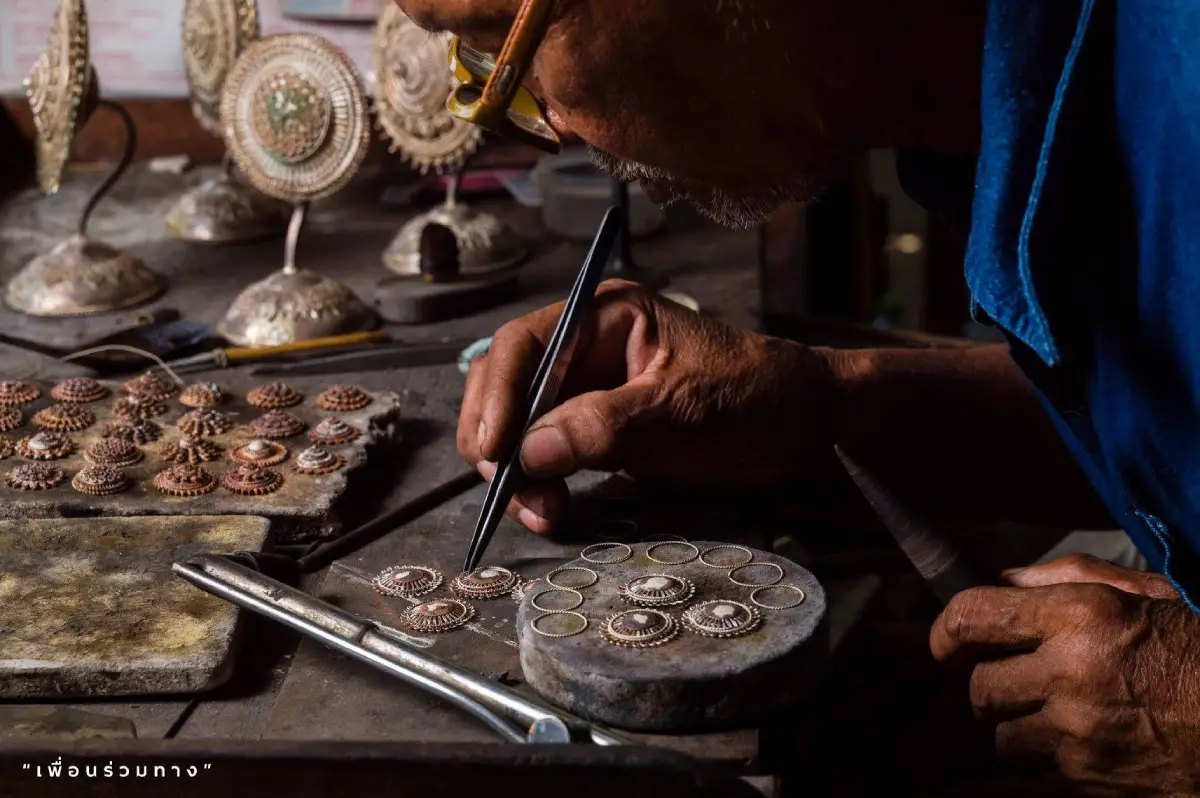
8. Khwao Sinarin Handicraft Village is an important craft community in Khwao Sinarin District, known for both silk and traditional silverwork. It is particularly suitable for visitors interested in seeing handicrafts that are still actively produced within the community.
Highlights: Traditional silk, silver bead jewelry, community handicrafts, demonstrations of production techniques, and locally made products available directly from artisans.
Khwao Sinarin silverwork has distinctive forms and patterns closely connected with local culture, particularly traditional silver beads and jewelry produced using inherited craft techniques.
Local silk also reflects Surin’s wide range of patterns and colors, allowing visitors to learn about both weaving and silverwork within the same community route.
Purchasing directly from local artisans helps generate community income and supports the continuation of traditional skills, making this an excellent destination for responsible cultural tourism.
Map (GPS): https://www.google.com/maps/dir/?api=1&destination=14.995411,103.597331&travelmode=driving
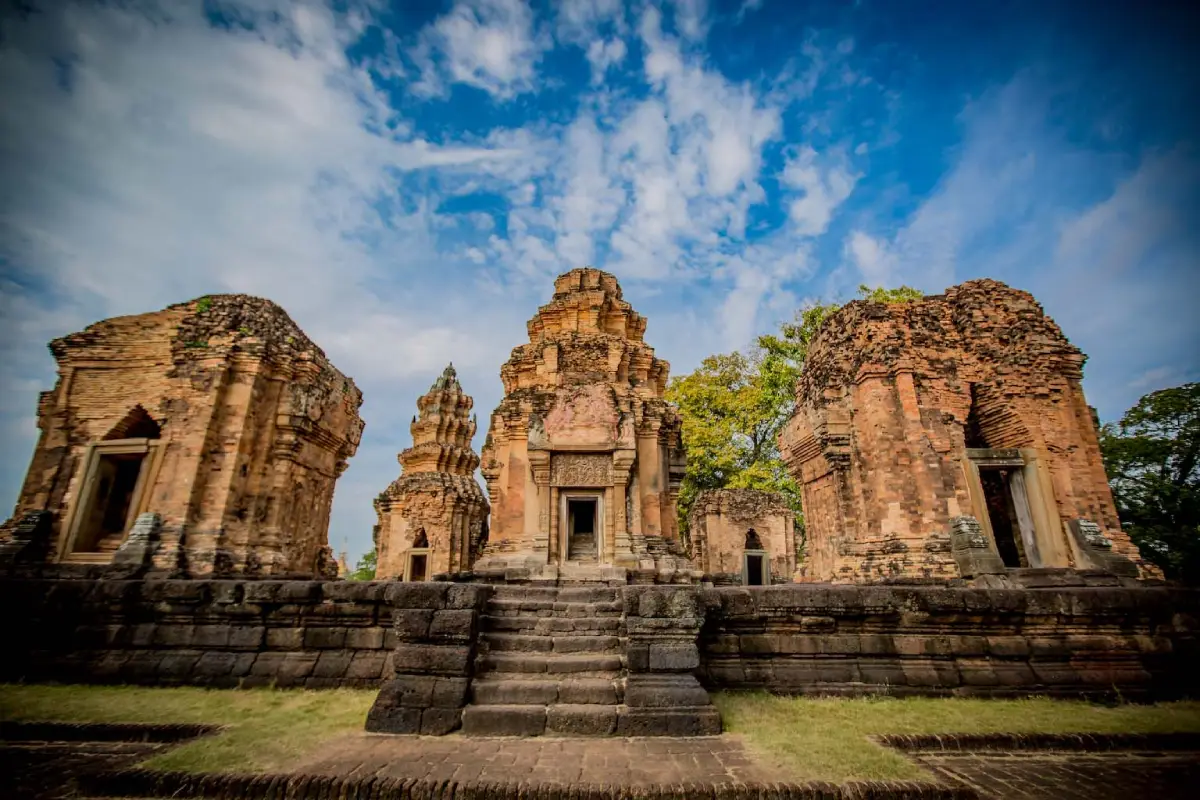
9. Prasat Sikhoraphum is located at Ban Prasat, Ra-ngae Subdistrict, Sikhoraphum District. It is one of the most famous and visually impressive Khmer archaeological sites in Surin, distinguished by 5 brick sanctuary towers standing on a shared laterite platform, with the principal tower in the center and 4 subsidiary towers positioned at the corners.
Highlights: Five brick towers, the Shiva Nataraja lintel, carved female deities, guardian figures, a U-shaped moat, and finely detailed sandstone carvings representing Khmer artistic traditions.
The sanctuary was built around the middle of the 12th century CE during the transition from Baphuon to Angkor Wat artistic styles. It was originally a Hindu sanctuary associated with Shaivism and was later adapted within a Buddhist context.
The most celebrated feature is the lintel depicting Shiva Nataraja, an important example of Khmer stone carving. Other decorative elements include Ganesha, Brahma, Vishnu, Uma, and guardian figures.
The arrangement of 5 towers on a shared platform reflects Khmer cosmological ideas, with the central sanctuary symbolically representing Mount Meru and the 4 surrounding towers completing the sacred spatial composition.
The U-shaped moat adds both visual beauty and symbolic meaning. Morning and late afternoon provide especially attractive light for photography because the brick surfaces and sandstone carvings appear more dimensional.
Getting There: From Surin city, take Highway 226 toward Sisaket for approximately 34–36 km. The site is open daily from 07:00–18:00. Admission is 10 baht for Thai visitors and 50 baht for foreign visitors.
Map (GPS): https://www.google.com/maps/dir/?api=1&destination=14.944243,103.798940&travelmode=driving
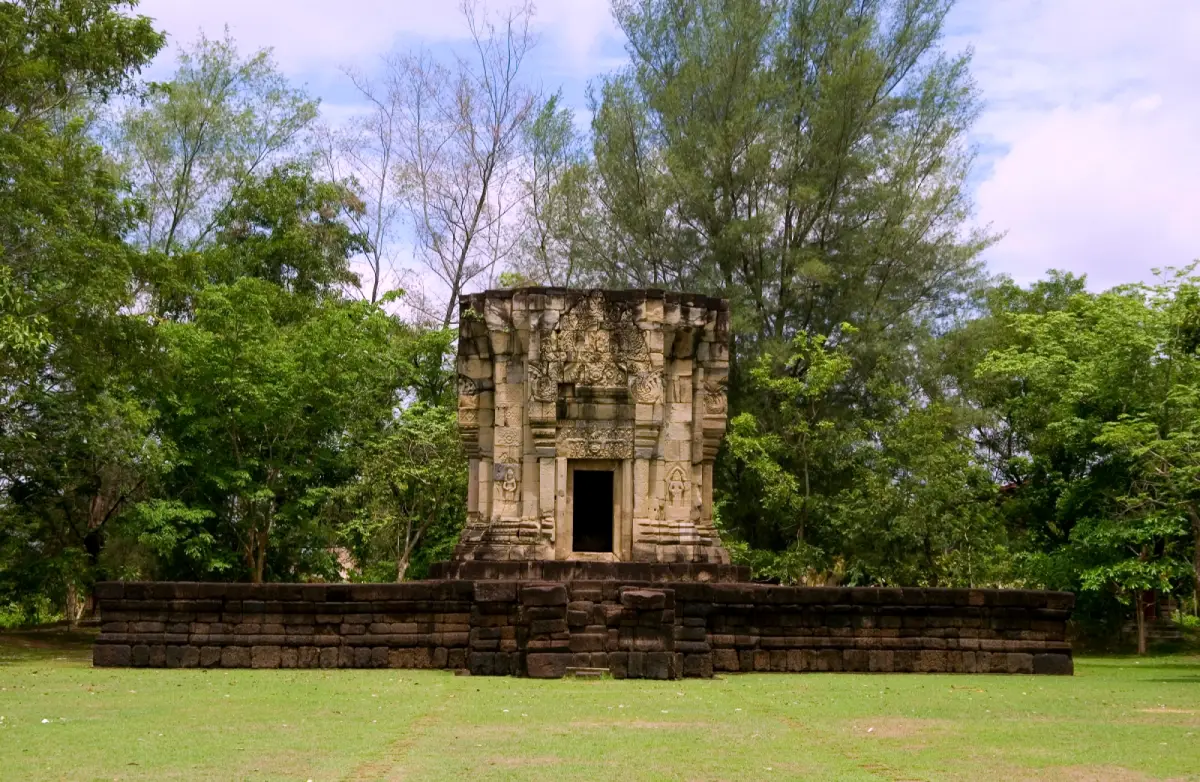
10. Prasat Hin Ban Phluang is located at Ban Phluang, Ban Phluang Subdistrict, Prasat District. Although relatively small, the sanctuary is celebrated for the quality and delicacy of its sandstone carvings. The single tower stands on a large laterite base and faces east in accordance with Khmer religious architectural traditions.
Highlights: A single sanctuary tower on a laterite platform, a pediment depicting Krishna lifting Mount Govardhana, a lintel showing Indra riding Airavata, the story of Krishna subduing Kaliya, guardian figures, and finely carved botanical motifs.
The sanctuary dates to around the late 11th to early 12th centuries CE and is associated with the Baphuon artistic style and Hindu Shaivism.
What makes Prasat Hin Ban Phluang especially noteworthy is the refinement of its carvings. Although smaller than Prasat Sikhoraphum, visitors interested in Khmer art can examine the pediments, lintels, and decorative columns at close range.
A U-shaped moat and eastern baray demonstrate how Khmer sacred architecture was designed in relation not only to buildings but also to the surrounding landscape and water system.
Visitors should not climb the sanctuary, touch or move stone fragments, or write on archaeological surfaces because every surviving element is part of the original historical evidence.
Getting There: From Surin city, take Highway 214 toward Prasat and Chong Chom. Around kilometer 34–35, turn toward Ban Phluang for approximately 1 km. The site is open daily from 08:00–16:00. Admission is 10 baht for Thai visitors and 50 baht for foreign visitors.
Map (GPS): https://www.google.com/maps/dir/?api=1&destination=14.610444,103.424208&travelmode=driving
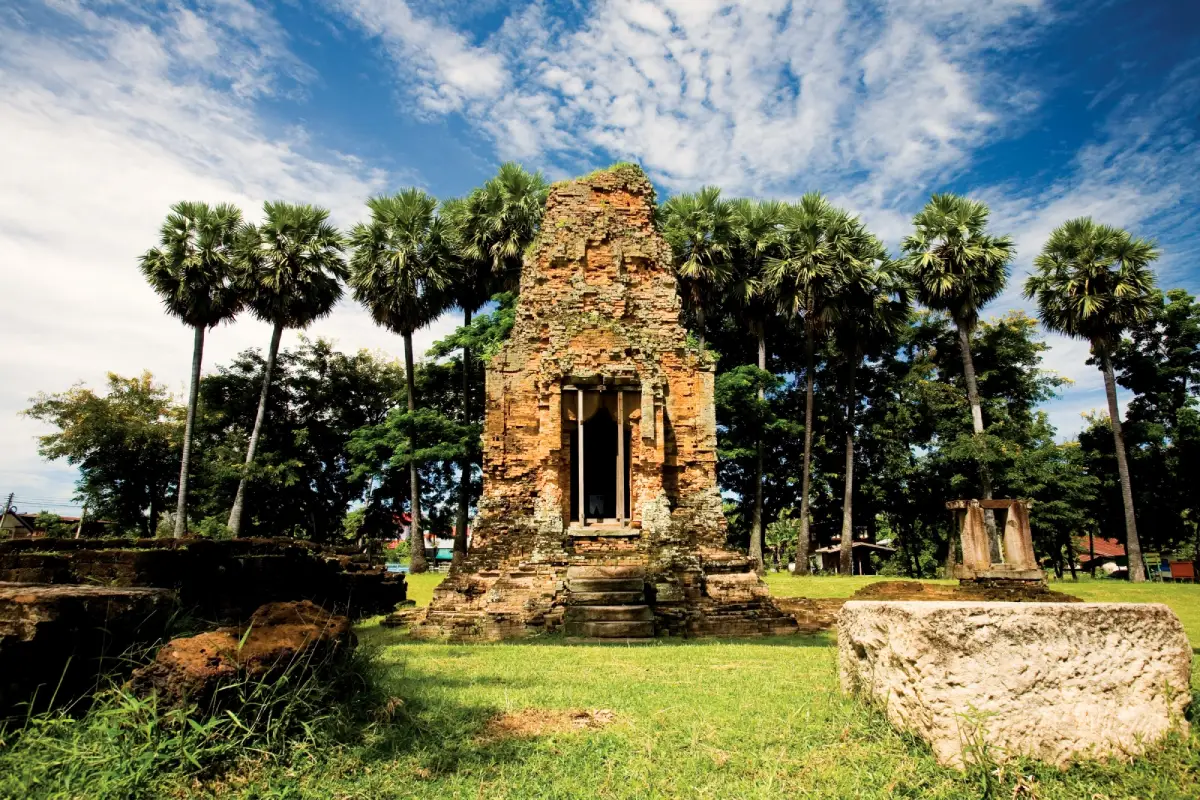
11. Prasat Phum Pon is located at Ban Phum Pon, Dom Subdistrict, Sangkha District. It is one of Thailand’s oldest groups of Khmer archaeological monuments and is particularly important for understanding the development of Khmer civilization before the Angkorian period. The complex consists of 3 brick sanctuaries and the laterite base of another structure arranged along a north–south axis.
Highlights: Pre-Angkorian brick sanctuaries, a sacred drainage channel, Pallava-script Sanskrit inscriptions, sandstone lintel fragments, decorative door columns, and ancient water systems around the settlement.
Prasat Phum Pon dates to around the late 7th to early 8th centuries CE, making it considerably older than many Surin sanctuaries from the Baphuon, Angkor Wat, or Bayon periods. Its importance lies in demonstrating the early foundations of Khmer culture in southern Isan.
The main sanctuary is built of brick without mortar and faces east. Elements associated with Hindu ritual have been found within the structure, including a sacred drainage channel used to carry ritual water away from the shrine.
Several ancient water sources have also been identified around the archaeological site, demonstrating the relationship among religion, settlement, and water management in early communities.
Getting There: From Surin city, travel toward Sangkha and continue on Highway 2124 toward Buachet until reaching Ban Phum Pon. The site is open daily and admission is free.
Map (GPS): https://www.google.com/maps/dir/?api=1&destination=14.548417,103.876650&travelmode=driving
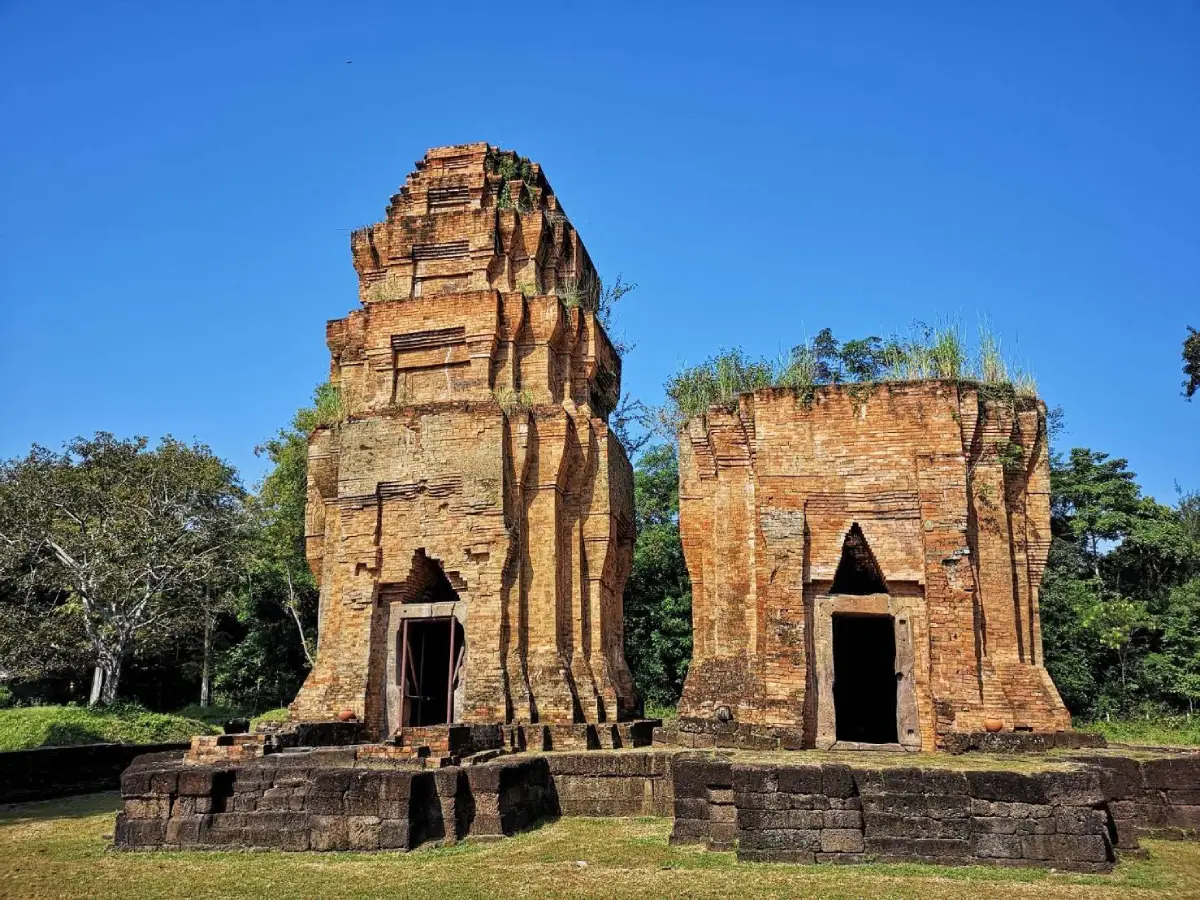
12. Prasat Yai Ngao is located near Ban Phon Chai, Ban Chop Subdistrict, Sangkha District, close to Highway 24. It is a group of brick Khmer sanctuaries in the Angkor Wat artistic style dating to around the 12th century CE and is one of the more accessible archaeological sites in the Sangkha area.
Highlights: Two surviving brick sanctuary towers, laterite bases, evidence of an original 3-tower arrangement, a makara motif producing a 5-headed Naga, and sandstone architectural fragments.
The original sanctuary group was arranged north–south and faced east. Each tower had a single functional doorway at the front and false doors on the remaining 3 sides, a characteristic feature of Khmer architecture.
The grounds have been landscaped to make exploration relatively easy. Visitors should begin from the eastern side to understand the original arrangement before walking around the structures to examine the laterite base, brickwork, and carved stone fragments.
Although access is possible throughout the day, morning and late afternoon are better for seeing details clearly and avoiding the strongest midday heat.
Getting There: From Sangkha District, use Highway 24 around kilometer 190–191 and continue approximately 700–800 meters into the site. Admission is free.
Map (GPS): https://www.google.com/maps/dir/?api=1&destination=14.619501,103.887588&travelmode=driving
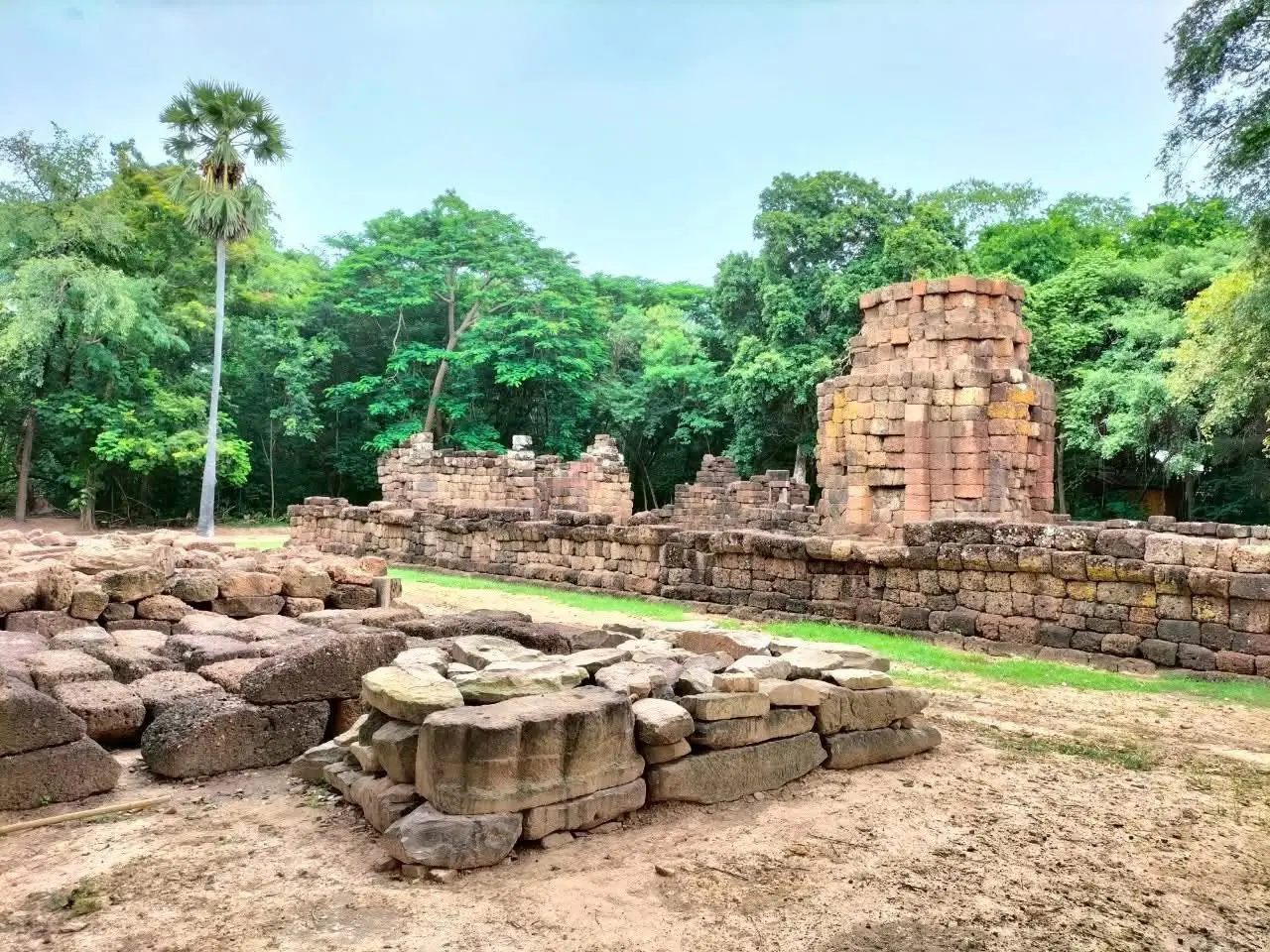
13. Prasat Chom Phra is located inside Wat Pa Prasat Chom Phra at Ban Dong Bang, Chom Phra Subdistrict, Chom Phra District. The monument is an Arokayasala, a sanctuary associated with the hospital network established during the reign of King Jayavarman VII of the Khmer Empire.
Highlights: Laterite principal sanctuary, library, enclosure wall, gateway, ancient reservoir, and archaeological finds reflecting Mahayana Buddhism in the Bayon artistic tradition.
The Arokayasala network is historically important because it demonstrates how the reign of Jayavarman VII connected religious faith, healing, and public welfare. Prasat Chom Phra therefore provides insight into Khmer history beyond the construction of temples alone.
The main sanctuary has a recessed square plan built of laterite, with an eastern entrance projection. A library and gateway stand toward the front, while an ancient reservoir lies outside the northeastern section of the enclosure, an arrangement found at many Arokayasala sites.
Archaeological finds including representations of Avalokiteshvara, Vajrasattva, a Buddha protected by a Naga, and inscriptions confirm the site’s relationship with Mahayana Buddhist beliefs during the Bayon period.
Getting There: Prasat Chom Phra is located within Wat Pa Prasat Chom Phra, Moo 4, Ban Dong Bang, Chom Phra Subdistrict, approximately 26 km from Surin city. The site is open daily and admission is free.
Map (GPS): https://www.google.com/maps/dir/?api=1&destination=15.105032,103.601544&travelmode=driving
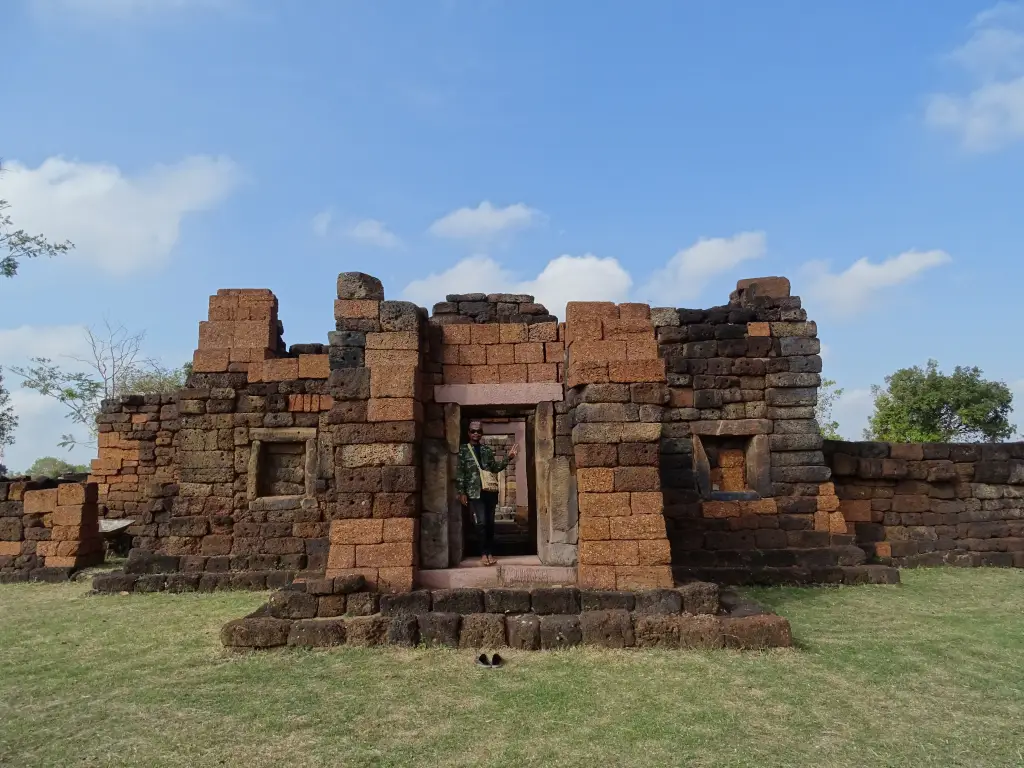
14. Prasat Ban Chang Pi is located in Chang Pi Subdistrict, Sikhoraphum District. This Khmer archaeological site adds another important piece to the wider network of ancient religious centers and settlements in Surin. Its rural community setting also allows visitors to see how an ancient monument remains integrated with contemporary village life.
Highlights: Laterite and sandstone structures, the layout of a Khmer religious site, surviving architectural remains, and a peaceful setting suitable for travellers with a strong interest in archaeology.
The site is significant as evidence of the distribution of Khmer religious monuments across Sikhoraphum District, an area with numerous archaeological remains and an important position within Surin’s broader Khmer cultural route.
Visitors should take time to examine surviving foundations, construction materials, and architectural components. Doing so helps illustrate how smaller community sanctuaries differed in function and scale from major monuments such as Prasat Sikhoraphum.
Prasat Ban Chang Pi can be combined with Prasat Sikhoraphum and Huai Lam Phok Reservoir in a single day, creating an itinerary that combines archaeology and nature.
Map (GPS): https://www.google.com/maps/dir/?api=1&destination=14.929885,103.701910&travelmode=driving
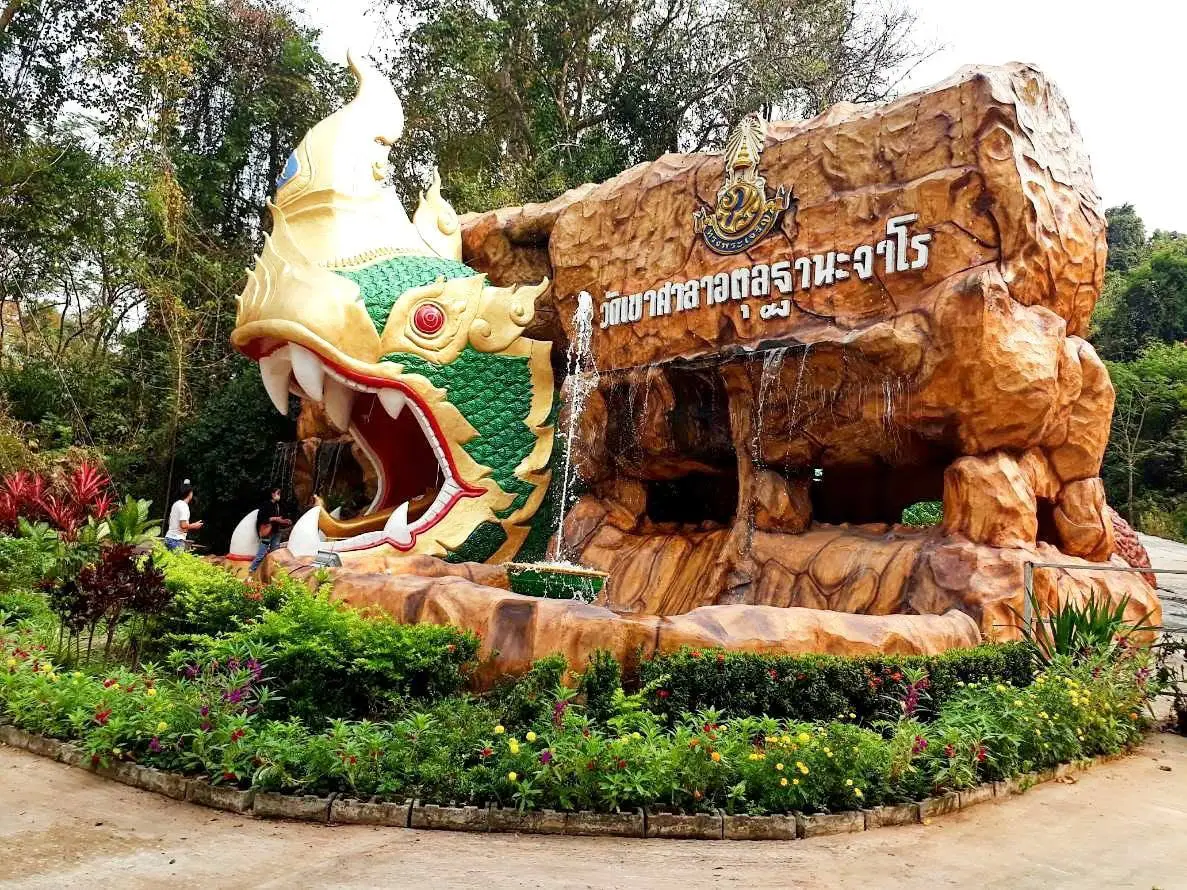
15. Wat Khao Sala Atulthanacharo is located in Charat Subdistrict, Buachet District. This forest temple lies amid the natural landscape of the Phanom Dong Rak range, surrounded by mountains and forest. Its peaceful environment makes it suitable for both Buddhist practice and travellers who want to experience nature together with religious culture.
Highlights: Forest-temple surroundings, mountain scenery, natural viewpoints, religious structures, and a quiet environment suitable for meditation and reflection.
The temple’s distinctive atmosphere comes from the way the natural landscape forms part of the religious environment. Paths, stairways, rock terraces, and forest create a setting very different from temples located on flat urban land.
Visitors should dress respectfully, remain quiet, and avoid disturbing monks or people practicing meditation because the temple remains an active religious site rather than simply a tourist attraction.
Because the temple is close to the Phanom Dong Rak Mountains, travellers should check weather and road conditions on the day of travel, particularly during the rainy season when some surfaces may become slippery.
Map (GPS): https://www.google.com/maps/dir/?api=1&destination=14.430102,103.937607&travelmode=driving
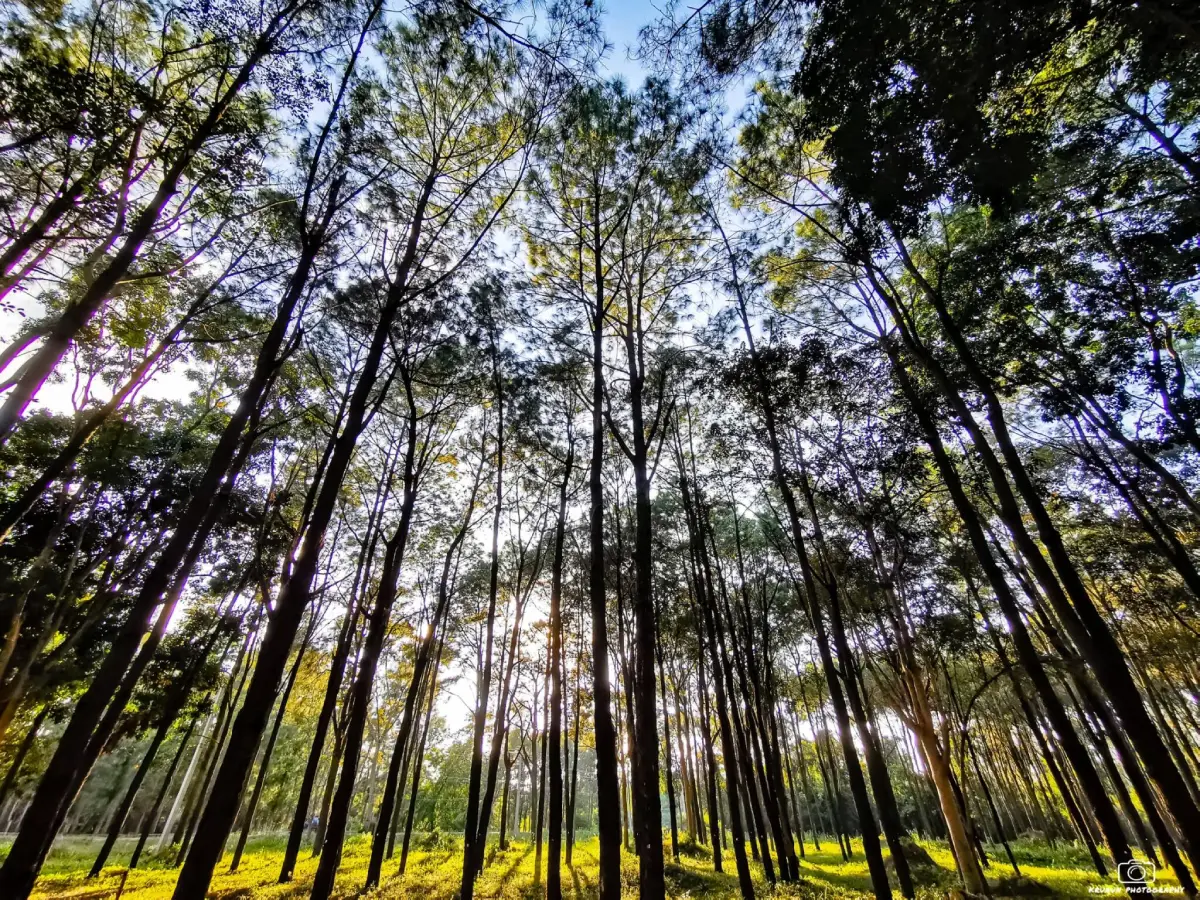
16. Surin Two-Needle Pine Conservation Area is located in Chok Nuea Subdistrict, Lamduan District. The site is notable for the presence of two-needle pine trees in southern Isan and serves as a learning area for plant diversity, ecology, and forest conservation.
Highlights: Two-needle pine stands, natural forest, plant-study routes, a quiet atmosphere, and scenery that differs from the agricultural landscapes surrounding much of Surin.
Two-needle pine is a distinctive tree species that does not occur densely throughout northeastern Thailand. The survival of these trees in the area therefore has ecological, educational, and genetic-conservation value.
The site is better suited to nature study and quiet exploration than commercial tourism. Visitors should not collect plants, branches, or disturb the forest environment.
Morning or late afternoon is the best time for walking because temperatures are lower and the light gives the pine trees and forest floor greater visual depth.
Map (GPS): https://www.google.com/maps/dir/?api=1&destination=14.684152,103.763603&travelmode=driving
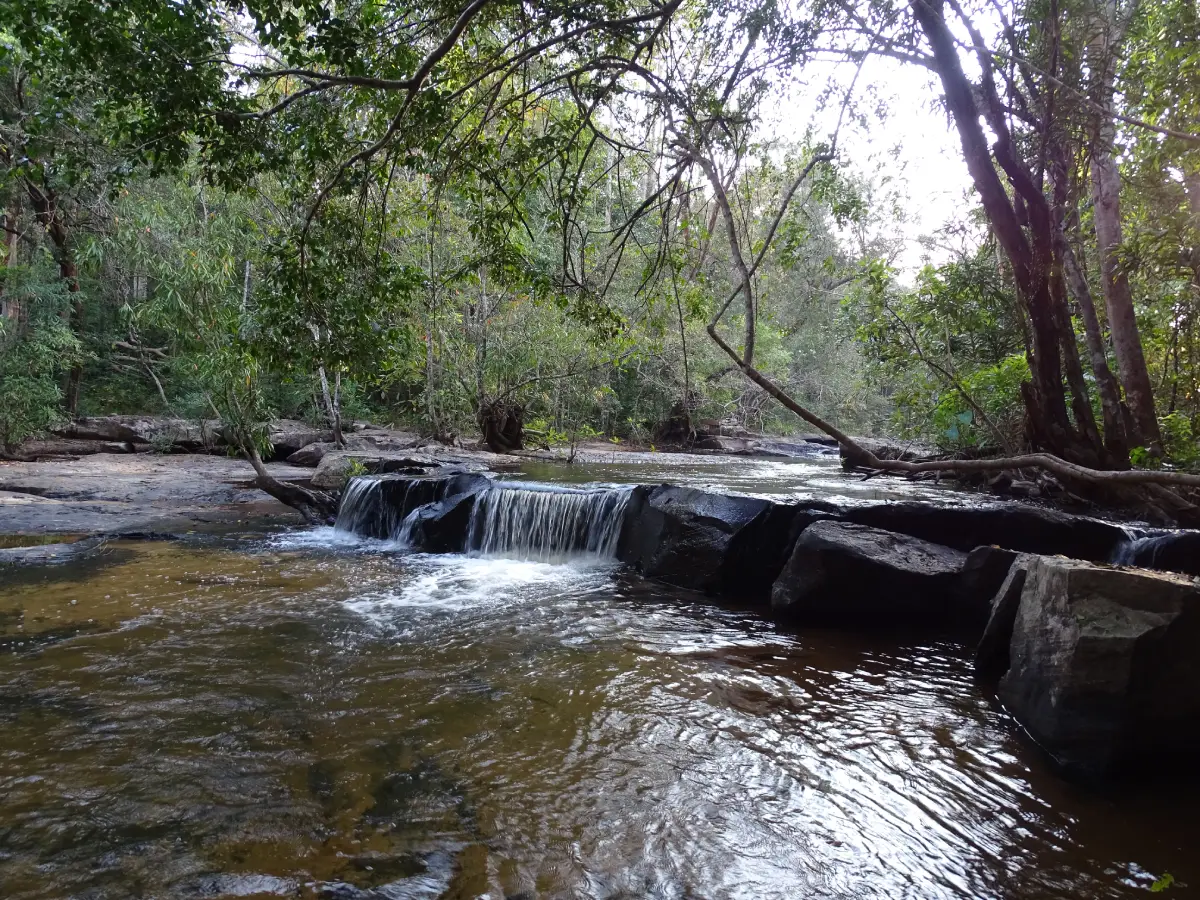
17. Tri Khiri Waterfall is located in Charat Subdistrict, Buachet District. It is a natural attraction in the Phanom Dong Rak range characterized by forest, streams, and rocky terrain, making it a good addition to a southern Surin itinerary focused on temples and archaeological sites.
Highlights: Natural waterfall scenery, streams, rock formations, lush forest, and the quiet atmosphere of Surin’s southern mountain landscape.
The character of the waterfall depends strongly on rainfall, so its appearance varies with the season. The rainy season through early winter is generally better for seeing stronger water flow and greener forest than the dry season.
Visitors should wear footwear suitable for natural terrain, watch for slippery rocks, and avoid entering the water during heavy rain or periods of strong current.
The waterfall can be combined with Wat Khao Sala Atulthanacharo because both are in the Buachet zone, creating a day trip that combines religion, forest, and nature.
Map (GPS): https://www.google.com/maps/dir/?api=1&destination=14.395655,103.915061&travelmode=driving
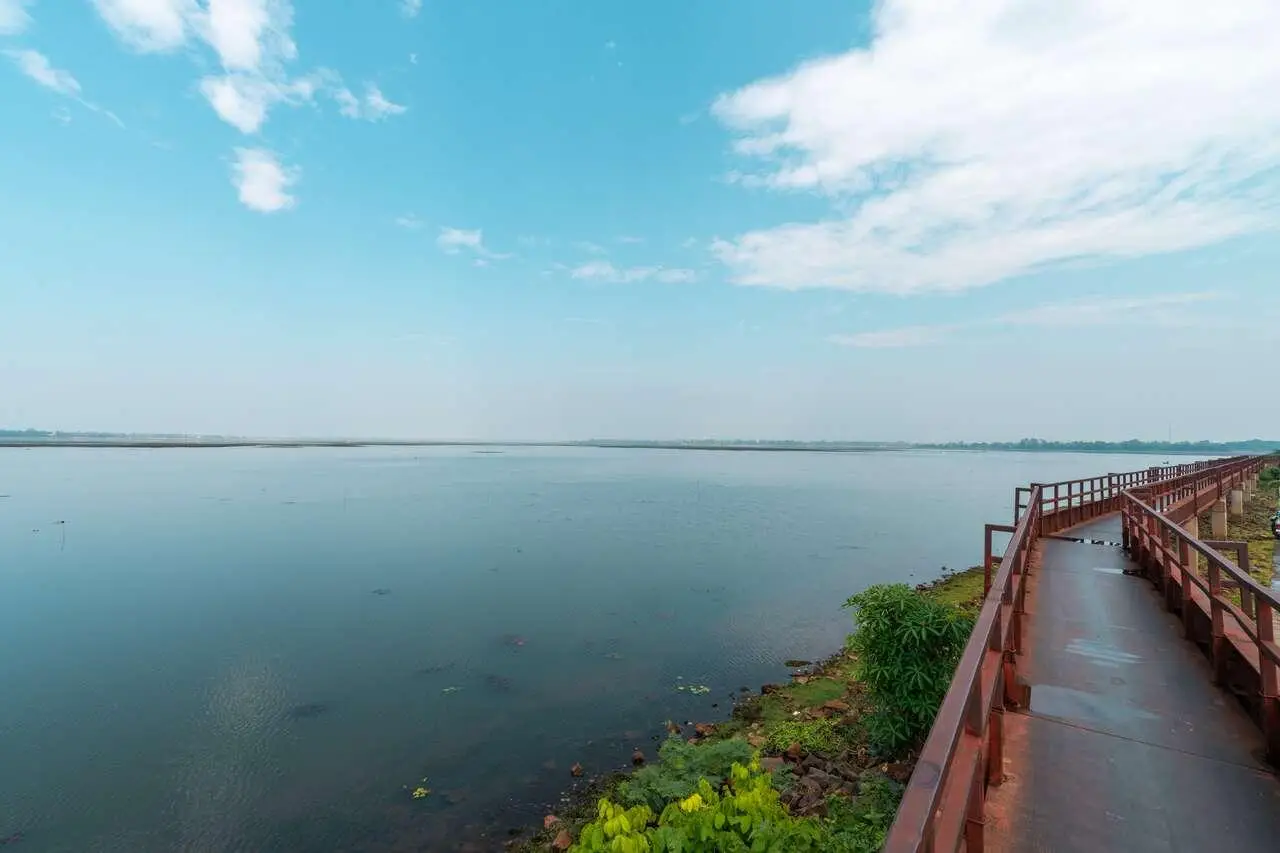
18. Huai Lam Phok Reservoir is located in Yang Subdistrict, Sikhoraphum District, with surrounding areas extending toward Ra-ngae Subdistrict. It is a large reservoir important to local agriculture while also serving as a peaceful recreation area with a distinctly rural Isan atmosphere.
Highlights: Expansive water views, surrounding rice fields and villages, the reservoir embankment, sunrise and sunset viewpoints, and a quiet setting suitable for a break between sightseeing stops.
Huai Lam Phok plays an important role in storing water for agriculture and household use, helping communities manage shortages during the dry season and supporting the wider agricultural economy of Sikhoraphum District.
For visitors, its main appeal is the open landscape where water, sky, and agricultural areas can be seen across a broad horizon. The reservoir is particularly suitable for photography and relaxing in the late afternoon.
It can be combined with Prasat Sikhoraphum and Prasat Ban Chang Pi in the same day, giving the Sikhoraphum route both archaeological and natural attractions.
Getting There: The reservoir is located in Yang Subdistrict, Sikhoraphum District. It is open daily from 08:00–17:00. The public area has no admission fee.
Map (GPS): https://www.google.com/maps/dir/?api=1&destination=14.933517,103.852620&travelmode=driving
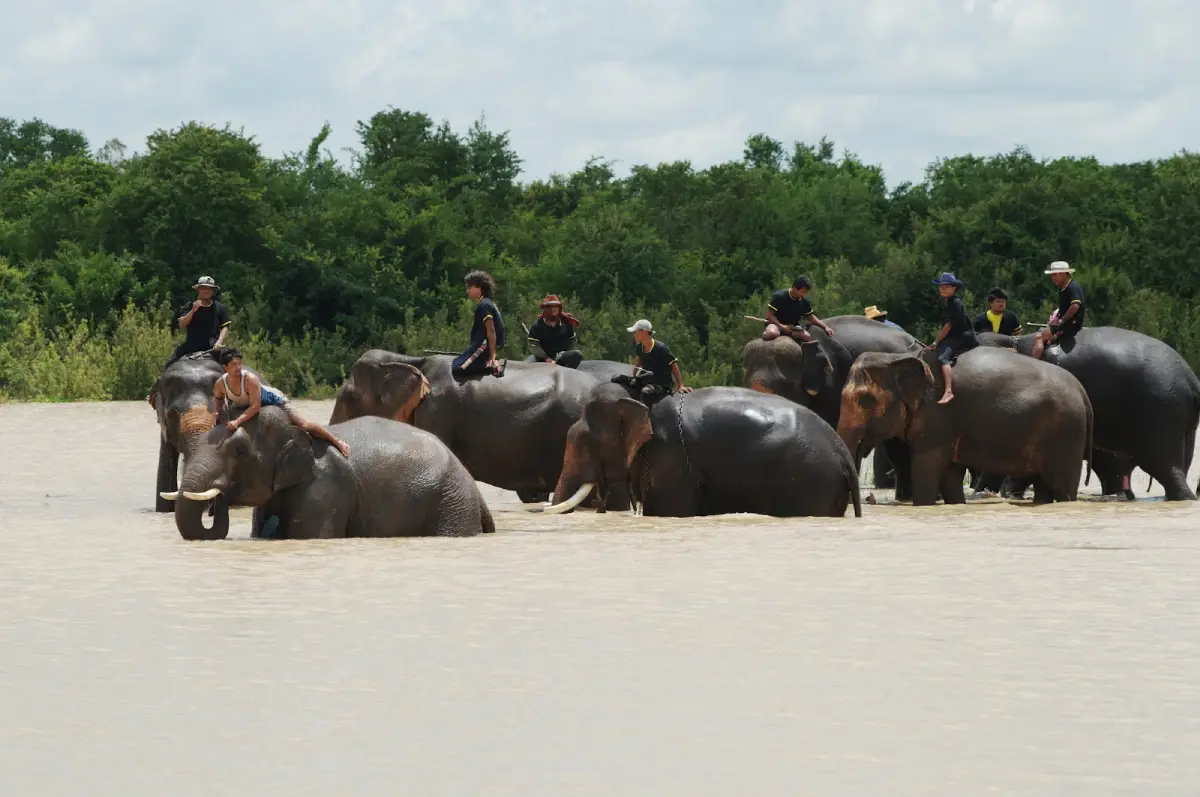
19. Wang Thalu is located near Ban Ta Klang, Krapho Subdistrict, Tha Tum District. The riverside area is notable as a meeting point of the Mun and Chi rivers and is closely connected with the elephant culture of Ban Ta Klang.
Highlights: The meeting of the Mun and Chi rivers, riverside scenery, water activities, Ban Ta Klang elephant culture, and a rural river landscape.
Wang Thalu adds an important natural dimension to a visit to Surin’s elephant community. Elephants in Ban Ta Klang are connected not only with families and the Elephant Study Center but also with the river environment and surrounding landscape.
During high-water periods, the 2 rivers are full and their meeting point is easier to observe. During lower-water seasons, sandbanks, riverbanks, and riverside vegetation become more visible, giving the area a very different character.
Water activities should be arranged through local operators. Visitors should wear life jackets and avoid entering the water during periods of strong current or unsuitable weather.
Getting There: From the Elephant Study Center at Ban Ta Klang, continue toward Wat Chaeng Sawang for approximately 3 km. The area is open daily from 08:00–17:00.
Map (GPS): https://www.google.com/maps/dir/?api=1&destination=15.291693,103.501692&travelmode=driving
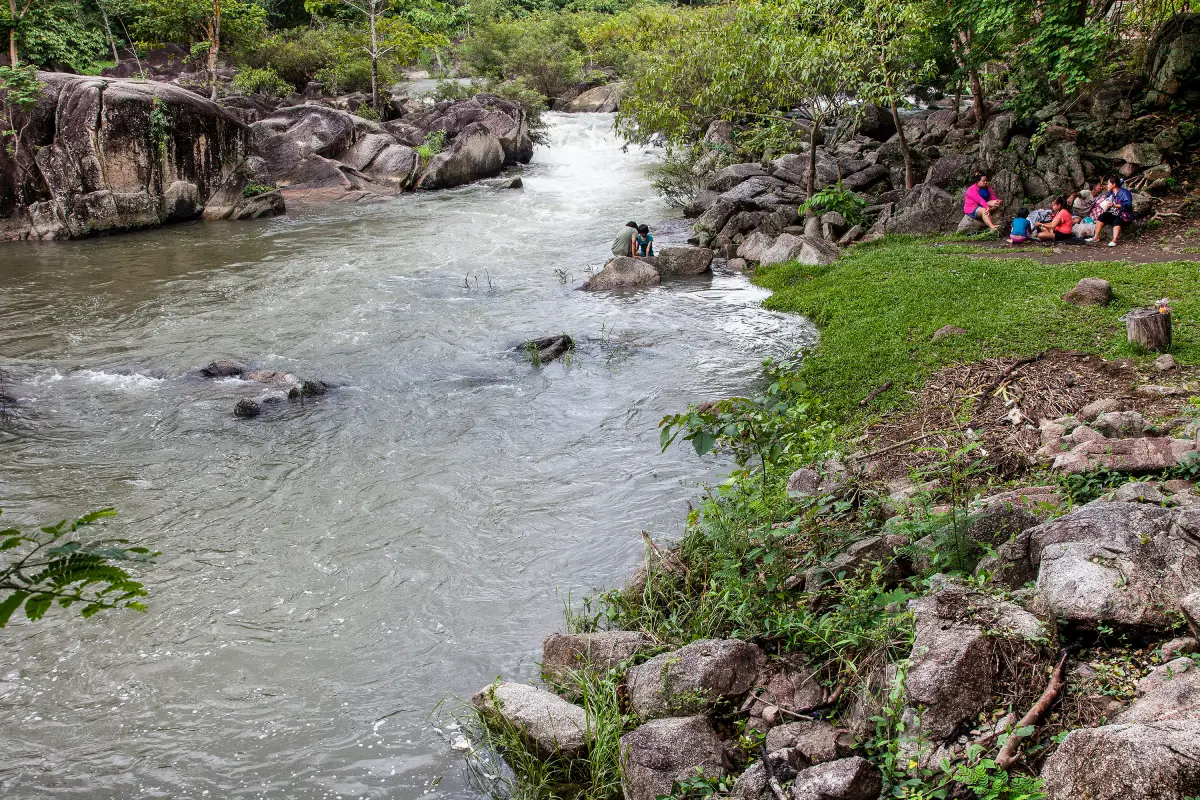
20. Sirikit Forest Park is located around the Wat Pa Dong Nam Kham monastic area at Ban Mok Tao, Bert Subdistrict, Rattanaburi District. Covering approximately 560 rai, the mixed forest combines natural scenery, streams, Buddhist religious space, and traces of local history within the same area.
Highlights: Mixed deciduous forest, large Yang Na trees, Teng trees, shaded streams, nature-viewing areas, a forest temple, and traces of archaeological remains within the area.
The forest contains a variety of plant species and changes noticeably with the seasons. During the rainy season and immediately afterward, the landscape is green and moist and streams carry more water. During the dry season, the form of the larger trees and forest floor becomes more visible.
Many parts of the stream are shaded by vegetation growing along both banks, creating cool sections suitable for quiet nature walks and learning about Surin’s indigenous forest environment.
The forest-monastery area also contains traces of historical remains connected with local history, giving Sirikit Forest Park not only ecological value but also religious and historical significance.
Visitors should maintain a quiet atmosphere, remain on appropriate paths, avoid disturbing wildlife, and take care on slippery ground after rain because part of the area remains natural forest.
Getting There: The site is located at Ban Mok Tao, Moo 8, Bert Subdistrict, Rattanaburi District. From the district center, take Highway 2076 and continue along local roads into the area. It is open daily from 08:00–17:00.
Map (GPS): https://www.google.com/maps/dir/?api=1&destination=15.130376,103.649836&travelmode=driving
| Topic | Details |
| Province Overview | Surin is a major province in southern Isan, known for elephants, silk, silverwork, Khmer civilization, Buddhism, Kuy communities, Thai-Khmer communities, local food, and natural attractions. Trips can range from 1 day in the city to 4–5 days covering several districts. |
| 20 Attractions in This Guide | 1. Wat Burapharam 2. Phraya Surin Phakdi Si Narong Changwang (Pum) Monument 3. Surin National Museum 4. Phanom Sawai Forest Park 5. Huai Saneng Reservoir 6. Elephant Study Center 7. Chan Soma Gold Brocade Silk Weaving Village 8. Khwao Sinarin Handicraft Village 9. Prasat Sikhoraphum 10. Prasat Hin Ban Phluang 11. Prasat Phum Pon 12. Prasat Yai Ngao 13. Prasat Chom Phra 14. Prasat Ban Chang Pi 15. Wat Khao Sala Atulthanacharo 16. Surin Two-Needle Pine Conservation Area 17. Tri Khiri Waterfall 18. Huai Lam Phok Reservoir 19. Wang Thalu 20. Sirikit Forest Park |
| Top 10 for First-Time Visitors | 1. Wat Burapharam 2. Phraya Surin Phakdi Si Narong Changwang Monument 3. Surin National Museum 4. Phanom Sawai Forest Park 5. Elephant Study Center 6. Chan Soma Gold Brocade Silk Weaving Village 7. Khwao Sinarin Handicraft Village 8. Prasat Sikhoraphum 9. Prasat Hin Ban Phluang 10. Prasat Phum Pon |
| Surin City Zone | 1. Wat Burapharam 2. Phraya Surin Phakdi Si Narong Changwang Monument 3. Surin National Museum 4. Phanom Sawai Forest Park 5. Huai Saneng Reservoir 6. Chan Soma Gold Brocade Silk Weaving Village Suitable for a 1–2 day trip focused on history, religion, silk, and nature close to the city. |
| Tha Tum–Ban Ta Klang Zone | 1. Elephant Study Center 2. Wang Thalu Best for learning about elephant culture, Kuy communities, and the relationship among people, elephants, and rivers. |
| Khwao Sinarin Zone | 1. Khwao Sinarin Handicraft Village Ideal for silk, silverwork, traditional crafts, and purchasing directly from community artisans. |
| Sikhoraphum Zone | 1. Prasat Sikhoraphum 2. Prasat Ban Chang Pi 3. Huai Lam Phok Reservoir A convenient route combining Khmer archaeology with relaxing reservoir scenery. |
| Prasat District Zone | 1. Prasat Hin Ban Phluang Recommended for travellers interested in Baphuon-style Khmer art and highly detailed sandstone carving. |
| Sangkha Zone | 1. Prasat Phum Pon 2. Prasat Yai Ngao Suitable for exploring Khmer monuments from the pre-Angkorian period through the Angkor Wat artistic period. |
| Chom Phra Zone | 1. Prasat Chom Phra Recommended for travellers interested in Arokayasala hospitals, Mahayana Buddhism, and architecture from the reign of Jayavarman VII. |
| Buachet Zone | 1. Wat Khao Sala Atulthanacharo 2. Tri Khiri Waterfall Suitable for forest temples, mountains, and waterfall scenery in the Phanom Dong Rak range. |
| Lamduan–Rattanaburi Zone | 1. Surin Two-Needle Pine Conservation Area 2. Sirikit Forest Park Suitable for ecology, native forests, and quiet nature travel. |
| Elephant and Kuy Culture Route | 1. Elephant Study Center – human-elephant relationships and traditional elephant knowledge 2. Wang Thalu – river landscape and Ban Ta Klang elephant culture 3. Phraya Surin Phakdi Si Narong Changwang Monument – history of a Kuy leader and the founding of Surin |
| Khmer Sanctuary Route | 1. Prasat Sikhoraphum 2. Prasat Hin Ban Phluang 3. Prasat Phum Pon 4. Prasat Yai Ngao 5. Prasat Chom Phra 6. Prasat Ban Chang Pi |
| Silk and Handicraft Route | 1. Chan Soma Gold Brocade Silk Weaving Village – advanced gold-brocade silk techniques 2. Khwao Sinarin Handicraft Village – silk, silver beads, and community crafts 3. Surin National Museum – cultural context for silk and handicrafts |
| Temples and Faith Route | 1. Wat Burapharam – Luang Pho Phra Chi and Luang Pu Dul Atulo 2. Phanom Sawai Forest Park – sacred mountain and pilgrimage tradition 3. Wat Khao Sala Atulthanacharo – forest temple in a natural mountain setting |
| Nature Route | 1. Phanom Sawai Forest Park 2. Huai Saneng Reservoir 3. Surin Two-Needle Pine Conservation Area 4. Tri Khiri Waterfall 5. Huai Lam Phok Reservoir 6. Wang Thalu 7. Sirikit Forest Park |
| Food to Try | Surin cuisine reflects Kuy, Khmer, and Lao-Isan traditions. Common dishes include larb, koi, som tam, kaeng om, grilled chicken, fish soup, cassia-leaf curry, spicy dipping sauces, and seasonal dishes using mushrooms, bamboo shoots, local vegetables, and freshwater fish. Local restaurants and community markets are the best places to experience these flavors. |
| Rice and Local Ingredients | Jasmine rice is an important agricultural product of Surin and southern Isan and pairs naturally with spicy, herb-based local cuisine. Freshwater fish, local vegetables, mushrooms, bamboo shoots, and seasonal farm produce also reflect the province’s agricultural character. |
| Souvenirs | Surin silk, gold-brocade silk, Khwao Sinarin silverwork, community handicrafts, jasmine rice, processed foods, and agricultural products from different districts. |
| Ethnic Heritage | Surin is home to Kuy, Thai-Khmer, Lao-Isan, and other local communities. Each has distinctive languages, cuisine, music, clothing, rituals, and handicrafts, giving the province exceptional cultural diversity. |
| Saen Don Ta Tradition | An ancestral worship ceremony practiced by Thai people of Khmer descent. Families gather, prepare food and ritual offerings, honor their ancestors, and reinforce bonds between relatives and the wider community. |
| Surin Elephant Festival | One of Surin’s most famous cultural events, generally associated with November. It reflects the relationship among Kuy communities, elephants, and the identity of Surin. Travellers should check the official dates for each year before planning a trip. |
| Best Time to Visit | November–February is generally the most comfortable period for travelling around Surin. Those interested in waterfalls should consider the rainy season through early winter. |
| 1 Day in and Around Surin City | Morning: Phraya Surin Phakdi Si Narong Changwang Monument – Wat Burapharam Late Morning–Afternoon: Surin National Museum – Chan Soma Gold Brocade Silk Weaving Village Evening: Huai Saneng Reservoir |
| 2 Days / 1 Night | Day 1: Surin city – Wat Burapharam – Surin National Museum – Phanom Sawai – Huai Saneng Reservoir Day 2: Elephant Study Center – Wang Thalu – Khwao Sinarin Handicraft Village |
| 3 Days / 2 Nights | Day 1: Surin city and Phanom Sawai Day 2: Elephant Study Center – Wang Thalu – Khwao Sinarin Day 3: Prasat Sikhoraphum – Prasat Ban Chang Pi – Huai Lam Phok Reservoir |
| 4 Days / 3 Nights | Add Prasat Hin Ban Phluang – Prasat Phum Pon – Prasat Yai Ngao, grouping Prasat and Sangkha districts to reduce unnecessary backtracking. |
| 5 Days / 4 Nights | Add Prasat Chom Phra, Wat Khao Sala Atulthanacharo, Tri Khiri Waterfall, Surin Two-Needle Pine Conservation Area, and Sirikit Forest Park, dividing the nature route into 1–2 additional days according to distance. |
| Getting Around | Local transport is practical within Surin city, but trips to Tha Tum, Khwao Sinarin, Sikhoraphum, Prasat, Sangkha, Buachet, Lamduan, and Rattanaburi are much easier with a private car, rental car, or hired vehicle with driver. |
| Temple and Community Etiquette | Dress modestly, remain respectful, avoid disturbing monks or meditation practitioners, ask permission before photographing people or community activities, and support locally produced goods where appropriate. |
| Responsible Archaeological Travel | Do not climb sanctuary structures, touch or move archaeological fragments, write on ancient surfaces, or enter restricted areas. Brick, laterite, sandstone, and carved elements are all part of the archaeological record. |
| Nature Safety | Check weather before visiting mountains, forests, and waterfalls. Wear suitable footwear, take care on slippery surfaces during rain, and avoid water activities when currents or weather conditions are unsafe. |
Frequently Asked Questions (FAQ)
Q: What are the must-visit attractions in Surin?
A: First-time visitors should consider Wat Burapharam, the Phraya Surin Phakdi Si Narong Changwang Monument, Surin National Museum, the Elephant Study Center, Chan Soma Gold Brocade Silk Weaving Village, Prasat Sikhoraphum, Prasat Hin Ban Phluang, and Prasat Phum Pon. Together, they represent Surin’s history, elephants, silk, religion, and Khmer heritage.
Q: Where should I go if I have only 1 day in Surin?
A: Focus on the city and nearby attractions. Start at the Phraya Surin Phakdi Si Narong Changwang Monument, continue to Wat Burapharam and Surin National Museum, visit Chan Soma Gold Brocade Silk Weaving Village, and finish the day at Huai Saneng Reservoir.
Q: How many days are recommended for travelling around Surin?
A: 3 days are suitable for Surin city, Ban Ta Klang, Khwao Sinarin, and Sikhoraphum. Travellers who want to cover all 20 attractions, including Sangkha, Buachet, Lamduan, and Rattanaburi, should allow around 4–5 days.
Q: Why is Surin known as the City of Elephants?
A: Kuy communities in Surin have passed down knowledge of capturing, raising, training, and caring for elephants through many generations. Elephants are closely connected with family life, beliefs, and local culture rather than existing only as a tourism activity.
Q: Where should I go to learn about elephants in Surin?
A: Visit the Elephant Study Center at Ban Ta Klang in Tha Tum District and continue to Wang Thalu to learn about Kuy community life, traditional elephant knowledge, and the relationship between elephants and the riverside environment.
Q: Which Khmer archaeological sites are important in Surin?
A: Major sites include Prasat Sikhoraphum, Prasat Hin Ban Phluang, Prasat Phum Pon, Prasat Yai Ngao, Prasat Chom Phra, and Prasat Ban Chang Pi. Together, they represent several periods of Khmer art from the pre-Angkorian era through the Bayon period.
Q: Why is Prasat Phum Pon important?
A: Prasat Phum Pon is one of Thailand’s oldest groups of pre-Angkorian Khmer sanctuaries. Important evidence includes brick towers, a sacred drainage channel, Pallava-script inscriptions, and ancient water systems.
Q: Is Prasat Chom Phra an Arokayasala?
A: Yes. Prasat Chom Phra is associated with the Arokayasala hospital network established during the reign of King Jayavarman VII, linking Mahayana Buddhist belief with healing and public welfare.
Q: Where should I go if I am interested in Surin silk?
A: Visit Chan Soma Gold Brocade Silk Weaving Village at Ban Tha Sawang for advanced gold-brocade silk and Khwao Sinarin Handicraft Village for silk, silverwork, and community-made products.
Q: What are popular souvenirs from Surin?
A: Surin silk, gold-brocade silk, Khwao Sinarin silverwork, community handicrafts, jasmine rice, and processed foods made from local ingredients are among the most representative souvenirs.
Q: What food should I try in Surin?
A: Try larb, koi, som tam, kaeng om, grilled chicken, fish soup, cassia-leaf curry, spicy dipping sauces, and seasonal dishes using mushrooms, bamboo shoots, local vegetables, and freshwater fish, ideally served with southern Isan jasmine rice.
Q: Which temple is important in Surin city?
A: Wat Burapharam is an important royal temple and spiritual landmark. It houses Luang Pho Phra Chi and is closely associated with Luang Pu Dul Atulo, an important Thai Forest meditation master.
Q: What is interesting about Phanom Sawai Forest Park?
A: Phanom Sawai is both a sacred mountain and natural area with Buddha images, chedis, a Buddha footprint, panoramic viewpoints, forest scenery, and the traditional Phanom Sawai pilgrimage.
Q: Which Surin attractions are best for nature lovers?
A: Phanom Sawai Forest Park, Huai Saneng Reservoir, Surin Two-Needle Pine Conservation Area, Tri Khiri Waterfall, Huai Lam Phok Reservoir, Wang Thalu, and Sirikit Forest Park are the main choices.
Q: When is the best time to visit Tri Khiri Waterfall?
A: The rainy season through early winter is generally better because water flow is stronger and the forest is greener than during the dry season. Check weather conditions before travelling.
Q: What is the Saen Don Ta tradition?
A: Saen Don Ta is an important ancestral worship ceremony practiced by Thai people of Khmer descent. Families gather and prepare food and ritual offerings to remember and express gratitude toward deceased ancestors.
Q: When is the Surin Elephant Festival held?
A: It is generally associated with November, but exact dates can change each year, so travellers should check the official event announcement before planning a trip.
Q: Can I travel around Surin without a private car?
A: City attractions can be reached using local transport, but many important destinations are spread across districts such as Tha Tum, Sikhoraphum, Prasat, Sangkha, and Buachet. A private car, rental car, or hired vehicle with driver is considerably more convenient.
Q: How should I plan a Surin itinerary to avoid backtracking?
A: Divide the province into zones: Surin city–Phanom Sawai, Tha Tum–Ban Ta Klang, Khwao Sinarin, Sikhoraphum, Prasat–Sangkha, and Buachet–Lamduan–Rattanaburi. Complete the main attractions within one zone before moving to the next.
Q: What is the best season to visit Surin?
A: November–February is generally the most comfortable period because temperatures are cooler and suitable for archaeological sites and community attractions. Travellers interested in waterfalls and greener forests should consider the rainy season through early winter.
 Category: ●Travel Articles, Recipes
 Group: ●Travel Review, Food Review
Last Update : 3 WeekAgo
 Last Update : 3 WeekAgo
Recommend

 Art, Culture and Heritage
 Historical Sites and Monuments(11)
 Landmarks and Memorials(2)
 Art, Craft Centres, Tradition(5)
 Museums(1)
 Places of Worship
 Temple(15)
 Other Sacred Sites(1)
 Suburban Living
 Village, Community(9)
 Local Market(1)
 Nature and Wildlife
 National Parks and Marine Reserves(2)
 Mountain (Doi)(2)
 Dam, Reservoir, Lake(6)
 Waterfalls(1)
 River, Canal(2)
 Other natural attractions(4)
 Entertainment and Agricultural
 Animal camps and shows(1)
 Farms, Parks and Ecotourism(2)
Travel Review, Food Review(1)


