
lovethailand home >Northeastern Travel Attractions >Surin Travel Attractions >Prasat >Ban Phluang > Prasat Hin Ban Phluang
TL;DR: Prasat Hin Ban Phluang is located at Ban Phluang, Village No. 1, Ban Phluang Subdistrict, Prasat District, Surin Province, open Daily, hours 08.00 – 16.00.
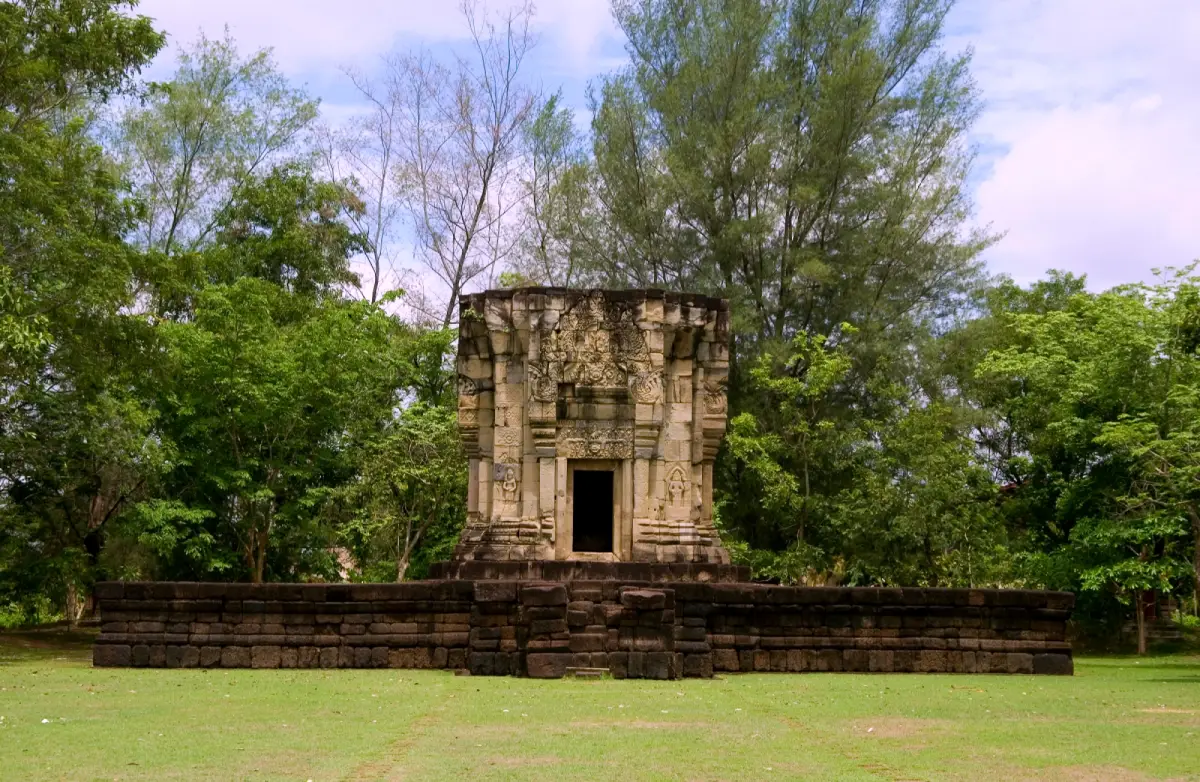
Prasat Hin Ban Phluang
Open Days: Daily
Opening Hours: 08.00 – 16.00
Prasat Hin Ban Phluang in Surin Province is one of the finest small Khmer monuments in Prasat District. It is located in Ban Phluang, Ban Phluang Subdistrict, about 4 km from Prasat District Office and close to Highway 214 on the Surin–Prasat–Chong Chom route. Although the sanctuary is modest in size, it is highly valued for the elegance of its Baphuon-style sandstone carvings. Visitors can see refined pediments, lintels, guardian figures, floral motifs, and small animal carvings that give the monument a vivid and distinctive artistic character.
The monument consists of a single sanctuary tower standing on a large rectangular laterite base. It faces east, following the traditional orientation of Khmer sacred architecture. The eastern doorway is the only real entrance, while the northern, southern, and western sides are designed as false doors. The tower was built with sandstone and laterite, with brick used in the upper part. Today only the lower body of the sanctuary remains, as the upper section has disappeared, but the surviving structure still clearly shows the architectural plan, carving program, and sacred character of the site.
The importance of Prasat Hin Ban Phluang lies not in its scale, but in the quality of its sculpture. This small sanctuary demonstrates the skill and imagination of Khmer craftsmen. The carvings on the pediments and lintels are not merely decorative elements. They are visual narratives drawn from Hindu mythology, expressing ideas of divine protection, fertility, sacred power, and the relationship between the human world and the cosmic order.
Prasat Hin Ban Phluang dates to the late 16th to early 17th Buddhist centuries and belongs to the Baphuon style of Khmer art. This period is an important phase before the full development of Angkor Wat and Bayon styles. Baphuon art is known for balanced architectural forms, kala faces disgorging garlands, foliage motifs, divine figures, and narrative scenes from Hindu mythology. Ban Phluang is therefore an important example for understanding Khmer art in present-day Thailand.
The laterite base is much larger than the sanctuary tower that stands today. The broad side areas of the base show that the original architectural plan was larger than the single tower now visible. This incomplete condition does not reduce the value of the monument. Instead, it makes Ban Phluang especially interesting for archaeology, because visitors can read traces of planning, construction, and change directly from the surviving structure.
The restoration of Prasat Hin Ban Phluang is an important chapter in the conservation of ancient monuments in Thailand. The site was restored between 1971 and 1973 using the anastylosis method. This means that original architectural blocks were dismantled, studied, strengthened, and reassembled in their original positions as much as possible. The method helped preserve the ancient fabric of the sanctuary and allows visitors today to understand the form of the sanctuary body, laterite base, entrance, and important carvings.
The eastern side is the most important viewpoint. It is the entrance side and contains some of the finest sculptural details. The eastern pediment depicts Krishna lifting Mount Govardhana, an important episode from the Krishna avatar. In this story, Krishna raises the mountain to protect cowherds and cattle from the storm sent by Indra. The scene expresses divine protection, abundance, nature, water, animals, and sacred power, all of which are central to the symbolic landscape of the monument.
Below the eastern pediment is a lintel showing Indra riding the elephant Airavata inside an arched frame above a kala face disgorging garlands. Indra is associated with the sky, rain, and fertility, while Airavata is his divine elephant mount. The image gives the entrance a strong meaning of protection and auspiciousness. The kala face and garland motif are also key features of Baphuon-style Khmer art and help confirm the artistic dating of the monument.
On the northern side, the lintel depicts Krishna subduing the naga Kaliya. This episode presents Krishna as a divine figure who controls a dangerous serpent and restores peace to the waters. The subject is especially meaningful when viewed together with the U-shaped moat and the large baray in front of the sanctuary. The religious imagery and the water landscape are closely connected, turning Ban Phluang into a sacred environment rather than a single isolated building.
The southern side also features a lintel of Indra riding Airavata, while the western side remains unfinished. This makes Prasat Hin Ban Phluang a valuable site for understanding the working process of Khmer artisans. Some areas show completed carvings, while others preserve traces of unfinished work. Visitors can observe how sculptors organized surfaces, planned figures, and gradually developed the final details of the stone carving.
One feature that makes Ban Phluang stand out from many other Khmer monuments is the presence of small animal carvings. Elephants, squirrels, wild animals, monkeys, cattle, and other creatures appear among the decorative motifs. These lively details bring the stonework to life. They also suggest ideas of abundance and the natural world surrounding the sacred site. The monument therefore presents not only gods and guardians, but also animals, plants, water, and community life.
Guardian figures are carved on both sides of the eastern doorway. These dvarapalas stand holding clubs, protecting the entrance into the sacred space. Their position reinforces the meaning of the doorway as a threshold between the outside world and the divine interior of the sanctuary. The figures express strength, protection, and sacred authority, while their posture and costume reveal the refinement of Khmer sandstone sculpture.
The U-shaped moat surrounding the sanctuary is an essential part of the ancient layout. It leaves the eastern side open as the main entrance route. About 100 m east of the monument is a large baray, or reservoir, which indicates that Ban Phluang was once part of a settled cultural landscape. The moat and baray show that water was central to ritual, fertility, and community life in this area.
Water was deeply meaningful in Khmer sacred landscapes. It was connected with purity, abundance, ritual, and daily life. At Ban Phluang, the moat defines the sacred boundary, while the baray connects the sanctuary to the wider settlement. The monument, water system, village, and agricultural landscape together form a cultural landscape that still reflects the long relationship between sacred space and local community.
Ban Phluang is a Thai-Khmer community with long cultural roots. The people of the area maintain language, beliefs, traditions, and memories connected with the monument. Prasat Hin Ban Phluang is therefore not separated from local life. It remains part of the identity of the community. Cultural ceremonies held around the monument show that the site continues to live in local memory, not merely in archaeology.
Today, Prasat Hin Ban Phluang is cared for as an important national ancient monument. The Fine Arts Department and related heritage agencies are responsible for conservation, maintenance, and site supervision. Ban Phluang Subdistrict Administrative Organization and the local community help support the surrounding context and tourism access. The area around the sanctuary is landscaped, peaceful, and suitable for historical sightseeing.
A good visit should begin by viewing the large laterite base. This helps visitors understand that the site was planned on a broader scale than the surviving tower alone. Then approach from the east to see the guardian figures, Krishna lifting Mount Govardhana, and Indra riding Airavata. After that, walk around the northern and southern sides to observe the lintels, false doors, and carved details. This route gives a complete understanding of both the architecture and the mythology of the site.
For photography, the eastern front is the most important angle because it captures the entrance, guardians, pediment, and lintel together. Side views reveal the wall thickness, indented plan, and carved surfaces. Wider shots from the moat and front area show the sanctuary in relation to its landscape. Morning and late afternoon are the best times to see the texture of the sandstone and the depth of the carvings.
A visit to Prasat Hin Ban Phluang usually takes around 45–90 minutes. Travelers who want only a brief stop can walk around the monument in less than 1 hour, but those interested in Khmer art should allow more time. The beauty of this site lies in small details, so slow observation is the best way to appreciate it.
Getting there from Surin city is straightforward. Take Highway 214 on the Surin–Prasat–Chong Chom route toward Prasat District. Around the 34–35 km marker, turn left into Ban Phluang and continue for about 1 km to the monument. The route is suitable for private cars, rental cars, and local hired vehicles. From Surin city, the site can be visited as a half-day trip or combined with other Khmer monuments in Prasat District.
From Prasat District Office, the monument is about 4 km away. It is a convenient stop for travelers continuing toward Chong Chom border market or exploring Khmer heritage sites in southern Surin. The route has restaurants, cafes, fuel stations, and accommodation options, making it easy to plan a relaxed cultural trip.
Nearby attractions that pair well with Prasat Hin Ban Phluang include Prasat Ban Phlai, a 3-tower brick sanctuary; Prasat Thanong, another Khmer monument in Prasat District; Surin National Museum, which presents the archaeology and cultural history of the province; Wat Burapharam in Surin city; and Surin City Pillar Shrine. Visiting several sites together helps travelers understand Surin as a province shaped by Khmer heritage and Thai-Khmer communities.
There are local restaurants and cafes near the monument, including Suan Ahan Pornnapha in Ban Phluang, Baan Thung Homestay Cafe, Ban Vision Cafe, and coffee shops along the Surin–Chong Chom route. More dining options are available in Prasat town, including local Thai restaurants, cafes, and convenience stores. These stops are practical before or after visiting the monument.
For accommodation, travelers who prefer staying near the site can choose options in Ban Phluang and Prasat District such as Baan Thung Home Stay, Thong Paeka Hotel, and Ryans Resort. Travelers who prefer more urban convenience can stay in Surin city at hotels such as Martina Hotel, Thongtarin Hotel, or The Wood Surin, then visit Prasat Hin Ban Phluang as a day trip.
Visitors should treat Prasat Hin Ban Phluang with respect. Do not climb on the structure, touch or move stones, write on the monument, litter, or disturb the local community. Every block of sandstone and laterite is part of the historical evidence of the site. Responsible travel helps preserve the monument for future generations.
For international visitors, Prasat Hin Ban Phluang is one of the clearest small sites for understanding Khmer Baphuon art in Thailand. It contains an east-facing sanctuary, sandstone carving, Indra on Airavata, Krishna lifting Govardhana, a moat, a baray, and a living Thai-Khmer community landscape. It is ideal for travelers interested in Khmer civilization who prefer quiet, detailed, and culturally grounded heritage sites.
Compared with other Khmer monuments in Surin, Prasat Hin Ban Phluang has its own identity. It differs from Prasat Sikhoraphum, which has a 5-tower layout; from Prasat Ban Phlai, which has 3 brick towers; and from Prasat Ta Muean Thom, a large border sanctuary. Ban Phluang completes the Khmer heritage route of Surin as a small but artistically refined sandstone sanctuary.
Prasat Hin Ban Phluang brings together religion, art, water, and community in one place. Its sandstone tower, U-shaped moat, eastern baray, carvings of Indra and Krishna, guardian figures, floral motifs, and small animals create a rich historical experience. For travelers who take time to observe the details, this small monument becomes one of the most memorable cultural stops in Surin Province.
| Name | Prasat Hin Ban Phluang |
| Location | Ban Phluang, Village No. 1, Ban Phluang Subdistrict, Prasat District, Surin Province |
| Address | Village No. 1, Ban Phluang, Ban Phluang Subdistrict, Prasat District, Surin Province 32140, Thailand |
| Coordinates | Latitude 14.610251, Longitude 103.424447 |
| Highlights | A small Baphuon-style Khmer sanctuary with refined sandstone carvings, pediments, lintels, guardian figures, floral motifs, and small animal carvings |
| History | Late 16th to early 17th Buddhist centuries, Baphuon-style Khmer art, associated with Brahmanism-Hinduism and Shaivite belief |
| Distinctive Features | Single sanctuary tower on a large rectangular laterite base, facing east, with one real entrance and three false doors, surrounded by a U-shaped moat and an eastern baray |
| Key Evidence | Pediment of Krishna lifting Mount Govardhana, lintels of Indra riding Airavata, lintel of Krishna subduing Kaliya, guardian figures, small animal carvings, and a five-headed naga antefix fragment |
| Travel Information | From Surin city, take Highway 214 on the Surin–Prasat–Chong Chom route. Around the 34–35 km marker, turn left into Ban Phluang and continue for about 1 km. The monument is about 4 km from Prasat District Office |
| Current Status | Open to visitors as an important ancient monument of Surin Province and able to receive tourists throughout the year |
| Open Days | Daily |
| Opening Hours | 08.00 – 16.00 |
| Fees | Thai Visitors 10 Baht / Foreign Visitors 50 Baht |
| Facilities | Walking area around the monument, front terrace, parking space around the community, photo spots, moat landscape, and easy access from the main road |
| Main Areas / Zones | Main sanctuary, laterite base, eastern entrance, three false doors, front pediment, lintels, guardian figures, U-shaped moat, and eastern baray |
| Monument Caretaker | Fine Arts Department through the 10th Regional Office of Fine Arts, Nakhon Ratchasima, and Surin National Museum, together with Ban Phluang Subdistrict Administrative Organization and Ban Phluang community |
| Main Contact Number | Ban Phluang Subdistrict Administrative Organization, Tel. 044-558-916 Surin National Museum, Tel. 044-513-274 10th Regional Office of Fine Arts, Nakhon Ratchasima, Tel. 044-471-518, 044-481-024 |
| Nearby Tourist Attractions | 1. Prasat Ban Phlai, about 14 km 2. Prasat Thanong, about 17 km 3. Surin National Museum, about 34 km 4. Wat Burapharam Royal Temple, about 35 km 5. Surin City Pillar Shrine, about 35 km 6. Chong Chom Border Market, about 37 km |
| Nearby Restaurants | 1. Suan Ahan Pornnapha, about 2 km, Tel. 088-186-5675, 044-551-622 2. Baan Thung Homestay Cafe, about 2 km, Tel. 081-632-7743, 080-786-0407 3. Ban Vision Cafe, about 4 km 4. PunThai Coffee Surin–Chong Chom Road, about 5 km, Tel. 065-520-7624 5. Local Restaurants In Prasat Town, about 4 km |
| Nearby Accommodations | 1. Baan Thung Home Stay, about 2 km, Tel. 081-632-7743, 080-786-0407 2. Thong Paeka Hotel, Prasat District, about 5 km, Tel. 044-532-555, 093-432-0862 3. Ryans Resort, about 20 km, Tel. 084-320-0279 4. Martina Hotel Surin, about 34 km, Tel. 044-713-555, 044-713-655 5. Thongtarin Hotel Surin, about 35 km, Tel. 044-514-281 |
Frequently Asked Questions (FAQ)
Q: Where is Prasat Hin Ban Phluang located?
A: Prasat Hin Ban Phluang is located in Ban Phluang, Village No. 1, Ban Phluang Subdistrict, Prasat District, Surin Province, about 4 km from Prasat District Office.
Q: Is Prasat Hin Ban Phluang open every day?
A: Yes. It is open daily from 08.00 to 16.00.
Q: Is there an admission fee for Prasat Hin Ban Phluang?
A: Yes. The admission fee is 10 baht for Thai visitors and 50 baht for foreign visitors.
Q: Why is Prasat Hin Ban Phluang important?
A: It is an important Baphuon-style Khmer sanctuary with refined sandstone carvings, including pediments, lintels, guardian figures, and small animal motifs that reflect ancient beliefs and abundance.
Q: What is the main highlight of Prasat Hin Ban Phluang?
A: The main highlights are the single sandstone sanctuary on a large laterite base, the Krishna lifting Mount Govardhana pediment, Indra riding Airavata lintels, the U-shaped moat, and the eastern baray.
Q: What period does Prasat Hin Ban Phluang belong to?
A: The monument belongs to the Baphuon style of Khmer art and dates to around the late 16th to early 17th Buddhist centuries.
Q: How do I travel from Surin city to Prasat Hin Ban Phluang?
A: Take Highway 214 on the Surin–Prasat–Chong Chom route. Around the 34–35 km marker, turn left into Ban Phluang and continue for about 1 km.
Q: How long should I spend at Prasat Hin Ban Phluang?
A: Around 45–90 minutes is suitable for walking around the monument, studying the carvings, viewing the moat and baray, and taking photographs.
 Category: ●Art, Culture and Heritage
 Group: ●Historical Sites and Monuments
Last Update : 2 MonthAgo
 Last Update : 2 MonthAgo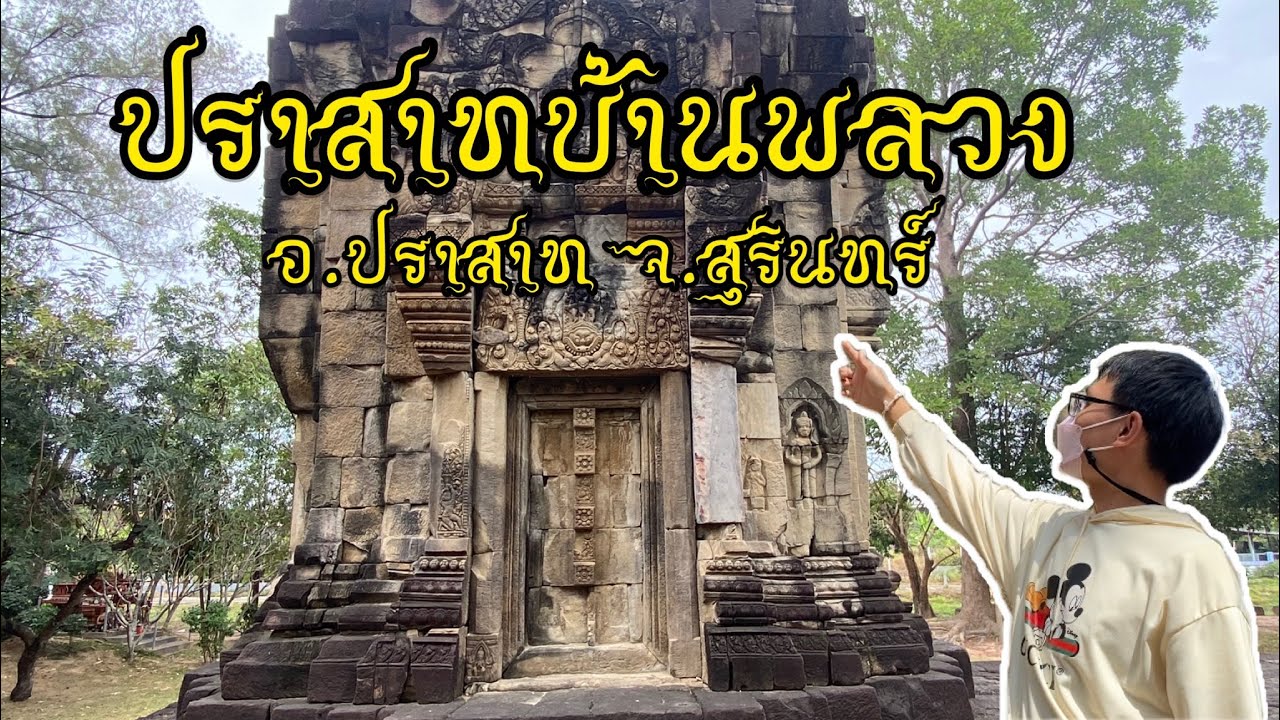
 Click to Access the Navigation Map GPS
Prasat Hin Ban Phluang Map
Recommend
 Historical Sites and Monuments(11)
 Landmarks and Memorials(2)
 Art, Craft Centres, Tradition(5)
 Museums(1)
 Places of Worship
 Temple(15)
 Other Sacred Sites(1)
 Suburban Living
 Village, Community(9)
 Local Market(1)
 Nature and Wildlife
 National Parks and Marine Reserves(2)
 Mountain (Doi)(2)
 Dam, Reservoir, Lake(6)
 Waterfalls(1)
 River, Canal(2)
 Other natural attractions(4)
 Entertainment and Agricultural
 Farms, Parks and Ecotourism(2)


