
lovethailand home >Northeastern Travel Attractions >Surin Travel Attractions >Bua Chet >Charat > Wat Khao Sala Atulthanacharo
TL;DR: Wat Khao Sala Atulthanacharo is located at Charat Subdistrict, Buachet District, Surin Province 32230, open Daily, hours 08.00 – 17.00.
Wat Khao Sala Atulthanacharo
Open Days: Daily
Opening Hours: 08.00 – 17.00
Wat Khao Sala Atulthanacharo Surin is one of the most important forest temples and Buddhist park sites in Surin Province. Located in Charat Subdistrict, Buachet District, the temple stands amid forests and mountains along the Phanom Dong Rak range near the Thai-Cambodian border. Covering about 10,865 rai, it is a remarkable religious and ecological landscape with rich forest, rare medicinal plants, wildlife, streams, viewpoints, sacred shrines, and meditation areas. This is not only a temple for worship, but also a place where Buddhism, forest conservation, meditation practice, and eco-cultural travel come together in one landscape.
The importance of Wat Khao Sala Atulthanacharo lies in the way it uses Buddhism as a foundation for forest protection and environmental care. The temple is surrounded by one of the most abundant forest areas in lower northeastern Thailand. Monks, local communities, government agencies, and Buddhist devotees have all played roles in preserving this forest. Because part of the area lies close to the border and the Phanom Dong Rak mountain range, the temple has religious, ecological, educational, and environmental value at the same time.
The name of the temple reflects both place and history. “Khao Sala” refers to the mountain and temple-shelter landscape, while “Atulthanacharo” is connected with General Chettha Thanajaro, who played an important role in initiating the project to promote Buddhism while conserving forests and developing the environment. The temple name therefore preserves the memory of the landscape, the conservation concept, and the people who supported its development.
In 1993, the Royal Forest Department declared the forest area a Buddhist park zone for the purpose of promoting Buddhism, conserving forests, and improving the environment. This gave Wat Khao Sala Atulthanacharo a role beyond that of an ordinary temple. It became responsible not only for religious buildings and monastic life, but also for a large forest, water sources, medicinal plants, wildlife habitats, and ecological learning areas that benefit the surrounding communities and the wider region.
The temple has long been associated with support from religious and public figures, and the Buddhist park project was placed under royal and ecclesiastical patronage. This made the site a model of how Buddhism can be linked with environmental responsibility. Meditation at this temple does not take place only inside halls or buildings. It also takes place in the forest, beside streams, on mountain paths, and in the quiet atmosphere of nature, which fits the spirit of forest-temple practice.
The forest of Wat Khao Sala Atulthanacharo is one of the most valuable natural areas in lower Isan. It includes forested mountains, rare plants, medicinal herbs, wild animals, and water sources. Its condition makes the temple meaningful beyond tourism. The forest teaches visitors about watersheds, ecological restoration, coexistence with nature, and the balance between faith and the environment. In this sense, a visit to the temple is also a lesson in conservation.
In 2012, the 10,865-rai forest area of Wat Khao Sala Atulthanacharo was accepted as part of a royal-initiative forest conservation project along the border. The project aims to conserve and restore the forest as a model area through cooperation between local communities, government agencies, and supporting networks. This reinforces the temple’s role as an ecological learning center and as a place that cultivates conservation awareness among people living around the forest.
Phra Thammawachirayanakoson Vi. (Yuen Khantipalo), widely known as Luang Pho Yuen Khantipalo, is the most important monastic figure associated with Wat Khao Sala Atulthanacharo. He is a respected Dhammayuttika monk known for Buddhist teaching, meditation training, temple development, and forest conservation work. His role helped make the temple known as both a meditation center and a Buddhist park of provincial and national importance.
Current provincial information identifies Phra Thammawachirayanakoson Vi. (Yuen Khantipalo) as the ecclesiastical provincial chief of Surin under the Dhammayuttika order, with continuing association with Wat Khao Sala Atulthanacharo. His name is therefore part of the temple’s identity. Visitors who come here encounter not only religious architecture, but also a long-standing model of temple development based on Dhamma, meditation, forest protection, and social benefit.
The ordination hall is one of the most important religious buildings at the temple. It was built to commemorate the 50th anniversary of the reign of King Bhumibol Adulyadej in 1996. The hall follows an applied Thai architectural style and measures about 30 meters wide and 60 meters long. Its construction was completed through the faith and effort of monks, disciples, and Buddhist devotees without the use of government budget. This makes the ordination hall a strong symbol of collective faith.
The ordination hall received its royal boundary in 1998, making it fully proper according to Buddhist monastic discipline. The temple later held the boundary-stone consecration and gilding ceremony on 21 August 2004, with General Chettha Thanajaro, then Minister of Defence, presiding over the ceremony. This was a major milestone in the temple’s history because it completed the religious status of the ordination hall and confirmed its role as the central sacred building of the temple.
The temple contains many important areas for worship and reflection. These include the ordination hall, the large Buddha footprint, the Naga tunnel, the large Naga-protected Buddha image known as Phra Phuttha Barami Siam Buri Phithak, the stupa containing relics of the Buddha, Pha Phra Phu Sala or Pha Nang Khoi viewpoint, Chedi Nam Sap, the replica of the Mahabodhi Buddha image from Bodh Gaya, and a large white-jade Guan Yin statue. These areas give the temple a rich combination of Buddhist art, pilgrimage, meditation, and nature.
The large Buddha footprint is one of the most meaningful sacred sites in the forest area. It is located on a large rock surface within the temple’s forest zone. The walk to the footprint takes visitors into a quieter natural setting, making the experience both devotional and contemplative. Paying respect to the footprint is not only an act of worship; it is also a way of entering the forest landscape with mindfulness.
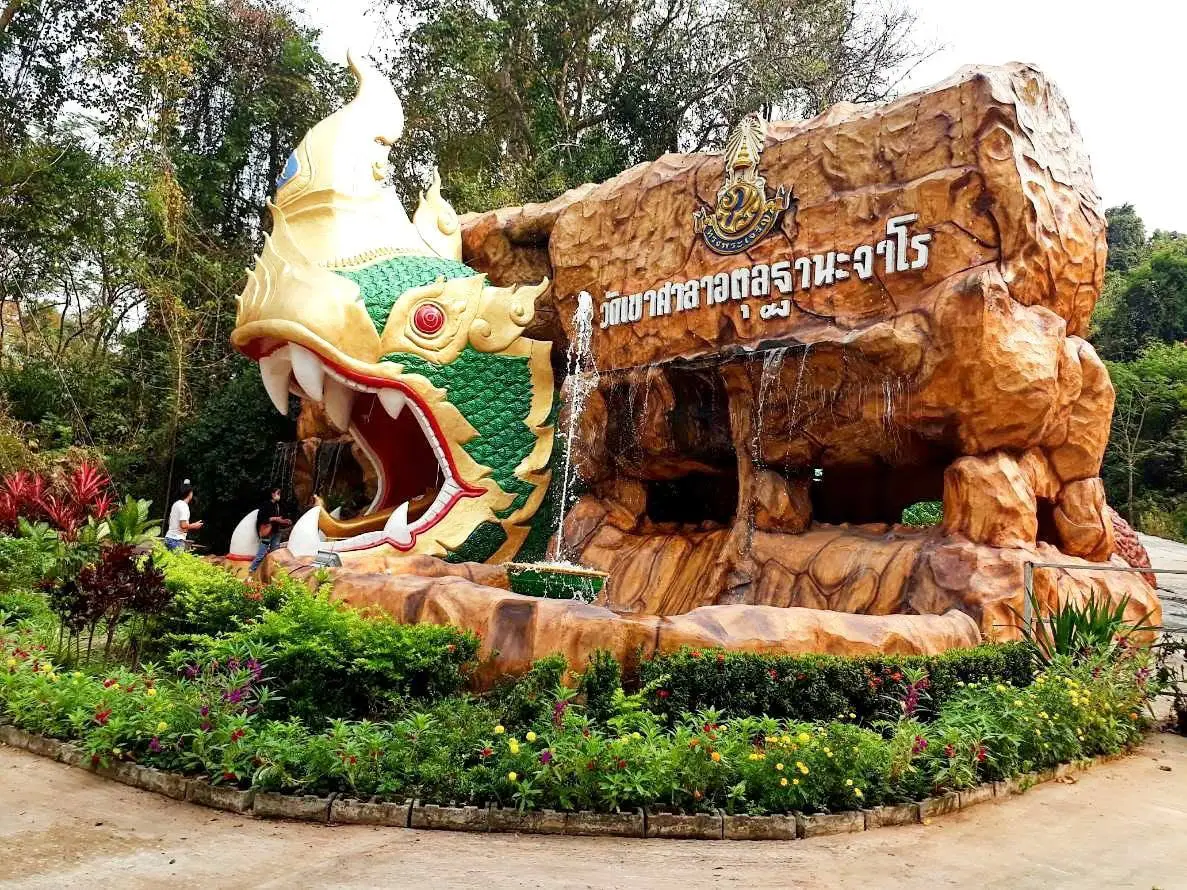
The Naga tunnel is another well-known highlight of the temple. Its design connects Naga symbolism with the idea of entering a sacred path. Visitors walk through or around this striking structure to reach worship areas and admire Buddhist art. The Naga tunnel is more than a photo spot. It represents protection, transition, and entry into a Buddhist landscape shaped by faith and local imagination.
Phra Phuttha Barami Siam Buri Phithak is a large golden Naga-protected Buddha image and one of the most important devotional points at the temple. The Naga-protected Buddha image symbolizes protection, peace, and spiritual shelter under the Dhamma. Surrounded by forest and mountains, the image creates a powerful atmosphere of devotion and calm. Many visitors come to pay respect here for auspiciousness and inner peace.
Pha Phra Phu Sala, also known as Pha Nang Khoi, is a major viewpoint. From this area, visitors can see the forest landscape, Ban Charat Reservoir, and the Phanom Dong Rak mountain range along the Thai-Cambodian border. The view makes the value of forest conservation visible. The green landscape below is not simply scenery; it is a watershed, habitat, and living ecological system protected through community and monastic effort.
The large white-jade Guan Yin statue adds another dimension of compassion to the temple. It represents mercy and kindness, which harmonize with Buddhist values. Together with the Buddha images, footprint, stupas, and forest setting, this statue helps make the temple accessible to visitors from diverse devotional backgrounds while preserving a peaceful spiritual atmosphere.
The overall environment of Wat Khao Sala Atulthanacharo is highly suitable for meditation practice. Those who wish to step away from urban noise can walk mindfully, sit in meditation, listen to Dhamma, and contemplate nature. The calm forest, mountain air, bird sounds, and shaded areas support concentration and inner stillness. The temple is appropriate for both beginners and serious practitioners who come as individuals or groups.
On 24 February 2004, the National Office of Buddhism selected Wat Khao Sala Atulthanacharo Buddhist Park to participate in a meditation-practice project for government officers and officials who voluntarily joined Dhamma practice. This reflected the readiness of the temple in terms of place, atmosphere, and suitability for using Buddhist practice to develop mental discipline and work efficiency.
The temple also plays a role in public welfare and social development by connecting Dhamma with environmental protection. Preserving 10,865 rai of forest means protecting water sources, wildlife, communities, and the future of younger generations. Buddhism at this temple is not limited to chanting or ceremonies. It extends into practical responsibility for nature and society, making the temple an important modern forest-temple model in lower Isan.
Religious activities take place throughout the year, including Buddhist holy day merit-making, Dhamma listening, meditation practice, Buddhist Lent, the end of Buddhist Lent, Kathin, forest-robe offerings, merit dedication, and Dhamma training. At a large forest temple like this, merit-making is closely connected with nature. Support for the temple also supports forest protection, watershed conservation, and ecological learning.
Buddhist holy days are especially peaceful at the temple. Devotees come to make merit, listen to teachings, observe precepts, and meditate. Unlike temples in urban areas, the experience here is shaped by wind, birds, forest silence, and mountain views. The natural setting helps visitors return to mindfulness, simplicity, and calm observation of life.
Kathin and forest-robe offering ceremonies reveal the power of Buddhist devotion. People from many areas come to support the monks and the temple’s mission. At Wat Khao Sala, such merit-making also helps sustain conservation work, learning areas, and the forest environment. Participants therefore support both Buddhism and nature at the same time.
Wat Khao Sala Atulthanacharo is highly suitable for conservation-oriented travel. Visitors can pay respect at the ordination hall, visit the Buddha footprint, walk through the Naga tunnel, worship Phra Phuttha Barami Siam Buri Phithak, enjoy the view at Pha Nang Khoi, and learn about the forest and watershed. A meaningful visit usually requires at least 2 to 4 hours, while meditation groups should coordinate with the temple in advance.
Visitors should dress modestly and wear comfortable shoes because the temple includes buildings, stairs, forest paths, viewpoints, and large open areas. It is wise to bring drinking water, a hat, or an umbrella on hot days. During the rainy season, visitors should walk carefully because natural surfaces may become slippery. A forest temple should be visited with attention to safety, silence, and respect for both sacred space and nature.
Important rules include not littering, not making loud noise, not disturbing wildlife, not collecting plants or natural objects, not entering deep forest areas without guidance, not climbing dangerous points, and not disturbing people who are meditating. Wat Khao Sala is both a sacred site and a conservation area. Respecting these rules helps preserve what monks and communities have worked to protect.
Getting There to Wat Khao Sala Atulthanacharo is most convenient by private car, rental car, or chartered vehicle. From Surin city, travel toward Buachet District, then continue to Charat Subdistrict and Ban Charat. The distance from Surin city is about 80 km depending on the route. Visitors should navigate specifically to “Wat Khao Sala Atulthanacharo, Charat Subdistrict, Buachet District, Surin Province” to avoid confusion with other places.
Families and elderly visitors should plan their time carefully. The most accessible areas include the ordination hall, Naga tunnel, Phra Phuttha Barami Siam Buri Phithak, and main viewpoints. Visitors who wish to walk deeper into natural areas should allow more time and check the weather. Because the temple is located in a forested mountain area, good preparation makes the visit safer and more meaningful.
There is no admission fee for general worship, merit-making, and ordinary visits. Visitors may donate according to their faith through proper donation points. Those who wish to join meditation practice as a group, make a formal offering, organize an activity, or conduct an environmental study visit should contact the temple or local authorities in advance.
The temple can be combined with nearby places in Buachet and surrounding districts, such as Ban Charat Reservoir, Buachet town, nearby local temples, Phum Pon Sanctuary in Sangkha District, Sikhoraphum Sanctuary, and Surin city attractions. Because the temple area is large and rich in highlights, it is best to make Wat Khao Sala the main destination of the day rather than a short stop.
Restaurants near the temple are mainly located in Buachet town and along the main access route. Visitors can find local Thai restaurants, simple made-to-order shops, cafés, and beverage shops. Since the temple lies in a forest and mountain environment, restaurant choices immediately near the temple are limited compared with the district town. Groups should plan meals in advance and carry drinking water.
Accommodation is available in Ban Charat, Buachet District, nearby districts, and Surin city. Those who want to stay closest to the temple should choose accommodation in the Charat or Buachet area. Travelers who prefer more restaurants, hospitals, markets, and services may stay in Surin city and visit the temple as a full-day trip, starting early in the morning.
For international visitors, Wat Khao Sala Atulthanacharo offers a deeper understanding of Surin beyond elephants, silk, and Khmer ruins. It shows how Thai Buddhism can be connected with forest conservation, meditation, community development, and environmental care. Visitors can see a working forest temple, a major Buddhist park, large sacred monuments, mountain viewpoints, and a living conservation landscape in one place.
The temple is suitable for many types of visitors: Buddhist pilgrims, meditation practitioners, nature lovers, students, families, photographers, conservation travelers, and international visitors who want to understand Thai forest-temple culture. Its value lies in the way it connects mind, community, faith, forest, water, and landscape. Few temples in Surin present these dimensions so clearly in one continuous area.
In summary, Wat Khao Sala Atulthanacharo Surin is a major Buddhist park and forest temple in Buachet District. Located amid the Phanom Dong Rak mountain forest, it covers about 10,865 rai and serves as a watershed, ecological learning area, meditation site, and sacred Buddhist destination. With its large ordination hall, Buddha footprint, Naga tunnel, Phra Phuttha Barami Siam Buri Phithak, Pha Nang Khoi viewpoint, relic stupa, and conservation forest, the temple offers worship, meditation, nature, and cultural learning in one powerful place.
| Name | Wat Khao Sala Atulthanacharo Surin / Khao Sala Buddhist Park |
| Location | Charat Subdistrict, Buachet District, Surin Province 32230 |
| Address | Wat Khao Sala Atulthanacharo, Ban Charat, Charat Subdistrict, Buachet District, Surin Province 32230 |
| Coordinates | 14.430102, 103.937607 |
| Highlights | Thailand’s first Buddhist park, 10,865-rai conservation forest, applied Thai-style ordination hall, large Buddha footprint, Naga tunnel, Phra Phuttha Barami Siam Buri Phithak, Pha Phra Phu Sala / Pha Nang Khoi viewpoint, relic stupa, and meditation areas surrounded by forest and mountains |
| History | In 1993, the Royal Forest Department declared the area a Buddhist park zone to promote Buddhism, forest conservation, and environmental development. In 2012, the 10,865-rai forest area was accepted as a royal-initiative forest conservation model project along the border |
| Monastic Order | Dhammayuttika Order |
| Name Origin | The name connects the Khao Sala forest-and-mountain landscape with the Buddhist park development concept initiated with the support of General Chettha Thanajaro |
| Distinctive Features | A large forest temple near the Thai-Cambodian border, combining sacred Buddhist sites, meditation areas, viewpoints, watershed forest, ecological learning, and conservation-oriented travel in one landscape |
| Travel Information | From Surin city, travel toward Buachet District, then continue to Charat Subdistrict and Ban Charat. The distance is about 80 km and is most convenient by private car, rental car, or chartered vehicle |
| Current Status | Open for worship, merit-making, meditation practice, and conservation-oriented visits. The temple is a Dhammayuttika community temple and a royal-initiative border forest conservation model area |
| Open Days | Daily |
| Opening Hours | 08.00 – 17.00 |
| Fees | No Admission Fee For General Worship And Ordinary Visits. Donations May Be Made According To Faith |
| Facilities | Ordination hall, meditation halls, worship areas, viewpoints, parking area, toilets, internal walking routes, quiet resting areas, sacred sites, and meditation spaces according to forest-temple conditions |
| Main Areas / Zones | 1. Applied Thai-Style Ordination Hall, 30 meters wide and 60 meters long 2. Large Buddha Footprint In The Forest Area 3. Naga Tunnel 4. Phra Phuttha Barami Siam Buri Phithak, Large Naga-Protected Buddha Image 5. Pha Phra Phu Sala / Pha Nang Khoi Viewpoint Over The Phanom Dong Rak Range 6. Stupa Containing Relics Of The Buddha 7. Chedi Nam Sap 8. Replica Of The Mahabodhi Buddha Image From Bodh Gaya 9. Large White-Jade Guan Yin Statue 10. Meditation Areas And Dhamma Halls 11. Conservation Forest, Watershed, And Nature Learning Areas |
| Important Sacred Objects | Main Buddha image in the ordination hall, Buddha footprint, Phra Phuttha Barami Siam Buri Phithak, relic stupa, Mahabodhi Buddha replica from Bodh Gaya, white-jade Guan Yin statue, and important Buddha images throughout the temple grounds |
| Important Rituals / Traditions | Buddhist holy day merit-making, Dhamma listening, meditation practice, Buddhist Lent, the end of Buddhist Lent, Kathin, forest-robe offerings, merit dedication, boundary-stone consecration ceremony, and Dhamma training connected with forest conservation |
| Abbot / Caretaker | Phra Thammawachirayanakoson Vi. (Yuen Khantipalo), also known as Luang Pho Yuen Khantipalo, Ecclesiastical Provincial Chief of Surin under the Dhammayuttika order and the key senior monk of Wat Khao Sala Atulthanacharo |
| Temple / Meditation Contact | Phra Suwit Katasaro, Tel. 089-033-3164 |
| Local Information Contact | Buachet Subdistrict Municipality, Tel. 044-579-025, 044-579-026 |
| Nearby Tourist Attractions | 1. Ban Charat Reservoir, about 4 km 2. Wat Charat Samakkhi Tham, Charat Subdistrict, about 7 km 3. Wat Chok Si Phanom Rung, Buachet District, about 12 km 4. Buachet Market And Local Community, about 18 km 5. Wat Phothiyan Thammaram, Buachet District, about 22 km 6. Phum Pon Sanctuary, Sangkha District, about 45 km 7. Sikhoraphum Sanctuary, Sikhoraphum District, about 65 km 8. Surin National Museum, about 82 km, Tel. 044-513-272, 044-513-274 |
| Nearby Restaurants | 1. Pornpen Restaurant, Buachet District, about 18 km, Tel. 044-579-114 2. Jungle Cafe Lotus Express Buachet, about 18 km, Tel. 095-332-3078 3. Ben Coffee, Buachet District, about 18 km 4. Local Thai Food Shops Around Buachet Market, about 18 km 5. Roadside Local Restaurants On The Buachet – Charat Route, about 12 km 6. Restaurants And Cafes In Surin City, about 80 km |
| Nearby Accommodations | 1. Ban Pak Charat Rim Nam, Charat Subdistrict, about 4 km, Tel. 087-258-1667 2. Rai Rung Saeng Resort, Buachet District, about 20 km, Tel. 095-385-6070, 083-257-8527 3. Jamjuree Resort, Sikhoraphum District, about 65 km, Tel. 044-560-289, 089-190-5156 4. The Wood Surin, Mueang Surin District, about 82 km, Tel. 063-023-7999 5. Thong Tarin Hotel, Mueang Surin District, about 83 km, Tel. 044-514-281, 085-300-8858 6. Maneerote Hotel Surin, Mueang Surin District, about 83 km, Tel. 044-514-569 7. Slive Hotel Surin, Mueang Surin District, about 84 km, Tel. 044-060-322, 044-060-323 |
Frequently Asked Questions (FAQ)
Q: Where Is Wat Khao Sala Atulthanacharo Located?
A: Wat Khao Sala Atulthanacharo is located in Charat Subdistrict, Buachet District, Surin Province 32230, near the Phanom Dong Rak mountain range and the Thai-Cambodian border.
Q: When Is Wat Khao Sala Atulthanacharo Open?
A: The temple is open daily from 08.00 to 17.00 for worship, merit-making, meditation practice, and conservation-oriented visits.
Q: Is There An Admission Fee?
A: No. There is no admission fee for general worship and ordinary visits. Visitors may donate according to their faith.
Q: What Is The Main Highlight Of Wat Khao Sala Atulthanacharo?
A: The main highlights are the 10,865-rai Buddhist park forest, large applied Thai-style ordination hall, Buddha footprint, Naga tunnel, Phra Phuttha Barami Siam Buri Phithak, Pha Nang Khoi viewpoint, and meditation areas surrounded by forest and mountains.
Q: Who Is The Important Senior Monk Of Wat Khao Sala Atulthanacharo?
A: Phra Thammawachirayanakoson Vi. (Yuen Khantipalo), also known as Luang Pho Yuen Khantipalo, is the important senior monk associated with the temple and the Ecclesiastical Provincial Chief of Surin under the Dhammayuttika order.
Q: How Is The Temple Connected With Forest Conservation?
A: The temple forest was declared a Buddhist park zone in 1993 and was accepted in 2012 as a royal-initiative model forest conservation project along the border, helping protect forest, watershed, wildlife, and ecological learning areas.
Q: What Nearby Places Can Be Visited With Wat Khao Sala Atulthanacharo?
A: Nearby places include Ban Charat Reservoir, Wat Charat Samakkhi Tham, Buachet town, Wat Phothiyan Thammaram, Phum Pon Sanctuary, Sikhoraphum Sanctuary, and Surin National Museum.
Q: What Should Visitors Wear And Prepare?
A: Visitors should dress modestly, wear comfortable shoes, bring drinking water, prepare a hat or umbrella on hot days, speak quietly, avoid littering, avoid disturbing wildlife or meditators, and respect the forest conservation area.
 Category: ●Places of Worship
 Group: ●Temple
Last Update : 3 MonthAgo
 Last Update : 3 MonthAgo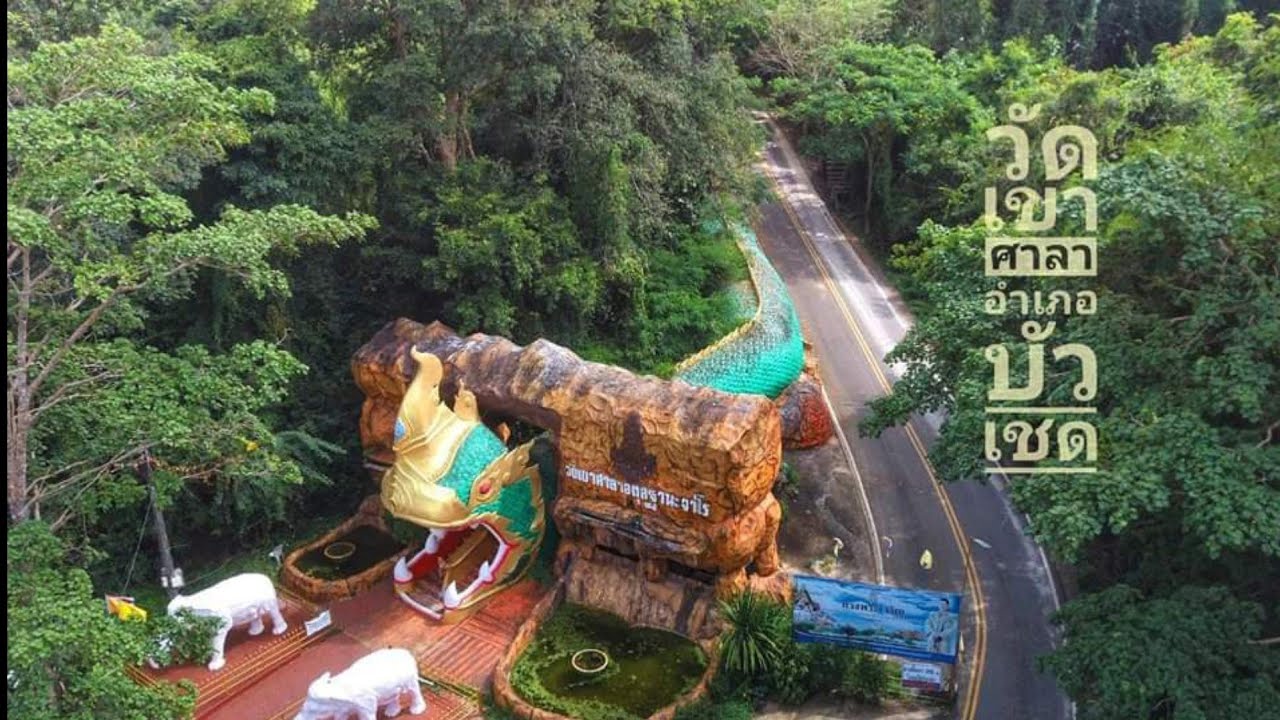
 Click to Access the Navigation Map GPS
Wat Khao Sala Atulthanacharo Map
Recommend

 Art, Culture and Heritage
 Historical Sites and Monuments(11)
 Landmarks and Memorials(2)
 Art, Craft Centres, Tradition(5)
 Museums(1)
Temple(15)
Museums(1)
Temple(15)
 Other Sacred Sites(1)
 Suburban Living
 Village, Community(9)
 Local Market(1)
 Nature and Wildlife
 National Parks and Marine Reserves(2)
 Mountain (Doi)(2)
 Dam, Reservoir, Lake(6)
 Waterfalls(1)
 River, Canal(2)
 Other natural attractions(4)
 Entertainment and Agricultural
 Animal camps and shows(1)
 Farms, Parks and Ecotourism(2)
 Travel Articles, Recipes
 Travel Review, Food Review(1)


