
lovethailand home >Northeastern Travel Attractions >Surin Travel Attractions >Sang Kha >Sang Kha > Prasat Yai Ngao
TL;DR: Prasat Yai Ngao is located at Ban Phon Chai / Near Ban Sangkha, Ban Chob Subdistrict, Sangkha District, Surin Province, open Daily, hours 24 Hours.
Prasat Yai Ngao
Open Days: Daily
Opening Hours: 24 Hours
Prasat Yai Ngao in Surin Province is an important Khmer ancient monument in Sangkha District, located in the Ban Phon Chai area of Ban Chob Subdistrict, close to Highway 24 on the Chok Chai–Det Udom route between kilometer markers 190 and 191. The site is about 4 km from Sangkha District town and is easily reached by a local concrete road leading from the main highway. Prasat Yai Ngao was originally a Hindu sanctuary in the ancient Khmer cultural tradition and dates to around the 17th Buddhist century, during the Angkor Wat artistic period. The monument is open daily, operates as a 24-hour local heritage site, and has no admission fee, making it one of the most accessible Khmer heritage destinations in southern Surin.
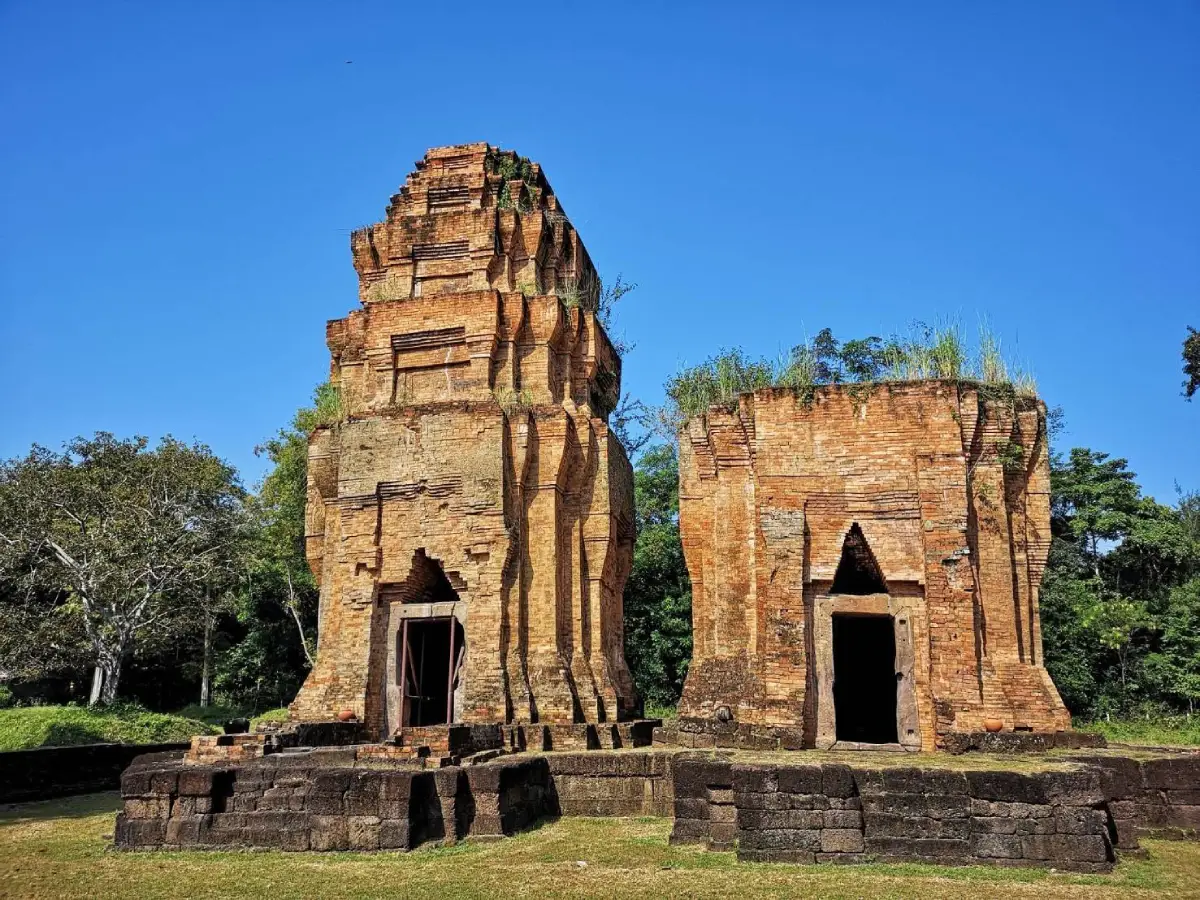
The defining character of Prasat Yai Ngao is its group of brick towers built on laterite foundations. The original plan was designed as 3 towers aligned from north to south. Today, 2 towers remain clearly visible: the central tower and the southern tower. The northern tower survives mainly as a brick and laterite base. This condition makes the monument especially interesting because visitors can read both the surviving architecture and the traces of the original layout. The site shows how a community-level Khmer sanctuary was planned, used, damaged, remembered, and restored over time.
The central and southern towers were built of brick on a rectangular laterite base. Both face east and have a single entrance on the eastern side. The other 3 sides were built as closed walls with false doors, a common feature in Khmer sacred architecture. These false doors were not meant for physical entry. Instead, they helped balance the architectural form and carried symbolic meaning related to sacred directions. The upper part of the central tower has mostly collapsed, while the southern tower preserves more of its upper structure, allowing visitors to see the stepped tower form more clearly.
The main construction materials at Prasat Yai Ngao are brick and laterite, with sandstone used for selected decorative architectural elements. Brick was used for the sanctuary towers because it allowed ancient builders to create refined vertical forms and wall surfaces. Laterite was used for the base because of its strength and durability. Sandstone was reserved for elements requiring detailed carving, such as door colonnettes, finials, and sculptural fragments. This combination of materials reflects the practical intelligence and artistic skill of Khmer builders in southern Isan.
One of the most important decorative features at Prasat Yai Ngao is the carving of a makara disgorging a 5-headed naga on the pediment frame. In Indian and Khmer art, the makara is a composite mythical creature associated with water, protection, and abundance. The naga is also deeply connected with water, sacred power, and fertility. The makara-and-naga motif at Prasat Yai Ngao therefore gives the monument a strong symbolic meaning. It links the sanctuary with divine protection, water imagery, and the sacred environment of the ancient community.
Several sandstone architectural fragments have been found around the monument and are displayed in front of the site. These include antefixes from the tower top, decorated door colonnettes, and other carved elements. Their presence confirms that Prasat Yai Ngao was not a purely brick structure. It combined brick, laterite, and sandstone to create a complete Khmer sacred building. These fragments also help visitors understand the original refinement of the monument before parts of the towers collapsed or disappeared.
Artistically, Prasat Yai Ngao belongs to the Khmer Angkor Wat style and dates to around the 17th Buddhist century. This period represents one of the most important phases of Khmer civilization, when religious architecture, carving, and sacred planning were highly developed. The presence of an Angkor Wat-style monument in Sangkha District shows that this area of Surin was connected with the wider Khmer cultural world. It also reflects the role of southern Isan as a region shaped by ancient routes, local settlements, water systems, and religious architecture.
Prasat Yai Ngao was built in a Hindu religious context, as were many Khmer sanctuaries from this period. Although the original main cult image is no longer present in its original position, the east-facing plan, tower form, laterite base, and decorative motifs all preserve the character of a Hindu sacred site. The eastern entrance is especially meaningful because the east is associated with light, renewal, and entry into sacred space. Visitors approaching from the east are therefore following the original ritual direction of the sanctuary.
The monument was once enclosed by a square boundary wall built of brick and laterite, measuring about 37 by 37 m. A gateway or gopura stood on the eastern side, aligned with the central tower. This arrangement defined the sacred precinct and separated the inner ritual area from the surrounding community landscape. The relationship between the entrance gateway, central tower, and tower group shows that the monument was carefully planned according to Khmer sacred architectural principles.
The incomplete condition of the 3-tower plan is one of the features that makes Prasat Yai Ngao memorable. The visible remains suggest an original composition of 3 towers, but only 2 stand prominently today. This allows visitors to imagine the original design while also seeing the effects of time, collapse, restoration, and historical change. The monument therefore teaches not only Khmer art history, but also how ancient buildings survive through different phases of use and conservation.
The name “Yai Ngao” is connected with a local legend about an elderly woman who waited for her husband or loved one who had gone away for a long time. According to the story, she built or was associated with the sanctuary while waiting for his return. Whether read as legend, memory, or symbolic storytelling, this tradition gives the monument emotional depth. It connects the ancient stone and brick remains with local feeling, longing, and community identity.
This local legend is one reason Prasat Yai Ngao remains meaningful to people in the area. Archaeological knowledge explains the age, style, plan, materials, and religious function of the monument. Local legend gives the site a human voice. Together, they create a more complete experience for visitors. Prasat Yai Ngao is not simply an ancient Khmer ruin; it is also a place where community memory continues to shape the way people understand the past.
After restoration and landscape improvement, the site has become more suitable for visitors. The open courtyard allows a clear view of the 2 standing towers, the laterite base, the boundary traces, and the sandstone fragments displayed nearby. The atmosphere is quiet and uncrowded, making it ideal for travelers who prefer slow cultural exploration. The monument is small enough to visit easily, yet rich enough to reward careful observation.
A good visit should begin from the east, the original entrance direction. From this point, visitors can see the central and southern towers aligned on the laterite base. Then walk closer to the central tower to study the brickwork, eastern doorway, false doors, and collapsed upper section. Continue to the southern tower, which preserves more of its upper form, and then observe the northern base to understand the original 3-tower concept. This sequence gives a clear reading of the monument’s layout.
Visitors interested in art should pay attention to the carved motifs and sandstone fragments. The makara disgorging a 5-headed naga, the door colonnettes, antefixes, and decorative stone pieces all help explain the original beauty of the sanctuary. These details show that even a modest community-level Khmer monument could contain refined religious symbolism and skilled craftsmanship.
For those interested in Khmer history, Prasat Yai Ngao can be compared with other monuments in Surin. Prasat Phum Pon is older and belongs to the pre-Angkor phase. Prasat Sikhoraphum is known for its 5 towers and Shiva Nataraja lintel. Prasat Ban Phluang is admired for Baphuon-style sandstone carving. Prasat Ban Chang Pi and Prasat Mueang Thi represent Mahayana Buddhist hospital sanctuaries from the reign of King Jayavarman VII. Prasat Yai Ngao adds another important layer to this heritage map as an Angkor Wat-style Hindu brick sanctuary.
A typical visit takes about 45–90 minutes. Travelers who only want to see the monument and take photographs can spend less than 1 hour, while those who enjoy archaeology, photography, local legend, and slow observation may prefer 1–2 hours. The site is suitable for general travelers, students, cultural tourists, and international visitors interested in Khmer civilization in Thailand.
The best time to visit is in the morning or late afternoon, when the weather is more comfortable and the sunlight brings out the texture of the brickwork. The site is listed as open 24 hours, but daylight visits are the best choice for safety and for seeing the architectural details clearly. During the rainy season, the surrounding landscape becomes greener, while the cool season offers the most comfortable conditions for walking around the monument.
Getting There from Surin city can be done by taking Highway 2077 on the Surin–Sangkha route through Lamduan District toward Sangkha. From Sangkha, connect to Highway 24 on the Chok Chai–Det Udom route. Between kilometer markers 190 and 191, turn onto the local concrete road for about 700–800 m to reach the monument. Private cars, rental cars, and local hired vehicles are the most convenient options. Travelers using public vans or buses can get off in Sangkha town and continue by local motorcycle taxi or hired transport.
From Sangkha District Office, Prasat Yai Ngao is only about 4 km away, making it an easy short trip from the district town. It can also be included in a broader southern Surin route with Prasat Phum Pon, Wat Khao Sala Atulathanacharoen, Chong Chom Border Market, or natural attractions in Buachet and Kap Choeng districts. This route combines Khmer heritage, local communities, nature, and southern Surin culture in one journey.
Food and rest stops are available in Sangkha District. Nearby options include DG Food & Drink, Muat Ya Restaurant Sangkha, Isan Shabu Sangkha, Baan Aum Cafe, and local coffee shops or restaurants in the district town. A practical plan is to visit the monument in the morning, return to Sangkha for lunch or coffee, and then continue to another cultural or natural attraction.
Accommodation is available in and around Sangkha District, including Malinee Hotel, Manee Sangkha Hotel, and nearby resorts or daily-room options. Travelers who prefer more restaurants, transport choices, and urban convenience can stay in Surin city and visit Prasat Yai Ngao as a day trip. The road from Surin city to Sangkha is direct and practical for self-driving travelers.
Visitors should treat Prasat Yai Ngao with respect. Dress appropriately, do not climb on the towers, do not move bricks, laterite blocks, or sandstone fragments, do not write on the monument, do not litter, and do not disturb the surrounding community. Every brick and carved fragment is part of the historical evidence of the site. Responsible travel helps preserve the monument for future generations.
For international visitors, Prasat Yai Ngao is a clear and approachable place to understand Khmer brick sanctuary architecture in Thailand. The site brings together an Angkor Wat-style plan, east-facing towers, laterite base, makara-and-naga motifs, Hindu sacred meaning, and local legend. It is quiet, compact, and meaningful, making it ideal for travelers who want to explore Khmer heritage beyond the most famous and crowded sites.
Overall, Prasat Yai Ngao brings together Khmer history, Angkor Wat-style art, Hindu sacred architecture, brick and laterite construction, local legend, and the living identity of Ban Chob community. Its beauty does not depend on monumental scale. It lies in the quiet presence of the towers, the carved details, the unfinished 3-tower memory, and the story behind its name. For travelers who want to understand Surin more deeply, Prasat Yai Ngao is one of the most rewarding cultural stops in Sangkha District.
| Name | Prasat Yai Ngao |
| Location | Ban Phon Chai / Near Ban Sangkha, Ban Chob Subdistrict, Sangkha District, Surin Province |
| Address | Highway 24, Ban Chob Subdistrict, Sangkha District, Surin Province 32150, Thailand |
| Coordinates | Latitude 14.619527, Longitude 103.887577 |
| Highlights | Angkor Wat-style Khmer brick sanctuary, 2 standing towers, laterite base, traces of an original 3-tower plan, makara disgorging a 5-headed naga motif, and the local Yai Ngao legend |
| History | Built around the 17th Buddhist century in the Khmer Angkor Wat style as a Hindu sanctuary in the ancient Khmer cultural tradition |
| Distinctive Features | Brick towers on laterite foundations aligned north–south, facing east, with one main eastern entrance, false doors on the other sides, and a sacred boundary layout |
| Key Evidence | Makara disgorging a 5-headed naga motif, tower antefixes, decorated door colonnettes, sandstone fragments, laterite base, and the northern brick-laterite tower base |
| Travel Information | From Surin city, take Highway 2077 on the Surin–Sangkha route, then connect to Highway 24 between kilometer markers 190–191 and turn onto a local concrete road for about 700–800 m |
| Current Status | Open daily as a restored and accessible ancient monument in Sangkha District |
| Open Days | Daily |
| Opening Hours | 24 Hours |
| Fees | No Admission Fee |
| Facilities | Walking area around the monument, photo spots, surrounding community area, concrete access road, and parking space around the village |
| Main Areas / Zones | Central tower, southern tower, northern tower base, laterite base, sacred boundary wall, eastern gateway area, front courtyard, and sandstone-fragment display area |
| Monument Caretaker | Fine Arts Department through the 10th Regional Office of Fine Arts, Nakhon Ratchasima, and Surin National Museum, together with Ban Chob Subdistrict Administrative Organization and the local community |
| Main Contact Number | Ban Chob Subdistrict Administrative Organization, Tel. 044-571-640 Surin National Museum, Tel. 044-513-274 10th Regional Office of Fine Arts, Nakhon Ratchasima, Tel. 044-471-518, 044-481-024 |
| Nearby Tourist Attractions | 1. Khun Mun Satsathorn Park, Sangkha District, about 5 km 2. Prasat Phum Pon, Dom Subdistrict, about 22 km 3. Prasat Ban Phluang, Prasat District, about 36 km 4. Wat Khao Sala Atulathanacharoen, Buachet District, about 40 km 5. Chong Chom Border Market, Kap Choeng District, about 47 km 6. Surin National Museum, about 54 km |
| Nearby Restaurants | 1. DG Food & Drink Sangkha, about 5 km, Tel. 087-127-8249 2. Muat Ya Restaurant Sangkha, about 5 km, Tel. 081-579-3898, 082-369-1196, 087-253-4019 3. Isan Shabu Sangkha, about 5 km, Tel. 090-906-4833, 090-197-5228 4. Baan Aum Cafe Sangkha, about 5 km, Tel. 084-589-5364 5. PunThai Coffee Sangkha 2, about 6 km |
| Nearby Accommodations | 1. Malinee Hotel Sangkha, about 5 km, Tel. 082-871-4444, 093-358-5066 2. Manee Sangkha Hotel, about 6 km, Tel. 081-669-8111, 091-887-0666 3. Srinuarn Resort Sangkha, about 6 km, Tel. 098-013-8952 4. 289home Daily Rooms, Ban Dom, about 20 km, Tel. 094-282-3246, 099-328-9289 5. Martina Hotel Surin, about 55 km, Tel. 044-713-555, 044-713-655 |
Frequently Asked Questions (FAQ)
Q: Where is Prasat Yai Ngao located?
A: Prasat Yai Ngao is located in the Ban Phon Chai area of Ban Chob Subdistrict, Sangkha District, Surin Province, close to Highway 24.
Q: Is Prasat Yai Ngao open every day?
A: Yes. Prasat Yai Ngao is open daily, and local information lists the site as open 24 hours.
Q: Is there an admission fee for Prasat Yai Ngao?
A: No. There is no admission fee to visit Prasat Yai Ngao.
Q: Why is Prasat Yai Ngao important?
A: It is an Angkor Wat-style Khmer Hindu sanctuary from around the 17th Buddhist century and an important example of Khmer brick architecture in Sangkha District.
Q: How many towers did Prasat Yai Ngao originally have?
A: The original layout was designed as 3 towers aligned north–south, but today 2 towers remain clearly visible, with the northern tower surviving mainly as a base.
Q: What is the main highlight of Prasat Yai Ngao?
A: The highlights are the brick towers on a laterite base, the makara disgorging a 5-headed naga motif, false doors, sandstone fragments, and the local legend of Yai Ngao.
Q: How do I travel from Surin city to Prasat Yai Ngao?
A: Take Highway 2077 on the Surin–Sangkha route, then connect to Highway 24 between kilometer markers 190–191 and turn onto the local road for about 700–800 m.
Q: How long should I spend at Prasat Yai Ngao?
A: Around 45–90 minutes is suitable for walking around the towers, viewing the laterite base and sandstone fragments, taking photographs, and learning about the local legend.
 Category: ●Art, Culture and Heritage
 Group: ●Historical Sites and Monuments
Last Update : 2 MonthAgo
 Last Update : 2 MonthAgo
 Click to Access the Navigation Map GPS
Prasat Yai Ngao Map
Recommend
 Historical Sites and Monuments(11)
 Landmarks and Memorials(2)
 Art, Craft Centres, Tradition(5)
 Museums(1)
 Places of Worship
 Temple(15)
 Other Sacred Sites(1)
 Suburban Living
 Village, Community(9)
 Local Market(1)
 Nature and Wildlife
 National Parks and Marine Reserves(2)
 Mountain (Doi)(2)
 Dam, Reservoir, Lake(6)
 Waterfalls(1)
 River, Canal(2)
 Other natural attractions(4)
 Entertainment and Agricultural
 Farms, Parks and Ecotourism(2)


