
lovethailand home >Northeastern Travel Attractions >Surin Travel Attractions >Chom Phra >Chom Phra > Prasat Chom Phra
TL;DR: Prasat Chom Phra is located at Inside Wat Prasat Chom Phra / Wat Pa Prasat Chom Phra, Village No. 4, Ban Dong Bang, Chom Phra Subdistrict, Chom Phra District, Surin, open Daily, hours No Specific Hours Stated.
Prasat Chom Phra
Open Days: Daily
Opening Hours: No Specific Hours Stated
Prasat Chom Phra in Surin Province is an important ancient monument located inside Wat Prasat Chom Phra, also known as Wat Pa Prasat Chom Phra, in Village No. 4, Ban Dong Bang, Chom Phra Subdistrict, Chom Phra District, Surin Province. The site is about 26 km from Surin city along Highway 214 on the Surin–Roi Et route. Prasat Chom Phra is an Arokayasala, or ancient hospital sanctuary, built during the reign of King Jayavarman VII of the Khmer Empire. It reflects Mahayana Buddhist belief, the concept of healing, and the royal merit-making policy that aimed to support the well-being of people across the kingdom. The monument is open daily, does not charge an admission fee, and is a meaningful cultural destination for travelers exploring Khmer heritage in Surin.
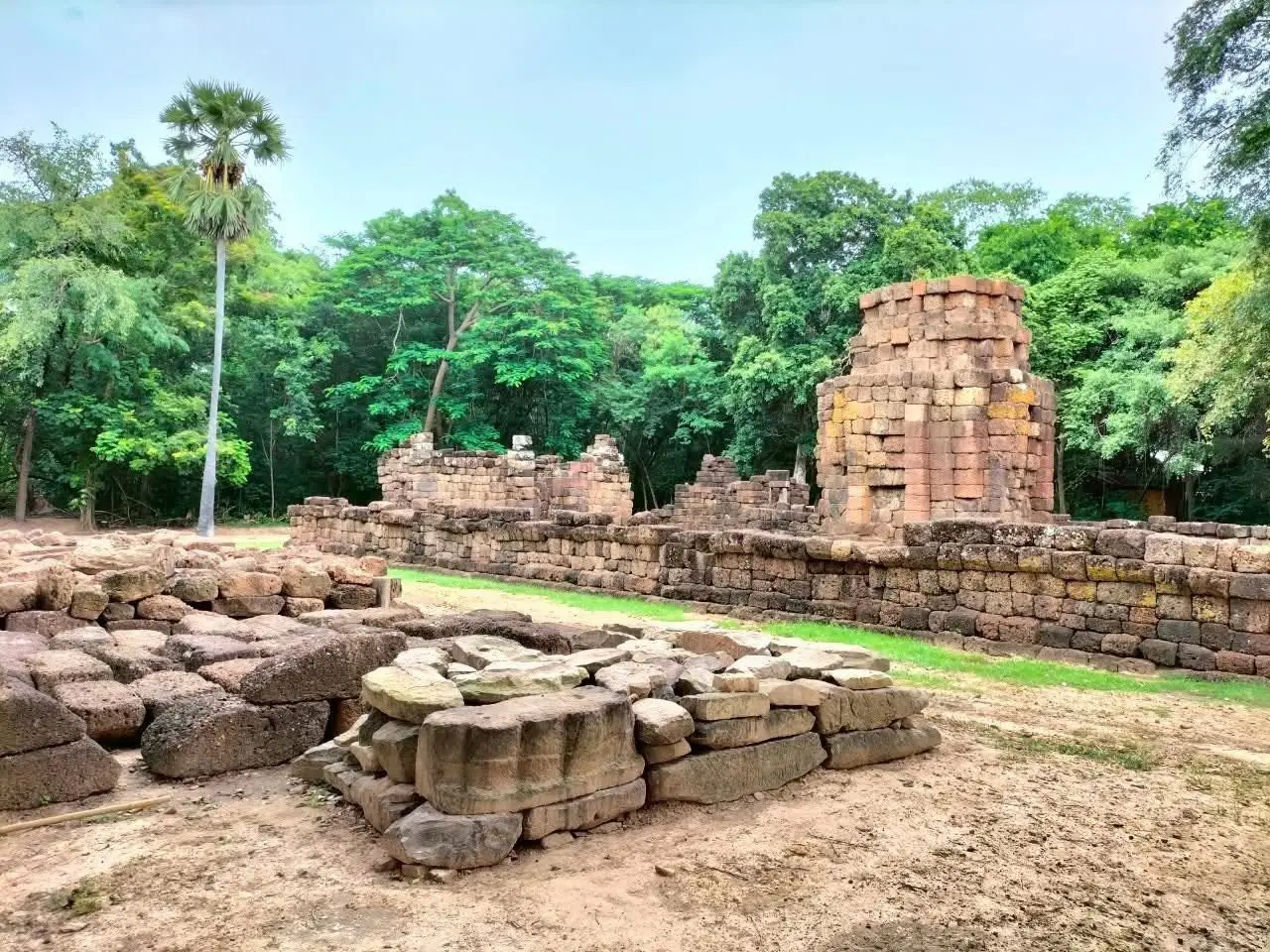
The appeal of Prasat Chom Phra lies in its compact yet clearly readable layout. It is not a large, fully restored monument, but its essential components remain visible enough to explain the function of an Arokayasala. The buildings were constructed mainly from laterite with sandstone elements and face east, following a pattern commonly found in Khmer religious architecture. The site includes a main sanctuary, a bannalai or library-like structure, an enclosing wall, an entrance gateway, and an ancient pond outside the enclosure. These elements represent the standard layout of hospital sanctuaries built under the influence of the Bayon period.
The word Arokayasala refers to a place associated with freedom from illness. In the context of King Jayavarman VII’s reign, it was a sanctuary connected with healing, Buddhist devotion, and public welfare. These hospital sanctuaries were not ordinary medical buildings in the modern sense. They were sacred spaces where healing was understood through a combination of religious faith, ritual practice, medicinal knowledge, and royal patronage. At Prasat Chom Phra, the surviving laterite structures allow travelers to understand how religion and healthcare were once integrated in ancient Southeast Asia.
The main sanctuary is the central structure of Prasat Chom Phra. Built of laterite, it has an indented square plan and faces east. The approximate size of the central tower is 5 m by 5 m, with a projecting front porch on the eastern side. Although parts of the structure have deteriorated over time, the core form of the sanctuary remains clearly visible. Visitors walking around the main tower can observe the base, wall lines, recessed corners, and front porch. The structure is visually simple, but its proportions and laterite construction reveal the character of Khmer architecture from the Bayon period.
In front of the main sanctuary is the bannalai, a rectangular building located toward the southeastern side of the main tower. Bannaluai-type structures are commonly found in Khmer religious complexes and are often associated with ritual use. At Prasat Chom Phra, this building helps complete the sacred layout. When viewed together with the main sanctuary and the entrance gateway, it becomes clear that the buildings were arranged according to a deliberate spatial order, not placed randomly. The relationship between the tower, the bannalai, and the enclosing wall gives the site its architectural meaning.
The enclosing wall defines the sacred zone of the sanctuary. It separates the inner ritual area from the surrounding temple grounds. The entrance gateway stands on the eastern side, marking the main approach into the ancient complex. Walking through this gateway is a useful way to experience the monument’s original spatial sequence. Visitors move from the outer area into the enclosed sacred precinct and toward the central sanctuary. This sense of progression is one of the key features that makes Khmer religious architecture so meaningful.
Outside the enclosure to the northeast is an ancient pond, another important element of the Arokayasala layout. Water played both practical and symbolic roles in ancient religious landscapes. It could be connected with purity, ritual use, healing, and community life. When considered together with the sanctuary, bannalai, enclosing wall, and gateway, the pond shows that Prasat Chom Phra was planned as a complete sacred landscape rather than a single isolated structure.
Important artifacts found at Prasat Chom Phra include the head of Avalokitesvara, an image of Vajrasattva, a sandstone sculpture of four-armed Avalokitesvara seated on a stone slab, a female deity figure, a sandstone Naga-protected Buddha image, and a sandstone inscription slab. These objects confirm the site’s connection with Mahayana Buddhism and Bayon-style Khmer art. Avalokitesvara represents compassion, while Vajrasattva is associated with purity and spiritual power. Their presence fits the meaning of an ancient hospital sanctuary dedicated to healing and relief from suffering.
Bayon-style Khmer art flourished during the reign of King Jayavarman VII. It is closely associated with Mahayana Buddhism, compassion, and royal projects created for the benefit of people. Prasat Chom Phra therefore provides evidence of how Khmer political, religious, and cultural influence extended into the area that is now Surin Province. The monument connects the landscape of southern Isan with the wider Khmer world, ancient routes, local settlements, and Buddhist sacred architecture.
The setting of Prasat Chom Phra inside Wat Pa Prasat Chom Phra gives the site another layer of meaning. It is not separated from living religious life. Instead, it stands within an active Buddhist temple where monks, local residents, and visitors continue to use the area for merit-making and religious activities. This continuity between the ancient Mahayana sanctuary and the present-day Buddhist temple makes the place especially meaningful. Travelers encounter both archaeological heritage and a peaceful temple atmosphere at the same time.
Wat Pa Prasat Chom Phra is located at No. 373, Village No. 4, Ban Dong Bang, Chom Phra Subdistrict, Chom Phra District, Surin Province. The temple belongs to the Dhammayuttika Nikaya and covers a large area. It was established in 1937 and received its Wisungkhamsima boundary on November 15, 1987. Phra Khru Phawana Panyaphon, also known as Luang Pu Somphon, is an important monk connected with the temple’s administration. The temple area functions as a place for Buddhist practice, local merit-making, and the preservation of an ancient monument.
One of the first details visitors should notice is the laterite construction. Laterite is commonly used in Khmer architecture across northeastern Thailand. Its rough texture, reddish-brown color, and weathered surface give the monument a strong sense of age. The appearance of the material changes with light and moisture. Morning light reveals the surface texture clearly, while late afternoon light creates shadows that emphasize the walls, corners, and architectural mass of the sanctuary.
The current condition of Prasat Chom Phra still shows traces of deterioration. Some laterite blocks have fallen or were once covered by soil before archaeological survey and excavation. This incomplete condition does not reduce the value of the site. Instead, it allows visitors to see the passage of time and understand the challenges of conserving ancient monuments. For people interested in archaeology, the remaining stones, wall lines, building bases, and structural traces are important evidence for reading the original plan.
Prasat Chom Phra is best visited slowly. Travelers should begin at the eastern entrance, move into the enclosed area, then walk around the main sanctuary to observe the porch, walls, and base. After that, look toward the bannalai and the enclosing wall to understand how each architectural element works together. This approach helps visitors see the monument not simply as old ruins, but as a carefully planned hospital sanctuary associated with the reign of King Jayavarman VII.
For general travelers, Prasat Chom Phra is easy to visit because it is close to Chom Phra town and accessible from Surin city. A normal visit takes about 30–60 minutes, depending on how much time is spent reading the layout, taking photographs, and walking around the temple grounds. The site is peaceful, rarely crowded, and offers a clear historical story. It is especially suitable for travelers interested in Mahayana Buddhism, Bayon art, Khmer architecture, and the cultural routes of Surin Province.
For students, researchers, and cultural travelers, Prasat Chom Phra is a useful example of an ancient Khmer hospital sanctuary. Its key components remain identifiable, and the artifacts found here connect the site clearly with Mahayana Buddhist belief. The monument can be studied together with other Arokayasala sites in northeastern Thailand, including those in Phimai, Khon Kaen, and other parts of Surin. Comparing these sites helps explain the network of religious, administrative, and healing institutions created under King Jayavarman VII.
At the local level, Prasat Chom Phra is more than an archaeological site. It is part of the identity of Chom Phra District. The names of the district, the temple, and the ancient monument are closely connected in local memory. Around the temple are community areas, local restaurants, cafes, small resorts, and everyday life. This makes the site suitable for a short cultural trip that combines historical learning with the quiet atmosphere of a local district in Surin.
Visitors should behave respectfully because the site is both an ancient monument and an active temple. Dress modestly, keep noise low, avoid climbing on the ancient structures, and do not move or touch laterite blocks unnecessarily. Some parts of the monument are fragile. Responsible behavior helps protect Prasat Chom Phra while maintaining the peaceful atmosphere of the temple.
The best time to visit is in the morning or late afternoon, when the sunlight is softer and walking around the open-air monument is more comfortable. During the rainy season, the surroundings become green and fresh, but the ground can be slippery. During the cool season, the weather is pleasant and suitable for combining Prasat Chom Phra with other cultural attractions in Surin. In the hot season, travelers should bring drinking water, a hat, or an umbrella.
Getting There from Surin city is straightforward. Take Highway 214 on the Surin–Roi Et route toward Chom Phra District. The distance from Surin city is about 26 km. Once you enter Chom Phra town, turn toward Wat Pa Prasat Chom Phra and continue for about 1 km. Private cars, rental cars, and local hired vehicles are the most convenient options. Travelers using inter-district transport can get off in Chom Phra town and continue by local transport to the temple.
A practical 1-day itinerary can begin with Prasat Chom Phra in the morning. Spend about 1 hour exploring the sanctuary, then stop at a local restaurant or cafe in Chom Phra. After that, continue to nearby attractions such as Ban Tha Sawang Silk Weaving Village, Surin City Pillar Shrine, Wat Burapharam, or Surin National Museum. Travelers who want to focus on Khmer heritage can also combine Prasat Chom Phra with Prasat Mueang Thi or Prasat Sikhoraphum on a longer route.
There are several restaurants and cafes around Chom Phra District suitable for a break before or after visiting the monument. Hommali Factory Chom Phra is a cafe and local product space connected with Surin’s famous jasmine rice. Ban Vision JJ Cafe offers drinks and a casual resting atmosphere. PunThai Coffee has branches in the district, and local Thai restaurants are available near the town center. Travelers looking for more dining choices can return to Surin city, where there are many Thai restaurants, Isan restaurants, coffee shops, and hotel dining rooms.
Accommodation options are available in Chom Phra and nearby areas for travelers who prefer to stay close to the district. These include small resorts and homestays such as Sabai Dee Resort Chom Phra, Kan Kluay Resort, Tanya Bukraeng Resort, and Chiang Song Homestay. Travelers who prefer city convenience can stay in Surin city and visit Prasat Chom Phra as a half-day or full-day trip. Staying in Surin city is also practical for travelers planning to visit several attractions across the province.
The broader importance of Prasat Chom Phra is that it reveals southern Isan as a cultural zone shaped by Khmer heritage, Mahayana Buddhism, and living Thai communities. The monument is not as large as famous Khmer sites such as Phanom Rung or Prasat Sikhoraphum, but it has strong value as an Arokayasala with a recognizable layout. It reminds travelers that Surin is not only a province of elephants, silk, and local traditions. It is also a province with deep Buddhist and Khmer historical layers.
For travelers who love Khmer history, Prasat Chom Phra adds important context to the network of ancient monuments in Surin. Unlike Hindu temples or large ceremonial sanctuaries, this site represents a hospital sanctuary. Visiting it raises meaningful questions about why King Jayavarman VII built healing sanctuaries across his kingdom, and how religion, medicine, and governance were brought together in one architectural form.
The discovery of Avalokitesvara and Vajrasattva-related objects deepens the meaning of the site. Avalokitesvara is associated with compassion, an idea that fits naturally with a hospital sanctuary intended to relieve suffering. Vajrasattva is associated with purity and spiritual strength in Mahayana Buddhist belief. These artifacts provide direct religious context and make Prasat Chom Phra more than an architectural ruin. It is a sacred site with a clear spiritual identity.
Prasat Chom Phra also helps visitors understand the difference between fully restored monuments and sites that retain more of their original traces. Some travelers may see the monument as simple or incomplete, but this is part of its value. The exposed laterite, fallen blocks, and visible structural remains allow visitors to see how time, excavation, and conservation shape the present appearance of ancient sites.
The site is best experienced as a learning destination. Visitors should observe the 4 main components of the Arokayasala: the main sanctuary, the bannalai, the enclosing wall with entrance gateway, and the ancient pond. Then connect these architectural elements with the Mahayana Buddhist artifacts found at the site. Once this relationship is understood, standing among the laterite remains inside Wat Pa Prasat Chom Phra becomes far more meaningful than a simple sightseeing stop.
Geographically, Prasat Chom Phra is well positioned for travel within Surin. Chom Phra District lies north of Surin city and is connected by Highway 214. The site can be included in different travel plans: a city-based cultural route, a handicraft route to silk villages, or a Khmer heritage route linking several ancient monuments. This flexibility makes Prasat Chom Phra a practical destination for both Thai and international travelers.
For foreign visitors, Prasat Chom Phra offers a deeper view of Thailand beyond modern temples and famous tourist cities. It shows the influence of the Khmer Empire in present-day Thailand, the role of Bayon-style Mahayana Buddhism, and the ancient idea of a hospital sanctuary. Travelers interested in Angkor, Khmer heritage, Buddhist art, and Southeast Asian history will find this small site highly rewarding.
For photography, the most interesting angles are the eastern approach, the front of the main sanctuary, the relationship between the tower and the bannalai, and the enclosing wall that defines the sacred precinct. Visitors should photograph responsibly without climbing on the ancient structures. Wide shots of the layout, close details of laterite surfaces, and images of the surrounding temple atmosphere help show how past and present coexist at the site.
Prasat Chom Phra gives the phrase “travel in Surin” a deeper meaning. It is not only a place to see old stones, but a place to encounter a historical system of belief, healing, public welfare, sacred geography, and community memory. The visit does not require much time, yet it provides a rich understanding of how ancient Khmer culture shaped the region.
Because it is located inside Wat Pa Prasat Chom Phra, is free to enter, and can be reached easily from Surin city, Prasat Chom Phra deserves a place on any cultural travel route in Surin Province. For travelers interested in Arokayasala sites, laterite architecture, Bayon-style Khmer art, and Mahayana Buddhist history, this small but meaningful monument is one of the province’s most valuable historical stops.
| Name | Prasat Chom Phra |
| Location | Inside Wat Prasat Chom Phra / Wat Pa Prasat Chom Phra, Village No. 4, Ban Dong Bang, Chom Phra Subdistrict, Chom Phra District, Surin Province |
| Address | No. 373, Village No. 4, Ban Dong Bang, Chom Phra Subdistrict, Chom Phra District, Surin Province 32180, Thailand |
| Highlights | An Arokayasala from the reign of King Jayavarman VII, built with laterite and sandstone, facing east and retaining the key components of a Khmer hospital sanctuary |
| History | Early 18th Buddhist century, Bayon-style Khmer art, reign of King Jayavarman VII, associated with Mahayana Buddhism |
| Distinctive Features | Main sanctuary with an indented square plan, front porch, bannalai, enclosing wall, entrance gateway, and ancient pond outside the enclosure |
| Key Evidence | Head of Avalokitesvara, Vajrasattva image, four-armed Avalokitesvara sculpture, female deity figure, sandstone Naga-protected Buddha image, and sandstone inscription slab |
| Travel Information | From Surin city, take Highway 214 on the Surin–Roi Et route for about 26 km to Chom Phra District, then turn into Wat Pa Prasat Chom Phra for about 1 km |
| Current Status | Open daily as an ancient monument inside a temple area, with laterite remains still visible for study |
| Open Days | Daily |
| Opening Hours | No Specific Hours Stated |
| Fees | No Admission Fee |
| Facilities | Temple grounds, nearby parking area, walking space around the ancient monument, peaceful resting areas, and religious areas of the temple |
| Main Areas / Zones | Main sanctuary, bannalai, enclosing wall, eastern entrance gateway, ancient pond, and Wat Pa Prasat Chom Phra temple grounds |
| Monument Caretaker | Fine Arts Department, through the 10th Regional Office of Fine Arts, Nakhon Ratchasima, and Surin National Museum |
| Abbot / Temple Clergy | Phra Khru Phawana Panyaphon (Luang Pu Somphon) |
| Main Contact Number | Wat Pa Prasat Chom Phra, Tel. 044-581-121 Surin National Museum, Tel. 044-513-274 Surin Provincial Office of Buddhism, Tel. 044-514-607 to 8 |
| Nearby Tourist Attractions | 1. Ban Tha Sawang Silk Weaving Village, about 20 km 2. Surin City Pillar Shrine, about 27 km 3. Wat Burapharam Royal Temple, about 28 km 4. Surin National Museum, about 31 km 5. Phanom Sawai Forest Park, about 36 km |
| Nearby Restaurants | 1. Hommali Factory Chom Phra, about 1 km 2. Ban Vision JJ Cafe Chom Phra, about 1 km, Tel. 098-866-6456 3. PunThai Coffee Chom Phra Surin, about 2 km, Tel. 095-619-1213 4. PunThai Coffee Pathamanon Road Chom Phra, about 2 km, Tel. 065-520-6244 5. Chitangme Thai Food, about 2 km, Tel. 096-367-6466 |
| Nearby Accommodations | 1. Sabai Dee Resort Chom Phra, about 5 km, Tel. 044-581-455, 064-719-0988 2. Kan Kluay Resort, about 6 km, Tel. 080-172-9107 3. Tanya Bukraeng Resort, about 12 km 4. Chiang Song Homestay, about 20 km, Tel. 044-515-832 5. Martina Hotel Surin, about 29 km, Tel. 044-713-555, 044-713-655 |
Frequently Asked Questions (FAQ)
Q: Where is Prasat Chom Phra located?
A: Prasat Chom Phra is located inside Wat Prasat Chom Phra, also known as Wat Pa Prasat Chom Phra, in Village No. 4, Ban Dong Bang, Chom Phra Subdistrict, Chom Phra District, Surin Province.
Q: Is Prasat Chom Phra open every day?
A: Yes. Prasat Chom Phra is open daily, with no specific opening hours stated by the official sources.
Q: Is there an admission fee for Prasat Chom Phra?
A: No. There is no admission fee. Visitors can walk around the ancient monument inside the temple area without buying a ticket.
Q: Why is Prasat Chom Phra important?
A: Prasat Chom Phra is an Arokayasala from the reign of King Jayavarman VII, associated with Mahayana Buddhism and the ancient concept of a hospital sanctuary.
Q: What are the main architectural elements of Prasat Chom Phra?
A: The site includes a main sanctuary, bannalai, enclosing wall, entrance gateway, and ancient pond, which are the key elements of a Khmer Arokayasala.
Q: What important artifacts were found at Prasat Chom Phra?
A: Important finds include the head of Avalokitesvara, a Vajrasattva image, a four-armed Avalokitesvara sculpture, a female deity figure, a sandstone Naga-protected Buddha image, and a sandstone inscription slab.
Q: How do I travel from Surin city to Prasat Chom Phra?
A: Take Highway 214 on the Surin–Roi Et route toward Chom Phra District for about 26 km, then turn into Wat Pa Prasat Chom Phra for about 1 km.
Q: How long should I spend at Prasat Chom Phra?
A: Around 30–60 minutes is enough for walking around the monument, taking photographs, and studying the Arokayasala layout. Travelers who enjoy history may want to spend longer.
 Category: ●Art, Culture and Heritage
 Group: ●Historical Sites and Monuments
Last Update : 2 MonthAgo
 Last Update : 2 MonthAgo
 Click to Access the Navigation Map GPS
Prasat Chom Phra Map
Recommend
 Historical Sites and Monuments(11)
 Landmarks and Memorials(2)
 Art, Craft Centres, Tradition(5)
 Museums(1)
 Places of Worship
 Temple(15)
 Other Sacred Sites(1)
 Suburban Living
 Village, Community(9)
 Local Market(1)
 Nature and Wildlife
 National Parks and Marine Reserves(2)
 Mountain (Doi)(2)
 Dam, Reservoir, Lake(6)
 Waterfalls(1)
 River, Canal(2)
 Other natural attractions(4)
 Entertainment and Agricultural
 Farms, Parks and Ecotourism(2)


