
lovethailand home >Northeastern Travel Attractions >Surin Travel Attractions >Si Khora Phum >Ra Ngaeng > Prasat Sikhoraphum
TL;DR: Prasat Sikhoraphum is located at Ban Prasat, Ra-Ngaeng Subdistrict, Sikhoraphum District, Surin Province, open Daily, hours 07.00 – 18.00.
Prasat Sikhoraphum
Open Days: Daily
Opening Hours: 07.00 – 18.00
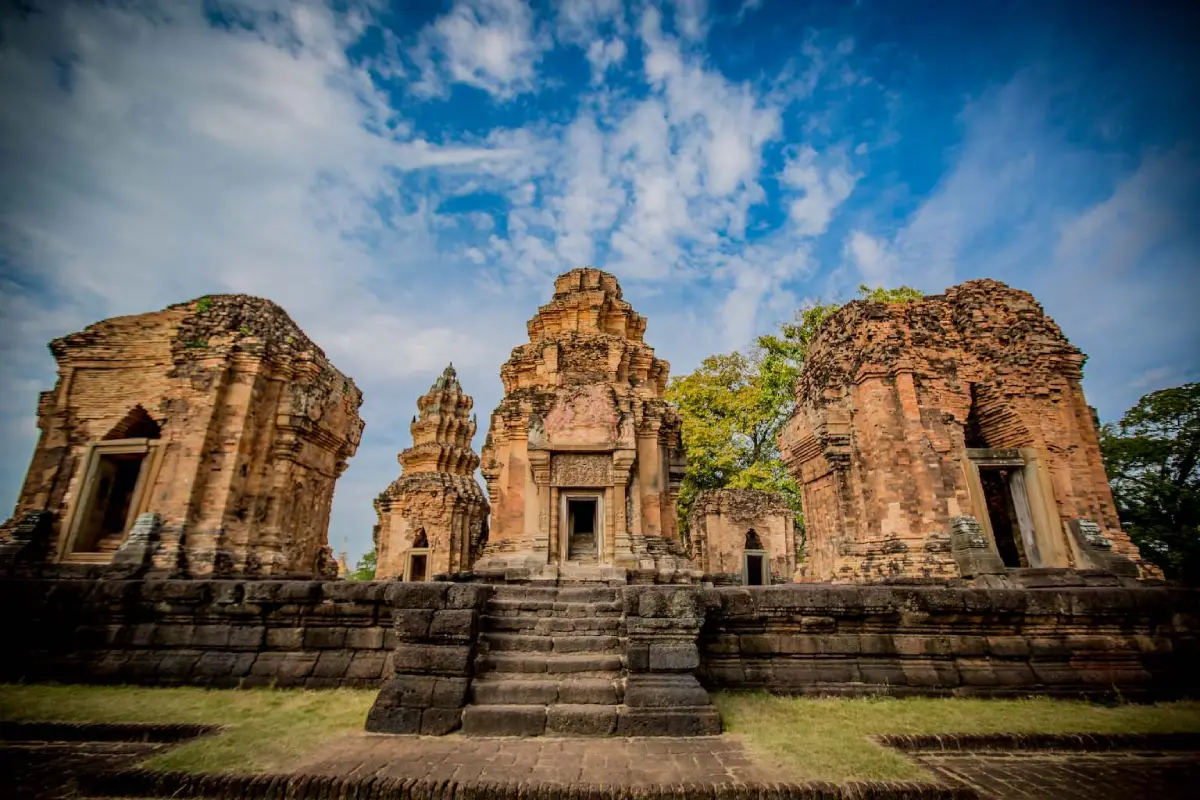
Prasat Sikhoraphum in Surin Province is one of the most important and visually impressive Khmer monuments in southern Isan. It is located in Ban Prasat, Ra-Ngaeng Subdistrict, Sikhoraphum District, about 34–36 km from Surin city along Highway 226 on the Surin–Si Sa Ket route, and about 1 km from Sikhoraphum District Office. The monument consists of 5 brick towers standing on the same laterite base. The central tower is the main sanctuary, while 4 smaller towers stand at the corners around it. The entire complex faces east and is surrounded by a U-shaped moat. Today, Prasat Sikhoraphum is open daily, charges an admission fee, and remains one of the best places in Surin for travelers who want to understand Khmer architecture, Hindu belief, and the cultural landscape of southern Isan.
The outstanding feature of Prasat Sikhoraphum is the combination of a 5-tower layout and exceptionally refined sandstone carving. The most celebrated detail is the lintel of Shiva Nataraja above the eastern entrance of the central tower. This carved lintel is regarded as one of the finest depictions of Shiva’s cosmic dance found in Thailand. It is not merely decorative. It is the central religious image of the sanctuary, expressing the Shaivite Hindu belief in Shiva as the supreme deity. For this reason, Prasat Sikhoraphum is valuable not only as architecture, but also as sculpture, religious history, and cultural memory.
The monument dates to around the middle of the 17th Buddhist century and belongs to the Khmer artistic phase between the Baphuon and Angkor Wat styles. This can be seen in the lintels, colonnettes, crab-claw motifs, guardian figures, female deities, and carved sandstone elements that decorate the brick towers. The combination of brick, sandstone, and laterite is characteristic of many Khmer monuments in present-day Thailand. Brick was used for the main bodies of the towers, laterite for the supporting base, and sandstone for the parts that required detailed carving, such as lintels, doorframes, colonnettes, and antefixes.
The layout of Prasat Sikhoraphum reflects the Khmer concept of the sacred universe. The central tower represents Mount Meru, the cosmic mountain at the center of the universe, while the 4 surrounding towers strengthen the symbolic arrangement of the sacred landscape. A 5-tower composition on a single base is not common among Khmer monuments in Thailand, which gives Sikhoraphum a distinct identity. The plan allows visitors to understand that the sanctuary was not built as a random group of structures, but as a carefully organized sacred space shaped by cosmology, ritual, and architectural order.
The central tower has an indented square plan and faces east. It has only one real entrance, on the eastern side, while the other sides were treated as closed walls or false doors. The tower is built mainly of brick, with sandstone used for the doorway and carved decorative elements. Although parts of the upper structure have changed over time, the main body of the tower still rises prominently above the laterite base. Its form and details clearly reveal the workmanship of Khmer craftsmen during the transition from Baphuon to Angkor Wat art.
The lintel above the main eastern entrance is the artistic heart of the site. It depicts Shiva in the Nataraja form, dancing above a base and above a kala or kirtimukha face. Three hamsa birds support the upper composition. Around Shiva are important Hindu deities including Ganesha, Brahma, Vishnu, and Parvati or Uma. This arrangement turns the lintel into a compact image of the Hindu divine universe. Shiva appears not simply as one god among many, but as the central cosmic force whose dance expresses creation, preservation, destruction, concealment, and grace.
The beauty of the Shiva Nataraja lintel lies in its balance between power and refinement. Shiva’s dancing body conveys movement and divine energy, while the surrounding figures, garlands, kala motif, hamsa birds, and foliage patterns are arranged in a disciplined and harmonious composition. The carving shows both technical mastery and deep religious understanding. Visitors should take time to observe this lintel closely, as it is the most important artistic feature of Prasat Sikhoraphum.
The decorated doorposts of the central tower also deserve close attention. They include carved female deities, crab-claw motifs, and guardian figures. The female deity carvings display the elegance of Khmer sculpture, while the guardians mark the entrance as a threshold between the ordinary world and the sacred interior. The crab-claw motifs help connect the monument with the Angkor Wat artistic phase. A careful look at the eastern doorway reveals how the base, doorframe, lintel, guardian figures, and upper tower work together as one complete sacred façade.
The 4 surrounding towers stand at the corners of the same base. Although some parts are damaged, they remain essential for reading the complete plan of the monument. Each tower follows a similar architectural logic: brick construction, sandstone decorative elements, and an eastern-facing entrance. The corner towers give the sanctuary a strong visual rhythm when viewed from the front. Together with the central tower, they create a balanced sacred composition that distinguishes Prasat Sikhoraphum from smaller single-tower Khmer sanctuaries in Surin.
Additional lintels from the surrounding towers depict episodes from the Krishna avatar. These objects are now preserved at Surin National Museum. One of the major scenes shows Krishna fighting an elephant and a mythical lion-like creature. These carvings reveal the presence of Vaishnavite narrative imagery within a sanctuary dominated by Shaivite meaning. The result is a sacred space where multiple Hindu mythological themes appear together, while Shiva remains the principal focus of devotion.
The U-shaped moat in front of and around the monument is an important part of the ancient landscape. In Khmer sacred architecture, water is closely connected with purity, fertility, boundary, and cosmic order. The moat helps define the sacred area around the towers and creates a calm visual setting for the brick structures. When seen together with the open space, trees, water, and surrounding community, Prasat Sikhoraphum becomes more than a group of ancient towers. It becomes a living cultural landscape.
In later history, Prasat Sikhoraphum was adapted into a Buddhist site during the late Ayutthaya period, around the 22nd–23rd Buddhist centuries. Evidence includes inscriptions in Tham Isan script, Thai, and Pali, connected with restoration by senior monks and local leaders. This transformation shows the continuity of sacred space from Hindu worship to Buddhism. Sikhoraphum therefore tells a layered story: first as a Khmer Hindu Shaivite sanctuary, and later as a Buddhist sacred place in the local Isan context.
The older name of the site is linked with Ban Ra-Ngaeng and Ban Prasat, the community surrounding the monument. This area has long been part of a Thai-Khmer and Lao-Isan cultural zone. Because the monument stands close to the community, it remains part of local identity rather than an isolated archaeological ruin. The name Ban Prasat itself shows how deeply the monument is embedded in local memory. Prasat Sikhoraphum functions as a landmark of history, tourism, and community pride.
The Fine Arts Department restored and improved the landscape of Prasat Sikhoraphum between 1985 and 1991. Important artifacts such as Krishna lintels, antefixes, and a model of the monument are preserved and displayed at Surin National Museum. This allows fragile objects to be protected while the monument itself continues to serve as an open-air learning site. Visitors can therefore combine an on-site visit with a museum visit in Surin city to understand the monument more completely.
A good visit should begin from the east, the original entrance side. From here, visitors can see the entire group of 5 towers on one base. After that, walk closer to the central tower to study the female deity carvings, guardian figures, doorposts, and the Shiva Nataraja lintel. Then walk around the base to observe the 4 surrounding towers, the moat, and the landscape around the sanctuary. This route gives a complete view of both the overall plan and the sculptural details.
For photography, early morning and late afternoon provide the best light. The reddish brick and sandstone surfaces appear more dimensional under soft light, and the carved details on the lintel and doorposts become easier to see. The eastern front is the most important viewpoint because it captures the central tower and the surrounding towers together. Side views help show the laterite base, moat, and height of the central tower in relation to the smaller towers. Visitors should photograph responsibly and avoid climbing on the ancient structures.
Prasat Sikhoraphum is best experienced slowly. A basic visit takes around 45–60 minutes, but travelers interested in Khmer art should allow 1–2 hours. The site rewards careful observation. Its value lies not only in the 5-tower layout, but also in the fine details of the carvings, the sacred meaning of the Shiva Nataraja image, the water landscape, and the later Buddhist adaptation visible in the site’s history.
Getting There from Surin city is straightforward. Take Highway 226 on the Surin–Si Sa Ket route for about 34–36 km to Sikhoraphum District, then continue to Ban Prasat in Ra-Ngaeng Subdistrict, about 1 km from the district office. The route is suitable for private cars, rental cars, and local hired vehicles. Travelers using the train can get off at Sikhoraphum Railway Station and continue by local transport, as the monument is located close to the district town and community area.
A practical half-day trip can begin in Surin city in the morning, followed by a visit to Prasat Sikhoraphum for about 1 hour. Afterward, travelers can stop for local food or buy local sweets in Sikhoraphum District before returning to Surin city for Wat Burapharam, Surin City Pillar Shrine, or Surin National Museum. Travelers who want a Khmer heritage route can continue to Prasat Mueang Thi or other monuments in Surin depending on available time.
Sikhoraphum District has local restaurants, cafes, noodle shops, som tam restaurants, coffee shops, and local sweet shops suitable for a break before or after visiting the monument. For more dining and accommodation options, Surin city offers a wider range of hotels, restaurants, transport services, and travel facilities. This makes Prasat Sikhoraphum easy to include in both short and full-day cultural itineraries.
For accommodation, travelers who want to stay near the site can choose options in Sikhoraphum District, such as Jamjuree Resort. Those who prefer more convenience can stay in Surin city and visit Prasat Sikhoraphum as a day trip. The route from Surin city to the monument is direct and convenient, making it suitable for both Thai and international travelers who want to explore Khmer heritage without a difficult journey.
Visitors should treat Prasat Sikhoraphum with respect. Dress appropriately, do not climb on the towers, do not touch or move carved stones, do not write on the monument, and do not litter. Every brick, sandstone block, and carved surface is part of the historical evidence of the site. Responsible travel helps preserve this monument for future generations.
For international visitors, Prasat Sikhoraphum is one of the clearest places in Thailand to understand Khmer heritage outside Cambodia. The site presents a complete set of themes: Khmer sanctuary, five brick towers, Shiva Nataraja lintel, Baphuon and Angkor Wat styles, Hindu Shaivism, later Buddhist adaptation, moat landscape, and a living local community. It is especially rewarding for travelers interested in Angkor, Hindu mythology, Southeast Asian art, and the cultural history of southern Isan.
Compared with other Khmer monuments in Surin, Prasat Sikhoraphum stands out for its 5-tower plan and Shiva Nataraja lintel. It differs from Prasat Ban Phluang, which is known for small-scale refined sandstone carving; from Prasat Ban Phlai, which has 3 brick towers; and from Prasat Mueang Thi, which is an Arokayasala connected with Mahayana Buddhism. Sikhoraphum therefore plays a central role in the Khmer heritage route of Surin Province.
Prasat Sikhoraphum brings together architecture, mythology, water, community, and history in one place. Its 5 brick towers, laterite base, sandstone carvings, Shiva Nataraja lintel, Krishna-related lintels, guardian figures, and U-shaped moat create a rich and memorable cultural experience. For travelers who take time to observe the details, this monument becomes one of the most meaningful historical sites in Surin Province.
| Name | Prasat Sikhoraphum |
| Location | Ban Prasat, Ra-Ngaeng Subdistrict, Sikhoraphum District, Surin Province |
| Address | Ban Prasat, Ra-Ngaeng Subdistrict, Sikhoraphum District, Surin Province 32110, Thailand |
| Highlights | Five brick towers on one laterite base, the Shiva Nataraja lintel on the central tower, female deity carvings, guardian figures, and a U-shaped moat around the monument |
| History | Built around the middle of the 17th Buddhist century in the Khmer Baphuon-to-Angkor Wat artistic phase; originally a Hindu Shaivite sanctuary and later adapted into a Buddhist sacred site during the late Ayutthaya period |
| Distinctive Features | Central tower surrounded by 4 corner towers on a shared base, all facing east, with one main entrance and sandstone carving on key architectural elements |
| Key Evidence | Shiva Nataraja lintel, Ganesha, Brahma, Vishnu, Uma, female deity doorpost carvings, guardian figures, Krishna avatar lintels, antefixes, and Tham Isan inscriptions in Thai and Pali |
| Travel Information | From Surin city, take Highway 226 on the Surin–Si Sa Ket route for about 34–36 km to Sikhoraphum District, then continue to Ban Prasat in Ra-Ngaeng Subdistrict, about 1 km from the district office |
| Current Status | Open daily as an important ancient monument of Surin Province under the care of the Fine Arts Department |
| Open Days | Daily |
| Opening Hours | 07.00 – 18.00 |
| Fees | Thai Visitors 10 Baht / Foreign Visitors 50 Baht |
| Facilities | Walking area around the monument, front courtyard, photo spots, moat landscape, ticket area, and easy access from Sikhoraphum community |
| Main Areas / Zones | Central tower, 4 surrounding towers, laterite base, eastern entrance, Shiva Nataraja lintel, decorated doorposts, guardian figures, U-shaped moat, and surrounding ancient monument area |
| Monument Caretaker | Fine Arts Department through the 10th Regional Office of Fine Arts, Nakhon Ratchasima, and Surin National Museum, together with Sikhoraphum Subdistrict Municipality and Ban Prasat community |
| Main Contact Number | Surin National Museum, Tel. 044-513-274 10th Regional Office of Fine Arts, Nakhon Ratchasima, Tel. 044-471-518, 044-481-024 Sikhoraphum Subdistrict Municipality, Tel. 044-561-243 |
| Nearby Tourist Attractions | 1. Prasat Mueang Thi, about 19 km 2. Surin National Museum, about 38 km 3. Wat Burapharam Royal Temple, about 36 km 4. Surin City Pillar Shrine, about 36 km 5. Ban Tha Sawang Silk Weaving Village, about 41 km 6. Prasat Ban Phlai, about 45 km |
| Nearby Restaurants | 1. Kalamae Sikhoraphum Ton Tamrap 5 Prasat, about 1 km, Tel. 044-561-285, 044-065-244 2. Phu Pha Boat Noodles Sikhoraphum, about 2 km, Tel. 093-343-3246 3. Tummour PTT Sikhoraphum, about 2 km, Tel. 089-844-4319 4. Home Hug Coffee & Steak, about 3 km, Tel. 044-560-189 5. Cream Mu Kratha Sikhoraphum, about 5 km, Tel. 092-836-5198 |
| Nearby Accommodations | 1. Jamjuree Resort Sikhoraphum, about 2 km, Tel. 044-560-289, 089-190-5156 2. Arena Hotel Surin, about 31 km, Tel. 044-519-555, 063-356-2455 3. Martina Hotel Surin, about 37 km, Tel. 044-713-555, 044-713-655 4. Thongtarin Hotel Surin, about 36 km, Tel. 085-300-8858, 044-514-281 ext. 8 5. The Wood Surin, about 36 km, Tel. 063-023-7999 |
Frequently Asked Questions (FAQ)
Q: Where is Prasat Sikhoraphum located?
A: Prasat Sikhoraphum is located in Ban Prasat, Ra-Ngaeng Subdistrict, Sikhoraphum District, Surin Province, about 34–36 km from Surin city.
Q: Is Prasat Sikhoraphum open every day?
A: Yes. Prasat Sikhoraphum is open daily from 07.00 to 18.00.
Q: Is there an admission fee for Prasat Sikhoraphum?
A: Yes. The admission fee is 10 baht for Thai visitors and 50 baht for foreign visitors.
Q: What is the main highlight of Prasat Sikhoraphum?
A: The main highlight is the group of 5 brick towers on one base and the Shiva Nataraja lintel on the central tower, one of the finest Khmer sandstone carvings in Thailand.
Q: What religion was Prasat Sikhoraphum originally built for?
A: It was originally built as a Hindu Shaivite sanctuary dedicated to Shiva, and was later adapted into a Buddhist sacred site during the late Ayutthaya period.
Q: What artistic period does Prasat Sikhoraphum belong to?
A: The monument belongs to the Khmer Baphuon-to-Angkor Wat artistic phase and dates to around the middle of the 17th Buddhist century.
Q: How do I travel from Surin city to Prasat Sikhoraphum?
A: Take Highway 226 on the Surin–Si Sa Ket route for about 34–36 km to Sikhoraphum District, then continue to Ban Prasat in Ra-Ngaeng Subdistrict.
Q: How long should I spend at Prasat Sikhoraphum?
A: Around 1–2 hours is suitable for walking around the 5 towers, studying the Shiva Nataraja lintel, viewing the moat, and photographing the main architectural details.
 Category: ●Art, Culture and Heritage
 Group: ●Historical Sites and Monuments
Last Update : 2 MonthAgo
 Last Update : 2 MonthAgo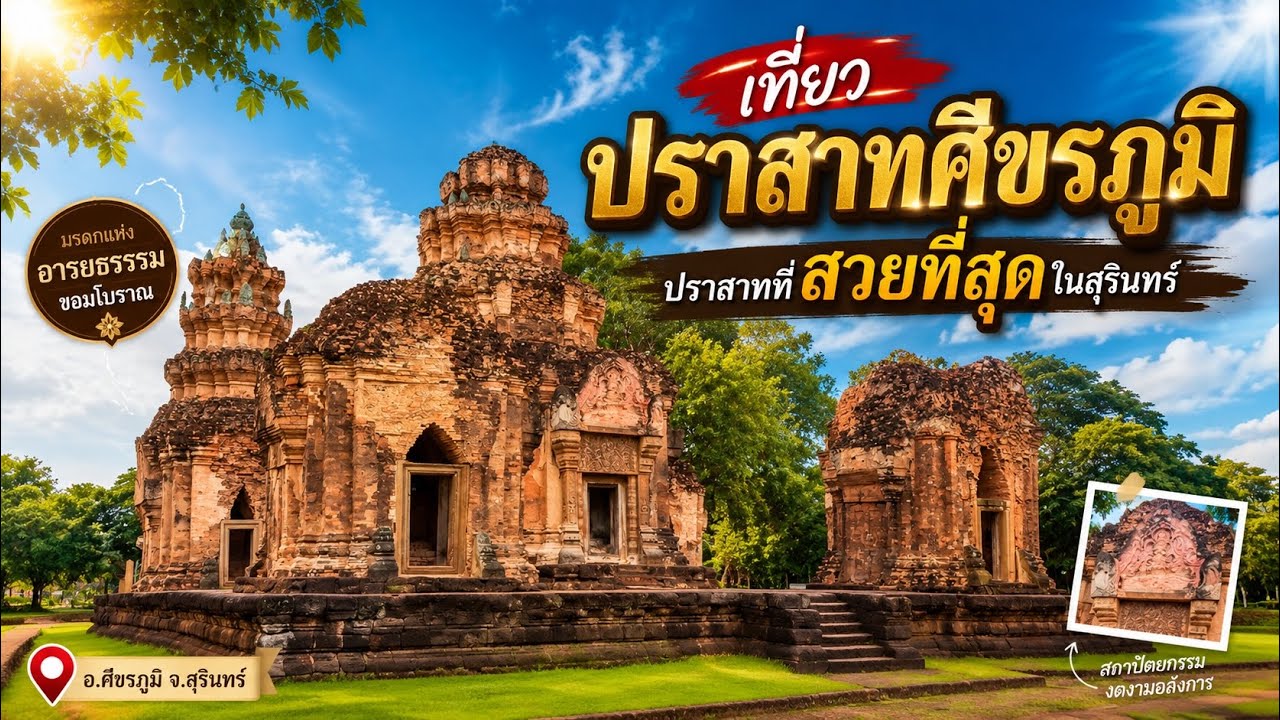
 Click to Access the Navigation Map GPS
Prasat Sikhoraphum Map
Gellery
Recommend
 Historical Sites and Monuments(11)
 Landmarks and Memorials(2)
 Art, Craft Centres, Tradition(5)
 Museums(1)
 Places of Worship
 Temple(15)
 Other Sacred Sites(1)
 Suburban Living
 Village, Community(9)
 Local Market(1)
 Nature and Wildlife
 National Parks and Marine Reserves(2)
 Mountain (Doi)(2)
 Dam, Reservoir, Lake(6)
 Waterfalls(1)
 River, Canal(2)
 Other natural attractions(4)
 Entertainment and Agricultural
 Animal camps and shows(1)
 Farms, Parks and Ecotourism(2)
 Travel Articles, Recipes
 Travel Review, Food Review(1)


