
lovethailand home >Northeastern Travel Attractions >Surin Travel Attractions >Prasat >Chuea Phloeng > Phanom Sawai Forest Park
TL;DR: Phanom Sawai Forest Park is located at Na Bua Subdistrict, Mueang Surin District, Surin Province, Thailand, open Daily, hours 08.30 – 16.30.
Phanom Sawai Forest Park
Open Days: Daily
Opening Hours: 08.30 – 16.30
Phanom Sawai Forest Park in Surin Province is one of the most meaningful nature-and-faith destinations in Thailand’s lower northeastern region. Located around Na Bua Subdistrict in Mueang Surin District and connected with nearby areas toward Prasat District, the forest park lies within the protected Khao Sawai forest area. Its identity comes from a cluster of 3 small hills rising clearly above the flat rice-growing landscape of Surin, together with dry dipterocarp forest, ancient rock surfaces, sacred Buddhist sites, Khmer cultural traces, local legends, and the annual Khao Sawai climbing tradition held on the first waxing moon day of the fifth lunar month.
Phanom Sawai Forest Park is suitable for travelers who want to experience Surin beyond the usual city route. In one visit, travelers can pay respect to Phra Phuttha Surin Mongkhon, walk along the stairway lined with merit bells, visit sacred footprints, see memorial structures connected with Luang Pu Dul Atulo, explore the remaining traces of Prasat Phanom Sawai, and enjoy a quiet forest atmosphere that reflects the natural landscape of southern Isan. The park is only about 20 – 22 km from downtown Surin, making it practical for a half-day cultural and nature trip.
The name “Phanom Sawai” is closely tied to local language and identity. “Phanom” means mountain, while “Sawai” means mango in the local language of Surin. Together, the name refers to a mountain associated with mango trees or Khao Sawai, as local people call it. The area consists of 3 small connected hills: Phanom Proh, also known as the male hill; Phanom Srai, also known as the female hill; and Phanom Krol, also known as the enclosure hill. Each hill carries both geographical and spiritual significance, and together they form one of the most respected sacred landscapes in Surin Province.
The landscape of Phanom Sawai is striking because the hills stand independently on a largely flat plain. The landform is linked with an extinct volcanic past, which explains the presence of scattered rock platforms and stone surfaces across the area. The soil is shallow and lateritic in many places, creating conditions suitable for dry dipterocarp forest rather than dense evergreen forest. This gives the park an open woodland character, where visitors can see paths, hill slopes, shrines, stairways, and viewing points through the trees.
The vegetation is dominated by dry dipterocarp forest. Native tree species include teng, rang, tio, taew, krad, daeng, chaiyaphruek, makham pom, and kwao, with some medium-sized trees growing in more sheltered areas between the hills. From February to April, the local tree known as mak mo or “at chroot” in the Khmer-influenced local dialect flowers across parts of the natural forest, adding seasonal interest for visitors who enjoy observing local plants.
Wildlife in the park consists mainly of small mammals, reptiles, and birds. Squirrels, tree shrews, wild rabbits, lizards, geckos, kingfishers, buttonquails, waterhens, coucals, magpie-robins, doves, common tailorbirds, mynas, ducks, and hawks can be found in the surrounding habitat. The forest is not a wilderness trekking destination in the dramatic sense, but it is a valuable learning site for travelers who want to understand dry dipterocarp ecology close to the city of Surin.
The forest park was officially established by the Royal Forest Department on 22 June 1984 within the Khao Sawai National Reserved Forest. This formal status helped protect a place that had already been important to local communities for generations. Today, Phanom Sawai functions as a conservation area, a public recreation site, a Buddhist pilgrimage route, and a cultural landmark of Surin. Its value lies in the way forest conservation, local devotion, and regional history coexist in the same landscape.
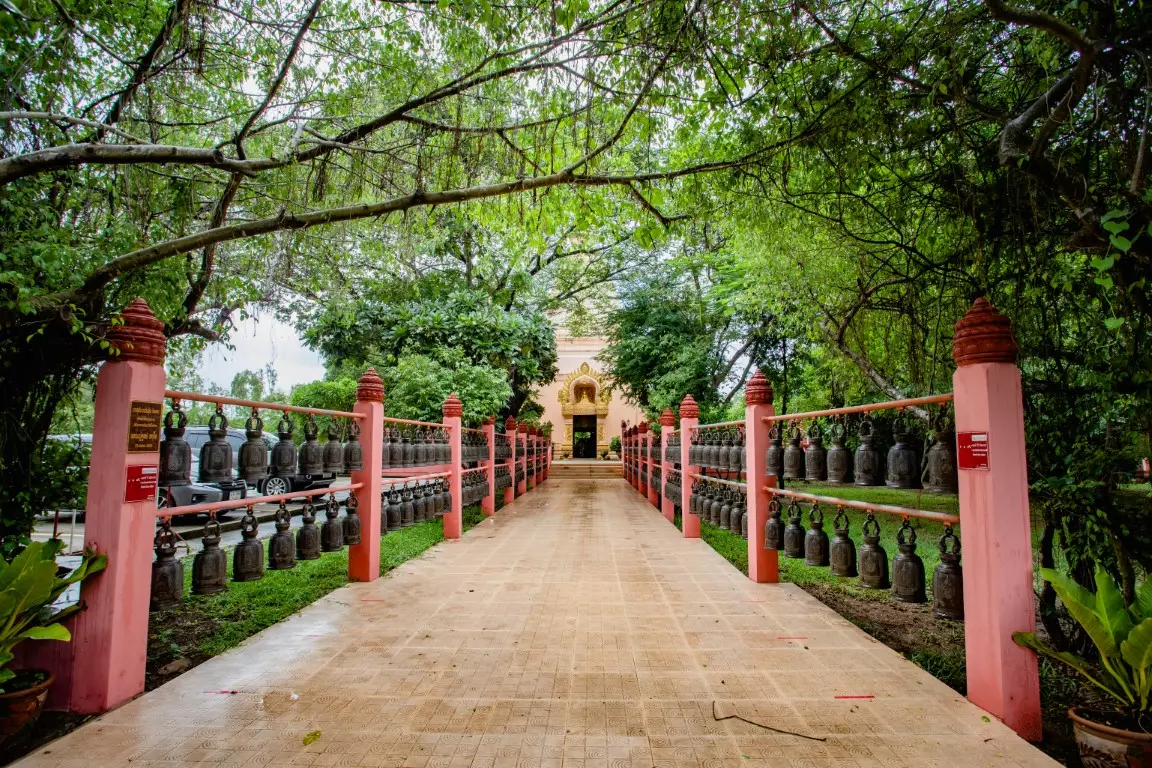
Phanom Proh, the male hill, is one of the most important points in the forest park because it is home to Phra Phuttha Surin Mongkhon, the prominent Buddha image that stands as a major spiritual symbol of the area. The route leading up to the hill includes stairways and rows of bells. Visitors often ring the bells while walking upward as an act of merit-making and blessing. The sound of bells echoing through the hillside has become one of the most memorable experiences of visiting Phanom Sawai.
Phanom Srai, the female hill, contains additional Buddhist images and sacred points, while Phanom Krol, the enclosure hill, is connected with Sala Atthamuk, a pavilion built to enshrine a replica of the Buddha’s footprint. The area is also associated with a stupa containing the relics of Luang Pu Dul Atulo, one of the highly respected meditation monks of Surin and northeastern Thailand. Moving between these hills gives visitors a layered experience of forest, pilgrimage, local history, and Buddhist devotion.
Beyond the large Buddha image and sacred footprint, Phanom Sawai is home to several other revered sites, including the black Buddha image, the memorial area of Luang Pu Suan, Prasat Phanom Sawai, the Guanyin shrine, the sacred stone turtle, the sacred pond, and a chedi connected with the eighth ruler of Surin. These places make the forest park more than a natural attraction. It is a living sacred geography shaped by Buddhism, local beliefs, Khmer cultural memory, and the civic identity of Surin Province.
Prasat Phanom Sawai, also known as Prasat Sonchai, adds an important historical layer to the forest park. Only limited remains are visible today, including laterite foundation traces, laterite blocks, brick fragments, and accounts of ancient objects discovered in the surrounding area. Reported finds include a sandstone Ganesha image, bronze objects, glazed brown jars, and other artifacts associated with Khmer cultural influence. These remains show that Phanom Sawai was not only a religious mountain in recent centuries but also part of a much older sacred and cultural landscape.
The annual Khao Sawai climbing tradition is the clearest expression of the park’s continuing role in local life. Held every year on the first waxing moon day of the fifth lunar month, the event brings local residents, pilgrims, officials, and travelers together to climb the hill, pay respect to sacred objects, make merit, and take part in cultural activities. The event normally includes ritual offerings, processions, local performances, and community participation. For foreign travelers interested in living traditions rather than static monuments, this is one of Surin’s most meaningful cultural experiences.
In local belief, climbing Khao Sawai is not simply a physical activity. It is a journey of blessing. Ringing the bells along the stairway symbolizes auspicious sound and good reputation spreading far and wide. Many visitors walk slowly, ring the bells respectfully, and make a personal wish before continuing toward the higher sacred points. This combination of movement, sound, prayer, and landscape gives Phanom Sawai a powerful atmosphere that is different from ordinary sightseeing stops.
For nature-oriented travelers, Phanom Sawai offers a calm and accessible forest experience. It is not a high mountain, but its isolated position above the surrounding plains creates wide views and a strong sense of place. During clear weather, the viewpoint near the rear side of Phra Phuttha Surin Mongkhon allows visitors to look out over the surrounding landscape, and local descriptions often connect the view with the broader line of the Phanom Dong Rak range. The best time for walking and photography is in the morning or late afternoon when the heat is lower and the light is softer.
The local climate has 3 clear seasons. The rainy season runs from June to November and brings greener forest conditions. The cool season from December to February is the most comfortable period for walking. The hot season from March to May is warmer but is also linked with the timing of the annual Khao Sawai tradition and the flowering season of some local plants. Travelers who want a quieter visit should avoid the central hours of the day, while those who want to see the traditional gathering should plan around the lunar calendar.
Facilities in the area include an access road, parking areas, stairways, walking paths, resting pavilions, worship points, bell-lined routes, and viewpoints. Because the park contains active sacred places, visitors should dress modestly and behave respectfully. Comfortable walking shoes are recommended. Travelers should bring drinking water, avoid loud behavior near worship areas, and avoid disturbing plants, wildlife, or religious objects. During the annual festival, visitors should allow extra travel time because the area becomes busier than usual.
Getting There is easiest by private car, rental car, or hired local transport from downtown Surin. From the city, take Highway 214 on the Surin – Prasat route for about 14 – 15 km, then turn toward the Ban Ka-nop – Ban Sawai route for another 6 – 7 km to reach the forest park. The total distance from central Surin is around 20 – 22 km. The uphill road is paved but relatively small, so careful driving is recommended, especially during busy festival periods or after rain.
A practical half-day itinerary begins in the morning from Surin city, followed by a visit to Phra Phuttha Surin Mongkhon, the bell stairway, Sala Atthamuk, the Buddha’s footprint replica, Luang Pu Dul Atulo’s memorial stupa, Prasat Phanom Sawai, and the surrounding dry dipterocarp forest. After returning to the city, travelers can continue to Surin National Museum, Wat Burapharam, the Phraya Surin Phakdi Si Narong Changwang Monument, or Huai Saneng Reservoir. Those with more time can extend the route toward Prasat Ban Phlai and other cultural sites in Prasat District.
Admission fees are applied for visitors and vehicles. Thai adults pay 20 baht, Thai children pay 10 baht, foreign adults pay 100 baht, and foreign children pay 50 baht. Vehicle fees are 20 baht for motorcycles, 30 baht for four-wheel cars, 100 baht for six-wheel vehicles, and 200 baht for vehicles with more than six wheels and up to ten wheels. Visitors should carry small cash for convenience.
What makes Phanom Sawai Forest Park especially valuable is the completeness of the travel experience. It brings together forest ecology, extinct volcanic landform, Buddhist worship, Khmer archaeological traces, local seasonal plants, the identity of Surin, and a living annual tradition. For travelers who want to understand Surin in a deeper way, Phanom Sawai is not just a hill near the city; it is a sacred cultural landscape where nature, memory, and faith remain strongly connected.
| Name | Phanom Sawai Forest Park |
| Location | Na Bua Subdistrict, Mueang Surin District, Surin Province, Thailand |
| Address | Phanom Sawai Forest Park, Na Bua Subdistrict, Mueang Surin District, Surin 32000, Thailand |
| Highlights | Three sacred hills, Phra Phuttha Surin Mongkhon, merit bells, Buddha’s footprint replica, Luang Pu Dul Atulo memorial stupa, Prasat Phanom Sawai, and the annual Khao Sawai climbing tradition |
| History | Officially established as a forest park on 22 June 1984 within the Khao Sawai National Reserved Forest. The area also contains Khmer cultural traces around Prasat Phanom Sawai. |
| Name Origin | In the local language, phanom means mountain and sawai means mango. |
| Distinctive Features | A group of 3 small hills rising from the Surin plain, with old volcanic rock surfaces, dry dipterocarp forest, religious monuments, and sacred local landmarks. |
| Travel Information | From downtown Surin, take Highway 214 toward Prasat for about 14 – 15 km, then turn toward the Ban Ka-nop – Ban Sawai route for about 6 – 7 km. Total distance is around 20 – 22 km. |
| Current Status | Open to visitors and remains a major nature, religious, and cultural attraction in Surin Province. |
| Open Days | Daily |
| Opening Hours | 08.30 – 16.30 |
| Fees | Thai adult 20 baht Thai child 10 baht Foreign adult 100 baht Foreign child 50 baht Motorcycle 20 baht Four-wheel car 30 baht Six-wheel vehicle 100 baht More than six wheels and up to ten wheels 200 baht |
| Facilities | Access road, parking areas, walking paths, stairways, resting pavilions, worship points, bell route, and viewpoints |
| Main Areas / Zones | 1. Phanom Proh, or the male hill 2. Phanom Srai, or the female hill 3. Phanom Krol, or the enclosure hill 4. Phra Phuttha Surin Mongkhon 5. Merit bell route 6. Sala Atthamuk and Buddha’s footprint replica 7. Luang Pu Dul Atulo memorial stupa 8. Prasat Phanom Sawai 9. Guanyin shrine, sacred stone turtle, and sacred pond |
| Caretaker | Phanom Sawai Forest Park, under Thailand’s state forest and conservation administration |
| Main Contact Number | Tourism Authority of Thailand, Surin Office: 0 4451 4447-8 |
| Official Website / Official Page | Phanom Sawai Forest Park official page |
| Nearby Tourist Attractions | 1. Prasat Ban Phlai, about 4 km 2. Huai Saneng Reservoir, about 9 km 3. Surin National Museum, about 11 km 4. Phraya Surin Phakdi Si Narong Changwang Monument, about 18 km 5. Wat Burapharam Royal Monastery, about 18 km 6. Surin city market and downtown area, about 18 km |
| Nearby Restaurants | 1. Gon Khmer Naem Nueang Surin, about 16 km, Tel. 08 3385 5599, 08 6497 7958 2. Just a Little Surin, about 17 km, Tel. 064 789 8864 3. Craft Cafe, about 17 km, Tel. 095 605 4281 4. Pa Pim Pla Phao, about 17 km, Tel. 044 512 949 5. Sit-in, about 16 km, Tel. 084 477 6688 6. SATI Coffee Roaster Surin, about 17 km, Tel. 085 567 7104 |
| Nearby Accommodations | 1. Slive Hotel Surin, about 18 km, Tel. 044 060 322, 044 060 323 2. Sorin Boutique Hotel, about 18 km, Tel. 044 060 188 3. The Wood Surin, about 18 km, Tel. 063 023 7999 4. HOP INN Surin, about 17 km 5. Maneerote Hotel Surin, about 18 km |
Frequently Asked Questions (FAQ)
Q: Where is Phanom Sawai Forest Park located?
A: Phanom Sawai Forest Park is located in Na Bua Subdistrict, Mueang Surin District, Surin Province, about 20 – 22 km from downtown Surin.
Q: What are the opening hours of Phanom Sawai Forest Park?
A: The forest park is open daily from 08.30 to 16.30.
Q: Is there an admission fee for Phanom Sawai Forest Park?
A: Yes. Thai adults pay 20 baht, Thai children pay 10 baht, foreign adults pay 100 baht, and foreign children pay 50 baht. Vehicle fees are charged separately according to vehicle type.
Q: What is Phanom Sawai Forest Park famous for?
A: It is famous for its 3 sacred hills, Phra Phuttha Surin Mongkhon, the bell-lined stairway, the Buddha’s footprint replica, Luang Pu Dul Atulo’s memorial stupa, Prasat Phanom Sawai, dry dipterocarp forest, and the annual Khao Sawai climbing tradition.
Q: When is the Khao Sawai climbing tradition held?
A: The tradition is held every year on the first waxing moon day of the fifth lunar month, when local people and visitors climb the hill to make merit and pay respect to sacred sites.
Q: How do travelers get from Surin city to Phanom Sawai Forest Park?
A: From downtown Surin, take Highway 214 toward Prasat for about 14 – 15 km, then turn toward Ban Ka-nop and Ban Sawai for another 6 – 7 km. The total distance is about 20 – 22 km.
Q: What is the best time to visit Phanom Sawai Forest Park?
A: Morning is the best time for walking and worship. The cool season from December to February is comfortable for nature walks, while the annual tradition period is ideal for travelers interested in local culture.
Q: What nearby places can be combined with a visit to Phanom Sawai Forest Park?
A: Travelers can continue to Prasat Ban Phlai, Huai Saneng Reservoir, Surin National Museum, Phraya Surin Phakdi Si Narong Changwang Monument, Wat Burapharam, and downtown Surin.
Tel : 044518132
 Tel : 044518132
 Category: ●Nature and Wildlife
 Group: ●National Parks and Marine Reserves
Last Update : 2 MonthAgo
 Last Update : 2 MonthAgo
 Click to Access the Navigation Map GPS
Phanom Sawai Forest Park Map
Recommend

 Art, Culture and Heritage
 Historical Sites and Monuments(11)
 Landmarks and Memorials(2)
 Art, Craft Centres, Tradition(5)
 Museums(1)
 Places of Worship
 Temple(15)
 Other Sacred Sites(1)
 Suburban Living
 Village, Community(9)
 Local Market(1)
National Parks and Marine Reserves(2)
Local Market(1)
National Parks and Marine Reserves(2)
 Mountain (Doi)(2)
 Dam, Reservoir, Lake(6)
 Waterfalls(1)
 River, Canal(2)
 Other natural attractions(4)
 Entertainment and Agricultural
 Farms, Parks and Ecotourism(2)


