
lovethailand home >Northeastern Travel Attractions >Sakon Nakhon Travel Attractions > 20 Best Places to Visit in Sakon Nakhon Northeaste..
TL;DR: 20 Best Places to Visit in Sakon Nakhon Northeastern Thailand.
20 Best Places to Visit in Sakon Nakhon Northeastern Thailand
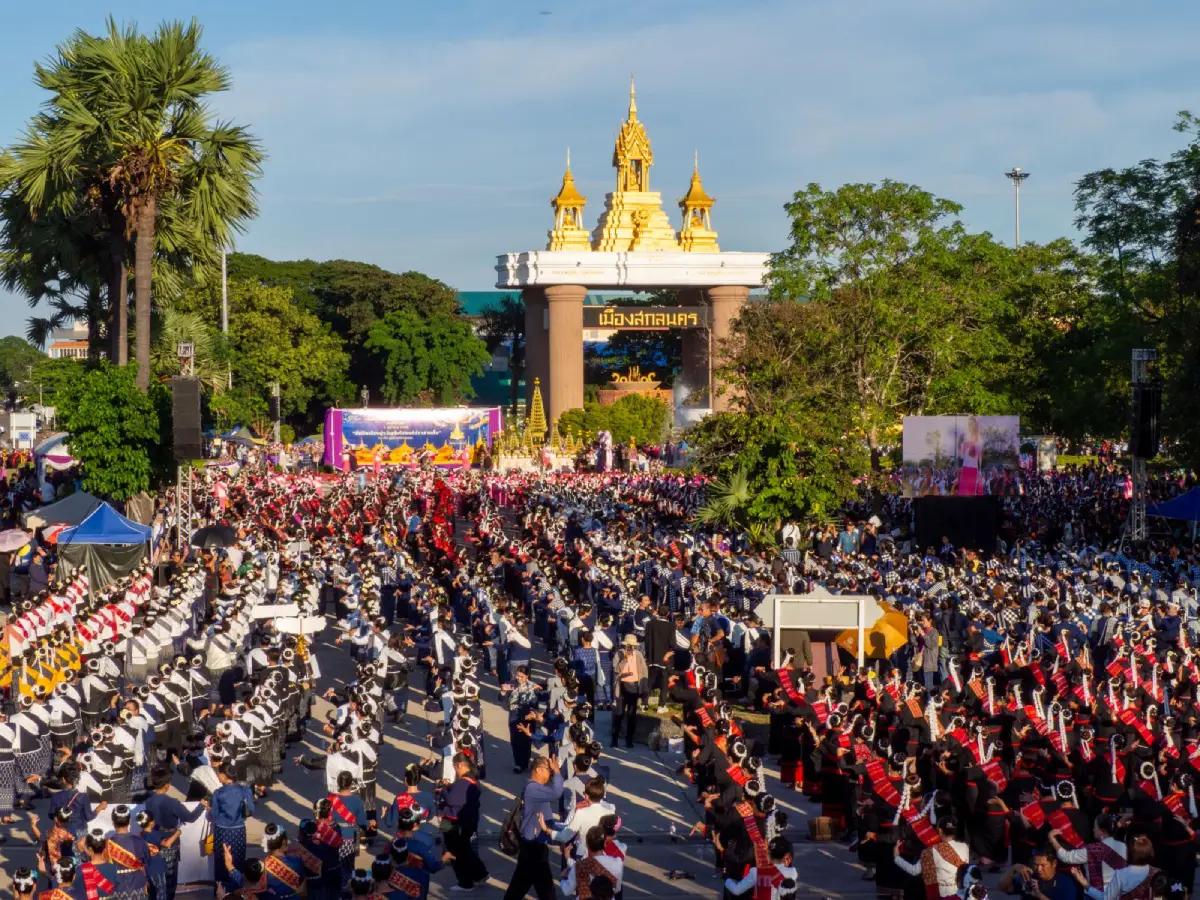
20 Best Places to Visit in Sakon Nakhon – Popular Attractions in Northeastern Thailand Sakon Nakhon is one of the most distinctive destinations in northeastern Thailand, combining Buddhism, ancient Khmer heritage, the Thai Forest Tradition, mountains, forests, freshwater lakes, ethnic communities, and a long-established Catholic culture. The province is known not only for Wat Phra That Choeng Chum and Nong Han Lake, but also for the Phu Phan mountain range, ancient religious monuments, museums dedicated to revered forest monks, Tha Rae Catholic community, Wat Tham Pha Daen, and numerous natural attractions spread across the province.
For first-time visitors, the easiest way to understand Sakon Nakhon is to begin in the city center, with Wat Phra That Choeng Chum as the spiritual landmark, followed by Nong Han Lake and the lakeside public parks. From there, travellers can continue into the Phu Phan Mountains to visit Wat Tham Pha Daen, Phu Phan National Park, and Phu Phan Ratchaniwet Palace. With more time, continue to Phanna Nikhom District for Phra That Phu Phek and the history of the Thai Forest Tradition before exploring Tha Rae and other cultural attractions around Nong Han Lake.
Sakon Nakhon has a long history that predates the modern city. Archaeological evidence reflects strong Khmer cultural influence, particularly at Phra That Narai Cheng Weng, Phra That Dum, and Phra That Phu Phek. Their architecture and building materials connect Sakon Nakhon with ancient Khmer religious networks across northeastern Thailand, making the province especially interesting for travellers interested in the historical civilizations of the Mekong region and the Khorat Plateau.
Another defining identity of Sakon Nakhon is the Thai Forest Tradition. The province is closely associated with Ajahn Mun Bhuridatto, Ajahn Fan Acharo, and many other respected meditation masters. Temples and museums dedicated to these teachers are not merely places of worship; they also preserve the history of forest wandering, meditation practice, and the development of the northeastern Thai forest-monastery tradition.
Nong Han Lake is another major feature that helps define Sakon Nakhon. This extensive freshwater lake contains numerous islands and raised landforms, fishing communities, and local legends, and has supported local life for generations. The lake also connects several attractions, including Somdet Phra Srinagarindra Park, Koh Don Sawan Yai, and Tha Rae Village on the opposite side of the water.
Sakon Nakhon is also notable for its ethnic and religious diversity. The Phu Thai community at Ban Non Hom preserves its language, traditional dress, cuisine, dances, and local knowledge, while Tha Rae has been home to a Catholic community for more than a century. Its landmarks include St. Michael the Archangel Cathedral, colonial-influenced historic houses, and the Christmas Star Parade, which has become one of the province’s best-known annual festivals.
In terms of nature, the Phu Phan mountain range runs through the province and creates ecosystems very different from the lowlands surrounding Nong Han Lake. Phu Phan National Park, Wat Tham Pha Daen, Kham Hom Waterfall, Phu Pha Yon National Park, and Huai Huat Reservoir add mountain scenery, forests, waterfalls, viewpoints, and outdoor experiences to a Sakon Nakhon itinerary.
To reduce unnecessary backtracking, Sakon Nakhon is best explored by zone: the city center and Nong Han Lake, the Phu Phan zone, the Phanna Nikhom–Phang Khon–Waritchaphum route, the Tao Ngoi–Phu Pha Yon area, and the Tha Rae community zone. Three days are enough to cover many major landmarks, while 4–5 days are more suitable for travellers who want to explore ancient stupas, forest-monk heritage, communities, nature, and museums in greater depth.
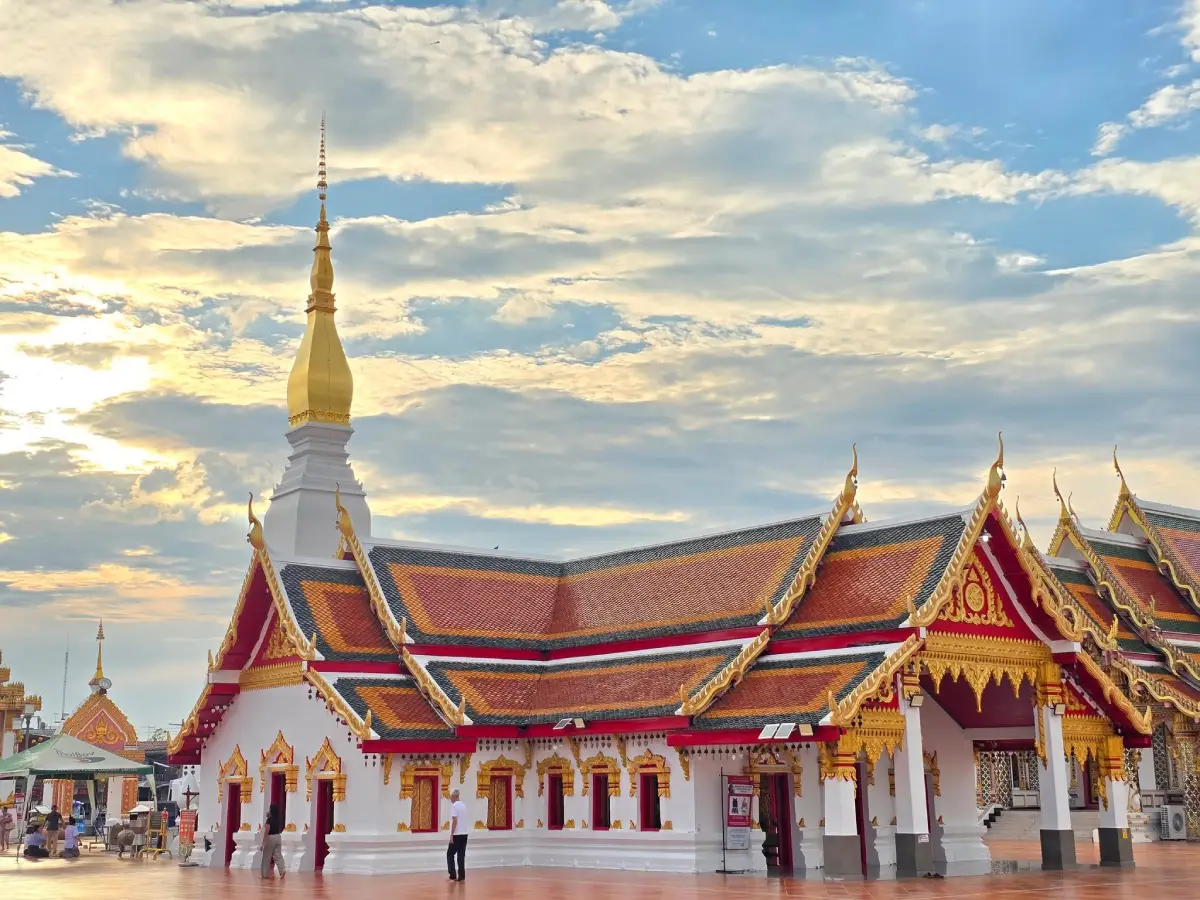
1. Wat Phra That Choeng Chum is a second-class royal temple of the Worawihan type and one of the most important sacred landmarks in Sakon Nakhon Province. Located in the heart of the city in That Choeng Chum Subdistrict, Mueang Sakon Nakhon District, the temple contains Phra That Choeng Chum, Luang Pho Phra Ong Saen, the historic ordination hall, and other important religious structures reflecting the long development of Buddhism in the region.
Highlights: The white Phra That Choeng Chum with its golden ceremonial umbrella, Luang Pho Phra Ong Saen, the historic ordination hall, traces of Khmer and Lan Xang artistic influence, the annual Phra That Choeng Chum worship festival, and the Wax Castle Festival, one of Sakon Nakhon’s most important traditions.
Phra That Choeng Chum is a brick-and-stucco stupa standing on a site regarded as sacred in local tradition. The site is associated with the footprints of 4 Buddhas, a belief that has made the monument not only an archaeological landmark but also a major spiritual center for residents of Sakon Nakhon and Buddhist pilgrims from neighbouring provinces.
The stupa has a square base and rises to approximately 24 meters. Its upper section features a lotus-shaped form topped by a golden ceremonial umbrella. The architecture reflects several phases of restoration and cultural influence, while surviving older elements around the base demonstrate connections with the artistic traditions of the Mekong region.
The temple is also home to Luang Pho Phra Ong Saen, a Chiang Saen-style Buddha image in the subduing-Mara posture. It is deeply revered by local residents, and most visitors pay respect to both the sacred stupa and Luang Pho Phra Ong Saen during the same visit.
Wat Phra That Choeng Chum is also the center of major annual traditions, especially the Phra That Choeng Chum worship festival and the Wax Castle Festival held around the end of Buddhist Lent. Elaborate castle-like structures made from wax are created and carried in procession to the temple as offerings, making this one of the most visually distinctive cultural events in Sakon Nakhon.
The temple is close to Sa Phang Thong, Somdet Phra Srinagarindra Park, and the Nong Han lakeside area, making it easy to include in a morning city itinerary before continuing to the Ajahn Mun Bhuridatto Museum or other central attractions.
Getting There: The temple is located at 1255 That Choeng Chum Subdistrict, Mueang Sakon Nakhon District. It can be reached via Charoen Mueang Road or Rueang Sawat Road. It is open daily from 08:00–18:00. Admission is free, while donations may be made voluntarily.
Map (GPS): https://www.google.com/maps/dir/?api=1&destination=17.164161,104.153335&travelmode=driving
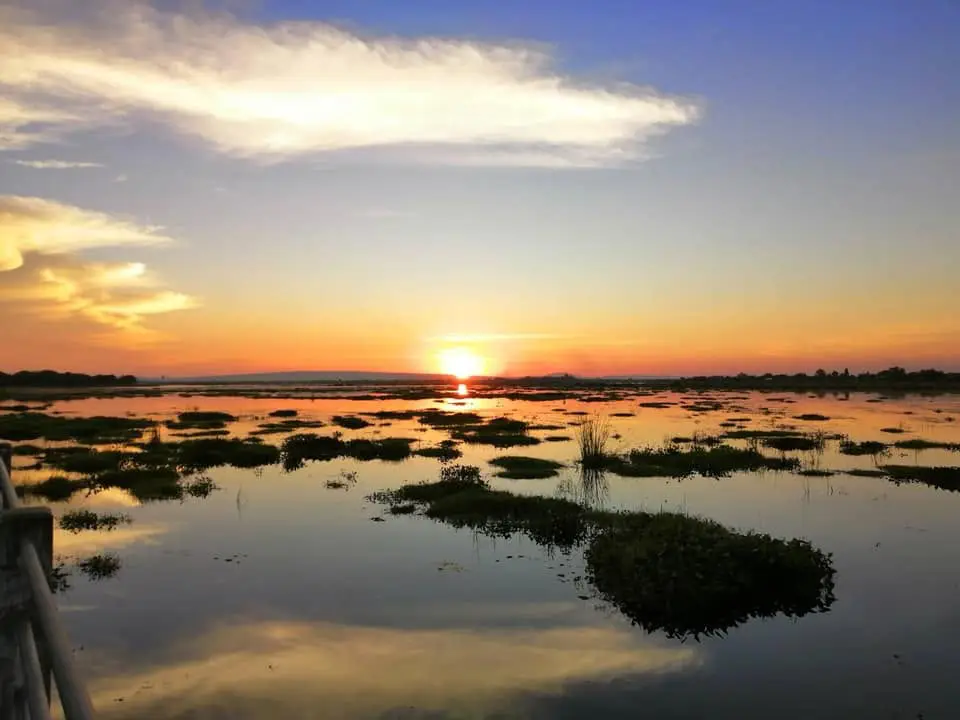
2. Nong Han Lake is one of the largest freshwater lakes in northeastern Thailand, covering parts of Mueang Sakon Nakhon and Phon Na Kaeo districts. The lake has a broad water surface, numerous islands and raised landforms, and an important role in local ecology, fishing, agriculture, community life, and the historical development of Sakon Nakhon.
Highlights: Vast freshwater scenery, Koh Don Sawan, numerous islands and raised landforms, sunrise views, waterbirds, local fishing life, and boat trips across the lake.
Nong Han covers approximately 123 square kilometers and contains more than 20 islands or raised land areas. Its mixture of open water, aquatic vegetation, islands, and lakeside settlements creates a diverse ecosystem supporting fish, birds, and many forms of aquatic life.
The lake is also an important fishing and water resource. Communities around Nong Han have long depended on it for food, agriculture, livestock, and transportation. This relationship makes Nong Han much more than a scenic viewpoint; it is a landscape closely tied to the everyday life of Sakon Nakhon residents.
Nong Han also appears in several local legends, including stories of the ancient city of Nong Han Luang, Nagas, and traditional explanations for the origin of the lake. These stories show how local communities have used natural landscapes to interpret their history and relationship with water.
One of the most popular activities is a boat trip to Koh Don Sawan Yai, an important island in the middle of the lake with mature trees, sacred sites, and panoramic water views. Visitors who prefer to stay on shore can enjoy the lake from Somdet Phra Srinagarindra Park and Sa Phang Thong.
Early morning is particularly suitable for first light over the water, while evenings are pleasant for lakeside walks. Travellers planning a boat trip should use organized services and check weather conditions beforehand, especially on days with strong wind or rain.
Getting There: Easy-access viewpoints are available around Somdet Phra Srinagarindra Park and Sa Phang Thong in central Sakon Nakhon. General lakeside areas have no admission fee. Boat services generally operate around 08:00–17:00, but availability should be reconfirmed on the day of travel.
Map (GPS): https://www.google.com/maps/dir/?api=1&destination=17.218917,104.180095&travelmode=driving
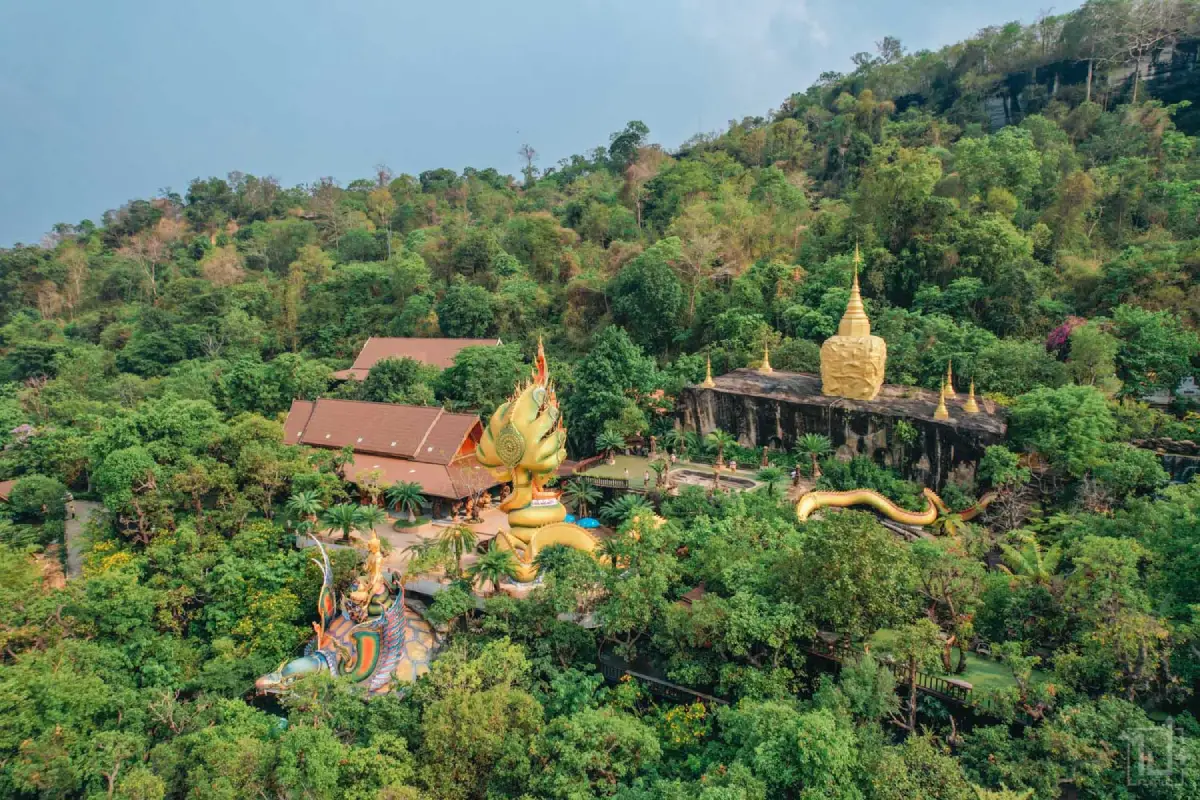
3. Wat Tham Pha Daen is located at Ban Dong Noi, Dong Mafai Subdistrict, Mueang Sakon Nakhon District, on elevated terrain in the Phu Phan mountain range. The temple and meditation retreat are especially notable for combining the natural mountain landscape with contemporary Buddhist art, including sandstone carvings, Naga sculptures, Buddha images, chedis, and landscaped gardens integrated into the rocky terrain.
Highlights: Large Naga-protected Buddha composition, sandstone carvings, reclining Buddha, replica of the Four Buddha Footprints, golden rock chedi, Phaya Tao Phu Pha Daen, natural-wood pavilion, mountain gardens, and viewpoints.
The temple was established in 1940, and the surrounding mountain area has long been associated with several Vipassana meditation monks. It was later developed as both a meditation center and a faith-based attraction while preserving the mountain, rocks, and forest as essential parts of the landscape.
What distinguishes Wat Tham Pha Daen from many other temples is the use of natural cliffs and boulders as foundations for religious art. Buddhist carvings are distributed along paths and rock formations, creating the feeling of walking through an open-air Buddhist art garden on the mountain.
The large Naga sculptures and monumental religious artworks have become visual symbols of the temple, but visitors should also take time to examine the smaller carvings and details, as each section is designed to relate to Buddhist teachings and religious narratives.
The elevated setting also provides expansive views over the surrounding landscape. On clear days, distant mountain ridges and lowlands can be seen from the temple. Morning visits are generally more comfortable for walking than midday, when temperatures can be considerably higher.
Because the temple is located on steep mountain terrain, visitors park at the lower parking area and use the shuttle system organized by the temple and local community. This arrangement reduces traffic on the steep approach road and helps control vehicle movement within the temple grounds.
Getting There: From central Sakon Nakhon, travel toward Dong Mafai Subdistrict and Ban Dong Noi, approximately 17–20 km from the city. The temple is open daily from 06:00–17:00. Visitors should dress respectfully and follow the temple’s shuttle system and site regulations.
Map (GPS): https://www.google.com/maps/dir/?api=1&destination=17.031019,104.073116&travelmode=driving
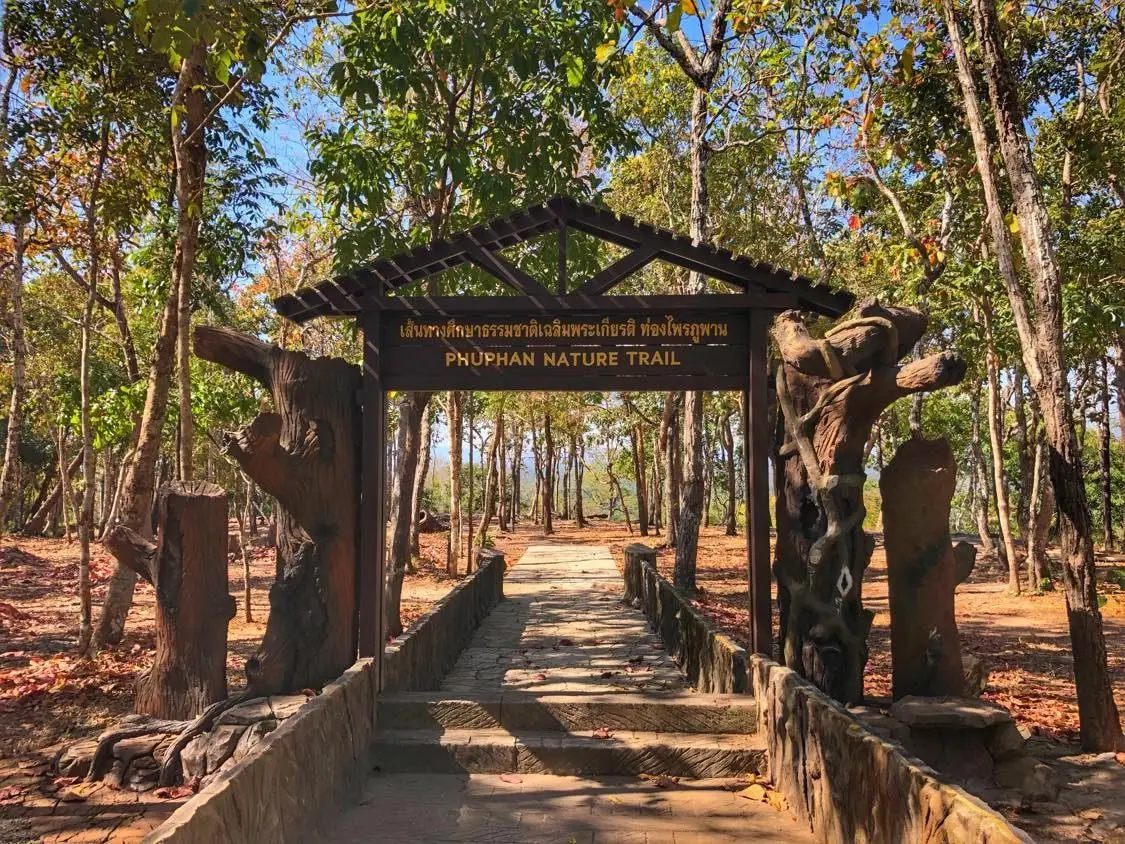
4. Phu Phan National Park is an important protected area within the Phu Phan mountain range, covering parts of Sakon Nakhon and Kalasin provinces. The park contains forests, mountains, cliffs, waterfalls, nature trails, and historically significant sites, offering a very different side of Sakon Nakhon from Nong Han Lake and the urban area.
Highlights: Phu Phan mountain scenery, dry dipterocarp and mixed deciduous forest, viewpoints, nature trails, waterfalls, and historically important locations within the national park.
The Phu Phan range is one of the major mountain systems of the upper Northeast. Its landscape includes ridges, plateaus, and valleys, creating headwaters and diverse ecosystems. Phu Phan National Park protects these forest environments and provides habitat for a wide variety of wildlife.
A visit to the park does not need to focus on a single attraction. Travellers can choose according to their interests, whether scenic viewpoints, nature walks, waterfalls, or historical sites connected with the role of the Phu Phan Mountains in the political and security history of northeastern Thailand.
The rainy season brings lush forests and stronger waterfall flows, although some paths can become slippery and heavy rain may affect access. Winter is generally more suitable for outdoor activities because temperatures are cooler and visibility is often better.
Visitors planning nature activities should carry drinking water, wear suitable footwear, and check which areas are open on the day of travel. Some natural attractions may be restricted due to weather, environmental restoration, or park-management measures.
Phu Phan National Park can be combined with Phu Phan Ratchaniwet Palace and other sites along Highway 213, creating a full-day route that includes nature, mountain scenery, and historically significant locations.
Getting There: From Sakon Nakhon city, follow Highway 213 toward Kalasin and enter the Phu Phan mountain area. Current opening conditions and access rules for individual natural attractions should be checked with the national park before travel.
Map (GPS): https://www.google.com/maps/dir/?api=1&destination=16.954137,103.877979&travelmode=driving
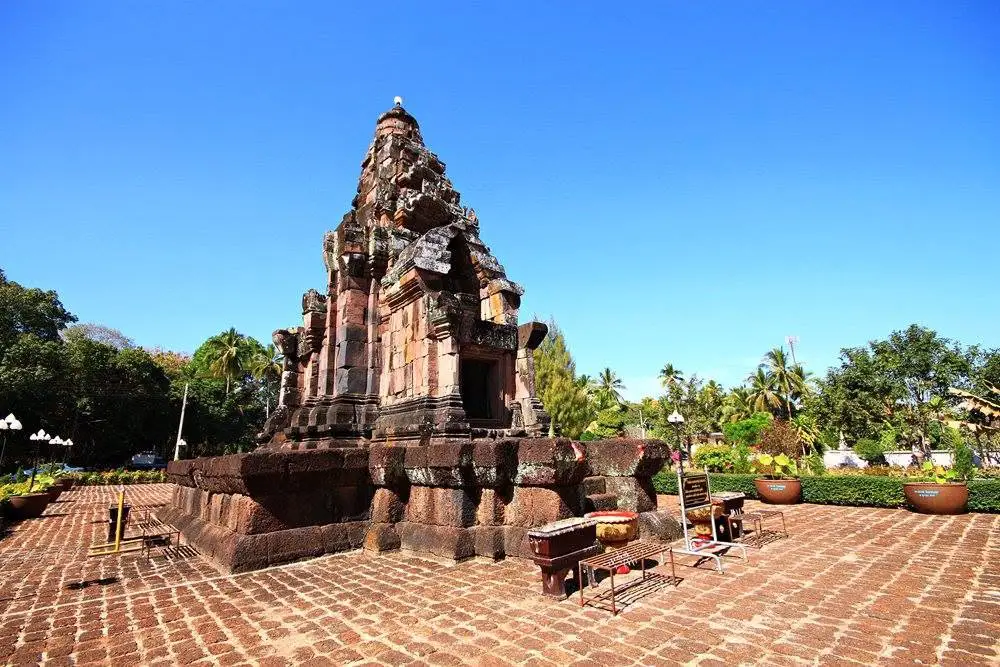
5. Phra That Narai Cheng Weng is an important archaeological monument in Mueang Sakon Nakhon District that reflects Khmer artistic and religious influence in the upper Northeast. The sanctuary was built using ancient stone construction techniques and contains architectural details associated with Hindu religious concepts before the site was later interpreted and used within a Buddhist context.
Highlights: Khmer-style sanctuary architecture, sandstone and laterite construction, carved decorative details, the Narai Cheng Weng legend, and its connection with the local legend surrounding the construction of Phra That Phu Phek.
Phra That Narai Cheng Weng provides important evidence that Sakon Nakhon once lay within the cultural sphere of Khmer civilization. Religious monuments of this type were designed as sacred spaces and symbolic centers representing cosmological ideas.
The sanctuary is relatively compact compared with major Khmer complexes elsewhere in Thailand, but it remains highly important archaeologically and historically because it links Sakon Nakhon to the extensive network of ancient religious sites across northeastern Thailand.
The name “Narai Cheng Weng” appears in a local legend about a competition between groups of women and men to build sacred monuments. According to the story, the men constructed Phra That Phu Phek on the mountain while the women built Phra That Narai Cheng Weng on the plain. The legend has continued to connect the 2 sites in local cultural memory.
Travellers interested in history should combine Phra That Narai Cheng Weng with Phra That Dum and Phra That Phu Phek. Comparing sanctuaries in lowland and mountain settings helps reveal differences in architectural development and geographical context.
Visitors should avoid climbing on the monument, touching fragile stonework, or moving any archaeological fragments, as each element forms part of a heritage site that has survived for centuries.
Map (GPS): https://www.google.com/maps/dir/?api=1&destination=17.187186,104.095765&travelmode=driving
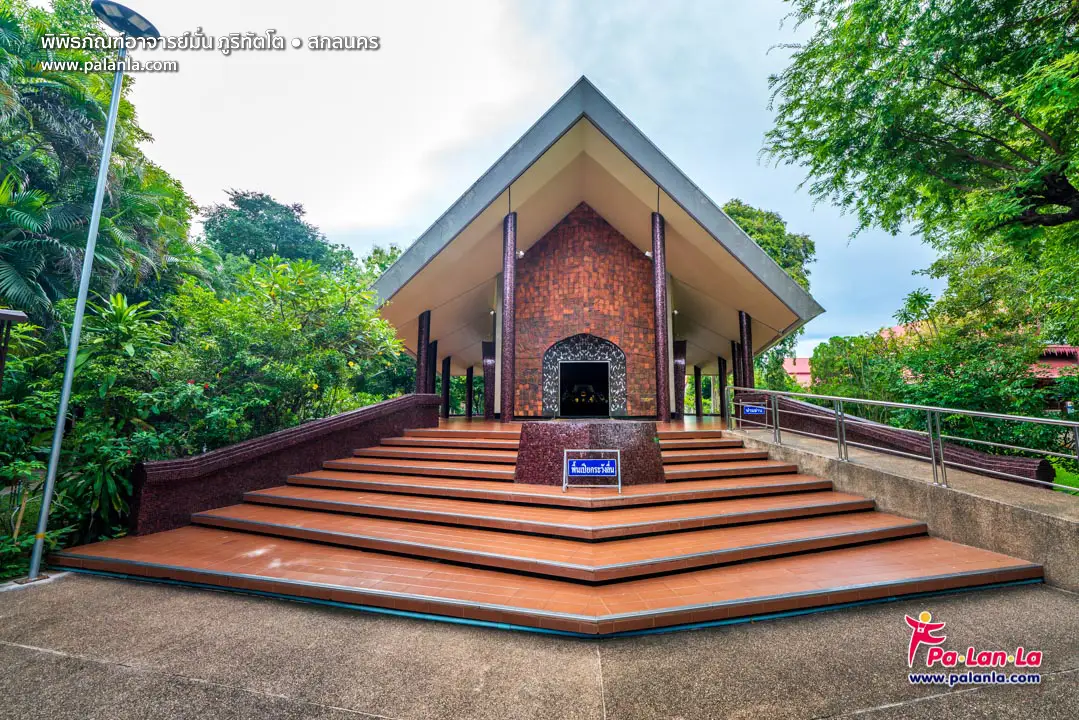
6. Ajahn Mun Bhuridatto Museum is located inside Wat Pa Sutthawat in That Choeng Chum Subdistrict, Mueang Sakon Nakhon District. It is one of the most important places for understanding the history of the Thai Forest Tradition because Ajahn Mun Bhuridatto was a highly influential meditation master whose teachings helped shape the modern forest-monastery tradition in Thailand.
Highlights: Life-size image of Ajahn Mun seated in meditation, sacred relics, monastic requisites, objects used during forest wandering, photographs, and biographical exhibitions covering his life from birth to passing away.
Wat Pa Sutthawat has a long association with forest-meditation monks. The temple grounds are shaded, quiet, and simple, creating an atmosphere very different from large tourist temples and encouraging visitors to walk respectfully and learn about the disciplined life of forest monks.
The museum contains a life-size representation of Ajahn Mun in meditation, an important focal point for worship. Nearby displays include relics, monastic requisites, and objects connected with his forest-wandering practice, helping visitors understand the simplicity and discipline of the Thai Forest Tradition in a tangible way.
Ajahn Mun trained many disciples who later became some of Thailand’s most respected meditation masters. Sakon Nakhon therefore contains several places associated with this tradition, including the Ajahn Fan Acharo Museum in Phanna Nikhom District. Visiting both museums provides a clearer picture of the wider forest-monastery network of northeastern Thailand.
The museum is suitable for visitors interested in Buddhism, the history of forest monks, meditation practice, and travellers who want to understand why Sakon Nakhon occupies such an important position in the Thai Forest Tradition.
Getting There: The museum is located within Wat Pa Sutthawat on Suk Kasem Road, That Choeng Chum Subdistrict, Mueang Sakon Nakhon District. It is open daily from 06:00–18:00. Admission is free. Visitors should dress respectfully and maintain a quiet atmosphere within the temple.
Map (GPS): https://www.google.com/maps/dir/?api=1&destination=17.151574,104.139075&travelmode=driving
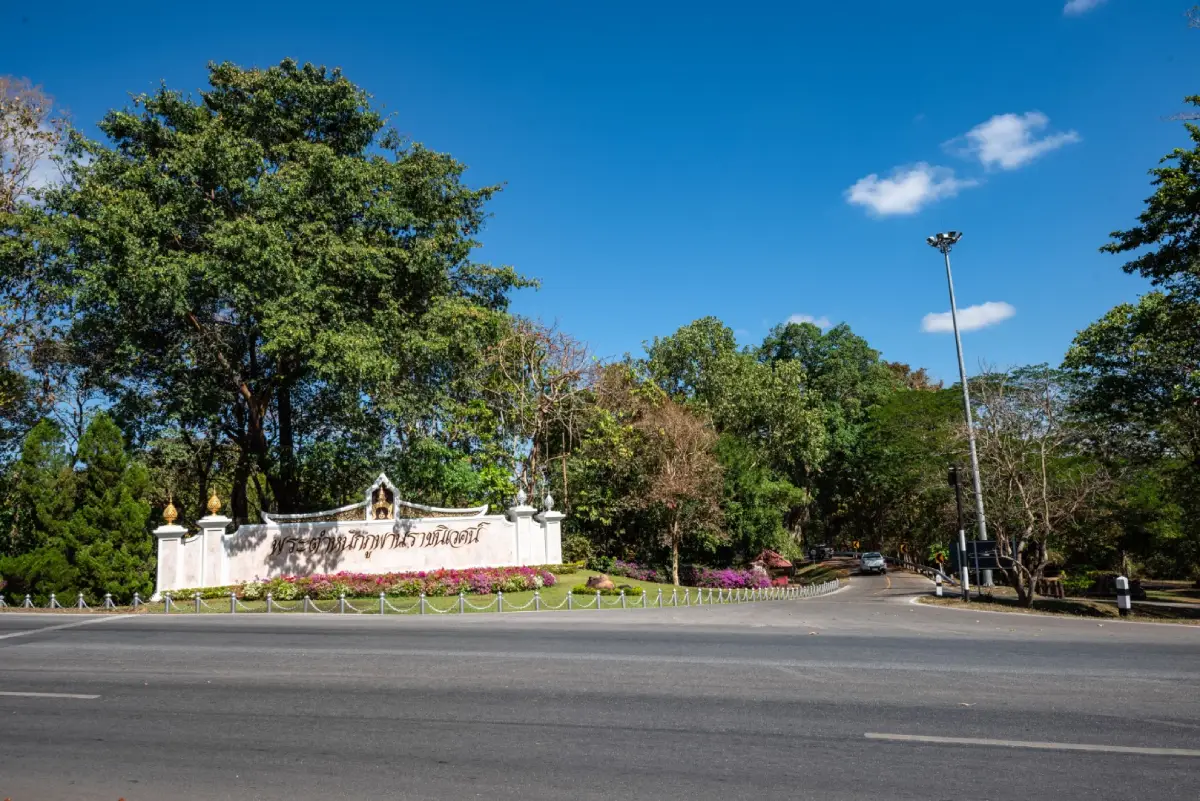
7. Phu Phan Ratchaniwet Palace is a royal residence located within the forested landscape of the Phu Phan Mountains. It was established for royal stays during official duties in northeastern Thailand and reflects the close relationship between royal development work and the communities of the Northeast.
Highlights: Royal residence buildings, flower gardens, natural Phu Phan forest, landscaping designed to blend with the mountain environment, and historical importance as a royal base for official duties in northeastern Thailand.
The location was selected for its quiet mountain environment, relatively cool climate, and strategic position for travelling to different areas of the upper Northeast. It served as a base for royal development work relating to rural communities, water resources, agriculture, and local quality of life.
The architecture and landscaping emphasize simplicity and integration with the surrounding Phu Phan forest. Gardens contain a variety of ornamental plants and flowers, but the design relies heavily on the natural mountain environment rather than creating the atmosphere of a conventional urban garden.
Visiting arrangements differ from ordinary tourist attractions because the site is a royal residence. Public access depends on periods when the royal residence is not in use and on current official conditions. Some inner areas require prior permission, so visitors should always confirm access before travelling.
Travellers following the Phu Phan route can combine the palace with Phu Phan National Park and other attractions along Highway 213. Sufficient travel time should be allowed because the route includes mountainous and winding sections.
Getting There: From Sakon Nakhon city, follow Highway 213 toward Kalasin for approximately 13–16 km. Entry is subject to the regulations of the royal residence and permission from officials. Current public-access status should be checked before travel.
Map (GPS): https://www.google.com/maps/dir/?api=1&destination=17.122243,104.026790&travelmode=driving
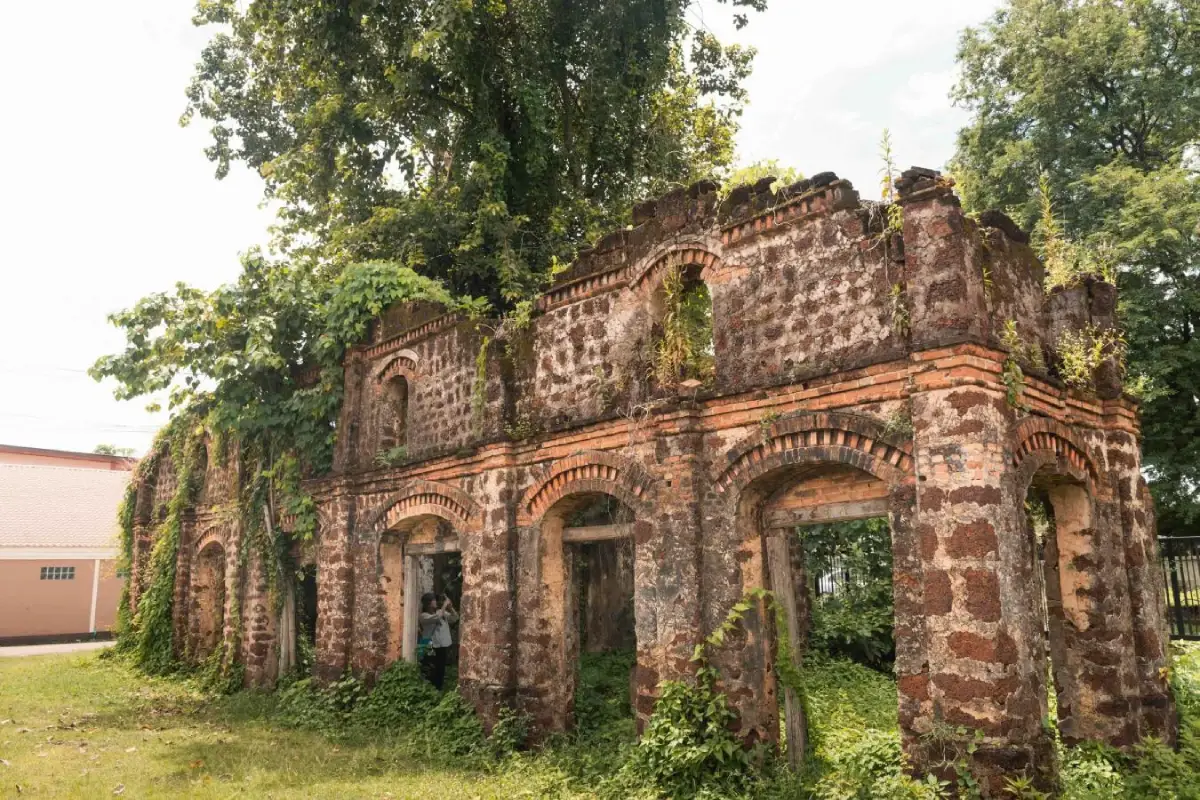
8. Tha Rae Village (Catholic Community) is located in Tha Rae Subdistrict, Mueang Sakon Nakhon District, on the shore of Nong Han Lake. The community has a Catholic history stretching back more than 140 years and is one of the clearest examples of Sakon Nakhon’s religious and cultural diversity.
Highlights: St. Michael the Archangel Cathedral, colonial and French-influenced historic houses, the old community layout, St. Michael the Archangel Museum, and the Christmas Star Parade.
Tha Rae was founded in 1884 when a group of Christians migrated from Sakon Nakhon city across Nong Han Lake and established a new settlement. The lakeside area gradually developed into a community with its own church, residences, and street network.
The center of the community is St. Michael the Archangel Cathedral, a large Catholic religious building whose form evokes a ship, symbolizing the journey of Christians who crossed Nong Han Lake to establish the settlement.
In addition to the cathedral, Tha Rae contains several old houses influenced by colonial and French architecture. Some buildings feature thick masonry walls, arches, and decorative details that differ significantly from traditional Isan houses, giving the village the atmosphere of a small historic quarter.
Tha Rae is especially famous during Christmas, particularly for the Star Parade. Large numbers of decorative stars are displayed on homes, streets, and parade floats, making the community one of Sakon Nakhon’s most important year-end destinations. Travellers visiting during the festival should arrange accommodation and transportation in advance.
Outside the Christmas period, the village is much quieter and suitable for walking among historic houses, visiting the cathedral, learning about community history, and observing lakeside life. Visitors should respect religious activities, particularly during Mass.
Getting There: From Sakon Nakhon city, follow Highway 22 toward Nakhon Phanom for approximately 21 km to Tha Rae Subdistrict. The community can be visited daily. St. Michael the Archangel Cathedral is generally open to visitors from 06:00–18:00. Admission is free.
Map (GPS): https://www.google.com/maps/dir/?api=1&destination=17.254120,104.181700&travelmode=driving
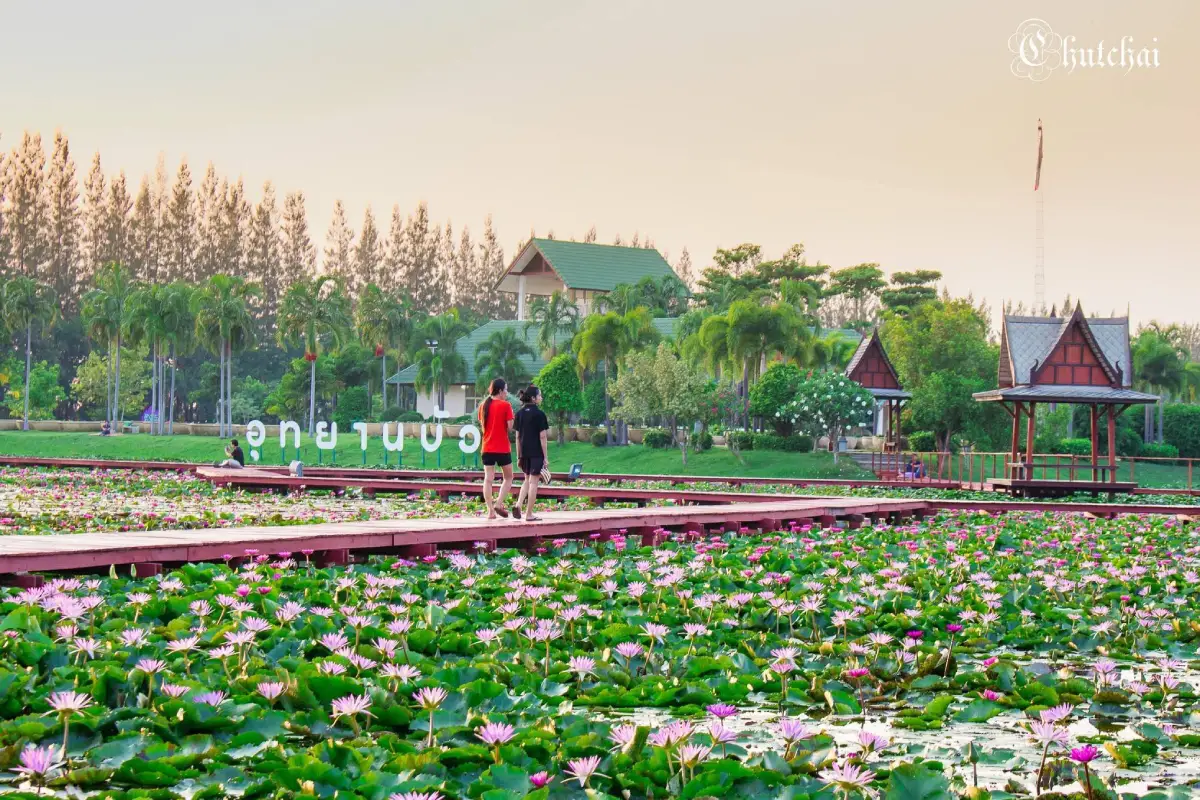
9. Bua Chaloem Phrakiat Park is located within Kasetsart University Chalermphrakiat Sakon Nakhon Province Campus in Chiang Khruea Subdistrict, Mueang Sakon Nakhon District. It serves as a recreational area, photography destination, and educational site devoted to lotus varieties collected from different sources.
Highlights: Large lotus ponds, red wooden bridge, lakeside pavilion, white Naga sculpture, photography spots, and collections of Thai and international lotus varieties.
The park was established in 2010 as a lotus collection and to support an international lotus conference hosted by the university. Its development therefore combines tourism, education, and conservation.
The display areas include large lotus ponds, lotus plants grown in containers, and educational exhibits. Visitors can compare differences in leaf shapes, flower colors, and growth characteristics across many lotus varieties.
The red wooden bridge crossing the pond is one of the park’s principal photography spots, allowing visitors to walk closer to the lotus displays. A pavilion over the water provides a place to rest and enjoy broader views of the surrounding landscape.
Morning is the best time to see the lotus flowers because many varieties are in bloom and temperatures are still comfortable. Visitors interested in photography should avoid the harshest midday sunlight.
The park is suitable for families, students, and older travellers because the main routes are easy to access and do not require mountain walking. It can conveniently be combined with Tha Rae or other attractions north of Nong Han Lake in the same day.
Getting There: The park is located at 59 Moo 1, Chiang Khruea Subdistrict, Mueang Sakon Nakhon District, within Kasetsart University Chalermphrakiat Sakon Nakhon Province Campus. Monday–Friday hours are 08:30–16:30, while Saturday–Sunday hours are 08:30–18:00. Admission is free.
Map (GPS): https://www.google.com/maps/dir/?api=1&destination=17.291076,104.112302&travelmode=driving
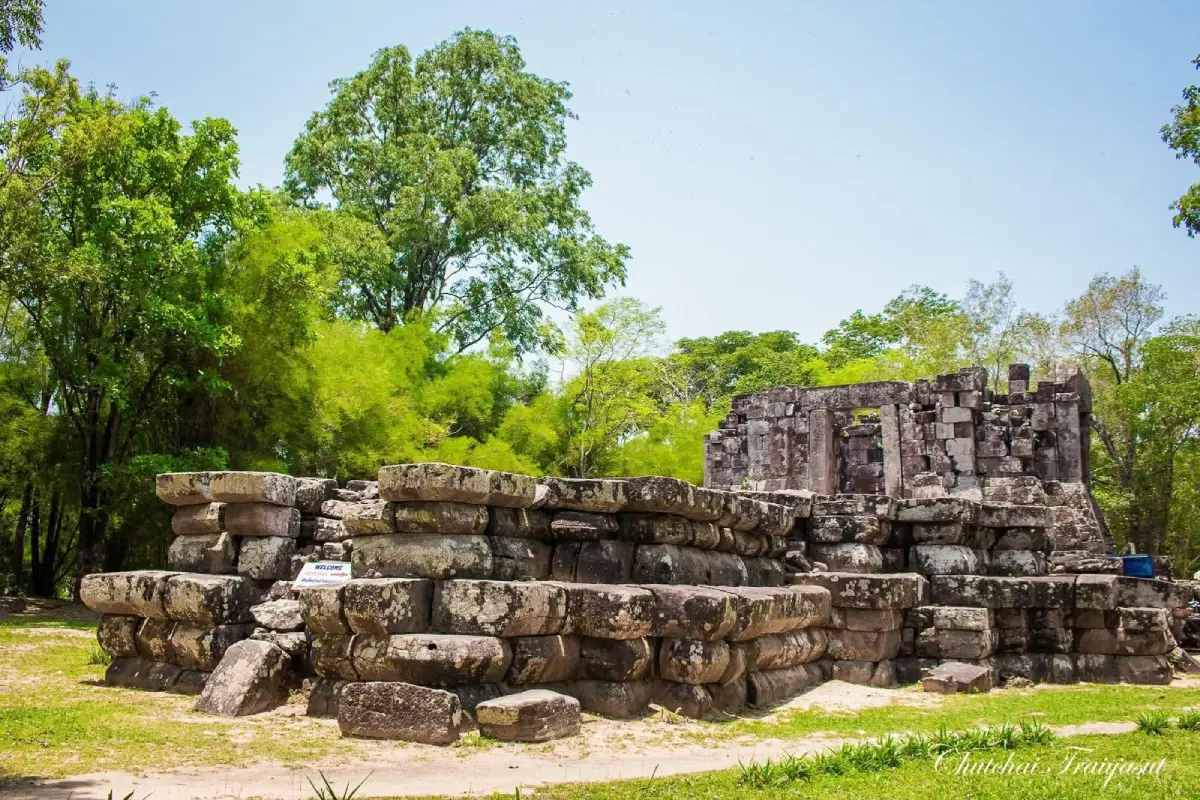
10. Phra That Phu Phek stands on the summit of Phu Phek in Na Hua Bo Subdistrict, Phanna Nikhom District. It is an important archaeological site combining Khmer civilization, local legend, religious belief, and the mountain landscape of the Phu Phan range. Reaching the sanctuary requires climbing approximately 491 steps, making the visit both a historical excursion and a mountain-walking experience.
Highlights: Sandstone sanctuary on the mountaintop, laterite base, unfinished architecture, approximately 491 steps, the Dao Phek legend, and views over the Phu Phan Mountains.
Phra That Phu Phek dates to around the 11th–12th centuries CE and was originally a Hindu sanctuary based on the sacred-mountain concept, in which religious structures were placed on elevated terrain to represent Mount Meru. The meaning of the site was later absorbed into Buddhist belief and local legend.
The sanctuary is constructed from sandstone on a laterite base. It has a square plan with a mandapa at the front and a sanctuary chamber inside. The true entrance faces east while the other 3 sides contain false doors. One of its most unusual characteristics is the absence of a completed roof and tower, corresponding with the local story that construction stopped before completion.
The best-known legend describes a competition between men and women to construct sacred monuments. The men built Phra That Phu Phek on the mountain while the women built Phra That Narai Cheng Weng on the plain. According to the story, the “Dao Phek” star was used as a trick that caused the men to believe dawn had arrived, prompting them to stop work and leaving the sanctuary unfinished.
Climbing approximately 491 steps is part of the experience. Travellers with knee problems, heart conditions, or mobility limitations should assess their physical condition before attempting the climb. Rest points are available along the way, and carrying drinking water is advisable, especially in hot weather.
At the summit, visitors can explore the archaeological monument while enjoying views across the Phu Phan range. Morning visits are preferable because temperatures are lower and walking conditions are more comfortable than in the afternoon.
Phra That Phu Phek can be combined with the Ajahn Fan Acharo Museum in Phanna Nikhom District, allowing visitors to experience both ancient Khmer heritage and the history of the Thai Forest Tradition in a single day.
Getting There: From Sakon Nakhon city, follow Highway 22 toward Udon Thani, then turn toward Na Hua Bo Subdistrict and the base of Phu Phek before climbing approximately 491 steps. The site is open daily from 06:00–18:00. There is no admission fee for the sanctuary area.
Map (GPS): https://www.google.com/maps/dir/?api=1&destination=17.192899,103.941319&travelmode=driving
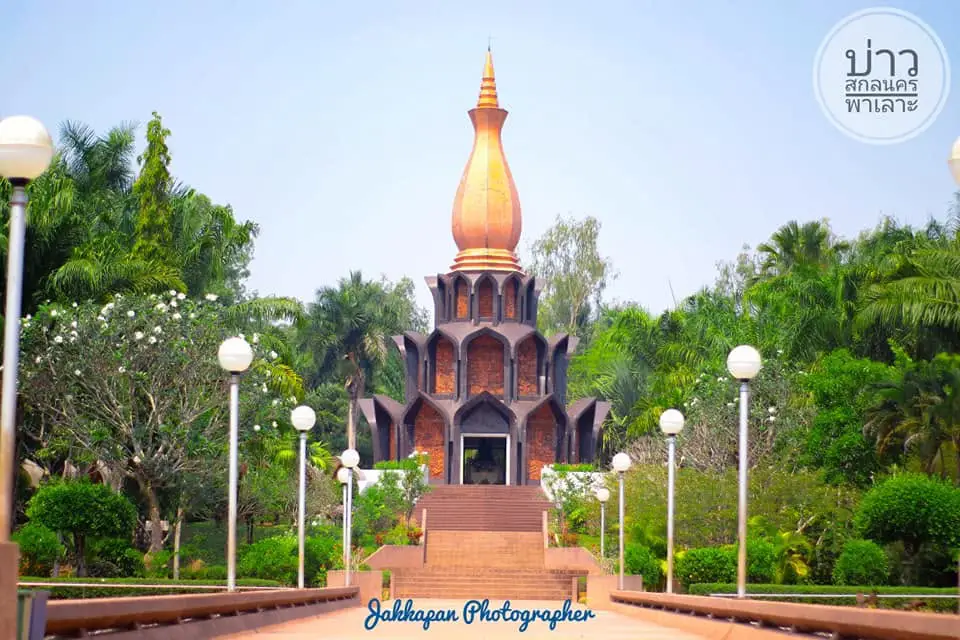
11. Ajahn Fan Acharo Museum is located within Wat Pa Udom Somphon at Ban Na Hua Chang, Phanna Subdistrict, Phanna Nikhom District. It is one of the most important destinations associated with the Thai Forest Tradition in Sakon Nakhon. The museum was established in memory of Ajahn Fan Acharo, a highly respected Vipassana meditation master and one of the important disciples of Ajahn Mun Bhuridatto.
Highlights: Three-tiered lotus-petal museum chedi, life-size image of Ajahn Fan, sacred relics, monastic requisites, photographs, and biographical exhibitions covering his childhood, ordination, forest wandering, meditation practice, teaching, and passing away.
The museum was constructed on the site used for the royal cremation ceremony of Ajahn Fan and was completed in 1982. The building resembles a rounded chedi with layered lotus-petal forms around its base, symbolizing serenity and devotion, and stands within the peaceful forest environment of Wat Pa Udom Somphon.
Inside is a life-size image of Ajahn Fan seated with his legs hanging down and holding a walking stick, creating an intimate impression as though the meditation master were still welcoming disciples and visitors. Nearby displays contain relics, personal belongings, and monastic requisites that illustrate the simplicity of his life as a forest monk.
The biographical exhibition follows Ajahn Fan from his early life through ordination, his period as a disciple of Ajahn Mun, forest wandering, residence at different monasteries, and the training of his own disciples. The museum therefore provides an opportunity to understand the Thai Forest Tradition through the life of an actual meditation master rather than through written accounts alone.
The temple grounds also contain forest areas, monks’ residences, pavilions, and meditation spaces that retain the character of a traditional forest monastery. Visitors should walk quietly, behave respectfully, and avoid disturbing monks or people engaged in meditation.
Ajahn Fan Acharo Museum combines naturally with Phra That Phu Phek because both are located in Phanna Nikhom District. Visiting the 2 sites in the same day gives travellers an opportunity to experience both ancient Khmer heritage and the history of the Thai Forest Tradition, 2 important dimensions of Sakon Nakhon.
Getting There: The museum is located at 56 Moo 4, Ban Na Hua Chang, Phanna Subdistrict, Phanna Nikhom District. From Sakon Nakhon city, follow Highway 22 toward Udon Thani. It is open daily from 07:00–17:00. Admission is free.
Map (GPS): https://www.google.com/maps/dir/?api=1&destination=17.357115,103.865342&travelmode=driving
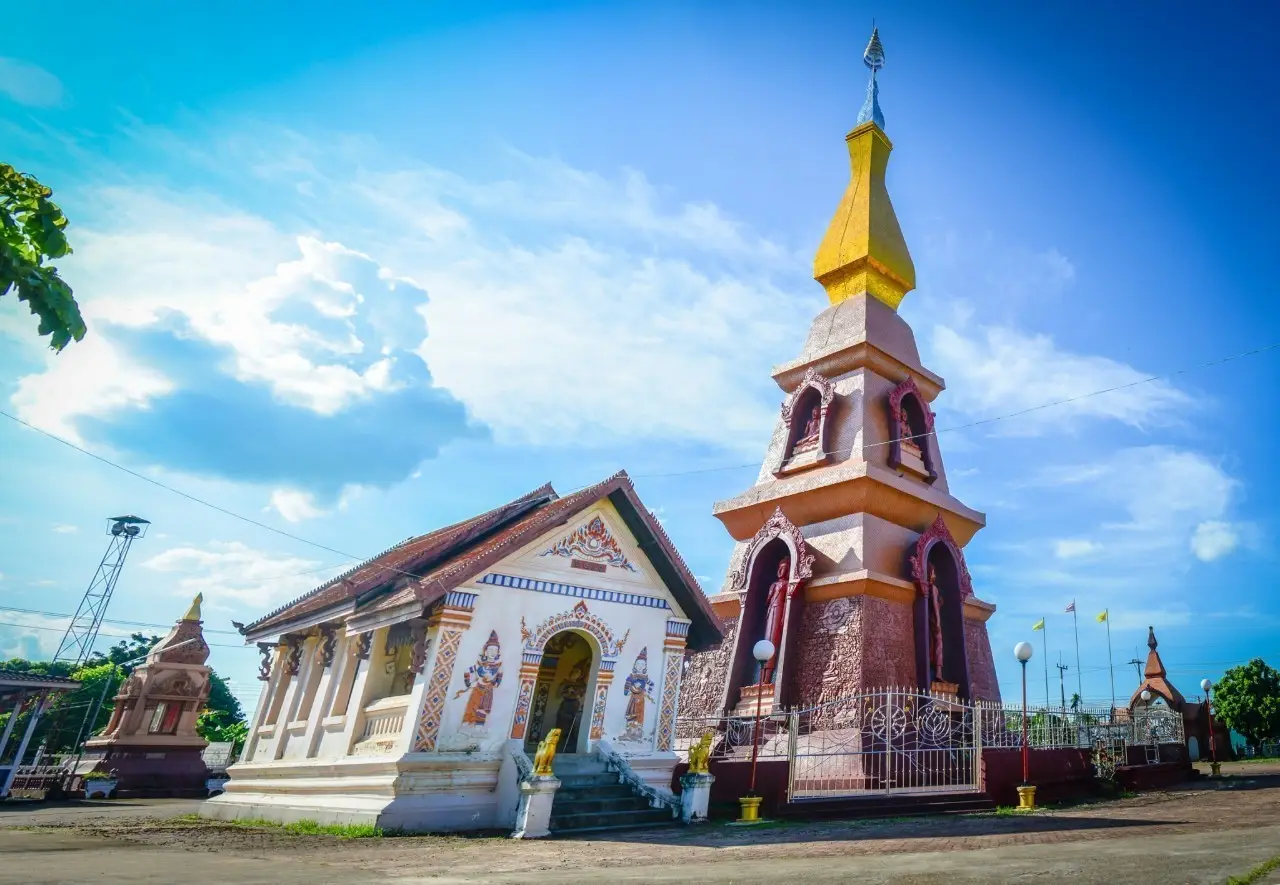
12. Phra That Si Mongkhon is a sacred stupa closely associated with the people of Waritchaphum District. It stands within Wat Phra That Si Mongkhon at Ban That, Waritchaphum Subdistrict. The present monument is a square-based brick-and-stucco chedi with a pointed top, constructed around an older laterite stupa that had deteriorated over time.
Highlights: Square-based pointed chedi, terracotta decoration, Buddhist narrative scenes around the base, the original laterite stupa preserved inside, and the Phra That Si Mongkhon worship festival held together with the traditional million-rocket Bun Bang Fai celebration.
The history of the stupa is closely connected with the Ban That community. When villagers settled in the area, they discovered an abandoned ancient stupa in the forest and subsequently established a temple to care for the sacred site. The original monument was built from laterite before a newer structure was later constructed around it.
The present architecture differs from ancient Khmer monuments such as Phra That Phu Phek and Phra That Narai Cheng Weng. It represents a later Buddhist architectural tradition designed to preserve the older sacred structure while adding terracotta decoration and visual narratives from the life of the Buddha around the base.
Phra That Si Mongkhon remains an important spiritual center for residents of Waritchaphum and surrounding Phu Thai communities. Its major annual tradition combines worship of the sacred stupa with the Bun Bang Fai Lan, or million-rocket festival, reflecting the close relationship among Buddhism, beliefs about rain, and the agricultural life of northeastern communities.
A visit to Waritchaphum is therefore best understood not simply as viewing a stupa, but as experiencing a cultural center where religion, ethnic identity, and community traditions come together.
Getting There: Phra That Si Mongkhon is located at Ban That, Waritchaphum Subdistrict, Waritchaphum District, approximately 200 meters from the district office. It is open daily from 08:00–17:00. Admission is free.
Map (GPS): https://www.google.com/maps/dir/?api=1&destination=17.318274,103.654171&travelmode=driving
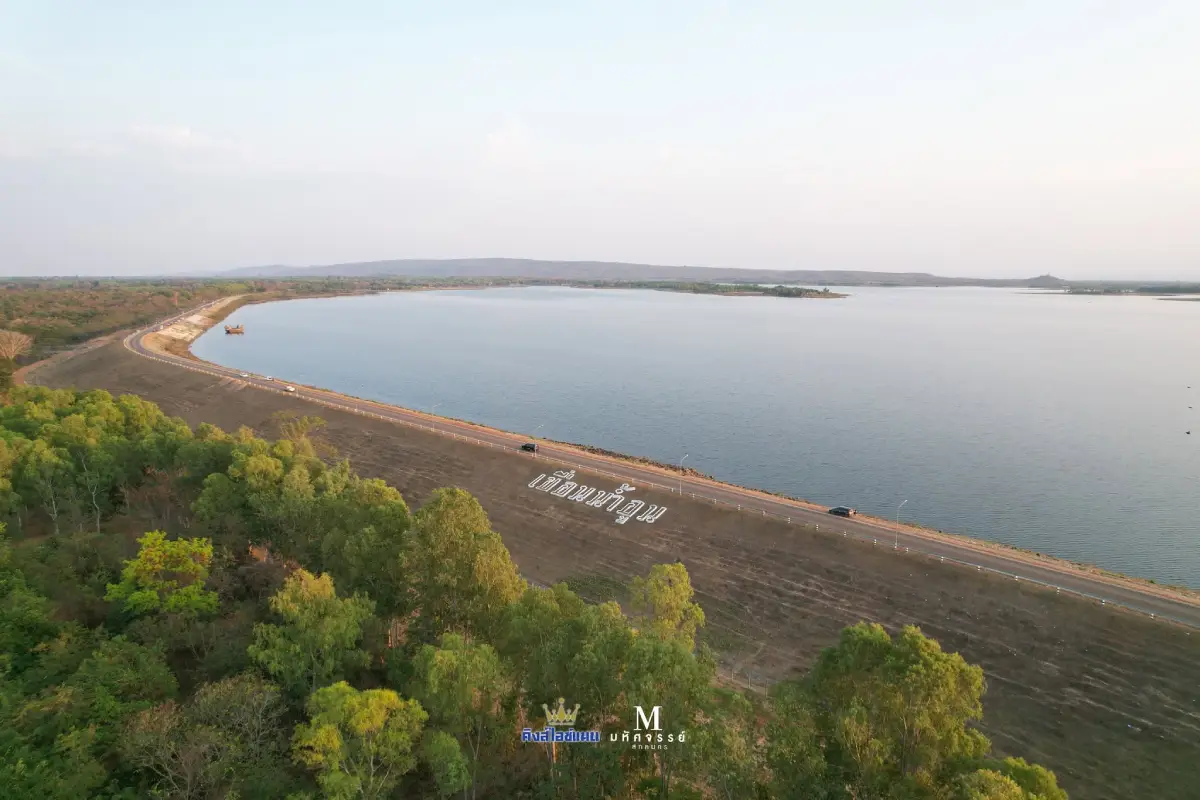
13. Nam Oon Dam is a large earth-fill dam under the Royal Irrigation Department, located in Rae Subdistrict, Phang Khon District. It was constructed across the Nam Oon River, which originates in the Phu Phan Mountains and is an important tributary of the Songkhram River. The dam plays major roles in irrigation, agriculture, flood mitigation, and recreation around its broad reservoir landscape.
Highlights: Earth-fill dam approximately 29.5 meters high, dam crest around 3,000 meters long, reservoir capacity of approximately 520 million cubic meters, broad water views, Phu Phan mountain scenery, and a peaceful atmosphere.
Construction of Nam Oon Dam began in 1967. The main dam was completed in 1974, while the irrigation distribution system was completed in 1981. The project was designed primarily to address seasonal flooding during the rainy season and water shortages during dry periods, both longstanding challenges for agricultural communities in the Nam Oon basin.
Water stored in the reservoir now supports extensive agricultural areas, particularly rice fields and field crops. The dam is therefore far more important to regional water security and local livelihoods than its role as a sightseeing destination alone.
For visitors, the main attraction is the broad reservoir backed by forests and mountain ridges. The dam crest provides a good location for enjoying the scenery, feeling the breeze, and taking photographs, particularly in the morning or later afternoon when the sunlight is softer.
Near the dam’s discharge structures, flowing water can sometimes resemble a small waterfall when water is being released. The appearance and volume depend entirely on reservoir management, so travellers should not expect the same conditions throughout the year.
Nam Oon Dam is suitable for travellers interested in reservoir landscapes, photography, and irrigation projects. It can be incorporated efficiently into a Phanna Nikhom–Phang Khon–Waritchaphum route without returning to Sakon Nakhon city between stops.
Getting There: Nam Oon Dam is located in Rae Subdistrict, Phang Khon District and is easily accessible by car. General sightseeing hours are daily from 08:00–17:00. Access to restricted areas must follow signs and instructions issued by irrigation officials.
Map (GPS): https://www.google.com/maps/dir/?api=1&destination=17.309038,103.742803&travelmode=driving
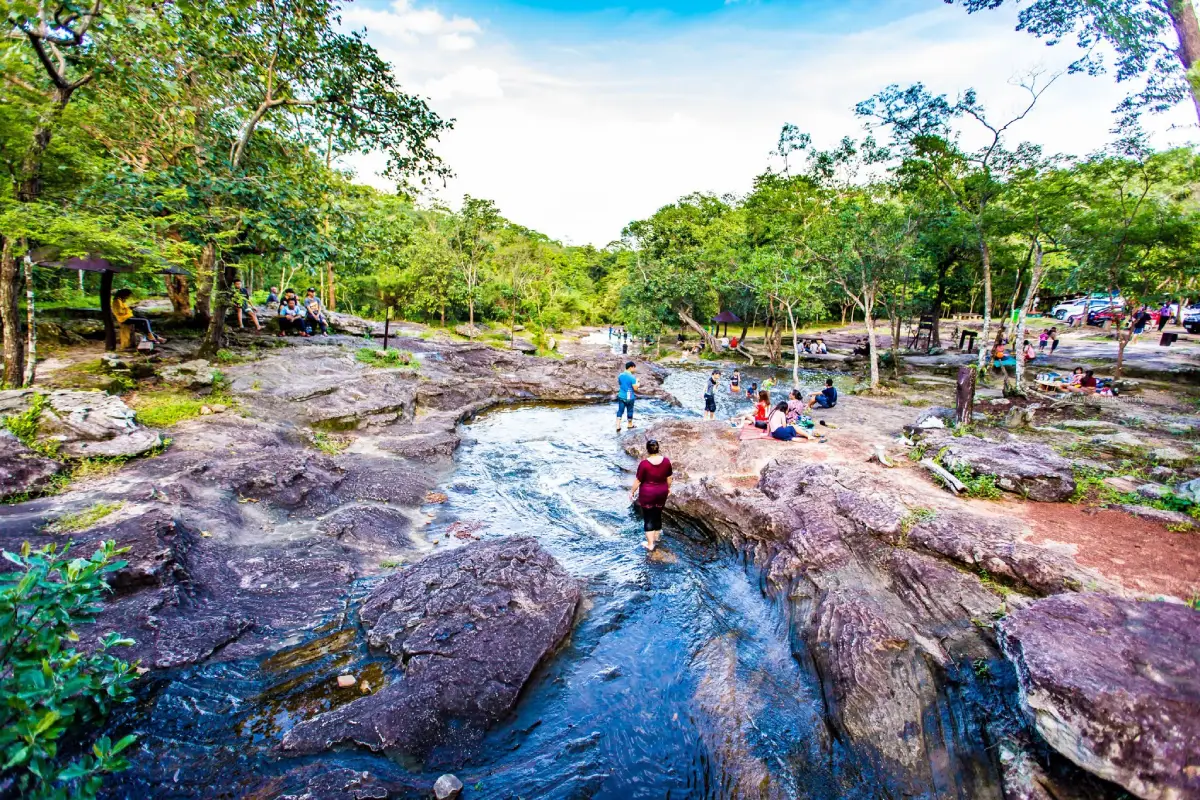
14. Kham Hom Waterfall is a waterfall in the Phu Phan Mountains within Phu Phan National Park, close to the Sakon Nakhon–Kalasin route. Its main attraction is the stream flowing across natural rock slabs and boulders surrounded by forest, with water levels changing significantly according to the season. It can also be combined easily with the Khong Ping Ngu viewpoint.
Highlights: Natural waterfall, sandstone slabs, Phu Phan forest, seasonal pools, Khong Ping Ngu mountain road, and viewpoints overlooking Sakon Nakhon city and Nong Han Lake when visibility is clear.
Kham Hom Waterfall is formed by a mountain stream flowing across the sandstone terrain of the Phu Phan range. Rather than a single high vertical drop, the water forms a series of cascades, pools, and broad rock surfaces that blend naturally into the surrounding forest.
The rainy season is the best period for seeing the waterfall at its fullest, when surrounding vegetation is lush and the stream carries more water. Conditions often remain attractive into early winter, while during the dry season water levels fall considerably and some sections of exposed rock may become almost dry.
Close to the waterfall is Khong Ping Ngu, a famously winding section of mountain road associated with the Phu Phan route. Rest areas along this section provide views down toward the lowlands, and on clear days Sakon Nakhon city and Nong Han Lake can be seen in the distance.
Visitors should take extra care on wet rock surfaces, especially after rainfall. Swimming should be avoided when currents are strong, and all instructions from Phu Phan National Park officials should be followed.
Kham Hom Waterfall combines well with Phu Phan National Park and Phu Phan Ratchaniwet Palace, creating a full-day route that includes mountain scenery, forest, waterfall landscapes, viewpoints, and an important historical site.
Getting There: Kham Hom Waterfall is located in the Phu Phan mountain area along the Sakon Nakhon–Kalasin route. General visiting hours are daily from 08:00–17:00. Water flow is strongest during the rainy season and decreases significantly during the dry season.
Map (GPS): https://www.google.com/maps/dir/?api=1&destination=17.123404,104.018709&travelmode=driving
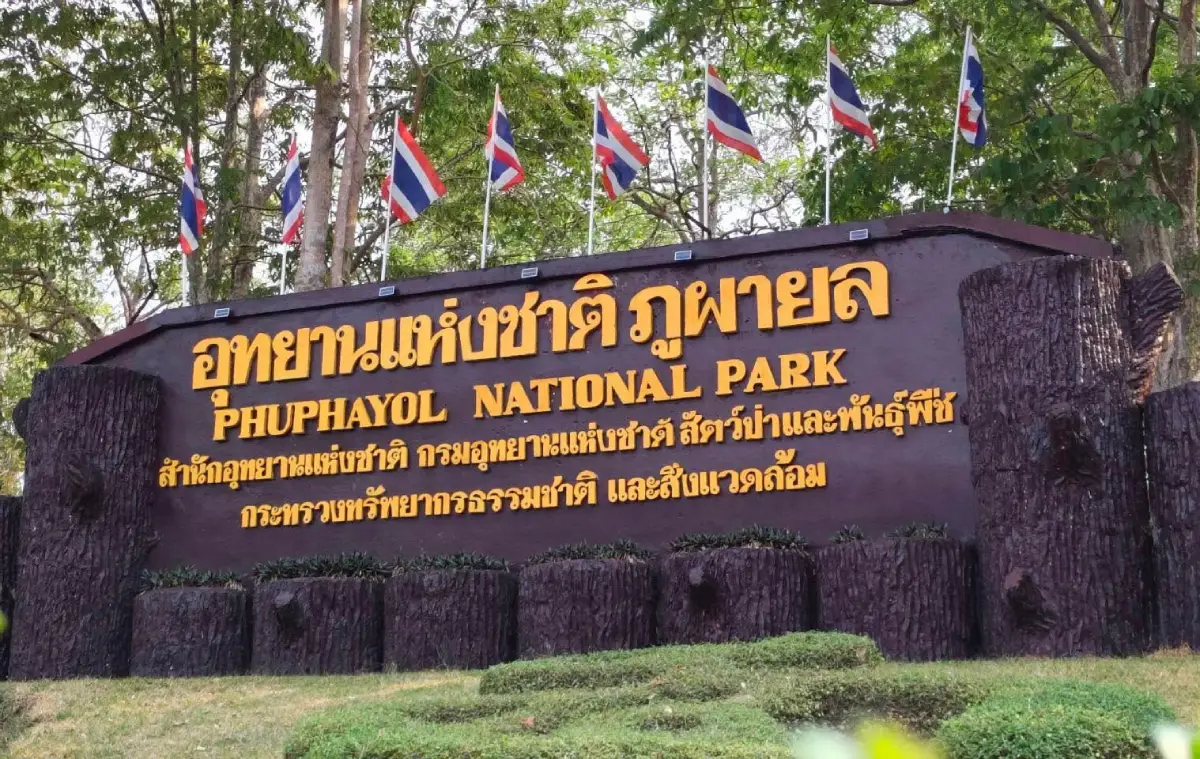
15. Phu Pha Yon National Park is a large protected area within the Phu Phan mountain range. Its headquarters are located near Ban Huai Huat, Chan Phen Subdistrict, Tao Ngoi District. The park extends across parts of Sakon Nakhon, Nakhon Phanom, and Mukdahan provinces and contains forests, sandstone mountains, reservoirs, waterfalls, rock fields, cliffs, ancient carvings, and stargazing areas.
Highlights: Huai Huat Reservoir, seasonal waterfalls, rock fields, wildflowers, ancient rock carvings, viewpoints, stargazing areas, nature trails, camping grounds, and the forest atmosphere of the Phu Phan Mountains.
Phu Pha Yon National Park covers approximately 825 square kilometers, or more than 500,000 rai. Its landscape consists of plateaus interspersed with sandstone mountain ranges, creating several types of ecosystem, including mixed deciduous forest, dry dipterocarp forest, dry evergreen forest, and more humid forest at higher elevations.
The variety of terrain allows for many different types of travel experiences. Visitors can relax beside a reservoir, walk through forest trails, visit waterfalls, study ancient rock carvings, enjoy views from cliffs, camp, or observe the night sky when conditions are clear.
Huai Huat Reservoir is one of the park’s principal landmarks and lies close to the headquarters. The wide body of water is surrounded by forests and mountains, offering peaceful scenery in the morning and evening. On clear nights, open areas around the reservoir can also be suitable for stargazing.
The rainy season brings lush forests and stronger waterfall flows, but some paths may become slippery or temporarily restricted for safety. Winter is generally more suitable for camping, nature walks, and stargazing.
Because the park covers a large area, travellers should not attempt to visit every attraction in a single day. Those with limited time should focus on Huai Huat Reservoir and natural attractions close to the park headquarters, adding other routes only when time and access conditions allow.
Getting There: The park headquarters are located at Ban Huai Huat, Chan Phen Subdistrict, Tao Ngoi District. The park is open daily from 06:00–18:00. Visitors planning to enter nature trails, waterfalls, or more remote areas should confirm current access conditions with park officials before setting out.
Map (GPS): https://www.google.com/maps/dir/?api=1&destination=16.888695,104.232844&travelmode=driving
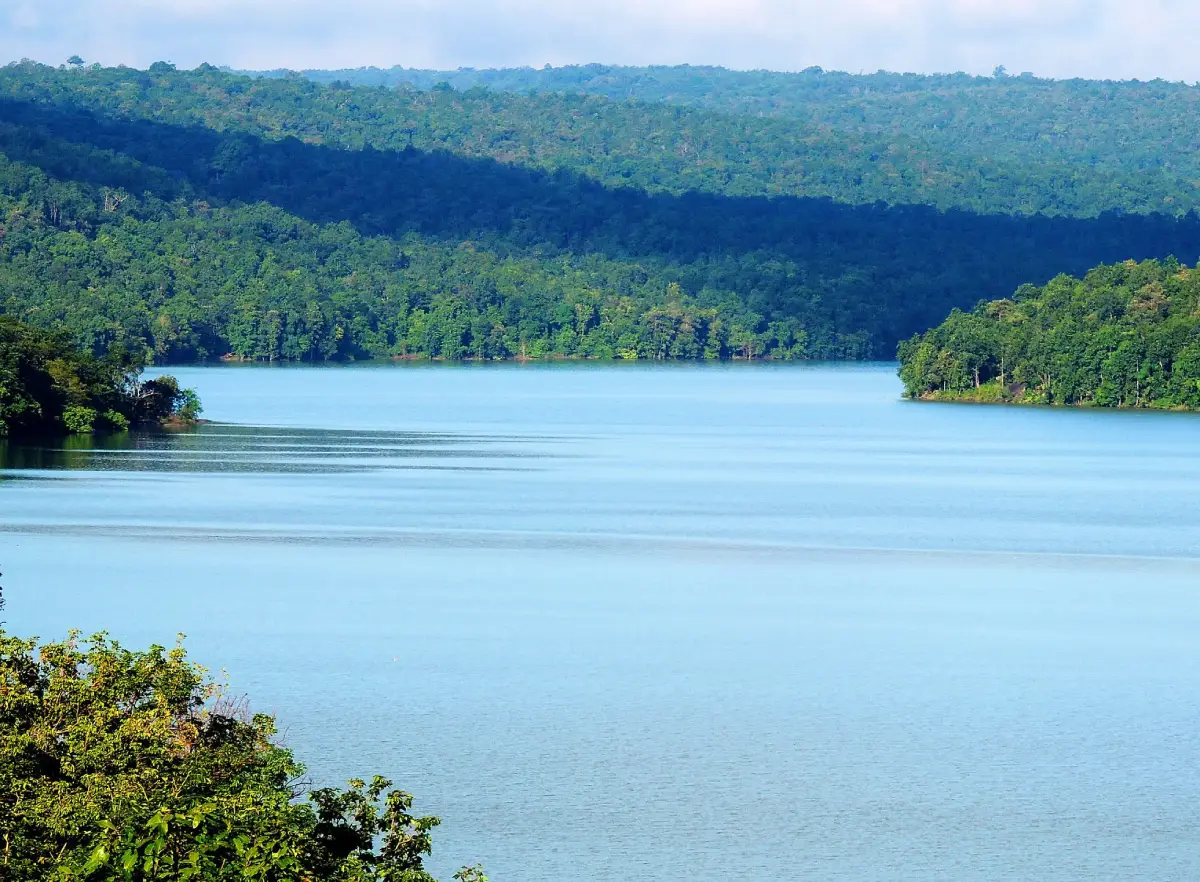
16. Huai Huat Reservoir is located at Ban Huai Huat, Moo 4, Chan Phen Subdistrict, Tao Ngoi District, within Phu Pha Yon National Park. It is a medium-sized royal-initiative reservoir serving agriculture, domestic water use, fisheries, and nature-based tourism.
Highlights: Broad reservoir surrounded by mountains, dam crest, viewpoints, stargazing locations, royal working pavilion area, seasonal waterfalls, and the quiet atmosphere of the Phu Phan landscape.
The project originated from a royal initiative on November 28, 1981, aimed at addressing water shortages affecting communities in Tao Ngoi District. The Royal Irrigation Department began construction in 1983 and completed the reservoir in 1987.
The earth-fill dam is approximately 26 meters high and 395 meters long. The reservoir has a storage capacity of around 21 million cubic meters and a water-surface area of approximately 1,200 rai. Its water supports several thousand rai of farmland and also provides an important fishery resource for local communities.
For travellers, the dam crest provides broad views across the reservoir toward surrounding mountains. Morning brings soft light and cooler air, while late afternoon is suitable for watching changing skies and reflections across the water.
The reservoir also connects with seasonal waterfalls and other natural attractions in Phu Pha Yon National Park. It therefore works well as a base for a 1-day nature trip or an overnight park visit for travellers interested in stargazing and early-morning scenery.
Visitors should keep the area clean, avoid swimming in undesignated zones, and follow national-park regulations because the reservoir is both an important water resource and part of a protected forest ecosystem.
Getting There: Huai Huat Reservoir is located at Ban Huai Huat, Moo 4, Chan Phen Subdistrict, Tao Ngoi District. The reservoir can be reached by car and is generally open daily from 08:00–17:00. Access to other areas of the national park depends on current route conditions and park regulations.
Map (GPS): https://www.google.com/maps/dir/?api=1&destination=16.924444,104.158611&travelmode=driving
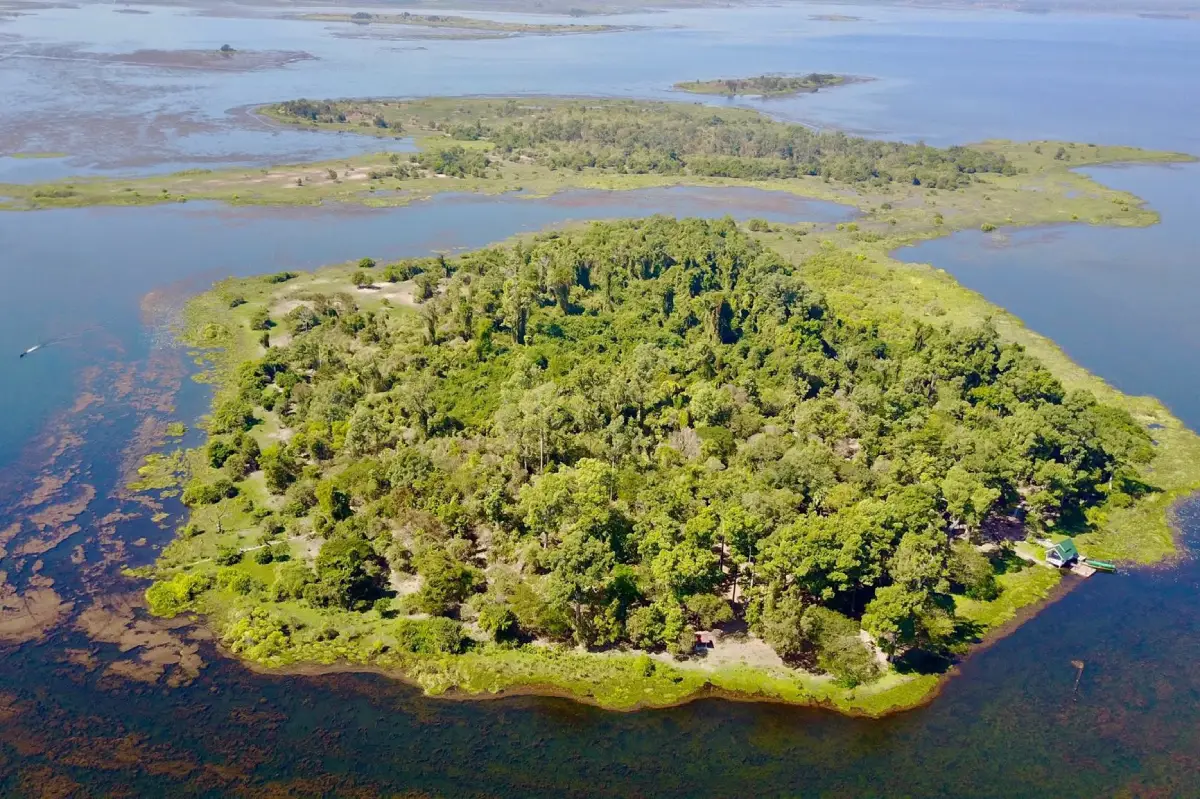
17. Koh Don Sawan Yai is a large freshwater island in the middle of Nong Han Lake, Mueang Sakon Nakhon District. The island contains mature trees, natural areas, old religious sites, Buddha images, sacred places, and wide views across the surrounding lake. Access is by boat from the city side, offering a very different experience from simply viewing Nong Han from the shore.
Highlights: Freshwater island, shaded natural environment, Nong Han viewpoints, old Buddha images, a locally revered water source, Naga sculptures, and walking routes around the island.
The Isan word “don” refers to raised land or an island that remains above floodwater. Koh Don Sawan Yai is therefore one of the significant raised islands within Nong Han and has both ecological and cultural importance to surrounding communities.
The island contains large trees and shaded areas suitable for slow walking. Its atmosphere is quieter than the urban shore, and different points around the island provide perspectives across Nong Han Lake that cannot be experienced from the mainland.
Naga stories and other beliefs associated with Nong Han add an additional cultural dimension to the island. Beyond enjoying nature, visitors can learn how islands and raised land within the lake feature in the imagination and worldview of lakeside communities.
Visitors usually reach the island by boat from Somdet Phra Srinagarindra Park or Sa Phang Thong. The crossing takes approximately 15–20 minutes. Visits are made as day trips, and overnight stays on the island are not permitted.
Weather conditions should be checked before departure. Boat trips should be postponed during strong winds, rain, or poor visibility. Children should wear life jackets and remain closely supervised throughout the journey.
Getting There: Boats depart from the city side near Somdet Phra Srinagarindra Park or Sa Phang Thong. Round-trip services generally operate from 08:00–17:00. There is no admission fee for the island, while boat charges depend on the operator’s current rate on the day of travel.
Map (GPS): https://www.google.com/maps/dir/?api=1&destination=17.181694,104.189921&travelmode=driving
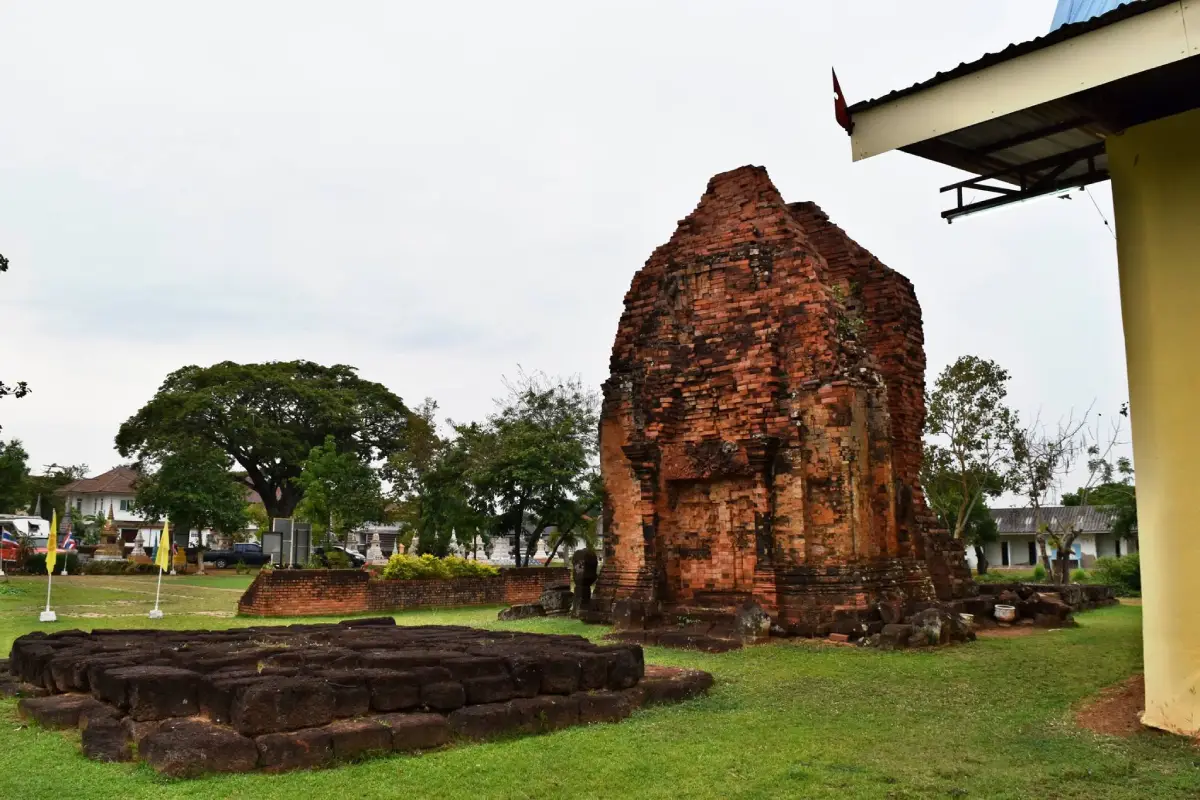
18. Phra That Dum is a Khmer archaeological monument at Ban That Dum, Ngio Don Subdistrict, Mueang Sakon Nakhon District, only a short distance from the city. The site originally consisted of 3 brick towers aligned north–south, although the central sanctuary is now the principal surviving structure.
Highlights: Ancient brick sanctuary, laterite base, sandstone lintels, Kala motifs, elephants, lions, scrolling foliage, and archaeological traces of the original 3-tower complex.
Phra That Dum dates to around the 11th–12th centuries CE and displays artistic characteristics associated with Khmer Baphuon to Angkor Wat-period influence. It is therefore another important piece of evidence showing that Sakon Nakhon was part of the wider cultural network of ancient Khmer civilization.
The surviving central tower has its true entrance on the eastern side, while the remaining 3 sides contain false doors. This architectural arrangement is common in Khmer religious monuments and emphasizes a clearly defined sacred axis.
Fragments of lintels and decorative carvings found at the site include Kala faces, lions, elephants, and plant motifs. These details are valuable evidence for understanding the religious beliefs and craftsmanship of the period in which the sanctuary was constructed.
In later centuries, the site came under the influence of Lan Xang culture and became associated with a Buddhist temple. Phra That Dum therefore provides a good example of a sacred place that continued to be used and reinterpreted across different historical periods.
Because it lies close to the city, Phra That Dum can be combined with Phra That Narai Cheng Weng and Wat Phra That Choeng Chum in a 1-day historical route, allowing visitors to compare ancient Khmer sanctuaries with Buddhist sacred monuments that developed in later periods.
Getting There: Phra That Dum is located within Wat Phra That Dum at Ban That Dum, Ngio Don Subdistrict, Mueang Sakon Nakhon District, only a few kilometers from the city center. The site can be visited daily during daylight hours. Admission is free.
Map (GPS): https://www.google.com/maps/dir/?api=1&destination=17.143584,104.164290&travelmode=driving
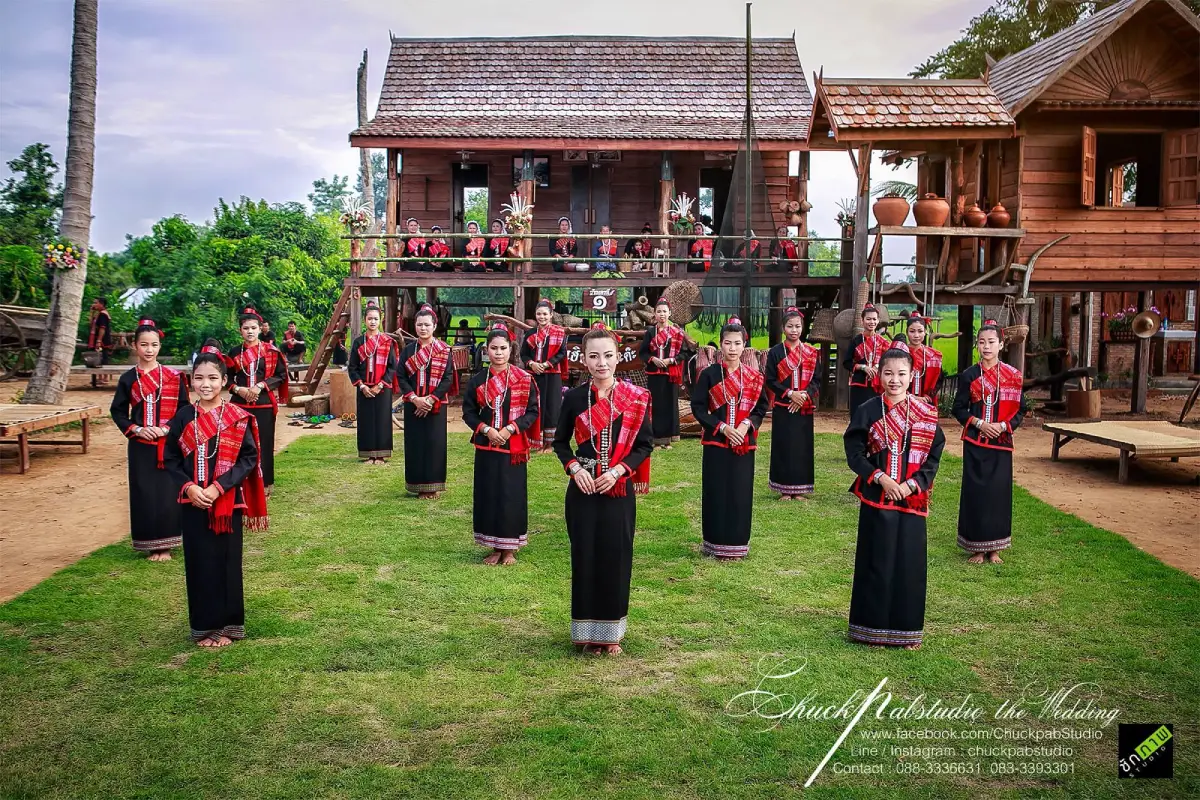
19. Phu Thai (Ban Non Hom) is a Phu Thai cultural community in Non Hom Subdistrict, Mueang Sakon Nakhon District. The community continues to preserve Phu Thai language, traditional dress, cuisine, weaving, rituals, dance, and everyday cultural practices, making it particularly suitable for travellers who want to understand Sakon Nakhon through its people and living heritage.
Highlights: Pha Laeng communal dinner, Phu Thai dance, traditional martial-arts performances, handwoven textiles, Phu Thai cuisine, traditional clothing, and community activities that express Phu Thai identity.
The Phu Thai people of Ban Non Hom trace their roots to migrations from the eastern side of the Mekong River into the Sakon Nakhon region more than a century ago. These movements created numerous Phu Thai communities across Sakon Nakhon and neighbouring provinces, each preserving distinctive accents, clothing, and cultural details.
The name Ban Non Hom is associated with both local geography and community memory. “Non” refers to elevated ground, while “Hom” is linked with Nai Hom, who played an important role in leading early settlers into the area.
One of the community’s best-known activities is Pha Laeng, an evening communal meal combined with traditional hospitality and cultural performances. Visitors may experience Phu Thai dance, local music, traditional dress, and regional food in a setting closely connected with community life.
Textile weaving is another important part of local identity. Phu Thai women are highly skilled in weaving and pattern design, with knowledge passed down through families. Purchasing textiles and community-made products helps support local income while contributing to the preservation of traditional skills.
Independent visitors can travel through the community, but organized Pha Laeng meals, dance performances, or group welcomes should be arranged in advance so that residents can prepare performers, food, and facilities appropriately.
Getting There: From Sakon Nakhon city, follow Highway 223 toward Na Kae for approximately 13 km before turning into Ban Non Hom. The community can generally be visited daily from 09:00–18:00. Pha Laeng dinners and cultural performances should be arranged in advance.
Map (GPS): https://www.google.com/maps/dir/?api=1&destination=17.053265,104.212502&travelmode=driving
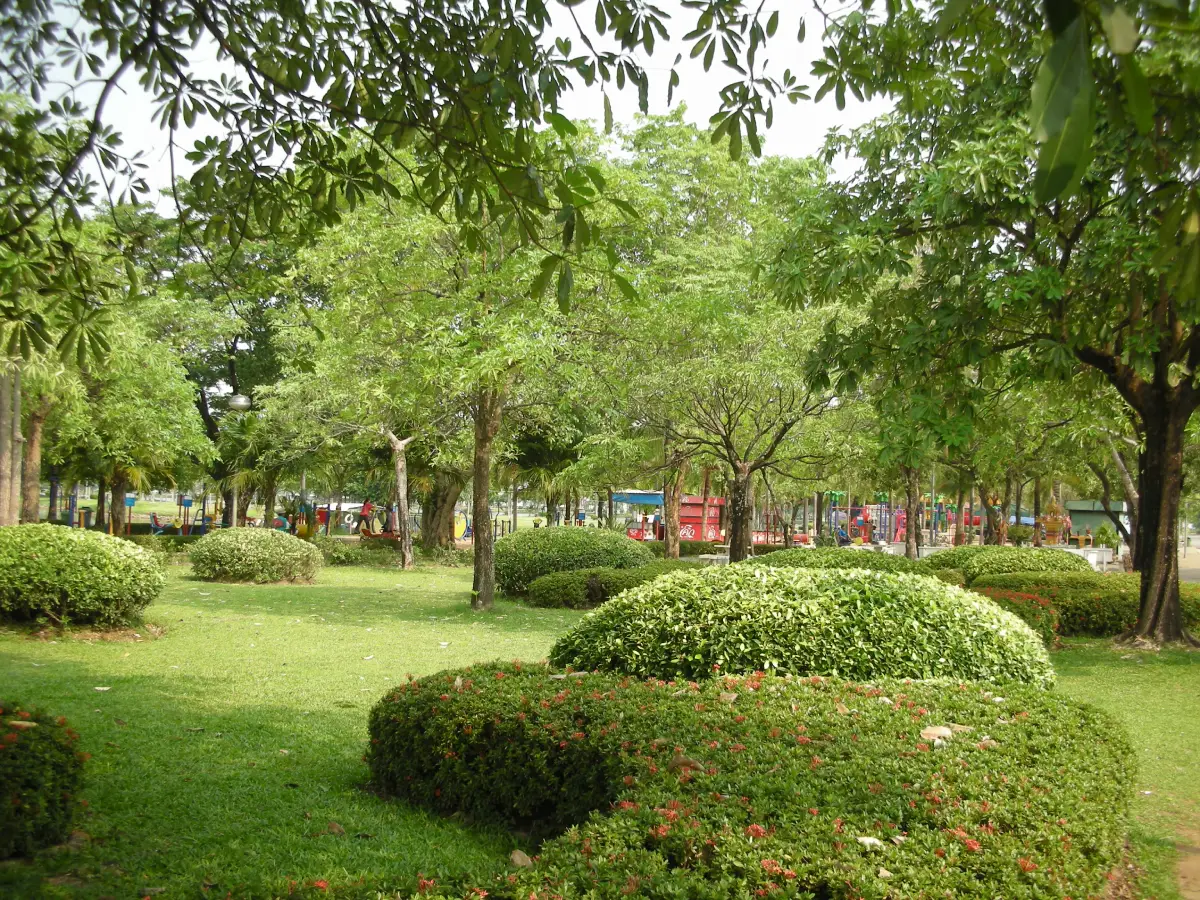
20. Somdet Phra Srinagarindra Park is a large public park beside Nong Han Lake in central Sakon Nakhon. The park surrounds Sa Phang Thong in That Choeng Chum Subdistrict, covers approximately 120 rai, and is one of the city’s most important green spaces for recreation, walking, jogging, exercise, and community activities.
Highlights: Sa Phang Thong, flower and ornamental gardens, forest garden, water garden, rock garden, exercise areas, fountains, and a convenient lakeside location connected with other central attractions.
The park was established to honor Her Royal Highness Princess Srinagarindra, the Princess Mother, on the occasion of her 80th birthday. It was the fifth Somdet Phra Srinagarindra Park and was officially opened by the Princess Mother on November 9, 1987.
One of the most important features is Sa Phang Thong, an ancient pond associated in local tradition with the construction of Phra That Choeng Chum. The park therefore has value not only as a recreational area but also as a landscape connected with the history and collective memory of Sakon Nakhon.
The park is divided into flower gardens, ornamental planting areas, forest sections, rock gardens, waterfront areas, walking paths, and exercise zones. It is suitable for families, older travellers, and visitors who want a relaxing break from longer-distance travel.
Morning and evening are the best times to observe everyday urban life, with residents walking, jogging, and exercising around the park. Travellers can also use the park as a starting point for viewing Nong Han Lake or taking a boat to Koh Don Sawan Yai.
A convenient route begins at Wat Phra That Choeng Chum, continues to Somdet Phra Srinagarindra Park and Sa Phang Thong, and then ends with views of Nong Han Lake or a boat trip to Koh Don Sawan Yai. This route combines faith, history, and nature within a relatively compact area.
Getting There: The park is located beside Nong Han Lake around Sa Phang Thong on Rueang Sawat Road, That Choeng Chum Subdistrict, Mueang Sakon Nakhon District. It is open daily from 05:00–21:00. Admission is free.
Map (GPS): https://www.google.com/maps/dir/?api=1&destination=17.166624,104.156330&travelmode=driving
| Topic | Details |
| Province Overview | Sakon Nakhon is an important province in the upper Northeast, known for sacred stupas, the Thai Forest Tradition, ancient Khmer sites, the Phu Phan Mountains, Nong Han Lake, Phu Thai communities, the historic Catholic community of Tha Rae, waterfalls, reservoirs, and protected natural areas. Visitors can spend 1 day exploring the city or 4–5 days travelling across several districts. |
| 20 Attractions in This Guide | 1. Wat Phra That Choeng Chum 2. Nong Han Lake 3. Wat Tham Pha Daen 4. Phu Phan National Park 5. Phra That Narai Cheng Weng 6. Ajahn Mun Bhuridatto Museum 7. Phu Phan Ratchaniwet Palace 8. Tha Rae Village (Catholic Community) 9. Bua Chaloem Phrakiat Park 10. Phra That Phu Phek 11. Ajahn Fan Acharo Museum 12. Phra That Si Mongkhon 13. Nam Oon Dam 14. Kham Hom Waterfall 15. Phu Pha Yon National Park 16. Huai Huat Reservoir 17. Koh Don Sawan Yai 18. Phra That Dum 19. Phu Thai (Ban Non Hom) 20. Somdet Phra Srinagarindra Park |
| Top 10 for First-Time Visitors | 1. Wat Phra That Choeng Chum 2. Nong Han Lake 3. Wat Tham Pha Daen 4. Phu Phan National Park 5. Phra That Narai Cheng Weng 6. Ajahn Mun Bhuridatto Museum 7. Phu Phan Ratchaniwet Palace 8. Tha Rae Village 9. Phra That Phu Phek 10. Phu Pha Yon National Park |
| City and Nong Han Zone | 1. Wat Phra That Choeng Chum 2. Nong Han Lake 3. Phra That Narai Cheng Weng 4. Ajahn Mun Bhuridatto Museum 5. Koh Don Sawan Yai 6. Phra That Dum 7. Phu Thai (Ban Non Hom) 8. Somdet Phra Srinagarindra Park Suitable for a 1–2 day itinerary focused on faith, history, the Thai Forest Tradition, local culture, and lake scenery. |
| Phu Phan Zone | 1. Wat Tham Pha Daen 2. Phu Phan National Park 3. Phu Phan Ratchaniwet Palace 4. Kham Hom Waterfall Ideal for mountain scenery, forests, waterfalls, viewpoints, Buddhist sites, and nature routes. |
| Phanna Nikhom–Phang Khon–Waritchaphum Zone | 1. Phra That Phu Phek 2. Ajahn Fan Acharo Museum 3. Nam Oon Dam 4. Phra That Si Mongkhon Suitable for ancient heritage, Thai Forest Tradition sites, reservoir scenery, and community culture. |
| Tao Ngoi–Phu Pha Yon Zone | 1. Phu Pha Yon National Park 2. Huai Huat Reservoir Suitable for forests, mountains, seasonal waterfalls, stargazing, camping, and reservoir scenery. |
| Tha Rae–Chiang Khruea Zone | 1. Tha Rae Village (Catholic Community) 2. Bua Chaloem Phrakiat Park Ideal for Catholic heritage, historic community architecture, and relaxing lotus-garden visits. |
| Temples and Faith Route | 1. Wat Phra That Choeng Chum – Luang Pho Phra Ong Saen 2. Wat Tham Pha Daen 3. Phra That Phu Phek 4. Phra That Si Mongkhon 5. Ajahn Mun Bhuridatto Museum 6. Ajahn Fan Acharo Museum |
| Thai Forest Tradition Route | 1. Ajahn Mun Bhuridatto Museum – Wat Pa Sutthawat 2. Ajahn Fan Acharo Museum – Wat Pa Udom Somphon 3. Wat Tham Pha Daen – mountain meditation site |
| History and Archaeology Route | 1. Phra That Narai Cheng Weng 2. Phra That Phu Phek 3. Phra That Dum 4. Wat Phra That Choeng Chum Suitable for travellers interested in Khmer artistic influence, ancient religious monuments, and the development of sacred architecture in Sakon Nakhon. |
| Nature and Scenic Route | 1. Nong Han Lake 2. Phu Phan National Park 3. Kham Hom Waterfall 4. Phu Pha Yon National Park 5. Huai Huat Reservoir 6. Nam Oon Dam 7. Koh Don Sawan Yai |
| Community and Cultural Route | 1. Tha Rae Village – Catholic heritage and historic houses 2. Phu Thai (Ban Non Hom) – language, cuisine, textiles, and Phu Thai dance 3. Phra That Si Mongkhon – faith and community traditions of Waritchaphum |
| Suitable for Families | Somdet Phra Srinagarindra Park, Bua Chaloem Phrakiat Park, Nong Han Lake, Tha Rae Village, and Nam Oon Dam are relatively easy to access and suitable for visitors of different ages. |
| Suitable for Older Travellers | Wat Phra That Choeng Chum, Ajahn Mun Bhuridatto Museum, Tha Rae Village, Bua Chaloem Phrakiat Park, and Somdet Phra Srinagarindra Park are generally more accessible than attractions requiring mountain climbs or nature trails, such as Phra That Phu Phek. |
| Sunrise Views | The Nong Han lakeside is suitable for sunrise views over the water. Choose an open shoreline location facing east and check weather conditions on the day of travel. |
| Sunset Spots | 1. Huai Huat Reservoir 2. Nam Oon Dam 3. Nong Han Lake 4. Koh Don Sawan Yai |
| 1-Day Itinerary | Morning: Wat Phra That Choeng Chum – Ajahn Mun Bhuridatto Museum – Phra That Dum Afternoon: Phra That Narai Cheng Weng – Somdet Phra Srinagarindra Park Evening: Nong Han Lake |
| 2 Days / 1 Night | Day 1: City center – Wat Phra That Choeng Chum – Phra That Dum – Ajahn Mun Bhuridatto Museum – Nong Han Lake Day 2: Wat Tham Pha Daen – Phu Phan Ratchaniwet Palace – Phu Phan National Park – Kham Hom Waterfall |
| 3 Days / 2 Nights | Day 1: Sakon Nakhon city and Nong Han Lake Day 2: Wat Tham Pha Daen – Phu Phan – Kham Hom Waterfall Day 3: Phra That Phu Phek – Ajahn Fan Acharo Museum – Nam Oon Dam – Phra That Si Mongkhon |
| 4 Days / 3 Nights | Add Tha Rae Village and Bua Chaloem Phrakiat Park, grouping Tha Rae and Chiang Khruea into the same day to reduce unnecessary backtracking. |
| 5 Days / 4 Nights | Add Phu Pha Yon National Park, Huai Huat Reservoir, and Phu Thai (Ban Non Hom). This is suitable for travellers who want to cover faith, history, the Thai Forest Tradition, community culture, and nature in greater depth. |
| Best Time to Visit | November–February is generally the most comfortable period because temperatures are cooler, making it suitable for temples, sacred monuments, the Phu Phan Mountains, and outdoor activities. |
| Waterfall Season | Kham Hom Waterfall and waterfalls in the Phu Phan mountain area are generally at their best from the rainy season into early winter. Water levels may decline significantly during the dry season. |
| Wax Castle Festival | One of Sakon Nakhon’s most important traditions, held around the end of Buddhist Lent. Elaborate wax castles are created and carried in procession to Wat Phra That Choeng Chum, reflecting religious devotion, craftsmanship, and strong community participation. |
| Tha Rae Christmas | Tha Rae is famous for its Christmas Star Parade. Houses and streets are decorated with numerous stars, while large illuminated star floats reflect the Catholic heritage that has been preserved in the community for generations. |
| Getting Around the Province | Attractions in the city can be reached by local transport or private vehicle, but a private car, rental car, or hired vehicle with driver is recommended for Phu Phan, Phanna Nikhom, Waritchaphum, Phang Khon, and Tao Ngoi because attractions are spread out and public transport does not serve every site. |
| Food to Try | Traditional Isan cuisine, freshwater fish and dishes from Nong Han Lake, jaew dipping sauces, larb, koi, kaeng om, som tam, grilled chicken, Phu Thai food, and local dishes from different communities across Sakon Nakhon. |
| Souvenirs | Indigo-dyed textiles, Phu Thai woven fabrics, community-made products, handicrafts, processed foods, and locally produced souvenirs from communities around the province. |
| Mountain Safety | Check weather and trail conditions before visiting Phu Phan National Park, Phu Pha Yon National Park, Kham Hom Waterfall, and Phra That Phu Phek. Take extra care on slippery rock surfaces during the rainy season and remain on designated routes. |
| Water Safety | When taking a boat on Nong Han Lake or travelling to Koh Don Sawan Yai, use organized boat services, wear a life jacket, and avoid travelling during rain, strong winds, or poor visibility. |
| Responsible Travel | Dress respectfully at temples and religious sites, do not climb archaeological monuments, avoid touching historic objects unnecessarily, remain quiet in forest monasteries, do not disturb wildlife, take rubbish away, and support local community products and services. |
Frequently Asked Questions (FAQ)
Q: What are the must-visit attractions in Sakon Nakhon?
A: First-time visitors should consider Wat Phra That Choeng Chum, Nong Han Lake, Wat Tham Pha Daen, Phu Phan National Park, Phra That Narai Cheng Weng, Ajahn Mun Bhuridatto Museum, Phu Phan Ratchaniwet Palace, Tha Rae Village, Phra That Phu Phek, and Phu Pha Yon National Park.
Q: Where should I go if I have only 1 day in Sakon Nakhon?
A: Focus on the city area. Begin at Wat Phra That Choeng Chum, continue to Ajahn Mun Bhuridatto Museum, Phra That Dum, and Phra That Narai Cheng Weng, then finish the afternoon at Somdet Phra Srinagarindra Park and enjoy Nong Han Lake in the evening.
Q: How many days are recommended for visiting Sakon Nakhon?
A: 3 days are suitable for the main landmarks in the city, Phu Phan, and Phanna Nikhom. Travellers who want to visit all 20 attractions, including Tha Rae, Waritchaphum, Tao Ngoi, and Phu Pha Yon, should allow around 4–5 days.
Q: Which temple is one of the most important in Sakon Nakhon?
A: Wat Phra That Choeng Chum is a royal temple and houses the sacred Phra That Choeng Chum together with Luang Pho Phra Ong Saen, making it one of the province’s most important spiritual centers.
Q: What is special about Wat Tham Pha Daen?
A: Wat Tham Pha Daen is known for Buddhist art integrated into the Phu Phan mountain landscape, including sandstone carvings, Naga sculptures, Buddha images, chedis, mountain gardens, and viewpoints. Visitors use a shuttle service from the lower parking area to reach the temple.
Q: Where can I learn about the Thai Forest Tradition in Sakon Nakhon?
A: The key sites are Ajahn Mun Bhuridatto Museum at Wat Pa Sutthawat and Ajahn Fan Acharo Museum at Wat Pa Udom Somphon. Together, they provide a strong introduction to the history and practices of the Thai Forest Tradition.
Q: Is Phra That Phu Phek difficult to climb?
A: Reaching Phra That Phu Phek requires climbing approximately 491 steps. Visitors with knee problems, heart conditions, or mobility limitations should assess their physical condition before climbing. Morning is generally the most comfortable time.
Q: Which Khmer archaeological sites should I visit in Sakon Nakhon?
A: Phra That Narai Cheng Weng, Phra That Phu Phek, and Phra That Dum are the principal choices. All 3 preserve evidence of Khmer artistic influence in Sakon Nakhon but are located in different geographical settings.
Q: How can I explore Nong Han Lake?
A: Visitors can enjoy the lake from shoreline areas such as Somdet Phra Srinagarindra Park and Sa Phang Thong, or take a boat to Koh Don Sawan Yai for nature and panoramic views from the middle of the lake.
Q: Can I stay overnight on Koh Don Sawan Yai?
A: No. Visits to Koh Don Sawan Yai are day trips only, and overnight stays are not permitted. Travellers should return to the mainland before boat services end.
Q: What is interesting about Tha Rae Village?
A: Major highlights include St. Michael the Archangel Cathedral, historic colonial and French-influenced houses, the history of the Catholic community beside Nong Han Lake, and the Christmas Star Parade.
Q: What is the Tha Rae Christmas festival famous for?
A: Tha Rae is famous for its Christmas star decorations and Star Parade, which reflect the community’s Catholic identity and have become one of Sakon Nakhon’s major year-end tourism events.
Q: Which Sakon Nakhon attractions are suitable for families?
A: Bua Chaloem Phrakiat Park, Somdet Phra Srinagarindra Park, Nong Han Lake, Tha Rae Village, and Nam Oon Dam are relatively easy to access and offer experiences suitable for families.
Q: Where should I go for nature in Sakon Nakhon?
A: The Phu Phan Mountains and Tao Ngoi District are the main areas for nature-based travel, with Phu Phan National Park, Kham Hom Waterfall, Phu Pha Yon National Park, and Huai Huat Reservoir offering forests, mountains, waterfalls, viewpoints, and outdoor activities.
Q: When is the best time to visit Kham Hom Waterfall?
A: The rainy season through early winter is generally the best period because water levels are higher and the Phu Phan forest is lush. During the dry season, water levels can fall considerably and some rock sections may become dry.
Q: What is special about Ban Non Hom?
A: Ban Non Hom is a Phu Thai community that preserves its language, traditional clothing, weaving, cuisine, Phu Thai dance, traditional martial arts, and Pha Laeng communal dining. Organized cultural performances and group activities should be arranged in advance.
Q: Which attraction is connected with the Wax Castle Festival?
A: The Wax Castle Festival is closely associated with Wat Phra That Choeng Chum. During the end of Buddhist Lent, elaborate wax castles are created and carried in procession to the temple as religious offerings.
Q: Can I travel around Sakon Nakhon without a private car?
A: Attractions in central Sakon Nakhon can be reached by local transport, but a private car, rental car, or hired vehicle with driver is more convenient for Wat Tham Pha Daen, Phu Phan, Phanna Nikhom, Phang Khon, Waritchaphum, and Tao Ngoi.
Q: How should I plan my Sakon Nakhon itinerary to avoid backtracking?
A: Divide the province into zones: city center–Nong Han Lake, Phu Phan, Phanna Nikhom–Phang Khon–Waritchaphum, Tha Rae–Chiang Khruea, and Tao Ngoi–Phu Pha Yon. Complete each zone before moving to the next.
Q: What is the best season to visit Sakon Nakhon?
A: November–February is generally the most comfortable period for overall travel, especially for Phu Phan routes and outdoor activities. Travellers interested in waterfalls should consider the rainy season through early winter.
 Category: ●Travel Articles, Recipes
 Group: ●Travel Review, Food Review
Last Update : 3 WeekAgo
 Last Update : 3 WeekAgo
Recommend

 Art, Culture and Heritage
 Historical Sites and Monuments(9)
 Landmarks and Memorials(2)
 Royal Palace(1)
 Art, Craft Centres, Tradition(8)
 Museums(3)
 Educational Places
 Educational Gardens, Farm(2)
 Places of Worship
 Temple(18)
 Church(2)
 Other Sacred Sites(4)
 Research and Development
 Royal Project(3)
 Suburban Living
 Village, Community(7)
 Nature and Wildlife
 National Parks and Marine Reserves(4)
 Mountain (Doi)(3)
 Dam, Reservoir, Lake(14)
 Waterfalls(4)
 Caves(4)
 River, Canal(9)
 Bays and Beaches(1)
 Islands(1)
 Other natural attractions(5)
 Entertainment and Agricultural
 Zoos and Aquariums(1)
 Farms, Parks and Ecotourism(4)
 Outdoor and Adventure Activities(1)
Travel Review, Food Review(1)


