
lovethailand home >Northeastern Travel Attractions >Sakon Nakhon Travel Attractions >Muang Sakon Nakhon >Non Hom > Phu Thai (Ban Non Hom)
TL;DR: Phu Thai (Ban Non Hom) is located at Non Hom Subdistrict, Mueang Sakon Nakhon District, Sakon Nakhon Province 47000, Thailand, open Daily; Palang dinner and cultural performances should be booked in advance, hours 09.00 – 18.00.
Phu Thai (Ban Non Hom)
Open Days: Daily; Palang dinner and cultural performances should be booked in advance
Opening Hours: 09.00 – 18.00
The Phu Thai Community of Ban Non Hom in Non Hom Subdistrict, Mueang Sakon Nakhon District, Sakon Nakhon Province, is one of the most meaningful cultural communities for travelers who want to understand northeastern Thailand beyond ordinary sightseeing. This is a living Phu Thai village where language, traditional dress, food culture, textile wisdom, folk dance, community rituals, and local hospitality remain part of everyday life. Visitors can experience Palang, an evening meal shared with the Phu Thai villagers, watch graceful Phu Thai dance, learn about traditional weaving, and discover the migration history of the Phu Thai people from the left bank of the Mekong River to the foothills of the Phu Phan range in Sakon Nakhon.
Ban Non Hom is not a place designed only for quick photographs. It is a cultural landscape where local identity continues through people, food, speech, costume, craft, and memory. Many villagers still maintain the Phu Thai language and a strong sense of kinship. Respect for elders, ancestral belief, community cooperation, and a close relationship with nature remain visible in the rhythm of daily life. When travelers enter the village, they encounter a calm rural atmosphere surrounded by agricultural land, community roads, and cultural learning areas connected to the Sakon Nakhon–Na Kae route.
The story of Ban Non Hom is closely linked to the migration of the Phu Thai people across the Mekong River more than a century ago. Their ancestors moved from areas in present-day Laos, crossed the Mekong, traveled along the Phu Phan mountain range, and settled in places suitable for farming and community life. Some groups chose areas near water sources, while others settled on higher ground near the foothills. Over time, Ban Non Hom became a Phu Thai village with a strong identity expressed through language, dress, cuisine, ritual, oral history, and forms of hospitality that remain distinctive in Sakon Nakhon today.
The name Non Hom carries local meaning. The word “non” refers to raised ground or a mound, while “Hom” is associated with Nai Hom, an early community leader who played an important role in bringing villagers to settle in this area. The name therefore reflects both the physical landscape and the memory of local settlement. This connection between place, person, and community history gives Ban Non Hom a cultural depth that travelers can still sense when listening to local stories and observing the way the villagers speak about their roots.
One of the most important features of Ban Non Hom is its ability to preserve Phu Thai traditions within ordinary life. The villagers value family relationships, community bonds, respect for ancestors, and ritual connections with the natural world. Beliefs related to ancestral spirits and sacred community guardians continue to shape the way people understand farming seasons, protection, health, and social harmony. This makes Ban Non Hom especially valuable for travelers interested in culture as a living practice rather than as something displayed only in museums.
The best-known cultural experience in Ban Non Hom is Palang. In the Phu Thai context, Palang means sharing an evening meal with the villagers. It is not simply dinner; it is a form of welcome. During Palang, visitors sit with the host community, taste local food, listen to explanations, exchange conversation, and experience the warmth of Phu Thai hospitality. The meal becomes a bridge between guests and hosts. Through food, speech, music, and performance, travelers come closer to the values of generosity, togetherness, and respect that shape village life.
Phu Thai food in Ban Non Hom is deeply connected to local ingredients and seasonal knowledge. Dishes may include vegetables, herbs, bamboo shoots, freshwater ingredients, fermented flavors, and local products associated with Sakon Nakhon. The food is not arranged only for visual appeal; it expresses the relationship between the villagers and the surrounding fields, streams, forests, and agricultural landscape. Eating with the community allows visitors to understand that local cuisine is more than taste. It is a record of land, labor, memory, and seasonal adaptation.
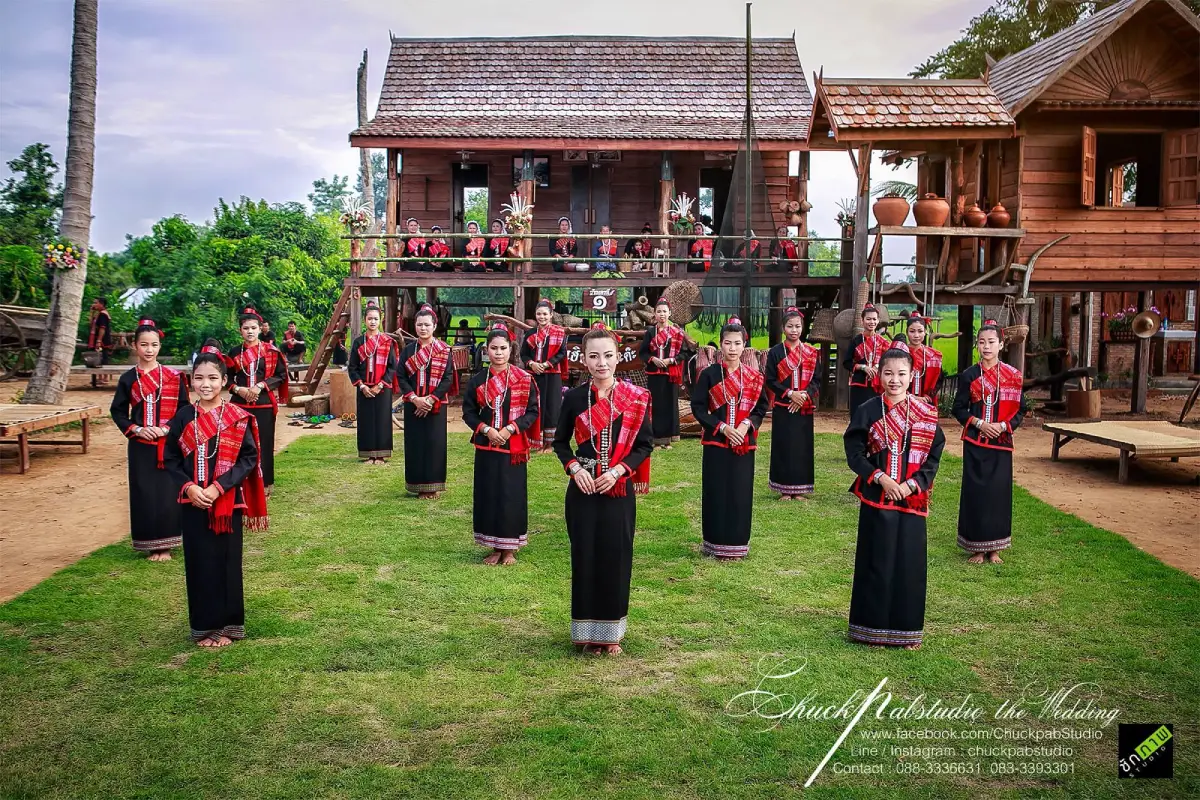
Another highlight is the Phu Thai dance performance. Phu Thai dance is graceful, controlled, and filled with symbolic body language. Performers usually wear traditional woven garments in dark tones such as black, red, or indigo, often decorated with local textiles and ornaments. The dance is not merely entertainment. It represents pride in ethnic roots, continuity between generations, and the beauty of a folk art that remains meaningful to the community. Watching the young and old share this tradition shows how Ban Non Hom keeps its cultural identity alive.
Ancient martial dance adds another layer to the cultural experience. While Phu Thai dance often emphasizes grace, ancient martial dance reflects strength, discipline, agility, and the protective spirit of the community. Its movements combine artistic expression with gestures that recall older forms of self-defense and masculine energy. This performance helps travelers understand that Phu Thai culture includes both delicacy and strength, both softness and resilience, both beauty and readiness to protect the community.
Ban Non Hom is also a good place to learn about weaving and indigo-dyed textiles, two important forms of wisdom in Sakon Nakhon. Local fabrics are not only clothing; they are cultural markers. Patterns, colors, and weaving techniques reveal the skill of local women and the value of inherited knowledge. Traditional textiles are used in daily life, ceremonies, performances, and community identity. For travelers interested in craft, Ban Non Hom offers a way to understand how cloth connects economy, aesthetics, gender roles, and ethnic memory.
The strength of Ban Non Hom lies in the completeness of its cultural experience. In one community, travelers can learn about migration history, Phu Thai language, rural life, traditional food, local dress, belief, performance, weaving, and community-based tourism. The village is suitable for families, students, cultural travelers, study groups, and foreign visitors who want to understand Sakon Nakhon through people and living heritage rather than only through monuments or well-known temples.
Non Hom Market, known as Talat Non Hom Withi Chumchon Khon Phu Thai, extends the visitor experience beyond the village itself. Located along the Sakon Nakhon–Na Kae road, the market offers local agricultural products, seasonal fruit, plants, community goods, souvenirs, and everyday items from the area. It functions as a local economic space, a roadside stop, and a gateway to the Phu Thai way of life. Travelers can stop here before or after visiting the community to see how local trade supports household income and keeps community products visible.
A trip to Ban Non Hom can be connected with several nearby attractions. Kaeng Tan Pat on the Phung River adds a natural dimension to the route. Farm Hug Sakon Nakhon and the Phon Yang Kham cattle cooperative introduce travelers to Sakon Nakhon’s famous beef culture. Wat Phra That Choeng Chum Worawihan and Nong Han bring visitors back to the religious and geographical heart of the city. Phu Phan Royal Palace adds a mountain and historical landscape to the journey. Together, these places make Ban Non Hom a strong starting point for a cultural route in Sakon Nakhon.
Kaeng Tan Pat is a nearby natural site that helps visitors see the relationship between the village and the surrounding water landscape. The route passes agricultural land and rural scenery, allowing travelers to understand the geography that has supported village life. A short visit to this riverside area can complement the cultural program by showing how water, fields, and rural pathways are part of the wider environment of Ban Non Hom.
Farm Hug Sakon Nakhon and the Phon Yang Kham cooperative are useful additions for travelers who want to combine culture with food. Sakon Nakhon is widely associated with Phon Yang Kham beef, and the route between the city and Non Hom includes restaurants and food stops that highlight this identity. After learning about Phu Thai culture, travelers can continue to taste local beef dishes, visit a roadside farm-style restaurant, or purchase local products before returning to the city.
For travelers interested in religious culture, Ban Non Hom pairs well with Wat Phra That Choeng Chum Worawihan. This important temple is one of Sakon Nakhon’s major spiritual landmarks and is closely associated with the city’s identity. A route that combines the temple with Ban Non Hom allows visitors to see two complementary sides of Sakon Nakhon: the sacred urban center and the living ethnic community in the rural landscape.
Nong Han is another important entity in the landscape of Sakon Nakhon. The migration history of the Phu Thai people and the development of settlements in the region are connected to lowland areas, water systems, and routes around the Phu Phan range. Mentioning Nong Han in connection with Ban Non Hom helps visitors understand that local history is shaped not only by people, but also by water, land, mountains, and routes of movement.
The atmosphere of Ban Non Hom is best appreciated slowly. This is not a destination to rush through. Visitors should allow time to listen, observe, taste, and speak with local hosts. The details matter: the rhythm of the language, the arrangement of food, the color of the costumes, the gestures of the dance, the texture of woven cloth, and the role of elders in storytelling. These elements turn a visit into a deeper cultural encounter.
Foreign travelers will find Ban Non Hom especially useful for understanding Thailand’s cultural diversity. Thailand is not defined by a single cultural form. In Ban Non Hom, visitors encounter a distinct ethnic community with its own language, clothing, cuisine, history, and performance tradition. This experience helps travelers see Isan, or northeastern Thailand, as a region of layered identities and living heritage. A Phu Thai performance or Palang meal can explain local culture more vividly than a conventional sightseeing stop.
Advance contact is important for visitors who want to join Palang or watch a cultural performance. These activities require preparation: food must be arranged, performers must be scheduled, the venue must be prepared, and the program must match the size and needs of the group. Booking ahead helps the community provide a complete experience and allows visitors to receive updated details about timing, meeting points, and activity arrangements.
Respectful behavior is essential when visiting Ban Non Hom. Travelers should dress modestly for cultural activities, ask before taking portraits, especially of elders, children, and performers, and listen carefully to local explanations. A community visit is not only a consumer experience. It is a relationship between guests and hosts. Good manners help preserve the dignity of the community and make cultural tourism beneficial for both sides.
The best travel schedule is usually from late morning to evening. Visitors can explore the community, stop at Non Hom Market, learn about textiles or local life, and then join Palang in the evening. For group visits, the itinerary should include time for a village introduction, cultural explanation, food, and performance without rushing. The value of Ban Non Hom comes from allowing the stories of the community to unfold at a natural pace.
Ban Non Hom is also valuable as an educational field site. Students, researchers, and study groups interested in ethnicity, anthropology, folklore, local food, textile craft, and folk performance can use the community as a real-world classroom. The village offers insight into migration, settlement, adaptation, cultural preservation, and community-based tourism management. Learning in the field allows visitors to notice details that books alone cannot fully convey.
For photographers, Ban Non Hom offers many meaningful subjects: Phu Thai costumes, woven textiles, Palang settings, local food, roadside market scenes, agricultural landscapes, and warm community moments. The best photographs are those made with respect. Visitors should remember that every image involves people who own their culture and deserve dignity. A good travel photograph from Ban Non Hom should capture not only beauty, but also relationship and respect.
Ban Non Hom can be included in a one-day cultural itinerary around Sakon Nakhon. A traveler can begin with Wat Phra That Choeng Chum Worawihan, continue to Ban Non Hom for Phu Thai culture, visit Non Hom Market or a local beef restaurant along the route, and then add Nong Han or Phu Phan Royal Palace depending on available time. This route connects temple, village, food, craft, nature, and local identity in one coherent journey.
For foreign visitors, having a local guide or community coordinator is especially helpful. Many aspects of the experience are rooted in language and belief. The word Palang, the meaning of Phu Thai costumes, the role of ancestral memory, and the significance of community dance are easier to understand when explained in context. With good interpretation, Ban Non Hom becomes more than a cultural show; it becomes an introduction to the worldview of a living ethnic community.
Traveling to Ban Non Hom is convenient by private car, van, or group bus. From Sakon Nakhon city, take Highway 223 on the Sakon Nakhon–Na Kae route for about 13 km, then turn right and continue for about 2 km into the village. The total distance from the city is about 15 km, making it suitable for a half-day or full-day trip. The route also connects easily with Non Hom Market, Farm Hug, the Phon Yang Kham cooperative, and other attractions in Mueang Sakon Nakhon District.
Getting There from Sakon Nakhon city, follow Highway 223 toward Na Kae for about 13 km. At the right-hand junction, turn into Ban Non Hom and continue for about 2 km. Group travelers should contact the community in advance to confirm the meeting point, activity schedule, and cultural program. Those continuing to Non Hom Market, Farm Hug, or the Phon Yang Kham area can use the same route to connect local food, market life, and cultural experiences conveniently.
Ban Non Hom is a destination for travelers who want to understand Sakon Nakhon through people. Its beauty is found not only in places, but in language, food, dance, cloth, stories, and the pride of a community that continues to carry its heritage forward. A visit here offers a clear and memorable encounter with Phu Thai culture in northeastern Thailand.
| Name | Phu Thai Community of Ban Non Hom |
| Location | Non Hom Subdistrict, Mueang Sakon Nakhon District, Sakon Nakhon Province 47000, Thailand |
| Activity Contact Address | Ban Non Hom Marketing Demonstration Center, No. 5, Moo 2, Non Hom Subdistrict, Mueang Sakon Nakhon District, Sakon Nakhon 47000 |
| Navigation Coordinates For Non Hom Market Area | 17.070115, 104.215309 |
| Highlights | A long-established Phu Thai cultural community in Sakon Nakhon with Palang evening meals, Phu Thai dance, ancient martial dance, local textiles, traditional food, and living rural heritage |
| History | The ancestors of Ban Non Hom’s Phu Thai people migrated from the left bank of the Mekong River more than a century ago and settled in the Sakon Nakhon area near the Phu Phan range |
| Name Origin | The name Non Hom is connected to raised ground and Nai Hom, an early leader associated with the settlement of the community |
| Distinctive Features | Phu Thai language, traditional costume, local rituals, community food culture, woven textiles, folk dance, and ethnic identity preserved within everyday life |
| Travel Information | From Sakon Nakhon city, take Highway 223 toward Na Kae for about 13 km, then turn right and continue about 2 km into Ban Non Hom |
| Current Status | Open as a cultural tourism and study-visit community; Palang dinner and dance performances should be arranged in advance |
| Open Days | Daily |
| Opening Hours | 09.00 – 18.00 |
| Facilities | Private car access, bus access for groups, community activity areas, visitor reception areas, and a nearby community market along the Sakon Nakhon–Na Kae route |
| Main Areas / Zones | Ban Non Hom Marketing Demonstration Center Palang dinner and Phu Thai dance activity area Phu Thai lifestyle and textile learning area Non Hom Market, Local Phu Thai Community Market Community route and nearby natural areas |
| Caretaker / Community Coordinator | Mr. Sorachai Khanphiakaeo |
| Main Contact Number | 081-999-2007 |
| Additional Information Number | 042-513-490-1 |
| Nearby Tourist Attractions | 1. Non Hom Market, Local Phu Thai Community Market, about 2 km 2. Kaeng Tan Pat, Phung River, about 5 km 3. Farm Hug Sakon Nakhon, about 7 km 4. Phon Yang Kham Cattle Cooperative, about 8 km 5. Wat Phra That Choeng Chum Worawihan, about 17 km 6. Nong Han Lake, about 18 km 7. Phu Phan Royal Palace, about 29 km |
| Nearby Restaurants | 1. Khokhun Khun Thong Phon Yang Kham @ Farm Hug, about 7 km, Tel. 098-929-3565, 088-572-6288 2. Steak Sahakon Phon Yang Kham Sakon Nakhon, about 8 km, Tel. 081-676-7946 3. Come Home Sakon Nakhon, about 19 km, Tel. 081-873-7564 4. Big-Aon Naem Nueng, about 18 km, Tel. 080-295-7181 5. Orawan Naem Nueng, about 18 km 6. Willy Naem Nueng Sakon Nakhon, about 18 km |
| Nearby Accommodations | 1. At Sakon Hotel, about 18 km, Tel. 042-713-234 2. Nong Han Elegant Hotel, about 18 km, Tel. 042-713-338, 085-680-9155 3. Hop Inn Sakon Nakhon, about 18 km, Tel. 042-716-399 4. TAFAH Residence, about 18 km, Tel. 042-712-710, 088-571-9995 5. U Style Hotel, about 22 km, Tel. 042-724-032, 088-564-4724 6. Sakol Grand Palace, about 18 km, Tel. 042-714-886 |
Frequently Asked Questions (FAQ)
Q: Where is the Phu Thai community of Ban Non Hom located?
A: It is located in Non Hom Subdistrict, Mueang Sakon Nakhon District, Sakon Nakhon Province, about 15 km from Sakon Nakhon city via the Sakon Nakhon–Na Kae route.
Q: What is Ban Non Hom known for?
A: Ban Non Hom is known for Phu Thai culture, Palang evening meals, Phu Thai dance, ancient martial dance, traditional food, local weaving, and a living ethnic community atmosphere.
Q: What does Palang mean?
A: Palang means sharing an evening meal with the Phu Thai villagers. It is a welcoming cultural experience that combines local food, conversation, and community performance.
Q: Should visitors book Palang and cultural performances in advance?
A: Yes. Advance booking is recommended because the community needs to prepare food, performers, activity space, and the visitor program according to group size.
Q: How do travelers get to Ban Non Hom from Sakon Nakhon city?
A: Take Highway 223 toward Na Kae for about 13 km, then turn right and continue for about 2 km into Ban Non Hom.
Q: Who is Ban Non Hom suitable for?
A: It is suitable for cultural travelers, families, students, study groups, and foreign visitors who want to learn about the Phu Thai ethnic heritage of Sakon Nakhon.
Q: What nearby attractions can be combined with Ban Non Hom?
A: Travelers can visit Non Hom Market, Kaeng Tan Pat, Farm Hug, the Phon Yang Kham cooperative, Wat Phra That Choeng Chum Worawihan, Nong Han Lake, and Phu Phan Royal Palace.
Q: How should visitors behave when visiting Ban Non Hom?
A: Visitors should dress respectfully, ask permission before taking portraits, listen to local explanations, and treat the community as a living cultural space.
 Category: ●Suburban Living
 Group: ●Village, Community
Last Update : 3 MonthAgo
 Last Update : 3 MonthAgo
 Click to Access the Navigation Map GPS
Phu Thai (Ban Non Hom) Map
Recommend

 Art, Culture and Heritage
 Historical Sites and Monuments(9)
 Landmarks and Memorials(2)
 Royal Palace(1)
 Art, Craft Centres, Tradition(8)
 Museums(3)
 Educational Places
 Educational Gardens, Farm(2)
 Places of Worship
 Temple(18)
 Church(2)
 Other Sacred Sites(4)
 Research and Development
 Royal Project(3)
Village, Community(7)
 Nature and Wildlife
 National Parks and Marine Reserves(4)
 Mountain (Doi)(3)
 Dam, Reservoir, Lake(14)
 Waterfalls(4)
 Caves(4)
 River, Canal(9)
 Bays and Beaches(1)
 Islands(1)
 Other natural attractions(5)
 Entertainment and Agricultural
 Zoos and Aquariums(1)
 Farms, Parks and Ecotourism(4)
 Outdoor and Adventure Activities(1)
 Travel Articles, Recipes
 Travel Review, Food Review(1)


