
lovethailand home >Northeastern Travel Attractions >Sakon Nakhon Travel Attractions >Muang Sakon Nakhon >That Choeng Chum > Phra That Narai Cheng Weng
TL;DR: Phra That Narai Cheng Weng is located at Ban That, That Na Weng Subdistrict, Mueang Sakon Nakhon District, Sakon Nakhon Province, open Daily, hours 06.00 – 18.00.
Phra That Narai Cheng Weng
Open Days: Daily
Opening Hours: 06.00 – 18.00
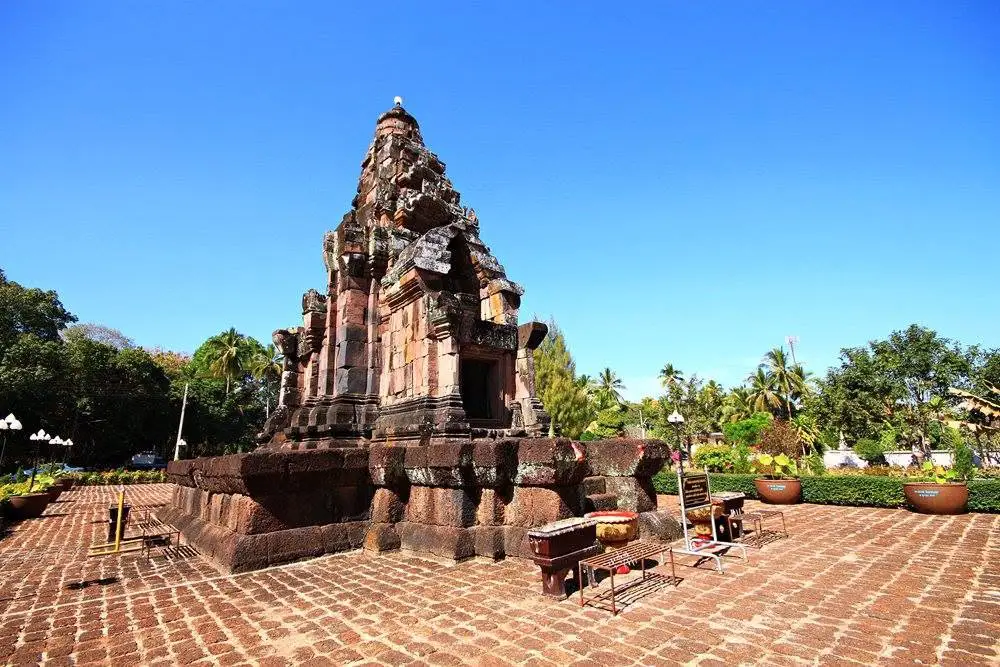
Phra That Narai Cheng Weng in Sakon Nakhon is an ancient Khmer-style sandstone sanctuary located inside Wat Phra That Narai Cheng Weng in Ban That, That Na Weng Subdistrict, Mueang Sakon Nakhon District. The monument stands on a large laterite base and is known for its richly carved lintels and pediments, including Krishna Slaying A Lion, Indra Riding Erawan, Shiva Nataraja, Krishna Subduing Kaliya, and Vishnu Reclining On Ananta. It is open daily, free to visit, and easy to reach from Sakon Nakhon city by Highway 22.
Phra That Narai Cheng Weng is one of the most important cultural and archaeological landmarks in Sakon Nakhon Province. Located inside Wat Phra That Narai Cheng Weng in Ban That, That Na Weng Subdistrict, the site combines ancient Khmer architecture, Hindu iconography, Buddhist devotion, and local legend in one compact temple compound. For foreign travelers, it is an excellent place to understand how Sakon Nakhon connects with the wider history of northeastern Thailand and mainland Southeast Asia.
The monument is situated about 5–6 km from Sakon Nakhon city center, near the Sakon Nakhon–Udon Thani route on Highway 22. This makes it one of the easiest Khmer-era archaeological sites to visit in the city area. Travelers can combine a visit here with Wat Phra That Choeng Chum Worawihan, Wat Pa Suthawat, Phu Phan Museum, Suan Somdet Phra Srinagarindra Park, and other cultural attractions in Mueang Sakon Nakhon District.
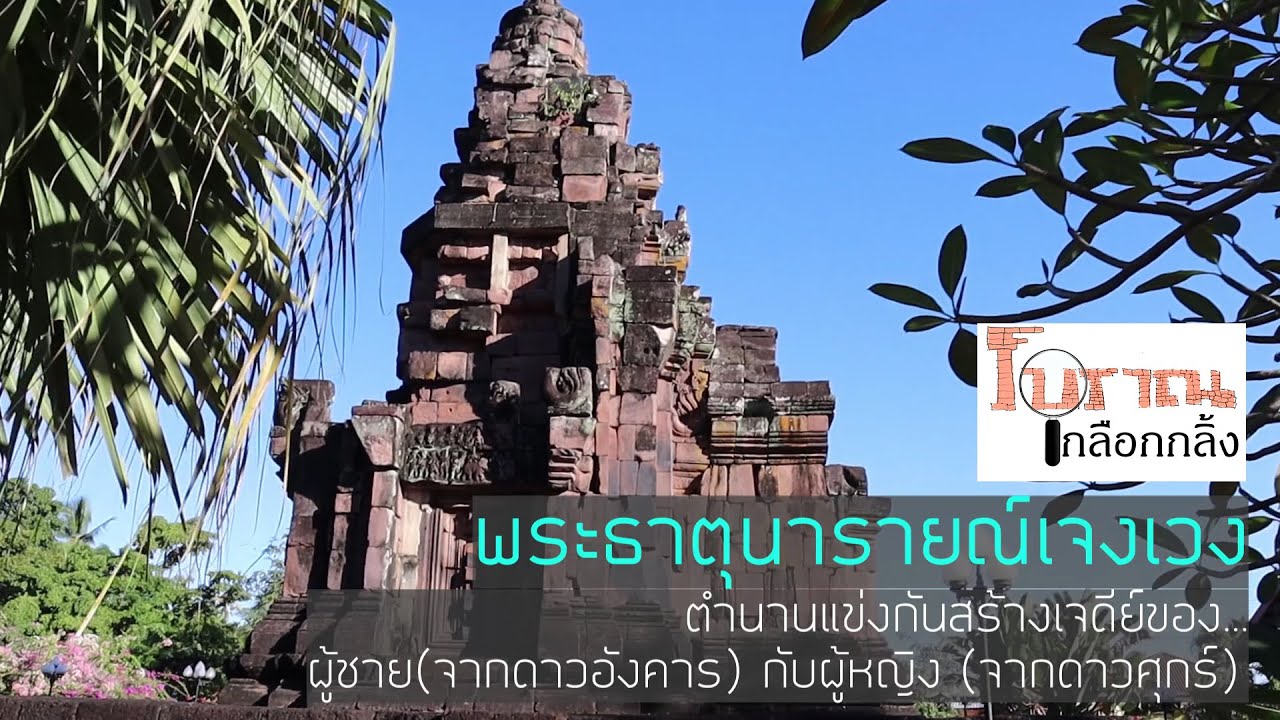
Phra That Narai Cheng Weng consists of a single sandstone prang standing on a large laterite base. The tower faces east, following the traditional orientation of ancient sacred architecture. The eastern side has the main entrance and projecting porch, while the other sides are designed as false doors. This layout is typical of Khmer religious architecture, in which direction, entrance, axis, chamber, and sacred space are carefully organized according to ritual and cosmological ideas.
The main tower is built almost entirely of sandstone, while the base is made of laterite. This combination gives the monument a strong and distinctive appearance. The reddish-brown laterite base supports the carved sandstone body of the prang, creating a contrast between structural strength and sculptural refinement. The monument is not large, but it preserves many important architectural details, making it highly valuable for travelers interested in ancient Khmer art.
The inner chamber of the tower was originally a garbhagriha, or sacred inner chamber, a central space in Hindu temple architecture. Inside this chamber, traces of a ritual drainage system remain, including a channel that allowed sacred water to flow out toward the northern side through a somasutra outlet. This feature shows that the tower was not merely a decorative structure, but a ritual space designed for worship, consecration, and the symbolic movement of sacred water.
The most impressive features of Phra That Narai Cheng Weng are its carved lintels and pediments. On the eastern side, one lintel depicts Indra riding the three-headed elephant Erawan, the guardian deity of the east. Another lintel above the entrance to the inner chamber shows Krishna slaying a lion. The pediment of the inner chamber contains the figure of Shiva Nataraja, the dancing Shiva, a powerful image connected with cosmic rhythm, destruction, renewal, and divine energy.
The western false doorway features a lintel showing Krishna subduing the serpent Kaliya, while the northern side includes another Krishna scene and a pediment of Vishnu reclining on Ananta, also known in Thai as Narai Banthom Sin. This scene depicts Vishnu resting on the cosmic serpent in the ocean of milk, with a lotus emerging from his navel and Brahma appearing from the lotus. The image reflects a profound Hindu cosmological concept and explains why this sanctuary is strongly associated with the name Narai, the Thai name for Vishnu.
These carvings reveal the high skill of ancient stone craftsmen. The door frames, false doors, window-like openings, pilasters, decorative bands, stepped roof forms, and five-headed naga motifs all contribute to the monument’s visual and symbolic richness. Even after many centuries, the carved details remain clear enough for visitors to recognize key scenes and appreciate the level of craftsmanship involved in building the sanctuary.
The artistic style of Phra That Narai Cheng Weng belongs to the late Baphuon to early Angkor Wat tradition, around the 16th–17th Buddhist centuries. This period corresponds to a time when Khmer cultural and artistic influence extended across much of the northeastern region of present-day Thailand. Sakon Nakhon was not an isolated local settlement. It formed part of a larger cultural network that linked communities, sacred sites, trade routes, religious beliefs, and architectural forms across the region.
The name Phra That Narai Cheng Weng carries multiple layers of meaning. Narai refers to Vishnu, one of the most important deities in Hindu belief. Cheng Weng is connected with local legends of Queen Na Weng of the ancient city of Nong Han Luang. Some traditions also refer to the monument as Oradimaya Narai Cheng Weng. The name therefore combines Indic religious symbolism with a local narrative that continues to be remembered by the people of Sakon Nakhon.
According to local legend, the monument was built by a group of women associated with Queen Na Weng of Nong Han Luang. They competed with a group of men who were building Phra That Phu Phek. The condition was that whichever side completed its sacred tower before the rising of the Phek star would win. The women used clever strategy by hanging lights high in the trees, making the men believe that the star had already risen. The men stopped working too early, allowing the women to finish first.
This legend gives Phra That Narai Cheng Weng a distinctive cultural identity. It is remembered not only as a Khmer-style stone sanctuary, but also as a monument connected with female intelligence, determination, and communal effort. The story also links the site directly with Phra That Phu Phek, creating a meaningful cultural route between two important ancient monuments in Sakon Nakhon.
The legend of the Buddha’s relics also gives the monument an important Buddhist meaning. In the Urangkhathat tradition, Phra Maha Kassapa Thera carried the Buddha’s breastbone relic toward Phu Kamphra, the site now associated with Phra That Phanom. When he reached Nong Han Luang, local devotees asked for a share of the relic. Since the breastbone relic had to be taken to its intended destination, the community was instead given sacred ashes from the Buddha’s cremation. These ashes were then enshrined at this monument. Through this story, the originally Hindu sanctuary became integrated into the Buddhist sacred landscape of the Isan region.
This transformation is one of the most fascinating aspects of Phra That Narai Cheng Weng. The site began as a Hindu sanctuary shaped by Khmer architecture and iconography. Over time, it became a Buddhist relic monument in local belief. Today, it remains inside an active Buddhist temple where people come to worship, make merit, and join the annual festival. The site therefore shows how sacred places in Southeast Asia can change religious meaning while retaining cultural continuity.
The annual festival of Phra That Narai Cheng Weng takes place from the 11th waxing-moon day to the 15th waxing-moon day of the 4th lunar month. During this period, local people and devotees gather to pay respect to the relic monument, make merit, and take part in religious activities. The festival keeps the monument connected to the living community and ensures that the site remains a center of faith rather than only an archaeological attraction.
When visitors enter Wat Phra That Narai Cheng Weng, the old sandstone tower stands within a peaceful temple compound. The setting is calm, green, and suitable for slow observation. The area includes the ancient prang, walking space around the monument, worship areas, an ordination hall, a viharn, and other temple structures. Travelers can walk around the tower, observe each side, take photographs, and pay respect inside the temple area.
The eastern side is the best place to begin. This is the formal front of the sanctuary, with the main entrance, projecting porch, and important lintel carvings. Visitors should look closely at the door frame, stone blocks, entrance axis, and the carved images above the doorway. This side shows how the ancient builders controlled the movement from the outside world into the sacred inner space.
The northern side is also highly significant because of the Vishnu reclining scene and the somasutra outlet. This side helps visitors understand that the building functioned as a ritual space. Sacred water could pass from the inner chamber through the carved outlet, linking worship inside the sanctuary with the outer world. Such details are easy to overlook, but they are essential to understanding the monument properly.
The western and southern sides complete the architectural experience. Their false doors are not functional entrances, but symbolic architectural elements that create balance and sacred presence on all sides of the tower. In Khmer architecture, a false door can represent spiritual access even when it is not physically open. This idea gives the monument a complete and centered form.
Visitors should also pay attention to the roof structure. The tower rises in receding tiers that imitate smaller versions of the building itself. This stepped composition gives the prang a sense of vertical movement, guiding the eye upward from the laterite base to the upper form. Although parts of the top have been lost or weathered, the structure still clearly reflects Khmer design principles.
Phra That Narai Cheng Weng is especially suitable for travelers who enjoy quiet cultural sites. It is not a large tourist complex, and that is part of its appeal. The atmosphere allows visitors to spend time with the monument without feeling rushed. Those who enjoy photography will find good angles around the eastern entrance, the side carvings, the laterite base, and the contrast between the ancient stone tower and the modern temple buildings.
For travelers interested in Khmer heritage, this site can be paired with Phra That Phu Phek and Phra That Dum. Phra That Narai Cheng Weng is outstanding for its sandstone carvings and Hindu iconography. Phra That Phu Phek is known for its mountain setting and legendary link to the temple-building competition. Phra That Dum is a smaller brick-and-laterite Khmer-style monument within the city area. Together, these three sites reveal the richness of Sakon Nakhon’s ancient cultural landscape.
For general travelers, the site works well in a half-day city itinerary. Start with Wat Phra That Choeng Chum Worawihan, continue to Suan Somdet Phra Srinagarindra Park, visit Wat Pa Suthawat and the Phra Ajarn Mun Bhuridatta Thera Museum, and then travel to Phra That Narai Cheng Weng. This route combines Buddhist devotion, forest monk heritage, urban landscape, and ancient Khmer art in one practical route.
The location is also convenient for those arriving by air or staying near Sakon Nakhon Rajabhat University. The monument is not far from the airport, the university area, and the main route out toward Udon Thani. Travelers with a private car or rental car can stop here before entering the city center or before continuing to another province. The temple has parking space and is suitable for a short cultural visit.
Getting There is straightforward. From Sakon Nakhon city center, follow Highway 22, the Sakon Nakhon–Udon Thani route, toward Ban That and That Na Weng Subdistrict. Near Ban That, before reaching the bypass intersection, turn left into the local road for about 400 meters to reach Wat Phra That Narai Cheng Weng. The total distance from the city center is about 5–6 km. A private car, rental car, local taxi, or app-based ride is the most convenient option.
Travelers using public transport can first arrive in Sakon Nakhon city and then hire local transport to the temple. It is best to tell the driver the full destination name: Wat Phra That Narai Cheng Weng, Ban That, That Na Weng Subdistrict. Because the site is close to the city, visitors can easily arrange a return ride or combine it with nearby restaurants and hotels in the university and city areas.
Visitors should dress respectfully because the monument is located inside an active Buddhist temple. Clothing that covers shoulders and knees is appropriate. Travelers should avoid climbing on the ancient stonework, touching fragile carved surfaces, or disturbing worshippers. Responsible behavior helps preserve the monument and respects its role as both an archaeological site and a living sacred place.
The best time to visit is in the morning or late afternoon, when the light makes the sandstone carvings easier to see and photograph. A visit usually takes 30–60 minutes, but travelers interested in architecture, art history, or photography may want to stay longer. Walking slowly around all four sides of the tower reveals details that are easy to miss at first glance.
For foreign travelers trying to understand Sakon Nakhon as a city of Buddhism, nature, and culture, Phra That Narai Cheng Weng is one of the most meaningful stops. The Khmer sandstone tower represents ancient cultural exchange. The Buddhist relic legend reflects Isan religious memory. The annual festival shows the continuing faith of the local community. These layers make the site far more than a small ruin near the city.
Phra That Narai Cheng Weng deserves a place on any cultural itinerary in Sakon Nakhon. It is easy to reach, free to enter, visually rich, historically deep, and connected with some of the province’s most memorable legends. Travelers who take time to look closely will find that every part of the monument has meaning: the laterite base, the sandstone tower, the east-facing entrance, the carved lintels, the false doors, the somasutra, the naga motifs, and the living temple compound that surrounds it today.
| Name | Phra That Narai Cheng Weng / Wat Phra That Narai Cheng Weng |
| Location | Ban That, That Na Weng Subdistrict, Mueang Sakon Nakhon District, Sakon Nakhon Province |
| Address | Wat Phra That Narai Cheng Weng, Ban That, That Na Weng Subdistrict, Mueang Sakon Nakhon District, Sakon Nakhon 47000, Thailand |
| Coordinates | 17.186856, 104.095789 |
| Highlights | Khmer-style sandstone prang on a laterite base, with carved scenes of Krishna Slaying A Lion, Indra Riding Erawan, Shiva Nataraja, Krishna Subduing Kaliya, and Vishnu Reclining On Ananta |
| History | Late Baphuon to early Angkor Wat Khmer artistic style, around the 16th–17th Buddhist centuries; originally a Hindu sanctuary and later integrated into the Buddhist sacred landscape of Isan |
| Name Origin | The name connects Narai, the Thai name for Vishnu, with the local legend of Queen Na Weng and the women of Nong Han Luang who built the monument |
| Distinctive Features | A single sandstone prang on a rectangular laterite base, facing east, with one true entrance on the east and false doors on the other sides |
| Travel Information | From Sakon Nakhon city center, follow Highway 22 toward Udon Thani. Near Ban That, before the bypass intersection, turn left for about 400 meters. The temple is about 5–6 km from the city center. |
| Current Status | Open to visitors. The monument is located inside Wat Phra That Narai Cheng Weng and remains an active sacred site for the local community. |
| Open Days | Daily |
| Opening Hours | 06.00 – 18.00 |
| Fees | Free Admission |
| Facilities | Parking area, walking space around the monument, ordination hall, viharn, worship area, merit-making area, and photo spots within the temple compound |
| Main Areas / Zones | 1. Sandstone Prang 2. Large Laterite Base 3. Eastern Entrance And Porch 4. Lintels And Pediments With Hindu Iconography 5. False Doors On The North, South, And West 6. Northern Somasutra Outlet 7. Ordination Hall And Temple Worship Area 8. Annual Festival Area During The 11th–15th Waxing-Moon Days Of The 4th Lunar Month |
| Abbot / Caretaker | Phra Khru Si Pariyattiwutthikhun (Suwat Konthanyo, Pali Level 5, M.A.) |
| Annual Festival | The annual Phra That Narai Cheng Weng festival takes place from the 11th waxing-moon day to the 15th waxing-moon day of the 4th lunar month. |
| Nearby Tourist Attractions | 1. Phu Phan Museum, about 5.4 km 2. Wat Pa Suthawat And Phra Ajarn Mun Bhuridatta Thera Museum, about 6.1 km 3. Sakon Nakhon Freshwater Aquarium, about 6.3 km 4. Wat Phra That Choeng Chum Worawihan, about 6.6 km 5. Suan Somdet Phra Srinagarindra Sakon Nakhon, about 6.8 km 6. Hug Mueang Sakon Walking Street, about 7.3 km 7. Phra That Dum, about 8.7 km 8. Phu Phan Ratchaniwet Palace, about 10.3 km |
| Nearby Restaurants | 1. Shinjang Coffee Shop, about 0.3 km 2. POOH WHAN COFFEE, Sakon Nakhon Rajabhat University, about 0.4 km, Tel. 091-052-8507 3. The Pool Bar & Restaurant, about 0.4 km, Tel. 091-864-2268 4. Tem Kham Bakery Sakon Nakhon, about 0.4 km 5. Baan Bai Tong, about 0.4 km, Tel. 084-282-2898 6. Kuay Jub Yuan Khrueng Naen, about 0.4 km 7. Food’s Land, about 5.8 km, Tel. 090-345-4318 |
| Nearby Accommodations | 1. NK Residence Sakon Nakhon, about 0.8 km, Tel. 089-391-6594 2. Honghub Sakon Hotel, about 1.5 km, Tel. 099-021-5595 3. Hug Sakonnakhon Hotel, about 2 km, Tel. 081-661-0809 4. O2 Hotel Sakonnakhon, about 2 km 5. Sakon Grand Palace Hotel, about 5.5 km, Tel. 042-714-886 6. @SAKON Hotel, about 6.5 km, Tel. 042-713-234, 080-422-5929 7. HOP INN Sakon Nakhon, about 7 km, Tel. 065-945-9214 |
Frequently Asked Questions (FAQ)
Q: Where is Phra That Narai Cheng Weng located?
A: Phra That Narai Cheng Weng is located inside Wat Phra That Narai Cheng Weng in Ban That, That Na Weng Subdistrict, Mueang Sakon Nakhon District, Sakon Nakhon Province.
Q: What are the opening hours of Phra That Narai Cheng Weng?
A: It is open daily from 06.00 to 18.00.
Q: Is there an admission fee for Phra That Narai Cheng Weng?
A: No. Admission is free.
Q: Why is Phra That Narai Cheng Weng important?
A: It is an ancient Khmer-style monument from the late Baphuon to early Angkor Wat artistic tradition, with well-preserved sandstone carvings and a later Buddhist relic legend connected with Sakon Nakhon’s local faith.
Q: What are the main highlights of Phra That Narai Cheng Weng?
A: The highlights include the sandstone prang, laterite base, east-facing entrance, carved lintels, Hindu pediments, false doors, somasutra outlet, and scenes such as Krishna Slaying A Lion, Shiva Nataraja, and Vishnu Reclining On Ananta.
Q: When is the annual festival held?
A: The annual Phra That Narai Cheng Weng festival is held from the 11th waxing-moon day to the 15th waxing-moon day of the 4th lunar month.
Q: How do travelers get to Phra That Narai Cheng Weng?
A: From Sakon Nakhon city center, follow Highway 22 toward Udon Thani. Near Ban That, turn left for about 400 meters before the bypass intersection. The site is about 5–6 km from the city center.
Q: What nearby attractions can be visited on the same trip?
A: Nearby attractions include Phu Phan Museum, Wat Pa Suthawat, Sakon Nakhon Freshwater Aquarium, Wat Phra That Choeng Chum Worawihan, Suan Somdet Phra Srinagarindra, Hug Mueang Sakon Walking Street, and Phra That Dum.
 Category: ●Art, Culture and Heritage
 Group: ●Historical Sites and Monuments
Last Update : 3 MonthAgo
 Last Update : 3 MonthAgo
 Click to Access the Navigation Map GPS
Phra That Narai Cheng Weng Map
Recommend
 Historical Sites and Monuments(9)
 Landmarks and Memorials(2)
 Royal Palace(1)
 Art, Craft Centres, Tradition(8)
 Museums(3)
 Educational Places
 Educational Gardens, Farm(2)
 Places of Worship
 Temple(18)
 Church(2)
 Other Sacred Sites(4)
 Research and Development
 Royal Project(3)
 Suburban Living
 Village, Community(7)
 Nature and Wildlife
 National Parks and Marine Reserves(4)
 Mountain (Doi)(3)
 Dam, Reservoir, Lake(14)
 Waterfalls(4)
 Caves(4)
 River, Canal(9)
 Bays and Beaches(1)
 Islands(1)
 Other natural attractions(5)
 Entertainment and Agricultural
 Zoos and Aquariums(1)
 Farms, Parks and Ecotourism(4)
 Outdoor and Adventure Activities(1)
 Travel Articles, Recipes
 Travel Review, Food Review(1)


