
lovethailand home >Northeastern Travel Attractions >Sakon Nakhon Travel Attractions >Phanna Nikhom >Phanna > Ajahn Fan Acharo Museum
TL;DR: Ajahn Fan Acharo Museum is located at 56 Moo 4, Ban Na Hua Chang, Phanna Subdistrict, Phanna Nikhom District, Sakon Nakhon 47130, Thailand, open Open Daily, hours 07.00 - 17.00.

Ajahn Fan Acharo Museum
Open Days: Open Daily
Opening Hours: 07.00 - 17.00
Ajahn Fan Acharo Museum In Sakon Nakhon is located inside Wat Pa Udom Somphon at Ban Na Hua Chang, Phanna Subdistrict, Phanna Nikhom District, Sakon Nakhon Province. It is one of the most important spiritual sites connected with the Thai Forest Meditation Tradition and one of the key Dhamma destinations in Sakon Nakhon. The museum was built to honor Ajahn Fan Acharo, a highly revered forest meditation master and an important disciple of Ajahn Mun Bhuridatto. Inside the museum, visitors can pay respect to a life-size statue of Ajahn Fan seated with his feet lowered and holding his walking stick, view the glass case containing his relics, see the monastic requisites he used during his lifetime, and learn about his life from birth to passing away.
Wat Pa Udom Somphon is an important forest temple in Phanna Nikhom District, about 37 km from Sakon Nakhon city. The temple is reached by Highway 22 on the Sakon Nakhon - Udon Thani route. After arriving in Phanna Nikhom District, visitors turn right and continue past the district office for about 2 km to the entrance of the temple. Although the temple is easy to reach from the main road, its atmosphere remains peaceful, shaded, and contemplative. This contrast between accessibility and serenity makes it a meaningful place for both pilgrimage and cultural travel.
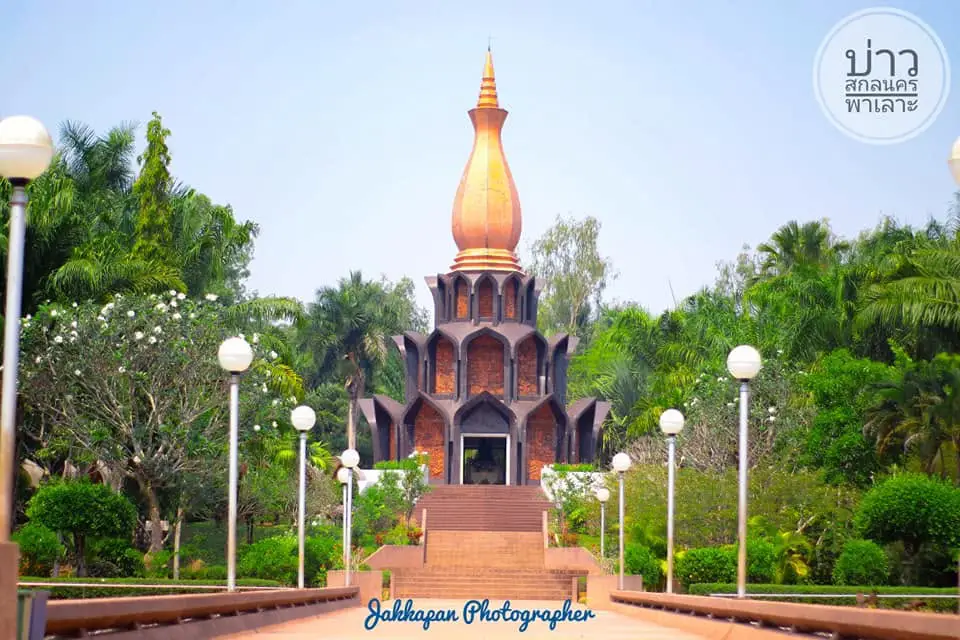
The most distinctive feature of the museum is its stupa-shaped building with a round lotus-petal base in 3 tiers and a pointed spire. The architecture is elegant, symbolic, and closely connected with Buddhist meaning. The lotus-petal form suggests purity, calmness, and spiritual elevation. The building is not only a museum structure. It is a memorial monument that expresses the spirit of forest practice through architecture. Its setting inside the temple garden reinforces the atmosphere of reflection and devotion.
Inside the museum, the central focus is the life-size image of Ajahn Fan Acharo. The statue shows him seated with his feet lowered and a walking stick in his hand. This posture gives visitors the impression of a teacher still present to receive disciples and lay followers with compassion. Many visitors begin by paying respect to the statue before continuing through the exhibition. The image functions as the emotional and spiritual center of the museum.
The glass case containing Ajahn Fan’s relics is one of the most sacred points in the museum. The relics are preserved together with his monastic requisites and life-history displays so that disciples and visitors can pay respect in one place. This arrangement allows visitors to see the connection between the teacher’s life, his discipline, his practice, and the continuing reverence of later generations. The museum therefore functions as both a memorial and a shrine.
The monastic requisites on display are especially important because they were used by Ajahn Fan during his lifetime. These objects reveal the practical life of a Thai forest monk. Bowls, robes, umbrella-tents, bags, walking sticks, vessels, and simple personal items show a life based on restraint, simplicity, and meditation. Their value does not come from luxury. Their value comes from authenticity. They are physical traces of a monk who lived for the Dhamma, used only what was necessary, and devoted his life to training the mind.
Ajahn Fan Acharo was born into the Suwannarong family on 20 August 1899 at Ban Muang Khai, Phanna Nikhom District, Sakon Nakhon Province. He entered novice ordination at the age of 19 at Wat Phon Thong. At the age of 20, he was ordained as a Buddhist monk in the Mahanikaya order. Later, he became a disciple of Ajahn Mun Bhuridatto and followed the path of forest meditation practice with deep commitment. His life became closely connected with discipline, meditation, wandering practice, and the teaching of Dhamma to monks and laypeople.
Ajahn Fan’s spiritual path reflects the essence of the Thai Forest Tradition. As a disciple of Ajahn Mun, he absorbed a style of practice focused on morality, meditation, wisdom, solitude, simplicity, and direct investigation of the mind. His teaching was not based only on words. It was expressed through his way of living. He became known for kindness, seriousness in practice, and the ability to encourage people to turn toward goodness, non-harming, mindfulness, and inner discipline.
Ajahn Fan was widely respected throughout Northeastern Thailand and across the country. People traveled to see him, listen to his teachings, ask for guidance, and receive moral encouragement. His presence was remembered as gentle but firm, compassionate but deeply disciplined. He taught people to value moral conduct, meditation, self-restraint, and the practice of Dhamma in daily life. This is why his influence continues through the museum, the temple, and the memory of his disciples.
Wat Pa Udom Somphon is closely tied to Ajahn Fan’s life. The temple grew from a quiet forest area suitable for meditation. Ajahn Fan spent important periods of his life here, and the temple became a center of devotion for many disciples and lay followers. He passed away at Wat Pa Udom Somphon on the night of 4 January 1977. From that time onward, the temple became a permanent place of memory for those who follow the forest meditation lineage.
After Ajahn Fan’s royal cremation on 21 January 1978, monks and lay disciples discussed building a memorial structure to preserve his relics, requisites, and teachings in one place. King Rama IX expressed the wish that the disciples remain united, avoid division, and hold firmly to Ajahn Fan’s teachings. He also encouraged the preservation of Ajahn Fan’s relics and monastic requisites together. The museum was therefore born from both the devotion of disciples and a strong national recognition of Ajahn Fan’s spiritual importance.
King Bhumibol Adulyadej graciously presided over the foundation-stone laying ceremony for the museum building, and the construction was completed in 1982. This royal connection gives the museum special significance. It is not merely a local memorial. It is a national spiritual heritage site that reflects the relationship between the monarchy, Thai forest monks, and Buddhist devotion in Thailand.
The museum exhibition presents Ajahn Fan’s life in chronological form, from birth and ordination to discipleship under Ajahn Mun, forest wandering, teaching, illness, passing away, and the construction of the museum. This structure helps visitors understand him not only as a famous monk, but as a person who trained himself continuously from youth to the end of life. The displays make his spiritual path concrete and accessible.
The area around the museum is calm and suitable for slow walking. Visitors can pay respect briefly or spend longer reading the displays and reflecting on the objects. The temple does not feel like a busy tourist attraction. Its main atmosphere is quietness. This quietness is part of the experience because it allows visitors to sense the discipline and simplicity of forest practice.
Other areas inside Wat Pa Udom Somphon are also meaningful. The temple grounds include halls, meditation spaces, shaded walking areas, forested zones, and places connected with Ajahn Fan’s memory. These areas help visitors understand that a forest temple is not only a collection of buildings. It is a living environment for monastic discipline, meditation, simplicity, chanting, and quiet practice.
The Ajahn Fan Museum is also connected with the wider Dhamma route of Sakon Nakhon. It can be visited together with the Ajahn Mun Bhuridatto Museum at Wat Pa Sutthawat in Sakon Nakhon city. Ajahn Fan was an important disciple of Ajahn Mun, and both museums help visitors understand the continuity between teacher and disciple in the Thai Forest Tradition. Together, they form one of the most meaningful Buddhist heritage routes in the province.
Another important nearby site is Wat Tham Kham, also known as Phu Kham, which is connected with Ajahn Fan and Luang Pu Thate Thesarangsi. Located on the Phu Phan mountain range in Phanna Nikhom District, Wat Tham Kham is a peaceful forest temple and another important location in the Thai forest meditation landscape. Visitors interested in forest monk history can combine Wat Pa Udom Somphon and Wat Tham Kham in the same spiritual itinerary.
Phanna Nikhom District also offers other nearby attractions such as Phra That Phu Pek, the Phu Phan Royal Development Study Center, Nam Un Dam, and natural areas of the Phu Phan range. The Ajahn Fan Museum can therefore serve as the starting point for a route combining Dhamma, local history, natural scenery, and royal development learning sites in Sakon Nakhon.
For international visitors, the Ajahn Fan Acharo Museum is a clear and accessible place to learn about the Thai Forest Tradition. Visitors can see real monastic objects, a memorial stupa, a forest temple environment, and the biography of a respected meditation master. The place explains Thai Buddhism not through theory alone, but through objects, space, atmosphere, and lived memory.
Getting There is straightforward. From Sakon Nakhon city, take Highway 22 on the Sakon Nakhon - Udon Thani route toward Phanna Nikhom District, about 37 km away. When reaching Phanna Nikhom, turn right past the district office and continue for about 2 km to Wat Pa Udom Somphon. The temple is suitable for private cars, rental cars, or local transport. Travelers arriving at Sakon Nakhon Airport can first enter the city, then continue west along Highway 22.
Visitors should allow at least 1 - 2 hours for paying respect, viewing the museum, reading the biography, and walking quietly around the temple grounds. Those who plan to continue to Wat Tham Kham, Phra That Phu Pek, or the Phu Phan Royal Development Study Center should allow half a day or a full day. Morning and late afternoon are especially suitable for visiting because the atmosphere is calm and the light is gentle.
Respectful behavior is essential. Visitors should dress modestly, speak softly, avoid touching the statue, relic case, monastic requisites, or any displayed objects, and follow temple signs. Monks and meditation practitioners should not be disturbed. The museum and temple should be approached as a sacred learning space rather than a conventional sightseeing stop.
Food and accommodation are available in Phanna Nikhom District and along nearby routes. Visitors can also stay in Sakon Nakhon city and visit the museum as a day trip. Those planning to travel during public holidays or major religious events should arrange accommodation in advance because temples connected with forest masters often attract many devotees.
The value of the Ajahn Fan Acharo Museum goes beyond religious tourism. It teaches visitors that the greatness of a forest monk lies not in material display, but in effort, compassion, simplicity, and disciplined practice. A few simple objects in the museum can express an entire way of life. For many visitors, the experience brings calmness and reflection rather than ordinary sightseeing pleasure.
Overall, the Ajahn Fan Acharo Museum is a complete spiritual learning site. It preserves the biography, relics, monastic requisites, statue, memorial stupa, temple atmosphere, and Dhamma legacy of Ajahn Fan in one place. It is suitable for Buddhists, meditation practitioners, students, cultural travelers, and foreign visitors who want to understand the Thai Forest Tradition through an authentic site.
The Ajahn Fan Acharo Museum at Wat Pa Udom Somphon is therefore one of the essential places for understanding Sakon Nakhon as a land of Dhamma and forest meditation masters. Visitors can pay respect to a revered teacher, study his life, see the simplicity of his monastic objects, and experience the quiet atmosphere of a forest temple in Phanna Nikhom District. For those who want to know Sakon Nakhon beyond ordinary attractions, this museum is a place to visit with respect, stillness, and attention.
| Place Name | Ajahn Fan Acharo Museum / Phra Ajahn Fan Acharo Museum Chedi At Wat Pa Udom Somphon |
| Main Location | Inside Wat Pa Udom Somphon, Ban Na Hua Chang, Phanna Subdistrict, Phanna Nikhom District, Sakon Nakhon Province |
| Address | 56 Moo 4, Ban Na Hua Chang, Phanna Subdistrict, Phanna Nikhom District, Sakon Nakhon 47130, Thailand |
| Approximate Coordinates | 17.3559, 103.8669 |
| Highlights | Three-Tiered Lotus-Petal Chedi Building, Life-Size Statue Of Ajahn Fan Seated With His Feet Lowered And Holding A Walking Stick, Glass Case Containing His Relics, Monastic Requisites, And Biographical Exhibition |
| History / Importance | Built To Honor Ajahn Fan Acharo, A Revered Forest Meditation Master And Important Disciple Of Ajahn Mun Bhuridatto. The Museum Was Built At The Site Of His Royal Cremation And Completed In 1982 |
| Name Origin | Named After Ajahn Fan Acharo, A Revered Thai Forest Monk Born In Phanna Nikhom District And Deeply Connected With Wat Pa Udom Somphon |
| Architecture | A Chedi-Shaped Building With A Round Three-Tiered Lotus-Petal Base And Pointed Spire, Located Within The Temple Garden And Designed As A Memorial Space For Relics, Requisites, And Life-History Displays |
| Travel Information | From Sakon Nakhon City, Take Highway 22 Toward Phanna Nikhom District For About 37 km, Then Turn Right Past The District Office And Continue About 2 km To Wat Pa Udom Somphon |
| Current Status | Open To Visitors As A Spiritual Learning Site And Sacred Museum Inside Wat Pa Udom Somphon |
| Open Days | Open Daily |
| Opening Hours | 07.00 - 17.00 |
| Fees | No Admission Fee |
| Facilities | Parking Area, Worship Area, Museum Building, Walking Paths, Restrooms In The Temple Area, Forested Temple Grounds, Halls, And Quiet Spaces For Respectful Visits |
| Main Areas / Zones | Ajahn Fan Acharo Museum Chedi Life-Size Statue Zone Relic Glass Case Zone Monastic Requisites And Personal Items Zone Biographical Exhibition Zone Wat Pa Udom Somphon Temple Grounds Temple Halls And Meditation Areas Forest Garden And Walking Areas |
| Caretaker / Abbot | Phra Ratchamongkhon Wachiramuni (Luang Pu Plaeng Suntharo), Abbot Of Wat Pa Udom Somphon |
| Contact Number | Ajahn Fan Acharo Museum Tel. 084-798-1394 |
| Visitor Guidelines | Dress Respectfully, Speak Softly, Do Not Touch The Statue, Relic Case, Relics, Monastic Requisites, Or Displayed Objects, Do Not Disturb Monks Or Meditation Practitioners, And Follow Temple Signs |
| Nearby Tourist Attractions | 1. Wat Pa Udom Somphon, About 0 km 2. Phra Ajahn Fan Acharo Hospital, About 1 km 3. Phanna Nikhom Town And Local Market, About 2 km 4. Wat Tham Kham / Thesaka Chedi Thesarangsi Memorial, About 25 km 5. Phra That Phu Pek, About 30 km 6. Phu Phan Royal Development Study Center, About 35 km 7. Wat Phra That Choeng Chum Worawihan, Mueang Sakon Nakhon, About 40 km |
| Nearby Restaurants | 1. Jungle Cafe Phanna Nikhom Branch, About 3 km, Tel. 092-984-1412 2. Kaprao Suea Nuea Luan Luan, Phanna Nikhom, About 3 km, Tel. 093-485-7266 3. PunThai Coffee Phanna Nikhom, About 5 km 4. Kanna Coffee, Pok Noi Subdistrict, About 12 km, Tel. 081-804-5739 5. MK Restaurants Lotus Sakon Nakhon, About 40 km, Tel. 042-722-645 6. Café Amazon PTT Pratu Mueang Sakon Nakhon, About 40 km, Tel. 084-031-4920 |
| Nearby Accommodations | 1. Andaman Grand Resort, Phanna Nikhom, About 4 km, Tel. 081-959-3049 2. Maleemantra Homestay, Phanna Nikhom, About 20 km 3. The Majestic Sakon Nakhon Hotel, About 40 km, Tel. 042-733-771 4. Dusit Hotel Sakon Nakhon, About 40 km, Tel. 042-711-198 5. Imperial Sakon Hotel, About 40 km, Tel. 042-711-119 6. Hop Inn Sakon Nakhon, About 42 km, Tel. 02-080-2222 |
Frequently Asked Questions (FAQ)
Q: Where is the Ajahn Fan Acharo Museum located?
A: It is located inside Wat Pa Udom Somphon at Ban Na Hua Chang, Phanna Subdistrict, Phanna Nikhom District, Sakon Nakhon Province, about 37 km from Sakon Nakhon city.
Q: What are the opening days and hours?
A: The museum is open daily from 07.00 to 17.00.
Q: Is there an admission fee?
A: No. There is no admission fee for visiting the museum.
Q: What can visitors see inside the museum?
A: Visitors can see the life-size statue of Ajahn Fan seated with his feet lowered and holding a walking stick, the glass case containing his relics, his monastic requisites, and displays about his life history.
Q: Why is Ajahn Fan Acharo important?
A: Ajahn Fan was a highly revered forest meditation master, an important disciple of Ajahn Mun Bhuridatto, and a respected teacher in the Thai Forest Tradition.
Q: How do visitors get there from Sakon Nakhon city?
A: Take Highway 22 toward Phanna Nikhom District for about 37 km, then turn right past the district office and continue about 2 km to Wat Pa Udom Somphon.
Q: What important areas are inside Wat Pa Udom Somphon?
A: Important areas include the Ajahn Fan Acharo Museum Chedi, worship area, relic and requisites displays, temple halls, meditation spaces, and quiet forested temple grounds.
Q: What nearby places can visitors see after the museum?
A: Nearby places include Wat Tham Kham, Phra That Phu Pek, the Phu Phan Royal Development Study Center, Wat Phra That Choeng Chum Worawihan, and other Dhamma and cultural sites in Sakon Nakhon.
 Category: ●Art, Culture and Heritage
 Group: ●Museums
Last Update : 3 MonthAgo
 Last Update : 3 MonthAgo

 Click to Access the Navigation Map GPS
Ajahn Fan Acharo Museum Map
Recommend

 Historical Sites and Monuments(9)
 Landmarks and Memorials(2)
 Royal Palace(1)
 Art, Craft Centres, Tradition(8)
Museums(3)
 Educational Places
 Educational Gardens, Farm(2)
 Places of Worship
 Temple(18)
 Church(2)
 Other Sacred Sites(4)
 Research and Development
 Royal Project(3)
 Suburban Living
 Village, Community(7)
 Nature and Wildlife
 National Parks and Marine Reserves(4)
 Mountain (Doi)(3)
 Dam, Reservoir, Lake(14)
 Waterfalls(4)
 Caves(4)
 River, Canal(9)
 Bays and Beaches(1)
 Islands(1)
 Other natural attractions(5)
 Entertainment and Agricultural
 Zoos and Aquariums(1)
 Farms, Parks and Ecotourism(4)
 Outdoor and Adventure Activities(1)
 Travel Articles, Recipes
 Travel Review, Food Review(1)


