
lovethailand home >Northeastern Travel Attractions >Sakon Nakhon Travel Attractions >Warit Chaphum >Warit Phum > Phra That Si Mongkhon
TL;DR: Phra That Si Mongkhon is located at Ban That, Waritchaphum Subdistrict, Waritchaphum District, Sakon Nakhon Province, open Daily, hours 08.00 – 17.00.
Phra That Si Mongkhon
Open Days: Daily
Opening Hours: 08.00 – 17.00
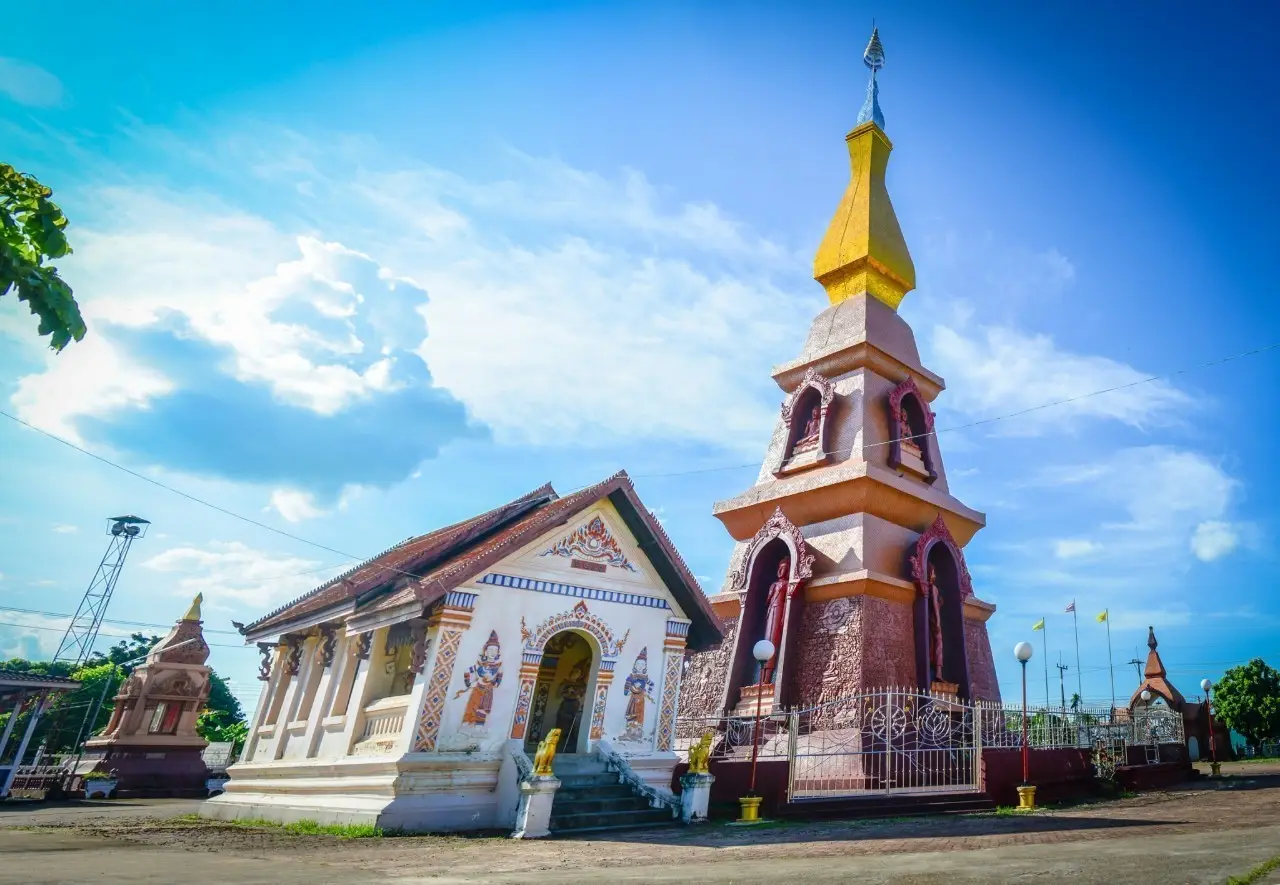
Phra That Si Mongkhon in Sakon Nakhon is the revered community stupa of Waritchaphum District. It is located inside Wat Phra That Si Mongkhon in Ban That, Waritchaphum Subdistrict, about 200 meters from the Waritchaphum District Office and around 65 km from Sakon Nakhon city. The stupa has a square base, a pointed spire, modern brick-and-plaster construction, and distinctive terracotta reliefs around the base depicting scenes from the Buddha’s life. It was built to enshrine and protect the older damaged laterite relic monument inside. The temple is open daily, free to visit, and strongly connected with local Phu Thai culture and the annual Bun Bang Fai Lan festival in honor of the stupa.
Phra That Si Mongkhon is one of the most meaningful Buddhist landmarks in Waritchaphum District, Sakon Nakhon Province. Located inside Wat Phra That Si Mongkhon in Ban That, Waritchaphum Subdistrict, the stupa is both a sacred place of worship and a cultural symbol of the local community. For foreign travelers, this site offers a clear view of how Buddhist faith, village history, Phu Thai identity, and modern religious art come together in northeastern Thailand.
The temple stands near the center of Waritchaphum District, only about 200 meters from the district office. It is accessible by car from Sakon Nakhon city via the Sakon Nakhon–Phang Khon–Waritchaphum route, with a total distance of about 65 km. Unlike mountain temples or remote archaeological sites, Wat Phra That Si Mongkhon is easy to reach and suitable for families, elderly visitors, pilgrims, and travelers who want to explore local culture without a difficult walk.
The first thing visitors notice is the tall stupa rising from a square base. The current structure is built of brick and plaster and decorated with terracotta reliefs. Around the base, panels illustrate scenes from the life of the Buddha, turning the stupa into both a sacred monument and a visual lesson in Buddhist history. These terracotta decorations are among the most distinctive features of the site and give Phra That Si Mongkhon a unique identity among the sacred monuments of Sakon Nakhon.
The present stupa was built to cover and protect an older relic monument made of laterite. The older structure had become damaged over time, but it remained deeply respected by the community. Instead of abandoning it, local monks and villagers preserved its sacred core by building the new stupa over it. This act of preservation is central to the meaning of the site. Phra That Si Mongkhon is not only a new artistic creation; it is a continuation of an older sacred presence.
The origin of the temple is closely linked with the story of Ban That village. The area was once forest. A group of villagers from the old settlement of Mueang Wari came to clear land for farming. As they moved deeper into the forest, they discovered an abandoned relic monument. They stopped clearing the land out of reverence and invited Phra Khru Lak Kham, the senior monk of Mueang Wari, to examine the site. He recognized the place as auspicious and suitable for settlement and religious use.
The villagers then cleared the area respectfully, made merit, dedicated blessings to the sacred guardians of the relic monument, and established a temple at the site. Phra Khru Lak Kham named the relic monument Phra That Si Mongkhon and named the temple Wat That Si Mongkhon around 1901. The surrounding village became known as Ban That, a name that continues today. This origin story shows how the relic monument became the spiritual center of both the temple and the village.
The name Si Mongkhon means auspicious glory or auspicious prosperity. It reflects the way local people understood the discovery of the relic monument. The site was not treated as ordinary forest land. It was recognized as sacred and suitable for building a community around faith. In this sense, Phra That Si Mongkhon is more than a stupa; it is a founding point of local memory, settlement, and identity.
After a major fire in the old Mueang Wari area and because of problems with limited space and flooding, many residents moved to new settlements, including Ban Phang Ho, Ban Huai Bang, and Ban That. The growth of Ban That was closely tied to Phra That Si Mongkhon. The relic monument helped anchor the community and gave the new settlement a spiritual focus. This close relationship between sacred site and village remains visible today.
The original relic monument was made of laterite and had already suffered damage before the current stupa was built. Its exact date of construction is not confirmed in surviving local tradition, but it is widely associated with older Buddhist culture in the Lan Xang sphere. Local accounts also connect Phra That Si Mongkhon with Phra That Dong Chiang Khruea, another relic site located about 500 meters to the north. These connections place the temple within the broader cultural landscape of the Mekong region and northeastern Thailand.
When the old relic monument collapsed or deteriorated, villagers collected sacred objects and ancient items found around the stupa, including Buddha images made of gold, bronze, and other materials. Some objects were kept for worship, while others were re-enshrined within the stupa. This reflects the community’s respect for the old monument and its relics. The sacred meaning of the site remained continuous even as the physical form of the stupa changed.
The restoration history of Phra That Si Mongkhon is an important part of the temple’s identity. The first major restoration took place in 1929 under the supervision of Phra Khru Than. Later, beginning in 1973, local monks, villagers, and supporters worked together to restore the stupa again. A reinforced concrete structure was created, and terracotta reliefs depicting the life of the Buddha were added around the base. This restoration shaped the appearance of the stupa that visitors see today.
A major milestone occurred on 28 November 1983, when His Majesty King Bhumibol Adulyadej visited the temple to enshrine relics of the Buddha and raise the ceremonial umbrella of the stupa. The temple was then royally renamed Wat Phra That Si Mongkhon. This event gave the temple a lasting place in the shared memory of Waritchaphum and Sakon Nakhon. For local people, it remains one of the most important moments in the modern history of the temple.
The form of the stupa is elegant and direct. It rises from a square base into a pointed spire, guiding the eye upward in a way that reflects the symbolic function of a Buddhist relic monument. The broad base gives the structure stability and space for narrative decoration, while the tall upper form expresses reverence and aspiration. The balance between mass, height, and ornament makes the stupa visually memorable without overwhelming the surrounding temple compound.
The terracotta reliefs around the base are the most important artistic feature for visitors to study. They present scenes from the Buddha’s life and function as a visual teaching tool. Travelers can walk slowly around the stupa and read the story through images. The warm color and texture of the terracotta make the artwork feel grounded and closely connected to local craftsmanship. This gives the monument a human and community-based quality.
Terracotta is a meaningful material in this context. It comes from earth and is transformed by water, fire, and human skill. When used to depict Buddhist history, it becomes a bridge between ordinary material and sacred meaning. The reliefs at Phra That Si Mongkhon therefore represent not only decoration, but also local devotion expressed through craft.
Another important structure within the temple compound is the old ordination boundary hall, located to the south of the stupa. It was built in 1947 and shows a combination of central Thai architectural influence and Vietnamese craftsmanship. Its decorative elements include guardian figures, Kala motifs, Rahu swallowing the moon, Nang Mani Mekhala, and intertwined naga forms. This building adds another artistic layer to the temple and helps visitors understand that Wat Phra That Si Mongkhon developed over several periods.
The temple remains an active center of local religious life. The annual worship event for Phra That Si Mongkhon brings together villagers from Ban That, Ban That Phatthana, and nearby communities. Devotees come to make merit, pay respect to the stupa, and honor the sacred heart of Waritchaphum District. The temple is not a silent monument from the past; it is a living sacred place that continues to shape community life.
The Bun Bang Fai Lan festival in honor of Phra That Si Mongkhon is one of the most important annual cultural events connected with the temple. Local people dress in traditional Phu Thai clothing, join religious ceremonies, perform dances in honor of the stupa, and take part in community activities. The festival blends Buddhist devotion, agricultural belief, local performance, and ethnic identity. For travelers, it is one of the best times to experience the living culture of Waritchaphum.
Visitors should begin at the open courtyard in front of the stupa. From this point, the full structure can be seen clearly: the square base, the terracotta panels, the upper tiers, and the pointed spire. After paying respect, visitors can walk around the base to observe the terracotta scenes. This slow circular movement around the stupa is both a form of respectful viewing and a way to understand the narrative artwork.
The old ordination hall and surrounding temple buildings should also be included in the visit. Together they show the temple’s development from an old relic site to a modern community temple. The compound is calm and suitable for photography, worship, and cultural learning. Visitors should dress respectfully, keep the area clean, avoid touching the terracotta reliefs, and give space to local people who come to make merit.
For travelers interested in local history, Phra That Si Mongkhon tells a story of migration, settlement, religious discovery, and community formation. The villagers did not destroy the abandoned relic monument when they found it. They protected it, built a temple around it, and allowed a village to grow around the sacred place. This story is a powerful example of how Buddhist sacred sites can shape the geography and memory of rural communities in Thailand.
The temple is also an excellent place to understand Phu Thai cultural identity in Sakon Nakhon. The communities around Ban That and Waritchaphum preserve a strong sense of local identity through dress, festival participation, ritual practice, and respect for the relic monument. During major ceremonies, the temple becomes a gathering place where religious devotion and cultural pride appear together.
Phra That Si Mongkhon is different from many better-known monuments in Sakon Nakhon. Phra That Phu Phek is a Khmer-style mountain sanctuary. Phra That Narai Cheng Weng is known for sandstone carvings and Hindu iconography. Phra That Dum is an ancient Khmer-related relic site in the city area. Phra That Si Mongkhon, by contrast, is remembered for its laterite relic core, modern stupa, terracotta Buddhist storytelling, and close relationship with a living district community.
Because of its convenient location, the temple can be visited as part of a half-day or one-day itinerary. Nearby places include Phra That Dong Chiang Khruea, Nam Oun Dam, local restaurants in Waritchaphum, and accommodation within the district. Travelers with more time can continue toward Phanna Nikhom, Sawang Daen Din, Song Dao, or Sakon Nakhon city. The site works well as a cultural stop between natural attractions and urban religious landmarks.
The best time to visit is in the morning or late afternoon, when the light is softer and the terracotta details are easier to see. The temple is open daily and has no admission fee. Visitors who want to experience the most active cultural atmosphere should plan around the annual worship event or the Bun Bang Fai Lan festival, when villagers gather in traditional clothing and the temple becomes the center of community celebration.
Foreign visitors will find Phra That Si Mongkhon especially useful for understanding how Thai Buddhist heritage is not limited to ancient ruins. Some sacred places continue by being restored, rebuilt, renamed, and reinterpreted while still protecting their original sacred core. The old laterite relic monument remains inside, while the visible modern stupa expresses the ongoing faith of the community. This layered identity is one of the strongest reasons to visit the temple.
Getting There from Sakon Nakhon city is straightforward. Follow the route from Sakon Nakhon toward Phang Khon and Waritchaphum. The total distance is about 65 km. Once in Waritchaphum District, Wat Phra That Si Mongkhon is located near the district office, about 200 meters away. A private car, rental car, or hired local vehicle is the most convenient option. The temple can also be included in a route with Nam Oun Dam, Phra That Dong Chiang Khruea, and local restaurants in Waritchaphum.
Visitors should allow at least 30–60 minutes for the temple. Those interested in art, photography, or community history may want more time to walk around the base, study the terracotta panels, view the old ordination hall, and experience the quiet atmosphere of the compound. The visit is easy, accessible, and meaningful for travelers who want to understand Sakon Nakhon beyond its main city attractions.
Phra That Si Mongkhon is a sacred landmark where local history, Buddhist devotion, terracotta craftsmanship, and Phu Thai culture meet. It preserves the memory of an old laterite relic monument while presenting a modern stupa shaped by community faith. For anyone traveling through Waritchaphum District, this temple is one of the essential cultural stops and one of the clearest expressions of the spiritual identity of the local people.
| Name | Phra That Si Mongkhon / Wat Phra That Si Mongkhon |
| Location | Ban That, Waritchaphum Subdistrict, Waritchaphum District, Sakon Nakhon Province |
| Address | Wat Phra That Si Mongkhon, Ban That, Waritchaphum Subdistrict, Waritchaphum District, Sakon Nakhon 47150, Thailand |
| Coordinates | 17.288889, 103.659444 / Plus Code: 7MQ5+V94 |
| Highlights | Square-based stupa with a pointed spire, terracotta Buddhist-life reliefs, the older laterite relic monument enshrined inside, and the annual Bun Bang Fai Lan festival honoring the stupa |
| History | The abandoned relic monument was discovered in a forest by villagers from Mueang Wari. Wat That Si Mongkhon was founded around 1901. The present stupa was restored in modern form and the temple received the royal name Wat Phra That Si Mongkhon in 1983. |
| Name Origin | Phra Khru Lak Kham recognized the site as auspicious and named the relic monument Phra That Si Mongkhon and the temple Wat That Si Mongkhon. |
| Distinctive Features | A brick-and-plaster stupa with a square base and pointed spire, decorated with terracotta reliefs around the base and built over the older damaged laterite relic monument |
| Travel Information | From Sakon Nakhon city, travel via the Sakon Nakhon–Phang Khon–Waritchaphum route for about 65 km. The temple is about 200 meters from the Waritchaphum District Office and can be reached conveniently by car. |
| Current Status | Open to visitors as an active Buddhist temple and the principal sacred relic monument of Waritchaphum District |
| Open Days | Daily |
| Opening Hours | 08.00 – 17.00 |
| Fees | Free Admission |
| Facilities | Parking area, worship courtyard, walking area around the stupa, old ordination hall, merit-making area, photo spots, and nearby restaurants in Waritchaphum town |
| Main Areas / Zones | 1. Phra That Si Mongkhon Stupa 2. Terracotta Buddhist-Life Relief Base 3. Older Laterite Relic Monument Enshrined Inside 4. Worship Courtyard Around The Stupa 5. Old Ordination Boundary Hall 6. Area For Preserved Sacred Objects And Local Learning 7. Merit-Making And Ceremony Area 8. Annual Worship And Bun Bang Fai Lan Festival Area |
| Caretaker | Wat Phra That Si Mongkhon and Waritchaphum Subdistrict Administrative Organization as the local public body supporting community activities |
| Main Contact Number | 042-781-146 / Waritchaphum Subdistrict Administrative Organization, Tel. 042-973-769 |
| Important Figures | Phra Khru Lak Kham, who named the relic monument and temple / Phra Khru Withan Pariyattitham (Wichit Chanthachoto), former abbot who played an important role in temple and stupa restoration |
| Important Annual Events | Annual worship of Phra That Si Mongkhon and the Bun Bang Fai Lan festival in honor of the stupa, organized by Ban That, Ban That Phatthana, and local Buddhist communities |
| Nearby Tourist Attractions | 1. Phra That Dong Chiang Khruea, about 0.5 km 2. Nam Oun Dam, about 4.3 km 3. Nong Hua Chang, Ban Huai Bang, about 5 km 4. Phang Khon District, about 17 km 5. Wat Pa Bhuridatta Thirawat, about 24 km 6. Wat Tham Phuang And Phra Ajarn Wan Uttamo Museum, about 30 km 7. Ku Phanna, about 35 km 8. Phra That Narai Cheng Weng, about 55 km |
| Nearby Restaurants | 1. ROCK IN CAFE, about 0.8 km 2. Heng 9 Korean BBQ, about 1 km, Tel. 086-239-6590, 081-060-1578 3. Som Tam Zab Phu Thai, about 1 km, Tel. 080-186-9343 4. Krua Thi Ban, about 1.5 km, Tel. 087-052-6715 5. Zab Esan Ban Kut Phrao, about 3 km, Tel. 061-113-5019 6. Just Today Slow Bar, about 8 km, Tel. 099-261-4651 7. Jungle Cafe, Phanna Nikhom Branch, about 24 km, Tel. 092-984-1412 |
| Nearby Accommodations | 1. Talay Thong Resort Hotel, about 1 km, Tel. 081-739-7506, 084-955-1376 2. Tan Tawan Resort, about 2 km, Tel. 086-226-5518 3. Chai Thung Grand Resort, about 3 km, Tel. 042-781-224, 087-218-5448, 089-843-4582 4. Sai Thong Resort, about 3.5 km, Tel. 089-575-1756 5. Rachawadee Resort, about 4 km, Tel. 087-856-3230 6. Ruean Pik Mai Resort, about 5 km, Tel. 090-279-1495 7. Mo Paet Resort Hotel, about 6 km, Tel. 065-742-9559, 082-524-8235 |
Frequently Asked Questions (FAQ)
Q: Where is Phra That Si Mongkhon located?
A: Phra That Si Mongkhon is located inside Wat Phra That Si Mongkhon in Ban That, Waritchaphum Subdistrict, Waritchaphum District, Sakon Nakhon Province, about 200 meters from the Waritchaphum District Office.
Q: What are the opening hours of Phra That Si Mongkhon?
A: The temple is open daily from 08.00 to 17.00.
Q: Is there an admission fee for Phra That Si Mongkhon?
A: No. Admission is free.
Q: What is the main highlight of Phra That Si Mongkhon?
A: The main highlight is the square-based stupa with a pointed spire, decorated with terracotta reliefs of the Buddha’s life and built over the older damaged laterite relic monument.
Q: Why is Phra That Si Mongkhon important?
A: It is the principal sacred relic monument of Waritchaphum District, a spiritual center of Ban That community, and an important site connected with local settlement history and Phu Thai culture.
Q: What annual festival is associated with Phra That Si Mongkhon?
A: The temple is associated with the annual worship of Phra That Si Mongkhon and the Bun Bang Fai Lan festival, during which local communities gather to honor the stupa.
Q: How do travelers get to Phra That Si Mongkhon?
A: From Sakon Nakhon city, follow the Sakon Nakhon–Phang Khon–Waritchaphum route for about 65 km. The temple is near the Waritchaphum District Office and is easily accessible by car.
Q: What nearby places can be visited with Phra That Si Mongkhon?
A: Nearby places include Phra That Dong Chiang Khruea, Nam Oun Dam, Wat Pa Bhuridatta Thirawat, Wat Tham Phuang, Phra Ajarn Wan Uttamo Museum, Ku Phanna, and Phra That Narai Cheng Weng.
 Category: ●Art, Culture and Heritage
 Group: ●Historical Sites and Monuments
Last Update : 3 MonthAgo
 Last Update : 3 MonthAgo
 Click to Access the Navigation Map GPS
Phra That Si Mongkhon Map
Recommend
 Historical Sites and Monuments(9)
 Landmarks and Memorials(2)
 Royal Palace(1)
 Art, Craft Centres, Tradition(8)
 Museums(3)
 Educational Places
 Educational Gardens, Farm(2)
 Places of Worship
 Temple(18)
 Church(2)
 Other Sacred Sites(4)
 Research and Development
 Royal Project(3)
 Suburban Living
 Village, Community(7)
 Nature and Wildlife
 National Parks and Marine Reserves(4)
 Mountain (Doi)(3)
 Dam, Reservoir, Lake(14)
 Waterfalls(4)
 Caves(4)
 River, Canal(9)
 Bays and Beaches(1)
 Islands(1)
 Other natural attractions(5)
 Entertainment and Agricultural
 Zoos and Aquariums(1)
 Farms, Parks and Ecotourism(4)
 Outdoor and Adventure Activities(1)
 Travel Articles, Recipes
 Travel Review, Food Review(1)


