
lovethailand home >Northeastern Travel Attractions >Sakon Nakhon Travel Attractions >Muang Sakon Nakhon >Huai Yang > Phu Phan National Park
TL;DR: Phu Phan National Park is located at Huai Yang Subdistrict, Mueang Sakon Nakhon District, Sakon Nakhon Province 47000, Thailand, with protected areas extending across Sakon, open Daily, hours 08.00 – 16.30.

Phu Phan National Park
Open Days: Daily
Opening Hours: 08.00 – 16.30
Phu Phan National Park is one of the most important protected natural areas in upper northeastern Thailand. The park covers parts of Mueang Sakon Nakhon, Phanna Nikhom, and Phu Phan districts in Sakon Nakhon Province, as well as Somdet, Huai Phueng, and Kut Bak districts in Kalasin Province. It covers approximately 655 square kilometers, or 415,838 rai, and was officially declared a national park on 29 October 1982. The park is known for its forested mountains, waterfalls, sandstone outcrops, cliffs, nature trails, historical caves, Khmer-period ruins, and ecological importance as a watershed area of the Phu Phan range.
The park headquarters is located in Huai Yang Subdistrict, Mueang Sakon Nakhon District, on the Phu Phan mountain range. The main access route is Highway 213, the Sakon Nakhon–Kalasin road, a scenic mountain route that passes through forests, curves, viewpoints, and local communities. This makes Phu Phan National Park an accessible nature destination from Sakon Nakhon city, suitable for travelers who want to experience forest scenery, seasonal waterfalls, historical landmarks, and short nature walks without traveling far from the provincial center.
The landscape of Phu Phan National Park consists of mountains, rocky terraces, cliffs, valleys, streams, and forested slopes. The area is an important source of streams and watercourses that support communities around the Phu Phan range. The park contains dry dipterocarp forest, mixed deciduous forest, and dry evergreen forest in some areas. Because of these different forest types, the atmosphere changes noticeably by season. During the rainy season the forests are lush and waterfalls become more active. During the cool season the cliffs, nature trails, and camping areas are especially pleasant. Late rainy season to early cool season is also the period when small wildflowers appear on some rock fields.
Wildlife found in the park includes langurs, civets, slow lorises, and various smaller forest animals. These species reflect the ecological value of the park as a forest habitat, feeding ground, water source, and refuge for wildlife. Visitors should avoid feeding animals, making loud noise, or leaving the marked routes because these actions disturb wildlife and reduce the quality of the natural environment. Responsible travel helps preserve the forest character of Phu Phan for future visitors.
Phu Phan National Park is distinctive because it combines historical attractions and natural attractions in one protected area. Historical highlights include Phra That Phu Phek and Seri Thai Cave. Natural attractions include Kham Hom Waterfall, Ping Ngu Curve, Pha Nang Moen, Lan Sao Ae, Pha Sawoey, Huai Yai Waterfall, Preecha Suksan Waterfall, the Natural Stone Bridge known as Thang Phi Phan, and the park’s nature trail. Together these places make Phu Phan more than a forest park. It is a landscape of ecology, archaeology, wartime history, mountain scenery, and northeastern Thai cultural memory.
Phra That Phu Phek is an important ancient site on the Phu Phan range. It is associated with the Khmer period and was built with sandstone on a laterite base in a style connected with ancient religious architecture. The site is significant for travelers interested in archaeology, architecture, and the cultural history of northeastern Thailand. Its location on the mountain adds to the sense of age and atmosphere, making it one of the most meaningful historical sites connected with the park.
Seri Thai Cave is one of the park’s most important historical sites. Located about 4.5 kilometers from the park headquarters, the cave was used during World War II by the Seri Thai movement as a place to store weapons and supplies. The surrounding forest provided natural cover, and the terrain was suitable for concealment. Traces of an old secret airstrip are also associated with the area. This makes Seri Thai Cave a rare place where visitors can connect forest geography with national wartime history.
Kham Hom Waterfall is one of the best-known natural attractions in Phu Phan National Park. It is located near the Sakon Nakhon–Kalasin route and not far from the Phu Phan Ratchaniwet Palace area. The waterfall flows over rock terraces in a shaded forest setting. Nearby waterfalls and natural sites include Tat Ton Waterfall, Heo Sin Chai Waterfall, Sam Lan Waterfall, Sao Hai Waterfall, and Pha Hin Son. The rainy season is the best time to see the waterfall with strong water flow and lush forest scenery, while the dry season brings lower water levels according to the natural rhythm of mountain streams.
Ping Ngu Curve is a well-known landmark on Highway 213. The road winds sharply along the mountain, creating a snake-like curve that gave the place its name. It is one of the most memorable points on the route between Sakon Nakhon and Kalasin. The area offers attractive roadside views, descending shoulders, and landscaped sections with ornamental plants. Drivers should use caution, reduce speed, and follow road signs carefully because this section contains curves and slopes typical of mountain roads.
Pha Nang Moen is a rocky cliff area about 700 meters on foot from the park headquarters. The trail passes through dry dipterocarp woodland before reaching the cliff edge. The viewpoint faces west and offers broad views of the forested landscape below, making it one of the best places in the park for sunset and quiet scenic relaxation. Pha Nang Moen also connects naturally with the walking route toward Lan Sao Ae, making it a good starting point for a short nature experience.
Lan Sao Ae is located about 2 kilometers from the park headquarters along a walking route. The word “Ae” in the Isan language refers to dressing up or presenting oneself beautifully, and the name reflects the beauty of this natural rock terrace. The area includes open stone surfaces, steep cliffs, and surrounding forest. From August to October, seasonal wildflowers such as Dusita, Kradum Ngoen, and Soi Suwanna bloom in colorful patches across the rock field. This makes Lan Sao Ae especially attractive for nature photography and slow walking during the late rainy season.
Pha Sawoey is located in the Kalasin side of the park. It is a south-facing cliff associated with a royal visit during which His Majesty the King stopped to have lunch there. The name Pha Sawoey was given from that event. The cliff offers open views of the forested Phu Phan landscape on the Kalasin side and helps visitors understand that the park is a cross-provincial protected area linking communities and forest systems in both Sakon Nakhon and Kalasin.
Huai Yai Waterfall is about 12 kilometers from the park headquarters. It is formed by a stream that drops in descending levels through a cool, forested setting. The beauty of the waterfall depends strongly on the season, with the rainy season and the period after rainfall giving the most complete flow. This site is suitable for travelers who want a quieter waterfall atmosphere in the wider Phu Phan landscape.
Preecha Suksan Waterfall is located on the Phu Phan range in Mueang Sakon Nakhon District, about 24 kilometers from Sakon Nakhon city and around 50 kilometers from the park headquarters along the Sakon Nakhon–Udon Thani route. The waterfall flows over a sloping rock surface in descending layers, with some sections resembling a natural slide. The stream is about 12 meters long and is surrounded by forest. Water is most abundant during the rainy season, but the site can be reached throughout the year.
The Natural Stone Bridge, also called Thang Phi Phan, is a remarkable natural rock formation. It connects two groups of rocks, with the bridge about 1.5 meters wide and 8 meters long. Beneath it is a broad cave-like hollow that can provide shade and shelter from rain. The formation is a striking example of natural erosion and rock structure on the Phu Phan range, making it interesting for visitors who enjoy geology, landscape forms, and unusual natural features.
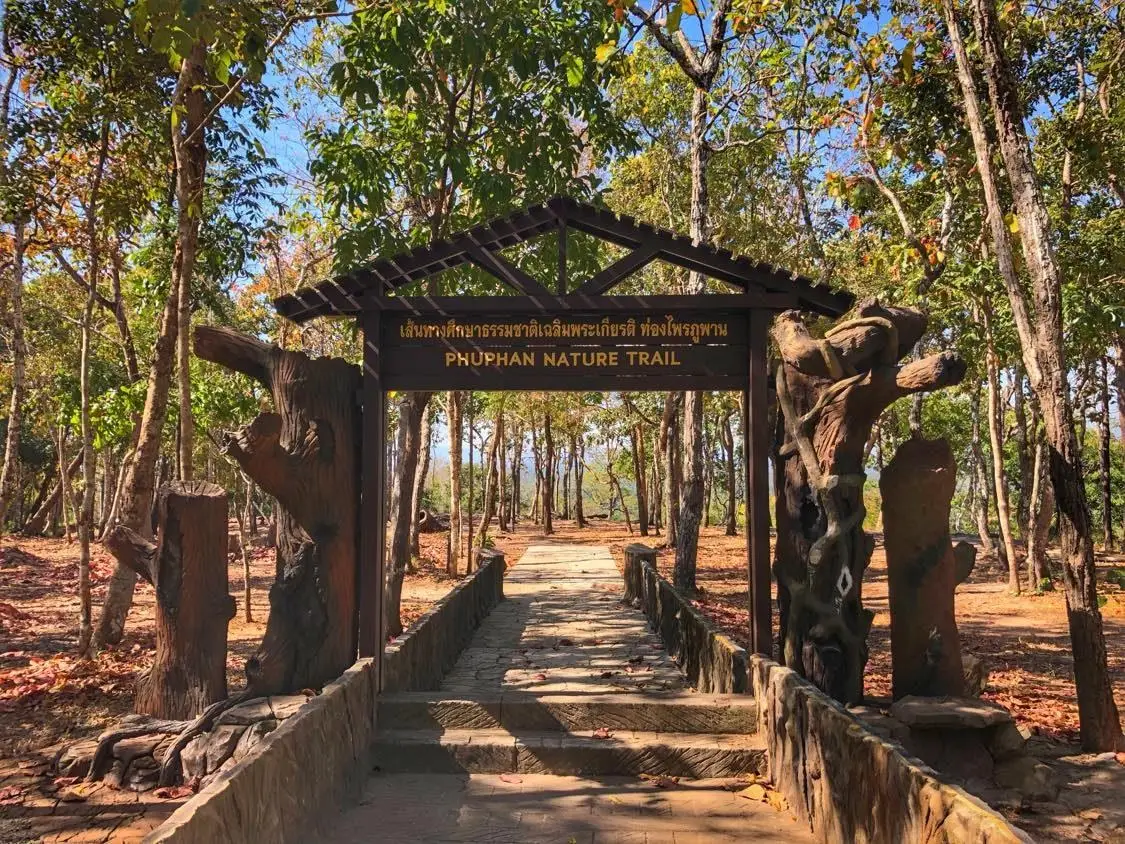
The park has a nature study trail of about 1 kilometer. The route begins around Pha Nang Moen, continues through Lan Sao Ae and Kaeng Khi Ling, passes mixed deciduous and dry evergreen forest, and returns to the nature study center. The walk takes about one hour. Along the route, visitors can learn about forest types, ferns, sandstone, moss, lichens, rock fields, and important trees. It is a suitable trail for travelers who want a short but meaningful forest walk.
Phu Phan National Park suits many travel styles. History-focused travelers can visit Seri Thai Cave and Phra That Phu Phek. Nature travelers can enjoy Kham Hom Waterfall, Huai Yai Waterfall, Preecha Suksan Waterfall, Pha Nang Moen, Lan Sao Ae, and the nature trail. Families can combine the park with the nearby Phu Phan Royal Development Study Center, Phu Phan Ratchaniwet Palace, and roadside restaurants in Huai Yang Subdistrict. Travelers who want to stay overnight can use the park’s houses, camping area, and youth camp facilities.
The best time to visit depends on the activity. The rainy season is best for waterfalls and lush forest scenery. The cool season is ideal for nature trails, viewpoints, camping, and comfortable weather. The late rainy season to early cool season is suitable for seeing seasonal wildflowers at Lan Sao Ae. The hot season is still good for viewpoints and historical sites, although waterfall flow is lower. Choosing the season according to the activity gives travelers the best experience of Phu Phan.
Facilities in the park include the headquarters, visitor service area, accommodation, camping ground, youth camp, nature trail, toilets, parking areas, and rest areas. Some attractions can be reached by vehicle, while others require short walks. Because the park contains multiple zones across a large protected landscape, travelers can plan half-day, full-day, or overnight trips depending on their interests.
The park collects national park entrance fees. Thai adults pay 20 baht and Thai children 10 baht. Foreign adults pay 200 baht and foreign children 100 baht. Vehicle fees are charged according to vehicle type, including motorcycles, four-wheel cars, six-wheel vehicles, and larger vehicles. These fees support park management, visitor facilities, and the protection of natural resources.
Food and accommodation are available both inside and around the park. Visitors can use the park welfare shop, nearby restaurants along the Sakon Nakhon–Kalasin route, restaurants in Huai Yang Subdistrict, and hotels or resorts in Sakon Nakhon city. Those who prefer to stay close to nature can choose the park accommodation or camping area, while those who want more urban convenience can stay in Sakon Nakhon city and drive to the park during the day.
Visitors should follow national park manners. Do not litter, feed wildlife, pick wildflowers, write on rocks, make loud noise, or leave marked trails. Cliff edges and wet rock surfaces require special caution, especially during or after rain. Traveling respectfully helps preserve both the natural beauty and historical value of Phu Phan National Park.
For international travelers, Phu Phan National Park offers a strong introduction to the natural and historical landscape of northeastern Thailand. It combines dry dipterocarp forest, mixed forest, seasonal waterfalls, cliffs, wildflower fields, Khmer-period ruins, and World War II history. A visit here shows that Sakon Nakhon is not only a province of temples and culture; it is also home to a large mountain forest that protects water sources, wildlife habitats, and important historical memory.
Getting There from Sakon Nakhon city, take Highway 213 on the Sakon Nakhon–Kalasin route toward Huai Yang Subdistrict and the Phu Phan range. The distance from the city to the park access area is about 25 kilometers. The road is paved and suitable for private cars, rental cars, and group vans. Drivers should take care on curves, slopes, and mountain sections, especially around Ping Ngu Curve.
In summary, Phu Phan National Park is a major natural and historical destination of Sakon Nakhon and Kalasin. It protects a large mountain forest with waterfalls, cliffs, rock terraces, streams, wildlife, nature trails, and historical sites. Its highlights include Phra That Phu Phek, Seri Thai Cave, Kham Hom Waterfall, Ping Ngu Curve, Pha Nang Moen, Lan Sao Ae, Pha Sawoey, Huai Yai Waterfall, Preecha Suksan Waterfall, and the Natural Stone Bridge. Travelers who visit the park experience Phu Phan as a living forest, a historical landscape, and one of the most meaningful mountain environments in northeastern Thailand.
| Name | Phu Phan National Park |
| Location | Huai Yang Subdistrict, Mueang Sakon Nakhon District, Sakon Nakhon Province 47000, Thailand, with protected areas extending across Sakon Nakhon and Kalasin provinces |
| Coverage Area | Mueang Sakon Nakhon, Phanna Nikhom, and Phu Phan districts in Sakon Nakhon Province; Somdet, Huai Phueng, and Kut Bak districts in Kalasin Province |
| Park Size | Approximately 655 square kilometers, or 415,838 rai |
| National Park Declaration Date | 29 October 1982 |
| Highlights | Mountain forest of the Phu Phan range with waterfalls, cliffs, rock terraces, nature trails, seasonal wildflowers, watershed forests, and historical attractions |
| Forest Types | Dry dipterocarp forest, mixed deciduous forest, and dry evergreen forest in some areas |
| Wildlife | Langurs, civets, slow lorises, and various small forest animals |
| Travel Information | From Sakon Nakhon city, take Highway 213 on the Sakon Nakhon–Kalasin route for about 25 kilometers toward Huai Yang Subdistrict and the park access area |
| Current Status | Open as a national park, ecological tourism destination, nature learning area, and overnight recreation area of Sakon Nakhon and Kalasin |
| Open Days | Daily |
| Opening Hours | 08.00 – 16.30 |
| Entrance Fee | Thai Visitors: Adult 20 Baht, Child 10 Baht Foreign Visitors: Adult 200 Baht, Child 100 Baht Vehicle Fee: Motorcycle 20 Baht, Four-Wheel Car 30 Baht, Six-Wheel Vehicle 100 Baht, Vehicle Over Six Wheels But Not More Than Ten Wheels 200 Baht |
| Facilities | Park headquarters, visitor service center, park accommodation, camping ground, youth camp, nature trail, toilets, parking areas, and rest areas |
| Main Areas / Zones | Park Headquarters And Visitor Service Zone Pha Nang Moen, Lan Sao Ae, And Nature Trail Zone Seri Thai Cave Zone Kham Hom Waterfall, Tat Ton Waterfall, Heo Sin Chai Waterfall, Sam Lan Waterfall, And Sao Hai Waterfall Zone Huai Yai Waterfall Zone Pha Sawoey Zone In Kalasin Province Phra That Phu Phek Zone Preecha Suksan Waterfall Zone Natural Stone Bridge / Thang Phi Phan Zone |
| Caretaker / Coordinator | Phu Phan National Park, Department Of National Parks, Wildlife And Plant Conservation; Mr. Suwit Chanrueang, Chief Of Phu Phan National Park |
| Main Contact Number | Phu Phan National Park Tel. 042-703-044, 081-263-5029; Department Of National Parks Tel. 02-562-0760 |
| Recommended Activities | Nature walks, waterfall visits, cliff viewpoints, sunset watching, seasonal wildflower photography, camping, Seri Thai Cave history learning, Phra That Phu Phek visit, and Phu Phan route relaxation |
| 1. Nearby Tourist Attractions | 1. Pha Nang Moen, about 700 meters, Tel. 042-703-044 2. Seri Thai Cave, about 4.5 km, Tel. 042-703-044 3. Phu Phan Royal Development Study Center, about 6 km, Tel. 042-712-975 4. Phu Phan Ratchaniwet Palace, about 8 km, Tel. 042-703-044 5. Ping Ngu Curve, about 8.5 km, Tel. 042-703-044 6. Kham Hom Waterfall, about 8.5 km, Tel. 042-703-044 7. Phra That Phu Phek, about 35 km, Tel. 042-703-044 |
| 2. Nearby Restaurants | 1. Phu Phan National Park Welfare Shop, about 0 km, Tel. 042-703-044 2. View Phuphan Restaurant, about 8 km, Tel. 086-569-8252 3. Ta Phan Kai Yang, about 8.5 km 4. Amazing Ping Ngu, about 8 km 5. Khrua Lamduan, Huai Yang Subdistrict, about 15 km, Tel. 042-747-032 6. Local Restaurants And Cafés Around Huai Yang Subdistrict, about 10–15 km |
| 3. Nearby Accommodations | 1. Phu Phan National Park Accommodation And Camping Ground, about 0 km, Tel. 042-703-044, 081-263-5029 2. Phuphan Park Hotel, about 18 km, Tel. 081-860-3991 3. 12 Panna Resort, about 20 km, Tel. 042-743-933, 085-741-9494 4. Dusit Hotel Sakon Nakhon, about 25 km, Tel. 042-711-198 5. Sakol Grand Palace Hotel, about 26 km, Tel. 042-714-886 6. Imperial Sakon Hotel, about 26 km, Tel. 042-711-119 |
Frequently Asked Questions (FAQ)
Q: Where Is Phu Phan National Park Located?
A: Phu Phan National Park has its headquarters in Huai Yang Subdistrict, Mueang Sakon Nakhon District, Sakon Nakhon Province, and covers several districts in Sakon Nakhon and Kalasin provinces.
Q: What Are The Opening Hours Of Phu Phan National Park?
A: The park is open daily from 08.00 to 16.30 for the main visitor areas and visitor service zone.
Q: How Much Is The Entrance Fee?
A: Thai adults pay 20 baht and Thai children 10 baht. Foreign adults pay 200 baht and foreign children 100 baht. Vehicle fees are charged according to vehicle type.
Q: What Are The Main Attractions In Phu Phan National Park?
A: Major attractions include Phra That Phu Phek, Seri Thai Cave, Kham Hom Waterfall, Ping Ngu Curve, Pha Nang Moen, Lan Sao Ae, Pha Sawoey, Huai Yai Waterfall, Preecha Suksan Waterfall, and the Natural Stone Bridge.
Q: Does Phu Phan National Park Have Accommodation?
A: Yes. The park has accommodation, a camping ground, and a youth camp area near the visitor service zone. Travelers can contact Phu Phan National Park for booking details.
Q: When Is The Best Time To Visit Kham Hom Waterfall?
A: Kham Hom Waterfall is best during the rainy season and shortly after rainfall, when the water flow is strong and the surrounding forest is fresh and green.
Q: How Long Does The Nature Trail Take?
A: The nature trail is about 1 kilometer long and takes around 1 hour. It passes Pha Nang Moen, Lan Sao Ae, Kaeng Khi Ling, mixed deciduous forest, and dry evergreen forest.
Q: How Do Travelers Get From Sakon Nakhon City To Phu Phan National Park?
A: Take Highway 213 on the Sakon Nakhon–Kalasin route toward Huai Yang Subdistrict. The park access area is about 25 kilometers from Sakon Nakhon city and can be reached by private car, rental car, or group van.
 Category: ●Nature and Wildlife
 Group: ●National Parks and Marine Reserves
Last Update : 3 MonthAgo
 Last Update : 3 MonthAgo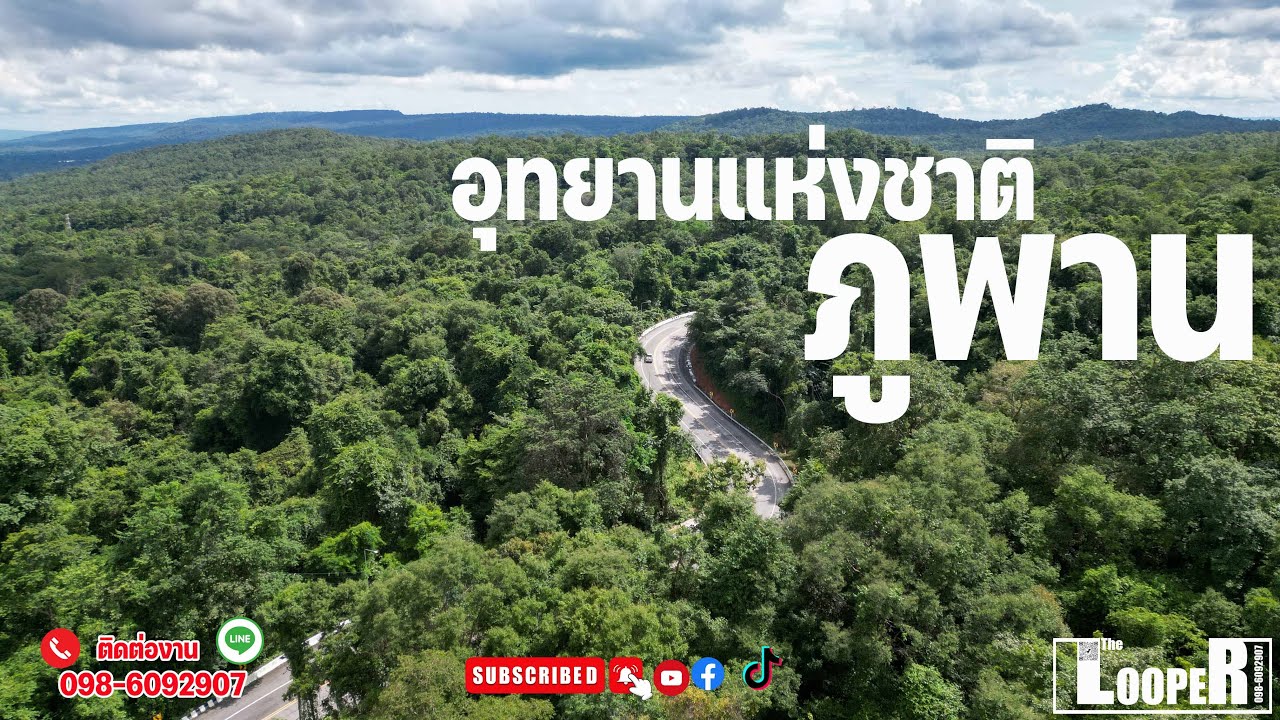
 Click to Access the Navigation Map GPS
Phu Phan National Park Map
Gellery
Recommend

 Art, Culture and Heritage
 Historical Sites and Monuments(9)
 Landmarks and Memorials(2)
 Royal Palace(1)
 Art, Craft Centres, Tradition(8)
 Museums(3)
 Educational Places
 Educational Gardens, Farm(2)
 Places of Worship
 Temple(18)
 Church(2)
 Other Sacred Sites(4)
 Research and Development
 Royal Project(3)
 Suburban Living
 Village, Community(7)
National Parks and Marine Reserves(4)
Village, Community(7)
National Parks and Marine Reserves(4)
 Mountain (Doi)(3)
 Dam, Reservoir, Lake(14)
 Waterfalls(4)
 Caves(4)
 River, Canal(9)
 Bays and Beaches(1)
 Islands(1)
 Other natural attractions(5)
 Entertainment and Agricultural
 Zoos and Aquariums(1)
 Farms, Parks and Ecotourism(4)
 Outdoor and Adventure Activities(1)
 Travel Articles, Recipes
 Travel Review, Food Review(1)


