
lovethailand home >Northeastern Travel Attractions >Sakon Nakhon Travel Attractions >Muang Sakon Nakhon >Ngiw Don > Phra That Dum
TL;DR: Phra That Dum is located at Ban That Dum, Ngio Don Subdistrict, Mueang Sakon Nakhon District, Sakon Nakhon Province, open Daily, hours Daytime Visit.
Phra That Dum
Open Days: Daily
Opening Hours: Daytime Visit
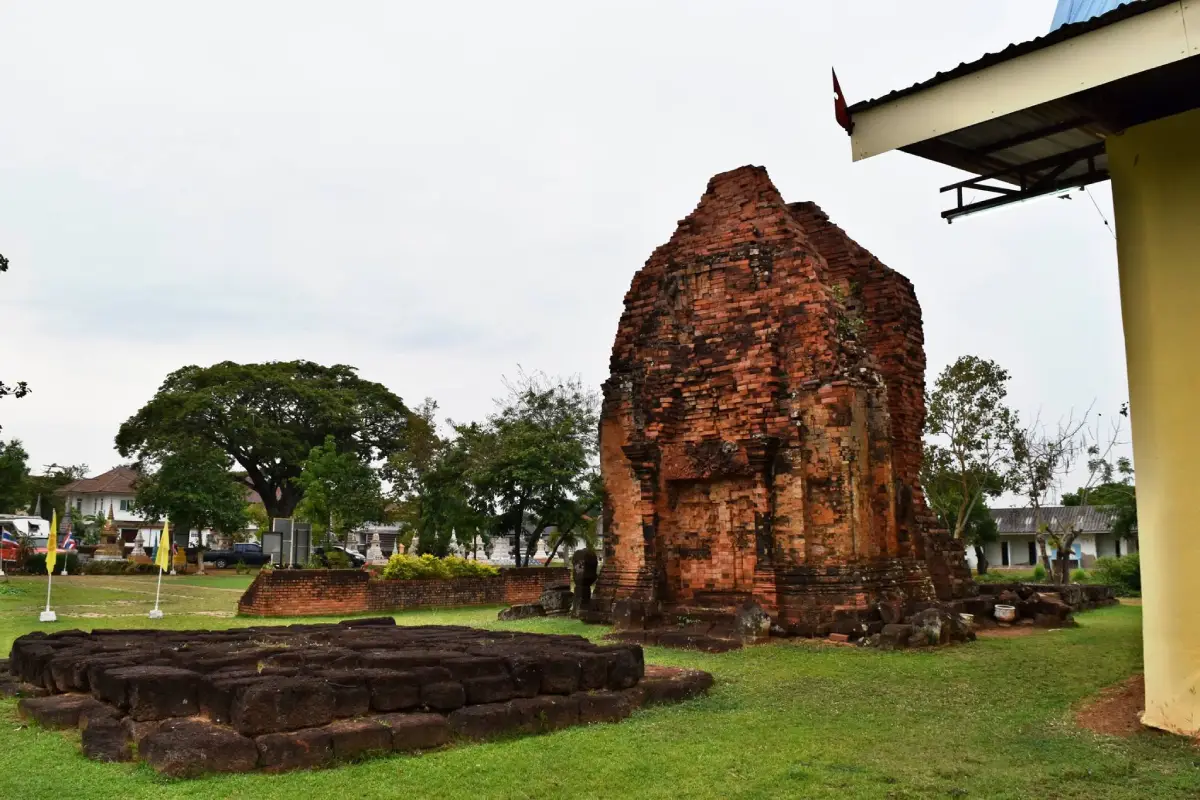
Phra That Dum in Sakon Nakhon is an ancient Khmer-style religious monument located inside Wat Phra That Dum in Ban That Dum, Ngio Don Subdistrict, Mueang Sakon Nakhon District. The site is known for its remaining brick prang, laterite base, sandstone lintel carvings, Kala motif, elephants, lions, leafy scrolls, ancient ponds, and the visible remains of a former three-tower sanctuary. It is one of the easiest Khmer-era archaeological sites to visit within Sakon Nakhon city.
Phra That Dum, also known as Wat Phra That Dum, is a compact but historically significant archaeological site in Sakon Nakhon Province. Located within the grounds of Wat Phra That Dum in Ban That Dum, Ngio Don Subdistrict, the monument offers travelers a rare opportunity to see a Khmer-style ancient religious structure without traveling far from the city center. Its value lies not only in its age, but also in the architectural traces that remain clearly visible around the brick tower.
For foreign travelers, Phra That Dum is a meaningful stop because it connects the local history of Sakon Nakhon with the broader cultural world of ancient Khmer civilization in mainland Southeast Asia. The site shows how sacred architecture, Hindu-Brahmanic symbolism, later Buddhist devotion, and local community life have overlapped across centuries. Unlike large archaeological parks, this site is small, quiet, and easy to explore, making it suitable for cultural travelers who prefer places with depth rather than crowds.
Phra That Dum originally consisted of 3 small brick prangs arranged on a north–south axis. Today, only the central prang remains standing, while the northern and southern structures are represented by laterite foundation traces. This surviving layout is one of the most important features of the site, as it allows visitors to understand the original plan of the sanctuary and the way sacred space was organized in ancient Khmer architecture.
The remaining prang faces east, a direction that carries strong ritual significance in many ancient religious structures. The east side served as the main entrance, while the other sides were designed as false doors. This layout reflects the architectural grammar of Khmer sanctuaries, where direction, axis, entrance, chamber, and surrounding landscape all worked together to create a sacred environment.
The tower is built mainly of brick on a laterite base, with sandstone used for decorative architectural elements. The combination of these materials is typical of Khmer-related religious monuments in northeastern Thailand. The weathered brick surface, dark laterite blocks, and sandstone carving fragments give the site a strong archaeological character. Even though the monument is smaller than many famous Khmer ruins, its remaining details are highly informative.
The most important artistic evidence at Phra That Dum includes sandstone lintel carvings and ornamental motifs. These carvings include a Kala face, garland-like designs, elephants, lions, and leafy scrolls. Such motifs are closely connected with Hindu-Brahmanic symbolism and the artistic vocabulary of Khmer architecture. They show that the site was originally created as a sacred monument shaped by ideas of cosmic order, divine protection, and ritual space.
Phra That Dum belongs to the artistic tradition of the Baphuon to Angkor Wat period, around the 16th–17th Buddhist centuries. This makes the monument part of a wider group of Khmer-influenced sites in Sakon Nakhon, including Phra That Narai Cheng Weng and Phra That Phu Phek. Together, these places help explain why Sakon Nakhon is important for understanding the ancient cultural networks of the upper northeastern region of Thailand.
The name Phra That Dum is also linked to later historical layers. Archaeological work in the area found a Thai Noi inscription that refers to “Phra Maha That Chiang Dum Chao.” This connection reflects how the site continued to hold sacred meaning after the Khmer period, especially during the time when Lan Xang cultural influence became important in the region. The name therefore carries more than one historical layer: ancient Khmer sacred architecture, later local Buddhist memory, and community devotion.
When visitors arrive at the site, the first impression is the old brick tower standing within an active temple compound. This contrast between ancient ruin and living Buddhist temple is one of the most memorable aspects of Phra That Dum. The monument is not isolated from local life. It remains surrounded by temple buildings, monks’ residences, a pavilion, and areas used for merit-making and religious activity.
The remaining central prang is the main focus of the visit. Walking around the tower allows travelers to observe the brickwork, laterite base, false doors, wall surfaces, and traces of the original architectural plan. The tower is modest in scale, but it rewards careful observation. Visitors interested in archaeology should take time to look not only at the tower itself, but also at the ground-level foundations and the alignment of the site.
The laterite foundations to the north and south of the standing prang are essential to understanding the monument. They show that Phra That Dum was once conceived as a group of 3 towers rather than a single isolated structure. This kind of arrangement is significant because Khmer sanctuaries often used symmetrical planning and symbolic spatial order to represent sacred cosmology.
Another important part of the site is the pair of ancient ponds located to the north and south of the prang group. In ancient temple landscapes, water was not merely decorative. It represented purity, fertility, boundaries, and cosmological order. The ponds at Phra That Dum help complete the original sacred landscape, showing that the monument was part of a broader ritual setting rather than only a freestanding tower.
The surviving carvings are especially worth studying. The Kala motif, often placed near entrances in Southeast Asian sacred architecture, represents the powerful passage of time and the threshold between the outer world and the sacred interior. The accompanying animals and leafy scrolls add both visual richness and symbolic depth. These details make the lintel fragments at Phra That Dum valuable evidence of artistic exchange and religious meaning.
Phra That Dum is also closely connected with Phra That Narai Cheng Weng in terms of period, cultural background, and architectural context. Travelers who visit both sites on the same trip will gain a clearer picture of Khmer-era Sakon Nakhon. Phra That Narai Cheng Weng is known for its sculptural richness and legendary associations, while Phra That Dum offers a quieter experience centered on architectural remains, laterite foundations, and sacred landscape.
For travelers who enjoy temple routes, Phra That Dum can be combined easily with Wat Phra That Choeng Chum Worawihan, Wat Pa Suthawat, the museum of Phra Ajarn Mun Bhuridatta Thera, Suan Somdet Phra Srinagarindra Park, and the Indigo Walking Street. This route offers a well-balanced introduction to Sakon Nakhon: sacred relics, forest monk heritage, urban parkland, local crafts, and ancient Khmer architecture.
The site is especially suitable for travelers who appreciate quiet places. Phra That Dum is not a large tourist complex, and that is part of its appeal. The atmosphere allows visitors to walk slowly, take photographs respectfully, observe the ruins, and understand the relationship between the ancient monument and the modern temple community around it. It is a place that reveals its value gradually.
Visitors should dress respectfully because the monument is located within an active Buddhist temple. Clothing that covers shoulders and knees is appropriate. Travelers should also avoid climbing on the ancient brickwork or touching fragile architectural elements. The materials are old and weathered, and responsible behavior helps preserve the monument for the local community and future visitors.
Phra That Dum is also a strong educational site for families, students, and cultural travelers. In one compact area, visitors can see the main elements of a Khmer sanctuary: a prang, a laterite base, false doors, sandstone lintel decoration, ancient ponds, and the transformation of a pre-modern sacred site into a Buddhist temple environment. This makes the site very useful for understanding how religious landscapes change over time.
The best visiting period is during daylight hours, especially in the morning or late afternoon when the light brings out the warm color of the brick and laterite. Most visitors can explore the site in about 30–60 minutes, but those interested in architecture and photography may want to spend longer. The quiet atmosphere makes it suitable for slow observation rather than a rushed stop.
Getting There is convenient from Sakon Nakhon city center. Travelers can drive or hire local transport toward Ban That Dum and Ngio Don Subdistrict, using the road that leads toward Phatthana Suksa School. The distance from the city area is approximately 3–5 km, depending on the starting point. A private car, rental car, local taxi, or app-based ride is the easiest option.
For visitors using public or local transport, it is best to tell the driver that the destination is Wat Phra That Dum or Phra That Dum Archaeological Site in Ban That Dum, Ngio Don Subdistrict. Since the site is close to the city, it can be included in a half-day itinerary. Travelers can visit Phra That Dum together with Wat Phra That Choeng Chum, Wat Pa Suthawat, and nearby restaurants or hotels in the city area.
One of the reasons Phra That Dum is worth visiting is that it helps travelers understand Sakon Nakhon beyond its best-known landmarks. The province is often described through Buddhism, nature, and culture, and this site brings all three dimensions together. It is a Buddhist temple today, an ancient Khmer religious monument in origin, and a local heritage site preserved within a living community.
In historical terms, Phra That Dum is small but highly meaningful. Its brick tower, laterite foundations, carved stone evidence, ancient ponds, and continued role within a temple compound make it an important stop for anyone interested in the layered history of northeastern Thailand. It is a place where architecture, archaeology, faith, and local identity remain visibly connected.
| Name | Phra That Dum / Wat Phra That Dum |
| Location | Ban That Dum, Ngio Don Subdistrict, Mueang Sakon Nakhon District, Sakon Nakhon Province |
| Address | Wat Phra That Dum, Ban That Dum, ITU Road / Boran Sathan Wat That Dum Road, Ngio Don Subdistrict, Mueang Sakon Nakhon District, Sakon Nakhon 47000, Thailand |
| Coordinates | 17.14967, 104.16586 |
| Highlights | Ancient Khmer-style brick prang, laterite foundation, sandstone lintel carvings, Kala motif, elephants, lions, leafy scrolls, and traces of the original three-tower sanctuary |
| History | Khmer-style monument in the Baphuon to Angkor Wat artistic tradition, around the 16th–17th Buddhist centuries, with later Lan Xang and Buddhist layers |
| Name Origin | The name is connected with a Thai Noi inscription referring to “Phra Maha That Chiang Dum Chao,” reflecting a later sacred memory of the site |
| Distinctive Features | Originally a group of 3 brick prangs aligned north–south; only the central prang remains standing today, with visible laterite foundations of the other structures |
| Travel Information | From Sakon Nakhon city center, travel toward Ban That Dum and Phatthana Suksa School. The site is about 3–5 km from the city area and is convenient by private car, rental car, local taxi, or app-based ride. |
| Current Status | Open to visitors. The monument is located within Wat Phra That Dum and remains an active heritage and religious site. |
| Open Days | Daily |
| Opening Hours | Daytime Visit |
| Fees | Free Admission |
| Facilities | Parking area, road access around the monument, pavilion, temple area for merit-making, and walking space around the archaeological site |
| Main Areas / Zones | 1. Central Brick Prang 2. Laterite Foundations Of The Former Northern And Southern Prangs 3. Sandstone Lintel And Carved Fragments 4. Ancient Ponds To The North And South 5. Eastern Pavilion Area 6. Viharn, Monks’ Residences, And Temple Merit-Making Area |
| Abbot / Caretaker | Phra Khru Pariyatti Thammaphiram |
| Nearby Tourist Attractions | 1. Wat Phra That Choeng Chum Worawihan, about 2.5 km 2. Suan Somdet Phra Srinagarindra Sakon Nakhon, about 2.6 km 3. Wat Pa Suthawat And Phra Ajarn Mun Bhuridatta Thera Museum, about 2.7 km 4. Indigo Walking Street, about 3 km 5. Isan Freshwater Aquarium, about 3.3 km 6. Phu Phan Museum, about 3.8 km 7. Phra That Narai Cheng Weng, about 8.7 km |
| Nearby Restaurants | 1. Mee Kai Cheek - Chai Fu, about 0.2 km 2. Phu Tao Khao Krua, about 0.2 km 3. Som Tam Pak Haek, about 0.3 km 4. DEEP IN specialty coffee, about 0.4 km 5. Nam Lam Yai Ban Mae, about 0.4 km 6. Saban Nga, about 4 km, Tel. 042-733-428, 088-983-1282 7. Sakol Phet Kitchen, about 4 km, Tel. 099-206-0298 8. Boonyaratphan Guay Jub Nam Khon Krua 11 Pee Nong, about 4 km, Tel. 064-158-4244, 094-474-9644, 088-743-1789 |
| Nearby Accommodations | 1. Sakon Grand Palace Hotel, about 1 km, Tel. 042-714-886 2. Metha Palace Hotel, about 1.6 km 3. NH Elegant Hotel, about 1.9 km, Tel. 042-713-338 4. @Sakon Hotel, about 2 km, Tel. 042-713-234 5. The Room Boutique Hotel - Sakon Nakhon, about 2.3 km, Tel. 099-262-9269 6. Dusit Hotel, about 2.9 km, Tel. 042-711-198 7. HOP INN Sakon Nakhon, about 3 km, Tel. 042-716-399 |
Frequently Asked Questions (FAQ)
Q: Where is Phra That Dum located?
A: Phra That Dum is located inside Wat Phra That Dum in Ban That Dum, Ngio Don Subdistrict, Mueang Sakon Nakhon District, Sakon Nakhon Province.
Q: Is Phra That Dum open to visitors?
A: Yes. Phra That Dum is open to visitors and remains an active heritage site within Wat Phra That Dum.
Q: Is there an admission fee for Phra That Dum?
A: No. Admission to Phra That Dum is free.
Q: Why is Phra That Dum historically important?
A: It is an ancient Khmer-style monument from the Baphuon to Angkor Wat artistic tradition, around the 16th–17th Buddhist centuries, and is an important piece of Sakon Nakhon’s archaeological heritage.
Q: What are the main highlights of Phra That Dum?
A: The highlights include the remaining brick prang, laterite base, sandstone lintel carvings, Kala motif, animal carvings, leafy scrolls, and traces of the former three-tower sanctuary.
Q: How do travelers get to Phra That Dum?
A: Travelers can drive or take local transport from Sakon Nakhon city center toward Ban That Dum and Phatthana Suksa School. The site is about 3–5 km from the city area.
Q: What nearby places can be visited together with Phra That Dum?
A: Nearby places include Wat Phra That Choeng Chum Worawihan, Wat Pa Suthawat, Phra Ajarn Mun Museum, Suan Somdet Phra Srinagarindra, Indigo Walking Street, and Phra That Narai Cheng Weng.
Q: Who should visit Phra That Dum?
A: It is ideal for travelers interested in Khmer architecture, archaeology, Buddhist temple culture, local history, quiet cultural sites, and photography in Sakon Nakhon.
 Category: ●Art, Culture and Heritage
 Group: ●Historical Sites and Monuments
Last Update : 3 MonthAgo
 Last Update : 3 MonthAgo
 Click to Access the Navigation Map GPS
Phra That Dum Map
Recommend
 Historical Sites and Monuments(9)
 Landmarks and Memorials(2)
 Royal Palace(1)
 Art, Craft Centres, Tradition(8)
 Museums(3)
 Educational Places
 Educational Gardens, Farm(2)
 Places of Worship
 Temple(18)
 Church(2)
 Other Sacred Sites(4)
 Research and Development
 Royal Project(3)
 Suburban Living
 Village, Community(7)
 Nature and Wildlife
 National Parks and Marine Reserves(4)
 Mountain (Doi)(3)
 Dam, Reservoir, Lake(14)
 Waterfalls(4)
 Caves(4)
 River, Canal(9)
 Bays and Beaches(1)
 Islands(1)
 Other natural attractions(5)
 Entertainment and Agricultural
 Zoos and Aquariums(1)
 Farms, Parks and Ecotourism(4)
 Outdoor and Adventure Activities(1)
 Travel Articles, Recipes
 Travel Review, Food Review(1)


