
lovethailand home >Northeastern Travel Attractions >Nakhon Phanom Travel Attractions > 20 Best Places to Visit in Nakhon Phanom
TL;DR: 20 Best Places to Visit in Nakhon Phanom.
20 Best Places to Visit in Nakhon Phanom
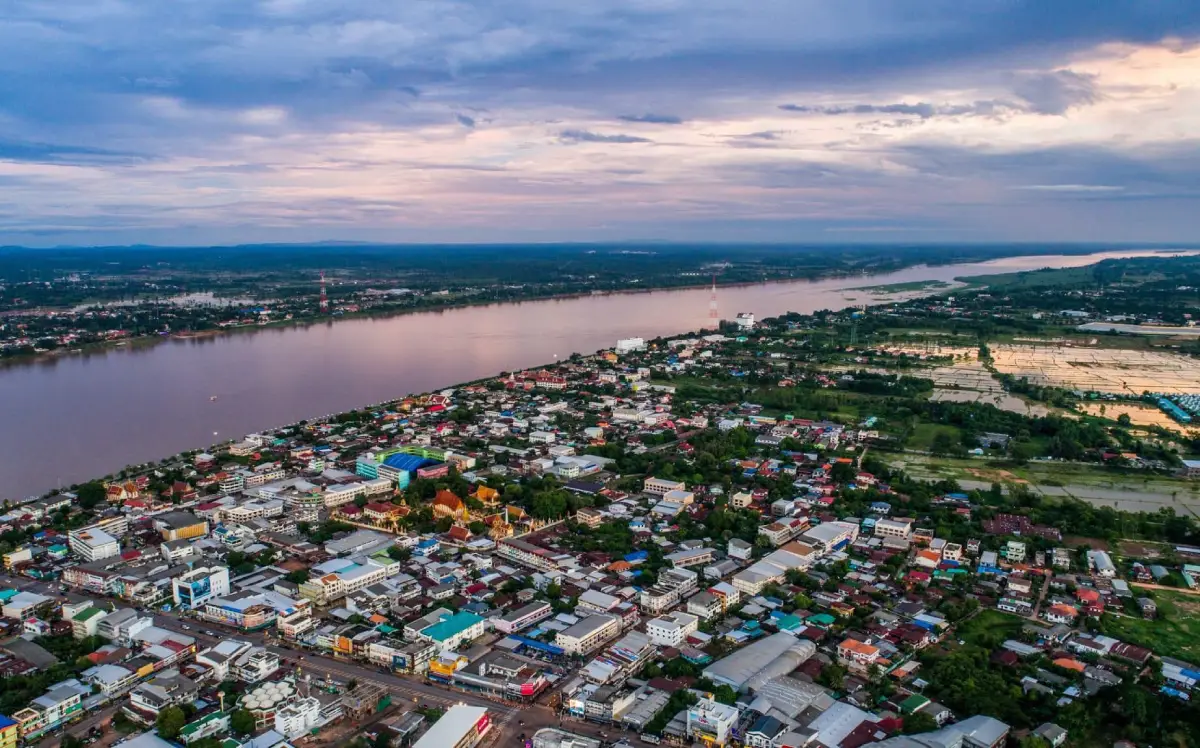
20 Best Places to Visit in Nakhon Phanom – Popular Isan Travel Destinations Nakhon Phanom is a province on the Mekong River with a distinctive combination of Buddhist faith, history, ethnic cultures, cross-border ways of life, and the natural landscapes of the Phu Langka mountain range. For first-time visitors, essential attractions include Wat Phra That Phanom Woramahawihan, Wat That Renu, Phra That Tha Uthen, Phra That Si Khun, Wat Phra That Mahachai, Phra That Prasit, Wat Marukkhanakhon, the Co-Cathedral of Saint Anne Nong Saeng, the Vietnamese Memorial Clock Tower, and Si Khotrabun Golden Sand Beach and Public Park. Together, these places reveal the province through religion, historic communities, Mekong culture, and nature.
Nakhon Phanom city lies along the Mekong River opposite Thakhek in Khammouane Province, Laos. Because the city stretches along the river, the Mekong waterfront has become one of its most important areas for tourism, recreation, and everyday life. Early in the morning, visitors can watch the sun rise above the mountains on the Lao side, while evenings bring walkers, runners, cyclists, diners, and families to the riverside.
The historical roots of Nakhon Phanom are closely connected with the ancient Si Khotrabun or Sri Kotrabong cultural sphere, which developed around the central Mekong basin. Important communities once existed on both sides of the present Thai–Lao border before political centers and settlements shifted several times. During the reign of King Rama I, the city received the name “Nakhon Phanom,” traditionally associated with a city facing the mountains visible beyond the Mekong.
Nakhon Phanom is widely known as a province of sacred stupas. Wat Phra That Phanom Woramahawihan is the most important center of faith, but the province also has a remarkable network of stupas associated with different days of birth. These include Wat That Renu, Phra That Tha Uthen, Phra That Si Khun, Wat Phra That Mahachai, Phra That Prasit, and several other important religious sites across the province.
Nakhon Phanom is also highly diverse in ethnicity and cultural heritage. Communities include Lao Isan, Tai Yo, Phu Thai, So, Kaleung, and people of Vietnamese descent. Their identities are reflected in language, traditional clothing, woven textiles, cuisine, rituals, music, dance, and vernacular architecture. Renu Nakhon is particularly important as a center of Phu Thai culture, while Nakhon Phanom city preserves strong traces of Vietnamese heritage in its food, architecture, churches, and monuments.
One of the most visible symbols of Thai–Vietnamese connections is the Vietnamese Memorial Clock Tower, built by Vietnamese residents before many returned to Vietnam. The Nong Saeng community is another historically important area, where the Co-Cathedral of Saint Anne remains a major center of Catholic faith. These landmarks demonstrate how different religions and cultural communities have coexisted in Nakhon Phanom for generations.
Nakhon Phanom is nationally famous for its Illuminated Boat Procession during the end of Buddhist Lent. Large boats decorated with thousands of lights form elaborate patterns before floating along the Mekong River. The festival represents religious devotion, community cooperation, local craftsmanship, and provincial identity. Other traditions include the annual Phra That Phanom worship festival, Bun Khao Chi, merit-making traditions following the Isan Heet Sip Song calendar, and ceremonies maintained by different ethnic communities.
For nature, northern Nakhon Phanom extends toward the Phu Langka mountain range. Ban Phaeng District is home to Tat Pho Waterfall and Tat Kham Waterfall, along with forests and nature trails within Phu Langka National Park. Along the Mekong, visitors can also explore Chai Buri River Mouth and Si Khotrabun Golden Sand Beach, which becomes especially visible when the Mekong water level falls during the dry season.
Nakhon Phanom cuisine reflects the coexistence of Isan and Vietnamese cultures. Popular dishes include som tam, larb, nam tok, Mekong River fish, naem nueang, pho, Vietnamese-style noodle soup, khao piak sen, Vietnamese bread, and moo yor. Exploring food around Sunthorn Wichit Road and riverside neighborhoods is therefore an important part of the travel experience.
For practical trip planning, the province can be divided into several zones. Nakhon Phanom City includes the Co-Cathedral of Saint Anne, Vietnamese Memorial Clock Tower, Si Khotrabun Golden Sand Beach, the riverfront embankment, Mekong Underwater World, and Ban Na Chok. That Phanom–Renu Nakhon includes Wat Phra That Phanom, Wat Marukkhanakhon, Wat That Renu, Phu Thai House, and Ban Thu Archaeological Site. Na Kae–Pla Pak–Na Wa includes Phra That Si Khun, Wat Phra That Mahachai, Phra That Prasit, and Ban Tha Ruea. Tha Uthen includes Phra That Tha Uthen, Phra Bang Wat Trai Phum, and Chai Buri River Mouth, while Ban Phaeng is ideal for waterfalls and nature.
If you have only 1 day, focus on either Nakhon Phanom city or the That Phanom–Renu Nakhon route. With 2–3 days, add Tha Uthen, Na Kae, and Pla Pak. A 4–5 day itinerary allows enough time to continue to Na Wa, Ban Tha Ruea, Ban Phaeng, and the natural attractions around Phu Langka without rushing.
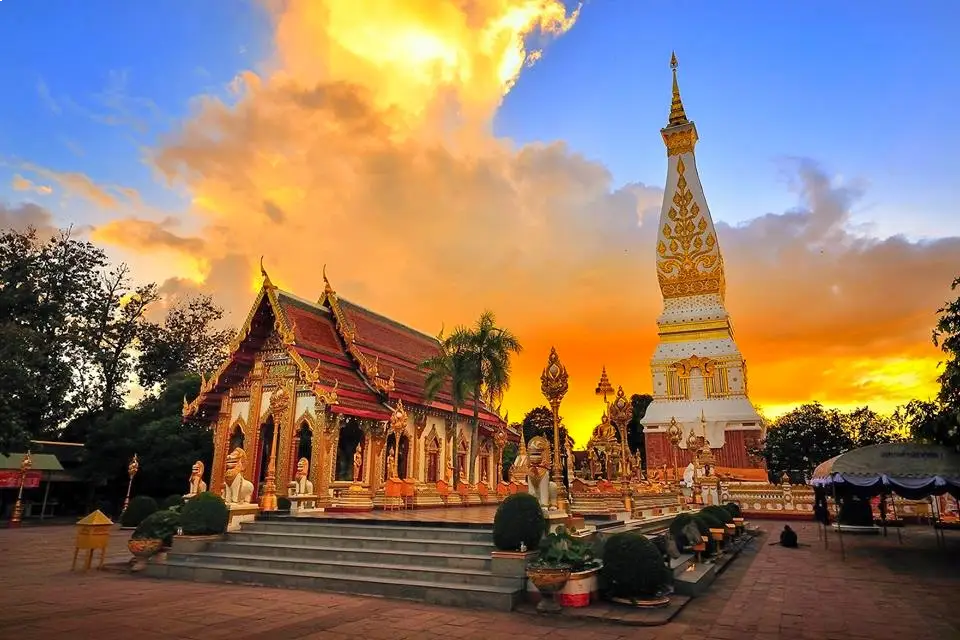
1. Wat Phra That Phanom Woramahawihan is located at 183/13 Moo 13, Chayangkun Road, That Phanom Subdistrict, That Phanom District. It is a first-class royal monastery and one of the most important centers of Buddhist faith in the Mekong region. The temple enshrines Phra That Phanom, traditionally believed to contain sacred relics associated with the chest of the Buddha.
Highlights: Phra That Phanom stupa, sacred Buddhist relics, Mekong Buddhist art, temple museum, the annual Phra That Phanom worship festival, devotional dance, and its association with the Year of the Monkey and people born on Sunday.
The importance of Phra That Phanom extends far beyond the modern history of Nakhon Phanom. The area has served as a major religious center for communities on both sides of the Mekong for centuries. The stupa has been restored and modified in several periods, creating visible layers of history, art, architecture, and belief.
A major event occurred on August 11, 1975, when the stupa collapsed following prolonged heavy rainfall. It was subsequently reconstructed through cooperation among the government, Buddhist clergy, and people from across Thailand. The rebuilt monument retained the location and essential form of the previous structure, while sacred relics and important objects were returned to the interior.
Today, pilgrims commonly circumambulate the stupa clockwise, present flowers, incense, candles, and other offerings, and spend time in prayer. Early morning and evening are generally quieter, while the annual festival attracts large numbers of worshippers and includes several days of Buddhist ceremonies.
Getting There: Located at 183/13 Moo 13, Chayangkun Road, That Phanom Subdistrict, That Phanom District, Nakhon Phanom 48110. Open daily from 05.00–21.00. Admission is free.
Map (GPS): https://www.google.com/maps/dir/?api=1&destination=16.942661,104.724071&travelmode=driving
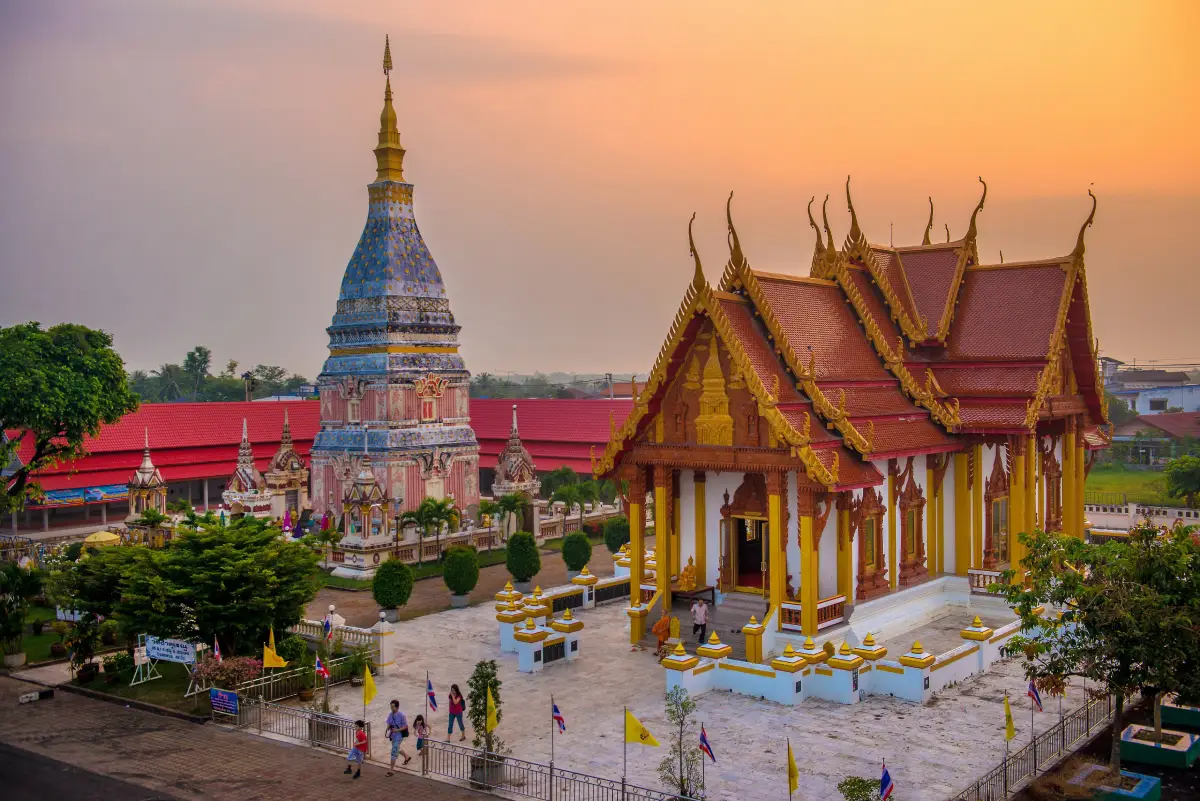
2. Wat That Renu, also known as Wat Phra That Renu, stands between Renu and Phon Thong communities in Renu Nakhon District. It is one of the principal temples of the local Phu Thai community and contains Phra That Renu, traditionally associated with people born on Monday.
Highlights: The approximately 35-meter-high Phra That Renu, architecture inspired by the former Phra That Phanom, Phra Ong Saen Buddha image, Lao-style Buddhist art, Phu Thai culture, and the distinctive atmosphere of Renu Nakhon.
The temple was formerly known as Wat Klang because of its position near the center of the historic community. After the construction of Phra That Renu, it became an important religious landmark visited by people from Nakhon Phanom, neighboring provinces, and Mekong communities across the Lao border.
Phra That Renu has a square form inspired by the former Phra That Phanom but reduced in scale for the site. Its slender proportions, decorative details, and distinctive colors are particularly striking from the temple courtyard. Inside the ordination hall is Phra Ong Saen, an important brass Buddha image in meditation posture.
A visit becomes more meaningful when combined with Phu Thai cultural attractions in the area. Travelers can continue to Phu Thai House, explore woven textiles, observe traditional dance, and learn how religious practice remains closely linked with local language, dress, and community customs.
Getting There: Located between Renu and Phon Thong communities in Renu Nakhon District, approximately 53 km from Nakhon Phanom city. Open daily from 05.00–19.00.
Map (GPS): https://www.google.com/maps/dir/?api=1&destination=17.047386,104.676396&travelmode=driving
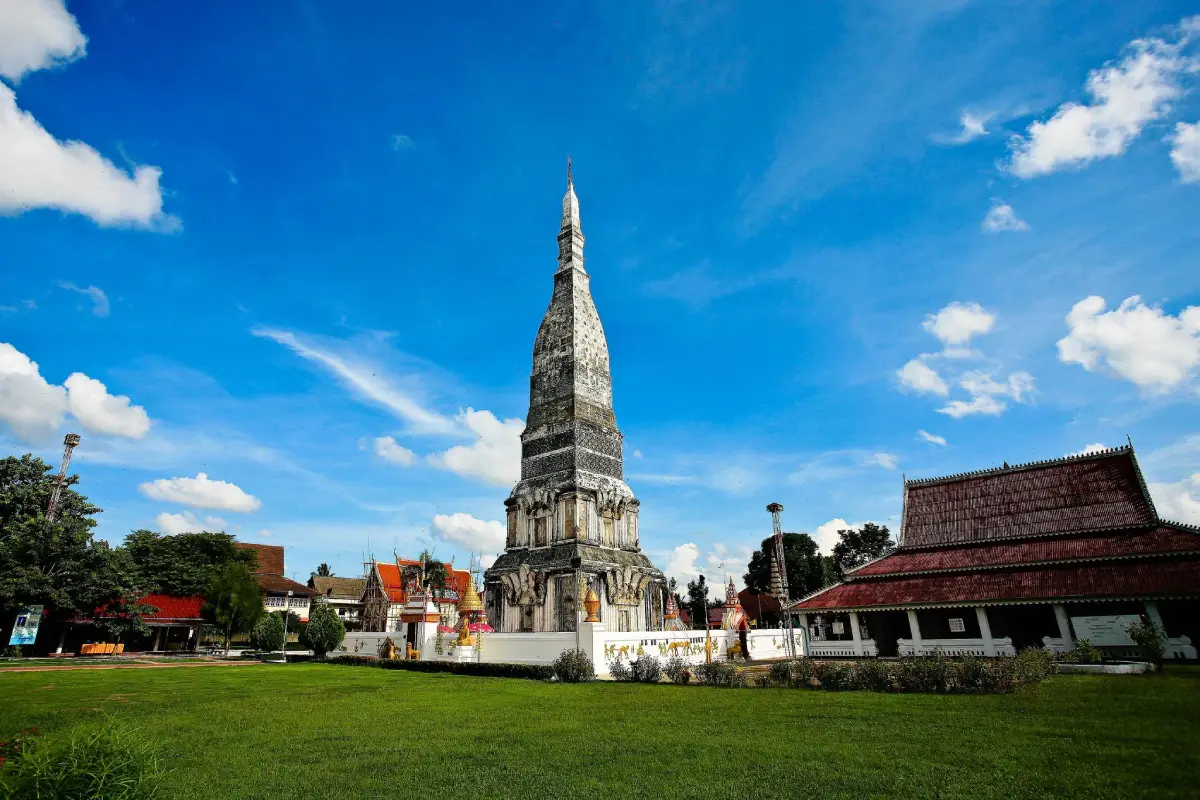
3. Phra That Tha Uthen is located inside Wat Phra That Tha Uthen near the Tha Uthen District Office and the Mekong River. It is traditionally regarded as the sacred stupa for people born on Friday and is one of the most important landmarks of historic Tha Uthen, a town with strong Tai Yo cultural roots and a long history of Mekong River trade.
Highlights: Tall riverside stupa, sacred Buddhist relics, relics of Buddhist disciples, the work of Phra Ajarn Si That Yanasampanno, historic Tha Uthen, and views across the Mekong toward Laos.
The stupa was constructed between 1911 and 1916 by Phra Ajarn Si That Yanasampanno together with monks and Buddhist communities from both sides of the Mekong. Sacred relics, Buddha images, and valuable objects donated by local worshippers were placed inside.
Its location near the Mekong illustrates the historical relationship between religious sites and river communities. Before modern roads became dominant, the river was the main route for transportation and trade, so temples, settlements, and river landings naturally developed close together.
Tha Uthen can also be combined with Phra Bang Wat Trai Phum and Chai Buri River Mouth. Travelers can dedicate a full day to the district, beginning with the stupa in the morning, continuing through the historic town, and visiting the mouth of the Songkhram River in the afternoon.
Getting There: Located beside the Mekong River near the Tha Uthen District Office, Tha Uthen Subdistrict, Tha Uthen District, approximately 26 km from Nakhon Phanom city. Open daily from 07.00–20.00. Admission is free.
Map (GPS): https://www.google.com/maps/dir/?api=1&destination=17.581658,104.590999&travelmode=driving
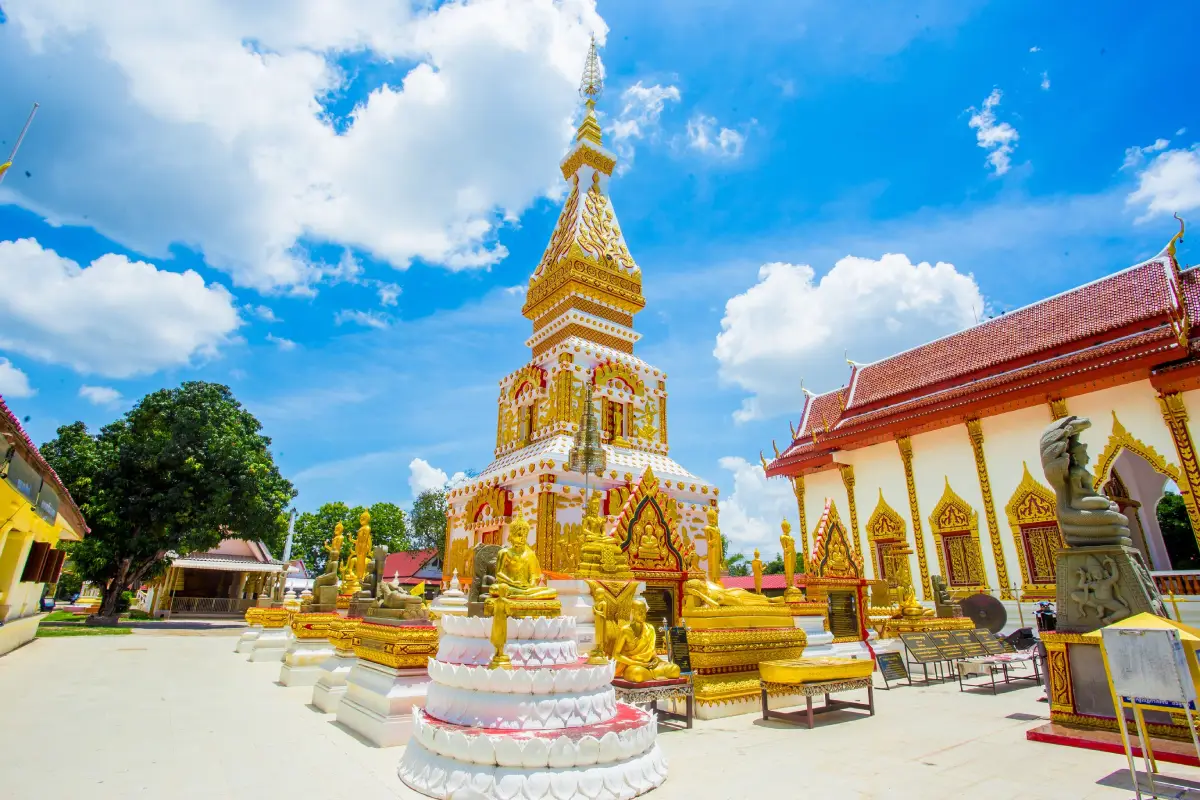
4. Phra That Si Khun stands inside Wat That Si Khun at Ban Na Kae Noi, Moo 3, Na Kae Subdistrict, Na Kae District. It is an important sacred monument for the people of Na Kae and is traditionally associated with those born on Tuesday. Its form shows influence from Phra That Phanom while retaining distinctive local details.
Highlights: Approximately 24-meter-high stupa, upper structure inspired by Phra That Phanom, stucco decoration, relics associated with important Buddhist disciples, and the religious traditions of the Na Kae community.
The lower base is divided into several architectural levels decorated with stucco before rising toward the main reliquary chamber and upper spire. Its overall form reflects the wider tradition of sacred stupas in the Mekong basin while retaining its own proportions and decorative identity.
The stupa is believed to contain relics associated with important disciples of the Buddha, including Maha Moggallana, Sariputta, and Maha Kaccayana. As a result, worshippers value the site not only as a birthday stupa but also as a place for remembering the virtues and teachings of the Buddha's disciples.
Na Kae District has strong Phu Thai communities and local historical traditions. A visit to Phra That Si Khun can therefore be combined with cultural exploration, agricultural landscapes, and routes along the lower Phu Phan area.
Getting There: Located at Ban Na Kae Noi, Moo 3, Na Kae Subdistrict, Na Kae District, Nakhon Phanom 48130. Open daily from 08.00–18.00.
Map (GPS): https://www.google.com/maps/dir/?api=1&destination=16.944992,104.496998&travelmode=driving
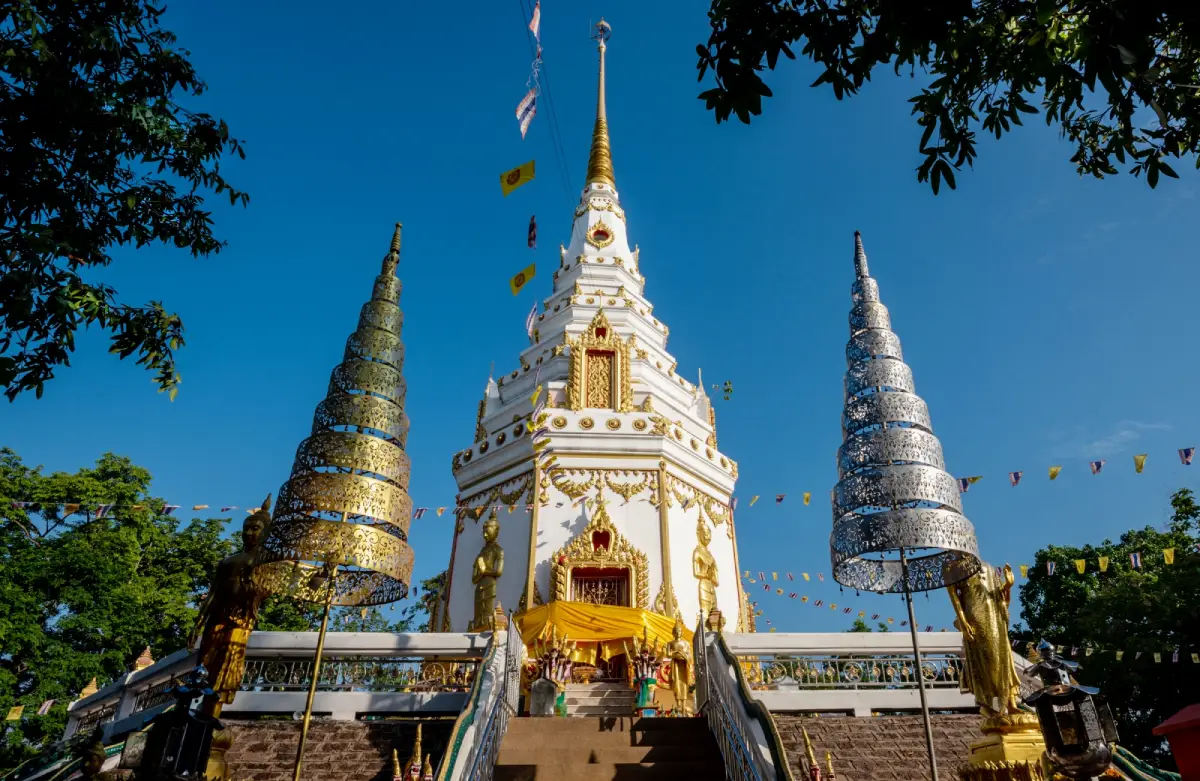
5. Wat Phra That Mahachai, also known as Wat That Mahachai, is located in Ban Mahachai, Mahachai Subdistrict, Pla Pak District. It is traditionally associated with people born on Wednesday during the daytime and has strong historical connections with Luang Pu Khamphan Khosapanyo, one of the province's highly respected meditation masters.
Highlights: 37-meter-high Phra That Mahachai, sacred Buddhist relics, Phra Phuttha Chaiyasit Buddha image, murals depicting the Buddha's life, a carved neem-wood Buddha image, and the history of Luang Pu Khamphan Khosapanyo.
The temple began developing into an important religious center in 1952 when Luang Pu Khamphan and local residents worked together to establish a Buddhist center for Ban Mahachai. The stupa later became one of the important sacred monuments of Nakhon Phanom.
On May 25, 1975, which coincided with Visakha Bucha Day, King Rama IX and Queen Sirikit presided over a ceremony to enshrine sacred Buddhist relics inside Phra That Mahachai. The event remains one of the most important milestones in the temple's history.
The present stupa was constructed around the earlier structure and completed during the 1990s. It has an octagonal plan and rises prominently above the temple grounds. Walking around the monument reveals changing patterns of light, shadow, and architectural detail on each side.
The ordination hall also contains Buddhist murals and important Buddha images, making the temple suitable for worship, study of Buddhist art, and learning about the meditation tradition of Nakhon Phanom.
Getting There: Located in Ban Mahachai, Mahachai Subdistrict, Pla Pak District, Nakhon Phanom 48160. From Nakhon Phanom city, take Highway 22 toward Sakon Nakhon for approximately 39–40 km. Open daily from 08.00–18.00.
Map (GPS): https://www.google.com/maps/dir/?api=1&destination=17.278567,104.458999&travelmode=driving
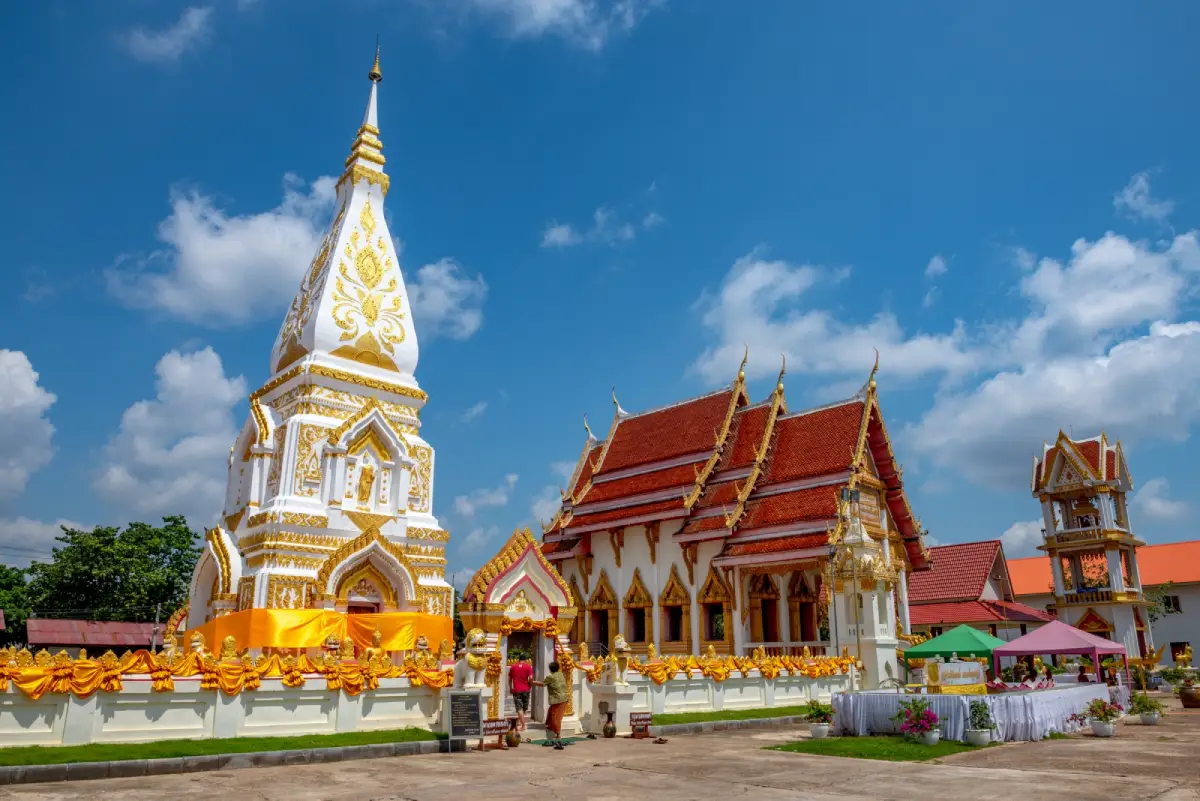
6. Phra That Prasit is located inside Wat That Prasit, a royal monastery in Na Wa Subdistrict, Na Wa District. It is traditionally associated with people born on Thursday and is an important center of faith for communities in western Nakhon Phanom.
Highlights: Mekong-style sacred stupa, Buddhist relics, royal-monastery status, Thursday birthday-stupa tradition, and proximity to cultural attractions in Na Wa District.
Phra That Prasit is an important part of Nakhon Phanom's sacred stupa route because it extends the pilgrimage network away from the Mekong riverfront into inland communities. Travelers can therefore experience the contrast between riverside settlements and agricultural communities farther west.
Na Wa District is also famous for traditional musical-instrument craftsmanship, especially Ban Tha Ruea, where craftsmen produce khaen, phin, and wot instruments. A visit to the stupa can therefore be combined with local craft learning in the same day.
The temple grounds are spacious and peaceful, suitable for elderly visitors, families, and travelers following the birthday-stupa route. Visitors should dress respectfully and maintain appropriate behavior inside the religious compound.
Getting There: Located at 187 Moo 2, Rom Pho Road, Na Wa Subdistrict, Na Wa District, Nakhon Phanom 48180. Open daily from 08.00–18.00.
Map (GPS): https://www.google.com/maps/dir/?api=1&destination=17.484565,104.097455&travelmode=driving
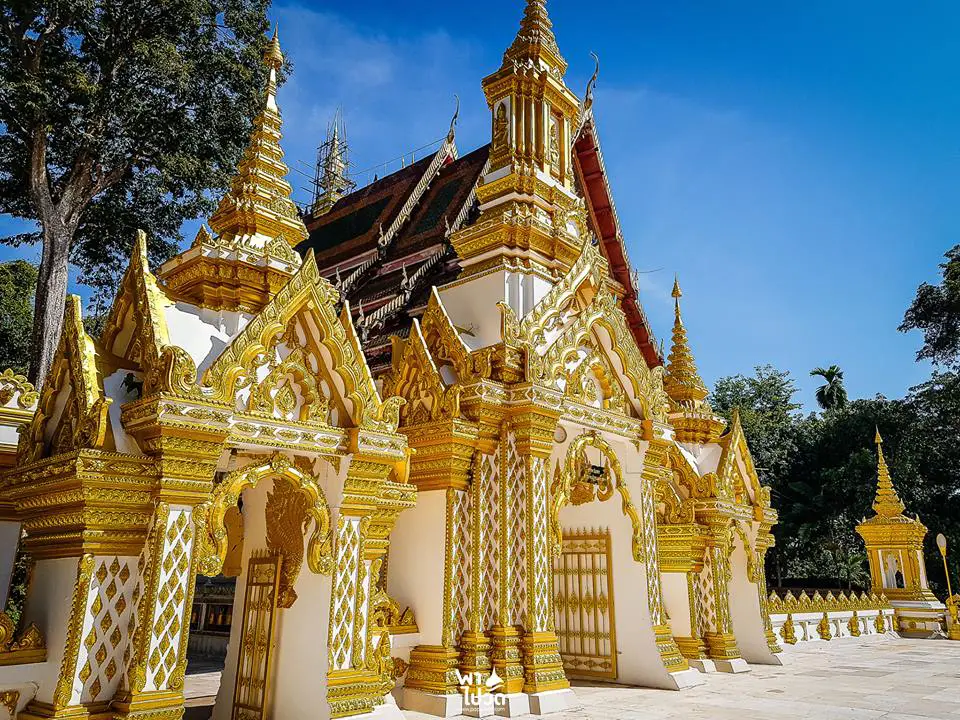
7. Wat Marukkhanakhon is located at Ban Don Nang Hong Tha, Moo 7, Don Nang Hong Subdistrict, That Phanom District. It functions as a Buddhist temple, meditation center, and historical site associated with the former city name Marukkhanakhon. The temple contains Phra That Marukkhanakhon, which has become part of Nakhon Phanom's birthday-stupa pilgrimage route.
Highlights: Phra That Marukkhanakhon, historical associations with the former city of Marukkhanakhon, meditation facilities, peaceful surroundings, and its traditional association with people born on Wednesday night.
The name “Marukkhanakhon” appears in different periods of Nakhon Phanom and Mekong history. It reflects the movement of political centers and communities in response to geography, politics, and regional change. Visiting the temple therefore helps explain that the history of Nakhon Phanom did not begin solely at the location of the present city.
Phra That Marukkhanakhon was constructed as a religious center for the surrounding community and later became connected with the birthday-stupa route. Its architecture draws inspiration from important sacred monuments of the Mekong region and is set within relatively peaceful temple grounds.
The temple can easily be combined with Wat Phra That Phanom Woramahawihan and Ban Thu Archaeological Site because all are located in That Phanom District. Together, they create a 1-day route covering religion, historic settlements, and archaeology.
Getting There: Located at Ban Don Nang Hong Tha, Moo 7, Don Nang Hong Subdistrict, That Phanom District, Nakhon Phanom 48110. Open daily from 06.00–18.00. Admission is free.
Map (GPS): https://www.google.com/maps/dir/?api=1&destination=17.096560,104.762265&travelmode=driving
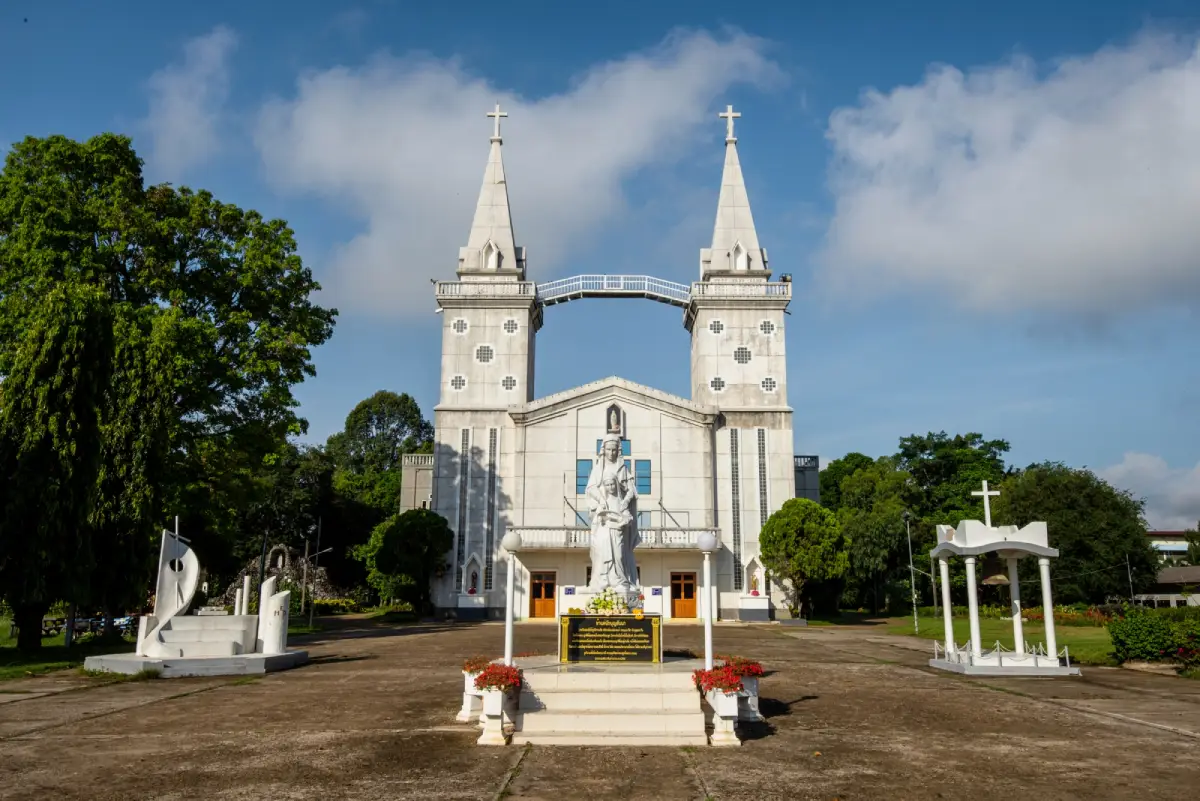
8. Co-Cathedral of Saint Anne, also known as Saint Anne Nong Saeng Church, is located on Sunthorn Wichit Road in the Nong Saeng neighborhood of Nakhon Phanom city. It is a historic Catholic church on the Mekong River and one of the most important architectural reminders of the Christian and Vietnamese communities in the province.
Highlights: Christian architecture on the Mekong waterfront, twin towers, history of the Nong Saeng Catholic community, Vietnamese heritage, and views toward Thakhek in Laos.
Christianity spread into the Nakhon Phanom area through missionaries and Christian communities of the Mekong region. The establishment of the church in Nong Saeng made the neighborhood an important religious center for Catholic families and gave the church a wider role in education, social services, and community support.
The church's Western architectural style contrasts with the Buddhist temples that dominate much of the province. Its twin towers and riverside setting have become part of the visual identity of Nakhon Phanom, while the building itself demonstrates how Christian architecture was adapted to the tropical climate and Mekong environment.
The site is especially suitable for visitors interested in religious history, architecture, Vietnamese communities, and photography. Visitors should remain quiet during Mass and other religious ceremonies and avoid entering areas reserved for worship.
Getting There: Located on Sunthorn Wichit Road along the Mekong River in Nong Saeng, Nai Mueang Subdistrict, Mueang Nakhon Phanom District. Open daily from 08.00–18.00.
Map (GPS): https://www.google.com/maps/dir/?api=1&destination=17.420869,104.775770&travelmode=driving
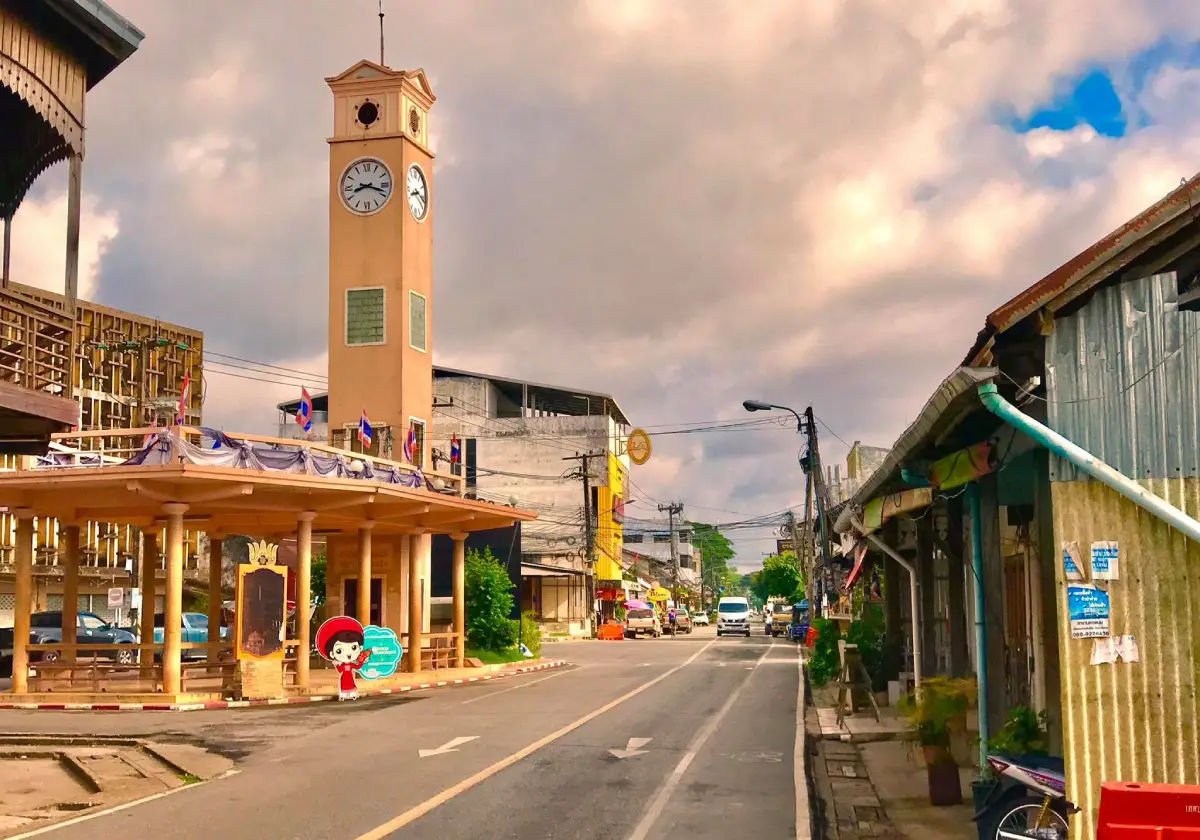
9. Vietnamese Memorial Clock Tower stands in the old-town area near Sunthorn Wichit Road and Si Thep Road in Nakhon Phanom city. It is a monument to the relationship between the Vietnamese community and Nakhon Phanom and helps tell the story of migration, settlement, and the return of Vietnamese residents during the 20th century.
Highlights: Clock tower built by Vietnamese residents in 1960, old-town streets, multicultural architecture, connection to the Mekong riverfront, and a lively atmosphere after sunset.
The clock tower was constructed as a memorial and gesture of gratitude toward Thailand before a number of Vietnamese residents returned to their homeland as political conditions changed. It is therefore more than a timepiece; it represents population movement and long-standing connections between people of the two countries.
The surrounding area is excellent for walking through the old town because it connects naturally with the Mekong promenade, Vietnamese restaurants, historic buildings, and public spaces. The area becomes especially lively from late afternoon into the evening.
Travelers interested in Vietnamese history in Thailand should combine the clock tower with other sites connected to Vietnamese settlement and Thai–Vietnamese relations for a more complete understanding of the community's role in Nakhon Phanom.
Getting There: Located in the historic town area near Sunthorn Wichit Road and Si Thep Road, Nai Mueang Subdistrict, Mueang Nakhon Phanom District. This is a public area accessible 24 hours a day.
Map (GPS): https://www.google.com/maps/dir/?api=1&destination=17.403782,104.787807&travelmode=driving
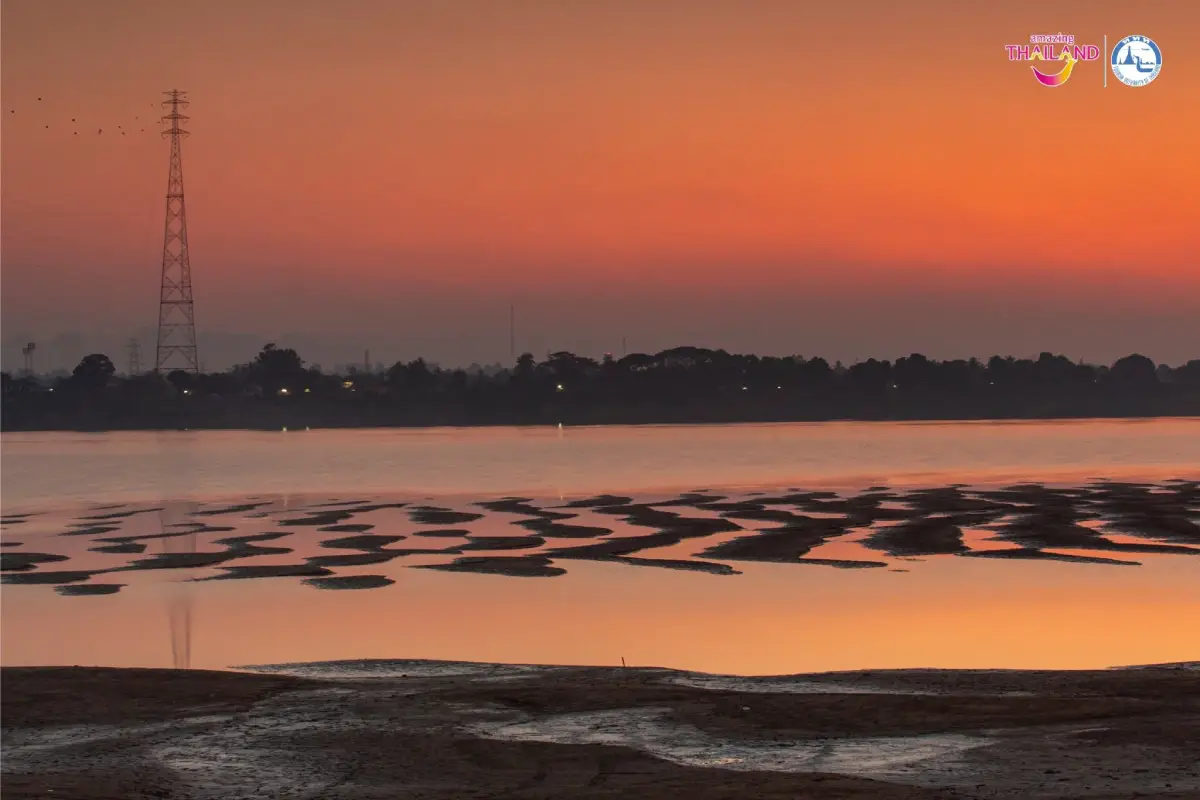
10. Si Khotrabun Golden Sand Beach and Public Park is located along Sunthorn Wichit Road in Nakhon Phanom city. It is a riverside recreation area and a viewpoint for a seasonal freshwater sandbar that becomes visible when the Mekong River level falls during the dry season.
Highlights: Golden sandbar during low-water periods, sunrise over Laos, riverside walking and exercise areas, views of Thakhek and the mountains of Khammouane Province, and natural ripple patterns formed by water and wind.
The golden sandbar is not a permanent beach. It forms from sediment deposited by the Mekong River and gradually emerges as the water level falls. Its size, shape, and visibility therefore vary from year to year.
February to May generally offers a better chance of seeing the exposed sand, although actual conditions depend on rainfall and Mekong water levels. During the rainy season, most of the sandbar may be submerged, but the public park above the river remains suitable for walking and exercise.
Early morning is excellent for photography because the sun rises from the Lao side and low-angle light emphasizes the patterns in the sand. Evenings are better for leisurely walks and observing everyday riverside life.
Although the area is called a beach, it should not be treated as a general swimming location. Mekong currents can be strong, depths can change quickly, and hidden channels or unstable sand may be present.
Getting There: Located on Sunthorn Wichit Road, Nai Mueang Subdistrict, Mueang Nakhon Phanom District. Open daily from 06.00–20.00. Admission is free. Access to the exposed sand depends on water level, weather, daylight, and local safety conditions.
Map (GPS): https://www.google.com/maps/dir/?api=1&destination=17.416358,104.780179&travelmode=driving
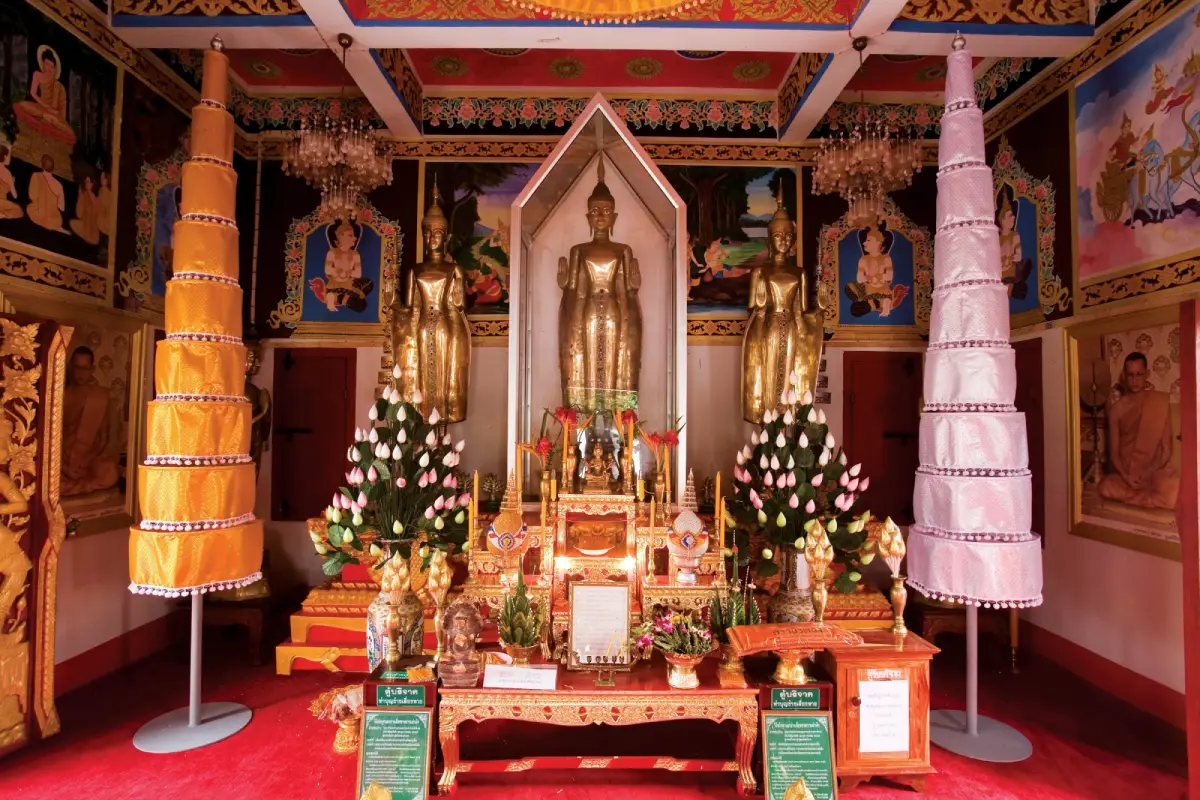
11. Phra Bang Wat Trai Phum is located inside Wat Trai Phum, Moo 3, Tha Uthen Subdistrict, Tha Uthen District. The temple houses a highly revered bronze standing Buddha image in the Pacifying the Ocean posture, created in the Lan Xang artistic tradition and closely connected with the history and beliefs of communities on both sides of the Mekong.
Highlights: Approximately 80-inch-tall bronze Phra Bang image, octagonal base supported by 8 elephants, Lan Xang Buddhist art, traditional bathing ceremony, and the atmosphere of historic Tha Uthen.
The image has an elongated face, forward-looking eyes, flame-shaped radiance, and both hands raised in the Pacifying the Ocean posture. The statue can be separated into several components, a feature that corresponds with historical accounts of moving the image through mountainous terrain and across the Mekong River.
Inscriptions and art-historical study help place the image within the broader cultural network of Lan Xang. The community continues to preserve traditions associated with the sacred image, particularly ceremonial processions and ritual bathing during important occasions.
Several major attractions are located nearby, including Phra That Tha Uthen, historic Tha Uthen, and Chai Buri River Mouth. Together, they form a convenient half-day or full-day route covering Buddhism, Lan Xang art, Tai Yo heritage, and Mekong landscapes.
Getting There: Wat Trai Phum is located at Moo 3, Tha Uthen Subdistrict, Tha Uthen District, Nakhon Phanom 48120. Open daily from 07.30–19.00. Admission is free.
Map (GPS): https://www.google.com/maps/dir/?api=1&destination=17.654295,104.460544&travelmode=driving
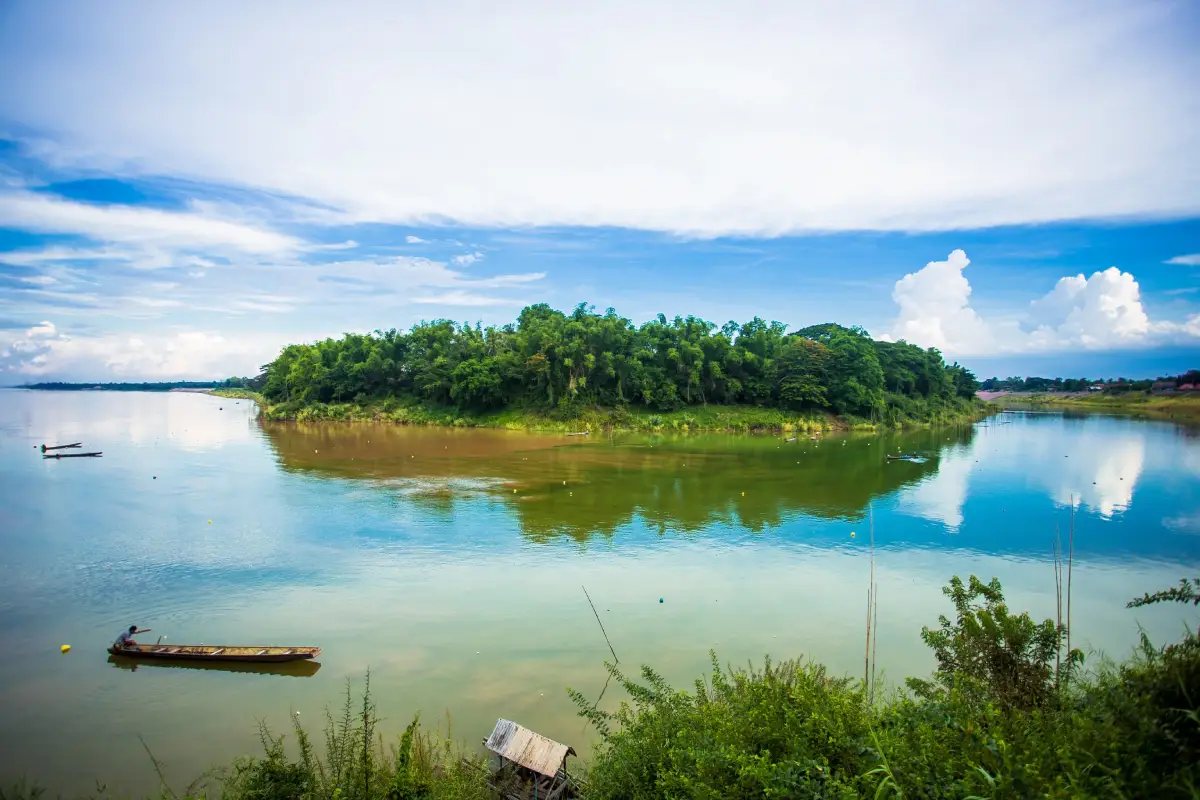
12. Chai Buri River Mouth is located where the Songkhram River meets the Mekong River in Chai Buri Subdistrict, Tha Uthen District. It is one of Nakhon Phanom's most interesting river viewpoints because differences in sediment, water level, and light can sometimes create a visible contrast between the two bodies of water before they merge.
Highlights: Confluence of the Songkhram and Mekong rivers, two-color river phenomenon, wetland ecosystems, traditional fishing, river-fish cuisine, and the historic Tai Yo community of Chai Buri.
The Songkhram River is an important river of upper northeastern Thailand and supports extensive seasonally flooded forests and wetlands. When it reaches Chai Buri, it joins the Mekong, whose sediment and currents may differ. The visible contrast between the waters therefore changes according to season, rainfall, sediment concentration, and sunlight.
The river mouth is also closely connected with local fishing culture. Fish from the Songkhram and Mekong support food, income, and local knowledge. Visitors can experience river-fish cuisine and observe fishing practices and daily life near the water.
Chai Buri is also an old settlement with strong Tai Yo cultural roots. It can be combined with local temples, historic neighborhoods, Phra That Tha Uthen, and Phra Bang Wat Trai Phum to create a varied district itinerary.
Getting There: Located around the mouth of the Songkhram River at Ban Chai Buri–Ban Tan Pak Nam, Chai Buri Subdistrict, Tha Uthen District. Open daily from 08.00–18.00. Admission is free. Approximately 46 km from Nakhon Phanom city.
Map (GPS): https://www.google.com/maps/dir/?api=1&destination=17.652409,104.465036&travelmode=driving
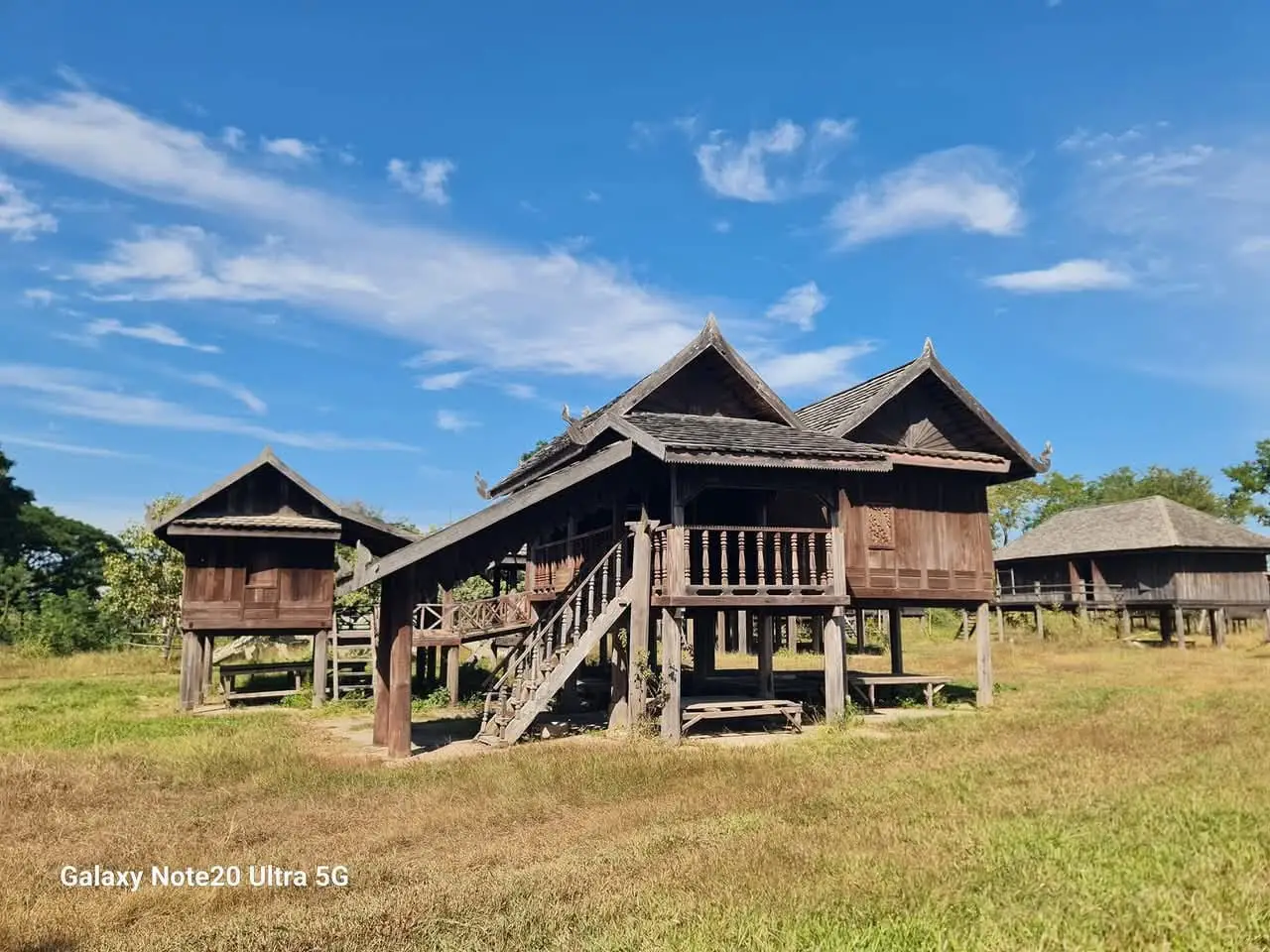
13. Phu Thai House is located within the Phu Thai Cultural Center at Renu Nakhon Witthayanukul School in Renu Nakhon District. It is a cultural learning center that brings together Phu Thai architecture, clothing, woven textiles, tools, household objects, and traditional knowledge.
Highlights: Raised wooden Phu Thai house, traditional textiles, weaving equipment, basketry, household tools, musical instruments, clothing, and exhibits about living Phu Thai culture in Renu Nakhon.
The house is more than a decorative reconstruction. Its design helps explain how architecture was adapted to tropical climate and agricultural life. Different parts of the raised house were associated with cooking, sleeping, weaving, storing crops, and other household activities.
The objects on display provide a deeper understanding of Phu Thai culture beyond traditional costumes. Exhibits include weaving tools, utensils, musical instruments, documents, and objects from everyday life. Renu Nakhon Witthayanukul School also plays an important role in preserving Phu Thai culture through education and community activities.
Phu Thai House should be combined with Wat That Renu and the surrounding Renu Nakhon community. Wat That Renu represents religious faith and Buddhist art, while Phu Thai House provides cultural context through language, textiles, music, dance, and daily life.
Getting There: Located within Renu Nakhon Witthayanukul School, 181 Moo 13, Mueang Mai Witthayanukul Road, Renu Subdistrict, Renu Nakhon District, Nakhon Phanom 48170. Open Monday–Friday from 08.00–16.00 and closed on weekends and public holidays. Admission is free. Groups should arrange visits in advance because the site is inside a school.
Map (GPS): https://www.google.com/maps/dir/?api=1&destination=17.056569,104.678344&travelmode=driving
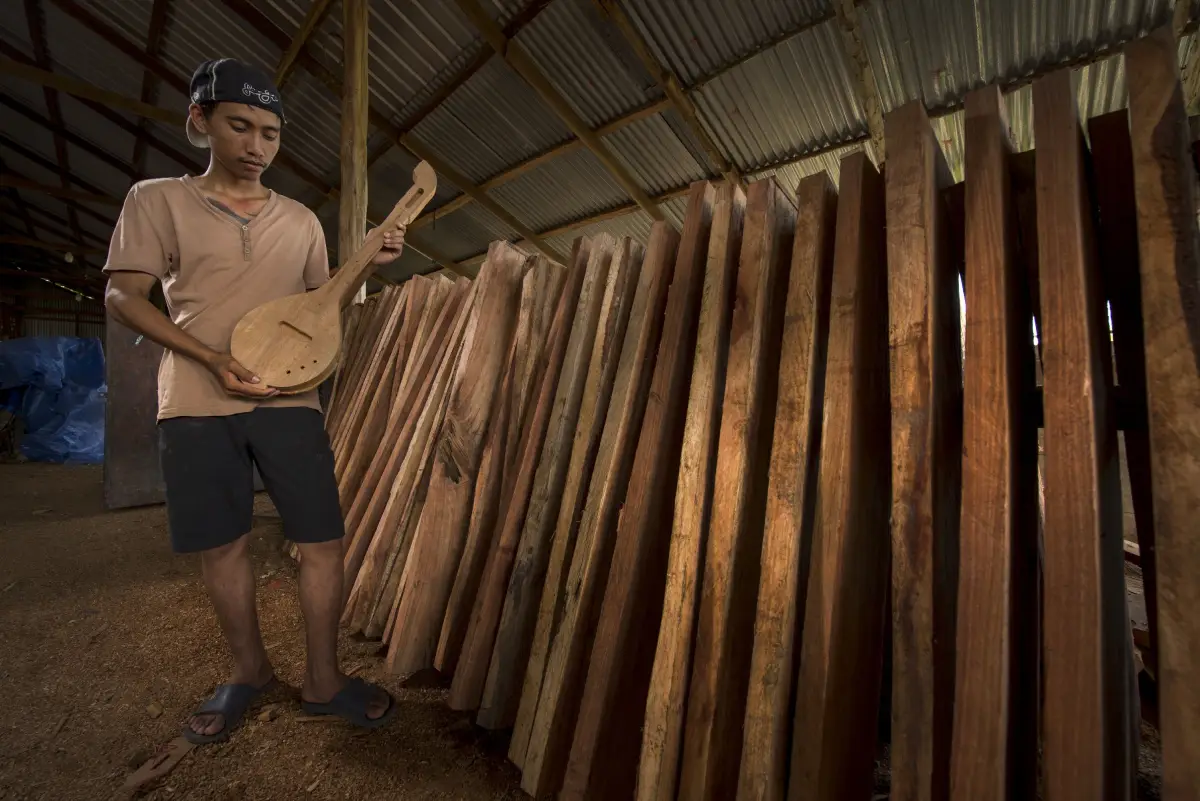
14. Ban Tha Ruea Khaen, Phin and Wot Craft Village is located in Tha Ruea Subdistrict, Na Wa District. The community is widely known for producing traditional Isan musical instruments, particularly khaen mouth organs, phin lutes, and wot panpipes, using specialized knowledge passed down through generations.
Highlights: Traditional production of khaen, phin, and wot instruments, local craftsmanship, instrument tuning, community products, and the connection between Isan music, festivals, dance, and everyday life.
Making a khaen requires careful selection and preparation of materials, construction of metal reeds, arrangement of bamboo pipes, and precise tuning. Even small differences in pipe length or reed construction can noticeably change the instrument's pitch.
Phin and wot making also require specialized knowledge. Phin construction involves the body, neck, strings, and fret positions, while wot makers arrange pipes to produce related notes. The community is particularly interesting for musicians, teachers, students, artists, and travelers interested in traditional craftsmanship.
Because Ban Tha Ruea is a living community rather than a museum with fixed demonstration schedules, travelers who specifically want to meet craftsmen or watch production should make arrangements in advance.
Getting There: Located in Tha Ruea Subdistrict, Na Wa District, Nakhon Phanom 48180, approximately 6 km from Na Wa town. Public parts of the village can be visited daily, preferably between 08.00–17.00. Demonstrations and craft-learning activities should be arranged in advance.
Map (GPS): https://www.google.com/maps/dir/?api=1&destination=17.517744,104.069485&travelmode=driving
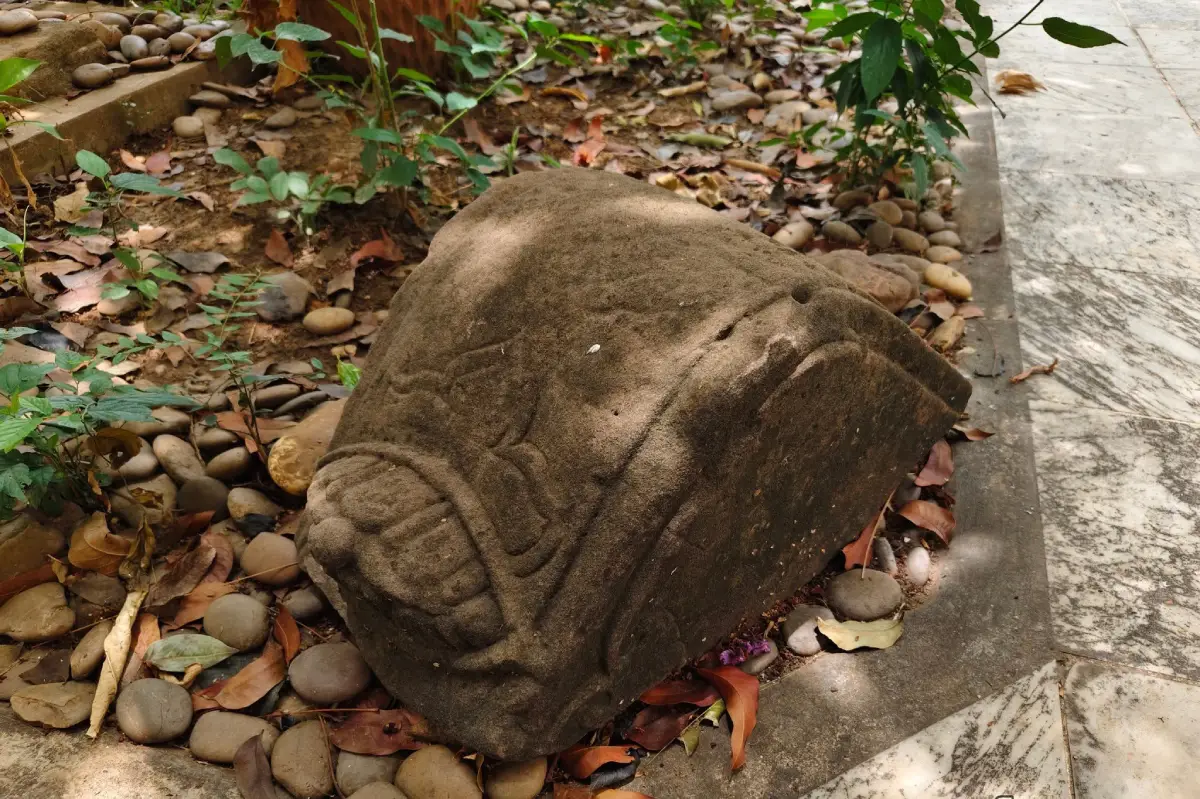
15. Ban Thu Archaeological Site is located at Ban Thu, Nam Kam Subdistrict, That Phanom District. It is an important community archaeological site where evidence has been discovered around the village, Wat Sa Phang Thong, and nearby areas, revealing long-term settlement and Buddhist activity in the Nam Kam and Mekong river basins.
Highlights: Eight sandstone boundary stones, carved stupa motifs, grinding stones, stone platforms, pottery, and archaeological evidence spanning several historical periods.
The sandstone sema boundary stones are among the site's most important remains. Today, they are preserved around the ordination hall of Wat Sa Phang Thong. Several feature carved stupa forms above lotus bases and decorative bead patterns associated with Buddhist art in northeastern Thailand.
Stone tools and several types of pottery have also been discovered, reflecting settlement, production, and exchange with other communities. The importance of Ban Thu therefore lies not in a monumental ruin but in the way a modern village overlaps with an older archaeological landscape.
The site can be combined with Wat Phra That Phanom Woramahawihan and Wat Marukkhanakhon in a 1-day route, connecting community-level archaeological evidence with the major religious centers of That Phanom District.
Getting There: Located at Ban Thu, Nam Kam Subdistrict, That Phanom District, Nakhon Phanom. The temple and community are best visited between 08.00–17.00. Permission should be requested before entering restricted areas or viewing objects kept inside educational facilities.
Map (GPS): https://www.google.com/maps/dir/?api=1&destination=16.912615,104.711133&travelmode=driving
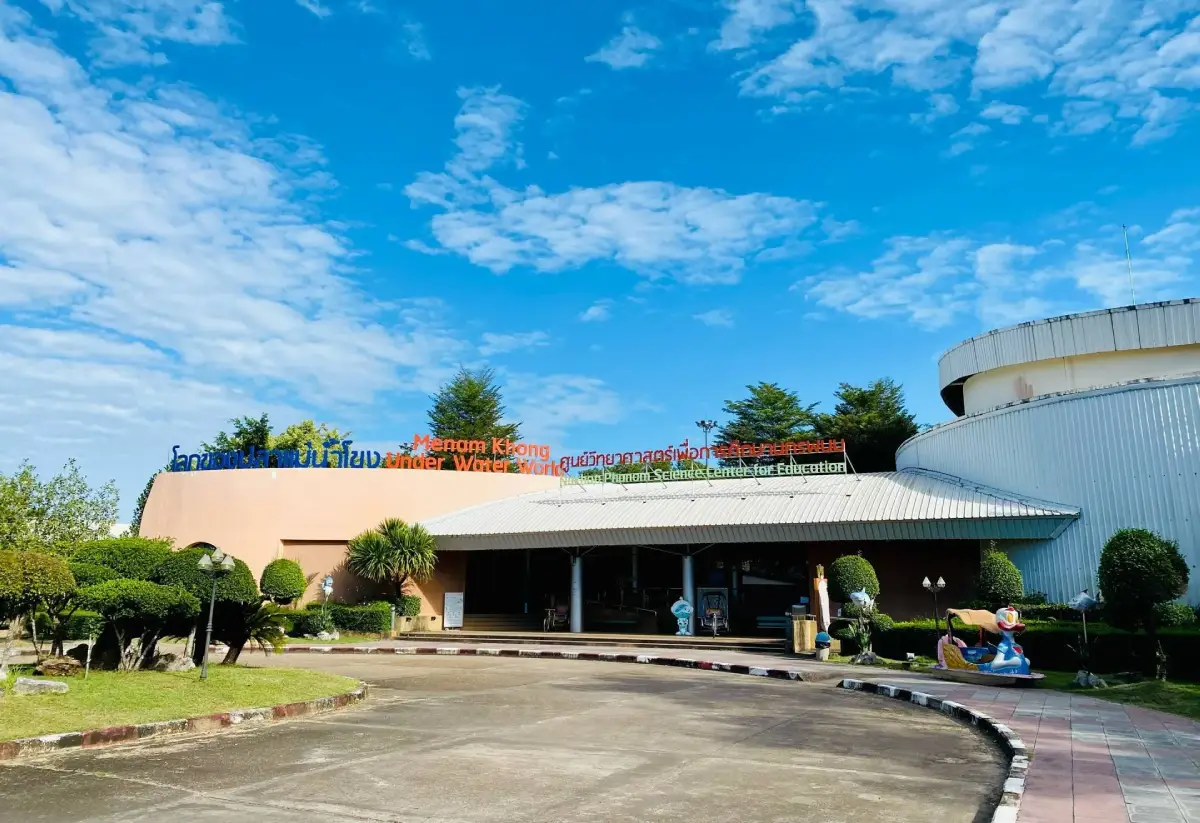
16. Mekong Underwater World is located at the Nakhon Phanom Science Center for Education in Nong Yat Subdistrict, Mueang Nakhon Phanom District. It is a learning attraction focusing on freshwater fish, aquatic ecosystems, and natural resources of the Mekong basin and is particularly suitable for families and children.
Highlights: Underwater fish tunnel, freshwater aquariums, rare Mekong species, science exhibitions, and educational displays about aquatic biodiversity.
The Mekong is one of the world's major freshwater ecosystems and supports a remarkable diversity of fish. The exhibits allow visitors to observe species that may be difficult to see in the wild and learn how fish are connected with currents, seasonal migration, spawning, and food sources.
The attraction is not intended solely for entertainment. It also functions as a science-learning center where children and young people can connect aquarium exhibits with broader issues such as ecosystems, aquatic conservation, water quality, and the importance of the Mekong to communities in several countries.
Because most exhibits are indoors, it is a useful attraction during hot weather or rainy days. It can be combined easily with Ban Na Chok and other attractions around Nakhon Phanom city.
Getting There: Located at Nakhon Phanom Science Center for Education, 355 Moo 6, Nong Yat Subdistrict, Mueang Nakhon Phanom District, Nakhon Phanom 48000. Open daily, including public holidays, from 08.30–16.30. Admission is 20 baht for children and 30 baht for adults. Monks, novices, and visitors aged 60 or above enter free.
Map (GPS): https://www.google.com/maps/dir/?api=1&destination=17.374487,104.736307&travelmode=driving
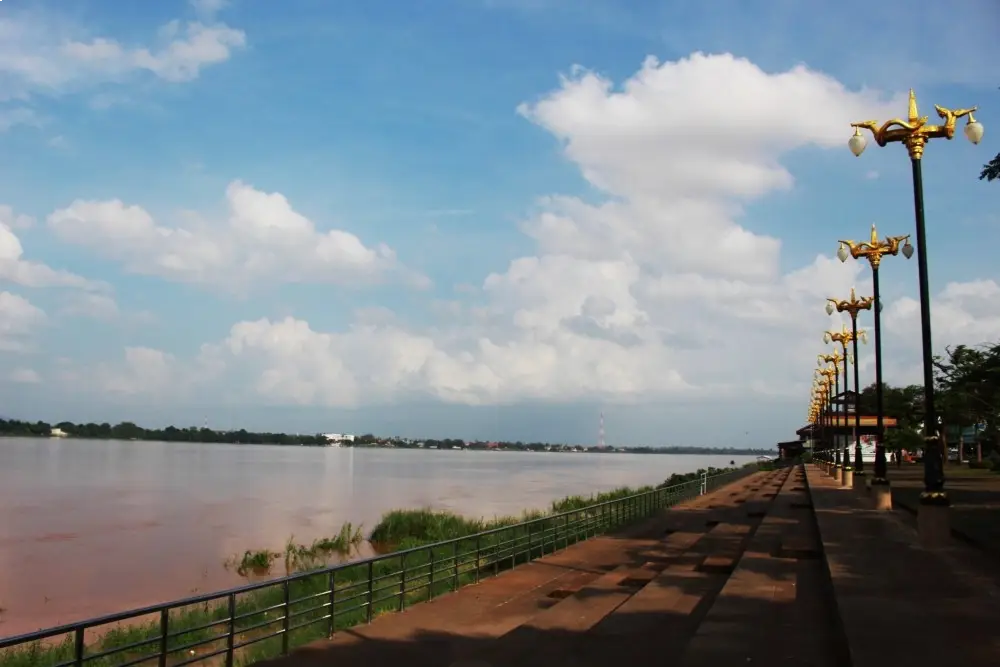
17. Na Muang Nakhon Phanom Dam is the riverside embankment and public recreation area extending along Sunthorn Wichit Road beside the Mekong River. Despite its name, it is not a large water-storage dam but a riverbank protection structure integrated with the city's public waterfront.
Highlights: Mekong promenade, sunrise over Laos, views of Thakhek and the mountains of Khammouane, cycling areas, public activity spaces, and convenient walking access to several city landmarks.
The riverfront makes exploring central Nakhon Phanom easy because visitors can walk between Phaya Si Sattanakharat, Indochina Market, the Vietnamese Memorial Clock Tower, the old town, and the Co-Cathedral of Saint Anne while using the Mekong as the main orientation point.
Early morning is especially peaceful, with sunrise over Laos and local residents running, walking, and cycling. From late afternoon into the evening, the riverfront becomes livelier as people gather for recreation, food, and social activities.
The embankment is therefore suitable for photographers, runners, cyclists, families, and visitors who want to experience everyday local life rather than simply moving between individual landmarks by car.
Getting There: Located along Sunthorn Wichit Road, Nai Mueang Subdistrict, Mueang Nakhon Phanom District. The public area is accessible 24 hours a day and admission is free. Recommended walking periods are around 05.30–08.00 and 16.30–21.00.
Map (GPS): https://www.google.com/maps/dir/?api=1&destination=17.402321,104.788829&travelmode=driving
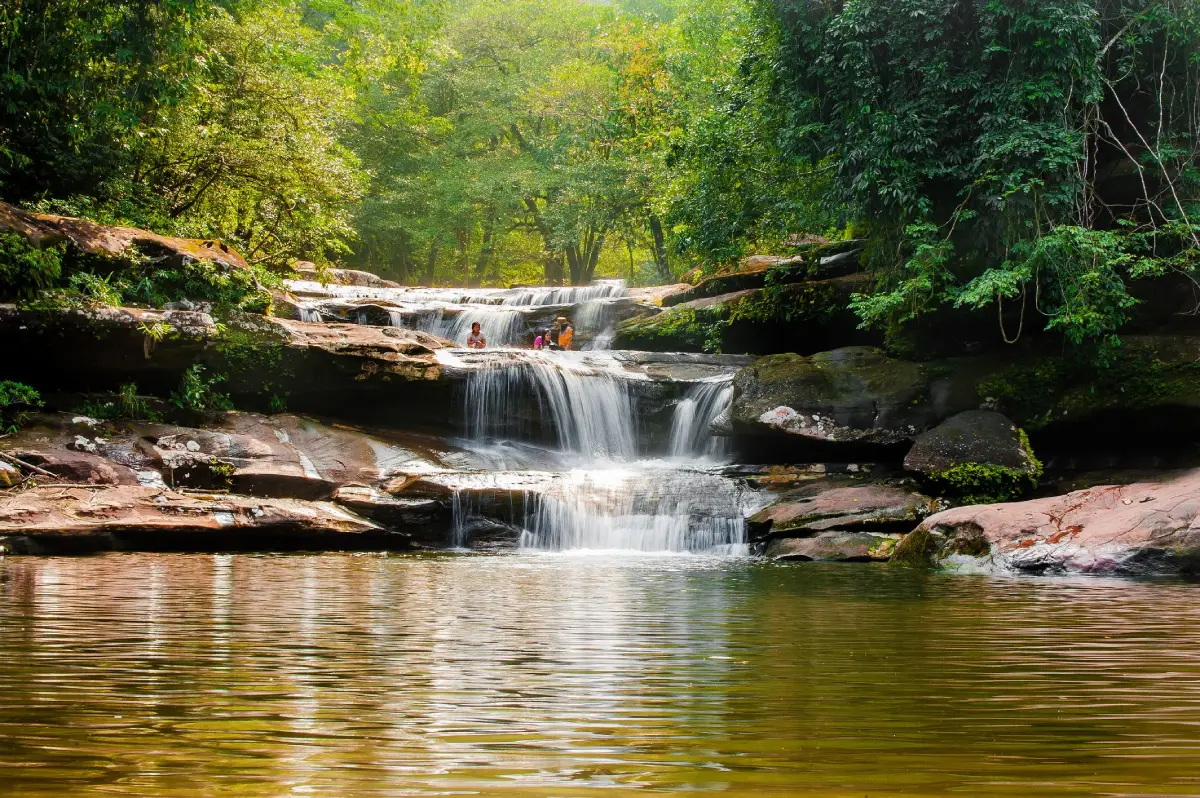
18. Tat Kham Waterfall is located within Phu Langka National Park in Na Ngua Subdistrict, Ban Phaeng District. The waterfall is formed by streams descending from the Phu Langka mountain range across rock terraces and cliffs, creating several main levels surrounded by forest.
Highlights: Approximately 4 waterfall levels, natural rock terraces and pools, Phu Langka forest, shaded surroundings, and proximity to Tat Pho Waterfall and other natural attractions around Ban Phaeng.
Water volume changes significantly with the season. During the rainy season and after sustained rainfall, the waterfall becomes much fuller, but rocks become slippery, currents grow stronger, and water levels may rise rapidly. Visitors should follow park safety instructions carefully.
The lower levels are more suitable for relaxing and enjoying the scenery than for long-distance trekking, making Tat Kham relatively accessible for families. Children should nevertheless remain closely supervised, and visitors should never enter areas closed by park staff.
The waterfall forms part of the broader Phu Langka forest ecosystem, an important headwater area for several streams. Visitors should avoid littering, contaminating waterways, collecting natural materials, or creating unnecessary disturbance.
Getting There: From Nakhon Phanom city, follow Highway 212 toward Ban Phaeng District and continue approximately 8 km from Ban Phaeng town toward Na Ngua. Access is seasonal and subject to park safety conditions, rainfall, and flash-flood risk. Typical access hours are around 07.00–15.30.
Map (GPS): https://www.google.com/maps/dir/?api=1&destination=17.951875,104.157590&travelmode=driving
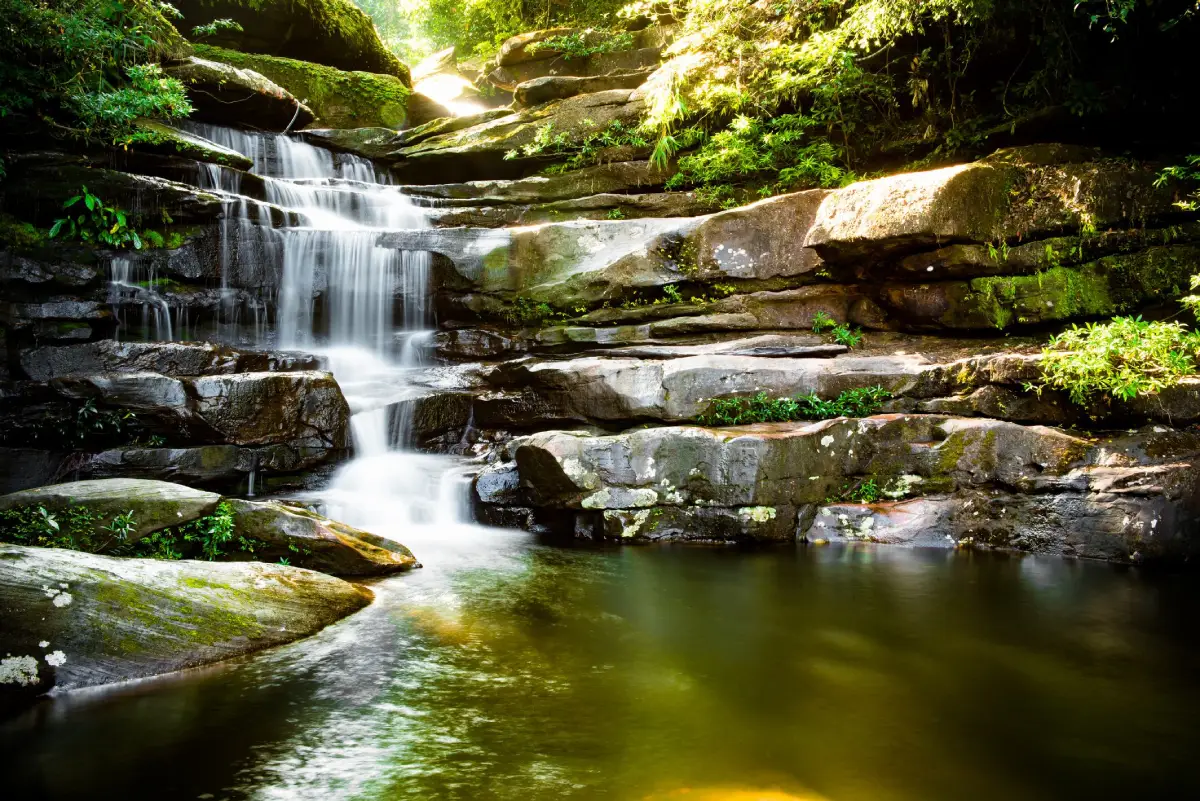
19. Tat Pho Waterfall is located within Phu Langka National Park in Phai Lom Subdistrict, Ban Phaeng District. It is one of the major waterfalls of the Phu Langka range on the Nakhon Phanom side, with streams descending across several rock levels and sections of high cliff surrounded by forest.
Highlights: Multi-level waterfall, high rock cliffs, Phu Langka forest, nature trails, strong rainy-season water flow, and a remote natural atmosphere away from the Mekong city route.
The waterfall is generally at its most impressive from the rainy season into early winter, especially after sustained rainfall. During periods of high water, visitors must be especially careful of slippery rocks, flash floods, and rapidly changing mountain weather.
Tat Pho is suitable for travelers who want to spend more time in nature rather than simply stop for photographs. Good walking shoes, drinking water, rain protection during the green season, and enough time to leave the forest before dark are recommended.
If you have a full day, Tat Pho can be combined with Tat Kham Waterfall. However, avoid attempting too many hiking routes in one day, particularly after heavy rain. Flexible planning based on park announcements is safer and more enjoyable.
Getting There: Located within Phu Langka National Park, Phai Lom Subdistrict, Ban Phaeng District, Nakhon Phanom. The drive from Nakhon Phanom city is more than 100 km along Highway 212. Typical access hours are around 07.00–15.00, depending on weather, seasonal closure schedules, and park safety announcements.
Map (GPS): https://www.google.com/maps/dir/?api=1&destination=17.985361,104.140033&travelmode=driving
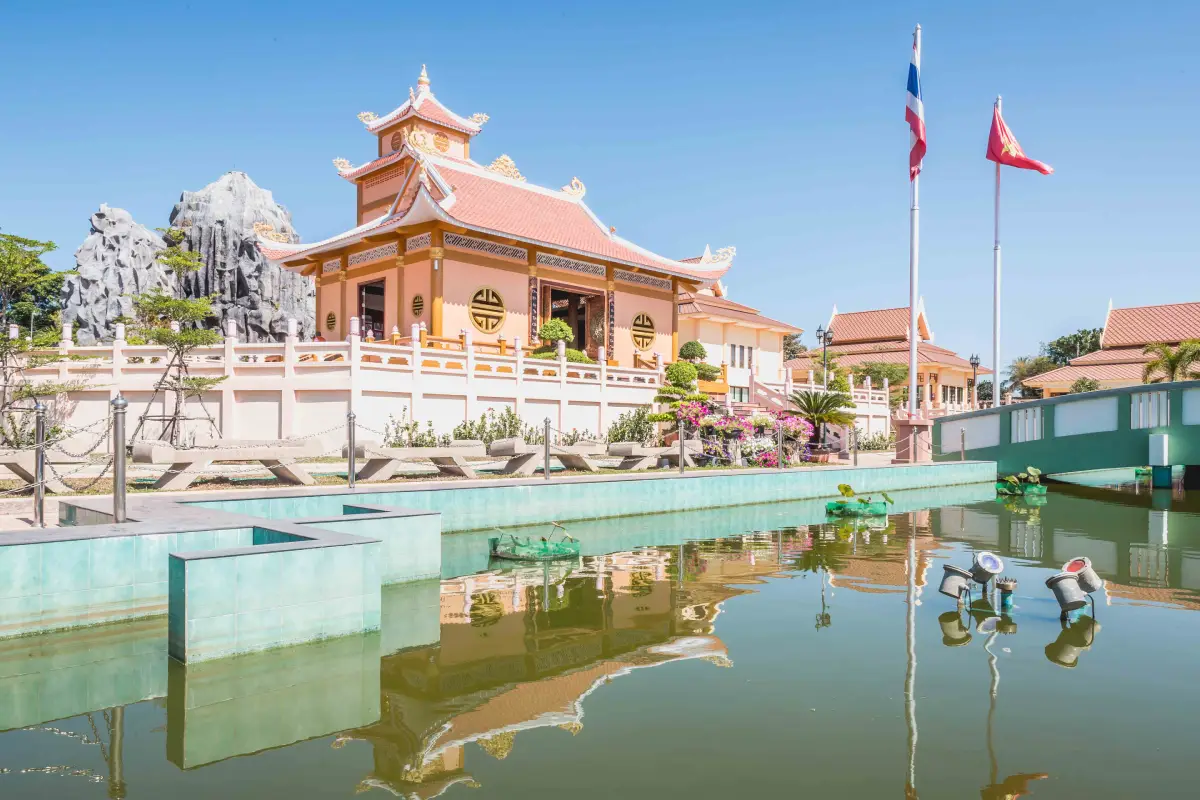
20. Ban Na Chok (Ban Lung Ho) is located in Nong Yat Subdistrict, Mueang Nakhon Phanom District. It is an important historical attraction connected with Thai–Vietnamese relations because the area is associated with the period when Ho Chi Minh lived among the Vietnamese community in Nakhon Phanom during the Vietnamese independence movement.
Highlights: Simple wooden house, household objects and stories connected with Ho Chi Minh, rice barn, surrounding garden, Thai-Vietnamese community, and displays explaining the historical relationship between Thailand and Vietnam.
The atmosphere differs from that of a large modern museum because the site retains the character of a rural house and community. Visitors can therefore gain a stronger sense of everyday life rather than learning only about major political events.
The story of Ban Na Chok also helps explain why Vietnamese influences remain visible in Nakhon Phanom's food, architecture, language, and communities. Vietnamese settlers did not exist separately from local society but contributed to the province's economy, culture, and urban identity.
A visit can be combined with Mekong Underwater World, which is also in Nong Yat Subdistrict, before returning to the city for the Co-Cathedral of Saint Anne, Vietnamese Memorial Clock Tower, and the Mekong riverfront. Together, these places provide a broader view of Vietnamese history in Nakhon Phanom.
Getting There: Located at Ban Na Chok, Nong Yat Subdistrict, Mueang Nakhon Phanom District. From central Nakhon Phanom, follow the Nakhon Phanom–Sakon Nakhon route toward Ban Na Chok. Open daily from 08.00–18.00. Admission is free.
Map (GPS): https://www.google.com/maps/dir/?api=1&destination=17.374905,104.761453&travelmode=driving
| Topic | Details |
| Province Overview | Nakhon Phanom is a Mekong River province known for sacred stupas, Mekong culture, Phu Thai and Tai Yo communities, Vietnamese heritage, and the natural landscapes of Phu Langka. Trips can range from 1 day to 4–5 days, with attractions best organized by geographical zone. |
| Top 10 Highlights | 1. Wat Phra That Phanom Woramahawihan 2. Wat That Renu 3. Phra That Tha Uthen 4. Phra That Si Khun 5. Wat Phra That Mahachai 6. Phra That Prasit 7. Co-Cathedral of Saint Anne 8. Vietnamese Memorial Clock Tower 9. Ban Na Chok (Ban Lung Ho) 10. Tat Pho Waterfall |
| Nakhon Phanom City Zone | 1. Co-Cathedral of Saint Anne 2. Vietnamese Memorial Clock Tower 3. Si Khotrabun Golden Sand Beach and Public Park 4. Mekong Underwater World 5. Na Muang Nakhon Phanom Riverfront Embankment 6. Ban Na Chok (Ban Lung Ho) Ideal for a 1-day trip focused on the Mekong waterfront, Thai–Vietnamese history, religion, local life, and river scenery. |
| That Phanom–Renu Nakhon Zone | 1. Wat Phra That Phanom Woramahawihan 2. Wat Marukkhanakhon 3. Ban Thu Archaeological Site 4. Wat That Renu 5. Phu Thai House Suitable for a full-day route combining Buddhist faith, history, religious art, archaeology, and Phu Thai culture. |
| Tha Uthen Zone | 1. Phra That Tha Uthen 2. Phra Bang Wat Trai Phum 3. Chai Buri River Mouth Ideal for sacred stupas, Lan Xang art, Tai Yo heritage, Mekong community life, and the confluence of the Songkhram and Mekong rivers. |
| Na Kae–Pla Pak–Na Wa Zone | 1. Phra That Si Khun 2. Wat Phra That Mahachai 3. Phra That Prasit 4. Ban Tha Ruea Khaen, Phin and Wot Craft Village Suitable for the birthday-stupa route, Buddhist meditation heritage, and traditional Isan musical-instrument craftsmanship. |
| Ban Phaeng–Phu Langka Zone | 1. Tat Kham Waterfall 2. Tat Pho Waterfall Best for forests, waterfalls, and nature travel in Phu Langka National Park. Always check weather and access announcements before visiting. |
| Sacred Stupas and Religious Sites | 1. Wat Phra That Phanom Woramahawihan 2. Wat That Renu 3. Phra That Tha Uthen 4. Phra That Si Khun 5. Wat Phra That Mahachai 6. Phra That Prasit 7. Wat Marukkhanakhon 8. Phra Bang Wat Trai Phum |
| Birthday Stupa Route | Nakhon Phanom is famous for sacred stupas associated with days of birth, including Phra That Phanom for Sunday, Phra That Renu for Monday, Phra That Si Khun for Tuesday, Phra That Mahachai for Wednesday daytime, Phra That Marukkhanakhon for Wednesday night, Phra That Prasit for Thursday, and Phra That Tha Uthen for Friday. |
| Phu Thai Culture | Wat That Renu and Phu Thai House in Renu Nakhon are key places for learning about Phu Thai language, clothing, textiles, music, dance, architecture, and community traditions. |
| Thai–Vietnamese History | 1. Ban Na Chok (Ban Lung Ho) 2. Vietnamese Memorial Clock Tower 3. Co-Cathedral of Saint Anne Together, these attractions help explain Vietnamese settlement, Catholic history, the Vietnamese independence movement, and connections between Thailand and Vietnam. |
| History and Archaeology | Ban Thu Archaeological Site preserves sandstone boundary stones, stone tools, pottery, and evidence from several periods, while Wat Marukkhanakhon, Phra That Phanom, and historic Tha Uthen provide broader historical context for the Mekong region. |
| Nature and Waterfalls | 1. Tat Kham Waterfall 2. Tat Pho Waterfall 3. Chai Buri River Mouth 4. Si Khotrabun Golden Sand Beach Several natural attractions depend on season, river level, rainfall, and weather conditions. |
| Mekong Riverside Attractions | Co-Cathedral of Saint Anne, Vietnamese Memorial Clock Tower, the city riverfront embankment, Si Khotrabun Golden Sand Beach, Phra That Tha Uthen, Phra Bang Wat Trai Phum, and Chai Buri River Mouth all reveal the close relationship between settlements, religion, trade, culture, and the Mekong River. |
| Family-Friendly Attractions | Mekong Underwater World, Phu Thai House, Ban Tha Ruea, Ban Na Chok, the city riverfront, and several temples are suitable for families and provide opportunities to learn about nature, science, history, and culture. |
| Suitable for Children | Mekong Underwater World, Phu Thai House, Ban Tha Ruea, Ban Na Chok, and the city riverfront are good choices for children. Adults should supervise children closely near rivers, waterfalls, and slippery terrain. |
| Suitable for Senior Travelers | Wat Phra That Phanom, Wat That Renu, Phra That Tha Uthen, Phra That Si Khun, Wat Phra That Mahachai, Phra That Prasit, the Co-Cathedral of Saint Anne, Vietnamese Memorial Clock Tower, and the Nakhon Phanom riverfront are relatively accessible and do not require long hikes. |
| Photography | Recommended locations include Si Khotrabun Golden Sand Beach at sunrise, the riverfront embankment, Co-Cathedral of Saint Anne, Vietnamese Memorial Clock Tower, Phra That Tha Uthen, Phra That Phanom, Tat Pho Waterfall, and Tat Kham Waterfall. |
| 1 Day | Choose one zone only. First-time visitors can explore central Nakhon Phanom, including the Co-Cathedral of Saint Anne, Vietnamese Memorial Clock Tower, riverfront, and Golden Sand Beach, or follow the Wat Phra That Phanom–Wat Marukkhanakhon–Wat That Renu–Phu Thai House route. |
| 2 Days / 1 Night | Day 1: Nakhon Phanom city – Ban Na Chok – Mekong Underwater World – Vietnamese Memorial Clock Tower – Co-Cathedral of Saint Anne – Mekong riverfront Day 2: Wat Phra That Phanom – Wat Marukkhanakhon – Wat That Renu – Phu Thai House |
| 3 Days / 2 Nights | Day 1: Nakhon Phanom city Day 2: That Phanom–Renu Nakhon Day 3: Tha Uthen with Phra That Tha Uthen, Phra Bang Wat Trai Phum, and Chai Buri River Mouth |
| 4–5 Days | Add Na Kae, Pla Pak, Na Wa, Ban Tha Ruea, and Ban Phaeng for important sacred stupas, traditional crafts, Tat Kham Waterfall, Tat Pho Waterfall, and the landscapes of Phu Langka National Park. |
| Best Time to Visit | Nakhon Phanom can be visited year-round. November–February generally offers cooler weather for city sightseeing, temples, and riverside activities. The dry season is better for exposed Mekong sandbars, while the rainy season into early winter is better for waterfalls and green forests, subject to safety conditions. |
| Si Khotrabun Golden Sand Beach | The natural sandbar appears when the Mekong water level falls and is not equally visible throughout the year. Dry-season conditions generally provide the best chance of seeing exposed sand. |
| Tat Kham and Tat Pho Waterfalls | Both are within Phu Langka National Park. Access and opening conditions depend on season, rainfall, flash-flood risk, and park safety announcements. Check current conditions before traveling. |
| Places Requiring Advance Contact | Phu Thai House is located inside Renu Nakhon Witthayanukul School, while Ban Tha Ruea is an active craft community. Group visits, demonstrations, and some activities should be arranged in advance. Nature activities inside Phu Langka National Park may also require confirmation. |
| Getting Around the Province | A private or rental car is the most convenient option because the 20 attractions are spread across Nakhon Phanom city, That Phanom, Renu Nakhon, Tha Uthen, Na Kae, Pla Pak, Na Wa, and Ban Phaeng. Organizing the trip by zone reduces unnecessary backtracking. |
| Food to Try | Som tam, larb, nam tok, Mekong River fish, naem nueang, pho, Vietnamese-style noodle soup, khao piak sen, Vietnamese bread, and moo yor reflect the combination of Isan, Lao, and Vietnamese culinary influences. |
| Important Festivals | The Illuminated Boat Procession around the end of Buddhist Lent is one of the province's most famous traditions. Other important events include the annual Phra That Phanom worship festival, Phu Thai cultural traditions, and merit-making ceremonies following the Isan Heet Sip Song calendar. |
| Safety | Avoid swimming in areas of strong Mekong currents. At waterfalls, watch for slippery rocks, flash floods, and rapidly changing weather. Follow official warnings and park instructions at all times. |
| Responsible Travel | Dress respectfully at religious sites, remain quiet during ceremonies, avoid touching archaeological objects unnecessarily, do not litter in rivers or forests, do not remove plants or natural materials, support community products, and follow the rules of schools, villages, temples, and national parks. |
Frequently Asked Questions (FAQ)
Q: What are the must-visit attractions in Nakhon Phanom?
A: Major highlights include Wat Phra That Phanom Woramahawihan, Wat That Renu, Phra That Tha Uthen, the Co-Cathedral of Saint Anne, Vietnamese Memorial Clock Tower, Ban Na Chok, the Mekong riverfront, Si Khotrabun Golden Sand Beach, and the natural attractions of Phu Langka National Park.
Q: Where should I go if I have only one day in Nakhon Phanom?
A: First-time visitors can focus on Nakhon Phanom city, including Ban Na Chok, the Co-Cathedral of Saint Anne, Vietnamese Memorial Clock Tower, and the Mekong riverfront, or follow the Wat Phra That Phanom–Wat Marukkhanakhon–Wat That Renu route for a faith-focused trip.
Q: How many days should I spend in Nakhon Phanom?
A: Two to three days are enough for the city, That Phanom, Renu Nakhon, and Tha Uthen. Four to five days are better if you also want to visit Na Wa, Ban Tha Ruea, Ban Phaeng, and Phu Langka National Park.
Q: Which sacred stupas in Nakhon Phanom are associated with days of birth?
A: Important examples include Phra That Phanom, Phra That Renu, Phra That Si Khun, Phra That Mahachai, Phra That Marukkhanakhon, Phra That Prasit, and Phra That Tha Uthen.
Q: Why is Wat Phra That Phanom important?
A: It is one of the most important Buddhist pilgrimage centers in the Mekong region and houses Phra That Phanom, traditionally believed to contain sacred relics of the Buddha.
Q: Where can I learn about Phu Thai culture?
A: Renu Nakhon is the main center. Visit Wat That Renu and Phu Thai House to learn about religion, woven textiles, language, clothing, music, dance, architecture, and local traditions.
Q: Which attractions are connected with Vietnamese history in Nakhon Phanom?
A: Ban Na Chok (Ban Lung Ho), the Vietnamese Memorial Clock Tower, and the Co-Cathedral of Saint Anne are 3 major sites associated with Vietnamese communities and Thai–Vietnamese history.
Q: What is special about Ban Na Chok?
A: Ban Na Chok is associated with the period when Ho Chi Minh lived among the Vietnamese community in Nakhon Phanom. The site preserves a simple wooden house, household objects, gardens, and historical interpretation within a community setting.
Q: Are there family-friendly attractions in Nakhon Phanom?
A: Yes. Mekong Underwater World, Phu Thai House, Ban Tha Ruea, Ban Na Chok, and the Mekong riverfront are particularly suitable for families.
Q: Who is Mekong Underwater World suitable for?
A: It is particularly suitable for families, children, students, and travelers interested in freshwater fish and Mekong ecosystems.
Q: What is interesting about Chai Buri River Mouth?
A: It is where the Songkhram River meets the Mekong River. Under suitable conditions, differences in water color and sediment can be observed, and the area is also valuable for learning about wetlands, fisheries, and Tai Yo culture.
Q: Can Si Khotrabun Golden Sand Beach be seen all year?
A: No. The sandbar becomes visible as the Mekong water level falls, so it is generally easier to see during lower-water periods than during the rainy season.
Q: When is the best time to visit Tat Kham and Tat Pho waterfalls?
A: The rainy season through early winter generally provides better water flow and greener forest scenery, but visitors must check park conditions because of slippery rocks, heavy rainfall, and flash-flood risk.
Q: What is special about Ban Tha Ruea?
A: Ban Tha Ruea is known for craftsmen who produce traditional Isan musical instruments, especially khaen, phin, and wot. It is suitable for visitors interested in music, handicrafts, and community knowledge.
Q: Which Nakhon Phanom attractions are suitable for senior travelers?
A: Wat Phra That Phanom, Wat That Renu, Phra That Tha Uthen, Phra That Si Khun, Wat Phra That Mahachai, Phra That Prasit, Vietnamese Memorial Clock Tower, Co-Cathedral of Saint Anne, and the city riverfront are relatively accessible.
Q: What food should I try in Nakhon Phanom?
A: Try Mekong River fish, som tam, larb, nam tok, naem nueang, pho, Vietnamese-style noodle soup, khao piak sen, moo yor, and Vietnamese bread.
Q: When is the Nakhon Phanom Illuminated Boat Procession held?
A: It is held around the end of Buddhist Lent. The exact dates and activity schedule vary each year, so travelers should check official announcements before planning a trip.
Q: Can I travel around Nakhon Phanom without a private car?
A: Attractions around the central Mekong riverfront can be reached using local transport or hired vehicles, but attractions in Na Wa, Ban Phaeng, Tha Uthen, and That Phanom are widely dispersed. A private car, rental car, or hired driver is more convenient.
Q: How should I organize a Nakhon Phanom itinerary to avoid backtracking?
A: Divide the trip into zones: Nakhon Phanom city, That Phanom–Renu Nakhon, Tha Uthen, Na Kae–Pla Pak–Na Wa, and Ban Phaeng. Complete each zone before moving to the next.
Q: What is the best time of year to visit Nakhon Phanom?
A: November–February is generally comfortable for sightseeing. The dry season is better for Mekong sandbars, while the rainy season is better for waterfalls and green forests, provided weather and park-access conditions are safe.
 Category: ●Travel Articles, Recipes
 Group: ●Travel Review, Food Review
Last Update : 3 WeekAgo
 Last Update : 3 WeekAgo
Recommend

 Art, Culture and Heritage
 Historical Sites and Monuments(3)
 Landmarks and Memorials(2)
 Art, Craft Centres, Tradition(3)
 Museums(3)
 Educational Places
 Library(1)
 Places of Worship
 Temple(23)
 Church(1)
 Other Sacred Sites(11)
 Suburban Living
 Village, Community(5)
 Nature and Wildlife
 National Parks and Marine Reserves(1)
 Dam, Reservoir, Lake(5)
 Waterfalls(2)
 River, Canal(3)
 Bays and Beaches(3)
 Other natural attractions(2)
 Entertainment and Agricultural
 Zoos and Aquariums(1)
 Farms, Parks and Ecotourism(2)
 Shopping
 Shopping and Night Market(1)
Travel Review, Food Review(1)


