
lovethailand home >Northeastern Travel Attractions >Nakhon Phanom Travel Attractions >Pla Pak >Maha Chai > Wat Phra That Mahachai
TL;DR: Wat Phra That Mahachai is located at Ban Mahachai, Mahachai Subdistrict, Pla Pak District, Nakhon Phanom Province 48160, Thailand, open Daily, hours 08.00 – 18.00.
Wat Phra That Mahachai
Open Days: Daily
Opening Hours: 08.00 – 18.00
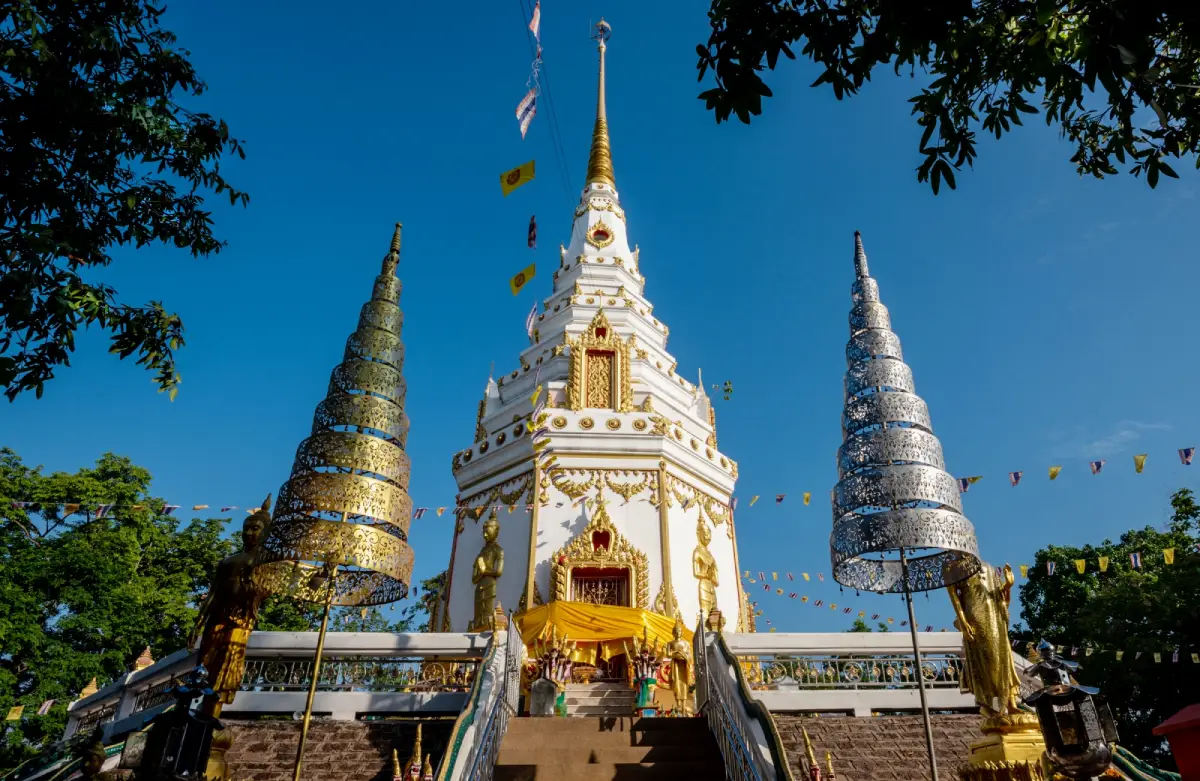
Wat Phra That Mahachai in Nakhon Phanom Province, also officially known as Wat That Mahachai, is one of the most important Buddhist sacred sites in the central Mekong region. Located at Ban Mahachai in Mahachai Subdistrict, Pla Pak District, the temple is home to the 37-meter-high Phra That Mahachai, which enshrines relics of the Buddha and relics associated with prominent arahant disciples. It is recognized as the birth-day stupa for people born on Wednesday during the daytime.
The temple combines several forms of religious and cultural heritage within one compound. Visitors can worship at the principal stupa, enter the ordination hall to pay respect to Phra Phuttha Chaiyasi, study detailed murals illustrating the life of the Buddha, view Thailand’s largest standing Buddha image carved from sweet neem wood, and learn about Luang Pu Khamphan Khosapanyo, one of the most respected meditation masters in Nakhon Phanom and northeastern Thailand.
The name Wat Phra That Mahachai is widely used in tourism and public communication, while the temple itself also uses Wat That Mahachai. Both names refer to the same monastery. The original name was Wat Khosakaram, reflecting the early stage of the settlement before the stupa became the temple’s defining symbol. The name was officially changed to Wat That Mahachai in 1985.
The history of the community and temple began in 1952, when Luang Pu Khamphan Khosapanyo and a small group of families helped establish Ban Mahachai and its monastery. Creating a temple was essential to the development of a stable village. It provided monks with a place to reside and gave local families a shared setting for merit-making, education, ceremonies, funerals, ordinations, and community cooperation.
Luang Pu Khamphan served as both a spiritual teacher and a community leader. He guided the development of the monastery, taught Buddhist principles, encouraged meditation, and helped residents cooperate in building a new settlement. The temple gradually became the moral and social center of Ban Mahachai.
Early construction depended on local labor and donations. Residents contributed timber, brick, cement, food, transportation, and practical skills. Some worked as builders, while others prepared meals or collected funds. The temple was therefore created through collective faith rather than the resources of a single patron.
An earlier stupa was constructed as the principal sacred monument. Its importance increased when the temple received relics of the Buddha and arahant disciples. From that point, the site became a destination not only for village residents but also for pilgrims from other parts of Nakhon Phanom and the wider Isan region.
A defining event took place on 25 May 1975, the full-moon day of the sixth lunar month and Visakha Bucha. King Bhumibol Adulyadej, Rama IX, and Queen Sirikit presided over the placement of the Buddha relics within Phra That Mahachai. The royal ceremony remains one of the most important moments in the temple’s recorded history.
The date carried particular Buddhist meaning because Visakha Bucha commemorates the birth, enlightenment, and passing into final nirvana of the Buddha. Enshrining the relics on this day linked the stupa with the central events of the Buddha’s life and gave the ceremony enduring religious significance.
The term Buddha relic refers to sacred remains associated with the historical Buddha. Arahant relics are associated with enlightened disciples. Phra That Mahachai enshrines relics connected with Añña Koṇḍañña, Sariputta, and Anuruddha, three disciples remembered for different forms of spiritual excellence.
Añña Koṇḍañña was the first disciple to understand the Buddha’s teaching after hearing the first sermon. He became the first monk of the Buddhist dispensation. His story represents openness to truth, careful listening, and the transformation of understanding into direct realization.
Sariputta was the Buddha’s chief disciple renowned for wisdom. Paying respect to his relics can inspire visitors to value knowledge, sound reasoning, patience, and the ability to consider causes and consequences before making decisions.
Anuruddha was distinguished for spiritual vision and determined practice. His example encourages mindfulness, careful observation, and perseverance. The deeper meaning is not simply extraordinary sight, but the ability to see one’s actions and their consequences with clarity.
As the number of pilgrims increased and the earlier monument required protection, construction of the present stupa began in 1993. The new structure was built around the older stupa, preserving the original sacred location and the relics within it rather than relocating them.
Construction was completed in 1996. On 14 November of that year, the then Crown Prince Maha Vajiralongkorn, who later became King Rama X, presided over the raising of the ceremonial umbrella above the stupa. This was another major royal occasion in the history of the temple.
The present Phra That Mahachai rises 37 meters above a base approximately 3 meters high. Its principal plan is octagonal, creating a balanced transition from the broad lower levels to the elevated crown and umbrella. The stupa is large enough to dominate the temple skyline while remaining visually integrated with the surrounding religious buildings.
The octagonal design changes appearance as visitors walk around it. Morning, midday, and afternoon light strike each surface differently, revealing alternating planes of light and shadow. Circumambulation therefore provides both a complete architectural view and a traditional Buddhist form of respect.
The principal orientation of the structure faces south. Decorative elements combine northeastern Thai craftsmanship with forms associated with the wider Mekong cultural region. Moldings and ornament distinguish the base, central body, upper levels, and crown while maintaining a clear vertical rhythm.
The open court around the stupa is used for worship, circumambulation, annual processions, and major ceremonies. On ordinary days, the same space allows visitors to walk quietly, sit in contemplation, and observe the monument from different viewpoints.
Phra That Mahachai is the designated birth-day stupa for people born on Wednesday during daylight hours. In Nakhon Phanom’s traditional system, Wednesday daytime is treated separately from Wednesday night. People born on Wednesday during the day often visit to make merit, strengthen their confidence, and reflect on qualities associated with mindfulness, communication, and intelligence.
Visitors born on other days are equally welcome. The birth-day association provides one cultural framework for pilgrimage but does not restrict access or worship. The stupa remains a Buddhist sacred site for everyone.
The name Mahachai can be translated as “great victory.” Within a Buddhist interpretation, the most valuable victory is not domination over others but overcoming carelessness, anger, greed, fear, and harmful habits. A pilgrimage can therefore become an opportunity to set practical goals for personal improvement.
Offerings may include flowers, candles, or other items provided at designated worship points. Expensive objects are unnecessary. Respectful conduct, sincere intention, and attention to the temple’s environmental guidelines are more important than the monetary value of an offering.
When signs request that visitors avoid incense or reduce smoke, the instruction should be followed. Flowers, folded hands, chanting, and silent meditation are sufficient forms of respect. Reducing smoke also protects architecture, artwork, children, older visitors, and people with respiratory conditions.
Inside the ordination hall, Phra Phuttha Chaiyasi is the principal Buddha image. The name evokes achievement and victory grounded in correct causes. Worshippers can connect this meaning with ethical conduct, effort, wisdom, and the refusal to harm others.
The principal image forms the visual and spiritual center of the hall. The entrance axis, altar, murals, and seating area all direct attention toward the Buddha. This arrangement helps visitors leave external distractions behind and settle into a quieter state of mind.
The ordination hall is not merely a tourist exhibition room. It is a consecrated building used by monks for formal acts such as ordinations and monastic ceremonies. Visitors should wait outside whenever a ritual is taking place and avoid crossing through the center of an active ceremony.
Another outstanding sacred object is the standing Buddha in the gesture of preventing conflict, carved from sweet neem wood. It is recognized as the largest sweet-neem-wood Buddha image in Thailand and represents both devotional commitment and highly skilled woodcarving.
The gesture is known in Thai as Pang Ham Yat, the posture of forbidding relatives from fighting. It recalls the Buddha intervening in a dispute over water between related groups. The image therefore symbolizes restraint, reason, compassion, and peaceful conflict resolution.
Sweet neem wood has distinctive grain, color, and physical properties. Producing a large image required careful selection of timber, knowledge of proportion, controlled drying, and protection against insects and cracking. The sculpture is consequently important as both a sacred image and a major work of Thai wood craftsmanship.
Visitors must view the wooden Buddha from the permitted distance. Touching, leaning against the base, or placing wet offerings nearby may damage the material. Repeated contact transfers moisture and oil from the hands, gradually altering the surface.
The murals inside the ordination hall are among the temple’s major artistic features. They depict episodes from the Buddha’s life, including his birth, renunciation, search for truth, enlightenment, teaching ministry, and final passing. The paintings function as a visual form of Buddhist education.
Characters, buildings, landscapes, animals, and symbolic details connect individual scenes into a continuous narrative. The Buddha is generally distinguished through placement, scale, posture, or radiance. Careful observation helps visitors identify the event represented on each section of wall.
Although the subjects come from Buddhist scripture, the visual language also reflects Isan artistic sensibilities. Color, clothing, buildings, vegetation, and spatial composition may combine canonical stories with forms familiar to local artists and audiences.
The mural cycle is regarded as one of the notable Buddhist narrative ensembles in northeastern Thailand. Its value lies not only in decorative beauty but also in its documentation of religious knowledge, artistic technique, community patronage, and methods of teaching morality through images.
Visitors should first study the overall wall before examining individual figures and events. The murals are best understood slowly, in relation to the principal Buddha image and the architectural space of the ordination hall.
Photography must follow posted rules or permission from temple representatives. Flash should not be used, and tripods must not obstruct movement. Photography should stop whenever monks or worshippers are chanting or conducting a private ceremony.
Painted surfaces must never be touched or cleaned by visitors. Cracking, moisture, or flaking paint should be reported to the temple. Conservation requires specialists familiar with pigments, plaster, humidity, and original materials.
Phra Sunthon Thammakon, widely known as Luang Pu Khamphan Khosapanyo, is central to the history of Wat That Mahachai. He was an influential Vipassana meditation master respected throughout Nakhon Phanom and northeastern Thailand. His teaching emphasized ethical discipline, mindfulness, perseverance, simplicity, and direct practice.
Luang Pu Khamphan was also a community builder. He helped establish Ban Mahachai, developed the monastery, guided residents, and used Buddhist teaching alongside practical service. Under his leadership, the temple grew from a village institution into a major pilgrimage destination.
His meditation approach encouraged practitioners to observe the body, mind, and emotions without immediately identifying with every thought. Visitors paying respect to him can honor his legacy by practicing restraint, honesty, awareness, and compassion rather than focusing only on sacred objects.
The change of name from Wat Khosakaram to Wat That Mahachai in 1985 reflected the growing importance of the stupa as the identity of the monastery and the community. It also connected the temple more clearly with Nakhon Phanom’s network of birth-day stupas.
Luang Pu Khamphan passed away on 24 November 2003 at the age of 89, after 59 rains retreats. His preserved remains are kept at the temple for public veneration, allowing disciples to remember both his teaching and his contribution to the development of the community.
The area dedicated to Luang Pu Khamphan should be entered quietly. Visitors should not touch display cases, place personal belongings on the altar, or photograph worshippers at close range without permission.
Stories connecting Luang Pu Khamphan with naga beings form part of the devotional folklore of the Mekong region. These accounts should be understood as expressions of faith rather than documented historical evidence. They remain culturally important because they connect Buddhist teachers, waterways, nature, and the spiritual worldview of local communities.
The current abbot is Phra Khru Sunthon Chayaphiwat, also known as Phra Ajarn Maha Samai Rakkhitadhammo. He supervises the monks, sacred objects, buildings, annual ceremonies, and cooperation between the monastery and the surrounding community.
Wat That Mahachai remains an active monastery with resident monks. Visitors may encounter chanting, ordinations, funerals, school activities, or community meetings. These functions take priority over sightseeing and photography.
The principal annual celebration is the Fourth Lunar Month Festival for the Veneration of Phra That Mahachai, generally held in March. Activities include religious ceremonies, offerings, processions, devotional dances, merit-making, and cultural programs organized by communities in Pla Pak District.
Community dances and processions require extensive preparation. Children, adults, and older residents work together on costumes, rehearsals, music, offerings, and ceremonial arrangements. The festival therefore transmits knowledge through participation rather than through written instruction alone.
During the festival, the grounds and parking areas become crowded. Visitors should arrive before the main ceremony, follow local traffic instructions, and avoid standing within procession routes. Commercial filming and drone use require advance permission.
Visakha Bucha is especially significant because it marks the anniversary of the 1975 royal relic ceremony. The temple holds merit-making, sermons, and circumambulation. Visitors should remain quiet and allow worshippers unobstructed access to the sacred areas.
Kathin is held after the end of Buddhist Lent. Residents offer robes, food, monastic necessities, and funds for temple maintenance. Its deeper purpose is cooperation and support for the Sangha rather than competition over the scale of donations.
Makha Bucha, Asalha Bucha, the beginning and end of Buddhist Lent, and regular lunar observance days are marked by alms-giving, chanting, sermons, and the keeping of precepts. Morning observance-day visits provide an authentic view of the monastery’s community role.
A logical visitor route begins at Phra That Mahachai and the circumambulation court, continues to the ordination hall and Phra Phuttha Chaiyasi, then proceeds to the sweet-neem-wood Buddha, the mural areas, the memorial space for Luang Pu Khamphan, and the preaching hall.
Morning is the best time to begin. Visitors can circumambulate clockwise, pay respect to the principal image, examine the murals, and then continue to the wooden Buddha and Luang Pu Khamphan area without rushing.
The stupa court provides several architectural viewpoints. Wide-angle photographs are possible from the main court, while detailed images should be taken with zoom rather than by climbing onto the base or crossing barriers.
The ordination hall requires the highest level of quiet. Shoes must be removed, phones silenced, and seating arranged so that monks and worshippers are not obstructed.
The wooden Buddha area requires particular attention to humidity and contact. Flowers containing water and incense smoke should not be placed near the sculpture unless the temple has provided a specific worship point.
The Luang Pu Khamphan memorial space is used by disciples for quiet devotion. Visitors should allow older worshippers sufficient room and avoid loud conversation or intrusive photography.
Monks’ residences are private. Visitors wishing to meet the abbot or another monk should inquire at the preaching hall or temple office. Women should not touch monks or hand objects directly to them.
The most comfortable visiting periods are from 08.00 to 10.00 and after 15.30. Midday temperatures can be high on the open stupa court. Hats should be removed before entering indoor sacred spaces.
The cool season from November to February offers the most pleasant weather. March brings the annual festival and warmer temperatures. During the rainy season, the landscape is green, but steps and paved areas may become slippery.
Clothing should cover shoulders and knees. Tight or transparent clothing is inappropriate. Shoes must be removed where required, and feet should not be pointed toward Buddha images or monks.
Visitors must not touch Buddha images, murals, display cases, stupa decorations, or wooden surfaces. Gold leaf, cloth, and offerings should be placed only where the temple has specifically permitted them.
Exterior photography is generally possible without disturbing others. Interior photography should follow temple signs and avoid flash. Professional filming and drone use require permission and compliance with Thai aviation regulations.
Families can use the murals as educational material, while supervising children so that they do not run, climb, or touch religious objects. Older visitors should rest in shaded areas and take care around steps and changes in floor level.
International visitors should understand that a that or stupa is a sacred reliquary, not merely a decorative tower. The ubosot is a consecrated ordination hall, while the sala kan parian serves preaching and community functions.
Admission is free. Voluntary donations may be placed in official boxes or made through temple activities. Money should not be placed directly on Buddha images or handed to unauthorized individuals.
Donations support electricity, water, monastic education, ceremonies, and the conservation of the stupa, murals, ordination hall, and wooden Buddha. Visitors requiring receipts should use official temple channels.
Getting There From central Nakhon Phanom, follow Highway 22 toward Sakon Nakhon and Pla Pak District. The temple is approximately 39 to 40 km from the city. Near kilometer markers 201 to 202, turn toward Mahachai Subdistrict and continue for approximately 2 km. The journey normally takes 45 to 50 minutes by car.
A private car or rental vehicle is the most convenient option. Travelers using a taxi should agree on the fare and return time in advance because scheduled public transport does not enter the temple compound on every service.
From Nakhon Phanom Airport, join Highway 22 and continue toward Pla Pak. Searching for both Wat That Mahachai and Wat Phra That Mahachai together with Mahachai Subdistrict will prevent confusion with other stupas.
The temple provides a parking court, toilets, resting pavilions, worship points, and paths connecting the principal areas. Parking becomes limited during annual festivals, Kathin, and major Buddhist holidays.
A half-day itinerary can combine Wat Phra That Mahachai with Phra Maha That Chedi Khosapanyosri Phanom at Wat Khosamangalaram, Suan Kham Kaeo, or Wang Po Phan Arboretum. A full-day route can continue to the giant rain tree at Wat Chom Si and Phra That Renu.
Phra Maha That Chedi Khosapanyosri Phanom is particularly relevant for travelers studying the legacy of Luang Pu Khamphan. Natural attractions and local cafés around Pla Pak add variety to the religious itinerary.
Restaurants near Mahachai and Pla Pak are generally small family businesses. Opening times may depend on ingredients and household schedules. Groups should contact restaurants with published phone numbers before traveling.
Nearby accommodation consists mainly of homestays, guest rooms, and small resorts around Nong Hi and Pla Pak. Travelers seeking full hotel services and a wider choice of restaurants may stay in central Nakhon Phanom and visit the temple on a day trip.
Homestays offer closer contact with rural life, but guests should respect household routines and noise rules. Reservations are recommended during the annual stupa festival, Kathin season, and long public holidays.
Responsible travel includes reducing plastic waste, conserving water, keeping noise low, and supporting legitimate local restaurants, accommodation, and community products. Private homes and agricultural land should not be entered without permission.
Online posts should identify the site accurately as Wat Phra That Mahachai or Wat That Mahachai, Ban Mahachai, Mahachai Subdistrict, Pla Pak District, Nakhon Phanom Province. Unverified miracle claims should not be added to historical or religious information.
Conservation must include the stupa, wooden Buddha, murals, ordination hall, documents, photographs, and community knowledge. Physical objects require technical care, while festivals and oral traditions depend on continuing participation by younger generations.
The temple links several historical phases: the establishment of the community in 1952, the royal relic ceremony in 1975, the renaming of the monastery in 1985, construction of the present stupa from 1993 to 1996, and the continuation of the annual festival today.
A thoughtful visit offers more than architectural beauty. The relics recall the Buddha and his disciples, the murals communicate the Buddha’s life, the standing wooden image teaches peaceful conflict resolution, and the legacy of Luang Pu Khamphan demonstrates the union of meditation with service to society.
Wat Phra That Mahachai is therefore a Wednesday-daytime birth stupa, a major spiritual center of Nakhon Phanom, an important site of Isan Buddhist art, and a memorial to one of the region’s most respected meditation masters. Respectful conduct and careful observation allow visitors to understand its full religious and cultural significance.
| Name | Wat Phra That Mahachai, also known as Wat That Mahachai |
| Former Name | Wat Khosakaram; renamed Wat That Mahachai in 1985 |
| Location | Ban Mahachai, Mahachai Subdistrict, Pla Pak District, Nakhon Phanom Province 48160, Thailand |
| Coordinates | 17.278690, 104.458800 |
| Temple Established | 1952 by Luang Pu Khamphan Khosapanyo and the Ban Mahachai community |
| Major Royal Ceremony | King Rama IX and Queen Sirikit presided over the placement of the Buddha relics on 25 May 1975 |
| Present Stupa | Construction around the older stupa began in 1993, was completed in 1996, and the ceremonial umbrella was raised on 14 November 1996 |
| Height and Form | 37 meters high, standing on a base approximately 3 meters high, with an octagonal plan and a principal southern orientation |
| Birth-Day Association | Birth-day stupa for people born on Wednesday during the daytime |
| Enshrined Relics | Relics of the Buddha and arahant relics associated with Añña Koṇḍañña, Sariputta, and Anuruddha |
| Principal Buddha Image | Phra Phuttha Chaiyasi in the ordination hall |
| Important Wooden Buddha | Thailand’s largest Buddha image carved from sweet neem wood, shown in the gesture of preventing relatives from fighting |
| Murals | Ordination-hall murals illustrating the life of the Buddha and regarded as a notable Buddhist art ensemble in northeastern Thailand |
| Important Meditation Master | Phra Sunthon Thammakon, or Luang Pu Khamphan Khosapanyo, former abbot, meditation master, and key figure in the establishment of the community and temple |
| Current Abbot | Phra Khru Sunthon Chayaphiwat, also known as Phra Ajarn Maha Samai Rakkhitadhammo |
| Main Areas | 1. Phra That Mahachai and circumambulation court 2. Ordination hall and Phra Phuttha Chaiyasi 3. Sweet-neem-wood standing Buddha hall 4. Buddha-life mural areas 5. Luang Pu Khamphan memorial and veneration area 6. Preaching hall and ceremonial court 7. Monastic residential area |
| Major Traditions | Fourth Lunar Month Phra That Mahachai Festival, Visakha Bucha, Kathin, Makha Bucha, Asalha Bucha, Buddhist Lent, and the end of Buddhist Lent |
| Current Status | Active monastery with resident monks and continuing religious ceremonies, annual festivals, and community activities |
| Open Days | Daily |
| Opening Hours | 08.00 – 18.00 |
| Admission Fee | Free admission; voluntary donations are welcome |
| Recommended Visit Duration | Approximately 1 – 2 hours |
| Facilities | Parking court, toilets, resting pavilions, flower-offering points, ceremonial court, and paths connecting the principal areas |
| Travel Information | Follow Highway 22 from Nakhon Phanom toward Sakon Nakhon and Pla Pak. Near kilometer markers 201 – 202, turn toward Mahachai Subdistrict and continue for approximately 2 km. Total distance is about 39 – 40 km. |
| Official Page | Facebook: Wat That Mahachai (@watthatmahachai) |
| Nearby Tourist Attractions | 1. Phra Maha That Chedi Khosapanyosri Phanom at Wat Khosamangalaram, approximately 12 km 2. Suan Kham Kaeo, approximately 15 km 3. Wang Po Phan Arboretum, approximately 18 km 4. Giant Rain Tree at Wat Chom Si, approximately 22 km 5. Phra That Renu, approximately 31 km |
| Nearby Restaurants | 1. Ban Suan Mahachai, approximately 2 km 2. Suan Kham Kaeo Café, approximately 15 km, Tel. +66 96 669 8245 3. Sathani Nom & Fresh Coffee Pla Pak, approximately 17 km, Tel. +66 87 644 2529 4. Ban Khao Jee Uncle Ho, approximately 22 km, Tel. +66 91 886 9446 or +66 99 479 4288 5. Inthira Coffee, Made-to-Order Food and Noodles, approximately 28 km, Tel. +66 98 484 8717 |
| Nearby Accommodations | 1. Ban Thung Un Ai Rak Homestay, approximately 19 km 2. Ban Suan Resort Nong Hi, approximately 19 km 3. Nano Mobile Resort, approximately 20 km, Tel. +66 83 335 8582 4. Sukjai Rooms, approximately 20 km, Tel. +66 93 675 2136 5. F2 Hotel Nakhon Phanom, approximately 39 km, Tel. +66 85 454 5411 |
Frequently Asked Questions (FAQ)
Q: Where is Wat Phra That Mahachai located?
A: The temple is located at Ban Mahachai, Mahachai Subdistrict, Pla Pak District, Nakhon Phanom Province 48160, approximately 39 – 40 km from central Nakhon Phanom.
Q: Which birth day is associated with Phra That Mahachai?
A: It is the birth-day stupa for people born on Wednesday during the daytime. People born on other days are also welcome to worship.
Q: How tall is Phra That Mahachai and what is its architectural form?
A: The stupa is 37 meters high, stands on a base approximately 3 meters high, and has an octagonal principal plan.
Q: Which relics are enshrined inside Phra That Mahachai?
A: It enshrines relics of the Buddha and arahant relics associated with Añña Koṇḍañña, Sariputta, and Anuruddha.
Q: Which important Buddha images can visitors see?
A: The ordination hall contains Phra Phuttha Chaiyasi, while another area contains Thailand’s largest Buddha image carved from sweet neem wood in the posture of preventing relatives from fighting.
Q: How is Luang Pu Khamphan Khosapanyo connected with the temple?
A: He was a respected Vipassana meditation master, former abbot, community founder, and key figure in the development of the temple. His preserved remains are kept at the monastery for public veneration.
Q: What are the opening hours and admission fee?
A: The temple is open daily from 08.00 to 18.00. Admission is free, and voluntary donations are welcome.
Q: How can travelers reach Wat Phra That Mahachai from Nakhon Phanom?
A: Follow Highway 22 toward Sakon Nakhon and Pla Pak. Near kilometer markers 201 – 202, turn toward Mahachai Subdistrict and continue for approximately 2 km.
 Category: ●Places of Worship
 Group: ●Temple
Last Update : 3 MonthAgo
 Last Update : 3 MonthAgo
 Click to Access the Navigation Map GPS
Wat Phra That Mahachai Map
Recommend

 Art, Culture and Heritage
 Historical Sites and Monuments(3)
 Landmarks and Memorials(2)
 Art, Craft Centres, Tradition(3)
 Museums(3)
 Educational Places
 Library(1)
Temple(23)
 Church(1)
 Other Sacred Sites(11)
 Suburban Living
 Village, Community(5)
 Nature and Wildlife
 National Parks and Marine Reserves(1)
 Dam, Reservoir, Lake(5)
 Waterfalls(2)
 River, Canal(3)
 Bays and Beaches(3)
 Other natural attractions(2)
 Entertainment and Agricultural
 Zoos and Aquariums(1)
 Farms, Parks and Ecotourism(2)
 Shopping
 Shopping and Night Market(1)
 Travel Articles, Recipes
 Travel Review, Food Review(1)


