
lovethailand home >Northeastern Travel Attractions >Nakhon Phanom Travel Attractions >Muang Nakhon Phanom >Nai Muang > Co-Cathedral of Saint Anne
TL;DR: Co-Cathedral of Saint Anne is located at Sunthon Wichit Road, Nong Saeng neighborhood, beside the Mekong River in Mueang Nakhon Phanom District, open Daily, hours 08.00 – 18.00.
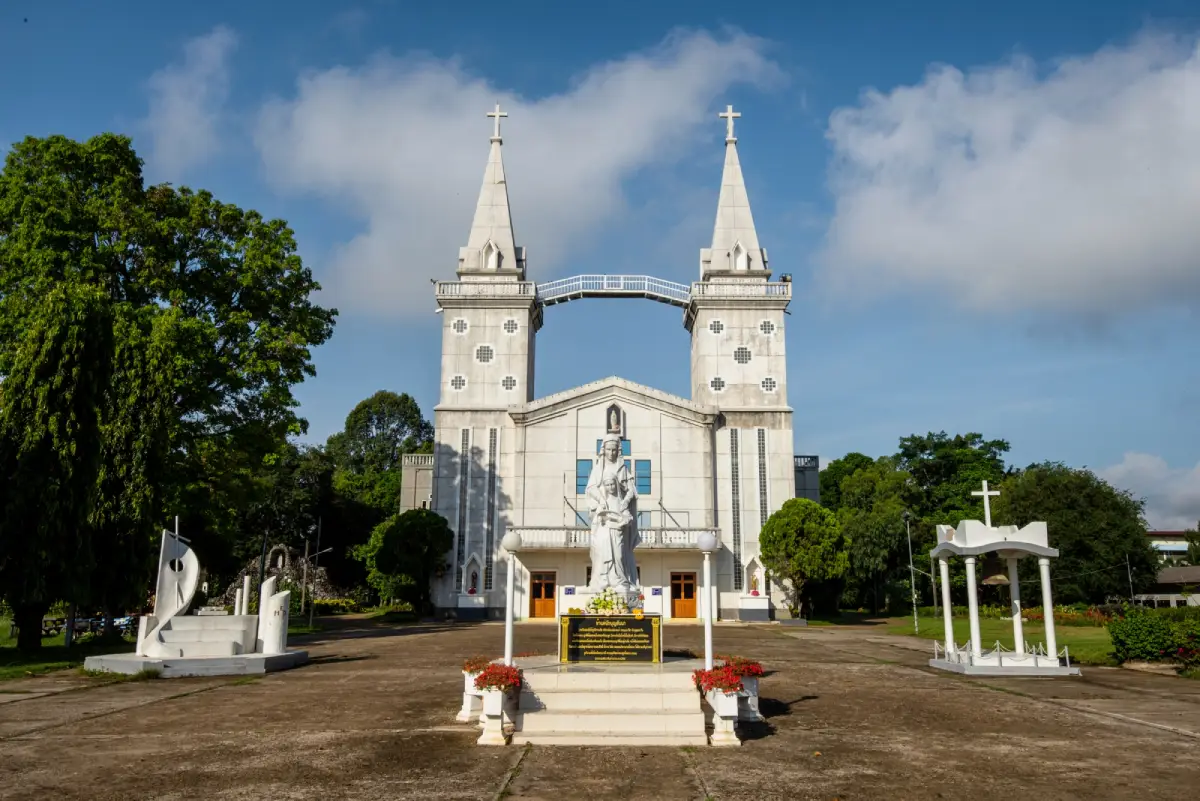
Co-Cathedral of Saint Anne
Open Days: Daily
Opening Hours: 08.00 – 18.00
The Co-Cathedral of Saint Anne, Nong Saeng, Nakhon Phanom, commonly known as Saint Anne Nong Saeng Church, is a historic Catholic place of worship overlooking the Mekong River. Located on Sunthon Wichit Road in central Nakhon Phanom, it is immediately recognizable by its white exterior, symmetrical twin towers, pointed spires, and peaceful riverside setting facing the Lao city of Thakhek across the water. The church is more than an architectural landmark. It is an active center of Catholic worship, an enduring record of Christian settlement in northeastern Thailand, and a symbol of Nakhon Phanom as an international border city shaped by Thai, Vietnamese, Lao, Chinese, and European cultural connections.
For travelers planning a visit, the church grounds are open daily from 08.00 to 18.00 and there is no admission fee. Visitors may explore the exterior, walk around the forecourt, appreciate the riverside atmosphere, and photograph the architecture during these hours. Access to the interior depends on parish activities and the liturgical schedule. When the main doors are closed, visitors should contact the parish office rather than entering through restricted areas. The Mass schedule published by the archdiocese lists weekday Mass at 06.15 and Sunday Mass at 07.00. Christmas, patronal feast days, and other special celebrations may follow a different timetable.
The official status of the church is expressed by the term “co-cathedral.” A co-cathedral shares an important episcopal role with the principal cathedral of a diocese or archdiocese. Saint Anne Nong Saeng belongs to the Roman Catholic Archdiocese of Thare and Nonseng, whose principal cathedral is the Cathedral of the Archangel Michael in the historic Catholic community of Thare, Sakon Nakhon Province. The inclusion of both Thare and Nong Saeng in the archdiocese’s name reflects the major contribution of these 2 communities to the development of Catholic life in the Mekong region.
Saint Anne, the patron saint of the co-cathedral, is honored in Catholic tradition as the mother of the Virgin Mary and the grandmother of Jesus Christ. She is therefore associated with family life, parenthood, education, intergenerational love, and the transmission of faith from one generation to the next. These meanings are particularly appropriate for Nong Saeng, where families have preserved religious traditions, cultural memories, foodways, languages, and community relationships over many generations. The universal feast of Saint Anne is observed on July 26, although the parish may schedule its principal local celebration on a nearby date.
The co-cathedral stands at 28 Sunthon Wichit Road in the Nong Saeng neighborhood of Mueang Nakhon Phanom District. The front of the compound faces the Mekong riverside road, providing open views toward the river and Thakhek in Khammouane Province, Laos. This location is significant for more than its scenery. For centuries, the Mekong served as a route for migration, commerce, communication, and religious missions connecting communities in present-day Thailand, Laos, and Vietnam. These cross-border movements played a direct role in the formation and growth of the Catholic community at Nong Saeng.
The history of Saint Anne Nong Saeng did not begin with the present building. Its origins can be traced to missionaries of the Paris Foreign Missions Society who traveled through the central Mekong region during the 19th century. Fr. Jean-Baptiste Prodhomme, Fr. Xavier Guego, and their companions arrived in Nakhon Phanom in June 1883 while exploring routes, local conditions, and the possibility of establishing new Catholic missions in the northern part of northeastern Siam.
During their stay, the missionaries met Vietnamese residents who were interested in learning about Christianity. On September 14, 1883, 13 members of this group received baptism, while 4 couples had their marriages solemnized according to Catholic practice. This event is regarded as a major milestone in the formation of the Catholic community of Nakhon Phanom and marks the beginning of the historical sequence that eventually produced the present Co-Cathedral of Saint Anne.
The first Christian families initially lived south of the town near an area known locally as Wat Pa. They later moved to Ban Kham Koem, northwest of central Nakhon Phanom. In early 1887, some Catholic families began cultivating land and settling at Ban Nong Saeng. Fr. Alfred-Marie Théophile Rondel encouraged the community to establish a permanent settlement and built a house that was subsequently used for worship. This simple structure became the foundation of Catholic life at Nong Saeng.
Nong Saeng developed as both an agricultural settlement and a migrant community closely connected to the Mekong River. Many residents were of Vietnamese ancestry, while families also formed relationships with Thai and Lao communities in the surrounding region. Over time, the neighborhood developed a distinctive mixture of languages, religious customs, domestic architecture, food traditions, and cross-border identities. This cultural layering remains visible throughout Nakhon Phanom in its Vietnamese food, colonial-era houses, Chinese shrines, Buddhist temples, Catholic churches, and riverside neighborhoods.
As missionary work expanded, Nong Saeng became more than a local parish. It once served as an administrative center of the historic Mission of Laos, with a bishop’s residence, priests’ quarters, a school, a seminary, a convent, charitable facilities, and buildings used for religious administration. This institutional role connected Nong Saeng with Catholic communities across Nakhon Phanom, Sakon Nakhon, Nong Khai, and settlements on the Lao side of the Mekong.
An early cathedral was already in use at the beginning of the 20th century, although its design was relatively simple. After Fr. Prodhomme became the second bishop of the Mission of Laos in 1913, a far more ambitious cathedral in a Western architectural style was planned. Construction began in 1914, stopped after the outbreak of the First World War, resumed in 1918, and was completed in the middle of 1919.
The cathedral completed in 1919 was a large and imposing structure with prominent twin towers and tall pointed spires that could be seen from a considerable distance. Much of its construction material was transported from Saigon through the regional river network. Building such a church required years of labor, financial support, and international transportation. It became one of the most remarkable Christian buildings in northeastern Thailand, but its existence was cut short by the Franco-Thai conflict of 1940.
During the Indochina border conflict, Nakhon Phanom occupied a sensitive strategic position opposite French-controlled Laos. A cathedral tower was used as an observation point and was damaged by artillery fire from across the river. The structure was subsequently dismantled until little remained. Other mission buildings, including residences, educational facilities, the seminary, convent buildings, and charitable institutions, were also lost. For the community, this was not simply the destruction of a building but the disappearance of a religious and social center created through decades of collective effort.
After the conflict, the administrative center of the mission moved to the Catholic community of Thare in Sakon Nakhon. The Catholics of Nong Saeng built a third, temporary church so that worship could continue. Fr. Edouard Thang Namlarp played a major role in repairing and improving this provisional structure and in caring for the community during a period of political and social uncertainty. His name consequently became closely associated with Saint Anne Church and the history of Catholics along the Mekong.
Many tourism summaries state that the church was constructed in 1926 by Fr. Edouard, whose Thai name is also rendered as Father Eduar or Father Etouar Namlarp. The more detailed chronology requires an important clarification. The year 1926 was the year in which Fr. Edouard Thang Namlarp was ordained to the priesthood. He came to assist at Nong Saeng in 1929 and later became parish priest. The large prewar cathedral had already been completed in 1919, while the present co-cathedral was constructed between 1972 and 1975. Understanding these separate dates provides a clearer picture of the community’s continuous history through several generations of church buildings.
Fr. Edouard Thang Namlarp was born in 1893 and spoke Vietnamese, an important skill in a parish where many Catholics were of Vietnamese descent. During the 1940 conflict, he was arrested, prosecuted, and eventually imprisoned at Bang Kwang Prison. Following an amnesty after the Second World War in 1945, he returned to Nong Saeng and resumed pastoral work among displaced Catholic families scattered along the Mekong from Ban Phaeng and That Phanom to Mukdahan and Don Tan.
His ministry extended far beyond the immediate parish compound. He traveled to locate dispersed communities, assisted families, celebrated the sacraments, and maintained contact among Catholics living across a wide frontier region. He died on September 14, 1965, while carrying out pastoral work in Ban Phaeng District. His life remains part of the local memory of sacrifice, perseverance, and service among Catholic priests in northeastern Thailand.
After several decades of use, the temporary church had become structurally inadequate. In March 1972, Archbishop Michael Kien Samophithak approved the construction of a fourth church that would serve as the co-cathedral of the Archdiocese of Thare and Nonseng. The project was intended to commemorate the courage of the early missionaries and the resilience of the Nong Saeng Catholic community. The foundation stone was laid on July 14, 1972, and construction proceeded through the cooperation of parishioners, Catholic supporters, and donors from other parts of Thailand.
The present co-cathedral was designed in a modern architectural language that reinterprets the memory of the destroyed cathedral. Its twin towers, pointed vertical elements, and monumental front elevation deliberately recall the earlier landmark without directly reproducing it. The completed church was solemnly blessed and opened on April 18, 1975. Consequently, the parish commemorated the 50th anniversary of the current building in 2025.
In 2000, the community completed Saint Anne Hall on the site associated with the third temporary church. The hall provides space for meetings, communal gatherings, parish activities, and the reception of visitors. In 2025, a celebration of faith and the blessing of a new bell tower added another important element to the compound, connecting the historic memory of the former cathedral towers with the continuing religious life of the present parish.
Viewed from Sunthon Wichit Road, the most immediately striking feature is the white front façade framed by 2 symmetrical towers. Their pointed spires create a strong vertical rhythm and make the church visible above the surrounding neighborhood. A connecting section between the towers gives the façade its recognizable silhouette. Although the decoration is more restrained than that of many European churches, the simple white surfaces respond beautifully to the blue sky, tropical sunlight, and open landscape of the Mekong riverside.
Arched openings, tall windows, and the principal entrance soften the mass of the building, while the open forecourt allows visitors to appreciate the entire façade. Morning light creates a gentle atmosphere suitable for examining architectural details. During the late afternoon, sunlight from the west produces stronger shadows across the white walls and towers. Photographers should remain clear of entrances, avoid obstructing parishioners, and maintain a respectful distance whenever worship is taking place.
Inside, the co-cathedral follows the functional arrangement of a Catholic church, with a central aisle, rows of pews, a sanctuary, an altar, and devotional images. The interior is designed to focus attention toward the sanctuary and to provide a calm environment for prayer and the celebration of Mass. Non-Christian visitors are welcome to sit quietly and observe when the church is open. Appropriate behavior includes dressing modestly, silencing mobile phones, avoiding unnecessary movement near the altar, and not photographing worshippers closely without permission.
The compound contains several areas of interest, including the church forecourt and statue of Saint Anne, the main co-cathedral, the twin towers and bell area, Saint Anne Hall, the parish office, clergy residence, and spaces used for community programs. Some buildings are working or residential areas rather than tourist attractions. Visitors should follow signs, seek permission before entering secondary buildings, and respect the privacy of residents and parish staff.
The deeper importance of Saint Anne Nong Saeng lies in the relationship between the church and the surrounding community. Nong Saeng has long been associated with families of Vietnamese ancestry, many of whom worked in trade, food production, crafts, and local services while preserving religious customs and family memories. Baptisms, marriages, funerals, feast days, charitable activities, and regular Masses have made the church part of community life from birth to death. It should therefore be understood as a living institution rather than a monument preserved only for tourism.
Within Nakhon Phanom, the co-cathedral provides physical evidence of coexistence among Buddhist, Catholic, Chinese, Vietnamese, Thai, and Lao cultural traditions. Along the same riverside route, travelers encounter Buddhist temples, Chinese shrines, Vietnamese-colonial houses, modern civic buildings, and Catholic architecture. This concentration of varied heritage gives Nakhon Phanom a distinctive identity that differs from destinations dominated by a single architectural or religious tradition.
Descriptions of Saint Anne Church as a symbol of an “international city” therefore refer to more than its Western-looking façade. The history of the site includes Vietnamese migration, Thai and Lao settlement, European missionary journeys, construction materials transported from Saigon, and religious networks extending along both sides of the Mekong. Each historical layer represents the movement and interaction of people across boundaries that changed repeatedly during the 19th and 20th centuries.
The most colorful and widely attended period at the co-cathedral is the Christmas season. Catholic communities in Nakhon Phanom create Christmas stars in many forms, including small hand-carried lanterns, decorations for homes, and large illuminated stars mounted on vehicles or parade structures. The star represents the Star of Bethlehem that guided people to the infant Jesus and is also understood as a sign of light, hope, and renewal.
Before Christmas, community members work together to build frames, attach colored materials, install lights, and prepare their stars for presentation. The completed stars are brought to Saint Anne Church, where they form part of an illuminated procession and festive gathering. The Christmas star procession held in December 2025 included brightly decorated vehicles and community activities around the co-cathedral, confirming that this tradition remains an active part of Nakhon Phanom’s contemporary cultural calendar.
Although the star procession originates in Catholic belief, the event welcomes people of different religions and backgrounds. Buddhist residents, local families, photographers, and domestic and international travelers attend the celebration, while municipal agencies, provincial organizations, community groups, and local businesses assist with the event. This broad participation transforms the Christmas celebration into a visible expression of peaceful coexistence in the city.
The date, parade route, road closures, and program vary from year to year. Travelers planning to attend should check announcements from the official Saint Anne Nong Saeng parish page, Nakhon Phanom Municipality, or the provincial public relations office. Roads along the Mekong may be restricted, and parking near the church can become limited. Arriving before the official starting time makes it easier to find parking and select an appropriate place from which to watch the procession.
The parish also observes the feast of Saint Anne, thanksgiving Masses, and other celebrations in the Catholic liturgical calendar. On July 18, 2026, the annual co-cathedral celebration was held under the presidency of Archbishop Anthony Weradet Chaiseri, with Fr. Peter Wiman Chai Nawaen serving as parish priest. This recent event confirms that the co-cathedral remains fully active as a place of worship and community life.
The current parish priest and caretaker is Fr. Peter Wiman Chai Nawaen, known in Thai as Khun Pho Petro Wiman Chai Nawaen. He oversees liturgical services, pastoral care, parish administration, and coordination with the local community. The parish is also involved in youth activities, visits to vulnerable residents, charitable work, and cooperation with provincial organizations. Tour groups, researchers, media crews, and visitors requiring special access should contact the parish office in advance.
The best time to visit depends on the desired experience. From 08.00 to 10.00, temperatures are generally more comfortable and the grounds are relatively quiet. Late afternoon, particularly after 16.00, is suitable for viewing the changing light and continuing with a walk along the Mekong promenade. Travelers interested in observing Catholic worship should check the current Mass schedule, arrive before the service begins, and choose seating that does not displace regular parishioners.
Nakhon Phanom can be visited throughout the year, but each season creates a different atmosphere. The cooler months from November to February are especially comfortable for walking and cycling and coincide with the Christmas period. During the hot season, early morning and late afternoon visits are preferable. In the rainy season, the river and cloud-filled sky can be particularly dramatic, although visitors should carry rain protection and take care on wet exterior surfaces.
Visitors should dress modestly, with shoulders covered and shorts or skirts of an appropriate length. Hats should be removed inside the church. Non-Catholics are not required to make the sign of the cross or participate in prayers. They may simply sit or stand quietly with the congregation. Visitors who are not Catholic should not receive Holy Communion, although they may remain respectfully in their places or follow instructions offered by parish staff during special services.
Photography should be approached with the awareness that the building is an active place of worship. Flash photography should not be used during Mass, tripods must not obstruct aisles, and visitors should avoid posing inappropriately near the altar or sacred images. Drone operation requires compliance with Thai aviation rules and advance permission from the parish because the church is located in a populated urban neighborhood where religious services and private community activities take place.
Facilities include parking, restrooms, places to sit, and a parish office where visitors may contact the caretaker. Parking inside or immediately beside the compound may be insufficient during the patronal feast and Christmas celebrations. During major events, travelers may find it easier to use a public parking area elsewhere in central Nakhon Phanom and walk to the church, or stay at a hotel on Sunthon Wichit Road or elsewhere along the riverfront.
Getting There from central Nakhon Phanom is straightforward. The co-cathedral is approximately 2 kilometers from the central riverside district and can be reached in about 5 minutes by car via Sunthon Wichit Road. Private cars, rental cars, local taxis, and ride-hailing services can reach the church. Travelers staying in the riverside area may also walk or cycle along the relatively flat Mekong promenade, which connects several important attractions.
Travelers arriving at Nakhon Phanom Airport can take a taxi or rental car into the city and continue to Sunthon Wichit Road. Interprovincial bus passengers may arrive at Nakhon Phanom Bus Terminal and use local transport to reach the church. Visitors driving from Bangkok normally travel through the northeastern highway network, choosing a route through major regional cities according to current road and traffic conditions.
A practical half-day itinerary can begin at Saint Anne Church in the morning before continuing south along the Mekong to the Former Nakhon Phanom Governor’s Residence, the Vietnamese Memorial Clock Tower, Wat Okat Si Bua Ban, Nakhon Phanom Walking Street, and the Phaya Si Sattanakharat Naga Monument. This route presents Catholic, Buddhist, Vietnamese, civic, and cross-border history within a compact urban area, with restaurants and cafés available throughout the riverside district.
Travelers with more than 1 day can extend the journey to the Ho Chi Minh Memorial at Ban Na Chok, Wat Phra That Phanom, and the Third Thai-Lao Friendship Bridge. Beginning at Saint Anne Nong Saeng provides a useful introduction to Nakhon Phanom as a border city before exploring Vietnamese revolutionary history, Thai-Lao relations, and Buddhist pilgrimage traditions elsewhere in the province.
Restaurants near the church range from Mekong fish restaurants and northeastern Thai dining rooms to Vietnamese food outlets and cafés in restored historic buildings. Riverside restaurants such as Rabiang Khong and Ban Nam Phon are suitable for lunch or dinner, while the Si Thep Road area is known for Nakhon Phanom breakfast dishes, including pan-fried eggs, Vietnamese-style noodles, pork sausage, grilled bread, and Vietnamese coffee.
Nearby accommodation includes small properties in the Nong Saeng neighborhood, riverside hotels, and larger hotels in central Nakhon Phanom. Staying near the co-cathedral is convenient for early Mass, morning walks beside the Mekong, or attending the Christmas star procession without driving into congested event areas. Guests should confirm room types, parking availability, check-in times, and cancellation terms directly with the hotel before booking.
The Co-Cathedral of Saint Anne deserves more than a brief stop for photographs. Its twin towers form only the most visible layer of a far deeper story involving 19th-century missionaries, Vietnamese Catholic migration, cross-Mekong travel, wartime destruction, postwar recovery, and the collective effort that produced the current church in 1975. Understanding this chronology allows visitors to see the co-cathedral as a place of community memory rather than simply an attractive European-style backdrop.
What keeps Saint Anne Nong Saeng relevant today is its ability to serve several purposes at once. It remains a place of worship, a center of community relationships, a historical record, a meeting point between cultures, and a travel destination open to people of different beliefs. Church bells, Christmas stars, family celebrations, charitable programs, and regular liturgies keep the compound alive. Visiting with respect allows tourism to support the preservation of this heritage without interfering with the religious mission that gives the site its meaning.
| Name | Co-Cathedral of Saint Anne, Nong Saeng |
| Common Thai Name | Wat Nakbun Anna Nong Saeng |
| Type | Active Roman Catholic co-cathedral and community church within the Archdiocese of Thare and Nonseng |
| Location | Sunthon Wichit Road, Nong Saeng neighborhood, beside the Mekong River in Mueang Nakhon Phanom District |
| Address | 28 Sunthon Wichit Road, Nai Mueang, Mueang Nakhon Phanom, Nakhon Phanom 48000, Thailand |
| Coordinates | 17.420855, 104.775856 |
| Highlights | White façade, twin pointed towers, Mekong River setting, Catholic community history dating to 1883, and the annual Christmas star procession |
| Historical Timeline | The Catholic community began in 1883 and settled at Nong Saeng from 1887. A major Western-style cathedral was completed in 1919 and destroyed in 1940. The present co-cathedral was begun in 1972 and officially opened on April 18, 1975. |
| Connection With 1926 | 1926 was the year Fr. Edouard Thang Namlarp was ordained. He came to serve Nong Saeng in 1929 and later became parish priest. It was not the construction year of the present building. |
| Patron Saint | Saint Anne, traditionally honored as the mother of the Virgin Mary and associated with family, education, and the transmission of faith between generations |
| Distinctive Features | Modern architecture recalling the former cathedral through twin towers, pointed vertical elements, arched openings, and a broad forecourt |
| Cultural Importance | Represents the shared heritage of Thai, Vietnamese, Lao, and other communities in an international Mekong border city |
| Major Traditions | The Feast of Saint Anne and the Christmas star procession, during which communities bring illuminated stars to the co-cathedral |
| Main Areas / Zones | 1. Main Co-Cathedral And Sanctuary 2. Forecourt And Statue Of Saint Anne 3. Twin Towers And Bell Area 4. Saint Anne Hall 2000 5. Parish Office, Residence, And Community Activity Areas |
| Parish Priest / Caretaker | Fr. Peter Wiman Chai Nawaen |
| Current Status | Open and active as a co-cathedral and parish church. The most recent annual co-cathedral celebration was held on July 18, 2026. |
| Open Days | Daily |
| Opening Hours | 08.00 – 18.00 for the church grounds. Interior access depends on services and parish arrangements. |
| Published Mass Schedule | Weekdays at 06.15 and Sundays at 07.00. Check parish announcements for feast days and special occasions. |
| Admission Fee | Free admission |
| Facilities | Parking, restrooms, seating areas, and a parish office. Parking may be limited during the patronal feast and Christmas events. |
| Visitor Etiquette | Dress modestly, silence mobile phones, avoid flash and loud conversation during worship, and request permission before photographing individuals or entering non-public buildings. |
| Travel Information | Approximately 2 km or a 5-minute drive from central Nakhon Phanom via Sunthon Wichit Road. Accessible by car, rental car, taxi, bicycle, or on foot from the central riverside district. |
| Main Contact Numbers | +66 63 712 2258 and +66 42 516 050 |
| Official Page | Facebook: วัดนักบุญอันนา หนองแสง (@SaintAnneNongSaeng) |
| Nearby Tourist Attractions | 1. Former Nakhon Phanom Governor’s Residence 2 km 2. Vietnamese Memorial Clock Tower 3 km 3. Nakhon Phanom Walking Street 3 km 4. Wat Okat Si Bua Ban 3 km 5. Phaya Si Sattanakharat Naga Monument 4 km 6. Ho Chi Minh Memorial At Ban Na Chok 8 km |
| Nearby Restaurants | 1. Rabiang Khong Nakhon Phanom 2 km, Tel. +66 92 865 5889 2. Ban Nam Phon Restaurant 3 km, Tel. +66 90 904 4999 3. Kitchen Khong The River Front 4 km, Tel. +66 85 924 7898 4. Pen Pla Pen Restaurant 5 km, Tel. +66 81 119 7663 5. The TREE Cafe & Restaurant 5 km, Tel. +66 80 892 9082 |
| Nearby Accommodations | 1. Baan Rim Khong Hotel 1 km, Tel. +66 98 775 8225, +66 42 514 400 2. Blu Hotel Nakhon Phanom 2 km, Tel. +66 63 958 4403 3. Chewa Khong Hotel 2 km, Tel. +66 98 935 1442, +66 42 514 242 4. Landmark Nakhon Phanom Hotel 3 km, Tel. +66 91 740 3001 5. The River Hotel Nakhon Phanom 5 km, Tel. +66 42 522 999, +66 83 669 2999 |
Frequently Asked Questions (FAQ)
Q: Where is the Co-Cathedral of Saint Anne, Nong Saeng?
A: It is located at 28 Sunthon Wichit Road in the Nong Saeng neighborhood of central Nakhon Phanom, beside the Mekong River.
Q: What are the opening hours and is there an admission fee?
A: The church grounds are open daily from 08.00 to 18.00 and admission is free. Interior access depends on the liturgical and parish schedule.
Q: Was Saint Anne Church built in 1926?
A: The year 1926 was when Fr. Edouard Thang Namlarp was ordained. He came to Nong Saeng in 1929. The former cathedral was completed in 1919, while the present co-cathedral was built between 1972 and 1975.
Q: What makes Saint Anne Nong Saeng important?
A: It is known for its white twin-towered architecture, Mekong River setting, Catholic history dating to 1883, and its role as a symbol of Nakhon Phanom’s multicultural border heritage.
Q: Can non-Christian travelers enter the church?
A: Yes, when the interior is open. Visitors should dress modestly, remain quiet, silence mobile phones, and avoid disturbing Mass or other religious activities.
Q: When is the Christmas star procession held?
A: It is organized during the period leading up to or around Christmas. Dates and routes change each year, so travelers should check official parish and provincial announcements.
Q: Who is the current parish priest of Saint Anne Nong Saeng?
A: The current parish priest and caretaker is Fr. Peter Wiman Chai Nawaen, who oversees worship, pastoral care, and community activities.
Q: Which attractions can be combined with a visit to the church?
A: Nearby attractions include the Former Governor’s Residence, Vietnamese Memorial Clock Tower, Nakhon Phanom Walking Street, Wat Okat Si Bua Ban, and the Phaya Si Sattanakharat Naga Monument.
 Category: ●Places of Worship
 Group: ●Church
Last Update : 3 MonthAgo
 Last Update : 3 MonthAgo
 Click to Access the Navigation Map GPS
Co-Cathedral of Saint Anne Map
Recommend

 Art, Culture and Heritage
 Historical Sites and Monuments(3)
 Landmarks and Memorials(2)
 Art, Craft Centres, Tradition(3)
 Museums(3)
 Educational Places
 Library(1)
 Temple(23)
Church(1)
 Other Sacred Sites(11)
 Suburban Living
 Village, Community(5)
 Nature and Wildlife
 National Parks and Marine Reserves(1)
 Dam, Reservoir, Lake(5)
 Waterfalls(2)
 River, Canal(3)
 Bays and Beaches(3)
 Other natural attractions(2)
 Entertainment and Agricultural
 Zoos and Aquariums(1)
 Farms, Parks and Ecotourism(2)
 Shopping
 Shopping and Night Market(1)
 Travel Articles, Recipes
 Travel Review, Food Review(1)


