
lovethailand home >Northeastern Travel Attractions >Nakhon Phanom Travel Attractions >Na Wa >Tha Ruea > Ban Tha Ruea Khaen Phin and Wot Craft Village
TL;DR: Ban Tha Ruea Khaen Phin and Wot Craft Village, Nakhon Phanom attractions : Suburban Living, Village, Community.

Ban Tha Ruea Khaen Phin and Wot Craft Village
Open Days: Daily for public community areas; craft demonstrations and learning activities should be arranged in advance
Opening Hours: Public areas are accessible as part of normal village life throughout the day; 08:00–17:00 is recommended for visiting workshops and learning centres
Admission: There is no general entrance fee for the village; demonstration sessions, workshops, performances, and handicraft products are charged by individual providers
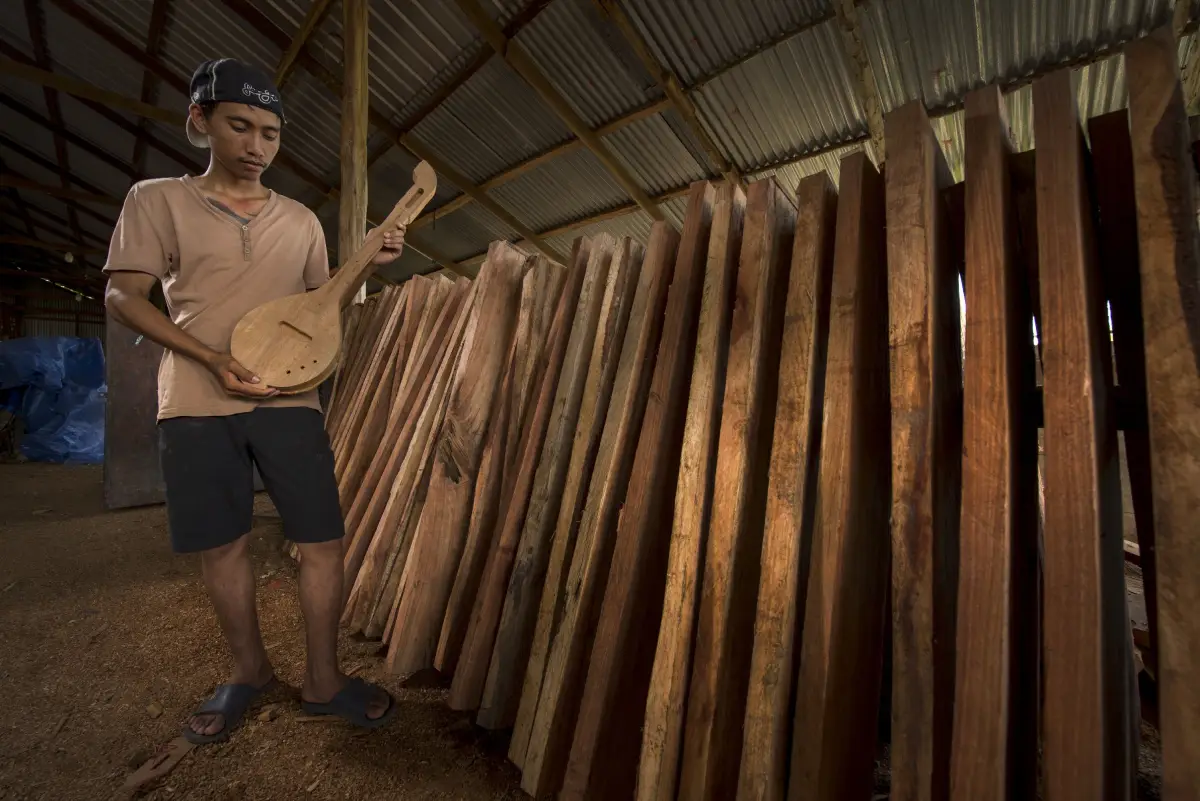
Ban Tha Ruea Khaen, Phin and Wot Craft Village in Nakhon Phanom is a living centre of Isan musical-instrument craftsmanship in Tha Ruea Subdistrict, Na Wa District. The village is renowned for handmade khaen mouth organs, phin lutes, wot panpipes, pong lang xylophones, traditional reed pipes, and related folk instruments. Its craft traditions have been transmitted for more than a century. The sounds of artisans testing khaen reeds, plucking newly completed phin instruments, and tuning the pipes of a wot can be heard from workshops and family homes across the community, earning Ban Tha Ruea the description “the Village of Music.” Visitors can learn about bamboo selection, reed making, drilling, assembly, tuning, electric-phin construction, instrument maintenance, and the purchase of instruments directly from their makers. The village is also home to an important SUPPORT handicraft centre and a respected silk-weaving tradition, making it a valuable destination for cultural travelers, musicians, teachers, students, collectors, and anyone seeking a deeper understanding of northeastern Thai culture.
The Isan way of life has long been associated with sociability, shared labour, community merit-making, and a love of celebration. When a religious festival or village ceremony approaches, local families help prepare food, processions, ceremonial objects, music, and performance areas. After a long day of collective work, dancing, singing molam, and playing folk instruments become a way of releasing fatigue and strengthening relationships among relatives, neighbours, and visitors. The enjoyment comes not only from the music itself but also from the experience of being together. The khaen supports the singer and carries the melodic line, the phin creates rhythm and emotional movement, while the wot and pong lang add brightness and energy. Music is therefore entertainment, emotional language, collective memory, and a social bond.
Isan instruments such as the khaen, phin, wot, and pong lang are not simply objects that create sound. They embody practical knowledge of plants, woodworking, metalwork, acoustics, mathematical relationships between pitches, and the behaviour of natural materials. An artisan must understand which type of wood provides the right weight, elasticity, resonance, and durability for each instrument. The maker must hear extremely small deviations in pitch and know how to correct them without weakening the material. Much of this expertise cannot be fully understood through written instructions. It is embedded in how a knife is held, how bamboo is shaved, how much pressure is applied to a metal reed, and how a craftsman listens to the response of each component. Ban Tha Ruea reveals the patient and technically demanding work behind the cheerful sound of Isan music.
Ban Tha Ruea is located in Tha Ruea Subdistrict, Na Wa District, Nakhon Phanom Province, postal code 48180. The principal settlement covers communities in Moo 1, Moo 2, and Moo 8. It lies approximately 6 kilometres from Na Wa town and about 98 kilometres from Nakhon Phanom city. The surrounding landscape consists of agricultural land, low-lying wetlands, ponds, streams, and community forest. Local livelihoods therefore combine rice farming, seasonal fishing, animal husbandry, weaving, and instrument making. After the main rice-farming period, or whenever agricultural work becomes less demanding, many households devote more time to producing musical instruments. The sound of testing and tuning is consequently part of ordinary village life rather than an attraction staged only for tourists.
The community was formerly known as Ban Nong Tae. The old name referred to a local pond and tae trees that grew around the area. As waterways became important routes for travel and trade, the settlement developed as a place where boats stopped to transfer passengers and goods. The name Ban Tha Ruea, meaning a boat-landing village, gradually reflected the function of the area and was adopted officially in 1956. The name illustrates how the community grew through its relationship with water, agriculture, transport, and exchange. These connections also enabled residents to obtain materials, ideas, and technical knowledge from neighbouring areas and adapt them to local craftsmanship.
The settlement history of Ban Tha Ruea can be traced to the early Rattanakosin period, around 1813. Many ancestors of the present community were Tai-Lao people who moved through several settlements before establishing permanent homes in this area. Some family histories are connected with Na Kae District and communities around the Mekong basin. Migration brought more than people. Families also carried language, religious beliefs, songs, agricultural knowledge, textile techniques, and musical traditions. As the settlement expanded, knowledge from different households was exchanged, compared, and refined. Khaen making, which may initially have served family celebrations and local ceremonies, gradually developed into a specialised occupation known throughout Nakhon Phanom and beyond.
The cultural landscape includes several bodies of water and natural areas closely connected with community memory. Nong Ruea is a reservoir of approximately 50 rai and serves as both a resource and a symbol of the settlement. Huai Bo Kok, or the Huai Kok wetland area, provides seasonal food, fishing grounds, and aquatic plants. The Pa Pu Ta sacred forest and the grounds associated with Wat Pa Muthitatham reflect beliefs concerning ancestors and the spiritual guardians of the village. These places demonstrate that a visit to Ban Tha Ruea should not be limited to shopping for instruments. The instruments are part of a larger system involving water, forest, farming, belief, family, and collective responsibility.
The population includes several cultural groups. Tai-Lao residents form the majority, while the community is also connected with Phu Thai, Nyaw, and other ethnic traditions found across Nakhon Phanom. This diversity can be heard and seen in local speech, food, clothing, melodies, ceremonies, and performance styles. Even the specifications of an instrument may reflect the preferences of different musicians, including the number of khaen pipes, musical key, phin neck shape, decorative motifs, or electrical configuration. Ban Tha Ruea instruments are therefore not produced according to a single rigid formula. Makers supply standard instruments for cultural performances, customised professional instruments, student models, souvenirs, and pieces made for collectors.
One of the most distinctive aspects of Ban Tha Ruea is that instrument production is distributed among family homes rather than concentrated in one large factory. One household may specialise in khaen instruments, another in wot, while other families make phin, repair instruments, apply decoration, or manage sales and delivery. This network keeps knowledge within families and the wider community. Visitors may see artisans working beneath raised houses, beside their homes, or in small workshops. They may hear an instrument tested repeatedly and speak directly with its maker. The experience is fundamentally different from buying a factory-made object because every instrument can be traced to an individual craft process and a specific set of decisions.
The early history of khaen making is remembered through several generations of master artisans. Nai Lon Saensuriyawong is recorded as one of the community’s pioneering khaen makers and an important figure in the transmission of the craft. Younger relatives and apprentices learned by preparing materials, shaving bamboo, arranging pipes, and listening during the tuning process. Training did not normally begin with the construction of an entire instrument. Beginners first completed smaller tasks that helped them understand the behaviour of each material. As their skill increased, they were trusted with more delicate components. This practical apprenticeship has allowed the characteristic sound and quality standards of Ban Tha Ruea instruments to continue despite changes in tools, musical styles, and markets.
Ajarn Ketchai Mingwongtham is another important figure in documenting and communicating the cultural knowledge of Ban Tha Ruea. At different stages he served as an adviser to the Ban Tha Ruea handicraft group and as a member of the Na Wa cultural council, while also working as a community scholar specialising in folk instruments and local culture. His accounts explain that instrument making has continued for more than one hundred years. The tradition began with the khaen and expanded to the phin, wot, pong lang, pi nok, pi phu thai, and other instruments so that local ensembles could produce complete melodic and rhythmic textures. He has also helped connect senior artisans with educational institutions, researchers, students, and study groups.
The formation of occupational groups strengthened the craft economy. A formal khaen and wot makers’ group was established in 1991 with members from many households. Additional occupational groups were later created and coordinated to purchase materials, divide production, market products, and organise demonstrations. Collective organisation enabled makers to exchange tuning techniques and respond more effectively to shortages or changes in raw materials. Instead of producing only one traditional model, the village became capable of supplying multiple sizes, musical keys, performance standards, student instruments, miniature souvenirs, and commissioned pieces.
A Ban Tha Ruea khaen begins with the selection of narrow bamboo pipes known locally as mai luk khaen or mai ku khaen. High-quality material has traditionally been obtained from areas in Laos because suitable bamboo has long internodes, relatively thin walls, and good resonance. Each piece must be mature, free from cracks, insect damage, and severe irregularities, while its diameter must match the intended pitch. After selection, the bamboo is dried slowly and evenly. Excessive heat can cause it to warp or split. Once the moisture content is stable, the pipes are cut to different lengths, with each pair corresponding to a specific note within the instrument.
The metal reed is the heart of the khaen. This small, thin component vibrates as air passes over it. Ban Tha Ruea artisans use brass or an appropriate metal alloy that combines flexibility and durability. The material is cut, hammered, shaped, and refined until it responds correctly. A reed must be thin enough to react immediately to air pressure, but not so thin that the sound becomes unstable or the component breaks easily. Local craftsmen use mai hia wood as part of the polishing process, smoothing the reed and removing rough fibres or marks that might interrupt its vibration. The pressure applied during polishing is critical. Removing a very small amount of metal can raise or lower the pitch, so the maker repeatedly adjusts, tests, and listens.
After the bamboo pipes and reeds are prepared, each pipe is cut to receive its reed and the pipes are arranged in pairs according to pitch. They are then fitted into the khaen’s central wind chamber. Every joint must be sealed to prevent air leakage. The sealing material must remain secure without interfering with the vibration of the bamboo or reed. The maker tests the instrument while both blowing and drawing air because a khaen produces sound in both directions. A well-balanced instrument should respond quickly, require a comfortable amount of breath, and produce a clear, resonant tone without unwanted noise from adjacent pipes.
Tuning is one of the clearest demonstrations of an artisan’s expertise. Earlier generations relied primarily on a highly trained ear and memory of pitch. Modern makers may use electronic tuners to confirm accuracy for contemporary ensembles, but the device does not replace human listening. The artisan must judge tonal character, stability, resonance, volume, and the relationship among every pair of pipes. If a note is too high or too low, the maker adjusts the length, weight, or shape of the reed with great care. The process may be repeated many times before an instrument is ready. A well-tuned khaen can perform naturally with a phin, pong lang, percussion, and singing without producing an uncomfortable clash of pitch.
Ban Tha Ruea makers have also developed khaen instruments that work more conveniently with Western and contemporary music. By setting instruments in recognised keys and aligning pitches with modern tuning systems, musicians can combine the khaen with guitar, keyboard, bass, brass, woodwind, and international ensembles. The khaen is therefore no longer limited to traditional molam accompaniment. It appears in luk thung, contemporary folk, experimental music, educational compositions, and international performances. This adaptation has not erased the instrument’s identity. Instead, it has allowed its distinctive sound to communicate with younger audiences and travel far beyond its place of origin.
A visitor buying a khaen should listen to the actual instrument and explain how it will be used. A beginner’s model may prioritise easy response, moderate weight, and a practical key for lessons. A professional instrument requires closer attention to pitch accuracy, reed sensitivity, balance between blowing and drawing, durability, and reliability during travel and stage performance. Decorative appearance is only one consideration. More important qualities include stable notes, airtight construction, straight pipes, a comfortable wind chamber, and an immediate response. Buying from the maker allows the musician to ask questions about care and request specifications suited to personal technique.
The wot is another major instrument produced in the village. It uses narrow bamboo similar to the material selected for a khaen, but its construction is completely different. Pipes of different lengths are arranged in a circular formation around a central core, and natural resin associated with stingless bees may be used to secure or seal components. The musician blows across the openings while rotating or tilting the instrument so that different pipes create different notes. The wot has a bright, floating tone that can carry a melody or add colour to an ensemble. Its maker must calculate the length and internal depth of each pipe accurately because a small difference can change the pitch.
Wot production begins with bamboo pieces of relatively consistent thickness. Each pipe is cut and adjusted for the required note. The blowing edge must be smooth so the air strikes it evenly, while the lower end must be securely closed. When the pipes are assembled in a circle, their spacing and structural strength must allow the musician to rotate the instrument without movement between components. The craftsman tests each pipe separately and then plays several notes in sequence to evaluate their relationship. A good wot responds to a comfortable breath pressure, remains clear rather than muffled, and feels balanced in the hands during extended performance.
Ban Tha Ruea phin instruments include both traditional acoustic forms and electric models widely used in modern Isan bands. The body is commonly carved from jackfruit wood or another timber with warm resonance and good working properties. The wood must be thoroughly seasoned to reduce warping. The maker shapes the body and neck, installs tuning pegs, calculates fret positions, and fits the strings. A phin is not complete simply because its outline is attractive. Fret spacing must be accurate or the instrument will play out of tune along the neck. Performance instruments may feature carved ornament, bright colours, or custom body shapes, while electric versions require pickups and wiring that transmit a clean signal.
The development of electric phin instruments requires knowledge of both woodworking and sound technology. The maker must consider pickup placement, wiring, controls, output connections, and the balance of the instrument. When amplified, the sound should remain clear while preserving the distinctive attack and expression of Isan playing. Some instruments are designed for rapid melodic passages and energetic stage techniques, while others emphasise a fuller tone suited to molam and luk thung. Direct commissioning enables musicians to select body shape, weight, number of strings, electronic components, colour, and decoration.
In addition to khaen, wot, and phin, local craftsmen produce pong lang, pi nok, pi phu thai, percussion, and music-related souvenirs. A pong lang requires hardwood such as padauk or redwood. Each bar is cut and refined to a different pitch before the complete set is suspended on a frame. Traditional pipes demand careful control of the wind channel, reed, and finger holes. Each instrument plays a different role in an ensemble. Because Ban Tha Ruea can produce many components of a complete musical group, its knowledge covers melody, rhythm, timbre, tuning, repair, and the interaction among instruments.
Raw materials determine the future of the craft. The community therefore recognises the importance of forest management and the cultivation of useful plant species. Bamboo suitable for khaen production has been introduced from Laos for local cultivation and study, helping reduce dependence on outside supplies. Harvesting must consider plant maturity, regeneration of bamboo clumps, and long-term land quality. Bamboo harvested too early produces weaker and less stable instruments, while the disappearance of mature material would threaten future production. The relationship among forest, craft, and sound demonstrates that protecting musical culture also requires the protection of natural resources.
Knowledge is transmitted through several channels. Some children begin by helping parents or grandparents organise materials and observing each stage of work. Students and outside visitors can learn through demonstrations, study visits, or activities associated with the community’s school of khaen masters. Local teachers can introduce instrument making, khaen performance, and folk music when arrangements are made in advance. Learning beside an artisan enables students to hear and solve problems that cannot be understood fully from photographs or videos, including how to detect an air leak, judge whether bamboo is sufficiently dry, or distinguish a bright tone from one that is unpleasantly hard.
Instrument making supports the local economy by distributing income across many households and specialised tasks. The production chain includes material suppliers, bamboo shavers, reed makers, assemblers, tuners, decorators, retailers, and delivery providers. A professional instrument may require considerable time and the work of an experienced specialist, while smaller souvenirs allow general visitors to support the community at a lower cost. Household production also enables some working-age residents to remain in the village, care for family members, and continue an ancestral occupation rather than migrating permanently to a distant city.
Silk weaving is another major element of Ban Tha Ruea’s cultural identity. A women’s weaving group began around 1975 and developed into the Ban Tha Ruea SUPPORT handicraft centre during the period around 1977. It is recognised as one of Thailand’s earliest centres of this kind. Weaving provided supplementary income beyond rice farming and strengthened women’s role in the community economy. Knowledge of silkworm raising, reeling, dyeing, preparing the warp, controlling motifs, and maintaining consistent textile density has been transferred across generations in a manner similar to instrument craftsmanship.
Ban Tha Ruea silk is respected for careful weaving and motifs connected with belief and the local environment. Important designs include Lai Naga Noi, Lai Ta Mak Nat, Lai Kunjae Noi, Lai Tum, and Lai Kho. Producing a complex motif requires memory, thread counting, and consistent pressure on the loom. A weaver may work for an extended period to maintain balance across the full width of the textile. The handicraft centre received more than 200 silk awards between 1992 and 2006 and produced items recognised at the five-star OTOP level. Visitors can purchase silk, cotton cloth, scarves, traditional skirts, and transformed textile products alongside musical instruments.
When buying a handwoven textile, visitors should consider its material, technique, and production time. Small irregularities may be part of the character of authentic handwork rather than defects. Value should not be judged only by price or perfect repetition. Buyers can ask about the meaning of the motif, origin of the silk, care instructions, and the name of the weaver. This conversation turns a piece of cloth into a record of community knowledge and helps ensure that a larger share of the purchase reaches the producer.
Ban Tha Ruea’s learning areas are distributed across the settlement rather than enclosed within a single formal tourist complex. Important points include artisan households and khaen-making groups, sometimes described through local names such as Khum Wang Khaen. Other areas produce, repair, and sell khaen, phin, wot, pong lang, and souvenirs, including a community learning point known as Sawan Kan Dontri, or the Paradise of Music. The school of khaen masters supports educational activities, while the SUPPORT centre introduces silk weaving. Wat Si Pho Chai is the principal venue for religious and cultural events. Nong Ruea, Huai Bo Kok, the sacred forest, and Wat Pa Muthitatham reveal the environmental setting of community life. Visitors should coordinate demonstrations through Tha Ruea Subdistrict Municipality or community leaders because each family workshop follows its own production schedule.
Wat Si Pho Chai plays a central role as a gathering place and venue for community traditions. In March 2026, Ban Tha Ruea held its fourth-lunar-month merit festival and the annual project to continue the legend of the khaen within the temple grounds. Activities included contests for beautifully crafted khaen instruments and exceptionally large khaen, cultural performances, a procession carrying the revered Phra Kaeo image from Nong Ruea, dancing, molam music, and events involving several generations. The festival demonstrates that the khaen is not preserved as a silent museum object. It remains active in processions, rituals, competitions, entertainment, and the public identity of the village.
The Bun Khaen tradition and related events are connected with respect for teachers, guardian spirits, and the desire for good fortune in the community’s principal occupation. Festival dates may be adjusted according to the local and lunar calendar, so visitors should confirm the annual programme before travelling. The event combines craftsmanship and performance. Visitors can appreciate the physical quality of an instrument and immediately hear how it functions in music. The sound of the khaen expresses religious devotion, enjoyment, and the collective identity of Ban Tha Ruea.
The Pa Pu Ta sacred forest and Wat Pa Muthitatham reflect a belief system that also supports environmental protection. Residents respect spiritually important areas and use community rules to manage access and resource use. Belief in ancestors is not separated from conservation. It establishes moral limits concerning which areas should remain protected, how plants should be harvested, and how people should behave in the forest. Visitors should follow signs and local instructions, avoid loud behaviour, and never remove natural or ritual objects from sacred areas.
A visit to Ban Tha Ruea differs from entering a conventional attraction with a ticket gate and a fixed route. This is a functioning village where people live, work, farm, cook, and raise families. Visitors may see children travelling to school, artisans completing orders, residents preparing food, or farmers leaving for their fields. The most appropriate style of travel is therefore slow and observant. Time should be allowed for conversation and explanation. During a scheduled demonstration, an artisan may begin with a small piece of material and continue through testing the completed sound, providing far more insight than a brief visit to a retail display.
Visitors should ask permission before entering a workspace or photographing people. Many workshops are private homes as well as places of business. Knives and specialised tools may be sharp, while prepared reeds and bamboo components can be damaged easily. Instruments should not be handled without permission. During a sound test, visitors should wait for instructions on how to hold and blow the instrument because excessive pressure or dropping a piece can cause damage. Respecting the maker’s time and space allows tourism to support rather than interrupt community life.
Anyone purchasing an instrument should explain the budget, musical experience, preferred key, and intended use. Travellers taking an instrument on an aircraft or a long journey should ask about protective cases and humidity control. A khaen or wot should be stored in a dry place, protected from impact, and never left for long periods inside an extremely hot vehicle. An electric phin should be checked for wiring and connection requirements before departure. For a commissioned instrument, the buyer and maker should agree on design, production time, price, payment, and shipping. Cost varies according to material, size, tuning precision, electronic components, and decoration.
Photography and video can help share the culture of Ban Tha Ruea, but permission should be requested before recording tuning sessions, lessons, or performances. Some techniques belong to individual families, and some performances may involve copyright agreements. When publishing images, visitors should identify the village, maker, or craft group accurately. Proper credit enables interested audiences to contact the actual producer and reduces the risk of community work being reproduced or commercialised without acknowledgement.
Ban Tha Ruea is particularly suitable for educational travel because it connects many fields of study. Students can explore the physics of vibration and pipe length through the khaen and wot, mathematical pitch relationships, biology through useful plant species, environmental management through community forest, visual art through instrument form and textile motifs, and social studies through migration history and occupational networks. Families visiting with children should arrange age-appropriate activities in advance so that young participants can learn safely without disrupting actual production.
The most practical visiting period is between approximately 08:00 and 17:00, when artisans and community coordinators are easier to contact. The cool season from November to February offers comfortable weather for walking through the village. The rice-growing and harvest seasons provide different agricultural landscapes. Travellers interested in festivals should follow announcements concerning the fourth-lunar-month merit festival and the annual continuation of the khaen legend, as exact dates change from year to year.
Getting There from Nakhon Phanom city is easiest by private car or rental vehicle. The distance is approximately 98 kilometres. Navigation can be set for Ban Tha Ruea, Tha Ruea Subdistrict Municipality, or Na Wa District. From Na Wa town, the village is approximately 6 kilometres away and the access roads are suitable for ordinary cars. Travellers arriving from Sakon Nakhon, Udon Thani, or neighbouring provinces can approach through Na Wa District. Fuel and navigation should be prepared before entering smaller community roads, particularly during rain or after dark.
Public transport is less convenient than travelling by car. Passengers can use interprovincial transport to Nakhon Phanom or the Na Wa area and then hire a local vehicle to Ban Tha Ruea. The fare, pickup point, return journey, and time should be agreed upon in advance because local transport does not operate at frequent intervals. Groups may find it more efficient to hire a vehicle with a driver, enabling them to combine Ban Tha Ruea with Wat Phra That Prasit and other nearby destinations.
A half-day visit can begin with a morning appointment at an artisan group. Visitors may observe bamboo preparation and khaen construction, compare instruments in different keys, and continue to a phin or wot workshop. The final stop can be the Ban Tha Ruea SUPPORT centre for silk weaving and local motifs, followed by food or coffee in Na Wa. This programme suits travellers with limited time, but workshop appointments should be confirmed so artisans can organise their production schedule.
A full-day programme can include Wat Si Pho Chai, Nong Ruea, Huai Bo Kok, the Pa Pu Ta forest, or Wat Pa Muthitatham. In the afternoon, travellers can continue to Wat Phra That Prasit, an important religious destination in Na Wa District. A full day reveals the relationship among music, religion, farming, water, and community forest. During festival periods, additional time should be allowed for processions, traffic, and parking.
Restaurants and cafés are distributed between Tha Ruea Subdistrict and Na Wa town, so meals should be planned before a workshop visit. Some establishments operate mainly during daytime or close on an individual weekly schedule. Most accommodation options are located in and around Na Wa. Staying near Na Wa is convenient for an early community visit, while travellers continuing to central Nakhon Phanom may prefer to stay in the city and make Ban Tha Ruea a day trip.
Responsible tourism begins by recognising that Ban Tha Ruea is not merely a background for photographs. Visitors should pay prices that respect the maker’s labour, avoid excessive bargaining, remain outside private areas unless invited, and never organise a large activity without coordination. Using local guides, purchasing food in the district, and buying directly from artisans distribute benefits more effectively than entering briefly for photographs and leaving without meaningful engagement.
For international visitors, Ban Tha Ruea explains Isan culture in a way that a stage performance alone cannot. A traveller can see how an instrument begins as a plant, passes through the hands of a craftsperson, and becomes a sound used in merit-making, courtship, storytelling, celebration, and contemporary entertainment. English communication may be limited in individual workshops. A local coordinator, interpreter, or Thai-speaking companion can provide a fuller experience. Learning the Thai names khaen, phin, wot, and pong lang before arrival also makes conversation easier and demonstrates respect for the craft.
The community faces future challenges involving younger artisans, high-quality materials, and a market willing to recognise the value of handwork. Low-cost mass-produced instruments may compete on price, but they cannot replace careful bamboo selection, reed adjustment, personal tuning, and direct dialogue between musician and maker. Local education, documentation, cultivation of useful plant species, and fair sales channels are therefore essential. Cultural tourism can support these goals when visitors devote time to learning and compensate artisans appropriately.
Ban Tha Ruea is consequently more than a place to buy a khaen, phin, or wot. It reveals the complete cultural life of Isan music, including settlement history, natural materials, artisan knowledge, family networks, religious festivals, temples, silk weaving, and adaptation to contemporary markets. Every instrument carries memories of earlier generations and the decisions of present-day makers. Travellers who arrive with respect and curiosity will leave with more than a souvenir. They will understand why the sound of the khaen remains central to northeastern Thailand and why Ban Tha Ruea is regarded as one of the country’s most important communities of traditional musical-instrument makers.
| Name | Ban Tha Ruea Khaen, Phin and Wot Craft Village |
| Also Known As | The Village of Music and Ban Tha Ruea Isan Musical Instrument Village |
| Location | Tha Ruea Subdistrict, Na Wa District, Nakhon Phanom Province 48180, Thailand |
| Community Area | The principal settlement includes communities in Moo 1, Moo 2, and Moo 8 |
| Coordinates | 17.505230, 104.052137 |
| Highlights | Observe the production of khaen, phin, wot, pong lang, and traditional pipes; learn about instrument tuning; purchase directly from artisans; and explore silk weaving at the Ban Tha Ruea SUPPORT centre |
| Community History | The settlement dates to the early Rattanakosin period, around 1813, and officially adopted the name Ban Tha Ruea in 1956 |
| Name Origin | The former name was Ban Nong Tae. The present name developed when the area became a landing point for boats, passengers, and trade |
| Main Instruments | Khaen, wot, traditional phin, electric phin, pong lang, pi nok, pi phu thai, percussion, and folk-music souvenirs |
| Main Materials | Mai luk khaen bamboo, brass or metal alloy for khaen reeds, jackfruit wood for phin, padauk or redwood for pong lang, and natural stingless-bee resin for assembly |
| Other Handicrafts | Handwoven silk and cotton from the Ban Tha Ruea SUPPORT centre, including Lai Naga Noi, Lai Ta Mak Nat, Lai Kunjae Noi, Lai Tum, and Lai Kho motifs |
| Main Areas / Learning Zones | 1. Khaen and wot artisan households 2. Phin and pong lang production and repair points 3. Khum Wang Khaen and Sawan Kan Dontri learning areas 4. School of khaen masters and folk-music activities 5. Ban Tha Ruea SUPPORT silk-weaving centre 6. Wat Si Pho Chai 7. Nong Ruea, Huai Bo Kok, Pa Pu Ta sacred forest, and Wat Pa Muthitatham |
| Important Tradition | The fourth-lunar-month merit festival and the annual continuation of the khaen legend, featuring instrument contests, cultural processions, molam, and community rituals; dates vary each year |
| Caretaker / Coordinator | Tha Ruea Subdistrict Municipality in cooperation with community leaders, folk-instrument artisan groups, the SUPPORT handicraft group, and local cultural networks |
| Community Scholar | Ajarn Ketchai Mingwongtham, a Na Wa community scholar specialising in culture and traditional musical instruments |
| Current Status | An active residential and craft community with continuing instrument production, cultural events, festivals, and educational visits |
| Open Days | Daily for public community areas; demonstrations and educational activities should be booked in advance |
| Opening Hours | Public areas follow normal village life throughout the day; 08:00–17:00 is recommended for contacting workshops and learning centres |
| Fees | No general village entrance fee; charges for demonstrations, workshops, performances, and group activities depend on the provider and programme |
| Facilities | Road access, parking at arranged meeting points, community shops, handicraft facilities, temples, and municipal coordination; large groups should confirm parking and restroom arrangements in advance |
| Travel Information | Approximately 98 km from Nakhon Phanom city by private car or rental vehicle and 6 km from Na Wa town; public-transport users should arrange a local transfer and return pickup |
| Main Contact Number | Tha Ruea Subdistrict Municipality: +66 42 533 505 |
| Nearby Tourist Attractions | 1. Wat Si Pho Chai, approximately 1 km 2. Ban Tha Ruea SUPPORT Handicraft Centre, approximately 1 km 3. Nong Ruea and Huai Bo Kok, approximately 3 km 4. Pa Pu Ta Sacred Forest and Wat Pa Muthitatham, approximately 4 km 5. Rai Wanida, Na Wa District, approximately 5 km 6. Wat Phra That Prasit, approximately 8 km |
| Nearby Restaurants | 1. Sawasdee Cafe & Bakery, approximately 4 km, Tel. +66 84 743 3354 2. Ban Rai Farm, approximately 8 km, Tel. +66 87 006 5285 3. Queen Cafe, approximately 8 km, Tel. +66 63 748 0883 4. Na Wa Phochana, approximately 8 km 5. Rai Pinkam Watthana, approximately 22 km, Tel. +66 95 646 0863, +66 61 414 6808 |
| Nearby Accommodations | 1. Newbebe Village Resort, approximately 7 km 2. Atcha Place Nakhon Phanom, approximately 9 km 3. Rungsin Resort, approximately 9 km 4. Kingthong Resort, approximately 10 km, Tel. +66 89 709 5567, +66 88 562 0643 5. Rai Pinkam Watthana, approximately 22 km, Tel. +66 95 646 0863, +66 61 414 6808 |
Frequently Asked Questions (FAQ)
Q: Where is Ban Tha Ruea Khaen, Phin and Wot Craft Village?
A: Ban Tha Ruea is located in Tha Ruea Subdistrict, Na Wa District, Nakhon Phanom Province. It is approximately 6 km from Na Wa town and 98 km from Nakhon Phanom city.
Q: On which days and at what times can travelers visit Ban Tha Ruea?
A: Public community areas can be visited daily as part of normal village life. The recommended period is 08:00–17:00. Demonstrations, artisan workshops, the school of khaen masters, and educational activities should be arranged in advance.
Q: Is there an admission fee for Ban Tha Ruea?
A: There is no general entrance fee for the village. Workshops, demonstrations, performances, and organised group programmes may charge according to the activity and provider.
Q: Which musical instruments are made in Ban Tha Ruea?
A: Artisans produce khaen, wot, traditional and electric phin, pong lang, pi nok, pi phu thai, percussion instruments, and musical souvenirs. Some workshops also accept repairs and customised orders.
Q: Can visitors watch a khaen-making demonstration?
A: Yes, when an appointment is made through an artisan group or Tha Ruea Subdistrict Municipality. Workshops are also private homes, so availability depends on each family’s production schedule.
Q: What is the best time of year to visit Ban Tha Ruea?
A: The village can be visited throughout the year. November to February usually offers more comfortable weather. Travelers interested in cultural events should check the annual dates of the fourth-lunar-month merit festival and the continuation of the khaen legend.
Q: Is Ban Tha Ruea suitable for children and educational groups?
A: Yes. The village is suitable for families, schools, universities, musicians, and study groups because it connects music, woodworking, acoustics, natural resources, community history, and textile weaving. Activities should be arranged according to group size and participant age.
Q: Who should groups contact before visiting Ban Tha Ruea?
A: Contact Tha Ruea Subdistrict Municipality at +66 42 533 505 to ask about meeting points, available artisan demonstrations, the handicraft centre, group activities, and parking arrangements.
 Category: ●Suburban Living
 Group: ●Village, Community
Last Update : 3 MonthAgo
 Last Update : 3 MonthAgo

 Click to Access the Navigation Map GPS
Ban Tha Ruea Khaen Phin and Wot Craft Village Map
Recommend

 Art, Culture and Heritage
 Historical Sites and Monuments(3)
 Landmarks and Memorials(2)
 Art, Craft Centres, Tradition(3)
 Museums(3)
 Educational Places
 Library(1)
 Places of Worship
 Temple(23)
 Church(1)
 Other Sacred Sites(11)
Village, Community(5)
 Nature and Wildlife
 National Parks and Marine Reserves(1)
 Dam, Reservoir, Lake(5)
 Waterfalls(2)
 River, Canal(3)
 Bays and Beaches(3)
 Other natural attractions(2)
 Entertainment and Agricultural
 Zoos and Aquariums(1)
 Farms, Parks and Ecotourism(2)
 Shopping
 Shopping and Night Market(1)
 Travel Articles, Recipes
 Travel Review, Food Review(1)


