
lovethailand home >Northeastern Travel Attractions >Nakhon Phanom Travel Attractions >Renu Nakhon >Renu > Wat That Renu
TL;DR: Wat That Renu is located at Near the meeting point of Renu and Phon Thong communities, Renu Nakhon District, Nakhon Phanom Province, open Daily, hours 05.00 – 19.00.
Wat That Renu
Open Days: Daily
Opening Hours: 05.00 – 19.00
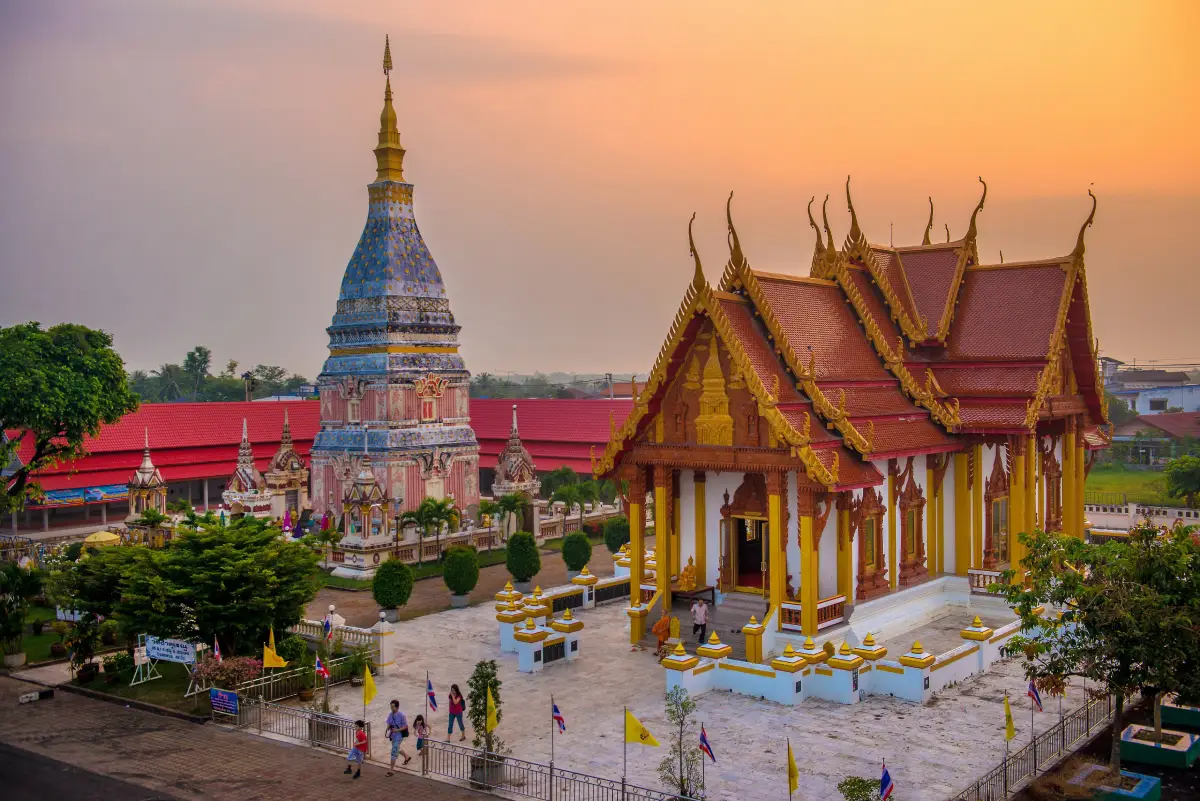
Wat That Renu, also known as Wat Phra That Renu, stands near the meeting point of Renu and Phon Thong communities in Renu Nakhon District, Nakhon Phanom Province. It is the principal community temple and one of the most revered spiritual landmarks of the Phu Tai people of Renu Nakhon. The temple’s centerpiece is Phra That Renu, a 35-meter-high square stupa modeled on the historic form of Phra That Phanom but constructed on a smaller scale suitable for the old town of Renu. Phra That Renu is recognized as the sacred birthday stupa for people born on Monday and receives worshippers from Nakhon Phanom, neighboring provinces and communities across the Mekong River in Laos. The ordination hall also houses Phra Ong Saen, a Lao-style brass Buddha image in the meditation posture that is regarded as the guardian Buddha of Renu Nakhon. A visit combines Buddhist pilgrimage, architectural study, local history and an introduction to the living culture of one of Thailand’s best-known Phu Tai communities.
The temple was originally called Wat Klang, meaning the central temple, because it occupied an important position at the heart of historic Renu Nakhon. Its grounds, covering approximately 16 rai, linked the settlements of Renu and Phon Thong and provided a common sacred space for several residential quarters. The temple predates the construction of the present stupa in the early twentieth century. Although no surviving document gives a precise foundation year for Wat Klang, local accounts state that the first ruler of Renu Nakhon, senior administrative officials and residents established it as the main temple of the town. Wat Klang was used not only for merit-making and monastic ceremonies but also for the traditional oath-of-allegiance ritual in which officials drank consecrated water to affirm loyalty and honesty. The temple therefore belonged simultaneously to the religious, administrative and social organization of the old town.
Renu Nakhon is a major center of Phu Tai, or Phu Thai, ethnic culture. The community’s history is linked to migrations from territories east of the Mekong River into present-day Thailand during the early Rattanakosin period. Phu Tai oral traditions refer to ancestral settlements in Muang Nam Noi Oi Nu, Muang Thaen and Muang Wang before groups crossed the Mekong and established new homes around the forested area once called Dong Wai. During the reign of King Rama III, Thao Sai was appointed Phra Kaeo Komon, the first ruler of Renu Nakhon, and the settlement became a tributary town under Nakhon Phanom. Migrating families brought their language, kinship system, ancestral beliefs, textiles, food, music and dance traditions. Phra That Renu consequently represents far more than Buddhist architecture. It links collective memories of migration, the founding of the town and the continuing identity of the Phu Tai people.
As Renu Nakhon became more settled and its population grew, monks, local leaders and residents planned a sacred stupa that would serve as the spiritual monument of their town. Construction began around 1917–1918 under Phra Upatcha In Phumiyo, also recorded as Phra Khru In, together with Ya Khru Song, the deputy abbot. Secular leadership was provided by Khun Phon Thong Thammarat, also known as Pum Singkha, headman of Phon Thong, and Khun Renu Nitikorn, or Khamfan Koponrat, headman of Renu. Residents of Renu, Phon Thong, Saen Phan and surrounding settlements contributed money, labor and materials. Their intention was to create a sacred stupa for Renu Nakhon based on Phra That Phanom, the most revered Buddhist monument of the central Mekong region and the principal architectural and spiritual model for many communities in Nakhon Phanom.
Construction was supervised by Phra Mao, a craftsman-monk from Tha Uthen who had experience in stupa building and was associated with the construction of Phra That Tha Uthen. His involvement demonstrates the movement of craftsmen and architectural knowledge between Mekong towns. The builders did not rely on industrial cement, standardized engineering plans or prefabricated decorative components. They used accumulated knowledge of proportion, masonry, load distribution and traditional mortar. Phra That Renu was built of brick bonded and coated with an old lime compound known locally as chathai. The mixture combined lime, sand, bong-tree resin and a liquid binder prepared from animal hide. This produced a workable mortar that adhered well to brick and responded more flexibly to humidity and temperature than rigid modern cement. Building the stupa required skilled judgment, long preparation and coordinated community labor.
The first completed structure was struck by lightning and collapsed. The disaster did not end the project. Monks, local administrators and villagers organized a second construction campaign, increasing the thickness of the brickwork and improving the structural mass of the stupa. The rebuilt monument was completed and formally celebrated in 1920. This event remains central to local memory because it shows that Phra That Renu was created through repeated effort rather than a single uninterrupted building campaign. Collapse strengthened collective determination instead of weakening belief. The Fine Arts Department later carried out conservation and constructed a protective structure over historic portions of the monument, adding another stage to its architectural history. The stupa visible today therefore contains both the community-built historical core and layers of later conservation intended to preserve it as a functioning sacred monument.
Phra That Renu is a square brick-and-plaster stupa approximately 35 meters high, rising from a square base measuring 8.37 meters on each side. Its overall form was reduced from the earlier appearance of Phra That Phanom so that it would suit the scale of Renu Nakhon. The base and main body are arranged in receding levels, gradually reducing the visual weight of the structure as it rises. False doorways are placed symmetrically on all four sides. Although these are not functional entrances, they animate the masonry surfaces and symbolically orient the monument toward every direction. The strong square base gives an impression of stability, while the progressively narrowing upper levels guide the viewer’s attention toward the gilded finial and the open sky.
The lower and second levels of the main body are covered with arched frames, molded ornament and carefully organized vertical divisions. These architectural panels increase the apparent height of the stupa and prevent its broad surfaces from looking heavy. Today the exterior is painted pale pink with white and gold details, leading many travelers to call it the pink stupa of Nakhon Phanom. The pink surface gives Phra That Renu a visual identity unlike that of other sacred stupas in the province and complements its association with Monday, gentleness and luminous beauty. Gold highlights emphasize the arches, moldings and important edges. In morning and late-afternoon light, the pale surfaces reflect a soft glow while the gilded details become brighter, creating a different character at each time of day.
A notable decorative feature is the image of the ceremonial horse, or achanai, the symbolic vehicle associated with Monday in the birthday-stupa tradition of Nakhon Phanom. Horse motifs on the four sides transform the temple’s calendrical identity into visible architectural language. Visitors do not need to rely solely on an explanatory sign; the symbolism is incorporated directly into the monument. Other molded patterns show the influence of Lan Xang art through arched frames, floral motifs, layered moldings and compositional ideas shared by religious monuments throughout the Mekong region. Lan Xang art cannot be confined to the political boundaries of modern Laos. It is widely represented in northeastern Thai temples, particularly in provinces connected by the Mekong, historic trade, migration and monastic networks.
Above the main body, inverted-lotus moldings lead to the constricted section known as the waist before the monument changes into an angular lotus-like pinnacle. Lao-speaking communities describe this upper profile as hua nam tao, resembling a bottle gourd, or mak pli, resembling a banana blossom. The form creates a continuous transition from the broad square mass below to the slender finial above. Rather than changing abruptly, the silhouette narrows through a sequence of carefully proportioned levels that end in a gilded spire and ceremonial umbrella. The umbrella represents honor, spiritual elevation and the highest form of offering to Buddhism. Visible from nearby streets and houses, the upper structure functions both as a landmark in the townscape and as a constant spiritual reference for the community.
The stupa is surrounded by two sacred enclosure walls. The inner enclosure measures approximately 10.50 meters, while the outer enclosure extends to about 23.15 meters. These walls do more than define property. They establish a sequence of movement from the open temple courtyard toward the most sacred zone around the stupa. Gateways in different directions frame changing views of the monument and organize the flow of worshippers. Small bell structures and decorative features at the corners transform the enclosure into a coordinated architectural composition rather than an empty boundary. Visitors may perform a clockwise circumambulation around Phra That Renu, expressing respect while observing the ornament on all four sides and experiencing the changing light, shadow and scale of the monument during the walk.
The chamber inside the stupa contains Buddhist texts and objects offered as acts of devotion. Recorded contents include a set of the Tripitaka, gold and silver Buddha images, jewelry, precious objects donated by local residents and royal regalia associated with regional rulers. Royal regalia represents political authority, and placing it inside a Buddhist monument symbolically offers worldly power to the higher authority of the Buddhist faith. In 2016, additional sacred relics were enshrined, including relics associated with the Buddha and the arahants Añña Koṇḍañña and Sariputta. These enshrinements strengthened Phra That Renu’s role as a pilgrimage destination and emphasized that the monument is not merely a commemorative structure but a sacred reliquary containing objects of profound religious significance.
The relationship between Phra That Renu and Phra That Phanom is both architectural and devotional. Phra That Phanom has long served as the principal sacred monument for communities on both sides of the Mekong and as a central focus of Buddhism in the region. Reproducing its earlier form in Renu Nakhon was never intended to compete with or replace the original. Instead, the people of Renu adopted the form of their most revered regional monument and established a related sacred center within their own town. Phu Tai residents continued to make pilgrimages to Phra That Phanom while using Phra That Renu for local ceremonies, annual festivals and everyday acts of worship. This relationship allows the temple to form part of a meaningful Mekong stupa route that includes Phra That Phanom, Phra That Marukkha Nakhon and other sacred monuments of Nakhon Phanom.
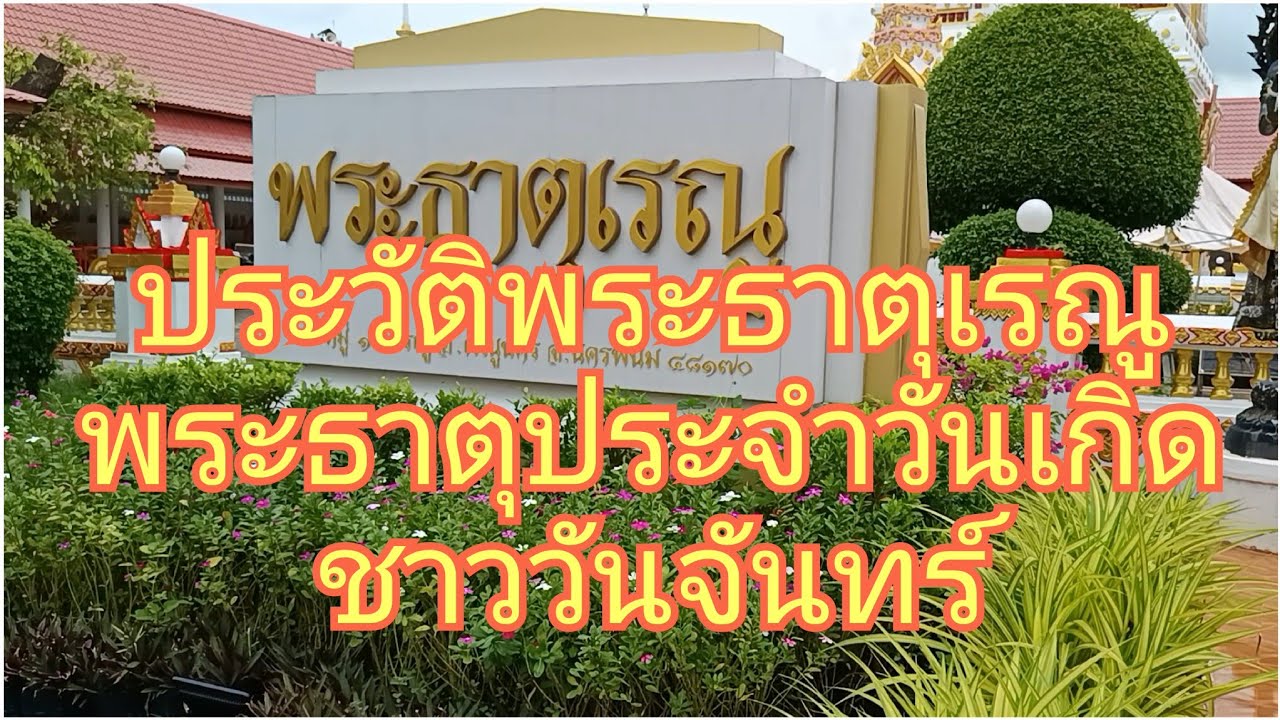
Phra That Renu is designated as the birthday stupa for people born on Monday. Within the Nakhon Phanom tradition of sacred stupas associated with days of the week, Monday-born worshippers commonly visit to pray for well-being, composure, personal charm and a luminous appearance. Local belief states that paying respect to Phra That Renu brings a complexion and presence as radiant as moonlight. This expression should be understood within the language of faith, where moonlight symbolizes clarity, gentleness and purity of mind. People born on other days are equally welcome. The temple is open to all Buddhists, local residents and respectful travelers. Worship is not limited by a person’s birthday; it is an opportunity to recollect the Buddha, Dhamma and Sangha and to reflect on one’s conduct and intentions.
Traditional offerings associated with the Monday stupa include 15 incense sticks, 2 white candles, a garland, yellow flowers, Thai scented water, grilled sticky rice and popped rice. These items combine standard Buddhist offerings with foods and materials rooted in local life. Flowers, incense and candles express reverence, while carefully prepared food symbolizes the intention to offer something wholesome. Visitors do not need to obtain every item to pay respect. A simple flower offering or a period of quiet prayer is sufficient. Offerings should not block walking routes or be placed against historic surfaces. Incense must be lit only in designated areas, and packaging should be removed from the temple grounds. These small actions help preserve the cleanliness and safety of the sacred courtyard.
The ordination hall houses Phra Ong Saen, also called Luang Pho Ong Saen, a Lao-style brass Buddha image seated in meditation. The image measures approximately 50 centimeters across the lap and about 50 centimeters in height. Its gentle facial form, small hair curls and flame-shaped ushnisha reflect the artistic vocabulary of Laos and the Lan Xang cultural world. Phra Ong Saen is regarded as the guardian Buddha of Renu Nakhon. A complete visit should therefore include both the stupa and the ordination hall, since together they represent the principal sacred objects of the community. The interior is quieter than the open courtyard, and filtered light from doors and windows emphasizes the Buddha image. It is an appropriate space for prayer, meditation and the respectful observation of local Buddhist art.
The name Phra Ong Saen is connected to a traditional system of weight. The image was described as weighing 10 muen. In a local measure, 1 muen was equivalent to approximately 12 kilograms, giving a total weight of about 120 kilograms. Because 10 units of ten thousand form one hundred thousand, or saen in Thai, the Buddha became known as Phra Ong Saen. The name preserves an intriguing connection between language, measurement and local culture. The image has been worshipped for roughly a century and has witnessed many important events in Renu Nakhon. During the annual Songkran festival, it is ceremonially carried around the town so that residents can pour scented water over it and receive blessings. The procession brings the Buddha image from the enclosed ordination hall into the streets and residential quarters, physically connecting temple devotion with the everyday geography of the community.
The present ordination hall is a concrete building approximately 8.80 meters wide and 19.50 meters long, constructed in 1960. Its architecture represents the transition from vernacular timber and lime-plaster construction to reinforced religious buildings during the mid-twentieth century. Although it was built decades after Phra That Renu, the hall is positioned in relation to the stupa courtyard. From inside, the stupa can be seen through doorways and openings, visually connecting the Buddha image representing the Enlightened One with the reliquary monument representing Buddhist teachings and sacred remains. Photographers should request permission before setting up equipment, speak quietly and avoid blocking the approach of worshippers entering the hall.
Other monastic buildings include a sermon hall approximately 13 meters wide and 27.50 meters long, constructed in 1971; monks’ residences in timber and mixed masonry; and a small vihara measuring approximately 4 by 6 meters, built in 1978. These buildings document the growth of the temple as its responsibilities expanded. Wat That Renu must accommodate resident monks, Buddhist education, annual festivals, funerals, ordinations, merit-making and visiting pilgrims. The grounds also contain Wat That Renu Witthaya Buddhist Scripture School, where monks and novices study both general subjects and Buddhist doctrine. The temple consequently serves several functions at once: active monastery, historic site, educational institution, ceremonial center and public gathering place.
The latest publicly listed abbot is Phra Ratcha Rattanakon, formally Phra Ratcha Rattanakon Thawat Dhammatecho, Pali Level 4. He also serves as an adviser to the ecclesiastical governor of Nakhon Phanom Province. His responsibilities include monastic administration, care of temple property, support for Buddhist education and coordination between the monastery and the community. Phra Ratcha Rattanakon has been respected by Buddhists in the province for many years. Phra Khru Si Thiraphiwat serves as deputy abbot and deputy ecclesiastical head of Renu Nakhon District, assisting with temple ceremonies and public activities. Researchers, documentary teams and organized tour groups should contact the temple before arrival so that visits do not conflict with chanting, funerals, educational schedules or other religious events.
The most important annual celebration is the Phra That Renu Worship Festival, locally associated with Bun Duean Si, the merit festival of the fourth lunar month. The traditional period is connected to the waxing moon of the fourth lunar month, while current dates are arranged each year by the province, temple and community. In 2026, the festival was held from March 1 to March 3. Activities included ceremonies of worship, processions carrying mak beng floral offerings from local temple quarters, mass Phu Tai devotional dances, traditional textile displays, cultural performances and community-product markets. The festival demonstrates that Phra That Renu is not a monument frozen in the past. It continues to organize the social calendar of Renu Nakhon and brings architecture, faith, dance, costume, food and intergenerational participation together in the same sacred setting.
Mak beng offerings are made from folded banana leaves, flowers and natural materials arranged in tall, carefully balanced forms. Their construction requires knowledge of folding, fastening and proportion. Each local quarter works collectively to prepare offerings and organize its procession toward the stupa. This is not merely festival decoration. It transfers practical skills from elders to younger participants and strengthens neighborhood cooperation. The large devotional dance serves a similar role. Dancers must learn coordinated steps, timing and formations, while dark Phu Tai clothing decorated with red, white and brightly colored woven textiles creates a recognizable visual identity. Bun Duean Si therefore brings tangible heritage, represented by the stupa and temple buildings, into direct contact with intangible heritage expressed through craft, music, movement and communal ritual.
Another important custom is the Songkran procession of Phra Ong Saen. Pouring scented water over a Buddha image is an expression of respect and renewal during the traditional Thai New Year. Families return home, make merit and ask blessings from elders. Carrying Phra Ong Saen beyond the ordination hall enables residents who cannot easily enter the temple to participate along the processional route. The ritual extends the sacred presence of the Buddha into streets, neighborhoods and shared public spaces. Travelers joining the event should dress respectfully despite the festive atmosphere, avoid colored water, powder or chemical substances and pour water only at the points designated by the temple committee. Appropriate behavior protects the historic image and preserves the religious meaning of the ceremony.
The temple can be understood through several visitor zones. The first is the stupa courtyard and its two sacred enclosure walls, the principal area for circumambulation, photography and worship. The second is the ordination hall containing Phra Ong Saen, intended for prayer and quiet contemplation. The third includes the sermon hall and public activity grounds used during festivals and community ceremonies. The fourth is the Buddhist Scripture School and residential monastic area, where visitors must respect privacy and avoid entering restricted spaces. The fifth is the nearby OTOP and cultural-product area, where travelers can purchase handwoven cloth, loincloths, scarves, rice containers, reed work and other Phu Tai handicrafts. Visiting all these areas reveals that Wat That Renu is a complete religious and community complex rather than a single isolated stupa.
The Renu Nakhon Cultural Center Market near the temple offers direct access to Phu Tai craft traditions. Handwoven cotton, mudmee textiles, pha khao ma, scarves and locally designed clothing are among the principal products. Buying from local makers helps return tourism income to the community and supports the continuation of weaving skills. Visitors can ask sellers about the origin of a pattern, the weaving technique and appropriate care for the textile. This conversation gives a handmade item cultural meaning beyond its function as a souvenir. Slight differences between individual pieces are normal characteristics of hand production, not defects. On days without a large market, stalls may follow community schedules rather than regular shopping-center hours, so travelers should allow flexibility.
A detailed architectural visit should begin outside the enclosure walls, where the full relationship between the square base, main body, lotus moldings, waist, banana-blossom pinnacle and gilded umbrella can be seen. Move inside to study the false doorways, horse motifs and the distribution of pink, white and gold decoration. Walking clockwise around the stupa reveals how sunlight, rain and prevailing winds have affected each elevation differently. Morning light is softer and creates long shadows, while afternoon light produces stronger reflections on gilded ornament. Tripods should never block circumambulation routes, and equipment must not be placed on altars or sacred walls. Remaining at an appropriate distance often produces a better complete view while respecting worshippers.
Visitors should cover their shoulders and wear trousers or skirts of appropriate length. Shoes must be removed before entering the ordination hall or any building marked by the temple. Inside, feet should not be pointed toward the principal Buddha, and photographers should not stand between an image and people who are praying. Flash photography near Phra Ong Saen should be avoided, and no Buddha image, historic surface or pedestal should be touched. During funerals, ordinations, chanting or monastic ceremonies, religious use takes priority over sightseeing. Wat That Renu is an active monastery, not a photographic set separated from the daily life of its community.
The temple is open daily and does not charge an admission fee. A practical visiting period is from approximately 05.00 to 19.00. Early morning is suitable for merit-making and a peaceful atmosphere. Late morning and afternoon provide clearer light for observing architectural details, while evening offers softer temperatures and gentler color. Individual buildings, particularly the ordination hall, may open and close according to chanting, Buddhist school classes and temple ceremonies. Groups or visitors specifically wishing to see Phra Ong Saen should telephone in advance. There is no admission ticket, although donations for electricity, water, education and conservation may be placed in official temple donation boxes or given through channels designated by the monastery.
The most comfortable season is generally from November to February, when Nakhon Phanom experiences cooler temperatures and clearer skies. March brings the Phra That Renu festival and a lively cultural atmosphere, but visitors should prepare for stronger heat and crowds. April is appropriate for travelers interested in Songkran and the bathing procession of Phra Ong Saen. The rainy season from approximately May to October gives the surrounding landscape fresh green color and creates striking contrasts with the pink stupa, although courtyards and steps may become slippery. An umbrella and easily removable shoes with reliable grip are useful. Visitors should avoid sheltering directly against historic surfaces or decorative structures that require conservation.
Getting There from Nakhon Phanom city involves a drive of approximately 53 kilometers and normally takes 55–65 minutes. Follow Highway 212 toward That Phanom and turn onto Highway 2031 for Renu Nakhon. In the town, continue toward Kaew Komon Road. The temple is at 59 Kaew Komon Road near the boundary between the Renu and Phon Thong communities. GPS coordinates are 17.04778, 104.67639. From That Phanom District, the distance is approximately 15 kilometers and the drive takes around 20 minutes. The road is generally flat and signposted. A private vehicle or rental car is the most practical choice because it allows visitors to continue to Phra That Phanom, Phra That Marukkha Nakhon and other cultural sites in one day.
Public-transport travelers can take a vehicle operating on the Nakhon Phanom–That Phanom corridor and alight near a connection for Renu Nakhon, then hire a local vehicle or motorized tricycle for the final section. Local services do not run as frequently or predictably as urban transport, so the return trip and fare should be agreed upon before departure. Air travelers may fly into Nakhon Phanom Airport and rent a car or hire a driver. Entering the exact coordinates is more reliable than searching only by a general temple name because Nakhon Phanom contains many places with similar religious names. Drivers should reduce speed when entering the residential area and watch for motorcycles, pedestrians and roadside market activity.
A practical one-day itinerary can begin at Wat That Renu in the morning, allowing 60–90 minutes for worship, circumambulation, a visit to Phra Ong Saen and shopping for Phu Tai products. Continue to the Pu Thala ancestral shrine to learn about local beliefs and the founding narratives of Renu Nakhon. Lunch may feature freshly pressed Phu Tai rice noodles or other regional dishes in the district center. In the afternoon, continue to Phra That Marukkha Nakhon and Wat Phra That Phanom Woramahawihan. Travelers beginning in That Phanom can reverse the route, visiting Phra That Phanom early and reaching Renu Nakhon before midday. The itinerary demonstrates how Mekong towns use sacred monuments as centers of history, identity and community life.
A signature food of Renu Nakhon is khao pun, freshly pressed rice noodles served with fish curry, fermented-fish sauce, vegetables and herbs. The noodles are soft yet pleasantly elastic because they are prepared and pressed close to serving time. Small community restaurants often produce limited quantities based on daily ingredients and may close when food is sold out, making morning or lunchtime the best period. Other options include khao piak sen, noodle soup, Isan food, seasonal vegetables and local mushroom dishes. Travelers who do not eat fermented fish or spicy food should explain their preference before ordering. Some businesses accept cash only, so carrying small banknotes is useful.
Accommodation in Renu Nakhon consists mainly of small resorts, local hotels and independently managed rooms. Their advantages are proximity to the temple, easy parking and a quieter environment than Nakhon Phanom city. Rooms should be booked early for the March worship festival because the district has limited capacity. Many properties provide parking and Wi-Fi, but breakfast, credit-card payment and check-in arrangements vary. Telephone confirmation is recommended. Travelers seeking larger hotels, extensive restaurant choices or more convenient intercity transport can stay in That Phanom or Nakhon Phanom city and make a day trip to Wat That Renu.
Facilities in and around the temple include parking areas, toilets, rest pavilions, donation boxes, shops selling flowers and worship items and nearby community-product outlets. During major festivals, additional food stalls, public-service points and performance zones are arranged. Older visitors can move through the main courtyard, although some surfaces change level and several buildings require steps. Wheelchair users should travel with assistance and follow the smoothest available route. Festival parking may be located away from the entrance, and drivers must follow local signs rather than blocking homes, emergency routes or procession paths. Orderly use of the space allows residents, pilgrims and tourists to share the temple safely.
Wat That Renu is simultaneously a historic monument, an active monastery and a social institution. The stupa preserves traditional chathai brick-and-lime technology and the historic form of Phra That Phanom. Phra Ong Saen represents Lao Buddhist art and a local system of measurement. The annual festival maintains Bun Duean Si traditions, while Phu Tai dance, textiles, mak beng offerings and food surround the architecture with living intangible heritage. The Buddhist school continues the temple’s educational role. Conservation must therefore extend beyond the stupa itself to include Buddha images, documents, craft knowledge, ceremonies, community spaces and the relationship between monks and residents.
Responsible travel begins with recognizing the temple as a sacred place. Visitors must not scrape, lean against or attach unauthorized gold leaf to historic surfaces. Drones require permission. Buying community products, eating at local restaurants, staying in locally owned accommodation and donating through official channels help tourism revenue support the area. Waste should be removed from the courtyard, and information about local beliefs should be shared accurately and respectfully. Wat That Renu is not simply a picturesque pink landmark. It is a record of Renu Nakhon’s history, Buddhist faith and enduring Phu Tai pride.
Travelers seeking a deeper understanding of Nakhon Phanom should not overlook Wat That Renu. From a distance, the stupa reveals its balanced silhouette. At close range, the horse motifs, arches and Lan Xang ornament become visible. Entering the ordination hall introduces Phra Ong Saen, while walking into the surrounding market and community brings visitors into contact with woven textiles, food, language and the people who maintain Phu Tai culture. Architecture and everyday life remain naturally connected. Wat That Renu is therefore a Monday birthday stupa, a sacred monument of the old town, a community center and one of the most complete gateways to the culture of Renu Nakhon.
| Name | Wat That Renu / Wat Phra That Renu |
| Location | Near the meeting point of Renu and Phon Thong communities, Renu Nakhon District, Nakhon Phanom Province |
| Address | 59 Kaew Komon Road, Phon Thong, Renu Nakhon District, Nakhon Phanom 48170, Thailand |
| Coordinates | 17.04778, 104.67639 |
| Former Name | Wat Klang, meaning the central temple of historic Renu Nakhon |
| Temple Type | Community temple of the Maha Nikaya order and the principal sacred temple of the Phu Tai people of Renu Nakhon |
| Highlights | The pink Phra That Renu, sacred Monday birthday stupa modeled on historic Phra That Phanom, and Phra Ong Saen, the guardian Buddha of Renu Nakhon |
| Construction History | Construction began around 1917–1918 under Phra Upatcha In Phumiyo, local monks, community leaders and residents. The first structure collapsed after a lightning strike and was rebuilt and celebrated in 1920. |
| Master Builder | Phra Mao, a craftsman-monk from Tha Uthen with experience in stupa construction |
| Architectural Style | Square brick-and-plaster Lan Xang stupa modeled on the historic form of Phra That Phanom, with four false doorways, lotus moldings, a constricted waist, bottle-gourd or banana-blossom pinnacle and gilded umbrella |
| Stupa Dimensions | Approximately 35 meters high with a square base measuring 8.37 meters on each side |
| Traditional Materials | Brick and chathai mortar prepared from lime, sand, bong-tree resin and animal-hide binder |
| Contents Of The Stupa | Tripitaka scriptures, gold and silver Buddha images, jewelry, royal regalia, donated valuables, Buddha relics and relics associated with revered arahants |
| Birthday Stupa | Monday; worship is traditionally associated with well-being, personal radiance and a luminous appearance like moonlight |
| Important Buddha Image | Phra Ong Saen, a Lao-style brass Buddha in meditation posture, approximately 50 centimeters across the lap, 50 centimeters high and about 120 kilograms in weight |
| Annual Festival | The Phra That Renu Worship Festival or Bun Duean Si. The 2026 event was held from March 1 to March 3 with mak beng processions, Phu Tai devotional dancing and cultural activities. |
| Abbot | Phra Ratcha Rattanakon (Thawat Dhammatecho, Pali Level 4), adviser to the ecclesiastical governor of Nakhon Phanom Province |
| Buddhist School | Wat That Renu Witthaya Buddhist Scripture School |
| Main Areas / Zones | 1. Stupa courtyard and two sacred enclosure walls 2. Ordination hall and Phra Ong Saen 3. Sermon hall and community activity grounds 4. Buddhist school and monastic residential area 5. Nearby OTOP and Phu Tai community-product area |
| Open Days | Daily |
| Opening Hours | 05.00 – 19.00; individual buildings may follow temple ceremony schedules |
| Admission Fee | Free admission; voluntary donations are welcome |
| Facilities | Parking, toilets, rest pavilions, donation boxes, flower and worship-item shops, community-product outlets and additional visitor services during festivals |
| Travel Information | Approximately 53 kilometers from Nakhon Phanom city via Highways 212 and 2031, taking 55–65 minutes. Approximately 15 kilometers or 20 minutes from That Phanom. |
| Main Contact Numbers | 042-579132, 081-2610930 |
| Current Status | Active Buddhist temple, religious center, educational institution and venue for major community traditions |
| Nearby Tourist Attractions | Approximate driving distances 1. Renu Nakhon Phra That Cultural Center Market, 1 km 2. Pu Thala Shrine, 1 km 3. Wat Wutthi Wararam at Ban Phon Sao Ae, 3 km 4. Phra That Marukkha Nakhon, 11 km 5. Wat Phra That Phanom Woramahawihan, 15 km |
| Nearby Restaurants | Approximate driving distances 1. Khoei Phu Tai Restaurant, 2 km, Tel. 086-4612634 2. Krua Khun Tiw, 2 km, Tel. 083-3353160 3. Kuai Chap Joy Khao Piak Sen Sot Renu Nakhon, 2 km 4. Phunsin Khanom Chin Renu, 2 km 5. Muang Wang Cafe & Restaurant, 4 km |
| Nearby Accommodations | Approximate driving distances 1. Muangway Garden Ville, 2 km, Tel. 089-1819190 2. The P.J. House Resort @Renunakorn, 2 km, Tel. 064-6365262 3. Baan Saengthip Resort, 2 km 4. KONG INN Renunakhon, 3 km, Tel. 085-7434491 5. The Wisteria Cafe & Resort, 5 km, Tel. 093-6491466 |
Frequently Asked Questions (FAQ)
Q: Where is Wat That Renu located?
A: The temple is at 59 Kaew Komon Road near the meeting point of the Renu and Phon Thong communities in Renu Nakhon District, Nakhon Phanom Province. Its coordinates are 17.04778, 104.67639.
Q: Which day of the week is associated with Phra That Renu?
A: Phra That Renu is the sacred birthday stupa for Monday. Monday-born visitors commonly pray for well-being and personal radiance, although people born on any day are welcome to worship.
Q: When was Phra That Renu built and which stupa inspired its design?
A: Construction began around 1917–1918 and the rebuilt monument was completed and celebrated in 1920. Its form was modeled on historic Phra That Phanom but reduced in size for Renu Nakhon.
Q: What are the most important things to see inside the temple?
A: Major features include Phra That Renu, Phra Ong Saen in the ordination hall, the two sacred enclosure walls, the sermon hall, the Buddhist Scripture School and nearby Phu Tai community-product outlets.
Q: What are the opening hours and is there an admission fee?
A: The temple is generally open daily from 05.00 to 19.00 and admission is free. Individual buildings may follow chanting, school and ceremony schedules.
Q: When is the annual Phra That Renu festival held?
A: The festival takes place during Bun Duean Si, the fourth lunar month. Exact dates change each year. In 2026, it was held from March 1 to March 3.
Q: How much time should travelers allow for a visit?
A: Allow 60–90 minutes to worship at the stupa, walk around the sacred enclosure, visit Phra Ong Saen and browse Phu Tai products near the temple.
Q: Which nearby attractions can be combined with Wat That Renu?
A: A one-day route can include Pu Thala Shrine, Wat Wutthi Wararam, Phra That Marukkha Nakhon and Wat Phra That Phanom Woramahawihan.
 Category: ●Places of Worship
 Group: ●Temple
Last Update : 3 MonthAgo
 Last Update : 3 MonthAgo
 Click to Access the Navigation Map GPS
Wat That Renu Map
Recommend

 Art, Culture and Heritage
 Historical Sites and Monuments(3)
 Landmarks and Memorials(2)
 Art, Craft Centres, Tradition(3)
 Museums(3)
 Educational Places
 Library(1)
Temple(23)
 Church(1)
 Other Sacred Sites(11)
 Suburban Living
 Village, Community(5)
 Nature and Wildlife
 National Parks and Marine Reserves(1)
 Dam, Reservoir, Lake(5)
 Waterfalls(2)
 River, Canal(3)
 Bays and Beaches(3)
 Other natural attractions(2)
 Entertainment and Agricultural
 Zoos and Aquariums(1)
 Farms, Parks and Ecotourism(2)
 Shopping
 Shopping and Night Market(1)
 Travel Articles, Recipes
 Travel Review, Food Review(1)


