
lovethailand home >Northeastern Travel Attractions >Nakhon Phanom Travel Attractions >Tha Uthen >Tha Uthen > Phra Bang Wat Trai Phum
TL;DR: Phra Bang Wat Trai Phum, open Wat Traiphum is open daily. The Tha Uthen Dinosaur Footprint Site opens to, hours Wat Traiphum is open from 07:30 to 19:00.
Phra Bang Wat Trai Phum
Open Days: Wat Traiphum is open daily. The Tha Uthen Dinosaur Footprint Site opens to visitors from July 21, 2026 onward.
Opening Hours: Wat Traiphum is open from 07:30 to 19:00.
Admission Fee: Admission to Wat Traiphum is free.
Phra Bang at Wat Traiphum and the Tha Uthen Dinosaur Footprint Learning Site in Nakhon Phanom are two remarkable places that reveal very different dimensions of Tha Uthen District. One represents Buddhist devotion, Lan Xang art and the long cultural relationship between communities on both banks of the Mekong River. The other preserves the tracks of animals that crossed northeastern Thailand approximately 100–110 million years ago. Phra Bang is a revered standing Buddha image enshrined inside Wat Traiphum in Tha Uthen’s historic community, while the dinosaur footprint site lies in Phanom Subdistrict beside Highway 212 between Tha Uthen and Ban Phaeng. Together they form an exceptional one-day journey combining faith, history, traditional culture, natural history and geology.
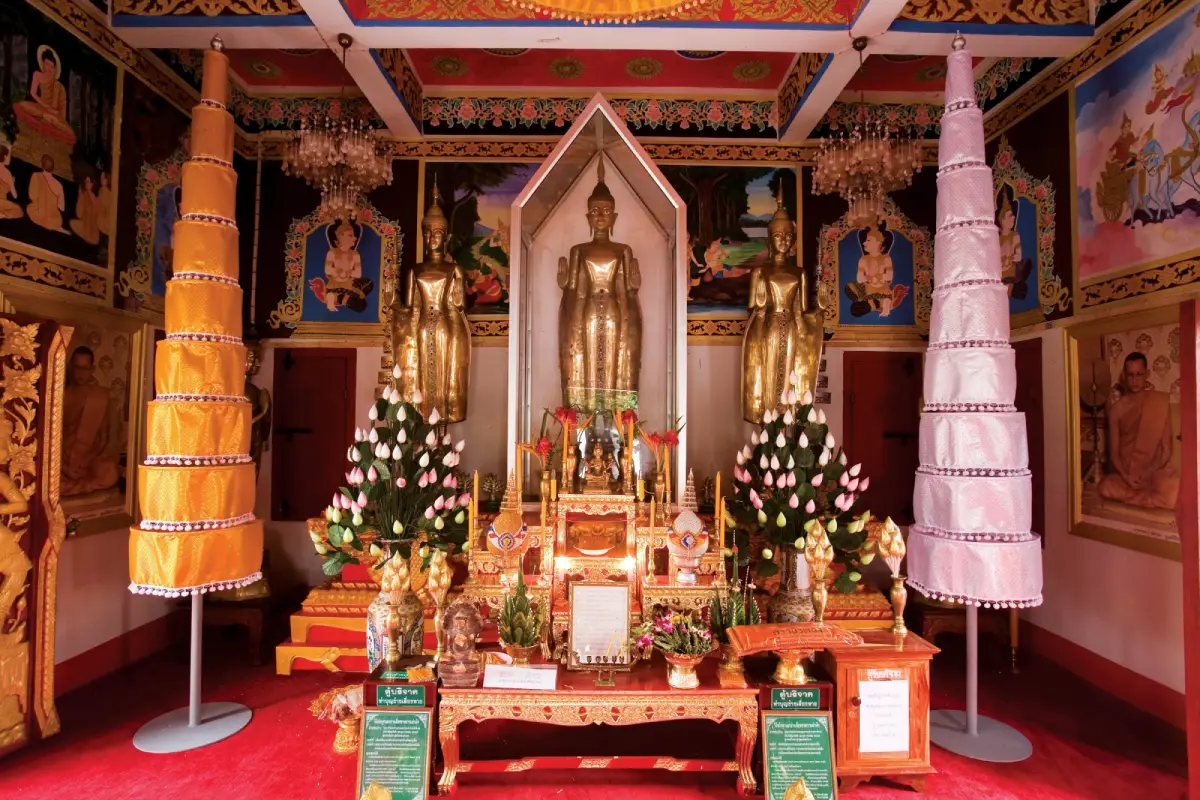
Wat Traiphum stands within Tha Uthen Municipality near the Mekong River and an old Tai Yo community. It is an active Maha Nikaya Buddhist monastery with resident monks, regular religious duties and continuing involvement in community life. Its most important sacred object is Phra Bang, a bronze standing Buddha image in the gesture known in Thailand as Paang Ham Samut, or Calming the Ocean. The image is approximately life-size, unlike most regional replicas of Phra Bang, which are normally much smaller. It is therefore significant both as a guardian image of Tha Uthen and as a major example of Lan Xang Buddhist sculpture in northeastern Thailand.
Phra Bang stands approximately 80 inches high with both hands raised in front of the chest. The image rests upon a low platform and an octagonal pedestal supported by eight elephants. The Buddha has an elongated face, forward-looking eyes, a small mouth with the characteristic gentle Lan Xang smile, small hair curls and a high flame-shaped finial. The body is upright and dignified. The two raised palms symbolize the calming of danger, the prevention of conflict and the restoration of peace and safety.
The gesture called Calming the Ocean shows the Buddha standing with both hands raised, palms facing outward. It resembles the gesture of granting protection but uses both hands simultaneously. In Lan Xang culture, this pose became closely associated with Phra Bang, the sacred Buddha image of Luang Prabang. Replicas were subsequently created throughout Lao communities and culturally related areas of northeastern Thailand. The Wat Traiphum image preserves the essential standing form while incorporating distinctive local decoration.
The image was cast from a mixture of metals. Local records refer to gold, nak alloy, silver, white metal and copper being combined in the casting process. Producing a large image required advanced knowledge of alloy preparation, mold construction, temperature control and the accurate fitting of separate components. Phra Bang can be dismantled into several pieces, including the flame finial, head, left and right hands, body and pedestal. This construction made it easier to transport the image through mountains, across ravines and over the Mekong River.
The waistband and front textile panel are decorated with patterns and colored stones, giving the image an appearance related to ornamented Buddha sculpture. A diamond measuring approximately half an inch in diameter was formerly set at the navel but later disappeared. Scholars have suggested that the elaborate waistband may reflect the influence of ornamented Buddha images in later Thai art, since traditional Phra Bang replicas rarely emphasize this area. The sculpture consequently combines a Lan Xang foundation with decorative preferences that developed within the local community.
The octagonal pedestal and eight supporting elephants carry structural and symbolic meaning. The number eight may evoke the eight directions and the extension of compassion and protection throughout the surrounding world. Elephants are associated with power, royal authority, stability and merit in Southeast Asian culture. By placing elephants beneath the Buddha’s pedestal, the design symbolically raises Buddhist wisdom above worldly strength while creating a visually stable and dignified composition.
Older tourism publications commonly state that Phra Bang was created in B.E. 2008, corresponding to A.D. 1465, in the Year of the Monkey on the ninth waxing-moon day of the third lunar month. More recent study of the inscription and artistic style reads the date as B.E. 2308, or A.D. 1765, and assigns the image to the early twenty-fourth Buddhist century. The later reading corresponds more closely with the facial form, flame finial, clothing and Lan Xang decoration. This article therefore uses B.E. 2308 as the principal date while recording that B.E. 2008 remains widespread in earlier travel literature.
The inscription identifies Somdet Phra Hemmavanna, his disciples and lay Buddhist supporters as the patrons. Local legend provides a fuller narrative, explaining that the image was cast in Laos under the joint leadership of the monastic and secular communities. Somdet Hemmavanna represented the monks, while Phraya Maengwan, ruler of Mueang Hoep, represented the lay population. Two images of similar size were reportedly created. One was a seated Buddha now associated with Ban Don Ting in the Hinboun area of Laos. The second was the standing Phra Bang now enshrined at Wat Traiphum.
During a period of warfare, the image was hidden inside Tham Hin Hoep Cave near Ban Nakok in the Khamkeut area to protect it from theft or destruction. Concealing sacred images in caves occurred in several Mekong communities during periods of political instability because mountains and remote caverns provided natural protection. Phra Bang remained hidden long enough for its story to become part of the oral heritage passed down through monks, leaders and village elders.
Phra Ajarn Ta Phongsri, a highly respected monk known to the ruler and residents of Hinboun, later resided in the Nakhon Phanom region. After learning of the beauty and sanctity of Phra Bang, he requested permission to remove it from the cave. The image had to be carried across a ravine using ropes and pulleys before being transported through mountainous terrain and across the Mekong. The ability to dismantle the sculpture into separate components helps explain how such a large sacred object could be moved through a difficult landscape.
After arriving in Tha Uthen, the image was initially enshrined at Wat Phra That Tha Uthen before being transferred to Wat Traiphum as its permanent home. Its journey from Laos through a cave, mountains, the Mekong and several temples transformed the image into a symbol of shared culture across the international border. Phra Bang is therefore not merely the property of one monastery but part of the heritage of communities connected by language, religion and history.
The most famous belief associated with Phra Bang is that carrying the image in procession can bring rain and agricultural abundance. This belief developed in a farming society dependent upon seasonal rainfall for rice cultivation. The Calming the Ocean gesture, with both hands raised to control danger and water, strengthened the association with rainmaking and protection from natural hardship. During drought, local residents invited Phra Bang from its shrine and carried it through the community as a prayer for relief.
The annual bathing and procession of Phra Bang during Songkran is one of Tha Uthen’s most important traditions. The image is ceremonially invited from its secure shrine so residents can pay respect and participate in a controlled bathing ritual. The procession moves through the community to bless the town and connects the Thai New Year with water, rainfall and agricultural fertility. Water is not poured freely over the ancient sculpture. Temple officials supervise the ritual and use appropriate methods to protect the metal, gemstones and detachable components.
In April 2026, Wat Traiphum continued the tradition with a royal ceremonial water presentation and a major celebration of Phra Bang. The event involved monks, government authorities, municipal officials, schools, community leaders and residents. Its continuation demonstrates that Phra Bang is not an inactive antiquity kept behind locked doors. It remains the spiritual center of a living religious and cultural tradition.
Phra Bang is enshrined as the principal image inside a secure viharn and is not available for unrestricted viewing throughout the day. The sculpture is artistically valuable, can be separated into multiple components and has lost gemstones in the past. Security is therefore stricter than for ordinary temple images. Visitors wishing to worship Phra Bang must contact the monastery and obtain permission from the abbot or caretaker. Arriving without prior arrangement may mean that the viharn is closed even though the general temple grounds remain open.
The current abbot is Phra Maha Wasan Bhuripanyo, Ph.D., who has served as abbot since 2018. He oversees monastic administration, Buddhist education, preservation of Phra Bang and community-development activities. He also cooperates with Tha Uthen authorities and supports educational opportunities for local young people. Visitors planning to view Phra Bang, arrange a ceremony, conduct research, photograph the image or bring a group should contact the temple in advance at 097-454-3492.
The general temple grounds are open daily from 07:30 to 19:00 and there is no admission fee. Access to the Phra Bang viharn depends upon religious duties, caretaker availability and permission from the abbot. Calling ahead is particularly important for visitors arriving from another province, school groups, researchers, photographers and travelers hoping to study the sculpture closely.
The main zones of Wat Traiphum include the Phra Bang viharn, ordination hall, religious pavilions, merit-making areas, monks’ residential zone and courtyards connecting the temple with the surrounding community. The Phra Bang viharn requires the highest level of restraint. Visitors should not touch the image, pedestal, supporting elephants or decorative details. Flash, tripods and close photography should not be used without explicit permission.
The ordination hall is used for monastic ceremonies and contains Buddha images. Shoes should be removed, phones silenced and worshippers should not be obstructed. Visitors must not sit with their feet directed toward a Buddha image or monk. The residential zone is private. Anyone wishing to make a formal offering or speak with a monk should first ask temple personnel.
Clothing should cover shoulders and knees, and thin or excessively tight garments should be avoided. Hats and sunglasses should be removed inside the viharn. International visitors are welcome when they follow the same etiquette. Women should not touch a monk or pass objects directly into his hands, and permission should be requested before photographing any member of the monastic community.
The most comfortable visiting periods are approximately 08:00–10:00 and 16:00–18:00. The morning is quiet and suitable for merit-making and exploring the old community. Late afternoon can be combined with a Mekong riverside walk or dinner in the district town. Visitors intending to see Phra Bang should confirm an appointment and arrive well before the viharn is due to close.
After exploring the religious heritage of Wat Traiphum, travelers can continue to the Tha Uthen Dinosaur Footprint Site in Phanom Subdistrict. This nationally important geological learning site occupies a former sandstone quarry in Moo 2, Phanom, beside Highway 212 on the Tha Uthen–Ban Phaeng route near kilometer marker 257. It lies approximately 30 kilometers from Wat Traiphum and normally requires around 35–45 minutes by car.
The footprints were discovered in 2001 after quarrying exposed a red sandstone surface containing numerous impressions. Geologists and paleontologists determined that the tracks did not belong to one animal. Several kinds of prehistoric animals crossed the same area at different times, leaving evidence of movement across a soft ancient surface.
Early tourism accounts referred to almost 200 footprints. Later excavation, cleaning and study exposed more than 600 individual prints and over 30 recognizable trackways. The site is therefore one of the richest and best-preserved dinosaur track localities in Thailand and Southeast Asia. The increased count does not mean new footprints appeared; it reflects broader exposure and more detailed scientific documentation.
The prints occur in red sandstone of the Khok Kruat Formation within the Khorat Group and date to the Early Cretaceous, approximately 100–110 million years ago. Northeastern Thailand then looked very different from the present landscape. The area consisted of low plains, shallow channels, mudflats and alternating sand deposits. Animals crossed wet sediment and left impressions that were covered by new material, hardened into rock and remained buried until quarrying exposed them.
Most tracks have three slender toes and resemble the footprints of birds. Some show pointed claw marks. The principal trackmakers were small theropod dinosaurs within coelurosaur and ornithomimosaur groups. Ornithomimosaurs had long necks, small heads, relatively light bodies and three-toed hind feet. They walked or ran on two legs and are often described as ostrich-like dinosaurs.
The name ornithomimosaur refers to a bird-mimicking body form, particularly one resembling an ostrich. These animals were theropod dinosaurs rather than modern birds. Their trackways allow scientists to estimate direction, pace, stride length and speed even where no skeleton of the same animal is present. Closely spaced tracks also provide evidence for how animals repeatedly used an ancient riverside or mudflat environment.
The site also preserves tracks attributed to ornithopod dinosaurs, an herbivorous group referred to as Iguanodon-like dinosaurs in older tourism descriptions, together with footprints of small crocodilians. The presence of several animal groups indicates that this was once a water-related habitat used for feeding, drinking and movement across the landscape.
Small crocodilian tracks are especially useful for reconstructing the environment because these animals were associated with rivers, pools and wetlands. Their presence alongside dinosaur tracks confirms that the ancient surface was moist and close to a water system. Ripple marks, mud cracks and other sedimentary structures are studied together with the footprints to reconstruct the ancient geography of Tha Uthen.
Footprints differ from fossilized bones because they are trace fossils, recording behavior rather than the body itself. A track can show direction of travel, whether an animal used two or four legs, the approximate length of each step and whether it moved quickly or slowly. Several parallel trackways may raise questions about group movement or repeated use of the same route. Exact dinosaur species cannot always be identified, but track shape and proportions allow researchers to classify the likely trackmaker.
The Tha Uthen locality became the first registered fossil site in Thailand under the Fossil Protection Act of 2008. Registration means that the tracks and surrounding area are legally protected. Excavation, drilling, cutting, removal, destruction or alteration without authorization is prohibited. The location is therefore not merely a tourist attraction; it is a scientific reference site for the study of Thailand’s prehistoric life and environments.
The Department of Mineral Resources and local authorities developed a protective roof, elevated walkways, safety railings, educational signs and dinosaur models. Visitors can view the rock surface without stepping on it. The roof reduces damage caused by rain, direct sunlight and temperature changes, while controlled walkways prevent accidental contact with the fossil tracks.
During the 2025 budget year, Phanom Subdistrict Administrative Organization continued improving access infrastructure, including the installation of solar-powered road lighting. Following development work, the Department of Mineral Resources announced that the site would reopen to visitors from July 21, 2026 onward. School groups and visitors seeking an educational guide should contact local authorities before travel.
The principal local caretaker is Phanom Subdistrict Administrative Organization, working with the Department of Mineral Resources and fossil-protection agencies. Current access information can be requested from the local authority at 042-530-997. Advance contact is useful for confirming access conditions, maintenance work and arrangements for large groups.
Visitors must remain on the designated walkway, avoid climbing over barriers and never step on or touch the rock surface. Water, chalk, powder, paint or other substances must not be applied to make prints more visible in photographs. Such actions can damage the sandstone and contaminate scientific evidence. No stone, however small, may be removed as a souvenir.
Parents should closely supervise children and prevent them from climbing railings, running on elevated walkways or throwing objects onto the fossil surface. The site is highly educational because it allows families to discuss footprint formation, the difference between tracks and bones and the work of paleontologists. Children can observe left and right prints, direction of movement and stride length rather than focusing only on dinosaur models.
Morning is generally the best time to visit because temperatures are lower and shadows may make shallow impressions easier to see. Rainy-season humidity can make walkways slippery, so shoes with good grip are advisable. During the hot season, visitors should carry water, a hat and breathable clothing. Although the main rock surface is roofed, parking and access paths remain exposed.
The route between Wat Traiphum and the footprint site follows Highway 212. The paved road passes villages and agricultural areas. Drivers should reduce speed through settlements and watch for motorcycles, farm vehicles and animals crossing the road. Navigation should be used together with roadside signs because the attraction lies away from the principal commercial district and public transportation is limited.
Getting There from Nakhon Phanom city to Wat Traiphum requires following Highway 212 north toward Tha Uthen for approximately 26 kilometers, a drive of around 30–40 minutes. Within Tha Uthen Municipality, continue toward the historic Mekong community. Wat Traiphum lies close to Phra That Tha Uthen and the district center. To reach the dinosaur site, return to Highway 212 and continue toward Ban Phaeng for approximately 30 kilometers before following signs into Phanom Subdistrict.
Travelers leaving Nakhon Phanom early can begin with a prearranged visit to Phra Bang, explore the Tha Uthen old community and Phra That Tha Uthen, and have lunch in town before driving to the dinosaur footprints in the afternoon. During the hottest months, it may be more comfortable to visit the geological site early and arrange the temple visit for late afternoon.
Nearby attractions around Wat Traiphum include Phra That Tha Uthen, the Phum-Mun-Mang community learning center, the Thai–Lao market, the Mekong cultural road and the Tha Uthen City Pillar Shrine. Together they demonstrate that Phra Bang belongs to a wider network of temples, beliefs, trade and daily life rather than standing in isolation.
Phra That Tha Uthen is a square stupa constructed by Phra Ajarn Si Tat Yannasampanno between 1911 and 1916. It contains sacred relics of the Buddha and arahants and is traditionally associated with Friday-born people. Combining Phra Bang and Phra That Tha Uthen allows travelers to see both a major Lan Xang Buddha image and an important Mekong stupa tradition.
Phum-Mun-Mang and the Tha Uthen old community provide historical context through wooden houses, roads and Tai Yo culture. Visitors should respect private homes and support local products. The Thai–Lao market reflects cross-border exchange, although operating dates may vary and should be confirmed with Tha Uthen Municipality.
Food options include fish noodles, local breakfast dishes, cafés and simple riverside meals. Tom Fish Noodle Tha Uthen is located behind Wat Phra That Tha Uthen, approximately 2 kilometers from Wat Traiphum, and can be contacted at 087-946-9123 or 097-302-8564.
HA-O Cafe x Guesthouse is approximately 1 kilometer from Wat Traiphum and serves coffee, drinks and desserts while also providing compact accommodation. The contact number is 086-515-3675. Baan Nam Ka Khanom is also about 1 kilometer away and can be contacted at 081-261-3875. PITI Cafe provides another place to rest during an old-town walk.
Uthen Tara Resort has a Mekong-view breakfast area approximately 2 kilometers from Wat Traiphum. It serves pan-fried eggs, Vietnamese noodle soup, rice porridge and Vietnamese coffee and can be contacted at 081-031-4528. Non-resident diners should confirm service hours before arrival.
Nearby accommodation includes HA-O Cafe x Guesthouse, Uthen Tara Resort and Tha Uthen Rim Khong Hotel, which is approximately 2 kilometers away and can be contacted at 084-428-9883. Rimkhong Tha Uthen Resort and several small hotels are also located within the district. Travelers intending to explore the old community on foot should stay in town, while those visiting the dinosaur site require a private vehicle or arranged driver.
Most publicly listed accommodation is concentrated in Tha Uthen town rather than beside the fossil site. Staying in town provides access to restaurants, shops, fuel stations, temples and the Mekong. Travelers can then drive to Phanom Subdistrict early the following morning.
Vehicles should be refueled before leaving the district center, and travelers should carry water and download a map. Small village shops are available along the route, but choices are limited. All packaging and waste should be removed from the geological site.
Elderly visitors may require assistance at temple steps and on elevated walkways. The temple has raised thresholds in some buildings, while the fossil site may require walking from the parking area. Shade, rest periods and an unhurried schedule are important during hot weather.
For families, the route connects two very different periods of time. Children encounter a historic Buddha image, a cross-Mekong legend and a living bathing tradition before traveling back more than 100 million years through real footprints. Parents can encourage observation by asking which print is left or right, which direction the animal moved and why the impression survived.
International visitors gain access to both Lan Xang Buddhist culture and the natural history of northeastern Thailand. English interpretation or a local guide is valuable for explaining Buddhist terminology, regional legends and geological information.
Photography of Phra Bang requires temple permission. Flash, physical contact and movement of offerings should be avoided. At the footprint site, photographs must be taken from the walkway without placing equipment on the rock surface or leaning over barriers.
Responsible temple tourism means respecting local devotion, avoiding loud behavior and donating only through official channels. Responsible fossil-site tourism means remaining behind barriers, leaving stones in place and following the Fossil Protection Act. Both forms of heritage depend upon visitor restraint.
The cool season from November to February is the most comfortable time for this itinerary. During summer, travel should begin early and midday heat should be avoided. Rainy-season visitors should check road, walkway and site announcements, since heavy rain can affect access even where the principal rock surface has a protective roof.
Songkran offers an opportunity to experience the bathing and procession of Phra Bang, but annual schedules and procession routes must be confirmed with the temple or municipality. Accommodation and restaurants may fill during the festival, so reservations and additional travel time are advisable.
Outside festival periods, the temple is quieter and detailed study is easier. Visitors can speak with caretakers and observe the sculpture without crowds before continuing to the fossil site in suitable weather. Planning remains essential because Phra Bang is not automatically available for viewing and the dinosaur site lies outside town.
Phra Bang represents the movement and exchange of Buddhist art between Laos and northeastern Thailand. The stories of Mueang Hoep, the hidden cave, mountain transport and the Mekong crossing reflect a world in which communities on both sides of the river were closely connected. Modern national borders have not erased their shared language, cuisine and traditions.
The Tha Uthen dinosaur tracks preserve a world vastly older than human history. Small impressions record animals no human ever witnessed. Their study shows that northeastern Thailand once contained rivers, wet sediment and ecosystems very different from the present landscape.
Placing the two destinations in one itinerary makes the scale of time especially clear, from a Buddha image created around two and a half centuries ago to footprints older than 100 million years. The route demonstrates that cultural and natural heritage require different conservation methods but equal respect.
Phra Bang requires protection from theft, touching, moisture and inappropriate movement. Dinosaur tracks require protection from erosion, rain, sunlight, trampling and stone removal. Permission systems and controlled walkways may limit spontaneous access, but they preserve authentic evidence for future generations.
Supporting local restaurants, accommodation and community products helps create income and encourages conservation. Visitors should use genuine local businesses, purchase fairly and consider staying overnight rather than making a hurried photographic stop.
Before travel, contact Wat Traiphum at 097-454-3492 to arrange viewing of Phra Bang and Phanom Subdistrict Administrative Organization at 042-530-997 to confirm access to the dinosaur footprints. School groups should provide participant numbers, vehicle types and expected arrival times.
Phra Bang at Wat Traiphum and the Tha Uthen Dinosaur Footprint Site reveal the identity of Tha Uthen District with unusual depth. Phra Bang connects faith with rain, water and agricultural abundance, while the tracks preserve evidence of ancient life and landscapes. Both places demonstrate the importance of authentic evidence and the transmission of knowledge.
Travelers who arrive respectfully, prepare in advance and take time to understand the stories will experience far more than a Buddha image and marks on stone. They will encounter overlapping histories of art, religion, community, natural processes and immense geological time, making Tha Uthen suitable for pilgrims, families, students, photographers, art enthusiasts and visitors seeking a deeper understanding of Nakhon Phanom.
| Article / Route Name | Phra Bang at Wat Traiphum and the Tha Uthen Dinosaur Footprint Learning Site, Nakhon Phanom |
| Primary Site 1 | Phra Bang at Wat Traiphum |
| Wat Traiphum Location | Moo 3, Tha Uthen Subdistrict, Tha Uthen District, Nakhon Phanom 48120, Thailand |
| Wat Traiphum Coordinates | 17.573909, 104.604990 |
| Phra Bang Description | An approximately 80-inch bronze standing Buddha in the Calming the Ocean gesture, created in Lan Xang style and standing on an octagonal pedestal supported by eight elephants |
| Period / Date | The inscription is currently read as B.E. 2308 or A.D. 1765, corresponding to the early twenty-fourth Buddhist century; older tourism sources commonly state B.E. 2008 |
| Patrons Named in the Inscription | Somdet Phra Hemmavanna, his disciples and Buddhist lay supporters |
| Material | Bronze and a mixture of metals including gold, nak alloy, silver and copper |
| Distinctive Features | Approximately life-size, made in detachable components, with a decorated waistband, front textile panel and colored stones |
| Traditional Belief | A procession of Phra Bang is believed to bring rainfall, agricultural abundance and peace to the community |
| Major Tradition | Songkran bathing and procession of Phra Bang, together with royal ceremonial water and annual celebrations |
| Abbot | Phra Maha Wasan Bhuripanyo, Ph.D. |
| Temple Open Days | Daily |
| Temple Opening Hours | 07:30 – 19:00 |
| Temple Admission Fee | Free admission |
| Viewing Requirement | Permission from the abbot or caretaker is required before entering the Phra Bang viharn; advance contact is recommended |
| Wat Traiphum Contact | 097-454-3492 |
| Main Temple Areas / Zones | 1. Phra Bang viharn 2. Ordination hall and principal Buddha image 3. Religious pavilions 4. Merit-making and sangha-offering areas 5. Community activity courtyard 6. Monastic residential zone |
| Primary Site 2 | Tha Uthen Dinosaur Footprint Site |
| Footprint Site Location | Moo 2, Phanom Subdistrict, Tha Uthen District, Nakhon Phanom, beside Highway 212 on the Tha Uthen–Ban Phaeng route near kilometer marker 257 |
| Geological Age | Approximately 100–110 million years, Early Cretaceous, Khok Kruat Formation of the Khorat Group |
| Number of Footprints | More than 600 prints forming over 30 recognizable trackways |
| Prehistoric Animals Represented | Small coelurosaur and ornithomimosaur theropods, ornithopod dinosaurs and small crocodilians |
| Protected Status | Thailand’s first registered fossil site under the Fossil Protection Act of 2008 |
| Current Status | Open to visitors from July 21, 2026 onward following site development and improvement |
| Main Footprint Site Areas / Zones | 1. Protective roof over the exposed rock 2. Elevated walkway and viewing areas 3. Geological interpretation signs 4. Dinosaur model display area 5. Parking and access path |
| Caretaker | Phanom Subdistrict Administrative Organization in cooperation with the Department of Mineral Resources and fossil-protection authorities |
| Phanom SAO Contact | 042-530-997 |
| Distance Between the Two Sites | Approximately 30 km or 35–45 minutes by road via Highway 212 |
| Travel From Nakhon Phanom City | Follow Highway 212 for approximately 26 km to Wat Traiphum in Tha Uthen, then continue toward Ban Phaeng for approximately 30 km to Phanom Subdistrict |
| Essential Visitor Rules | Do not photograph or touch Phra Bang without permission. At the fossil site, remain on the walkway and do not touch, mark, wet, walk on or remove any part of the rock surface |
| Nearby Tourist Attractions | 1. Phum-Mun-Mang Tha Uthen Old Community, about 1 km 2. Thai–Lao Market and Mekong Cultural Road, about 1 km 3. Phra That Tha Uthen, about 2 km 4. Tha Uthen City Pillar Shrine, about 2 km 5. Wat Phuttha Nimit at Ban Nong Tao, about 16 km 6. Tha Uthen Dinosaur Footprint Site, about 30 km from Wat Traiphum |
| Nearby Restaurants | 1. HA-O Cafe x Guesthouse, about 1 km, Tel. 086-515-3675 2. Baan Nam Ka Khanom, about 1 km, Tel. 081-261-3875 3. PITI Cafe Tha Uthen, about 1 km 4. Tom Fish Noodle Tha Uthen, about 2 km, Tel. 087-946-9123, 097-302-8564 5. Uthen Tara Resort Breakfast Area, about 2 km, Tel. 081-031-4528 |
| Nearby Accommodations | 1. HA-O Cafe x Guesthouse, about 1 km, Tel. 086-515-3675 2. Uthen Tara Resort, about 2 km, Tel. 081-031-4528 3. Tha Uthen Rim Khong Hotel, about 2 km, Tel. 084-428-9883 4. Rimkhong Tha Uthen Resort, about 2 km 5. Macaw Inn Hotel, about 3 km 6. Sunriver Hotel Tha Uthen, about 3 km |
Frequently Asked Questions (FAQ)
Q: Is Phra Bang at Wat Traiphum open for viewing every day?
A: The general temple grounds are open daily from 07:30 to 19:00, but entry to the Phra Bang viharn requires permission from the abbot or caretaker. Contact the temple at 097-454-3492 before traveling.
Q: When was Phra Bang at Wat Traiphum created?
A: Older tourism publications commonly state B.E. 2008 or A.D. 1465. Current inscription and art-historical study reads the date as B.E. 2308 or A.D. 1765, which better matches the Lan Xang style of the sculpture.
Q: Why do local people believe a Phra Bang procession brings rain?
A: Phra Bang is a standing Buddha in the Calming the Ocean gesture, symbolically connected with controlling danger and water. Farming communities therefore carried the image in procession during drought, a belief continued through the Songkran bathing tradition.
Q: When does the Tha Uthen Dinosaur Footprint Site open?
A: The Department of Mineral Resources announced that the site would open to visitors from July 21, 2026 onward. Contact Phanom Subdistrict Administrative Organization at 042-530-997 before travel.
Q: How many dinosaur footprints are preserved at Tha Uthen?
A: Current surveys record more than 600 prints forming over 30 trackways. The older figure of almost 200 footprints predates later exposure and documentation of a larger rock surface.
Q: Which prehistoric animals made the Tha Uthen tracks?
A: The site contains tracks of small coelurosaur and ornithomimosaur theropods, herbivorous ornithopod dinosaurs and small crocodilians. The tracks are approximately 100–110 million years old.
Q: Can visitors touch or walk on the dinosaur footprints?
A: No. Visitors must remain on the designated walkway. Touching, walking on, wetting, marking, powdering or removing rock from the site is prohibited.
Q: Can Phra Bang and the dinosaur footprints be visited in one day?
A: Yes. Arrange a morning appointment to view Phra Bang, have lunch in Tha Uthen town and then follow Highway 212 for approximately 30 kilometers to the dinosaur footprint site in Phanom Subdistrict.
Tel : 042538481
 Tel : 042538481
 Category: ●Places of Worship
 Group: ●Other Sacred Sites
Last Update : 3 MonthAgo
 Last Update : 3 MonthAgo
 Click to Access the Navigation Map GPS
Phra Bang Wat Trai Phum Map
Recommend

 Art, Culture and Heritage
 Historical Sites and Monuments(3)
 Landmarks and Memorials(2)
 Art, Craft Centres, Tradition(3)
 Museums(3)
 Educational Places
 Library(1)
 Temple(23)
 Church(1)
Other Sacred Sites(11)
 Suburban Living
 Village, Community(5)
 Nature and Wildlife
 National Parks and Marine Reserves(1)
 Dam, Reservoir, Lake(5)
 Waterfalls(2)
 River, Canal(3)
 Bays and Beaches(3)
 Other natural attractions(2)
 Entertainment and Agricultural
 Zoos and Aquariums(1)
 Farms, Parks and Ecotourism(2)
 Shopping
 Shopping and Night Market(1)
 Travel Articles, Recipes
 Travel Review, Food Review(1)


