
lovethailand home >Northeastern Travel Attractions >Nakhon Phanom Travel Attractions >Renu Nakhon >Renu > Phu Thai House
TL;DR: Phu Thai House is located at Inside the Renu Nakhon Phu Thai Cultural Center at Renu Nakhon Witthayanukul School, open Monday – Friday; closed on Saturdays, Sundays, and public holidays, hours 08:00 – 16:00.
Phu Thai House
Open Days: Monday – Friday; closed on Saturdays, Sundays, and public holidays
Opening Hours: 08:00 – 16:00
Admission Fee: Free admission
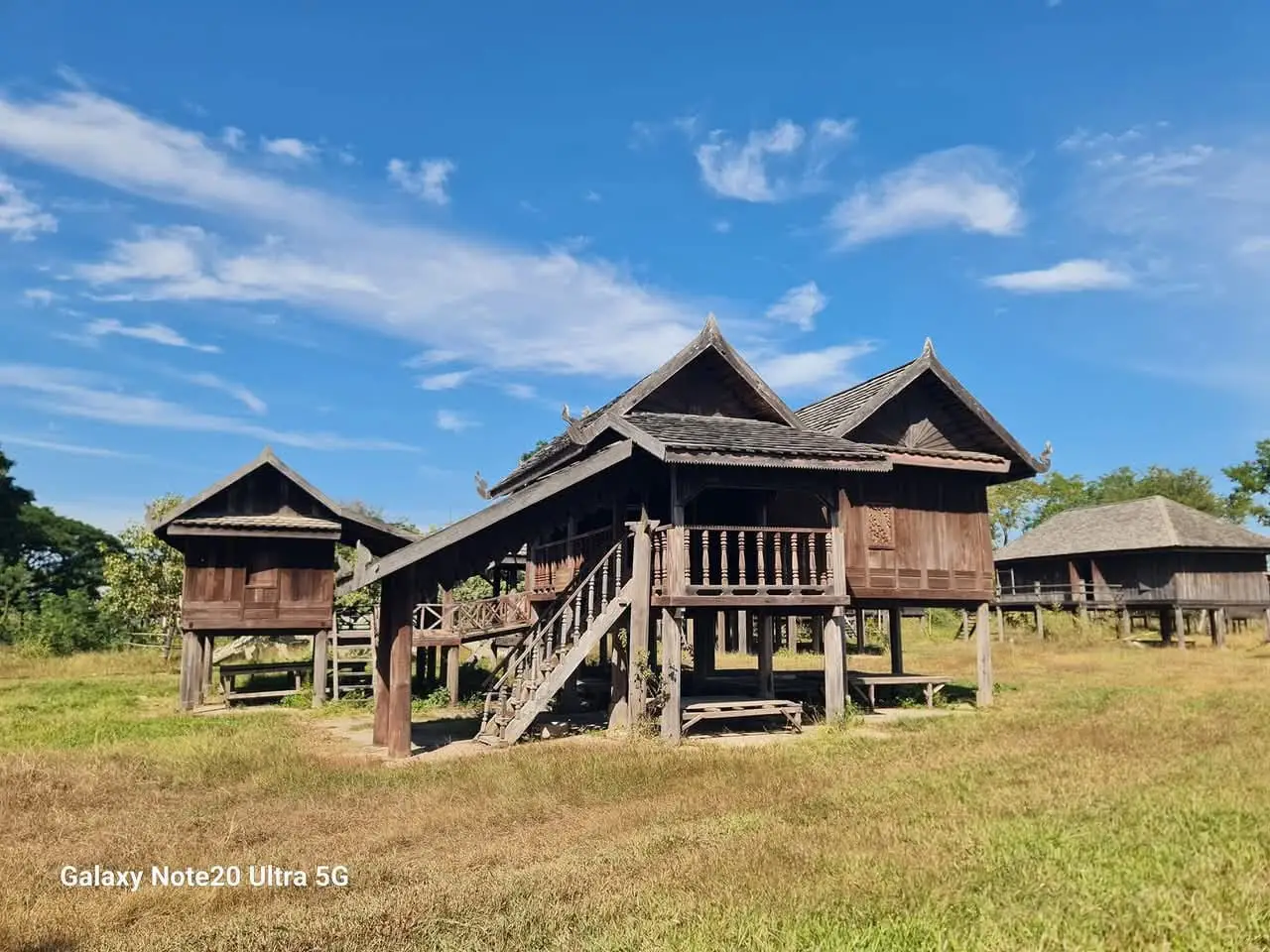
Phu Thai House in Nakhon Phanom Province, officially known locally as Renu Nakhon Phu Thai House, is a raised wooden house built to recreate the traditional architecture and former way of life of the Phu Thai people. It stands within the Renu Nakhon Phu Thai Cultural Center at Renu Nakhon Witthayanukul School in Renu Nakhon District, Nakhon Phanom Province. Inside, the house systematically displays traditional clothing, woven textiles, jewelry, weaving tools, household utensils, basketry, musical instruments, ancient books, weapons, and objects that reflect the life of the Renu Nakhon Phu Thai community. Through the building itself and artifacts donated collectively by local residents, visitors can learn about settlement history, vernacular architecture, language, beliefs, food, clothing, Phu Thai dance, and community life. Admission is free on school working days. Visitors should contact the school before traveling, particularly groups or those who would like a local guide or cultural interpreter.
The site is known by several names, including Ban Phu Thai, Ban Phu Tai, Ban Phu Thai, and Ban Phu Thai Renu. These spellings refer to the same ethnic group but vary according to academic usage, standard Thai spelling, local documents, and the community’s own preferred form. Academic writing commonly uses the Thai term “Phu Tai,” while residents of Renu Nakhon and many local records use “Phu Thai.” The form “Phu Thai” is also the spelling most familiar to the general public and is frequently used in tourism searches. Using the English name “Phu Thai House in Nakhon Phanom” therefore helps travelers locate the attraction, while the signs on the building and the center’s official local name continue to use “Phu Thai House” and “Renu Nakhon Phu Thai Cultural Center.”
Phu Thai House is not an antique residence relocated from a particular family home. It is a purpose-built structure designed to reproduce the traditional houses once used by the Phu Thai people of Renu Nakhon as closely as possible. The central idea was not merely to create a photographic backdrop, but to bring architecture and cultural objects together in one setting. This allows visitors to understand the environments in which individual tools were once used, which parts of the house supported different family activities, and how the building’s structure related to climate, agricultural life, and relationships within the household.
Construction of Phu Thai House began on March 23, 1992. The project grew from the determination of Renu Nakhon Witthayanukul School and local residents to establish a folk museum that would collect and preserve household objects used by earlier generations of Phu Thai people. Mr. Suphot Opromchop and Mrs. Uchanee Opromchop played major coordinating roles in raising funds. The project began with a donation of 80,000 baht, followed by additional contributions totaling 123,000 baht, together with another 20,375 baht generated through the presentation of Thai arts and culture in Egypt. The house was therefore created through the combined efforts of teachers, villagers, parents, students, and supporters of local heritage rather than as a privately developed tourism business.
Some of the timber used in construction came from a deteriorated school building formerly used for Scout camp activities. Reusing sound material from the old structure connected Phu Thai House to the history of the school and demonstrated careful use of available resources. The house is therefore more than a replica detached from its surroundings. It embodies memories of an earlier building, community labor, donated funds, and vernacular carpentry knowledge, all brought together to create a shared place of learning.
On June 3, 1995, the National Culture Commission designated Renu Nakhon Witthayanukul School as the Renu Nakhon District Cultural Center. From that point, Phu Thai House assumed a clearer role as a place for gathering and communicating the district’s knowledge. Responsibility for the site has passed to each successive school director, working with designated teachers, the school’s cultural program, students, and community networks. The school continues to include the conservation, revitalization, transmission, and care of Phu Thai culture and Phu Thai House within its institutional operations.
Current Caretaker responsibilities belong to Renu Nakhon Witthayanukul School under the administration of Mr. Itthiphon Phonliamhan, the school director, together with teachers and staff assigned to the house and the school’s cultural work. Because the attraction is located within a secondary school, visitors must respect the educational environment, avoid disturbing classes, stay out of unrelated school buildings, and follow staff instructions. Groups should telephone in advance so the school can arrange a coordinator and prepare the exhibition space appropriately.
The building is a raised wooden house with a tiled gable roof, hardwood flooring on the upper level, and an external staircase leading to a veranda. This form reflects key principles of northeastern Thai vernacular housing, which had to accommodate hot weather, the rainy season, and the daily routines of farming families. Raising the floor improves airflow, reduces moisture from the ground, provides protection from water and certain animals, and creates a shaded space beneath the house for work, rest, tool storage, and activities that do not require an enclosed room.
In the past, the space beneath a raised house was an essential working area rather than an unused void. Adults could sit there to weave baskets, repair tools, prepare agricultural materials, or talk with neighbors. Children used it as a place to play and to learn by observing adults at work. Depending on each household’s arrangement, domestic animals or certain types of equipment might also be kept nearby. At the Phu Thai House within the school, part of the underfloor area has been adapted as a room for the teachers responsible for the building. It therefore continues to support the use of the house, although its present function differs from that of a traditional residence.
The upper veranda serves as a transitional space between the outside world and the interior of the house. It is a place for receiving guests, resting, and preparing to enter the exhibition hall. The veranda shields the walls and doors from direct sun and rain while allowing household members to observe activity around the property. In the present museum arrangement, it also helps visitors appreciate the proportions of the wooden house and understand that traditional hospitality began not only after a guest entered a room, but from the staircase and raised platform onward.
Traditional Phu Thai houses include details associated with the group’s identity, such as a ventilation opening known locally as a “pong iam,” as well as doors and windows extending close to floor level. These features improve airflow and natural light while also demonstrating the builders’ knowledge of wood, climate, and spatial design. Phu Thai House should therefore be studied through both its overall form and its smaller elements, because every part developed from adaptation to the environment and inherited patterns of everyday life.
The upper floor contains a broad hall where objects are arranged by category, allowing visitors to see relationships among several kinds of artifacts at once. Such an open hall suited extended families and shared activities, including preparations for merit-making events, weaving, receiving guests, and communal sleeping arrangements according to the needs of each household. As a museum, the hall can accommodate display cases, musical instruments, tools, and objects of different sizes without losing the atmosphere of a vernacular home.
The exhibition does not focus only on expensive or prestigious objects. It places equal importance on items once used in ordinary daily life, because these seemingly simple things clearly explain household economies, domestic work, social relationships, and the skill of local craftspeople. Clay pots, baskets, sticky-rice containers, charcoal irons, clothing chests, weaving tools, and numerous vessels show that a single family depended on many kinds of knowledge, from cultivation and food preservation to dressmaking and the production of useful objects from locally available materials.
The books and documents section includes palm-leaf manuscripts, traditional folding books, printed works, and records concerning the Phu Thai people and Renu Nakhon studies. These items demonstrate that community knowledge was not transmitted through oral accounts alone. It was also recorded in writing and preserved as manuscripts, religious documents, local histories, and later scholarly studies. The palm-leaf manuscripts connect the house with Buddhist temples, which historically served as centers of education, manuscript copying, and literacy in northeastern Thai communities.
Displays of historic weapons, including swords and ivory-handled daggers, offer insight into travel, self-protection, social status, and metalworking skill in earlier times. Weapons were not associated solely with combat. Some were connected to leadership, trading journeys, and protection while goods were transported. In the past, some Phu Thai men of Renu Nakhon worked as traders and nai hoi, caravan leaders who moved buffalo herds or merchandise between towns. These artifacts therefore help explain a world extending far beyond the boundaries of the village.
Traditional musical instruments form another section that vividly reflects social life. The collection includes pong lang, phin, khaen, wot, phang hat, gongs, and long drums. Music created enjoyment, accompanied dance, supported ritual, and brought people together at community events. Viewing silent instruments reveals only their physical form, but linking them with Phu Thai dance, folk songs, and festival rhythms shows how music communicated emotion and expressed the identity of Renu Nakhon.
The khaen holds a particularly prominent place in Isan and Phu Thai musical culture because it can sustain continuous melodies and blend naturally with singing and dance. The phin adds rhythmic and melodic lines, while drums, gongs, and the phang hat regulate the dancers’ tempo. These instruments do not function separately; together they create a sound ensemble that supports bodily movement, welcomes guests, and shapes the atmosphere of merit-making celebrations. Anyone interested in Phu Thai dance should spend time observing the instruments, because they form the musical foundation that brings the choreography to life.
The textile and clothing section is among the most visually engaging parts of the collection, revealing the precision of Phu Thai weaving, dyeing, tailoring, and aesthetic judgment. Displays include silver-thread silk, mudmee silk, sin khen skirts, local dance costumes, and clothing associated with local nobles during the reign of King Rama V. Each textile is therefore more than an item of dress. It is evidence of labor, expertise, status, the occasions for which it was worn, and the community’s relationship with wider social change.
Phu Thai women are renowned for weaving, embroidery, and the careful coordination of clothing. These skills require learning from a young age, beginning with fiber preparation, dyeing, setting up the loom, controlling patterns, and finally tailoring the cloth into blouses or sin skirts. Weaving is therefore a production process that unites material knowledge, the mathematics of pattern, patience, and beauty. When textiles are worn for dances, merit-making ceremonies, or guest receptions, they publicly express the identity of the wearer.
The Renu Nakhon Phu Thai costume most commonly recognized by the public uses blue or indigo fabric, red trim, and silver ornaments. Women wear long-sleeved or fitted traditional blouses with sin skirts, styling their hair and adding flowers according to the occasion. Men wear local shirts and coordinating cloth suitable for performances or ceremonies. Indigo connects the costume to traditional dyeing knowledge, while red and silver create striking visual accents when dancers move together as a group.
Silver ornaments such as bracelets, earrings, silver belts, small silver boxes, lime containers, betel pouches, and ceremonial trays reveal both the skill of metalworkers and the relationship between possessions and their owners’ status. Silver could serve as personal adornment, stored wealth, and material for vessels used in rituals or hospitality. Displaying jewelry together with clothing helps visitors understand that the beauty of Phu Thai dress comes not from textiles alone, but from the coordination of color, shape, surface, and the movement of the wearer.
The household section contains a wide range of objects, including salang clothing chests, lamps, pleating presses, charcoal irons, clay pots, glazed jars, iron and wooden trunks, brassware, water ewers, and earthen gourds. These objects help visitors imagine homes before electricity, factory-made appliances, and modern storage systems. Lamps provided light, clothing was pressed with charcoal heat, and water and food were kept in containers selected according to the properties of each material.
Earthenware vessels and jars were vital for storing water, fermenting food, and preserving household ingredients. Their surfaces and forms reflect knowledge of temperature control, moisture, and protection from contamination. Brass pots and other metal utensils were durable and could also indicate a family’s means, while gourds and containers made from natural materials were light and readily available. Comparing different objects reveals that people selected materials according to function rather than relying on a single type of vessel for every purpose.
Basketry and wooden objects, including large woven storage baskets, carrying baskets, sticky-rice containers, rice boxes, bamboo steamers, weaving shuttles, and wooden trays, demonstrate the ability to transform bamboo and local timber into strong, lightweight, repairable equipment. Weaving requires an understanding of strip direction, thickness, flexibility, and patterns that distribute weight. Each object therefore represents knowledge of materials and experience accumulated through years of repeated practice.
Sticky-rice containers and bamboo steamers are directly connected to glutinous rice, the staple food of northeastern Thai communities. Steaming cooks the grains without making them waterlogged, while woven containers release excess steam and preserve the rice’s texture. Food preparation therefore depended on purpose-designed tools, not only on recipes. Viewing rice baskets and steamers alongside pots, jars, and other vessels allows visitors to understand the household food system as a complete process.
A weaving shuttle is a relatively small object, yet it is essential to the creation of cloth. It carries the weft repeatedly through the warp threads, while the weaver controls pressure, rhythm, and tension to produce an even textile. This small tool is consequently connected to sin skirts, shirts, ceremonial clothing, and family income. Displaying the equipment beside finished textiles allows visitors to understand the production process rather than seeing only the beautiful final product.
Most objects in every section of Phu Thai House were donated by teachers, students, parents, and residents of Renu Nakhon, while some were purchased with supporting funds. Donation has turned the museum into a repository of shared memory rather than a private collection detached from former owners. Each item was once genuinely used in a home, on a farm, during a merit-making event, or in a family ceremony. Bringing them together transformed personal possessions into evidence of the wider community.
The history of the Renu Nakhon Phu Thai people presented at the center is connected to population movements from Mueang Na Noi Oi Nu, Mueang Wang, and Mueang We on the left bank of the Mekong River before migration to areas on the right bank. Important leaders remembered in local narratives include Thao Ka, Phraya Kaeo, Chao Phet, and Chao Sai. Their movement through several areas before permanent settlement reflects the search for fertile, secure land suitable for establishing a new community.
The groups led by Chao Phet and Chao Sai crossed the Mekong and came ashore near present-day Ban Pho Sam Ton, or Ban Phra Klang Thung. They later moved toward the edge of Nong Han before returning to establish a community north of Phra That Phanom in the Dong Wai Sai Bo Kae area. The settlement was known in shortened form as Ban Dong Wai or Mueang We and was later elevated to the status of Mueang Renu Nakhon. This history explains why the name “Mueang We” still appears in businesses, accommodation names, cultural activities, and the memories of Renu Nakhon residents today.
In 1830, a proposal was submitted to establish Ban Dong Wai as Mueang Renu Nakhon. In 1844, King Rama III ordered that Ban Dong Wai, then under the jurisdiction of Nakhon Phanom, be formally established as Mueang Renu Nakhon and appointed Chao Sai as Phra Kaeo Komon, governor of the new town. The establishment of the town gave the Phu Thai community a clearer administrative structure and political status. Memories of Chao Phet and Chao Sai therefore remain central to the identity of Renu Nakhon.
Within the grounds of Renu Nakhon Witthayanukul School stands a monument to Chao Phet and Chao Sai, commemorating the leaders who guided the Phu Thai people to their settlement. Visitors to Phu Thai House can therefore connect museum objects more clearly with historical figures and events. The reconstructed house explains the lives of ordinary people, while the monument preserves collective memory of leadership and the founding of the town. Together, these elements make the school a learning site covering both social history and local political history.
Historically, the Phu Thai people of Renu Nakhon supported themselves through agriculture, handicrafts, and trade. Women played major roles in weaving, embroidery, food management, and household care. Some men farmed, traded, or traveled as nai hoi, leading caravans of animals and goods to different towns. This division of labor did not mean that every responsibility was rigidly fixed; rather, it reflected the range of skills and shared duties required of families in a society heavily dependent on human labor.
A raised house suited an agricultural way of life because different areas could change function with the seasons. During harvest, space might be used to store tools or produce. Between periods of fieldwork, household members could weave baskets, repair equipment, or make textiles. Verandas and platforms served for receiving guests and for work requiring good light, while interior rooms were used for rest, valuables, and family activities. The house was therefore simultaneously a residence, a small workshop, a storehouse, and a social space.
Relationships among family members can be understood through their shared use of space. Younger generations learned by observing and helping rather than through lessons separated from daily life. Children watched adults weave baskets, prepare silk thread, steam rice, care for animals, and receive guests. Knowledge was transmitted through participation. As a museum, Phu Thai House helps people today visualize the environment that once supported this kind of learning, even though modern households and family structures have changed.
The Phu Thai language is a major element of identity. It belongs to the Kra-Dai language family and is related to Lao, the Isan language, and the languages of several other Tai peoples. Although residents of Renu Nakhon use standard Thai at school and in official communication, Phu Thai continues to be spoken in families, everyday conversation, traditional events, songs, and performances. Language does more than communicate literal meaning; it preserves names for objects, forms of relationship, humor, musical rhythms, and ways of seeing the world that cannot always be translated completely into another language.
Visitors who hear Phu Thai should remain open to its distinctive sounds and rhythms. They should not mock the accent or regard the language as incomplete. Every local language has its own rules, vocabulary, and history. Preserving Phu Thai House should therefore go hand in hand with encouraging young people to speak the language confidently. Buildings and artifacts can retain their physical form, but much of their meaning will disappear without speakers who understand traditional terms and stories.
Renu Nakhon Phu Thai hospitality is renowned for the bai si su khwan blessing ceremony, wrist tying, Phu Thai dance, the communal evening meal known as pha laeng, and invitations for guests to share u, a fermented beverage traditionally consumed from a jar through long straws. These customs express goodwill as guests are welcomed into the community. They are not simply entertainment; they build relationships between hosts and visitors, helping guests feel safe, accepted, and included in the atmosphere of the occasion.
The bai si su khwan ceremony is associated with belief in the khwan, a vital spiritual essence or life force. Reciting the blessing and tying white threads around the wrist expresses a wish for stability, safety, health, and well-being. During a welcome ceremony, guests sit around the ceremonial bai si arrangement, listen to the invocation, and allow elders or hosts to tie threads around their wrists. Participation should be respectful. Guests should not immediately remove the thread in front of the person who tied it, nor treat a ceremony carrying deep emotional meaning for the community as a joke.
Pha laeng is a shared evening meal, often arranged for guest receptions. Eating together gives people who may not know one another an opportunity to talk, exchange stories, and experience local flavors. Menus vary with the season and the occasion, but the central values are the host’s generosity and the sharing of food. Travelers interested in this experience should contact the community or a local organization in advance, because pha laeng is not a regularly scheduled daily service within Phu Thai House.
U, sometimes described as traditional jar liquor, is a fermented beverage served in an earthen jar and shared through long drinking straws on certain social occasions. The expression “drinking u” therefore appears frequently in descriptions of Renu Nakhon culture. Participation depends on context, age, health, and personal choice. Visitors do not need to drink in order to show respect and may decline politely. At the same time, modern hosts should consider legal requirements, cleanliness, and hygiene when presenting this tradition.
Renu Nakhon Phu Thai dance is a graceful performing art and one of the most memorable cultural images of Nakhon Phanom Province. Male and female dancers may form pairs, move in a circle, and take turns presenting movements in the center according to the rhythm of the music. The performance involves far more than choreography alone. Clothing, music, smiles, hand positions, footwork, and group coordination all contribute to its character. The dance communicates the elegance, friendliness, and pride of the people of Renu Nakhon.
Phu Thai dance has roots connected with ritual, healing, belief, and communal celebration before developing into a performing art presented at provincial and national events. Today it can be seen during Phu Thai Day, Songkran, the Illuminated Boat Procession, the Phra That Phanom worship festival, official guest receptions, and school activities. Training young dancers ensures that transmission is not limited to older generations but continues within education and contemporary performance.
Phu Thai House is particularly valuable for understanding the dance because it preserves related costumes, ornaments, and musical instruments. Visitors can see more of the elements behind a performance than is possible during a few minutes on stage. A single textile requires long hours of weaving, silver objects depend on specialist craftsmanship, instruments require skilled musicians, and dancers must practice rhythm and coordination continuously. Understanding this labor prevents the dance from being viewed merely as an attractive image for photographs and reveals it instead as the product of an integrated community knowledge system.
Every February 14, the Renu Nakhon community, local authorities, and cultural networks jointly organize Phu Thai Day to present Phu Thai traditions, knowledge, food, handicrafts, clothing, and performance. The annual event has been held continuously since 1997 and has become known throughout Thailand. Travelers who would like to experience the culture in a lively festival atmosphere can plan a visit during the event, but should check the schedule and venue announced for each year before traveling.
Renu Nakhon Phu Thai culture is also deeply connected with Buddhism. Wat Phra That Renu is the town’s spiritual center and an important venue for community events. Phra That Renu was modeled on the former form of Phra That Phanom, though at a smaller scale. The temple also houses Phra Ong Saen, an important Buddha image. Combining Phu Thai House with Wat Phra That Renu allows travelers to encounter domestic life, ethnic arts and culture, and the community’s religious center within a single route.
Belief in Chao Pu Thala is another important part of Renu Nakhon identity. The Phu Thai people honor Chao Pu Thala as an ancestor and guardian of the town. His shrine stands west of the urban area and hosts an annual propitiatory ceremony. Ancestor reverence exists alongside Buddhism: the temple remains a center of teaching and merit-making, while the ancestral shrine connects residents with settlement history, collective security, and the memory of the town.
Visitors to Phu Thai House should therefore understand the culture as an interconnected system. The house explains family life; the temple expresses Buddhist faith; the Chao Pu Thala Shrine explains relationships with ancestors; textiles reveal labor and beauty; music and dance demonstrate communal expression; and food shows the use of everyday resources. When these elements are considered together, Renu Nakhon becomes more than a stop between Nakhon Phanom city and Phra That Phanom. It is a cultural town that deserves time and serious attention.
The food most widely associated with Renu Nakhon by visitors is khanom chin, locally called khao pun. Several long-established and community restaurants serve fresh rice noodles with a range of flavorful curries, vegetables, and accompaniments. Eating khanom chin after visiting Phu Thai House connects museum objects with living practice, because the displayed vessels, baskets, pots, and kitchen equipment all relate to the preparation and sharing of community food.
Phu Thai cuisine is not limited to dishes packaged as tourism products. It is grounded in sticky rice, seasonal vegetables, herbs, fish, meat, and ingredients from farms and fields. Household menus change according to season, means, and occasion. Merit-making and guest receptions require substantial quantities of food and cooperative labor. The kitchen is therefore another place where the knowledge of women, elders, and other family members is transmitted through tasting, observation, and participation.
A distinctive strength of Phu Thai House as a school museum is its role as a bridge between classroom learning and community knowledge. Students can study authentic objects, prepare reports, interview knowledge holders, practice guiding visitors, and join cultural conservation activities. This approach prevents local history from seeming remote. Students learn that their ancestors, families, language, and familiar household objects can be valuable sources of knowledge alongside material found in textbooks.
Phu Thai House also welcomes educational visits from schools, universities, government agencies, and groups interested in culture. A guided visit helps explain local names, the use of objects, and stories that exhibition labels may not fully communicate. Groups wishing to study a subject in depth should identify their interests in advance, such as weaving, music, Phu Thai dance, Renu Nakhon history, or household equipment, so the school can coordinate with an appropriate member of staff or local expert.
Main Areas Inside Phu Thai House can be understood as several important zones. The entrance and surrounding grounds provide views of the wooden architecture. The underfloor area follows, with part currently used as a room for the supervising teachers. The external staircase and upper veranda act as reception areas, while the main interior hall contains the principal displays. The school grounds also contain the monument to Chao Phet and Chao Sai, linking the site with the history of Renu Nakhon’s establishment.
The exhibition hall can be divided conceptually into sections for books and documents, historic weapons, traditional music, textiles and clothing, household objects, jewelry and valuables, and basketry and woodwork. This arrangement helps visitors explore according to their interests, but the connections between categories should also be considered. One object may relate to several activities: cloth, for example, is connected with domestic work, trade, ritual, and performance.
Visitors should allow at least 45 – 60 minutes to examine the building and exhibition. Guided visits or educational groups should reserve 1 – 2 hours. Walking quickly past the display cases reveals only the quantity of objects, whereas reading details, observing signs of use, and comparing different tools provides a deeper understanding of daily life. Students and children benefit from questions such as which modern appliance replaced a particular object, or why the house needed to be raised above the ground.
Photography should follow the caretaker’s instructions. Flash should not be used near documents, textiles, or light-sensitive materials. Visitors must not touch, move, or attempt to operate tools without permission. The wooden building and many artifacts are old or have undergone long periods of use, and repeated handling by large numbers of visitors can accelerate deterioration. Anyone intending to take photographs for education, media, or commercial projects should explain the purpose to the school in advance.
Because Phu Thai House is situated within an educational institution, visitors should dress appropriately, keep their voices at a suitable level, and avoid photographing students or staff without permission. They should not enter classrooms, offices, or other activity areas that are not open to visitors. Vehicles must be parked in designated places without obstructing access. Respecting these rules enables the school to share its cultural space with the public without disrupting its primary educational responsibilities.
Older visitors can explore the surroundings and lower level, but reaching the principal exhibition requires climbing an external staircase. People with limited mobility or wheelchair users should contact the school before traveling to arrange a suitable visit. As a raised wooden house modeled on traditional architecture, the building does not have the ramps or elevators found in many modern museums. Visitors who need assistance should be accompanied and should wear secure footwear, especially when surfaces are wet.
Morning is the most suitable time to visit, when temperatures are lower and staff coordination is generally easier. Visitors should avoid periods when the school is holding major activities, examinations, or large meetings. Phu Thai House is open Monday to Friday from 08:00 to 16:00 and is closed on Saturdays, Sundays, and public holidays. Calling in advance helps confirm that the display area will be available on the intended date.
The cool season from November to February is the most comfortable period for exploring Renu Nakhon. Mornings are pleasantly cool and suitable for continuing to Wat Phra That Renu or the Chao Pu Thala Shrine. February also includes the annual Phu Thai Day on February 14. During the hot season, visitors should travel in the morning and carry drinking water. In the rainy season, care is required on the stairs and paths around the wooden building because surfaces may be slippery.
Getting There from Nakhon Phanom city to Renu Nakhon Phu Thai House covers approximately 45 – 50 kilometers and takes around 50 – 60 minutes by car. The main route follows the road toward That Phanom District before turning toward Renu Nakhon as indicated by road signs. On reaching Renu Nakhon Municipality, continue to Renu Nakhon Witthayanukul School at 181 Moo 13, Mueang Mai Witthayanukul Road, Renu Subdistrict, Renu Nakhon District, Nakhon Phanom Province.
The reference coordinates for the Renu Nakhon Phu Thai Cultural Center are 17.056569, 104.678344. On arrival, visitors should inform the security guard or school office that they wish to visit Phu Thai House. They should not walk around the school looking for the building without first making contact, because the grounds contain classrooms and active student areas. Useful map search terms include “Renu Nakhon Phu Thai Cultural Center,” “Renu Nakhon Witthayanukul School,” and “Phu Thai House Renu.”
Travelers arriving at Nakhon Phanom Airport should use a rental car, hired vehicle, or prearranged transfer because there is no regular public transport service running directly to Phu Thai House throughout the day. A private vehicle also makes it easier to continue to Wat Phra That Renu, the Chao Pu Thala Shrine, Ban Na Bua Community, and Phra That Phanom. Passengers using hired transport should agree on the return time and fare before beginning the trip.
From That Phanom District, Renu Nakhon is approximately 15 – 20 kilometers away and the drive takes about 20 – 30 minutes. This makes the house easy to combine with Wat Phra That Phanom Woramahawihan. Travelers can begin the morning at Phra That Phanom, continue to Renu Nakhon for khanom chin, visit Phu Thai House, and pay respects at Phra That Renu before returning to Nakhon Phanom city or staying overnight in Renu Nakhon.
A half-day itinerary in Renu Nakhon can begin at Phu Thai House in the morning, allowing about 1 hour for the visit. Continue to Wat Phra That Renu and the Phu Thai Cultural Plaza, have lunch at a local khanom chin restaurant, and then visit the Chao Pu Thala Shrine. This route introduces traditional housing, daily-life artifacts, Buddhism, and ancestor belief while keeping travel distances between stops relatively short.
A full-day itinerary can add Ban Na Bua Tourism Community, Wat Phra That Marukkha Nakhon, and Wat Phra That Phanom Woramahawihan. The route connects Phu Thai culture with modern political history, faith associated with birthday stupas, and the community landscape of the Mekong Basin. Travelers should organize the day around the opening schedule of Phu Thai House, because many religious sites open daily while the cultural center inside the school follows school working days.
Restaurants around Renu Nakhon serve khanom chin, Isan food, noodles, khao piak rice-noodle soup, and grilled dishes. Khanom Chin Phitsamai is a well-known restaurant with clearly published contact information. Khoei Phu Thai Family Restaurant is near Wat Phra That Renu and serves local food. Choosing community restaurants distributes income locally and connects a visit with the present-day life of Renu Nakhon rather than limiting the experience to objects inside a museum.
Accommodation in Renu Nakhon consists mainly of small hotels and resorts suited to travelers seeking a quiet atmosphere and an early start for visiting surrounding attractions. Mueang We Garden Ville and Kong Inn publish public contact information and are located close to the cultural center. For other properties, visitors should confirm availability, prices, and current telephone details through the accommodation’s own channel or a booking platform, especially during Phu Thai Day, the Phra That Phanom worship festival, and long holiday periods.
Purchasing woven textiles, traditional clothing, food, and community products provides practical support for cultural conservation. Income from handicrafts gives weavers and producers an incentive to pass their skills to the next generation. Buyers should ask about materials, weaving methods, sources, and care instructions so they understand the value of each product. Excessive bargaining should be avoided because handwoven textiles require far more time and specialist skill than machine-made goods.
For international travelers, Phu Thai House offers a clear introduction to the cultural diversity within Thailand. The country does not possess a single uniform culture; it consists of different ethnic groups, languages, migration histories, and knowledge traditions. The Phu Thai people of Renu Nakhon maintain a distinct identity while also forming part of Thai society. Learning about them helps visitors avoid treating Isan culture as homogeneous and reveals longstanding connections among peoples on both sides of the Mekong River.
English explanations may not be available for every object. International visitors seeking detailed information should travel with a Thai-speaking companion or ask the school to arrange an interpreter or knowledgeable guide. Translation applications can help with basic labels, but names of tools, ritual terminology, and some cultural concepts require contextual explanation. Visitors should not handle objects in an attempt to investigate them independently and should instead ask the caretaker whenever they have questions.
The value of Phu Thai House does not rest solely on the physical age of the building. It also lies in the community process through which the house was constructed, objects were donated, repairs were undertaken, and the site has continued to function as a place of learning. Although built in 1992, the house can communicate a past far older than the structure itself because the objects, memories, and knowledge of donors have been organized within it. Conservation does not mean freezing everything unchanged; it means enabling younger generations to access, interpret, and use that knowledge with respect.
Major challenges for a community museum include maintaining a wooden building, controlling humidity, preventing insects, conserving textiles and documents, and keeping artifact information current. Visitors can assist by not touching objects, avoiding flash photography, keeping food and drinks outside the exhibition, and notifying caretakers if they notice damage. These small actions reduce the long-term burden of conservation.
Recording the stories of donors and former users is as important as preserving the objects themselves. Knowing only that an item is a basket or clothing chest explains its basic function. Learning who made it, when it was used, and how it was passed down gives the object life and connects it to family history. Collaboration with elders, weavers, musicians, and ritual specialists therefore allows Phu Thai House to become a knowledge repository deeper than a purely physical display.
Renu Nakhon Phu Thai House is suitable for school pupils, university students, historians, anthropologists, designers, musicians, weavers, and general travelers. Those interested in architecture can study the raised wooden structure; fashion enthusiasts can explore textiles and silverwork; food researchers can connect kitchen utensils with cooking methods; and performing-arts visitors can examine costumes, instruments, and Phu Thai dance. Although the site is not large, it opens multiple fields of study.
A visit should begin with the understanding that Phu Thai House is not an amusement park or merely a photographic set. It is a community educational space, and every object represents labor and memory. Taking time to read, listen, and ask polite questions provides more value than entering only to take photographs. Visitors should share the stories accurately, use the ethnic group’s name respectfully, and avoid presenting rituals or beliefs as exotic curiosities simply to attract attention.
Overall, Phu Thai House in Nakhon Phanom Province, or Renu Nakhon Phu Thai House, is a learning center that brings architecture, artifacts, history, language, textiles, music, food, belief, and everyday life together in one place. The house prevents objects from becoming detached from their original context, while the school and community ensure that the culture continues to be practiced, transmitted, and adapted. Travelers to Nakhon Phanom who wish to understand Renu Nakhon beyond a brief stop at a sacred stupa should make time for Phu Thai House and connect the visit with Wat Phra That Renu, the Chao Pu Thala Shrine, local restaurants, and nearby communities.
| Name | Renu Nakhon Phu Thai House, also known as Phu Thai House in Nakhon Phanom Province |
| English Name | Phu Thai House at Renu Nakhon Phu Thai Cultural Center |
| Place Type | Folk museum, ethnic cultural center, and learning site presenting the Phu Thai way of life |
| Location | Inside the Renu Nakhon Phu Thai Cultural Center at Renu Nakhon Witthayanukul School |
| Address | 181 Moo 13, Mueang Mai Witthayanukul Road, Renu Subdistrict, Renu Nakhon District, Nakhon Phanom 48170, Thailand |
| Coordinates | 17.056569, 104.678344 |
| Construction Began | 1992; construction began on March 23, 1992 |
| Architectural Form | Raised wooden house with a tiled gable roof, hardwood floor, external staircase, guest veranda, and upper exhibition hall |
| Highlights | Recreated Phu Thai architecture with exhibits on woven textiles, silverware, music, household objects, ancient books, basketry, and the history of Renu Nakhon |
| Main Areas and Zones | 1. Exterior grounds and architectural viewing area 2. Underfloor area and room for supervising teachers 3. External staircase and upper guest veranda 4. Books, palm-leaf manuscripts, and Renu Nakhon studies section 5. Historic weapons section 6. Traditional musical instruments section 7. Textiles, clothing, and Phu Thai dance costumes section 8. Household utensils and vessels section 9. Silverware, jewelry, and valuables section 10. Basketry, woodwork, and weaving tools section 11. Monument to Chao Phet and Chao Sai within the school grounds |
| Caretaker | Renu Nakhon Witthayanukul School under the administration of Mr. Itthiphon Phonliamhan, School Director, together with teachers and staff responsible for cultural work |
| Open Days | Monday – Friday; closed on Saturdays, Sundays, and public holidays |
| Opening Hours | 08:00 – 16:00 |
| Admission Fee | Free admission |
| Facilities | Parking within the school, school restrooms, and coordinating staff on working days. The upper exhibition floor is accessible only by an external staircase. |
| Recommended Visit Duration | Approximately 45 – 60 minutes, or 1 – 2 hours for an educational group with a guide or lecturer |
| Travel Information | Approximately 45 – 50 km from Nakhon Phanom city, taking about 50 – 60 minutes. A private or rental car is the most convenient option. On arrival, contact the school office or security staff before visiting. |
| Main Contact Numbers | Renu Nakhon Witthayanukul School: 042-579295, 042-579520 |
| Current Status | Operating as a learning center within the school. Advance coordination is recommended, especially for educational groups and international visitors. |
| Nearby Tourist Attractions | 1. Wat Phra That Renu, approximately 2 km, Tel. 042-579132, 081-2610930 2. Renu Nakhon Phu Thai Cultural Plaza, approximately 2 km 3. Chao Pu Thala Shrine, Renu Nakhon, approximately 3 km, Tel. 087-8629051 4. Ban Na Bua Tourism Community, approximately 8 km 5. Wat Phra That Marukkha Nakhon, approximately 14 km, Tel. 042-053155 6. Wat Phra That Phanom Woramahawihan, approximately 18 km |
| Nearby Restaurants | 1. Khanom Chin Phitsamai (Tae), approximately 2 km, Tel. 042-579764, 085-1843970 2. Khoei Phu Thai Family Restaurant, approximately 2 km, Tel. 086-4612634, 088-5649766 3. Phunsin Khanom Chin Renu, approximately 2 km 4. Kuai Chap Choi and Fresh Khao Piak Noodles, Renu Nakhon, approximately 2 km 5. Phailin Korean Barbecue, approximately 3 km, Tel. 093-3211275 |
| Nearby Accommodations | 1. Mueang We Garden Ville, approximately 2 km, Tel. 089-1819190 2. KONG INN Renunakhon, approximately 3 km, Tel. 085-7434491 3. Saengthip Resort, Renu Nakhon, approximately 3 km 4. The P.J. House Resort @ Renunakorn, approximately 4 km 5. Phet Phu Thai Resort, approximately 10 km, Tel. 082-8573836 |
Frequently Asked Questions (FAQ)
Q: Where is Phu Thai House in Nakhon Phanom located?
A: Phu Thai House, or Renu Nakhon Phu Thai House, is inside the Renu Nakhon Phu Thai Cultural Center at Renu Nakhon Witthayanukul School, 181 Moo 13, Renu Subdistrict, Renu Nakhon District, Nakhon Phanom Province.
Q: On which days and at what times is Phu Thai House open?
A: It is open Monday to Friday from 08:00 to 16:00 and closed on Saturdays, Sundays, and public holidays. Because it is located inside a school, visitors should telephone before traveling.
Q: Is there an admission fee for Renu Nakhon Phu Thai House?
A: Admission is free. Travelers and educational visitors may enter subject to the school’s rules.
Q: What can visitors see inside Phu Thai House?
A: The collection includes palm-leaf manuscripts, books, historic weapons, musical instruments, woven textiles, dance costumes, silverware, jewelry, household utensils, earthenware, basketry, and weaving tools.
Q: Who takes care of Renu Nakhon Phu Thai House?
A: Renu Nakhon Witthayanukul School manages the site under the administration of Mr. Itthiphon Phonliamhan, the school director, together with teachers and staff responsible for cultural work.
Q: How much time should visitors allow for Phu Thai House?
A: A general visit takes about 45 – 60 minutes. Educational groups or visitors who want a guided explanation should allow 1 – 2 hours.
Q: Can wheelchair users access the main exhibition inside Phu Thai House?
A: The principal exhibition is on the upper floor of a raised wooden house and is reached by an external staircase. Wheelchair users and people with limited mobility should contact the school in advance so an appropriate visit can be arranged around the lower level and exterior.
Q: Which attractions can be combined with a visit to Phu Thai House?
A: The visit can be combined with Wat Phra That Renu, Renu Nakhon Phu Thai Cultural Plaza, the Chao Pu Thala Shrine, Ban Na Bua Tourism Community, Wat Phra That Marukkha Nakhon, and Wat Phra That Phanom Woramahawihan.
 Category: ●Suburban Living
 Group: ●Village, Community
Last Update : 3 MonthAgo
 Last Update : 3 MonthAgo
 Click to Access the Navigation Map GPS

 Art, Culture and Heritage
 Historical Sites and Monuments(3)
 Landmarks and Memorials(2)
 Art, Craft Centres, Tradition(3)
 Museums(3)
 Educational Places
 Library(1)
 Places of Worship
 Temple(23)
 Church(1)
 Other Sacred Sites(11)
Village, Community(5)
 Nature and Wildlife
 National Parks and Marine Reserves(1)
 Dam, Reservoir, Lake(5)
 Waterfalls(2)
 River, Canal(3)
 Bays and Beaches(3)
 Other natural attractions(2)
 Entertainment and Agricultural
 Zoos and Aquariums(1)
 Farms, Parks and Ecotourism(2)
 Shopping
 Shopping and Night Market(1)
 Travel Articles, Recipes
 Travel Review, Food Review(1)


