
lovethailand home >Northeastern Travel Attractions >Nong Khai Travel Attractions > 20 Best Places to Visit in Nong Khai
TL;DR: 20 Best Places to Visit in Nong Khai.
20 Best Places to Visit in Nong Khai
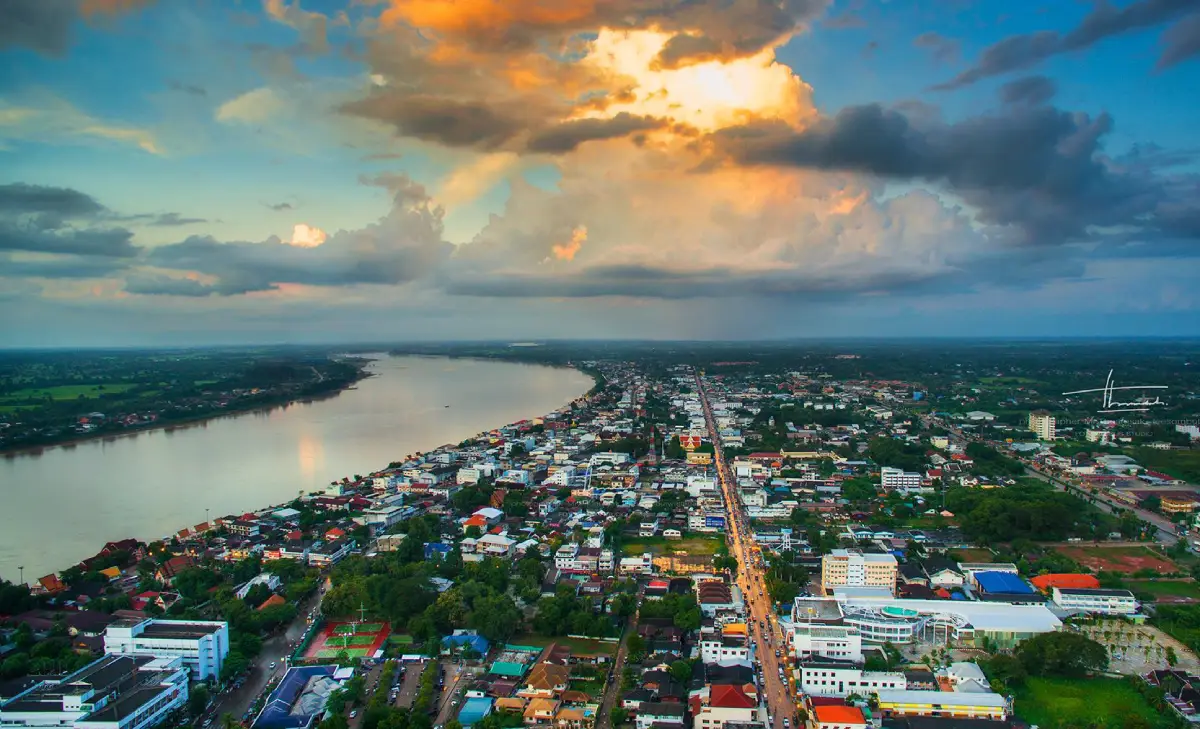
20 Best Places to Visit in Nong Khai – Popular Attractions in Northeastern Thailand Nong Khai is one of the most distinctive border provinces along the Mekong River in northeastern Thailand. Its geography, history, religion, trade, and local way of life are all closely connected to the river. Nong Khai city lies directly opposite Vientiane, the capital of the Lao People’s Democratic Republic, and serves as one of Thailand’s most important gateways to the central Mekong region through the First Thai–Lao Friendship Bridge. Beyond the city, the province stretches along the Mekong through ancient settlements, agricultural communities, riverside temples, mountains, caves, waterfalls, and scenic viewpoints. A trip to Nong Khai can therefore extend from Mueang Nong Khai to Tha Bo, Si Chiang Mai, Sangkhom, Phon Phisai, and other communities along the eastern Mekong corridor.
For first-time visitors, the province is often associated with Luang Pho Phra Sai at Wat Pho Chai, the revered Buddha image regarded as a spiritual symbol of Nong Khai; Tha Sadet Market on the Mekong riverfront; the First Thai–Lao Friendship Bridge; the monumental sculptures of Sala Kaeo Ku; Phra That Bang Phuan, which reflects the Buddhist artistic traditions of the Mekong region; and Phra That Nong Khai, also known as the submerged stupa in the Mekong. Farther west, Wat Hin Mak Peng, Wat Aranyabanphot, Wat Pha Tak Suea, Tham Din Phiang Cave, Than Thong Waterfall, and Than Thip Waterfall add forest monasteries, meditation heritage, panoramic viewpoints, caves, and natural attractions to the province’s cultural landscape.
Nong Khai’s historical importance reaches much further back than its modern role as a border province. Several communities along the Mekong once formed part of important settlement and trading networks connected with Vientiane, including Wiang Khuk, Pa Kho, and settlements around Tha Bo. The Mekong was not simply a political boundary; for centuries it functioned as a major route for travel, trade, migration, and cultural exchange. As a result, many temples and historic sites in Nong Khai reveal a natural blend of Lan Xang, Lao, Lanna, Ayutthaya, and Rattanakosin influences.
During the Rattanakosin period, Nong Khai became increasingly important during periods of conflict in the Mekong region, particularly after the Chao Anouvong conflict and later during the Haw campaigns of the 19th century. The Prap Ho Monument in the city preserves the memory of a period when the upper northeastern towns along the Mekong played major military and administrative roles. These events help explain how Nong Khai developed from a river settlement into one of Thailand’s most important border cities.
Religion is another central theme of travel in Nong Khai. The province includes important urban temples, forest monasteries associated with the Thai Forest Tradition, ancient stupas, sacred Buddha images, and religious sites closely connected with Naga beliefs. Luang Pho Phra Sai at Wat Pho Chai remains the spiritual focus of the provincial capital, while Luang Pho Phra Chao Ong Tue in Tha Bo represents an important legacy of Lan Xang Buddhist art. Wat Hin Mak Peng and Wat Aranyabanphot preserve the heritage of renowned meditation masters, while Wat Thai in Phon Phisai links Buddhist practice with local legends of the underwater Naga realm.
Naga beliefs are deeply woven into Nong Khai’s identity. Naga imagery appears at temples, public plazas, religious monuments, and along the Mekong riverfront. The annual Naga Fireball tradition around the end of Buddhist Lent also turns Phon Phisai and nearby Mekong communities into major destinations for faith-based tourism. Visiting during the festival period is very different from travelling at other times of the year, as large numbers of pilgrims and visitors gather along the river to make merit, join ceremonies, and wait for the phenomenon associated with the Mekong.
Nong Khai’s natural scenery becomes particularly impressive toward Si Chiang Mai and Sangkhom districts. Highway 211 follows the Mekong and offers a completely different atmosphere from the provincial capital, with mountains and forests on one side and the winding river forming the international boundary on the other. Important destinations along this route include Wat Pha Tak Suea, with its elevated views over the Mekong, Than Thong Waterfall, Than Thip Waterfall, and Tham Din Phiang Cave, where limestone formations and local Naga legends come together.
Food in Nong Khai also reflects the province’s borderland culture. Visitors will find Isan cuisine, Mekong River fish, and dishes influenced by Vietnamese communities, including naem nueang, Vietnamese steamed rice dumplings, khao piak sen, Vietnamese-style noodle soup, and baguette-based snacks. Tha Sadet Market and the riverfront neighborhoods are therefore not only places to shop for souvenirs but also excellent areas for understanding the cultural exchange that has long taken place through food and trade along the Mekong.
For an efficient itinerary, Nong Khai can be divided into several travel zones. The Nong Khai City Zone includes Wat Pho Chai, Sala Kaeo Ku, Tha Sadet Market, the First Thai–Lao Friendship Bridge, Phra That Nong Khai, the Prap Ho Monument, Naga Fountain Plaza, and Nong Khai City Pillar Shrine. The Wiang Khuk–Tha Bo Zone includes Wat Thepphon Pradittharam, Luang Pho Phra Chao Ong Tue, and Wat Weluwan. The Si Chiang Mai–Sangkhom Zone includes Wat Hin Mak Peng, Wat Aranyabanphot, Wat Pha Tak Suea, Tham Din Phiang Cave, Than Thong Waterfall, Than Thip Waterfall, and Khao Tao Waterfall. The Phon Phisai Zone is best known for Wat Thai and the local cultural landscape associated with Naga beliefs.
Travellers with only 1 day should concentrate on Nong Khai city, where Wat Pho Chai, Tha Sadet Market, Naga Fountain Plaza, the Prap Ho Monument, Sala Kaeo Ku, and the Friendship Bridge can be combined without long driving distances. With 2–3 days, Tha Bo, Si Chiang Mai, and Sangkhom can be added. A 4–5 day trip makes it possible to continue to Phon Phisai, waterfalls, caves, forest monasteries, and Mekong communities, providing a much more complete picture of Nong Khai than a short border-city visit alone.
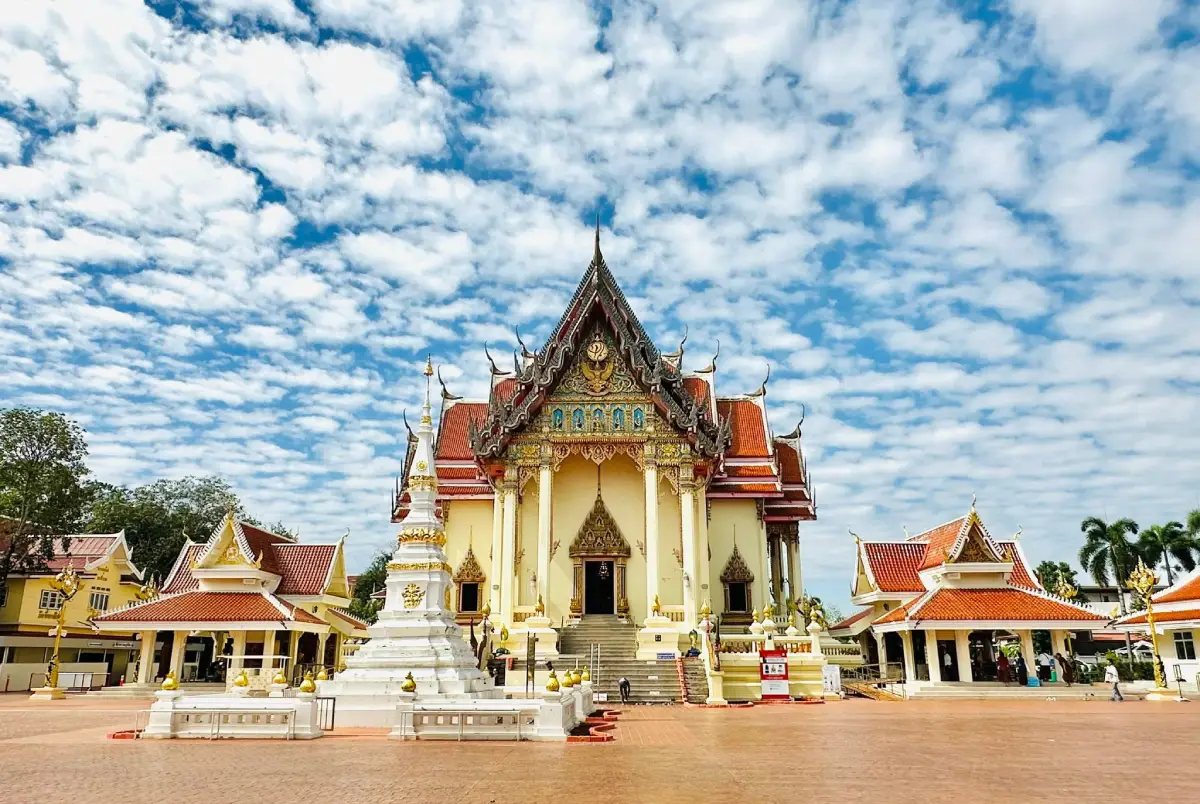
1. Wat Pho Chai is a third-class royal temple of the ordinary type located in Nai Mueang Subdistrict, Mueang Nong Khai District. It is one of the most important religious landmarks in Nong Khai because its ordination hall houses Luang Pho Phra Sai, the revered Buddha image regarded as a spiritual symbol of the province. The temple is significant not only as a place of worship but also as a site where Lan Xang history, Buddhist art, local traditions, and the collective memory of Nong Khai come together.
Highlights: Luang Pho Phra Sai, the ordination hall and interior murals, the legend of Phra Suk–Phra Soem–Phra Sai, the annual Songkran procession of Luang Pho Phra Sai, the Bun Bang Fai ceremony honoring Phra Sai, and the temple’s role as one of Nong Khai’s most important centers of faith.
The history of Wat Pho Chai is connected with earlier temples in the area and the development of Nong Khai during the Rattanakosin period. Local accounts say that the temple was once known as Wat Phi Phio and had at one time fallen into abandonment. It was later restored as Nong Khai became increasingly important as a major town along the Mekong. Phra Pathum Thewaphiban, also known as Bunma, the governor of Nong Khai, together with monks and local residents, helped revive the temple and establish it once again as an important religious center under the name Wat Pho Chai.
The spiritual heart of the temple is Luang Pho Phra Sai. According to tradition, the image is associated with three important Buddha images of the Lan Xang Kingdom: Phra Suk, Phra Soem, and Phra Sai. The story relates that three princesses of a Lan Xang ruler wished to have Buddha images created as representations of themselves. The three images were later enshrined in the Vientiane area before political changes in the Mekong region led to their transfer across the river to the Siamese side.
During the journey, tradition holds that Phra Suk was lost in the Mekong at a place remembered as Woen Suk or Woen Phra Suk, while Phra Soem and Phra Sai reached Nong Khai. Phra Soem was later taken to Bangkok and is now enshrined at Wat Pathum Wanaram, while Phra Sai remained in Nong Khai.
Another famous local story concerns the “broken cart” incident. When an attempt was made to transport Phra Sai to Bangkok, the cart carrying the sacred image reportedly became unable to continue and broke near Wat Pho Chai. Local people interpreted the event as a sign that Luang Pho Phra Sai wished to remain in Nong Khai. The image was therefore enshrined at Wat Pho Chai, where it has remained a major focus of local devotion ever since.
Luang Pho Phra Sai is a seated Buddha image in the Mara-Vijaya posture, cast in golden-colored metal and displaying the graceful proportions associated with Lan Xang Buddhist art. The serene facial expression and refined form distinguish it from many central Thai Buddha images, making the original image inside the ordination hall especially significant for visitors interested in Buddhist art history.
The ordination hall itself also contains murals and decorative work illustrating Buddhist stories, religious beliefs, and aspects of life in Mekong communities. Visitors should allow time to observe these details rather than simply making a brief offering, as the art provides valuable context for understanding the cultural relationship among Lan Xang, northeastern Thailand, and Nong Khai.
The temple’s most important annual event is the Luang Pho Phra Sai Songkran Festival in April. The sacred image is ceremonially brought down from the ordination hall and placed on a procession vehicle so that residents and visitors can pour water over it and pay respect. The event is one of Nong Khai’s major annual traditions. The temple is also associated with a rocket festival held in honor of Phra Sai, reflecting the close relationship between Buddhism, local faith, and northeastern Thai culture.
Wat Pho Chai is also an excellent starting point for exploring Nong Khai city. From here, visitors can continue to Tha Sadet Market, Phra That Nong Khai, Naga Fountain Plaza, the Prap Ho Monument, and Sala Kaeo Ku without complicated routing.
Getting There: Wat Pho Chai is located in Nai Mueang Subdistrict, Mueang Nong Khai District. It is open daily from 08:00–16:30. Admission is free. Visitors should dress respectfully and maintain a quiet atmosphere inside the ordination hall.
Map (GPS): https://www.google.com/maps/dir/?api=1&destination=17.884979,102.757300&travelmode=driving
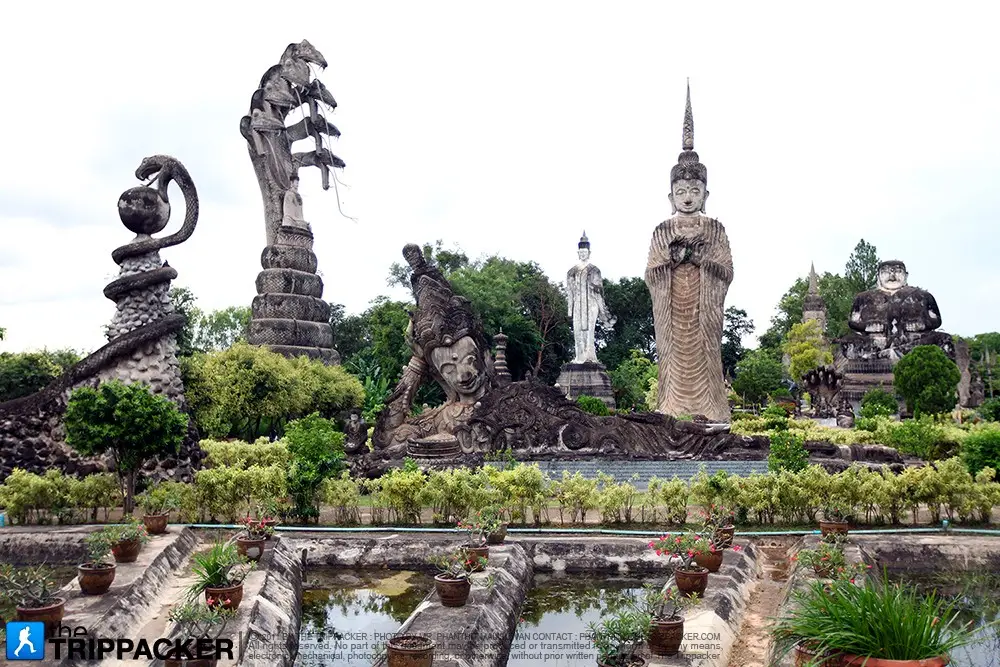
2. Wat Khaek (Sala Kaeo Ku), commonly known as Sala Kaeo Ku, is one of Nong Khai’s most unusual attractions. Located in Wat That Subdistrict, Mueang Nong Khai District, the extensive grounds are filled with monumental concrete and stucco sculptures depicting Buddhas, bodhisattvas, Hindu deities, Nagas, mythical figures, moral allegories, and symbols drawn from several religious traditions.
Highlights: Monumental sculptures, giant Naga figures, Hindu deities, Buddha images, the Wheel of Life, the Sala Kaeo Ku building, and the preserved body of Pu Bunluea Surirat, the creator of the site.
Sala Kaeo Ku is neither a conventional Buddhist temple nor simply a decorative sculpture garden. It is an ideological and spiritual landscape created from the worldview of Pu Bunluea Surirat, who developed the site in the late 20th century. His concept brought together teachings and symbols from different traditions to explore human life, sin and merit, karma, rebirth, and liberation.
The popular Thai nickname “Wat Khaek” developed because the complex includes many Brahmanic and Hindu images. However, a closer look shows that its symbolism is much broader, combining Buddhist teachings, Hindu deities, folk legends, and the creator’s own spiritual ideas. Sala Kaeo Ku is therefore better understood as a large allegorical sculpture park than as a temple belonging to a single religious tradition.
Many sculptures are monumental in scale, especially the groups of Nagas, Buddhas, and Hindu gods. Their exaggerated proportions are deliberate. Rather than aiming only for realism, the sculptures create a sense of a supernatural world and remind visitors of the smallness of human life when compared with karma and the endless cycle of rebirth.
One of the most thought-provoking areas presents sculptures representing stages of human life from birth and maturity to aging, illness, and death. Some forms appear strange or surreal, creating an experience that can be both entertaining and reflective. Visitors will understand the site better by reading the explanations and following the sequence of sculptures rather than treating it only as a photography location.
The main Sala Kaeo Ku building is also closely connected with Pu Bunluea Surirat. The upper floor is a place where followers pay respect to the preserved body of the site’s creator. Visitors should remain quiet and follow the rules of the building.
For photography, early morning or late afternoon is preferable because softer light and longer shadows reveal more detail in the sculptures. Midday can be very hot because much of the park is outdoors, so a hat and drinking water are useful.
Sala Kaeo Ku is only a short distance from central Nong Khai and can easily be combined with Wat Pho Chai, Phra That Nong Khai, Naga Fountain Plaza, and Tha Sadet Market. Visitors should allow approximately 1–2 hours to explore the site without rushing.
Getting There: Sala Kaeo Ku is located in Wat That Subdistrict, Mueang Nong Khai District. The outdoor sculpture park is open daily from 06:00–18:00. The third floor of the main building, where visitors pay respect to Pu Bunluea Surirat, is open from 07:00–17:00. Admission is 20 baht for adults, 10 baht for children, and 40 baht for foreign visitors.
Map (GPS): https://www.google.com/maps/dir/?api=1&destination=17.887087,102.782606&travelmode=driving
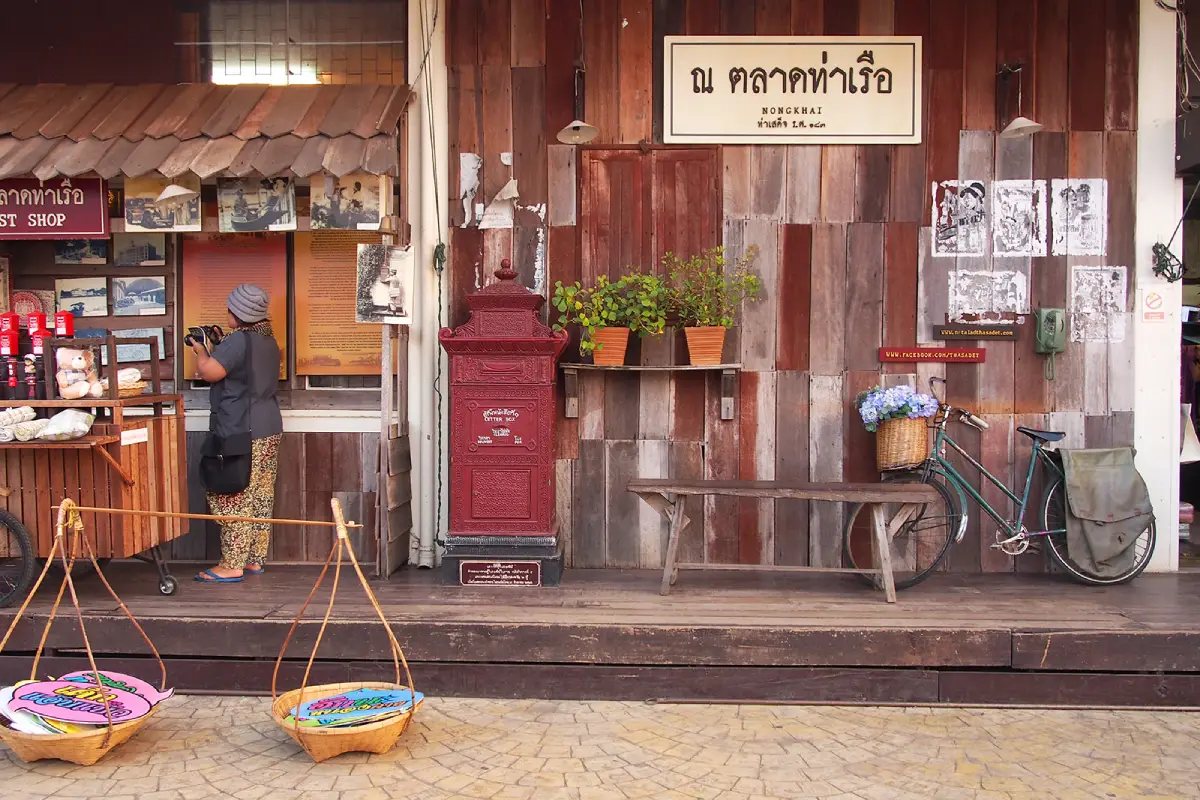
3. Tha Sadet Market is a Mekong riverfront market in the heart of Nong Khai that captures the atmosphere of a border trading city in one place. The area combines local shops, imported goods from neighboring countries, Isan food, Vietnamese cuisine, souvenirs, clothing, household goods, cafés, and riverside walkways overlooking the Mekong.
Highlights: Historic border market, Indochina-region goods, souvenirs, Vietnamese food, Mekong riverfront walkway, old commercial buildings, and the atmosphere of Thai–Lao border trade.
Historically, Tha Sadet Market was directly connected with river transportation. Before roads and bridges became dominant, the Mekong served as one of the city’s main transport routes. The riverbank therefore functioned as a pier, a trading point, and a meeting place for people from different communities. The market was previously known by names such as Tha Ruea Market and Indochina Market before the name Tha Sadet Market became widely established.
The name Tha Sadet is associated with a royal visit in the past, giving the market a historical dimension beyond shopping. Walking through the area, visitors can still see old shophouses, local businesses, and a wide variety of goods that reflect Nong Khai’s long-standing connection with regional Mekong trade.
Goods sold here include dried foods, local snacks, clothing, household products, souvenirs, jewelry, and border-trade merchandise. Restaurants around the market serve both Isan and Vietnamese dishes such as naem nueang, Vietnamese steamed rice dumplings, khao piak sen, and Vietnamese-style noodle soup, reflecting the influence of Vietnamese communities that settled in northeastern Thailand during different periods.
Another attraction is the riverfront promenade. Visitors can easily step out from the market toward the Mekong and look across to Laos. Mornings are quieter and well suited to food shopping, while late afternoon and evening offer breezes from the river and softer sunset light for walking and photography.
Tha Sadet Market is also close to Naga Fountain Plaza, Wat Lam Duan, and other sites along the city riverfront. Travellers staying in a riverside hotel can comfortably explore several nearby attractions on foot within half a day.
Those shopping for souvenirs should compare prices and check product quality carefully, especially for goods produced in different countries. Border markets offer merchandise at many quality levels, so shops that clearly display product details and prices are generally easier to evaluate.
Getting There: Tha Sadet Market is located around Meechai Road and the Mekong riverfront in Nai Mueang Subdistrict, Mueang Nong Khai District. It is open daily from 07:00–18:30. There is no admission fee.
Map (GPS): https://www.google.com/maps/dir/?api=1&destination=17.885747,102.747349&travelmode=driving
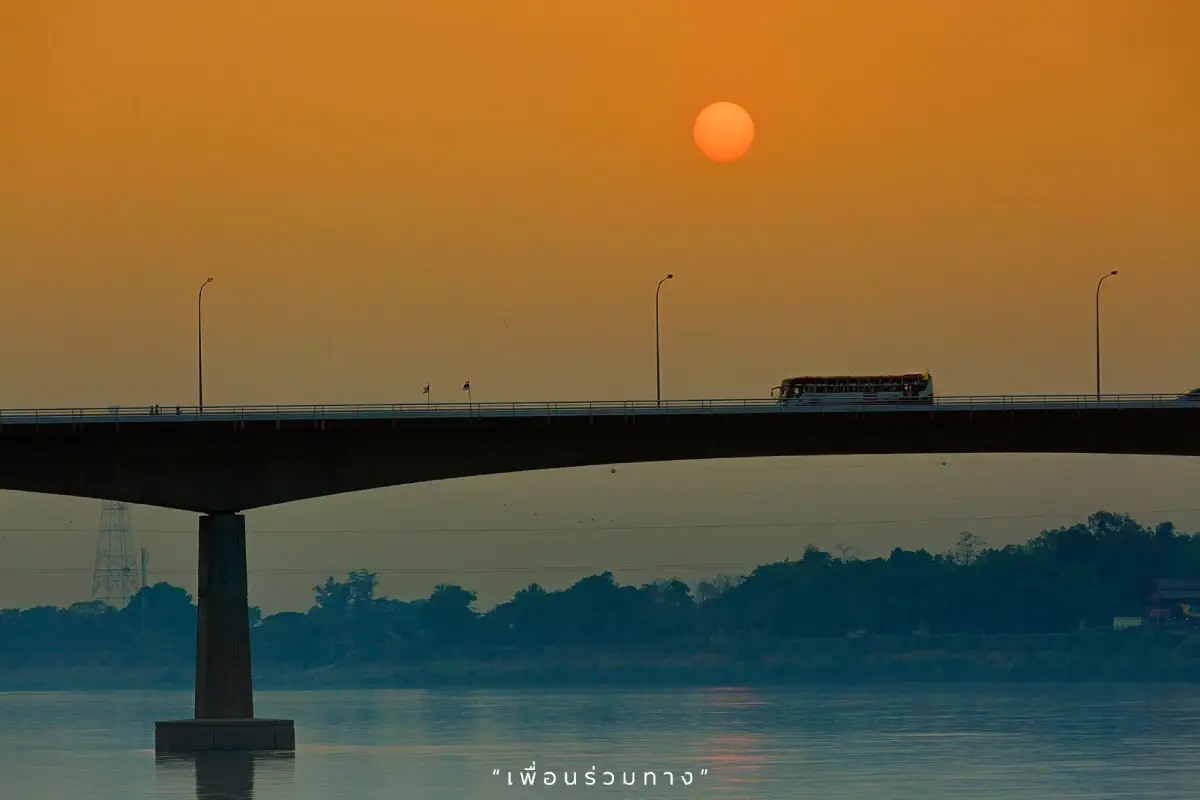
4. First Thai–Lao Friendship Bridge is one of the most recognizable symbols of Nong Khai. Spanning the Mekong River, it connects Thailand with the Lao People’s Democratic Republic and serves as a major route between Nong Khai and Vientiane.
Highlights: The first Mekong bridge linking Thailand and Laos, a viewpoint on the Thai side, international road and rail connections, and its major role in regional trade, transportation, and cross-border relations.
The opening of the bridge significantly changed Nong Khai’s role. Before its construction, travel between Nong Khai and Vientiane depended largely on ferries across the Mekong. Once the bridge opened, movement of residents, travellers, and goods between the two countries became much easier, strengthening Nong Khai’s position as a major gateway between Thailand, Laos, and the wider Indochina region.
The bridge accommodates both road traffic and railway infrastructure, with the railway track running along the central section. Rail connectivity has further increased Nong Khai’s importance as a transfer point between Thailand’s rail network and Laos, forming part of the broader development of international transportation links in the Mekong region.
Visitors who do not intend to cross the border can still stop on the Thai side to view the bridge and the Mekong. Late afternoon is particularly attractive, when softer light reveals the long structure extending across the river toward Laos.
Travellers planning to continue to Vientiane should check current passport requirements, visa rules, customs procedures, and border operating hours according to their nationality and mode of travel. These requirements can change and may differ between travellers.
The bridge can be combined with Nong Khai City Pillar Shrine, the Prap Ho Monument, Wat Pho Chai, and Tha Sadet Market. Travellers with a private vehicle can make a short sightseeing stop, while those crossing the border should allow additional time for immigration procedures and onward transport in Laos.
Getting There: The Thai-side viewing area is generally accessible daily from approximately 06:00–18:00, while the border checkpoint operates approximately 06:00–22:00. Viewing the bridge is free, while cross-border buses and vehicle services have separate charges.
Map (GPS): https://www.google.com/maps/dir/?api=1&destination=17.875384,102.716050&travelmode=driving
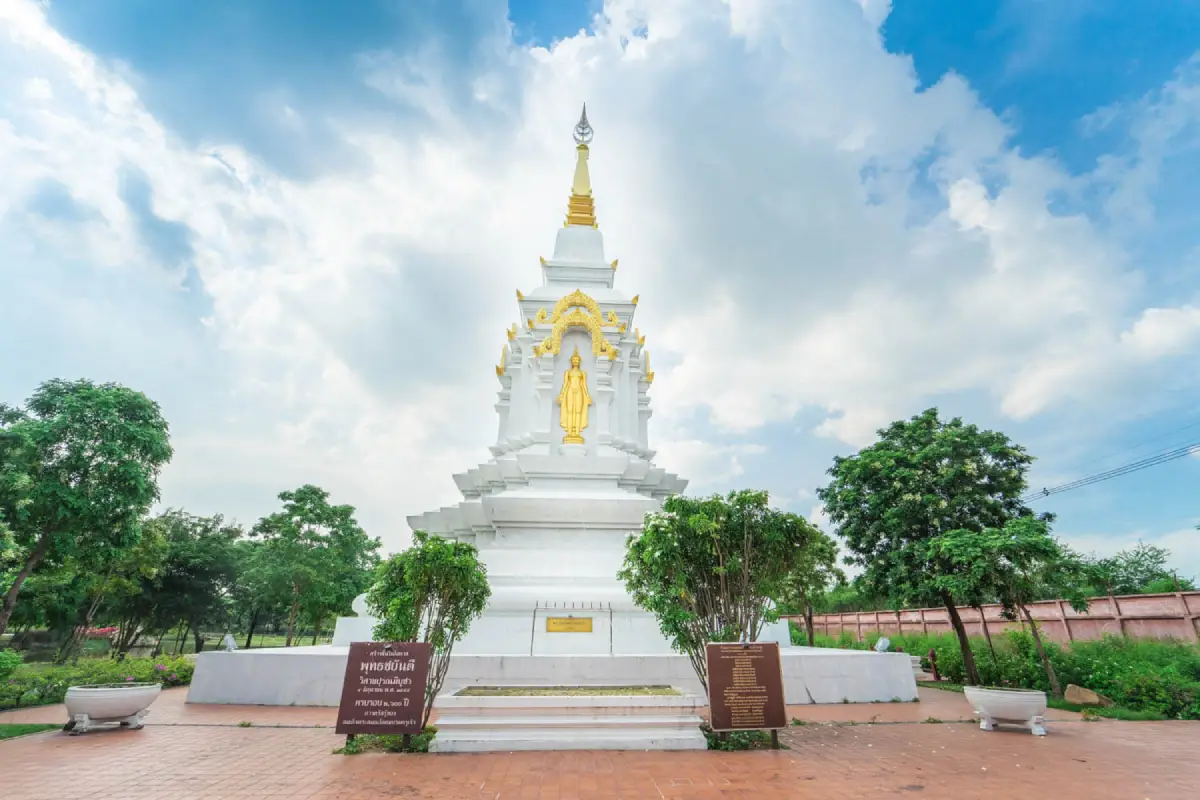
5. Phra That Bang Phuan is one of Nong Khai’s most important sacred stupas, located within Wat Phra That Bang Phuan in Mueang Nong Khai District. It is one of the province’s most significant historical Buddhist sites and provides a deeper understanding of religious development in the Mekong region. The stupa displays strong Lan Xang artistic influence and belongs to a broader network of sacred stupas across northeastern Thailand.
Highlights: Phra That Bang Phuan stupa, Lan Xang architecture, the Seven Great Places associated with the Buddha after Enlightenment, Muchalinda Pond, ancient religious structures, and the atmosphere of a historic temple complex.
The importance of Phra That Bang Phuan extends beyond the form of the main stupa. The temple forms part of an old sacred landscape in the Mekong region, with evidence of construction and restoration from different periods. This has created a complex in which architectural features and religious beliefs from several historical layers coexist.
The main stupa reflects Lan Xang artistic traditions that were centered around Vientiane and other Mekong towns. Its base, central body, and upper structure reflect the Buddhist concept of building a stupa as a sacred monument associated with relics and as a focal point for community faith.
Within the temple grounds is also the Seven Great Places, a group of sacred locations symbolically associated with the 7 weeks following the Buddha’s Enlightenment. This concept appears at several major Buddhist sites, but Phra That Bang Phuan is particularly notable for preserving these elements together within the temple grounds.
Muchalinda Pond is another important feature. It refers to the Buddhist story of the Naga king Muchalinda sheltering the Buddha from heavy rain after Enlightenment. The symbolism is especially meaningful in Nong Khai, where Naga beliefs already form a major part of the province’s religious and cultural identity.
While walking around the temple, visitors should notice that Phra That Bang Phuan is not an isolated monument. It forms the center of a larger group of religious structures that help reveal how ancient sacred landscapes were organized. Visitors should therefore allow enough time to explore the surrounding complex rather than stopping only at the main stupa.
Travellers interested in Buddhist heritage can combine Phra That Bang Phuan with Wat Pho Chai, Wat Thepphon Pradittharam, and Luang Pho Phra Chao Ong Tue. Together, these sites illustrate the evolution of Mekong Buddhist art from ancient stupas to important Buddha images and community temples in different parts of Nong Khai.
Getting There: Phra That Bang Phuan is open daily from 06:00–18:00. Admission is 20 baht. Visitors should dress respectfully and avoid climbing on or unnecessarily touching ancient structures.
Map (GPS): https://www.google.com/maps/dir/?api=1&destination=17.743166,102.681305&travelmode=driving
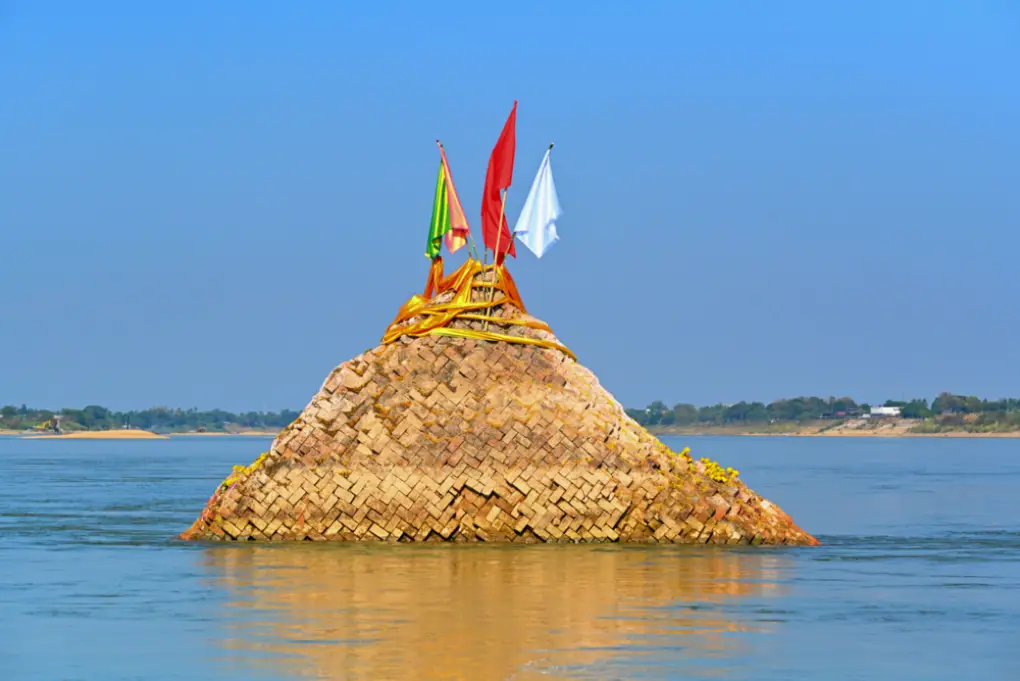
6. Phra That Nong Khai, also locally known as Phra That La Nong, is one of the most distinctive religious sites in Nong Khai. Unlike most ancient stupas that remain on land, the original monument now stands within the Mekong River after riverbank erosion caused the structure to collapse into the water. This unusual setting has made Phra That Nong Khai a powerful symbol of the relationship between local faith and the ever-changing forces of the Mekong.
Highlights: The original submerged stupa in the Mekong, the replica stupa on the riverbank, the legend of Phra That La Nong, Mekong River views, and the continuing religious traditions of riverside communities.
Phra That La Nong has long held spiritual importance for communities in Nong Khai. Local belief associates the monument with sacred Buddhist relics and with its role as a center of devotion for people living along the Mekong. The original stupa once stood safely on the riverbank, but the Mekong is a large and dynamic river whose current and shoreline can shift over time. Continuous erosion gradually weakened the surrounding land until the original stupa eventually collapsed into the river.
This history gives Phra That Nong Khai a character unlike most archaeological monuments. The remains of the original stupa are still directly affected by the seasonal level of the Mekong. During periods of lower water, more of the structure can become visible, while during the high-water season a larger portion may be submerged. The appearance of the site therefore changes from season to season.
A replica stupa has been constructed on the riverbank so that worshippers can pay respect without needing to travel by boat. The replica also allows the religious tradition associated with the original monument to continue even though the historic structure now lies in the river.
When water conditions and local services permit, boat trips may take visitors closer to the original stupa. Seeing it from the river provides a clearer sense of how far the present riverbank lies from the monument and helps visitors understand how the geography of the Mekong has changed over time.
Travellers interested in the history of Nong Khai should combine Phra That Nong Khai with Wat Pho Chai, Tha Sadet Market, and the city’s riverfront. Together, these sites reveal the close relationship among religion, commerce, urban development, and the Mekong River that has shaped Nong Khai for generations.
Morning is suitable for a quieter riverside atmosphere, while late afternoon offers softer light for photography. Those hoping to see more of the original stupa should pay attention to seasonal water levels, although actual river conditions vary from year to year.
Getting There: The riverside viewing area is generally accessible daily from approximately 07:00–17:00. Viewing from the shore is free. Visitors who wish to take a boat closer to the original stupa should check local river conditions and boat availability before travelling.
Map (GPS): https://www.google.com/maps/dir/?api=1&destination=17.898966,102.769191&travelmode=driving
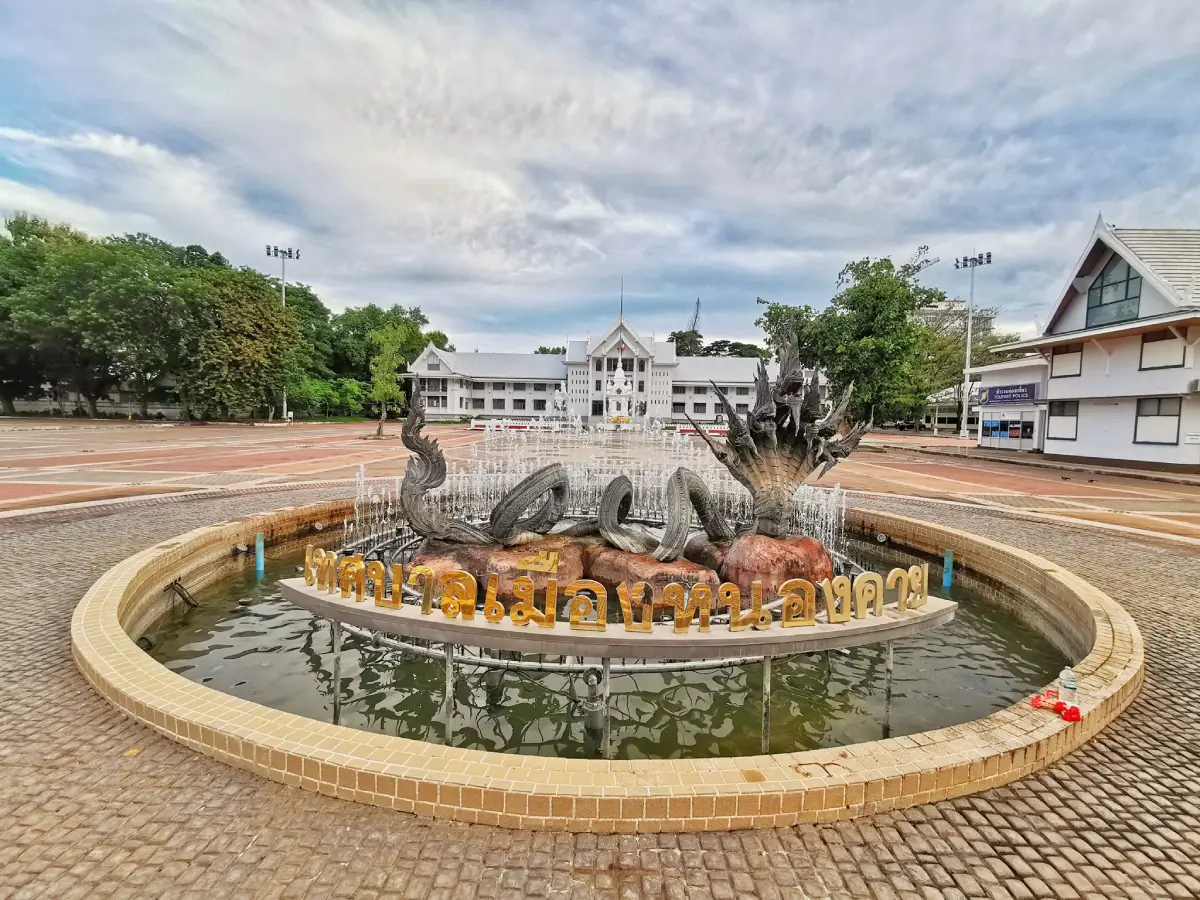
7. Prap Ho Monument is an important historical memorial in central Nong Khai, created to commemorate those who died during the Haw campaigns. The conflict formed an important chapter in the history of towns along the Mekong, when Nong Khai and the central Mekong region played significant roles in administration, military operations, and frontier security.
Highlights: Historic memorial, inscriptions commemorating the dead, public plaza, connection with the Haw campaigns, and a central location within walking distance of the Naga Fountain Plaza and Nong Khai riverfront.
During the 19th century, groups commonly referred to as the Haw moved into areas of Laos and the upper northeastern territories, creating instability in parts of the region. The Siamese government responded by sending military forces to restore control. Nong Khai and other Mekong towns consequently became strategically important bases for troop movements and military operations.
The monument was established to remember those who died during these campaigns. Its value therefore lies not simply in its appearance as a city landmark but in its role as a place of historical memory. Travellers who want to understand Nong Khai beyond temples and river views should include the monument in a city itinerary.
The site is an open public plaza in an easily accessible urban location. A visit does not require a great deal of time, but reading the inscriptions and considering the historical context makes the stop far more meaningful than using it only as a photography location.
From the monument, visitors can continue easily to Naga Fountain Plaza, Tha Sadet Market, Nong Khai City Pillar Shrine, and the Mekong riverfront. This makes it a useful stop on a historical and cultural walking route through central Nong Khai.
Morning is suitable for a quieter visit, while late afternoon allows travellers to continue directly to the riverfront for sunset without travelling far.
Getting There: The Prap Ho Monument is located in central Nong Khai. The public plaza is accessible throughout the day and there is no admission fee.
Map (GPS): https://www.google.com/maps/dir/?api=1&destination=17.879659,102.740536&travelmode=driving
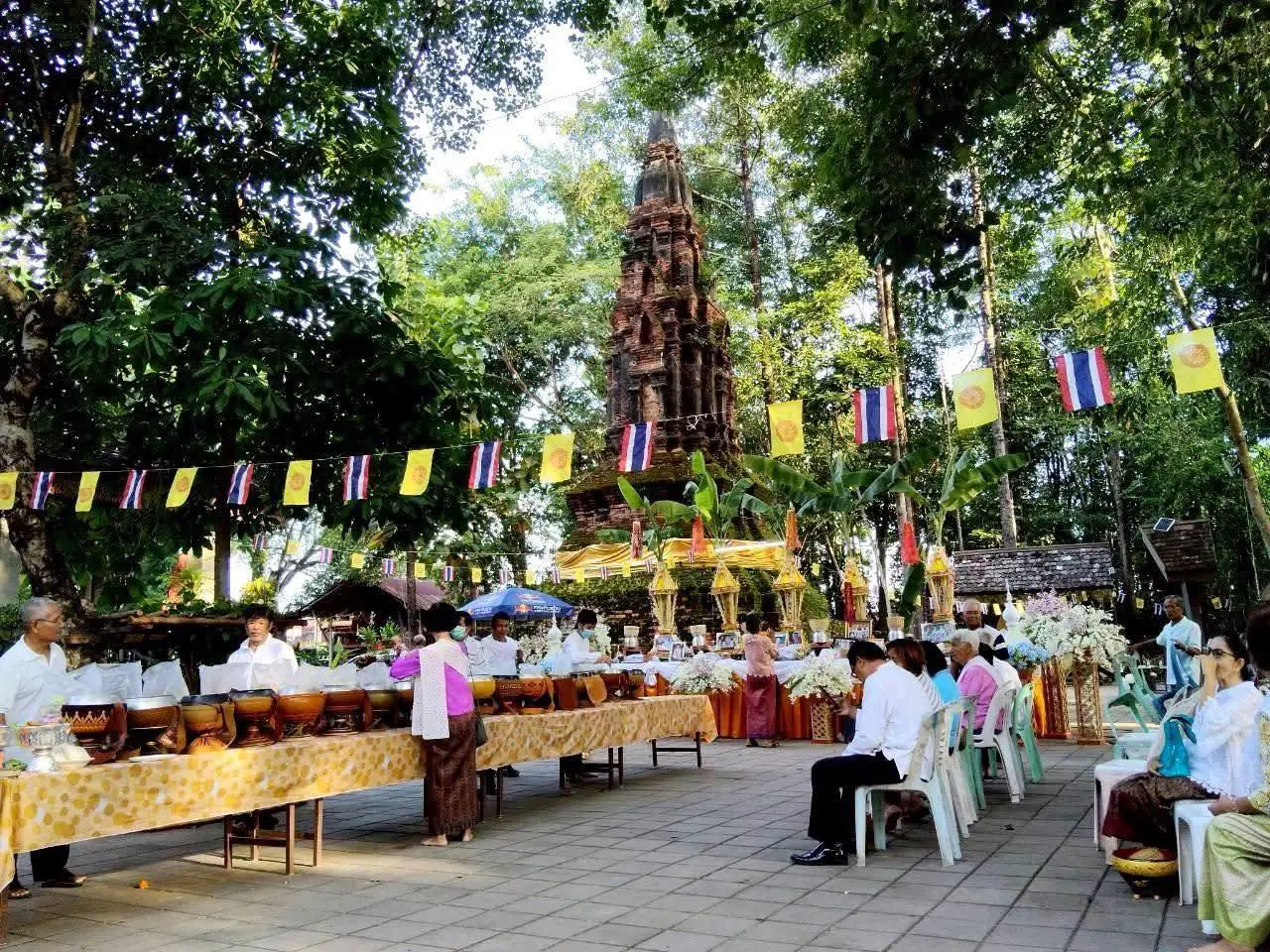
8. Wat Thepphon Pradittharam is an old temple and important archaeological site in the historic Wiang Khuk community of Mueang Nong Khai District. The area forms part of an ancient Mekong settlement connected with Vientiane and long-distance travel networks along the river. Within the temple grounds are ancient stupas, a wooden viharn, boundary stones, historic objects, and traces of artistic traditions from several periods, making this one of the most rewarding sites for visitors interested in the deeper history of Nong Khai.
Highlights: Two ancient stupas, Lan Xang art with Lanna and Ayutthaya influences, a wooden viharn, historic boundary stones, an ancient well, Wiang Khuk city-pillar traditions, and archaeological traces of an old Mekong settlement.
Wiang Khuk is an old community located in an area well suited to settlement near the Mekong and smaller waterways. Its riverside location offered advantages for transportation, commerce, agriculture, and contact with Vientiane across the river. In earlier periods, the Mekong did not function as a rigid national border in the modern sense but as a route connecting communities and cultures.
Wat Thepphon Pradittharam therefore offers a glimpse of Nong Khai before the age of modern highways and the Friendship Bridge. Its religious structures reveal artistic exchange among several regions, including Lan Xang, Lanna, and Ayutthaya. The ancient stupas should not be viewed as products of a single isolated artistic tradition, but rather as evidence of continuing contact among craftsmen and communities throughout the Mekong basin.
The ancient stupas are among the most important elements to observe. Their forms display characteristics of Lan Xang architecture while also revealing influences from neighboring artistic traditions. Alterations and restorations carried out over different periods have left several historical layers visible within the site.
Some of the boundary stones are also particularly interesting because they appear to incorporate reused materials or older artistic fragments. This illustrates how religious communities in the past did not always construct every component from new materials; older architectural or sculptural elements could be incorporated into later religious settings.
The wooden viharn creates an atmosphere very different from that of a modern concrete temple. Its timber structure and craftsmanship reflect local building traditions, while the ancient well and the Wiang Khuk city-pillar area further indicate that the temple was closely connected with the wider settlement and urban structure rather than standing in isolation.
Visitors interested in archaeology should avoid moving bricks, stones, or historic fragments. Even objects that appear ordinary may form part of the archaeological evidence of the site, so observing and photographing them in their original locations is more appropriate.
Wat Thepphon Pradittharam can be combined with Phra That Bang Phuan and Luang Pho Phra Chao Ong Tue when travelling toward Tha Bo. This route is particularly useful for travellers who want to trace the development of religion and artistic traditions along the Mekong from ancient settlement sites to major Lan Xang Buddha images.
Getting There: The temple is located in Wiang Khuk, Mueang Nong Khai District. It is open daily from 08:00–17:00. Admission is free. Visitors should dress respectfully and avoid unnecessarily touching archaeological objects.
Map (GPS): https://www.google.com/maps/dir/?api=1&destination=17.798285,102.669029&travelmode=driving
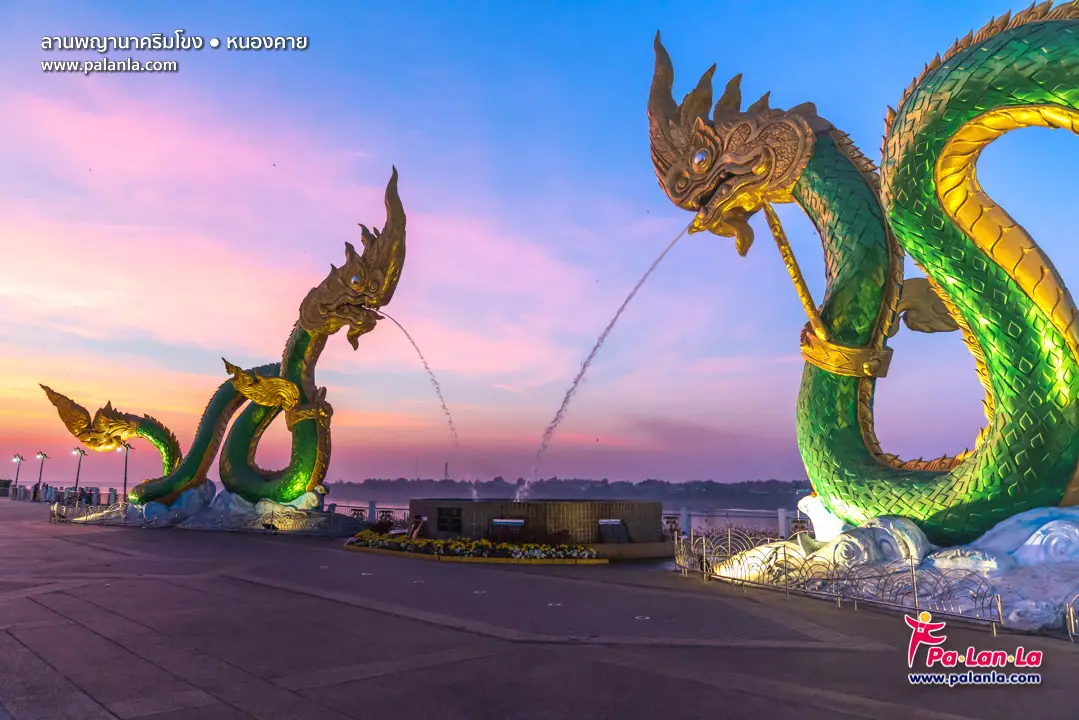
9. Naga Fountain Plaza is a Mekong riverfront landmark that clearly expresses Nong Khai’s identity as a city closely associated with Naga beliefs. Located in the city center near Tha Sadet Market and Wat Lam Duan, the plaza features large Naga sculptures, fountains, an open activity area, and a riverside promenade with broad views across the Mekong toward Laos.
Highlights: Monumental Naga sculptures, fountains, riverside activity plaza, views toward Laos, walking and exercise areas, and sunset scenery along the Mekong.
Nagas play an important role in the culture of Nong Khai and the wider Mekong region. Beliefs surrounding these serpent beings are closely connected with rivers, water, fertility, Buddhism, and the protection of communities. Naga images therefore appear frequently at temples, stupas, staircases, religious works of art, and public spaces throughout the province.
The Naga sculptures at this plaza are more than urban decoration. They directly represent the cultural identity of Nong Khai. Viewed against the Mekong River, the sculptures visually connect the province’s religious beliefs with the geography that has shaped local life.
The open plaza provides an unobstructed view of the river and Laos on the opposite bank. Late afternoon is the most pleasant time to visit because the sunlight becomes softer, breezes move in from the Mekong, and the area begins to fill with local residents walking, exercising, or relaxing.
The plaza is also easily connected with Tha Sadet Market. Travellers can shop at the market in the afternoon and then walk to the riverfront to see the Naga sculptures and sunset without needing a vehicle, making this one of the easiest walking routes in central Nong Khai.
During festivals and major city events, the riverfront may be used for cultural performances, traditional celebrations, and community activities. It therefore functions not simply as a public park but as an important shared civic space.
For a relaxed afternoon, visitors can combine Naga Fountain Plaza, Tha Sadet Market, the Prap Ho Monument, and the Mekong riverfront before having dinner in the market or riverside district. The route is suitable for families, older travellers, and photographers.
Getting There: Naga Fountain Plaza is located on the Mekong riverfront within Nong Khai municipality near Tha Sadet Market. It is open daily from 08:00–17:00 and there is no admission fee.
Map (GPS): https://www.google.com/maps/dir/?api=1&destination=17.879093,102.740770&travelmode=driving
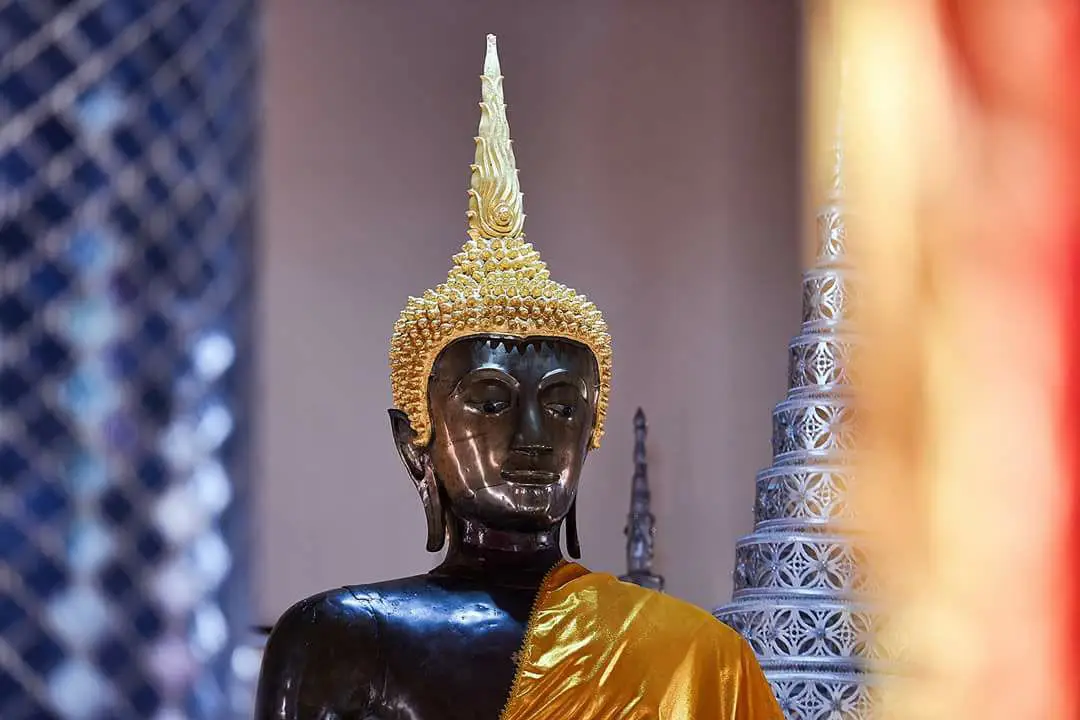
10. Luang Pho Phra Chao Ong Tue is enshrined at Wat Si Chomphu Ong Tue in Ban Nam Mong, Nam Mong Subdistrict, Tha Bo District. The large Buddha image is highly important for its Buddhist significance, Lan Xang artistic style, historical associations, and the continuing faith of communities on both sides of the Mekong.
Highlights: Large Mara-Vijaya Buddha image, Lan Xang art, historical connection with the reign of King Setthathirath, stone inscriptions, Phra Phuttha Sihing, ancient stupas, and local traditions of worshipping Ong Tue.
The Buddha image is seated cross-legged in the Mara-Vijaya posture. Its lap measures approximately 3.29 meters across and the image stands around 4 meters high. Its scale within the viharn gives visitors an immediate impression of dignity and spiritual presence.
According to inscriptional evidence, the image was created in 1562 during the reign of King Setthathirath of Lan Xang, a ruler who played a major role in supporting Buddhism and constructing religious sites throughout the Mekong region. This was a period when Vientiane was growing in importance and networks of temples and sacred Buddha images extended across both sides of the river.
The term “Tue” is associated with an old unit of weight and reflects the enormous quantity of metal required to cast the image. Historical accounts describe the use of several metals and a construction process lasting several years, demonstrating the scale of craftsmanship involved.
The temple also contains other important religious and historic objects, including Phra Phuttha Sihing, Lan Xang-style Buddha images, ancient stupas, and stone inscriptions. These allow visitors to understand the wider historical context of the temple rather than focusing only on the principal Buddha image.
The art of Luang Pho Phra Chao Ong Tue reveals the historical relationship among Tha Bo, Nong Khai, and Vientiane. Both the style of the Buddha image and the story of its creation belong to the broader Lan Xang cultural sphere that extended along the Mekong long before modern national borders were established.
Wat Si Chomphu Ong Tue has remained an important center of faith for the surrounding community. Residents and pilgrims continue to visit the temple to worship, make merit, seek blessings, and participate in Buddhist festivals and temple traditions.
Travellers following Highway 211 from Nong Khai city can combine Wat Thepphon Pradittharam, Phra That Bang Phuan, Luang Pho Phra Chao Ong Tue, and Wat Hin Mak Peng in sequence. This creates a particularly rich western Nong Khai route focused on Buddhist history and Mekong cultural heritage.
Getting There: Wat Si Chomphu Ong Tue is located in Ban Nam Mong, Nam Mong Subdistrict, Tha Bo District, along the route from Nong Khai via Highway 211. It is open daily from 08:30–16:30. Admission is free.
Map (GPS): https://www.google.com/maps/dir/?api=1&destination=17.876640,102.575373&travelmode=driving
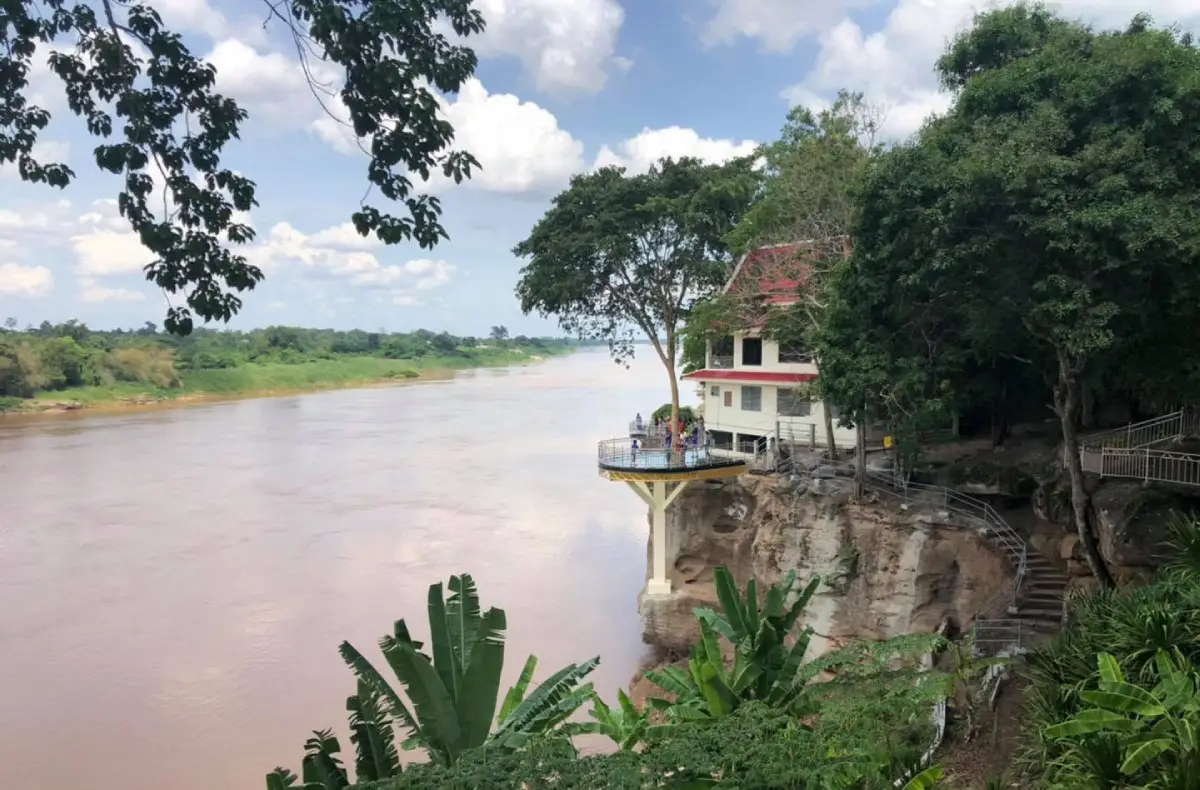
11. Wat Hin Mak Peng is located in Ban Thai Charoen, Phra Phutthabat Subdistrict, Si Chiang Mai District. It is an important Dhammayut forest monastery closely associated with Luang Pu Thet Thetsaransi, a respected meditation master in the lineage of Luang Pu Mun Bhuridatta. The temple developed into a peaceful riverside meditation center where forest, silence, simplicity, and contemplative practice remain central to the atmosphere.
Highlights: Luang Pu Thet museum stupa, meditation areas, forest monastery beside the Mekong, the natural rock formations associated with the temple’s name, a peaceful wooded setting, and views toward Laos across the river.
What distinguishes Wat Hin Mak Peng from many conventional sightseeing temples is its emphasis on stillness rather than monumental architecture. Parts of the grounds remain forested, with walking paths, monks’ residences, meditation areas, and simple religious structures dispersed throughout the natural landscape. This setting reflects the principles of the Thai Forest Tradition, in which nature itself forms part of the discipline of mindfulness, meditation, and a restrained way of life.
Luang Pu Thet Thetsaransi was one of the highly respected meditation masters associated with the forest tradition and played an important role in teaching Buddhist practice. Because of his connection with Wat Hin Mak Peng, the temple became more than a local monastery. Disciples and visitors interested in Buddhist meditation continue to come here to learn about his life, teachings, and approach to practice.
Areas connected with Luang Pu Thet have been developed as places of remembrance and learning, including a stupa, museum displays, and objects associated with his monastic life. These elements make the temple particularly rewarding for visitors who see Buddhist sites as places of study and reflection rather than only places for worship or photography.
The name “Hin Mak Peng” is associated with natural rocks beside the Mekong whose shape was compared with the weight used in an old balance scale. In local language, the word “mak” can refer to something rounded or fruit-like, while “peng” is connected with the form of an old weighing weight. The temple’s name therefore reflects both local vocabulary and the physical landscape of the riverbank.
Standing near the Mekong within the temple grounds helps visitors understand why the area was well suited to meditation. The river flows directly in front of the monastery, while the Lao landscape lies across the water. The quiet setting, removed from the busier provincial capital, reinforces the traditional forest-monastery ideal of seclusion and contemplation.
Travellers following Highway 211 from Nong Khai toward Sangkhom can use Wat Hin Mak Peng as a major stop before continuing to Wat Aranyabanphot, Wat Pha Tak Suea, and nearby natural attractions. The route works particularly well as a “Dhamma along the Mekong” journey combining forest monasteries, meditation heritage, river scenery, and natural landscapes.
Visitors should keep noise to a minimum, dress respectfully, and avoid disturbing areas where monks or lay visitors are meditating. Those who wish to spend time sitting quietly or studying Buddhist teachings should allow more than a brief sightseeing stop.
Getting There: Wat Hin Mak Peng is located in Ban Thai Charoen, Moo 4, Phra Phutthabat Subdistrict, Si Chiang Mai District, along Highway 211 on the Nong Khai–Si Chiang Mai–Sangkhom route. It is open daily from 08:30–16:30. Admission is free.
Map (GPS): https://www.google.com/maps/dir/?api=1&destination=17.983333,102.428476&travelmode=driving
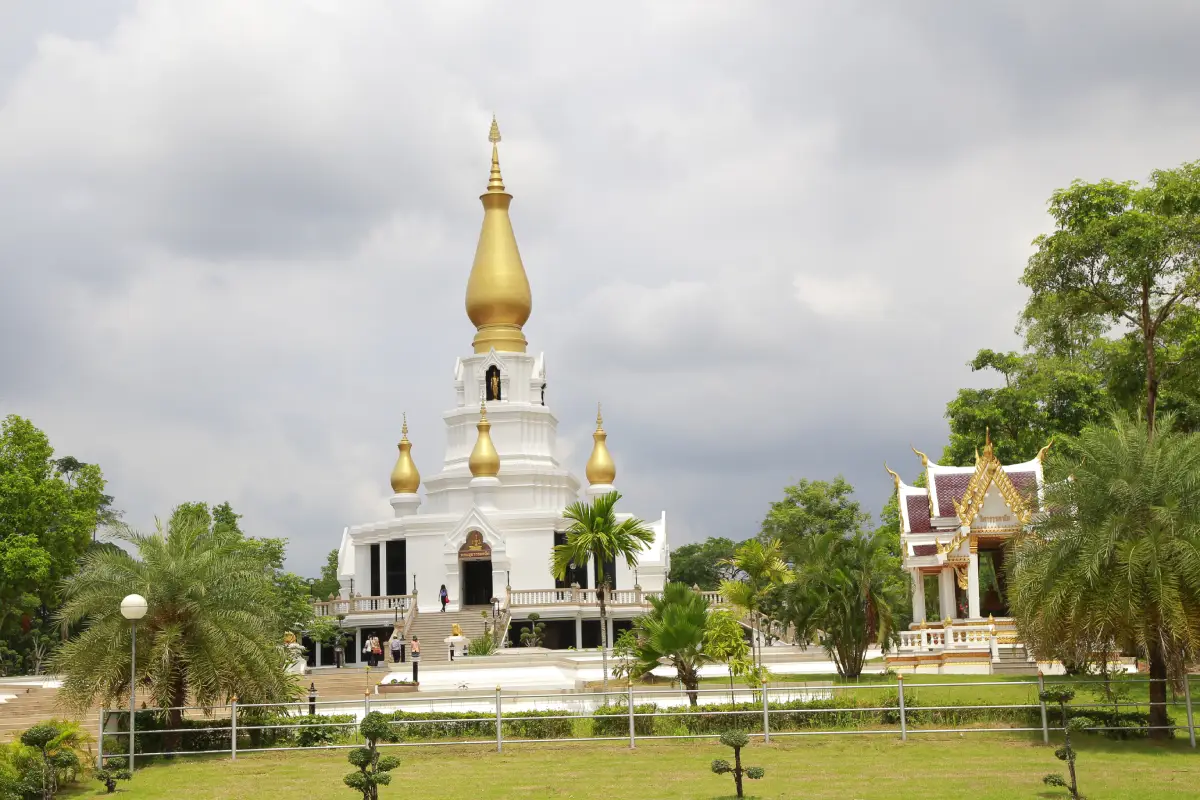
12. Wat Aranyabanphot (Phra Sutham Chedi) is located in Ban Mo Subdistrict, Si Chiang Mai District. It is a Dhammayut forest monastery closely associated with Luang Pu Rian Woralapho, another important meditation master of northeastern Thailand. The temple includes Phra Sutham Chedi, a mondop, viharn, Dhamma museum areas, and displays of monastic requisites, giving the site value in religion, meditation heritage, and Buddhist education.
Highlights: Phra Sutham Chedi, the Luang Pu Rian memorial mondop, Woralapho Viharn, monastic requisites, Dhamma books, sacred relics, and the quiet atmosphere of a forest monastery near the Mekong.
The monastery occupies a relatively large and peaceful area with mature trees, ponds, religious buildings, and walking paths linking different parts of the grounds. The setting feels very different from an urban temple because it is largely free from commercial activity and heavy traffic, allowing visitors to explore in a more contemplative atmosphere.
According to the temple’s history, the area originally served as a place where wandering monks could stay and practice meditation. Local people once referred to the site as Wat Pa Pha Chan before the name Wat Aranyabanphot became established. The later name is consistent with the monastery’s forested setting and elevated terrain close to the Mekong.
Luang Pu Rian Woralapho played an important role in the development of the temple and in the teaching of Buddhist practice. His life was closely associated with meditation and the forest-monastery tradition, and the temple remains a destination for disciples and visitors who wish to pay respect and learn from his teachings.
Phra Sutham Chedi is one of the temple’s principal architectural features. It functions as a sacred structure associated with Buddhist relics and with the memory of respected teachers. Its importance lies not only in its shape or size, but also in the symbolic role it plays within the spiritual landscape of the monastery.
The museum areas preserve items and monastic requisites connected with Luang Pu Rian, together with Dhamma books and interpretive material that help visitors understand the lifestyle and discipline of forest monks. Those interested in the Thai Forest Tradition should allow at least about an hour for a meaningful visit.
Wat Aranyabanphot can be combined naturally with Wat Hin Mak Peng because both lie along the same general route. Travellers continuing toward Sangkhom can then add Wat Pha Tak Suea, Than Thong Waterfall, and Tham Din Phiang Cave, creating an itinerary that combines Buddhist heritage, natural scenery, and Mekong viewpoints.
Visitors should dress respectfully, speak quietly, and avoid disturbing people who are meditating or taking part in religious activities. In museum and memorial areas, objects should not be touched unless explicitly permitted.
Getting There: Wat Aranyabanphot is located in Ban Mo Subdistrict, Si Chiang Mai District, along the Si Chiang Mai–Sangkhom route. It is open daily from 08:30–16:30.
Map (GPS): https://www.google.com/maps/dir/?api=1&destination=17.964185,102.500351&travelmode=driving
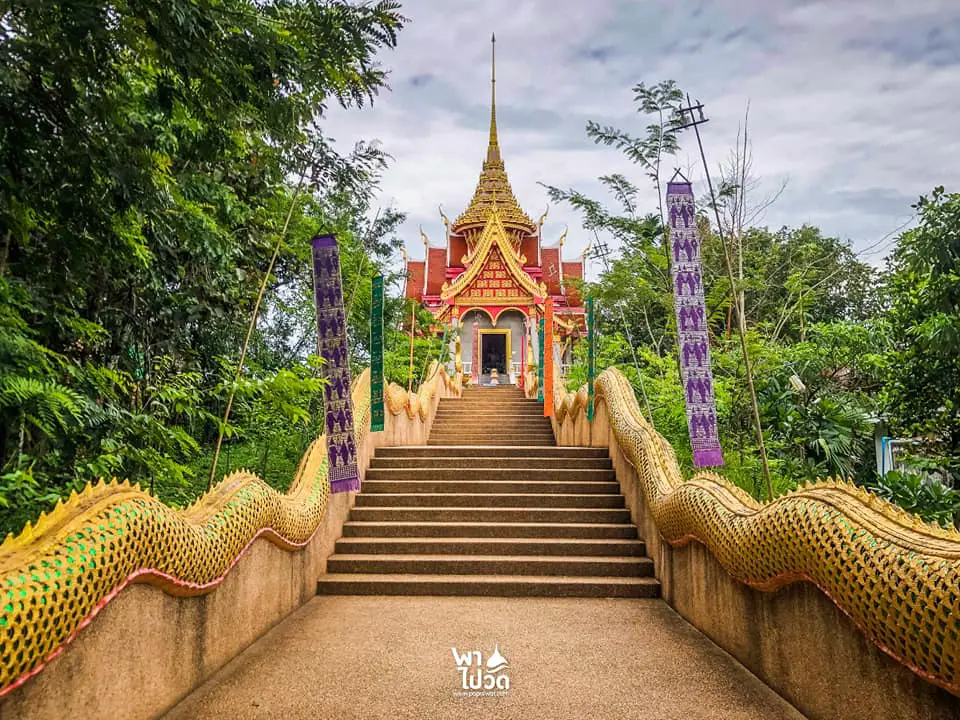
13. Wat Pha Tak Suea is located in Pha Tang Subdistrict, Sangkhom District, on elevated mountain terrain overlooking the Mekong River and Laos. It is one of Nong Khai’s best-known natural and religious landmarks, especially since the construction of its U-shaped glass Skywalk, which allows visitors to experience the Mekong landscape from a dramatic high viewpoint.
Highlights: U-shaped glass Skywalk, panoramic Mekong viewpoints, river bends and islands, sandbars during low-water periods, mountains on the Lao side, a hilltop temple, and the natural scenery of Sangkhom District.
Long before the Skywalk became a major tourist attraction, Wat Pha Tak Suea was already known as a quiet mountain temple where the surrounding natural environment supported Buddhist practice. The original cliffside viewpoint offered broad views of the Mekong as it winds along the Thai–Lao border.
The Skywalk introduced a new way of experiencing the landscape. The walkway projects outward from the cliff in a U-shaped form, with transparent glass sections underfoot. Visitors can look down toward the terrain below while simultaneously taking in the broad view across the Mekong and surrounding mountains.
During the low-water season, the river’s geography becomes especially visible, revealing sandbars, islands, and channels that may be hidden when the Mekong is full. During the rainy season, the river appears wider and the surrounding mountains become lush and green, giving the viewpoint a completely different character.
The elevated perspective also shows how closely communities in Thailand and Laos are situated along the Mekong. Although the river functions today as an international boundary, the view from the mountain reveals a continuous landscape of hills, river plains, agricultural fields, and villages extending across both sides.
Wat Pha Tak Suea remains a religious site in addition to being a scenic attraction. Visitors should therefore dress respectfully and behave appropriately within temple areas even if their main reason for coming is the viewpoint and Skywalk.
Skywalk safety rules should be followed carefully. These may include limits on the number of people allowed on the structure at one time, requirements to use protective footwear or coverings on the glass, and rules against running or jumping. Access may be restricted during heavy rain or unsafe weather conditions.
Morning offers cooler temperatures and a quieter atmosphere, while late afternoon provides attractive photographic light. Visitors planning to return to Nong Khai city the same day should allow sufficient time to leave before dark because the journey from Sangkhom is relatively long.
Wat Pha Tak Suea combines well with Wat Tham Sri Mongkhon and Than Thong Waterfall. A practical itinerary is to visit the temple and viewpoint in the morning, then continue to the cave or waterfall later in the day. This is one of the most rewarding nature-focused routes in Sangkhom District.
Getting There: Wat Pha Tak Suea is located in Pha Tang Subdistrict, Sangkhom District. The temple grounds are generally open daily from approximately 06:00–18:00, while the Skywalk is generally open from approximately 09:30–16:30. Skywalk access depends on weather and safety conditions.
Map (GPS): https://www.google.com/maps/dir/?api=1&destination=18.036393,102.304640&travelmode=driving
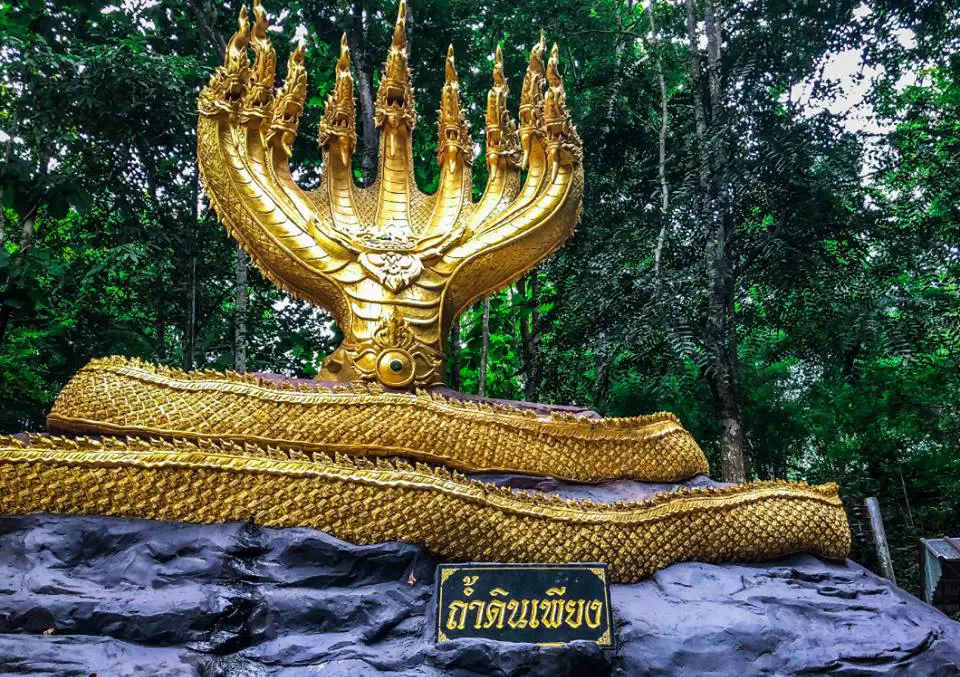
14. Wat Tham Sri Mongkhon (Wat Tham Piang Din) is one of Nong Khai’s most atmospheric cave destinations. Located in Sangkhom District, the site contains a limestone cave system with narrow passages, chambers, changes in elevation, and sections where water may flow through the cave. Its complex interior has become closely associated with local stories of the underground Naga realm.
Highlights: Limestone cave system, narrow passages, multiple cave chambers, water inside the cave, legends of the underground realm, Naga beliefs, and an adventurous cave experience unlike visiting a single large cavern.
The cave does not consist of one continuous open chamber. Visitors move through passages between rock formations, and in some areas may need to bend down, move carefully, or pass through confined sections. The enclosed environment and complex route contribute strongly to the cave’s distinctive atmosphere and help explain why stories about an underground world became attached to the site.
Local belief connects the cave with Nagas and the subterranean realm, traditions commonly found throughout communities along the Mekong. The combination of underground water, rock channels, hidden passages, and deeper chambers naturally reinforces these stories within the local cultural landscape.
Visitors should not enter the cave independently without guidance. The route is complex, and interior conditions can change depending on water levels. Following the temple’s visitor system or entering with a local guide reduces the risk of becoming disoriented and also provides context for the names and stories associated with different sections of the cave.
People with claustrophobia, respiratory problems, knee difficulties, or limited mobility should carefully consider whether the cave is suitable for them. Some sections require moving through confined spaces, while floors may be wet or partially covered by water.
Lightweight clothing that allows easy movement and shoes with good grip are recommended. Large bags should be avoided. Visitors should never touch or damage cave formations and should not leave litter or other objects inside the cave.
For a 1-day trip in Sangkhom, Wat Tham Sri Mongkhon can be combined with Wat Pha Tak Suea and Than Thong Waterfall. However, travellers should not overload the itinerary, as moving through the cave requires time and care rather than rushing between attractions.
Extra caution is necessary during the rainy season because water levels inside the cave can change. If access is restricted during certain conditions, visitors should follow instructions from temple staff and local caretakers.
Getting There: The site is open daily from 08:00–16:00. Entry into the cave is generally limited to approximately 15:00 or earlier so visitors have enough time to complete the route before closing.
Map (GPS): https://www.google.com/maps/dir/?api=1&destination=17.961865,102.302152&travelmode=driving
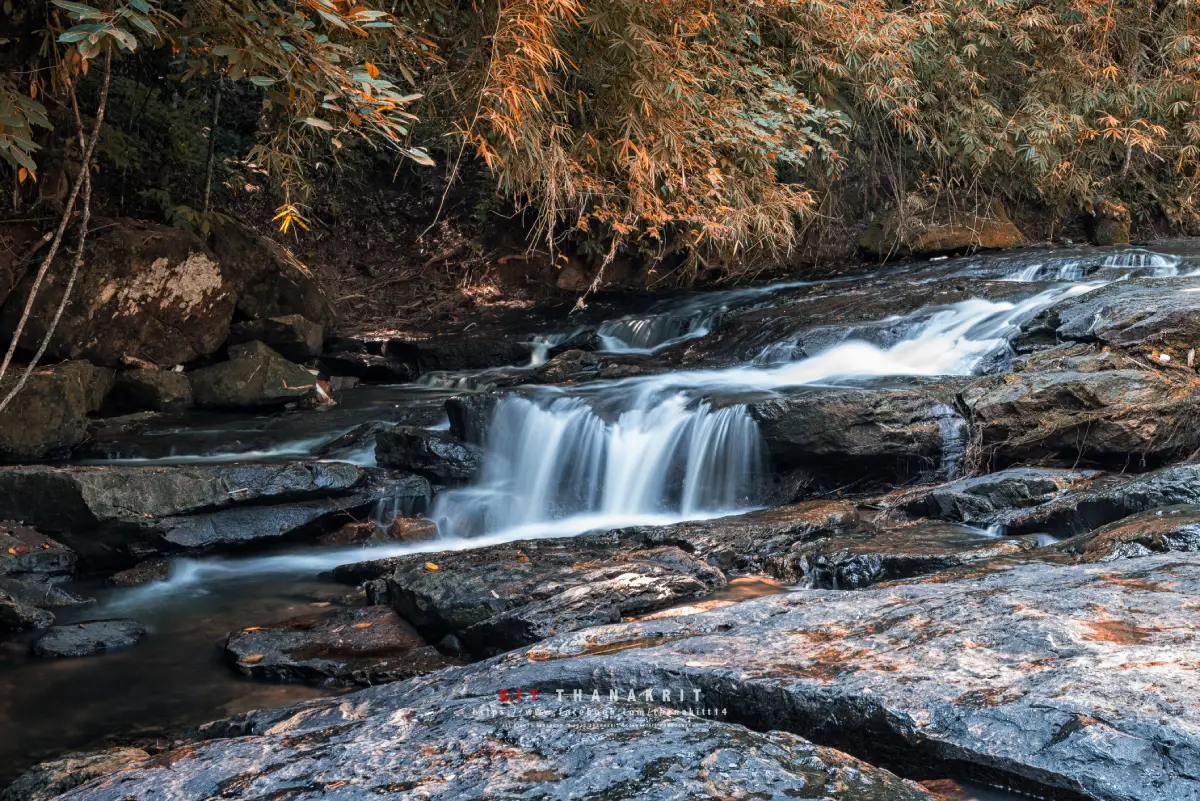
15. Namtok Than Thong is an important natural attraction in Sangkhom District, located near Highway 211 along the Mekong route. The waterfall is characterized by water flowing across natural rock terraces and boulders within a forested setting, making it a convenient place to rest while travelling between Wat Pha Tak Suea, Si Chiang Mai, and Sangkhom.
Highlights: Water flowing across natural rock levels, pools, shaded forest, rock formations, picnic and resting areas, and convenient access from the Mekong riverside highway.
Namtok Than Thong is not a single high vertical waterfall. Instead, water moves across several rock levels and natural formations, creating a landscape well suited to walking, relaxing, and enjoying the surrounding forest. The appearance of the waterfall changes significantly depending on seasonal water volume.
The rainy season and the period immediately following sustained rainfall generally produce the most visible flow, greener forest, and more humid conditions. During the dry season, water levels can fall considerably and some sections of the stream may appear much less dramatic.
Although higher water levels can make the waterfall more impressive, they also require greater caution. Wet rocks can be extremely slippery, and heavy rainfall in the surrounding mountains can cause stream levels to rise rapidly. Visitors should avoid entering the water when it appears muddy, unusually fast, or when severe weather warnings are in effect.
The area is suitable for families and groups looking for a break during a road trip, but children should remain under close supervision, especially near pools and wet rocks. Even shallow-looking areas should not be assumed to be safe without checking conditions.
Namtok Than Thong combines easily with Wat Pha Tak Suea. Visitors can begin the morning at the temple and viewpoint, then stop at the waterfall later in the morning or around midday before continuing to Wat Tham Sri Mongkhon or other attractions in Sangkhom.
Travellers coming from Nong Khai city generally follow Highway 211 through Tha Bo and Si Chiang Mai. The road offers attractive views of the Mekong and mountains in several sections, so it is worth allowing more travel time than the distance alone might suggest.
Visitors should take all rubbish out with them, avoid using soap or chemicals in the stream, and refrain from collecting rocks, plants, or wildlife. These simple practices help preserve the waterfall’s ecosystem and the quality of the surrounding environment.
Getting There: Namtok Than Thong is located in Sangkhom District near Highway 211. It is open daily from 08:30–16:30. Admission is free. Access to swimming areas or particular sections may depend on current weather and safety conditions.
Map (GPS): https://www.google.com/maps/dir/?api=1&destination=18.027756,102.365503&travelmode=driving
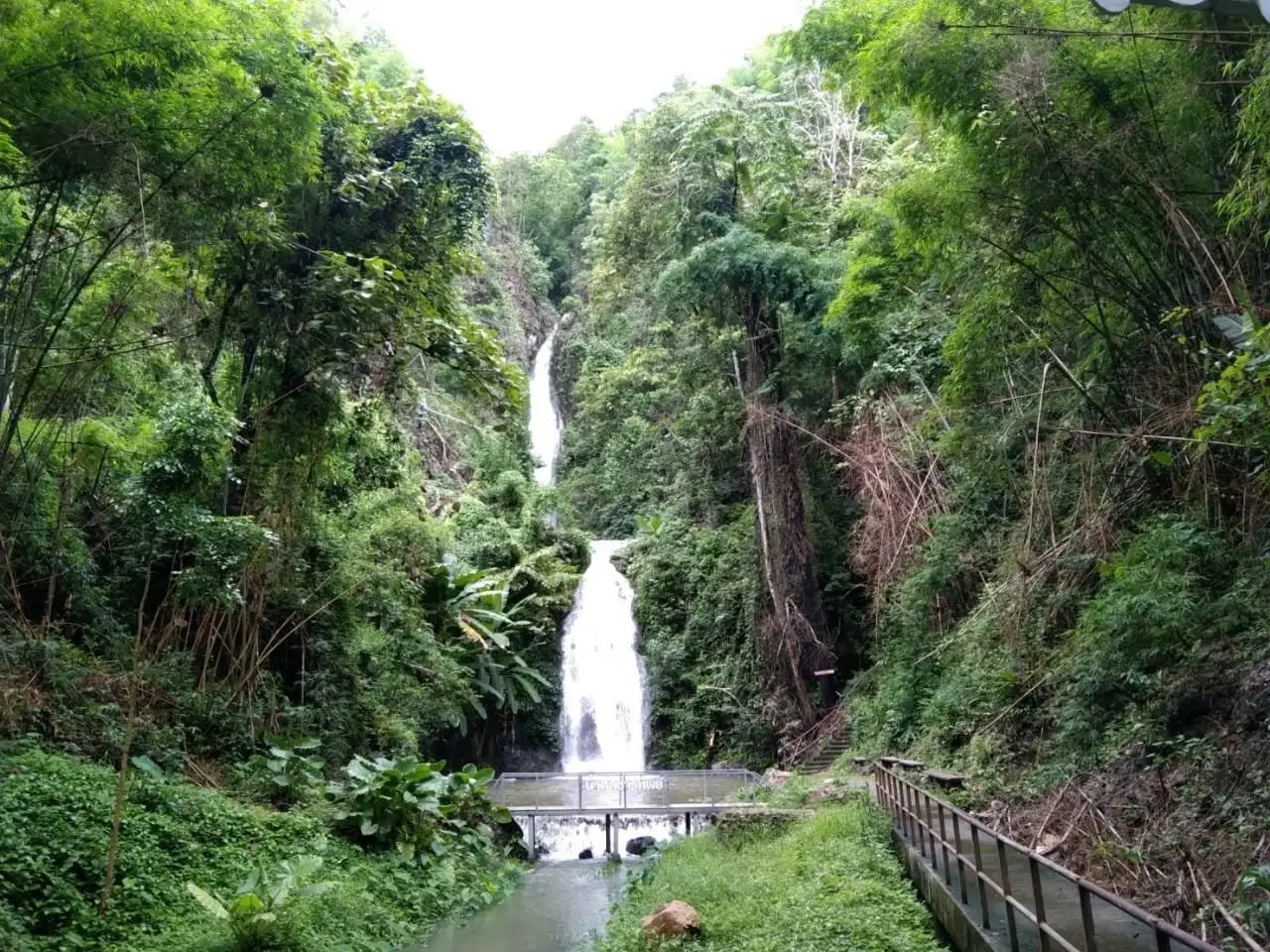
16. Than Thip Waterfall is another important natural attraction in Sangkhom District, Nong Khai. Surrounded by forest and mountain terrain in the western part of the province, the waterfall is known for streams flowing down natural rock levels in a shaded setting. It is well suited to travellers who want a break from the Mekong temple route and elevated viewpoints and prefer a quieter natural environment.
Highlights: Multi-level natural waterfall, rocky pools, shaded forest, nature trails, and the peaceful mountain atmosphere of Sangkhom District.
The character of Than Thip Waterfall changes significantly with the seasons. During the rainy season and after periods of sustained rainfall, the streams become fuller and the surrounding forest appears at its greenest. This is the most attractive period for photography and enjoying the waterfall, although wet rocks and rapidly changing water levels require greater caution.
During the dry season, water volume may decrease considerably and some sections can become much less dramatic. On the other hand, trails are generally easier to walk and the risk of sudden high water is lower. The late rainy season and early cool season can therefore provide a good balance between scenery and easier access.
Than Thip Waterfall is particularly suitable for travellers who enjoy slow-paced nature trips. Visitors should allow time to walk around, relax beside the stream, and experience the surrounding forest rather than treating it only as a short photography stop.
Anyone entering the water should choose only clearly safe areas without strong currents. Rocks covered with algae can be extremely slippery, and visitors should avoid entering the stream during heavy rain or when the water becomes muddy and fast-moving, as these conditions may indicate rising water from upstream.
The waterfall can be combined with Than Thong Waterfall, Wat Pha Tak Suea, and Wat Tham Sri Mongkhon. However, visitors should avoid trying to fit too many Sangkhom attractions into a single day because the roads include mountain sections and curves. Allowing extra travel time makes the route more comfortable and safer.
Families with young children should keep them under close supervision and avoid deep pools. Older visitors should remain in easily accessible areas rather than walking across uneven rocks or steep natural surfaces.
Visitors should keep the area clean, avoid using soap or chemicals in the stream, and leave plants and wildlife undisturbed. The forest and freshwater ecosystem can be easily affected by careless tourism.
Getting There: Than Thip Waterfall is located in Sangkhom District. It is open daily from 08:30–16:30. Admission is free. Access to some areas may depend on weather and water levels.
Map (GPS): https://www.google.com/maps/dir/?api=1&destination=17.977990,102.247370&travelmode=driving
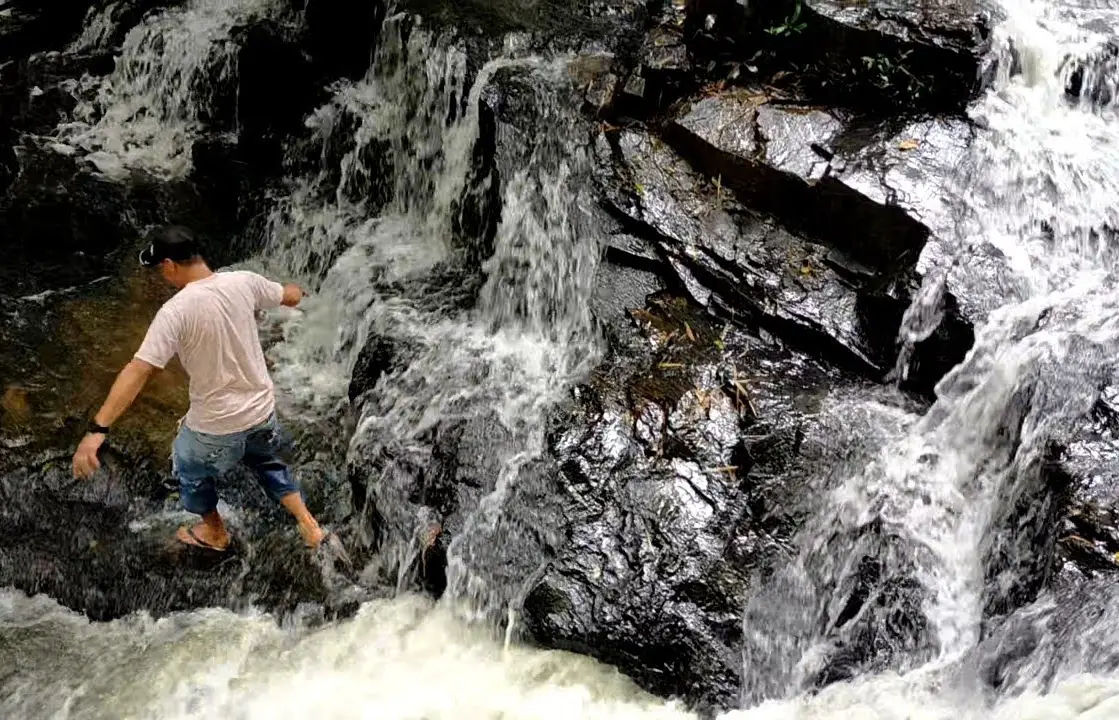
17. Khao Tao Waterfall is a quieter natural attraction in Nong Khai, known more locally than the province’s larger and more famous waterfalls. The site lies close to temple and community areas, allowing visitors to experience both natural scenery and local rural life within the same route.
Highlights: Natural stream, rock formations, local forest vegetation, resting areas, and a peaceful community-based atmosphere.
The waterfall consists of water flowing through rocky and forested terrain. Like many smaller waterfalls in northeastern Thailand, its appearance varies considerably with seasonal rainfall. The rainy season through the beginning of the cool season generally offers the best chance of seeing a stronger natural flow.
Khao Tao Waterfall suits travellers who prefer less crowded destinations and are interested in places that retain a local atmosphere. It is best approached as a quiet nature stop rather than as a highly developed commercial attraction with extensive tourist facilities.
During periods of higher water, the sound of the stream and humid forest create a particularly pleasant environment. At the same time, some sections may become slippery, so shoes with good grip are advisable. Visitors should avoid running on wet rocks or jumping between boulders without checking the surface first.
Flash-water safety is important here, as at other mountain streams. If heavy rain continues or the water level rises quickly, visitors should move away from the stream and toward higher ground rather than remaining close to the water.
Part of the appeal of Khao Tao Waterfall is its relationship with nearby temples and local communities. Visitors should therefore respect the quiet character of the area, avoid excessive noise, and not disturb private community spaces. Buying from local shops where available can directly support residents.
For travellers planning a multi-day nature itinerary, Khao Tao Waterfall works best as a supplementary stop combined with nearby temples, viewpoints, or other natural attractions rather than as the only destination of the day.
Getting There: The site is open daily from 08:00–17:00. Admission is free. The rainy season to early cool season is generally the best period for seeing stronger water flow, although visitors should check weather conditions before travelling.
Map (GPS): https://www.google.com/maps/dir/?api=1&destination=17.982901,102.206325&travelmode=driving
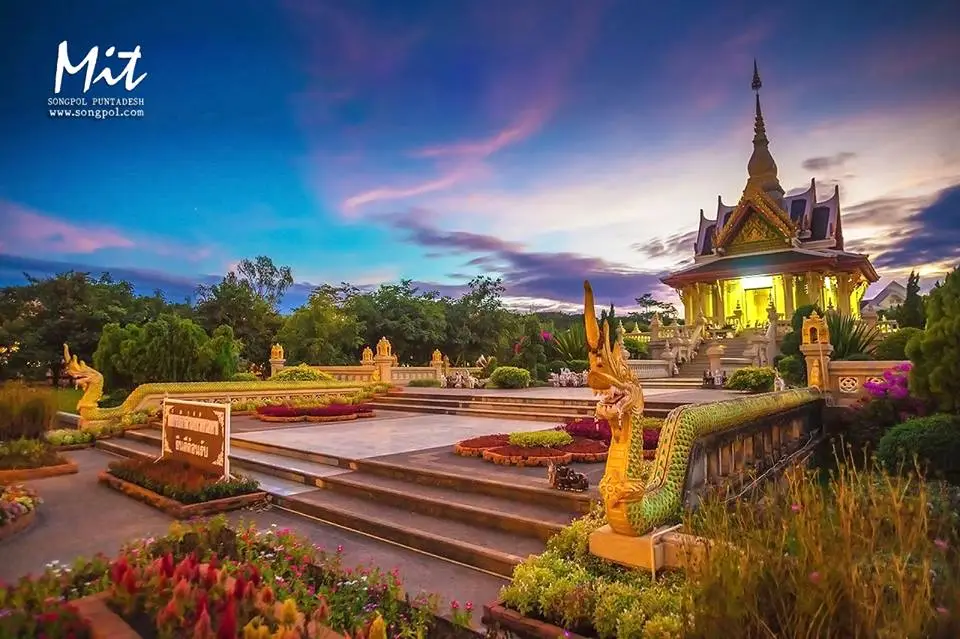
18. Nong Khai City Pillar Shrine is located along Mittraphap Road beside the Nong Khai Provincial Hall in Michai Subdistrict, Mueang Nong Khai District. It serves as a spiritual center for local residents and represents the traditional Thai concept of a city pillar as a symbol of stability, prosperity, and protection for the community.
Highlights: The city pillar, shrine architecture, worship area, auspicious symbolism, and a convenient central location close to other important attractions in Nong Khai city.
A city pillar shrine differs from a Buddhist temple because its symbolic role is directly connected with the identity and stability of the city itself. The pillar represents the spiritual center of the community, and visitors often come to pray for safe travel, success in work, stability, and good fortune.
The establishment of the shrine involved cooperation among government officials, merchants, local residents, and other sectors of the province. This reflects its role not merely as an official civic project but as a shared spiritual landmark for the local community.
The ceremony associated with establishing a city pillar carries deep cultural meaning in Thailand. Traditionally, the pillar symbolizes the foundation and stability of the city, and ceremonies are often linked with carefully selected auspicious dates, times, and formal rituals.
Nong Khai City Pillar Shrine is a practical place to begin a city itinerary, especially for travellers arriving in the morning. From here, visitors can continue easily to Wat Pho Chai, Tha Sadet Market, the Prap Ho Monument, and the First Thai–Lao Friendship Bridge.
The site is centrally located and easy to access, making it particularly suitable for older travellers, families, and visitors with limited time. A short stop can be incorporated into a 1-day Nong Khai city route without adding significant travel time.
Visitors should dress appropriately and treat the shrine with respect. Even though the site is located in a public urban area, sacred objects and structures should not be climbed on or handled unnecessarily.
Getting There: Nong Khai City Pillar Shrine is located along Mittraphap Road beside the provincial hall in Michai Subdistrict, Mueang Nong Khai District. It is open daily from 08:00–17:00. Admission is free.
Map (GPS): https://www.google.com/maps/dir/?api=1&destination=17.878873,102.741858&travelmode=driving
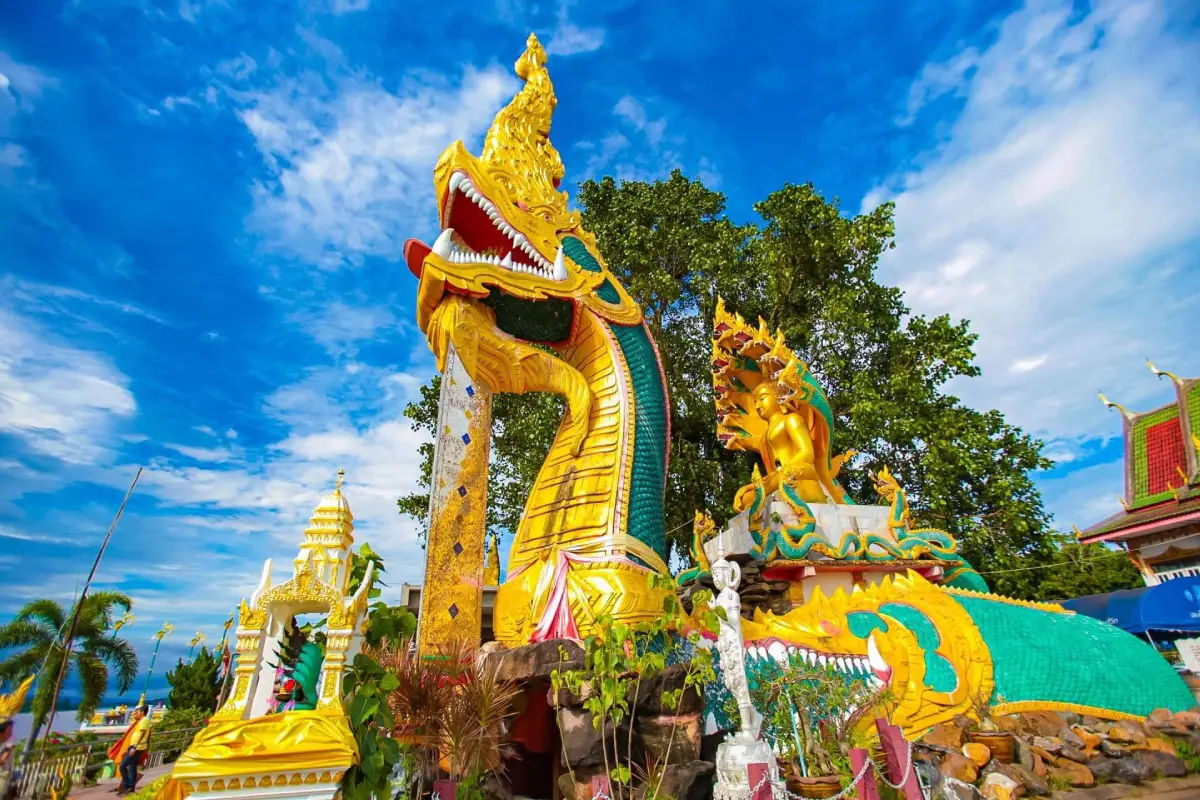
19. Wat Thai is located in Ban Chumphon, Chumphon Subdistrict, Phon Phisai District. This historic riverside temple is one of the places in Nong Khai where Buddhism, Naga beliefs, legends of the underwater realm, and the Naga Fireball tradition are most clearly connected.
Highlights: Simulated underwater Naga city, Naga sculptures, symbolic gateway to the underwater realm, sacred city-pillar features, Mekong riverfront area, Naga Fireball viewing traditions, and the temple’s long connection with the Phon Phisai community.
Wat Thai stands beside the Mekong in an area closely associated with the end-of-Buddhist-Lent traditions of Phon Phisai. The riverfront in front of the temple and surrounding areas becomes especially important during the annual festival, when large numbers of visitors gather along the river to watch for the phenomenon known as the Naga Fireballs.
The temple dates back to 1777, giving it a long history within the Phon Phisai community that predates the modern tourism era. Local tradition connects the name “Wat Thai” with the temple’s founder, who was said to have come from central Thailand while the surrounding residents were northeasterners. The site therefore became known locally as the temple of the “Thai” person, and the name continued through later generations.
The simulated underwater city is what most clearly distinguishes Wat Thai from other riverside temples. The area transforms local Naga legends and stories of an underwater kingdom into an environment visitors can walk through, incorporating symbolic gateways, sacred features, and multiple Naga sculptures.
Naga belief in Phon Phisai is deeply connected with the Mekong. Local tradition associates Nagas with water, fertility, Buddhism, and sacred protection. The idea of an underwater Naga realm is therefore not simply a decorative tourism theme but part of a wider cultural worldview shared by communities along the river.
The end of Buddhist Lent is the busiest period at the temple and in Phon Phisai. Large crowds gather along the riverbank for the Naga Fireball festival and related religious events. Travellers planning to visit during this period should arrange accommodation and transport well in advance, as traffic and visitor numbers are very different from normal days.
Outside the festival period, the temple is considerably quieter. This is a better time for visitors who want to explore the temple, simulated cave and underwater-city areas, Naga sculptures, and Mekong riverfront at a slower pace.
Wat Thai is particularly valuable for travellers seeking to understand why Nong Khai is widely associated with Naga culture. Within one location, the Mekong River, Buddhism, local mythology, sculpture, ritual practice, and contemporary festival traditions are closely intertwined.
Getting There: Wat Thai is located in Ban Chumphon, Chumphon Subdistrict, Phon Phisai District. It is open daily from 07:00–18:00. Admission is free. Travellers visiting during the end-of-Buddhist-Lent period should allow extra travel time and check local traffic arrangements.
Map (GPS): https://www.google.com/maps/dir/?api=1&destination=18.024340,103.076170&travelmode=driving
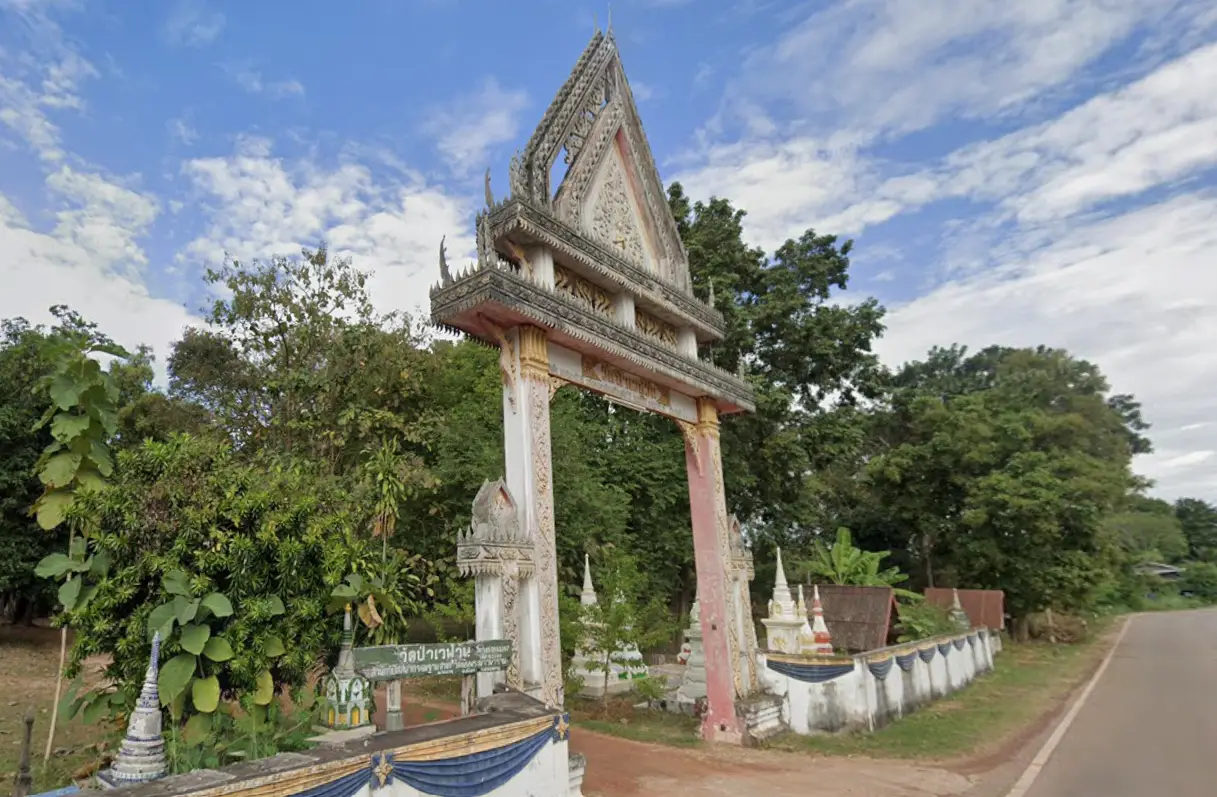
20. Wat Weluwan is located in Ban Dong Na Kham, Moo 5, Nong Nang Subdistrict, Tha Bo District. The temple plays an important role in Buddhism, religious education, and Dhamma teaching within the local community. One of its most distinctive features is a collection of Chinese-style wood carvings, together with its role as a place for Buddhist studies for monks, novices, and young people.
Highlights: 52 Chinese-style wood carvings, ordination hall, sermon hall, Buddhist education, and the atmosphere of a community temple in Tha Bo District.
Wat Weluwan clearly illustrates the traditional role of a Thai temple within community life. It functions not only as a place for ceremonies and worship but also as a center for education, ordination, and the teaching of Buddhist principles to local residents.
The term “Pariyatti Dhamma” refers to the systematic study of Buddhist scriptures, teachings, and monastic discipline. Temples involved in this type of education act as learning centers for monks and novices and help preserve religious knowledge across generations.
The collection of 52 Chinese-style wood carvings is particularly interesting because it demonstrates that the temple’s artistic character is not limited to northeastern Thai or Lan Xang traditions. The presence of Chinese-inspired woodwork provides an example of cultural exchange and artistic adaptation within a local Buddhist setting.
When viewed together with other religious sites in Tha Bo, the area reveals a surprisingly diverse cultural landscape. Luang Pho Phra Chao Ong Tue reflects Lan Xang heritage, Wiang Khuk preserves connections with ancient Mekong settlements, and Wat Weluwan introduces Chinese artistic elements. Travelling through Tha Bo therefore reveals several historical and artistic layers rather than a single temple tradition.
Wat Weluwan is particularly suitable for travellers interested in local architecture, community history, and the social role of Buddhist monasteries. Its value lies more in close observation and cultural context than in the presence of a single monumental landmark.
Visitors should dress respectfully and avoid disturbing classes, study sessions, or religious activities involving monks and novices. If Buddhist education is taking place, it is best to wait until activities have finished before approaching nearby areas.
Wat Weluwan can be combined with Luang Pho Phra Chao Ong Tue and Phra That Bang Phuan on a Tha Bo route. Travellers can continue farther west toward Si Chiang Mai or return to Nong Khai city after visiting the area.
Getting There: Wat Weluwan is located in Ban Dong Na Kham, Moo 5, Nong Nang Subdistrict, Tha Bo District. It is open daily from 08:00–17:00. Admission is free.
Map (GPS): https://www.google.com/maps/dir/?api=1&destination=17.850180,102.550760&travelmode=driving
| Topic | Details |
| Province Overview | Nong Khai is a border province along the Mekong River known for Buddhism, Lan Xang art, Naga beliefs, ancient settlements, forest monasteries, border markets, scenic viewpoints, caves, and waterfalls. Visitors can spend 1 day exploring Nong Khai city or 4–5 days travelling through Nong Khai, Tha Bo, Si Chiang Mai, Sangkhom, and Phon Phisai. |
| 20 Attractions in This Guide | 1. Wat Pho Chai 2. Wat Khaek (Sala Kaeo Ku) 3. Tha Sadet Market 4. First Thai–Lao Friendship Bridge 5. Phra That Bang Phuan 6. Phra That Nong Khai 7. Prap Ho Monument 8. Wat Thepphon Pradittharam 9. Naga Fountain Plaza 10. Luang Pho Phra Chao Ong Tue 11. Wat Hin Mak Peng 12. Wat Aranyabanphot (Phra Sutham Chedi) 13. Wat Pha Tak Suea 14. Wat Tham Sri Mongkhon (Wat Tham Piang Din) 15. Namtok Than Thong 16. Than Thip Waterfall 17. Khao Tao Waterfall 18. Nong Khai City Pillar Shrine 19. Wat Thai 20. Wat Weluwan |
| Top 10 for First-Time Visitors | 1. Wat Pho Chai 2. Sala Kaeo Ku 3. Tha Sadet Market 4. First Thai–Lao Friendship Bridge 5. Phra That Bang Phuan 6. Phra That Nong Khai 7. Wat Hin Mak Peng 8. Wat Pha Tak Suea 9. Wat Tham Sri Mongkhon 10. Wat Thai |
| Nong Khai City Zone | 1. Wat Pho Chai 2. Wat Khaek (Sala Kaeo Ku) 3. Tha Sadet Market 4. First Thai–Lao Friendship Bridge 5. Phra That Nong Khai 6. Prap Ho Monument 7. Naga Fountain Plaza 8. Nong Khai City Pillar Shrine Suitable for a 1-day trip focused on major landmarks, faith, history, border-city culture, and the Mekong riverfront. |
| Wiang Khuk–Tha Bo Zone | 1. Wat Thepphon Pradittharam 2. Phra That Bang Phuan 3. Luang Pho Phra Chao Ong Tue 4. Wat Weluwan Ideal for travellers interested in ancient settlements, Lan Xang art, sacred stupas, important Buddha images, and community temples. |
| Si Chiang Mai–Sangkhom Zone | 1. Wat Hin Mak Peng 2. Wat Aranyabanphot (Phra Sutham Chedi) 3. Wat Pha Tak Suea 4. Wat Tham Sri Mongkhon (Wat Tham Piang Din) 5. Namtok Than Thong 6. Than Thip Waterfall 7. Khao Tao Waterfall Best for a Mekong Dhamma route combining forest monasteries, viewpoints, caves, and waterfalls. |
| Phon Phisai Zone | 1. Wat Thai Best for learning about Naga beliefs, the underwater realm, riverside culture, and the Naga Fireball tradition during the end of Buddhist Lent. |
| Faith and Temple Route | 1. Wat Pho Chai – Luang Pho Phra Sai 2. Phra That Bang Phuan 3. Phra That Nong Khai 4. Luang Pho Phra Chao Ong Tue 5. Wat Hin Mak Peng 6. Wat Aranyabanphot 7. Wat Pha Tak Suea 8. Wat Thai 9. Wat Weluwan |
| Naga and Underwater Realm Route | 1. Naga Fountain Plaza 2. Phra That Nong Khai 3. Wat Tham Sri Mongkhon 4. Wat Thai 5. Phra That Bang Phuan – Muchalinda Pond Suitable for visitors interested in Naga traditions and beliefs of the Mekong region. |
| Historical Route | 1. Prap Ho Monument 2. Wat Thepphon Pradittharam 3. Phra That Bang Phuan 4. Luang Pho Phra Chao Ong Tue 5. Wat Pho Chai 6. Nong Khai City Pillar Shrine 7. First Thai–Lao Friendship Bridge |
| Forest Meditation Route | 1. Wat Hin Mak Peng – Luang Pu Thet Thetsaransi 2. Wat Aranyabanphot – Luang Pu Rian Woralapho Recommended for visitors interested in the Dhammayut forest tradition, respected meditation masters, and Buddhist practice. |
| Nature and Viewpoints | 1. Wat Pha Tak Suea 2. Wat Tham Sri Mongkhon 3. Namtok Than Thong 4. Than Thip Waterfall 5. Khao Tao Waterfall 6. Wat Hin Mak Peng 7. Phra That Nong Khai |
| Mekong River Viewpoints | 1. Tha Sadet Market 2. Naga Fountain Plaza 3. Phra That Nong Khai 4. First Thai–Lao Friendship Bridge 5. Wat Hin Mak Peng 6. Wat Pha Tak Suea 7. Wat Thai |
| Sunset Spots | 1. Naga Fountain Plaza 2. Tha Sadet Market and Mekong River Promenade 3. Wat Pha Tak Suea 4. Wat Hin Mak Peng 5. First Thai–Lao Friendship Bridge on the Nong Khai side |
| Suitable for Families | Sala Kaeo Ku, Tha Sadet Market, Naga Fountain Plaza, Nong Khai City Pillar Shrine, Wat Pho Chai, Phra That Bang Phuan, and the First Thai–Lao Friendship Bridge are relatively easy to access. Caves and waterfalls are better suited to families who can closely supervise children. |
| Suitable for Older Travellers | Wat Pho Chai, Tha Sadet Market, Naga Fountain Plaza, Nong Khai City Pillar Shrine, Prap Ho Monument, Phra That Bang Phuan, Luang Pho Phra Chao Ong Tue, and Wat Hin Mak Peng are generally easier to access than caves and waterfall trails. |
| Suitable for Children | Sala Kaeo Ku, Tha Sadet Market, Naga Fountain Plaza, and the First Thai–Lao Friendship Bridge are suitable for children. Wat Tham Sri Mongkhon and waterfall areas require close adult supervision. |
| 1-Day Itinerary | Morning: Wat Pho Chai – Nong Khai City Pillar Shrine Late Morning: Sala Kaeo Ku Afternoon: Phra That Nong Khai – Prap Ho Monument Evening: Tha Sadet Market – Naga Fountain Plaza – Mekong River sunset |
| 2 Days / 1 Night | Day 1: Wat Pho Chai – Sala Kaeo Ku – Phra That Nong Khai – Tha Sadet Market – Naga Fountain Plaza Day 2: Wat Thepphon Pradittharam – Phra That Bang Phuan – Luang Pho Phra Chao Ong Tue – Wat Weluwan |
| 3 Days / 2 Nights | Day 1: Nong Khai city Day 2: Wiang Khuk–Tha Bo–Si Chiang Mai – Phra That Bang Phuan – Luang Pho Phra Chao Ong Tue – Wat Hin Mak Peng – Wat Aranyabanphot Day 3: Wat Pha Tak Suea – Wat Tham Sri Mongkhon – Namtok Than Thong or Than Thip Waterfall |
| 4 Days / 3 Nights | Add Phon Phisai on Day 4 to visit Wat Thai and learn about Naga traditions along the Mekong. During the end-of-Buddhist-Lent period, accommodation and transport should be arranged in advance. |
| 5 Days / 4 Nights | Suitable for visiting all 20 attractions without rushing: 1 day in Nong Khai city, 1 day in Wiang Khuk–Tha Bo, 1 day in Si Chiang Mai, 1 day in Sangkhom, and 1 day in Phon Phisai. |
| Best Time to Visit | November–February is generally the most comfortable period for travelling around Nong Khai because temperatures are cooler and conditions are suitable for Mekong routes. The rainy season is better for waterfalls and green landscapes but requires extra caution regarding flash floods, slippery surfaces, and cave access. |
| Low Mekong Water Season | Lower Mekong water levels can make more of the original Phra That Nong Khai visible and reveal sandbars in the river. The landscape from Wat Pha Tak Suea can also show channels and islands more clearly than during high-water periods. |
| Rainy Season | Namtok Than Thong, Than Thip Waterfall, and Khao Tao Waterfall generally have stronger water flow, but visitors must watch for flash floods, slippery rocks, and heavy rainfall. Cave conditions at Wat Tham Sri Mongkhon should also be checked before entering. |
| End of Buddhist Lent and Naga Fireballs | Phon Phisai and other Mekong communities attract large numbers of visitors during this period. Wat Thai is an important location for Naga culture and stories of the underwater realm. Visitors should check the annual event dates and book accommodation in advance. |
| Songkran | Wat Pho Chai is the center of the Luang Pho Phra Sai Songkran tradition, when the sacred Buddha image is brought out for public worship and ceremonial water pouring. It is one of Nong Khai’s most important annual religious events. |
| Getting Around Nong Khai | Some attractions in central Nong Khai can be reached on foot or by local transport. A private car, rental car, or hired car with driver is more convenient for Tha Bo, Si Chiang Mai, Sangkhom, and Phon Phisai. Highway 211 is the main western route along the Mekong. |
| Food to Try | Naem nueang, Vietnamese steamed rice dumplings, khao piak sen, Vietnamese-style noodle soup, Mekong River fish, som tam, larb, and other Isan dishes. |
| Souvenirs | Tha Sadet Market is one of the main places to buy dried foods, local snacks, clothing, household items, and border-trade products. Visitors should compare prices and check product origin and condition before buying. |
| Mekong River Safety | Visitors should not enter the Mekong without proper local guidance because currents, water levels, and depth can change. When using boat services, choose local operators and follow safety instructions. |
| Cave Safety | Some passages inside Wat Tham Sri Mongkhon are narrow and may contain water. Visitors should follow the temple’s entry system. People with claustrophobia, breathing difficulties, or limited mobility should assess their condition before entering. |
| Waterfall Safety | Avoid entering the water when it is muddy, fast-moving, or during heavy rain. Wet rocks may be slippery, and flash floods are possible. Children should remain under adult supervision. |
| Responsible Travel | Dress respectfully at temples, keep quiet in meditation areas, avoid touching archaeological objects unnecessarily, never damage cave formations, do not leave rubbish in forests, waterfalls, or rivers, and support local shops and communities whenever possible. |
Frequently Asked Questions (FAQ)
Q: What are the must-visit attractions in Nong Khai?
A: First-time visitors should consider Wat Pho Chai, Sala Kaeo Ku, Tha Sadet Market, the First Thai–Lao Friendship Bridge, Phra That Bang Phuan, Phra That Nong Khai, Wat Hin Mak Peng, Wat Pha Tak Suea, Wat Tham Sri Mongkhon, and Wat Thai. Together, these attractions cover faith, history, Naga culture, natural scenery, and life along the Mekong.
Q: Where should I go if I have only 1 day in Nong Khai?
A: Focus on Nong Khai city. Begin with Wat Pho Chai and Nong Khai City Pillar Shrine in the morning, continue to Sala Kaeo Ku, then visit Phra That Nong Khai and the Prap Ho Monument before ending the day at Tha Sadet Market and Naga Fountain Plaza.
Q: How many days are recommended for Nong Khai?
A: 2–3 days are suitable for Nong Khai city, Tha Bo, and Si Chiang Mai. Travellers who also want to explore Sangkhom, waterfalls, caves, and Wat Thai in Phon Phisai should allow 4–5 days.
Q: Which temple is one of the most important in Nong Khai?
A: Wat Pho Chai is one of the province’s most important temples because it houses Luang Pho Phra Sai, the sacred Buddha image regarded as a spiritual symbol of Nong Khai and closely associated with Lan Xang history and Mekong communities.
Q: Why is Luang Pho Phra Sai important?
A: Luang Pho Phra Sai is a Lan Xang-style Buddha image associated with the legends of Phra Suk and Phra Soem. It is now enshrined at Wat Pho Chai and is the focus of the annual Luang Pho Phra Sai Songkran tradition.
Q: What is interesting about Sala Kaeo Ku?
A: Sala Kaeo Ku is known for its monumental sculptures of Buddhas, Hindu deities, Nagas, and allegorical figures exploring karma, life, death, and rebirth according to the ideas of Pu Bunluea Surirat.
Q: What is the best time to visit Tha Sadet Market?
A: Late morning through evening is suitable for shopping and trying local food. Visitors who also want to walk to Naga Fountain Plaza and enjoy the Mekong should arrive in the afternoon and remain until early evening.
Q: Can I travel from Nong Khai to Vientiane?
A: Yes. Travellers can cross via the First Thai–Lao Friendship Bridge, but they should prepare travel documents according to their nationality and check current border regulations and operating hours before travelling.
Q: Can Phra That Nong Khai be seen throughout the year?
A: The riverside site can be visited year-round, but the original stupa in the Mekong is more or less visible depending on the river level. Lower-water periods generally provide a better chance of seeing more of the structure.
Q: What else is important at Phra That Bang Phuan besides the main stupa?
A: The temple complex also contains the Seven Great Places associated with the Buddha after Enlightenment, Muchalinda Pond, and other historic religious structures, making it especially valuable for visitors interested in Buddhist history and Lan Xang art.
Q: Where is Luang Pho Phra Chao Ong Tue located?
A: The Buddha image is enshrined at Wat Si Chomphu Ong Tue in Ban Nam Mong, Tha Bo District. It is a large Lan Xang-style Buddha image associated with the reign of King Setthathirath.
Q: Which temples should I visit if I am interested in the Thai Forest Tradition?
A: Wat Hin Mak Peng, associated with Luang Pu Thet Thetsaransi, and Wat Aranyabanphot, associated with Luang Pu Rian Woralapho, are particularly suitable for visitors interested in forest meditation masters and Buddhist practice.
Q: What is special about Wat Pha Tak Suea?
A: Its main attractions are the glass Skywalk and the elevated viewpoint overlooking the Mekong River. Visitors can see river bends, islands, sandbars during lower-water periods, and the landscape of Laos across the river.
Q: Is Wat Tham Sri Mongkhon or Tham Din Phiang difficult to enter?
A: Some passages are narrow and may require visitors to bend down or move through confined areas. People with claustrophobia or limited mobility should assess their condition before entering and should follow the temple’s visitor system.
Q: When is the best time to visit Nong Khai’s waterfalls?
A: Namtok Than Thong, Than Thip Waterfall, and Khao Tao Waterfall generally have stronger water flow from the rainy season into the early cool season. Visitors should remain alert for slippery rocks, heavy rain, and flash floods.
Q: Which Nong Khai attractions are associated with Naga beliefs?
A: Major places include Naga Fountain Plaza, Phra That Nong Khai, Wat Tham Sri Mongkhon, and Wat Thai in Phon Phisai, which features a simulated underwater realm and is closely connected with Naga Fireball culture.
Q: Where should I go to learn about the Naga Fireball tradition?
A: Phon Phisai is one of the main areas associated with the tradition. Wat Thai and nearby Mekong riverfront areas are especially important for Naga beliefs and end-of-Buddhist-Lent activities. Visitors travelling during the festival should arrange accommodation and transport in advance.
Q: Are there attractions in Nong Khai suitable for older travellers?
A: Yes. Wat Pho Chai, Tha Sadet Market, Naga Fountain Plaza, Nong Khai City Pillar Shrine, Phra That Bang Phuan, Luang Pho Phra Chao Ong Tue, and Wat Hin Mak Peng are generally easier to access than cave or waterfall routes.
Q: What food should I try in Nong Khai?
A: Popular choices include Mekong River fish, som tam, larb, and Vietnamese-influenced dishes such as naem nueang, Vietnamese steamed rice dumplings, khao piak sen, and Vietnamese-style noodle soup.
Q: Can I travel around Nong Khai without a private car?
A: Many central-city attractions can be reached by local transport or partly on foot. For Tha Bo, Si Chiang Mai, Sangkhom, or Phon Phisai, a rental car, private vehicle, or hired car with driver is more convenient.
Q: How should I plan a Nong Khai itinerary to avoid backtracking?
A: Divide the province into 4 main zones: Nong Khai city, Wiang Khuk–Tha Bo, Si Chiang Mai–Sangkhom, and Phon Phisai. Complete the attractions within one zone before moving to the next. This makes a 3–5 day itinerary more efficient.
Q: What is the best season to visit Nong Khai?
A: November–February is generally the most comfortable period for overall travel because of cooler weather. For waterfalls, the rainy season to early cool season is better. Travellers interested in the Naga Fireball tradition should plan around the end of Buddhist Lent.
 Category: ●Travel Articles, Recipes
 Group: ●Travel Review, Food Review
Last Update : 3 WeekAgo
 Last Update : 3 WeekAgo
Recommend

 Art, Culture and Heritage
 Historical Sites and Monuments(1)
 Landmarks and Memorials(2)
 Art, Craft Centres, Tradition(1)
 Educational Places
 Educational Gardens, Farm(1)
 Places of Worship
 Temple(16)
 Mosque(1)
 Other Sacred Sites(8)
 Suburban Living
 Village, Community(3)
 Local Market(4)
 Nature and Wildlife
 National Parks and Marine Reserves(2)
 Dam, Reservoir, Lake(2)
 Waterfalls(4)
 River, Canal(8)
 Bays and Beaches(1)
 Entertainment and Agricultural
 Farms, Parks and Ecotourism(2)
 Shopping
 Shopping and Night Market(1)
Travel Review, Food Review(1)


