
lovethailand home >Northeastern Travel Attractions >Nong Khai Travel Attractions >Si Wilai >Chum Phu Phon > Wat Weluwan
TL;DR: Wat Weluwan is located at Ban Dong Na Kham, Village No. 5, Nong Nang Subdistrict, Tha Bo District, Nong Khai Province, open Daily, hours 08.00 – 17.00.
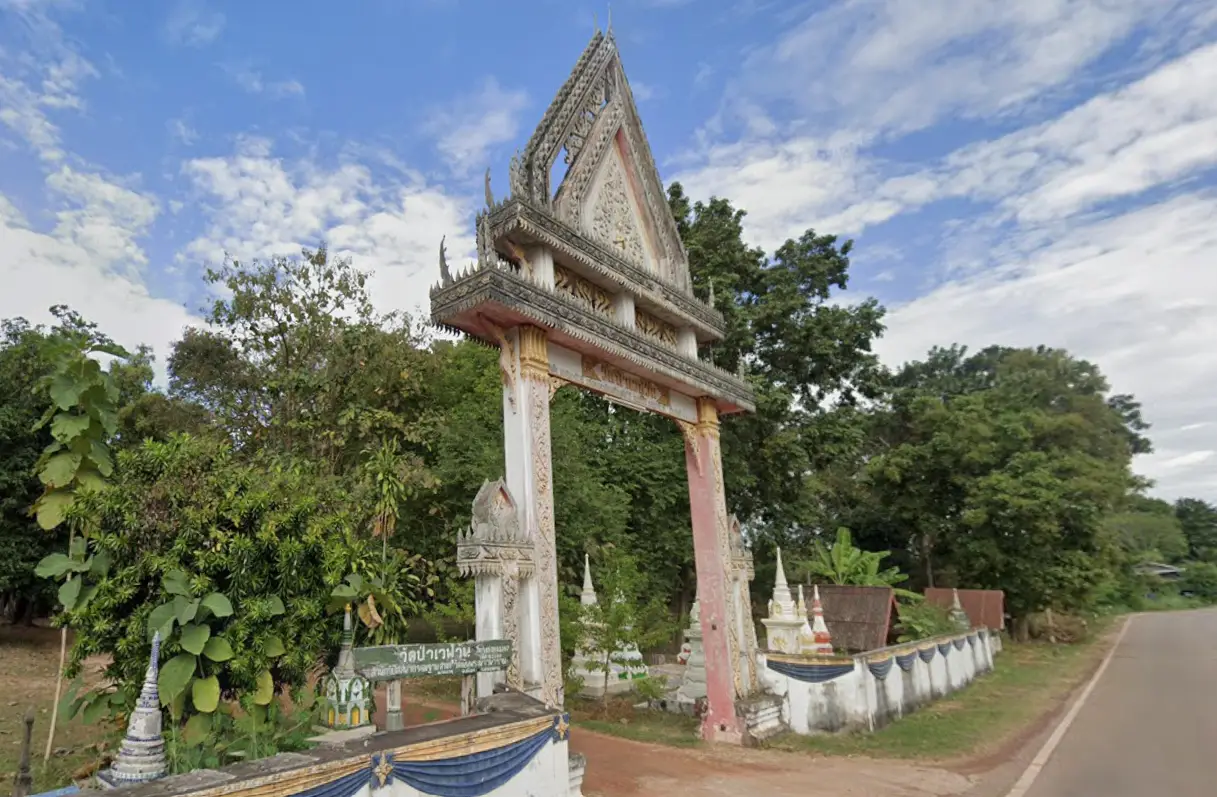
Wat Weluwan
Open Days: Daily
Opening Hours: 08.00 – 17.00
Wat Weluwan in Nong Khai Province is a community Buddhist temple in Nong Nang Subdistrict, Tha Bo District. It serves as a religious learning center, a place for Buddhist training, and a local hub for the study and transmission of Buddhist teachings. The temple is especially known for its role in teaching Buddhist doctrine and supporting religious education. One of its most distinctive features is a collection of 52 finely carved wooden Chinese figurines, an unusual artistic element that makes the temple stand out among local temples in northeastern Thailand.
Wat Weluwan is located at Ban Dong Na Kham, Village No. 5, Nong Nang Subdistrict, Tha Bo District, Nong Khai Province. It is a local Buddhist temple under the Mahanikaya order and covers approximately 12 rai of land. Within the temple grounds are an ordination hall, a sermon hall, monks’ residences, a bell structure, a kitchen, a roadside rest pavilion, toilets, and spaces used for religious education and Buddhist training. These facilities reflect the temple’s function as both a sacred place and a practical center for community life.
The temple is important because it is closely connected with Buddhist education. In Thai Buddhist society, a temple is not only a place for worship but also a place where people study, train, and develop moral discipline. Wat Weluwan supports the teaching of Buddhist doctrine, known in Thai as pariyatti-dhamma, which refers to the study of Buddhist scriptures and teachings. This educational role gives the temple significance beyond tourism. It remains a living religious institution where monks, novices, local residents, and young learners can connect with Buddhist knowledge.
The history of Wat Weluwan adds depth to its cultural value. The temple was established in 1935 on land that had previously been an abandoned temple site. Traces of an old ordination hall, a stupa, and an ancient well remained in the area, showing that the site had earlier religious importance. In 1940, local villagers restored the temple and built new religious structures. This restoration transformed the old site into a functioning temple once again. The story of Wat Weluwan is therefore also a story of community faith, collective effort, and the revival of a sacred space.
The name “Weluwan” means bamboo grove or bamboo garden. It is also associated with Veluvana in Buddhist history, one of the earliest and most important monastic sites connected with the Buddha. For this temple in Nong Khai, the name fits its peaceful and educational character. Wat Weluwan is a place where learning, discipline, and community devotion come together. Its name carries a sense of calmness and reflects the temple’s role as a place for training the mind and passing on Buddhist teachings.
Wat Weluwan received its official monastic boundary, known as wisungkhammasima, on 22 November 1988. This boundary is important because it allows the temple to conduct formal monastic ceremonies according to Buddhist discipline. The designated boundary measures 40 meters wide and 80 meters long. This detail shows the temple’s development from a restored community religious site into a fully established Buddhist temple with proper religious functions.
Important sacred objects within the temple include a Buddha image in the meditation posture and a Buddha image protected by the Naga. The meditation posture represents inner stillness, concentration, and mental discipline. The Naga-protected Buddha image symbolizes protection, faith, and an important episode in Buddhist tradition. Together, these images make the temple a meaningful place for worship and quiet reflection. Visitors can pay respect to the Buddha images and appreciate how Buddhist art communicates spiritual ideas through posture, form, and symbolism.
The most unusual artistic highlight of Wat Weluwan is its collection of 52 wooden Chinese figurines. These carved figures are beautiful examples of wood craftsmanship. Their presence inside a Thai Buddhist temple gives the place a distinctive identity, combining religious space with artistic heritage. The figurines show the skill of woodcarving and the beauty of cultural detail. For travelers interested in temple art, folk craftsmanship, and cross-cultural visual elements, this collection is one of the main reasons to visit Wat Weluwan.
The wooden Chinese figurines add another cultural layer to the temple. They are not merely decorative objects; they are part of the temple’s visual identity. Their forms, carved details, and material reflect the value of handcraft and traditional artistry. In a province shaped by the Mekong River, trade routes, local communities, and cultural exchange, such artistic elements help visitors understand that temples in Thailand often preserve more than religious images. They can also preserve evidence of craftsmanship, aesthetic taste, and cultural contact.
Visitors should take time to observe the details of the wooden figurines carefully. The charm of carved wood lies in the small details: facial expressions, posture, clothing, balance, and the texture of the material. Seeing all 52 figures together gives the collection a strong visual presence. This makes Wat Weluwan a meaningful stop for travelers who want to see something quieter and more local than the famous attractions in the city center of Nong Khai.
As a travel destination, Wat Weluwan is best appreciated as a local cultural temple rather than a large tourist landmark. Its value lies in its calm atmosphere, its educational role, and its connection with the surrounding community. Visitors can see how a rural Thai temple functions as a place of worship, learning, training, and community gathering. This makes the experience more intimate and grounded than visiting only major temples or heavily visited tourist sites.
The temple grounds are suitable for a quiet visit. Travelers can begin by paying respect to the Buddha images, then walk through the temple compound to see the ordination hall, sermon hall, monks’ residences, and the area connected with religious teaching and training. Visitors should dress respectfully, keep noise low, and treat the carved wooden objects with care. A visit to Wat Weluwan is most rewarding when approached slowly, with attention to both the religious and artistic details of the place.
Nong Nang Subdistrict and Tha Bo District are part of the broader cultural landscape of Nong Khai, a province closely tied to the Mekong River and Lao-Thai cultural connections. A trip to Wat Weluwan can be combined with other nearby places such as Wat Si Chomphu Ong Tue, Hat Tha Ma Fueang, Wat Phra That Bang Phuan, Nong Khai Aquarium, and Wat Pho Chai. This route gives travelers a wider view of Nong Khai, covering community temples, sacred Buddha images, river scenery, local food, and educational attractions.
For a half-day trip, visitors can start at Wat Weluwan in the morning, spend time paying respect and viewing the carved wooden Chinese figurines, then continue to Wat Si Chomphu Ong Tue, one of the most respected temples in Tha Bo District. Travelers with more time can continue toward riverside viewpoints and other cultural attractions in Nong Khai city. This makes Wat Weluwan a useful stop for travelers who want to go beyond the most familiar tourist route and explore a quieter part of the province.
Getting There is most convenient by private car or rental car. From Nong Khai city, travel toward Tha Bo District, then continue to Nong Nang Subdistrict and Ban Dong Na Kham. The route is suitable for travelers who want to combine several attractions in one day. Those coming from Udon Thani can first travel to Nong Khai and then continue westward toward Tha Bo. Having private transport makes it easier to visit the temple together with nearby temples, riverside areas, restaurants, and accommodations.
Before visiting, travelers should understand that Wat Weluwan is an active community temple. The best experience comes from visiting respectfully and allowing enough time to observe the temple’s details. The site is not designed as a commercial attraction. Its appeal comes from its religious role, its local atmosphere, and the rare presence of 52 wooden Chinese figurines. This makes it a valuable destination for travelers interested in Buddhism, Thai local culture, and lesser-known places in Nong Khai Province.
Wat Weluwan adds a meaningful dimension to a Nong Khai itinerary. Many travelers know Nong Khai for the Mekong River, the Thai-Lao Friendship Bridge, Tha Sadet Market, Luang Pho Phra Sai at Wat Pho Chai, and Wat Si Chomphu Ong Tue. A visit to Wat Weluwan reveals another side of the province: a quieter community temple where Buddhist learning, local devotion, and woodcarving art come together. For foreign travelers seeking a more authentic and less crowded temple experience, Wat Weluwan is a worthwhile cultural stop in Tha Bo District.
| Name | Wat Weluwan |
| Location | Ban Dong Na Kham, Village No. 5, Nong Nang Subdistrict, Tha Bo District, Nong Khai Province |
| Address | Village No. 5, Ban Dong Na Kham, Nong Nang Subdistrict, Tha Bo District, Nong Khai Province 43110, Thailand |
| Place Type | Local Buddhist temple under the Mahanikaya order |
| Highlights | A Buddhist learning and training temple known for religious education, Buddhist doctrine study, and 52 carved wooden Chinese figurines |
| History | Established in 1935 on a former abandoned temple site, restored by local villagers in 1940, and granted its official monastic boundary on 22 November 1988 |
| Name Origin | Weluwan means bamboo grove or bamboo garden, a name associated with an important place in Buddhist history and suitable for a temple dedicated to religious learning |
| Distinctive Features | A community temple with a strong Buddhist education role, a rare collection of wooden Chinese figurines, and a calm local atmosphere |
| Sacred Objects | One Buddha image in meditation posture and one Naga-protected Buddha image |
| Main Areas / Zones | Ordination hall, sermon hall, monks’ residences, bell structure, kitchen, roadside rest pavilion, toilets, Buddhist doctrine study area, Buddhist training area, and the carved wooden Chinese figurine area |
| Travel Information | From Nong Khai city, travel toward Tha Bo District, then continue to Nong Nang Subdistrict and Ban Dong Na Kham. Private car or rental car is the most convenient option. |
| Current Status | Open to visitors and still used as an active Buddhist and community religious site |
| Open Days | Daily |
| Opening Hours | 08.00 – 17.00 |
| Fees | No Admission Fee |
| Facilities | Sermon hall, roadside rest pavilion, kitchen, toilets, religious activity areas, and Buddhist training spaces |
| Nearby Tourist Attractions | 1. Wat Si Chomphu Ong Tue, about 13 km, Tel. 042-431-418 2. Hat Tha Ma Fueang, about 16 km 3. Wat Phra That Bang Phuan, about 20 km 4. Nong Khai Aquarium, about 32 km, Tel. 0-4241-5623 5. Wat Pho Chai, about 38 km |
| Nearby Restaurants | 1. Khrua Ek Pla Phao 2 Ban Tha Ma Fueang, about 16 km, Tel. 081-768-1307, 042-992-722 2. Isan Kan Eng 9 Tha Bo, about 13 km, Tel. 083-585-9049 3. The Model Cafe & Gallery Tha Bo, about 14 km, Tel. 088-584-4192, 099-320-4194 4. Hua Foo Tea & Coffee Tha Bo, about 14 km, Tel. 091-053-9647 5. Tuk Restaurant, about 14 km, Tel. 088-241-7108 |
| Nearby Accommodations | 1. Pobruk Resort Tha Bo, about 14 km, Tel. 092-798-2965 2. Punruk Resort Tha Bo, about 15 km, Tel. 095-192-1115 3. D.M. Resort Tha Bo, about 15 km, Tel. 042-432-260 4. Le Palm Riverfront Resort Nong Khai, about 25 km 5. Royal Jommanee Heritage Hotel, about 34 km |
Frequently Asked Questions (FAQ)
Q: Where is Wat Weluwan located?
A: Wat Weluwan is located at Ban Dong Na Kham, Village No. 5, Nong Nang Subdistrict, Tha Bo District, Nong Khai Province.
Q: What is Wat Weluwan known for?
A: The temple is known as a Buddhist education and training center and for its collection of 52 carved wooden Chinese figurines.
Q: What are the opening days and hours of Wat Weluwan?
A: Wat Weluwan is open daily from 08.00 to 17.00.
Q: Is there an admission fee to visit Wat Weluwan?
A: No. There is no admission fee.
Q: What can visitors see inside Wat Weluwan?
A: Visitors can see Buddha images, the ordination hall, the sermon hall, Buddhist learning areas, and the 52 wooden Chinese figurines.
Q: How can travelers get to Wat Weluwan?
A: The most convenient way is by private car or rental car from Nong Khai city toward Tha Bo District, then continuing to Nong Nang Subdistrict and Ban Dong Na Kham.
Q: Who should visit Wat Weluwan?
A: It is suitable for travelers interested in Buddhism, local Thai temples, wooden craftsmanship, religious education, and quiet cultural destinations in Nong Khai.
Q: What nearby attractions can be combined with Wat Weluwan?
A: Nearby places include Wat Si Chomphu Ong Tue, Hat Tha Ma Fueang, Wat Phra That Bang Phuan, Nong Khai Aquarium, and Wat Pho Chai.
 Category: ●Places of Worship
 Group: ●Temple
Last Update : 2 MonthAgo
 Last Update : 2 MonthAgo
 Click to Access the Navigation Map GPS
 Art, Culture and Heritage
 Historical Sites and Monuments(1)
 Landmarks and Memorials(2)
 Art, Craft Centres, Tradition(1)
 Educational Places
 Educational Gardens, Farm(1)
Temple(16)
Educational Gardens, Farm(1)
Temple(16)
 Mosque(1)
 Other Sacred Sites(8)
 Suburban Living
 Village, Community(3)
 Local Market(4)
 Nature and Wildlife
 National Parks and Marine Reserves(2)
 Dam, Reservoir, Lake(2)
 Waterfalls(4)
 River, Canal(8)
 Bays and Beaches(1)
 Entertainment and Agricultural
 Farms, Parks and Ecotourism(2)
 Shopping
 Shopping and Night Market(1)


