
lovethailand home >Northeastern Travel Attractions >Nong Khai Travel Attractions >Muang Nongkhai >Mi Chai > Nong Khai City Pillar Shrine
TL;DR: Nong Khai City Pillar Shrine is located at Mittraphap Road, beside Nong Khai Provincial Hall, Mi Chai Subdistrict, Mueang Nong Khai District, Nong Khai Province, open Daily, hours 08.00 – 17.00.
Nong Khai City Pillar Shrine
Open Days: Daily
Opening Hours: 08.00 – 17.00
Nong Khai City Pillar Shrine is located on Mittraphap Road, beside Nong Khai Provincial Hall in Mi Chai Subdistrict, Mueang Nong Khai District, Nong Khai Province. It is one of the most meaningful civic and spiritual landmarks in the province, serving as a symbolic center of unity, stability, and local identity. Built through the collective effort of government officials, merchants, prominent local supporters, and the people of Nong Khai, the shrine stands as a place of worship, a provincial landmark, and a reminder of the shared spirit that holds the community together.
For travelers arriving in Nong Khai, the City Pillar Shrine is a suitable place to visit early in the journey. It is easy to reach, located within the main government area of the city, and offers a calm introduction to the province’s civic and cultural identity. Visitors often stop here to pay respect, make wishes for safe travel, and begin their exploration of Nong Khai with a sense of connection to the city. From the shrine, it is convenient to continue to Wat Pho Chai, Tha Sadet Market, Phra That La Nong, the First Thai–Lao Friendship Bridge, and Sala Keoku.
The importance of Nong Khai City Pillar Shrine lies not only in its location beside the provincial hall, but also in the story of how it was built. Nong Khai is a Mekong border province with a long history of trade, travel, cross-cultural exchange, and religious devotion. The city pillar therefore represents more than a sacred object. It symbolizes the heart of the province, the confidence of its people, and the connection between public life, local belief, and civic pride.
The formal process of establishing the shrine began with the ritual of preparing the city pillar timber on 8 July 1999, corresponding to the 11th waning day of the 8th lunar month in the Year of the Rabbit, at the auspicious time of 09.39. This ceremony marked the beginning of the city pillar as a sacred symbol of stability and prosperity. In Thai belief, a city pillar represents the spiritual anchor of a town or province. It is associated with protection, harmony, and the well-being of the people who live there.
Construction of the shrine building began with the foundation stone ceremony on 23 April 2000, corresponding to the 15th waxing day of the 1st lunar month in the Year of the Dragon, at the auspicious time of 09.19. The ceremony was conducted by Phra Trilokachan of Wat Si Mueang. This important ritual added spiritual significance to the building process and confirmed the shrine’s role as both a civic monument and a sacred place for the people of Nong Khai.
The shrine was completed and later celebrated with a royal consecration ceremony on 28 February 2004, corresponding to the 9th waxing day of the 4th lunar month in the Year of the Goat. The total construction budget was 11,108,000 Baht. From that moment, Nong Khai City Pillar Shrine became an official and cherished landmark of the province, a place where local people could come to pay respect, seek blessings, and gather for important civic and cultural occasions.
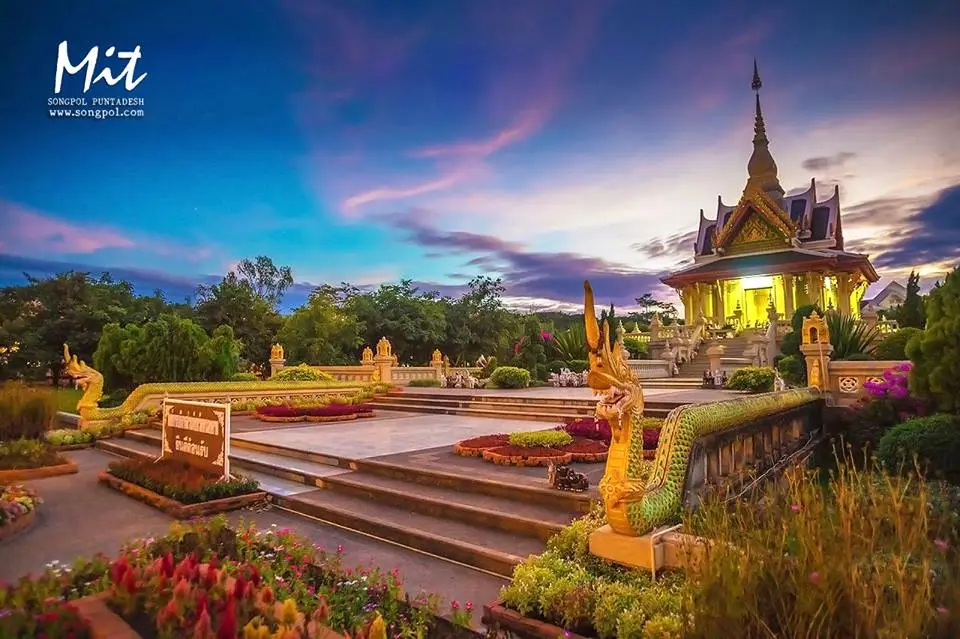
Architecturally, Nong Khai City Pillar Shrine is graceful and dignified. The building is divided into 2 levels. The lower level is used for storage and maintenance functions, while the upper level houses the city pillar. The structure features a Thai-style four-gabled pavilion form, known as a chaturamuk style, and the upper spire takes the form of a phra that, or sacred stupa-like tower. A surrounding balcony extends around all 4 sides, giving the shrine a balanced and ceremonial appearance.
The stupa-like roof form gives the shrine a strong connection to the sacred landscape of Nong Khai. The province is known for important Buddhist and sacred sites such as Phra That Bang Phuan, Phra That La Nong, and Wat Pho Chai. By using a roof form that recalls a sacred stupa, the shrine fits naturally into the religious and cultural character of the province. It is not only a civic building but also a visual expression of local spirituality.
The shrine’s location beside Nong Khai Provincial Hall gives it practical and symbolic importance. It stands near Mittraphap Road, one of the main routes connecting Nong Khai with Udon Thani and the First Thai–Lao Friendship Bridge. This makes the shrine easy to reach for residents, travelers, and people visiting the government center. Its position also places it at the intersection of official life, public identity, and local belief.
The atmosphere around the shrine is calm, orderly, and respectful. The raised building, front steps, and surrounding landscape give the place a formal yet welcoming character. Visitors can appreciate the architecture from the front courtyard, observe the roof details, and walk around the surrounding area without needing much time. The shrine is especially suitable for travelers who want a meaningful stop in the city center before continuing to riverside attractions or temples.
Visitors usually begin by paying respect at the front of the shrine before moving to the upper level where the city pillar is enshrined. The visit should be made quietly and respectfully. Offerings such as flowers, incense, candles, or garlands may be made according to local custom. Although the shrine is easily accessible, it remains a sacred place. Visitors should dress politely, speak softly, and avoid behavior that may disturb others who have come to pray.
For the people of Nong Khai, the shrine is more than a place to ask for blessings. It represents a shared memory of provincial unity. Because it was built through the cooperation of officials, merchants, local supporters, and ordinary citizens, the shrine stands as a symbol of collective effort. This gives the site emotional value beyond its architecture. It belongs to the people of Nong Khai as a visible sign of harmony and public spirit.
The shrine has also served as a gathering place for important civic activities. On the occasion of the 20th anniversary of the city pillar timber ceremony on 8 July 2019, large numbers of Nong Khai residents joined a ceremonial dance and public gathering in honor of the City Pillar Shrine. Such events show that the shrine remains part of living public culture, not merely a quiet monument by the road.
In Thai cultural belief, a city pillar shrine is associated with the spiritual foundation of a city. People come to pray for protection, prosperity, career stability, smooth travel, family well-being, and general good fortune. For visitors from other provinces or overseas, paying respect at the shrine is a way to acknowledge the province before exploring its temples, markets, riverfront, and border landmarks.
For tourists, Nong Khai City Pillar Shrine is a short but meaningful stop. It can be visited in the morning before a full day of sightseeing, during a city route, or in the late afternoon before heading to the Mekong River. From the shrine, visitors can easily continue to Prap Ho Monument, Wat Pho Chai, Tha Sadet Market, Phra That La Nong, the First Thai–Lao Friendship Bridge, Nong Thin Public Park, and Sala Keoku.
Prap Ho Monument is one of the nearby historical landmarks that pairs well with a visit to the City Pillar Shrine. It commemorates an important period in the history of Nong Khai and reflects the province’s role as a frontier city. Visiting both places together helps travelers understand Nong Khai as a city shaped by history, defense, public memory, and local pride.
Wat Pho Chai Royal Temple is another essential nearby destination. It enshrines Luang Pho Phra Sai, one of the most revered Buddha images in Nong Khai. The short distance between the City Pillar Shrine and Wat Pho Chai makes it easy for visitors to pay respect at 2 major spiritual sites in one trip. The shrine represents the civic heart of the province, while Wat Pho Chai represents its Buddhist devotional heart.
Tha Sadet Market is a lively riverside market near the Mekong River. It is one of the best places to experience local trade, souvenirs, riverfront life, and the relaxed atmosphere of Nong Khai city. Travelers can visit the City Pillar Shrine first, then continue to Tha Sadet Market for a walk, shopping, and food. This route combines civic heritage, local belief, and the everyday life of a Mekong border town.
Phra That La Nong, also known as Phra That Klang Nam, is another meaningful site within the city area. It is an ancient stupa ruin in the Mekong River, with a riverside replica where people can pay respect throughout the year. Combining the City Pillar Shrine with Phra That La Nong helps visitors see Nong Khai as a sacred riverside city where civic identity, Buddhist devotion, and the Mekong landscape are closely connected.
The First Thai–Lao Friendship Bridge is a major landmark that reflects Nong Khai’s role as a gateway between Thailand and Laos. It is not far from the City Pillar Shrine and can easily be included in the same itinerary. Visiting the shrine and then the bridge gives travelers a clear view of the province as both a spiritual community and an international border city.
Food options near Nong Khai City Pillar Shrine are varied because the shrine is located in the city area. Travelers can find breakfast shops, Vietnamese-style restaurants, Thai and Isan food, riverside restaurants, cafés, and family-friendly dining places. Jeen Zan Kai Kata Nong Khai is suitable for breakfast. Daeng Naem Nueng Nong Khai is a well-known Vietnamese-style restaurant. Macky’s Riverside Kitchen and Khong Cafe & Bistro Nongkhai are good choices for visitors who want a more relaxed riverside or café-style atmosphere.
Accommodation is also convenient. Visitors who want to stay near the old town and riverfront may choose White Inn Nongkhai Hotel or Mut Mee Garden Guesthouse. Travelers who prefer easy city access can consider Crystal Nongkhai Hotel, Amanta Hotel Nongkhai, Royal Nakhara Hotel & Convention Centre Nongkhai, or Park & Pool Resort. Staying in central Nong Khai makes it easy to visit the City Pillar Shrine, Tha Sadet Market, Wat Pho Chai, and the Mekong riverfront in a single day.
There is no admission fee to visit Nong Khai City Pillar Shrine. Visitors may enter during opening hours and make offerings or donations according to personal faith. Flowers, incense, candles, and garlands may be prepared in the usual manner for paying respect at a city pillar shrine. If caretakers or local staff provide guidance at the site, visitors should follow it politely.
The best time to visit is in the morning or late afternoon. Morning visits are suitable for beginning the day with prayer and good wishes, while late afternoon visits are convenient before continuing to the Mekong riverfront or Tha Sadet Market. During long weekends or provincial ceremonies, the area may be busier than usual, so visitors should allow extra time and park only in appropriate areas.
Photography is possible in the front courtyard, around the staircase, and from angles that show the four-gabled pavilion and stupa-like roof. The best images usually capture the full front view of the shrine, the elevated steps, and the upper spire. When photographing inside or near worshippers, visitors should be careful not to disturb prayers and should avoid taking close-up photos of people without permission.
For families traveling with children, the City Pillar Shrine is a useful place to explain the meaning of city pillar shrines in Thai culture. Children can learn that important places in a city are not limited to temples, markets, or scenic attractions. A city pillar shrine represents unity, stability, and the shared spirit of the people. A short visit can therefore become a meaningful cultural learning experience.
Nong Khai City Pillar Shrine is also a good starting point for foreign travelers who want to understand the province beyond ordinary sightseeing. It introduces the city as a place of belief, unity, border identity, and public life. After visiting the shrine, travelers can continue to the Mekong River, temples, markets, and the Thai–Lao Friendship Bridge with a deeper sense of how Nong Khai is organized around faith, community, and movement.
Getting There is straightforward. From central Nong Khai, follow Mittraphap Road or the main roads within Nong Khai Municipality toward the provincial government center. The shrine is located beside Nong Khai Provincial Hall. From Nong Khai Railway Station, travelers can use a car, taxi, local transport, or hired vehicle. From the First Thai–Lao Friendship Bridge, follow Mittraphap Road into the city and continue toward the provincial hall area. Travelers staying in town can reach the shrine by private car, rental car, local taxi, or three-wheeled transport.
In summary, Nong Khai City Pillar Shrine is an important spiritual and civic landmark that reflects the unity, identity, and pride of Nong Khai. Although it is not a large attraction that requires a long visit, it carries strong cultural meaning. Its Thai four-gabled architecture, stupa-like roof, city pillar, and location beside the provincial hall make it a suitable first stop for anyone who wants to understand Nong Khai as a Mekong border city with a deep sense of community and faith.
| Name | Nong Khai City Pillar Shrine / Nong Khai Provincial City Pillar Shrine |
| Location | Mittraphap Road, beside Nong Khai Provincial Hall, Mi Chai Subdistrict, Mueang Nong Khai District, Nong Khai Province |
| Address | Nong Khai Provincial Government Center, Mittraphap Road, Mi Chai Subdistrict, Mueang Nong Khai District, Nong Khai Province 43000, Thailand |
| Highlights | The provincial city pillar shrine of Nong Khai, a spiritual center and symbol of unity created through the cooperation of officials, merchants, local supporters, and residents |
| History | The city pillar timber ritual was held on 8 July 1999, the foundation stone ceremony took place on 23 April 2000, and the royal consecration ceremony was held on 28 February 2004 |
| Construction Budget | 11,108,000 Baht |
| Distinctive Features | Thai chaturamuk four-gabled architecture, upper level housing the city pillar, stupa-like roof form, and balcony surrounding all 4 sides |
| Important Elements Inside The Shrine | Nong Khai city pillar, main worship space, lower storage and maintenance area, and upper level where the shrine is enshrined |
| Main Areas / Zones | 1. Front Courtyard 2. Stairway To The Shrine 3. Upper Level Housing The City Pillar 4. Balcony Around 4 Sides 5. Lower Storage And Maintenance Area 6. Landscaped Area Around The Shrine |
| Annual Tradition / Activities | City pillar worship activities, ceremonial dances honoring the shrine, and important provincial events connected with the City Pillar Shrine |
| Caretaker / Local Area | Nong Khai provincial authorities and caretakers of the City Pillar Shrine area |
| Travel Information | Travel via Mittraphap Road to the Nong Khai Provincial Government Center. The shrine is beside Nong Khai Provincial Hall and is accessible by private car, rental car, taxi, or local transport |
| Current Status | Open for worship and visits |
| Open Days | Daily |
| Opening Hours | 08.00 – 17.00 |
| Fees | No admission fee |
| Facilities | Front courtyard, worship area, surrounding balcony, photo spots, parking area around the government center, and restaurants in nearby central Nong Khai |
| Nearby Tourist Attractions | 1. Prap Ho Monument, about 1 km 2. Wat Pho Chai Royal Temple, about 2 km, Tel. 084-796-9143 3. Tha Sadet Market, about 3 km 4. Phra That La Nong / Phra That Klang Nam, about 4 km 5. First Thai–Lao Friendship Bridge, about 4 km 6. Nong Thin Public Park, about 3 km 7. Sala Keoku, about 7 km |
| Nearby Restaurants | 1. Jeen Zan Kai Kata Nong Khai, about 2 km, Tel. 091-419-9559 2. Daeng Naem Nueng Nong Khai, about 3 km, Tel. 042-411-961 3. Macky’s Riverside Kitchen, about 3 km, Tel. 097-109-1022 4. Cà Phê Việt Nong Khai, about 3 km, Tel. 085-824-2356 5. Khong Cafe & Bistro Nongkhai, about 5 km, Tel. 098-402-2971 |
| Nearby Accommodations | 1. Royal Nakhara Hotel & Convention Centre Nongkhai, about 2 km, Tel. 042-422-889 2. Crystal Nongkhai Hotel, about 2 km, Tel. 042-464-678 3. White Inn Nongkhai Hotel, about 3 km, Tel. 042-422-666 4. Mut Mee Garden Guesthouse, about 4 km, Tel. 042-460-717 5. Amanta Hotel Nongkhai, about 4 km, Tel. 042-412-899 6. Park & Pool Resort, about 4 km, Tel. 088-568-2300 |
Frequently Asked Questions (FAQ)
Q: Where is Nong Khai City Pillar Shrine located?
A: Nong Khai City Pillar Shrine is located on Mittraphap Road, beside Nong Khai Provincial Hall, Mi Chai Subdistrict, Mueang Nong Khai District, Nong Khai Province.
Q: What are the opening days and hours of Nong Khai City Pillar Shrine?
A: The shrine is open daily from 08.00 to 17.00.
Q: Is there an admission fee for Nong Khai City Pillar Shrine?
A: No. There is no admission fee. Visitors may enter during opening hours and make offerings or donations according to personal faith.
Q: When was Nong Khai City Pillar Shrine built?
A: The city pillar timber ritual was held on 8 July 1999, the foundation stone ceremony took place on 23 April 2000, and the royal consecration ceremony was held on 28 February 2004.
Q: Why is Nong Khai City Pillar Shrine important?
A: It is the spiritual center and symbolic city pillar of Nong Khai Province, representing unity, stability, and the shared spirit of the people.
Q: What is distinctive about the architecture of Nong Khai City Pillar Shrine?
A: The shrine features Thai chaturamuk four-gabled architecture, an upper level housing the city pillar, a stupa-like roof form, and a balcony around all 4 sides.
Q: How can travelers get to Nong Khai City Pillar Shrine?
A: Travel via Mittraphap Road to the Nong Khai Provincial Government Center. The shrine is beside Nong Khai Provincial Hall and can be reached by private car, rental car, taxi, or local transport.
Q: What nearby attractions can be visited with Nong Khai City Pillar Shrine?
A: Nearby attractions include Prap Ho Monument, Wat Pho Chai, Tha Sadet Market, Phra That La Nong, the First Thai–Lao Friendship Bridge, Nong Thin Public Park, and Sala Keoku.
 Category: ●Places of Worship
 Group: ●Other Sacred Sites
Last Update : 2 MonthAgo
 Last Update : 2 MonthAgo
 Click to Access the Navigation Map GPS
Nong Khai City Pillar Shrine Map
Recommend

 Art, Culture and Heritage
 Historical Sites and Monuments(1)
 Landmarks and Memorials(2)
 Art, Craft Centres, Tradition(1)
 Educational Places
 Educational Gardens, Farm(1)
 Temple(16)
 Mosque(1)
Other Sacred Sites(8)
Mosque(1)
Other Sacred Sites(8)
 Suburban Living
 Village, Community(3)
 Local Market(4)
 Nature and Wildlife
 National Parks and Marine Reserves(2)
 Dam, Reservoir, Lake(2)
 Waterfalls(4)
 River, Canal(8)
 Bays and Beaches(1)
 Entertainment and Agricultural
 Farms, Parks and Ecotourism(2)
 Shopping
 Shopping and Night Market(1)


