
lovethailand home >Northeastern Travel Attractions >Nong Khai Travel Attractions >Phon Phisai >Chum Phon > Wat Thai
TL;DR: Wat Thai is located at Ban Chumphon, Chumphon Subdistrict, Phon Phisai District, Nong Khai Province, open Daily, hours 07.00 – 18.00.
Wat Thai
Open Days: Daily
Opening Hours: 07.00 – 18.00
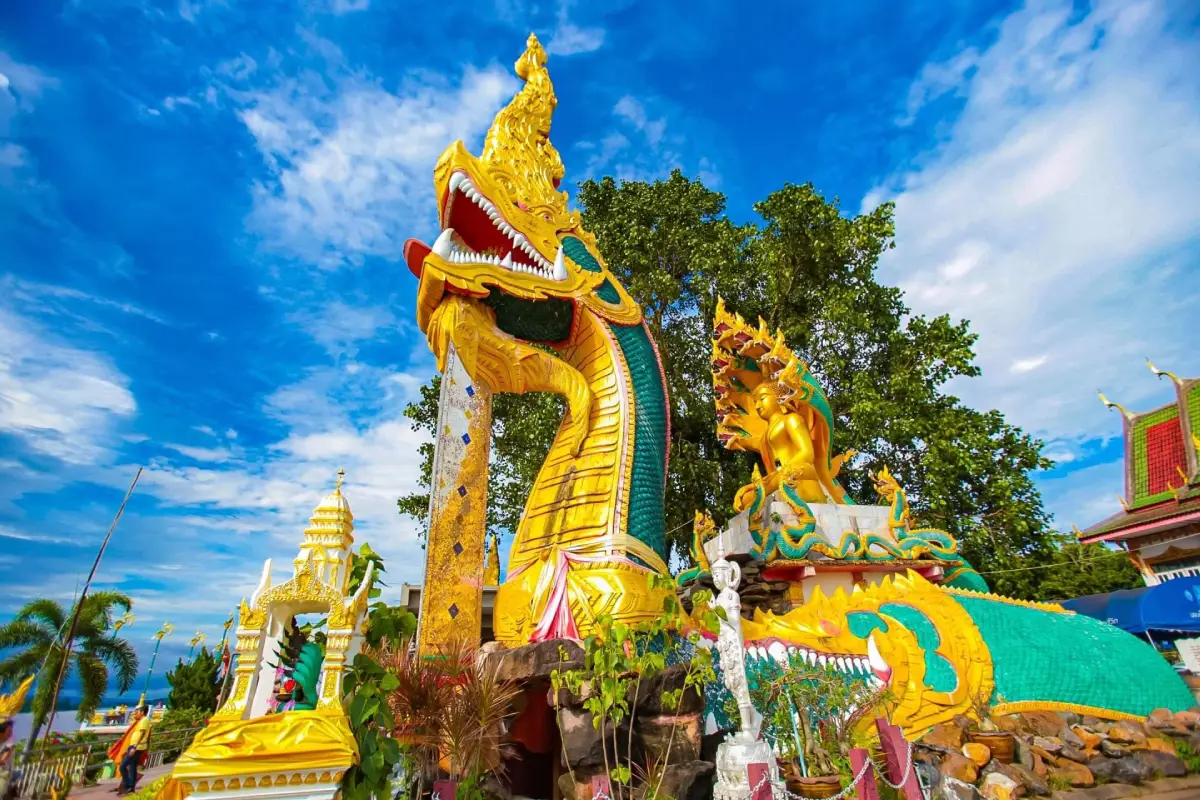
Wat Thai in Phon Phisai District, Nong Khai Province, is an old riverside Buddhist temple located at 327 Ban Chumphon, Phisai Soradet Road, Soi Sukkhaphiban 16, Moo 1, Chumphon Subdistrict. The temple belongs to the Mahanikaya order and has been part of the local community since 1777 CE, with its consecrated boundary granted in 1797 CE. Today, Wat Thai is widely known not only as an old community temple on the Mekong River, but also as the site of the Naga Cave, the simulated underwater city, the Naga King known as Nakarachaiyan, the nine-headed Naga, the Underwater City Gate, the symbolic pillar of the underwater realm, and one of Phon Phisai’s most important riverside areas for experiencing the Naga fireball tradition.
Wat Thai is a meaningful destination for travelers who want to understand Phon Phisai beyond ordinary sightseeing. The temple combines Buddhist devotion, old temple history, Mekong river culture, Naga mythology, and the identity of Phon Phisai as a town strongly associated with the Naga fireballs. Visitors can pay respect to the Buddha images, walk through the temple compound, see the Naga Cave and the simulated underwater city, and continue toward Lan Naka Boek Fa along the Mekong River. The experience is both spiritual and cultural, making the temple suitable for Thai pilgrims, cultural travelers, families, photographers, and foreign visitors interested in Isan beliefs.
The origin of the temple name is closely connected with local memory. Wat Thai was founded in 1777 CE. According to local tradition, it was established by officials from central Thailand who came to inspect the area, while the local residents were Isan people. Because villagers recognized the temple as one built by Thai officials from the central region, they came to call it Wat Thai. The name is therefore more than a general description. It reflects a historical encounter between officials, local residents, religion, and the Mekong borderland. This makes Wat Thai an interesting cultural site where the name itself tells part of the story.
The temple land covers 5 rai, 1 ngan, and 28 square wah. Its northern side borders Soi Sukkhaphiban 16, the southern side borders Soi Sukkhaphiban 15, the eastern side borders Phisai Soradet Road, and the western side meets the Mekong River. This location gives Wat Thai a special character. The front of the temple connects to the town and everyday community life, while the riverside side opens toward the Mekong, the sacred landscape most closely associated with Naga belief in Phon Phisai. The temple is therefore both an urban community temple and a riverside sacred site.
The temple compound includes an ordination hall measuring 11 meters wide and 21 meters long, a two-storey half-concrete and half-wood sermon hall built in 1876, a reinforced-concrete kitchen building built in 1986, and two monks’ residences. An important sacred object is a brick-and-stucco Buddha image with a lap width of 1.5 meters and a height of 2.50 meters. These elements show that Wat Thai has long functioned as a living Buddhist temple, supporting monastic activities, community gatherings, merit-making, worship, and festivals. It is not simply a tourist attraction, but an active religious space.
The temple’s strong connection with Naga belief is what makes it especially memorable. Phon Phisai is one of the most famous places in Thailand for the Naga fireball phenomenon, which is traditionally observed around the end of Buddhist Lent. The Mekong River in front of Wat Thai is believed by many local people to be connected with the underwater realm of the Naga. For this reason, the temple has become an important place where Buddhist faith, Naga mythology, and riverside community culture come together. Visitors who come here can see how belief is expressed through architecture, sculpture, ritual, and public space.
The creation of the Naga King known as Nakarachaiyan is one of the most distinctive stories associated with the temple. The inspiration for constructing the nine-headed Naga and the simulated underwater city began in 2007, the year Phon Phisai District marked the 100th anniversary of its town establishment. The abbot of Wat Thai at that time had a vision in which a black-bodied man and woman invited him to create symbols of the underwater Naga realm in the human world at Wat Thai. These symbols were intended to become sacred representations of the Naga city and spiritual supports for people who respected Buddhism and Naga belief.
The vision identified five major symbolic elements: a black Naga king standing as guardian of the Underwater City Gate, 19 meters high; a Naga form known as nak bat or naga-eating-naga, symbolizing the abundance of the town; a sacred triangular pillar of the underwater realm; the gateway into the underwater city; and a seven-room tunnel representing the underwater Naga city. The belief connected with the tunnel is that those who pass through it may succeed in what they sincerely wish for. These elements form a symbolic landscape rather than a simple decorative installation. They allow visitors to walk through a story of the Naga realm as imagined in local Mekong belief.
Phra Athikan Boonkwang Paphassaro played an important role in initiating and supporting the creation of the simulated underwater city and the Naga-related museum space at Wat Thai. The project was not presented as an act of grandeur, but as something meant to become a shared cultural and spiritual asset for the people of Phon Phisai and visitors from across Thailand. Through this work, the temple became a place where the story of the Naga city, the Mekong River, Buddhist faith, and the identity of Phon Phisai could be experienced in a physical and memorable way.
The Naga Cave or simulated underwater city is one of the main areas that attracts visitors. The space is designed to evoke the legendary world beneath the Mekong River. Its tunnels, Naga imagery, and symbolic rooms give visitors the feeling of entering another layer of reality between myth and faith. Passing through the cave is associated with auspiciousness, blessing, and the removal of obstacles. Visitors should walk through respectfully, avoid touching or climbing on sculptures, and follow all temple signs or instructions. The cave is a sacred cultural space, not merely a photo backdrop.
The nine-headed Naga and the Naga-protected Buddha imagery at Wat Thai also carry strong Buddhist meaning. In Buddhist tradition, the Naga is closely connected with the story of Mucalinda, the serpent king who sheltered the Buddha during meditation after enlightenment. In the Mekong region, this Buddhist image is further linked with local Naga belief, water, fertility, protection, and sacred rivers. At Wat Thai, the nine-headed Naga expresses protection, prosperity, abundance, and the spiritual bond between Buddhism and the underwater Naga world believed to exist beneath the Mekong.
In 2010, the creation of the nine-headed Naga-protected Buddha image connected with Luang Pho Yai of Wat Thai became another important expression of local faith. The project was linked with the identity of Phon Phisai as the town of the Naga fireballs and was blessed by respected monks from the upper Isan region. This reflects how Buddhist amulets, ritual blessing, Naga belief, and community identity can merge in the cultural life of the Mekong region. For visitors, these stories help explain why Naga symbols are so prominent in the temple.
The Mekong riverside in front of Wat Thai is a memorable part of the visit. On ordinary days, the area is suitable for walking, relaxing, taking photographs, and enjoying the river atmosphere. Around the end of Buddhist Lent, especially on the full moon night of the 11th lunar month, it becomes a major gathering place for people waiting to see the Naga fireballs. The phenomenon is part of local belief and annual cultural memory. The temple’s location allows visitors to experience not only religious art but also the living atmosphere of a riverside community during one of the most important periods of the year.
Lan Naka Boek Fa, located near Wat Thai, is another important landmark of Phon Phisai. It features a large Naga sculpture and an open riverside activity space used by local residents. In the evening, the area becomes a pleasant place for walking, exercise, photography, and enjoying the Mekong view. On some market days, especially Tuesday and Saturday, visitors may also find the Thai-Lao market atmosphere nearby. This makes the temple visit easy to combine with local food, riverside walking, and community life.
Wat Thai is suitable for several types of travelers. Buddhist visitors can come to make merit and pay respect to sacred images. Travelers interested in Naga belief can explore the Naga Cave, underwater city symbols, and riverside Naga sculptures. Cultural travelers can learn about the relationship between the Mekong River, Buddhism, and local mythology. Families can visit because the temple is accessible and located in the town area. Foreign visitors can use Wat Thai as a clear introduction to why the Naga is so important in Isan and Mekong culture.
Respectful behavior is important inside Wat Thai. Visitors should dress modestly, keep their voices at an appropriate level, avoid climbing on the Naga sculptures, the cave structures, religious buildings, or sacred objects, and refrain from touching images unnecessarily. During the Naga fireball festival or other crowded periods, visitors should allow extra time for traffic, parking, and walking. The temple is both a tourist attraction and an active Buddhist monastery, so respectful conduct helps preserve the dignity of the place.
The best time to visit Wat Thai is in the morning or late afternoon. Morning is suitable for merit-making and quiet temple walking, while late afternoon is ideal for riverside views, photography, and walking toward Lan Naka Boek Fa. Travelers who want to experience the Naga fireball atmosphere should visit during the end of Buddhist Lent, while those who prefer a quieter experience should come on weekdays or outside major festival periods. The temple is open daily, and a visit can take from 1 to 2 hours depending on how much time is spent in the Naga Cave and riverside area.
Getting There is convenient by private car, rental car, or local transport from Nong Khai city. Travelers can drive toward Phon Phisai District and enter the Chumphon Subdistrict area along Phisai Soradet Road. In digital navigation, enter Wat Thai Phon Phisai or Naga Cave Wat Thai. The temple is located by the Mekong River near Lan Naka Boek Fa. Travelers arriving by public transport can get off in Phon Phisai town and continue by local hired vehicle to the temple.
A half-day itinerary can begin with merit-making at Wat Thai, followed by a walk through the Naga Cave and simulated underwater city. Visitors can then continue to Lan Naka Boek Fa and the Mekong riverside before having a meal or coffee in Phon Phisai town. A full-day route can include Wat Luang Phisai Chetiyaram, Wat Mani Khot, the Thai-Lao market, and riverside restaurants. This combination allows travelers to experience Buddhist faith, Naga mythology, local food, and Mekong community life in a single trip.
For travelers interested in Naga culture, Wat Thai should be considered one of the central sites in Phon Phisai. It brings together the Naga Cave, Nakarachaiyan, the nine-headed Naga, the Naga fireball tradition, and the riverside festival landscape. Seeing all these elements in one place helps explain why Phon Phisai is strongly identified with Naga belief. It also shows how a local temple can become a cultural landmark that carries the memory and identity of an entire district.
Food options around Wat Thai include riverside restaurants, local eateries, coffee shops, bakeries, and simple chain restaurants in Phon Phisai town. Khong View Phon Phisai is a well-known local restaurant option with publicly listed contact numbers. Coffee shops such as PunThai Coffee and Café Amazon are convenient for short breaks, while restaurants and bakeries near the town center are suitable for families and travelers with limited time. Eating in Phon Phisai allows visitors to spend more time near the temple and Mekong riverside without returning immediately to Nong Khai city.
Accommodation is available in Phon Phisai and nearby areas. Staying in Phon Phisai is convenient for travelers who want to be close to the Naga fireball viewing area, especially during the end of Buddhist Lent. Riverside guesthouses and local hotels such as Keerawan House Rim Khong and Boontawee Hotel provide options near the district area. Travelers who prefer a wider range of hotels, restaurants, and transport services can stay in Nong Khai city and visit Wat Thai as a day trip. During festival periods, advance booking is strongly advisable because demand for rooms increases significantly.
For foreign visitors, Wat Thai is an excellent place to understand the relationship between Buddhism and local Isan belief. The Naga is not merely a mythical creature in the Mekong region. It represents water, abundance, protection, sacred rivers, and support for Buddhism. When visitors walk through the Underwater City Gate, see the Naga King, and stand by the Mekong River in front of the temple, they can understand how these beliefs are not only stories but also living cultural practices expressed through art, architecture, ritual, and public gathering.
Overall, Wat Thai is one of the most complete cultural and spiritual destinations in Phon Phisai. It has an old temple history dating to 1777 CE, long-standing community functions, Buddhist structures, sacred images, Naga sculptures, the Naga Cave, and a riverside landscape deeply connected with the Naga fireball tradition. A visit here is not only a temple visit but also a journey through the layered identity of Phon Phisai: Buddhism, the Mekong River, Naga mythology, community memory, and annual festival life.
Wat Thai deserves time and attention. Travelers who slow down, observe the details, and understand the stories behind the sculptures will see more than a riverside attraction. They will see how a local temple can preserve history, create cultural meaning, and provide a shared sacred space for residents and visitors. For anyone exploring Nong Khai’s spiritual and Mekong heritage, Wat Thai in Phon Phisai is one of the most meaningful places to include in the journey.
| Name | Wat Thai / Naga Cave Wat Thai |
| Location | Ban Chumphon, Chumphon Subdistrict, Phon Phisai District, Nong Khai Province |
| Address | 327 Ban Chumphon, Phisai Soradet Road, Soi Sukkhaphiban 16, Moo 1, Chumphon Subdistrict, Phon Phisai District, Nong Khai 43120, Thailand |
| Highlights | Old Mekong riverside temple, Naga Cave, simulated underwater city, Nakarachaiyan Naga King, nine-headed Naga, Naga fireball viewing area, and nearby Lan Naka Boek Fa |
| History | Founded in 1777 CE and granted its consecrated boundary in 1797 CE. Local tradition says the temple was built by officials from central Thailand, leading villagers to call it Wat Thai |
| Temple Land | 5 rai, 1 ngan, and 28 square wah. The western side borders the Mekong River, while the eastern side borders Phisai Soradet Road |
| Distinctive Features | Mahanikaya local Buddhist temple on the Mekong River, strongly connected with Buddhism, Naga mythology, the underwater city belief, and the Naga fireball tradition of Phon Phisai |
| Important Sacred Objects | Brick-and-stucco Buddha image with a lap width of 1.5 meters and height of 2.50 meters, Luang Pho Yai of Wat Thai, nine-headed Naga, and underwater city symbols |
| Temple Buildings | Ordination hall measuring 11 meters by 21 meters, two-storey half-concrete and half-wood sermon hall built in 1876, reinforced-concrete kitchen built in 1986, and two monks’ residences |
| Main Areas / Zones | Ordination hall Sermon hall Naga Cave / simulated underwater city Black Naga King guarding the Underwater City Gate Nak Bat or naga-eating-naga symbol Sacred triangular underwater-city pillar Underwater City Gate Seven-room tunnel of the simulated underwater realm Mekong riverside and Naga fireball viewing area |
| Abbot / Caretaker | Phra Khru Pariyatti Thammawaraphon, Dr. |
| Key Figure in the Underwater City Project | Phra Athikan Boonkwang Paphassaro |
| Travel Information | Best reached by private car, rental car, or local hired transport from Nong Khai city to Phon Phisai District. Use digital navigation to Wat Thai Phon Phisai or Naga Cave Wat Thai |
| Current Status | Active local Buddhist temple and Mekong riverside spiritual attraction |
| Open Days | Daily |
| Opening Hours | 07.00 – 18.00 |
| Fees | No admission fee |
| Facilities | Worship areas, temple courtyard, Mekong viewpoint, parking area within the temple compound, sermon hall, kitchen building, and festival activity space |
| Local Administrative Contact | Phon Phisai Municipality, Tel. 042-471711-3, 042-471090 |
| Nearby Tourist Attractions | 1. Lan Naka Boek Fa, about 0.2 km 2. Phaya Phisai Sattanakharat, about 0.2 km 3. Thai-Lao Market Phon Phisai, about 0.5 km 4. Wat Luang Phisai Chetiyaram, about 1 km 5. Wat Mani Khot, about 2 km 6. Phon Phisai Mekong Naga Fireball Viewing Area, about 0 km |
| Nearby Restaurants | 1. Khong View Phon Phisai, about 3 km, Tel. 095-241-9754, 092-659-6040 2. PunThai Coffee Phon Phisai, about 2 km, Tel. 080-929-2592 3. Café Amazon PTT Phon Phisai, about 3 km, Tel. 042-471-585 4. Baan Cake Phon Phisai, about 1 km, Tel. 080-421-2199 5. KFC Asawann Phon Phisai, about 2 km, Tel. 061-389-6134 |
| Nearby Accommodations | 1. Keerawan House Rim Khong, about 2 km, Tel. 081-692-4754, 042-472-155 2. Boontawee Hotel, about 2 km, Tel. 096-879-2615 3. PUBPUENG Resort, about 18 km 4. Beung Khong Resort Ban Si Kai Tai, about 21 km, Tel. 082-865-4815 5. Viengkham Resort Phon Phisai, about 4 km, Tel. 090-192-7319, 065-329-5939 |
Frequently Asked Questions (FAQ)
Q: Where is Wat Thai in Phon Phisai located?
A: Wat Thai is located at 327 Ban Chumphon, Phisai Soradet Road, Soi Sukkhaphiban 16, Moo 1, Chumphon Subdistrict, Phon Phisai District, Nong Khai Province, beside the Mekong River near Lan Naka Boek Fa.
Q: What are the opening days and hours of Wat Thai?
A: Wat Thai is open daily from 07.00 to 18.00. Morning and late afternoon are the best times for worship, walking through the Naga Cave, and enjoying the Mekong riverside view.
Q: Is there an admission fee at Wat Thai?
A: No. Wat Thai has no admission fee. Visitors can enter the temple compound, pay respect to sacred images, and walk through the simulated underwater city during opening hours.
Q: What is the main highlight of Wat Thai?
A: The main highlights are the Naga Cave, simulated underwater city, Nakarachaiyan Naga King, nine-headed Naga, sacred underwater-city symbols, and the Mekong riverside Naga fireball viewing area.
Q: How is Wat Thai connected with the Naga fireballs?
A: Wat Thai stands beside the Mekong River in Phon Phisai, one of the most famous areas for witnessing the Naga fireballs during the end of Buddhist Lent. Local belief connects the river in front of the temple with the underwater Naga realm.
Q: Who is the abbot of Wat Thai?
A: The abbot of Wat Thai is Phra Khru Pariyatti Thammawaraphon, Dr.
Q: How can travelers get to Wat Thai?
A: Travelers can reach the temple by private car, rental car, or local transport from Nong Khai city to Phon Phisai District. In digital maps, enter Wat Thai Phon Phisai or Naga Cave Wat Thai as the destination.
Q: What nearby places can be visited with Wat Thai?
A: Nearby places include Lan Naka Boek Fa, Phaya Phisai Sattanakharat, the Thai-Lao Market, Wat Luang Phisai Chetiyaram, Wat Mani Khot, and the Phon Phisai Mekong Naga Fireball Viewing Area.
 Category: ●Places of Worship
 Group: ●Temple
Last Update : 2 MonthAgo
 Last Update : 2 MonthAgo
 Click to Access the Navigation Map GPS
 Art, Culture and Heritage
 Historical Sites and Monuments(1)
 Landmarks and Memorials(2)
 Art, Craft Centres, Tradition(1)
 Educational Places
 Educational Gardens, Farm(1)
Temple(16)
Educational Gardens, Farm(1)
Temple(16)
 Mosque(1)
 Other Sacred Sites(8)
 Suburban Living
 Village, Community(3)
 Local Market(4)
 Nature and Wildlife
 National Parks and Marine Reserves(2)
 Dam, Reservoir, Lake(2)
 Waterfalls(4)
 River, Canal(8)
 Bays and Beaches(1)
 Entertainment and Agricultural
 Farms, Parks and Ecotourism(2)
 Shopping
 Shopping and Night Market(1)


