
lovethailand home >Northeastern Travel Attractions >Nong Khai Travel Attractions >Muang Nongkhai >Nai Muang > Wat Pho Chai
TL;DR: Wat Pho Chai is located at Nai Mueang Subdistrict, Mueang Nong Khai District, Nong Khai Province, open Daily, hours 08.00 – 16.30.
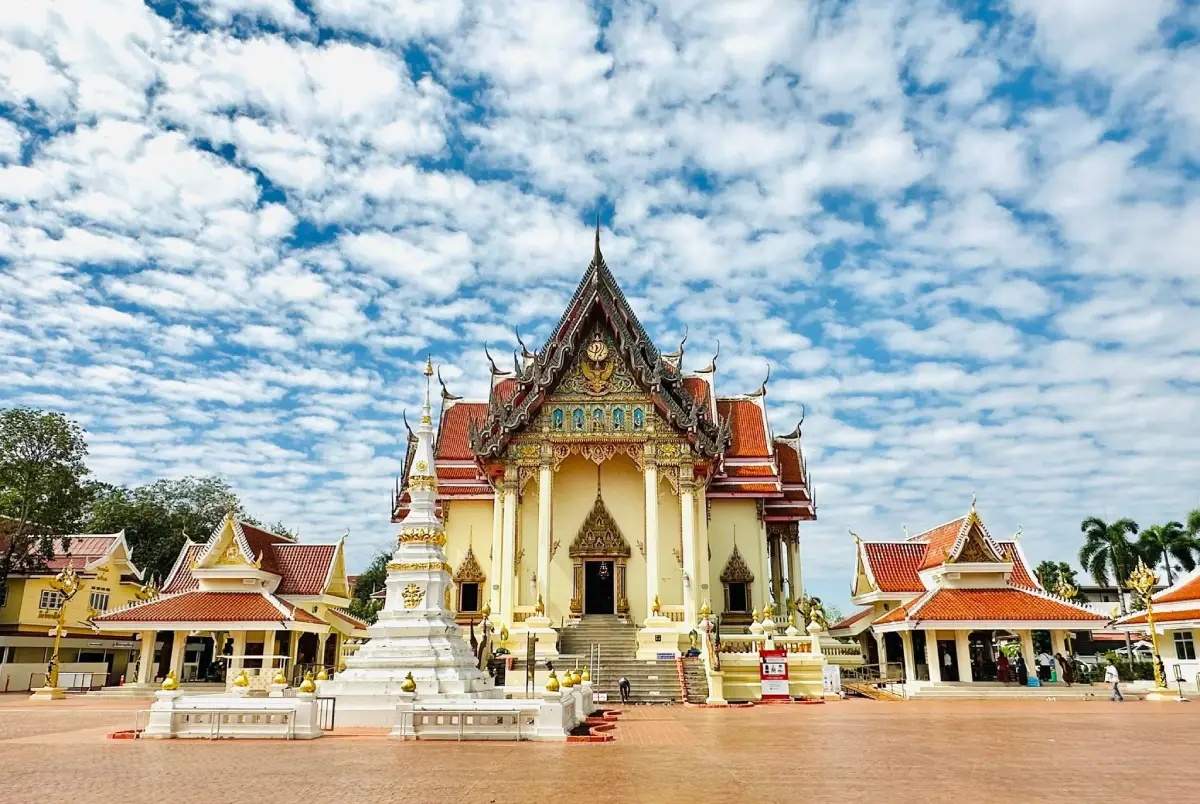
Wat Pho Chai
Open Days: Daily
Opening Hours: 08.00 – 16.30
Wat Pho Chai in Nong Khai is one of the most important royal temples in Nong Khai Province and one of the most meaningful Buddhist pilgrimage sites along Thailand’s Mekong border. Located in Nai Mueang Subdistrict, Mueang Nong Khai District, the temple is best known as the home of Luang Pho Phra Sai, the sacred Buddha image deeply revered as the spiritual symbol of Nong Khai. The temple is open daily for worship, merit-making, cultural visits, and sightseeing. For travelers, Wat Pho Chai is not only a place to pay respect to an important Buddha image, but also a place to understand the history of Nong Khai, the Lan Xang cultural world, Thai-Lao connections, and the living religious traditions of the Mekong region.
Wat Pho Chai should be included in almost every Nong Khai itinerary because it brings together faith, history, art, and local identity in one accessible site. Visitors can pay respect to Luang Pho Phra Sai inside the ordination hall, admire the temple’s Buddhist art, observe local worship practices, and continue easily to nearby places such as Tha Sadet Market, Phra That Klang Nam, the Mekong riverside Naga landmark, Prap Ho Monument, Sala Keoku, and the First Thai–Lao Friendship Bridge. For foreign travelers, the temple provides a clear and memorable introduction to Nong Khai as a city of Buddhism, border culture, and Mekong heritage.
The temple was formerly known as Wat Phi Phiu. Historical accounts describe it as an old temple site in the Ban Phai area that had once fallen into disuse. Although its exact founding date is not clearly recorded, it is believed to have been connected with the wider religious landscape of Vientiane and the Mekong region. During the Rattanakosin period, when Nong Khai developed as an important frontier town, the abandoned temple was restored under the support of local leaders and the Sangha. It was renamed Wat Pho Chai, a more auspicious name that conveys prosperity, sacredness, and victory through faith.
The importance of Wat Pho Chai grew greatly through its connection with sacred Buddha images brought from the Lao side of the Mekong. Local legend tells of 3 important Buddha images: Phra Suk, Phra Soem, and Phra Sai. These images were said to have been cast by 3 daughters of a Lan Xang king and named after them. The images were originally enshrined in the Vientiane region and were venerated by communities on both sides of the Mekong. This legend gives Luang Pho Phra Sai a deep connection with Lan Xang, Laos, and the shared Buddhist world of the Mekong basin.
During the reign of King Rama III, the 3 Buddha images were brought across the Mekong toward Nong Khai in connection with historical events in Vientiane. According to tradition, Phra Suk sank into the Mekong during the journey, at a place remembered as Woen Phra Suk or Woen Suk. Phra Soem and Phra Sai reached Nong Khai. Later, during the reign of King Rama IV, Phra Soem was taken to Bangkok and is now enshrined at Wat Pathum Wanaram. Phra Sai, however, remained in Nong Khai and became the sacred heart of Wat Pho Chai.
The most famous part of the Luang Pho Phra Sai legend is the story of the broken cart. When officials attempted to take Phra Sai to Bangkok together with Phra Soem, the cart carrying Phra Sai could not continue after reaching the area of Wat Pho Chai. Despite repeated efforts, the cart would not move and eventually broke. The people interpreted this as a sign that Luang Pho Phra Sai wished to remain in Nong Khai. The image was therefore enshrined at Wat Pho Chai, where it has remained ever since. This story is why Luang Pho Phra Sai is also remembered with the affectionate devotional title connected with the broken cart miracle.
Luang Pho Phra Sai is a seated Buddha image in the Mara Vijaya posture, sitting in meditation with a serene and dignified appearance. The image is cast in a golden-toned metal known in Thai descriptions as thong si suk. Its style is associated with Lan Xang Buddhist art, showing grace, calmness, balance, and spiritual presence. The Buddha’s expression is gentle yet powerful, and the image has long been believed to bring peace, protection, and blessings to worshippers. The atmosphere inside the ordination hall is therefore deeply devotional, especially when visitors offer flowers, incense, candles, garlands, and scented water.
The ordination hall is the heart of Wat Pho Chai. It houses Luang Pho Phra Sai and serves as the main space for worship and important ceremonies. Inside, visitors can also appreciate Buddhist murals and decorative details that reflect religious stories, local life, and the cultural world of the Mekong. The hall is not simply an architectural space; it is a living sacred place where local residents, pilgrims, monks, and travelers meet through shared reverence.
On ordinary days, Wat Pho Chai has a calm and orderly atmosphere. Visitors come to pray, make merit, light incense, offer flowers, or sit quietly before the sacred image. The temple grounds include open spaces, worship areas, offering points, nearby shops, and parking areas in the surrounding urban zone. Because the temple is located in central Nong Khai, it is easy to reach by private car, local tuk-tuk, motorized tricycle, taxi, or local transport from the railway station, bus terminal, riverside hotels, and the Tha Sadet Market area.
For the people of Nong Khai, Wat Pho Chai is more than a tourist attraction. It is a spiritual center woven into family life and public life. Many residents come to pay respect to Luang Pho Phra Sai on birthdays, before major journeys, before examinations, before starting a new job, during important family moments, and on Buddhist holy days. This continuing devotion shows that the temple remains a living part of the city, not a monument separated from everyday life.
As a royal temple, Wat Pho Chai also plays an important role in provincial religious ceremonies and Sangha administration. It is connected with important Buddhist events, royal merit-making, Kathin ceremonies, public worship, provincial ceremonies, and annual festivals related to Luang Pho Phra Sai. The current abbot is Phra Thep Wachirakhun, Assoc. Prof. Dr. Phisit Suviro, who also serves as the ecclesiastical chief of Nong Khai Province. This reflects the temple’s continuing importance within both the religious and civic life of Nong Khai.
One of the temple’s most important annual traditions is the Luang Pho Phra Sai Songkran Festival. Every April, during the Thai New Year period, Luang Pho Phra Sai is ceremonially invited down from the ordination hall, placed on a decorated procession vehicle, and carried around Nong Khai city. Local people and visitors gather along the route to pour scented water over the sacred image for blessings. This festival preserves the deeper meaning of Songkran as a time for Buddhist merit-making, respectful water pouring, renewal, and gratitude, rather than only public water play.
Another major tradition connected with Wat Pho Chai is the Bun Bang Fai ceremony in honor of Luang Pho Phra Sai. This event takes place around the seventh lunar month. On the 14th waxing moon of the seventh lunar month, local communities bring rockets to Wat Pho Chai in a procession and carry them around Luang Pho Phra Sai 3 times. In the evening, people listen to sermons, perform candlelight circumambulation, and celebrate through the night. On the 15th waxing moon, the full moon day of the seventh lunar month, monks and novices receive food offerings, the rockets are carried around the ordination hall, and the rocket launching begins as an act of devotion to Luang Pho Phra Sai.
The Bun Bang Fai tradition at Wat Pho Chai is special because it combines the agricultural rocket tradition of Isan with devotion to the city’s sacred Buddha image. In many parts of northeastern Thailand, Bun Bang Fai is associated with asking the sky deity for seasonal rain and agricultural abundance. In Nong Khai, the ritual gains another layer of meaning through the offering to Luang Pho Phra Sai. The ceremony therefore expresses faith, rainfall hopes, community unity, temple identity, and local heritage all at once.
For travelers interested in living culture, visiting Wat Pho Chai during Songkran or Bun Bang Fai provides a much deeper experience than visiting on an ordinary day. During Songkran, visitors can witness the ceremonial descent and city procession of Luang Pho Phra Sai. During Bun Bang Fai, they can see rocket processions, devotional rites, candlelight ceremonies, sermons, and the participation of local communities. These events show that Wat Pho Chai is not only a historic temple; it is a living cultural center that continues to shape the rhythm of Nong Khai life.
A normal visit to Wat Pho Chai can take 30 minutes to 1 hour for worship, photography, and a short walk around the temple. Travelers who want to look carefully at the murals, read the temple’s history, observe the architecture, and combine the visit with nearby riverside attractions should allow around 2 hours. The best times to visit are morning or late afternoon, when the weather is more comfortable and the light is softer for photography.
Visitors should dress respectfully because Wat Pho Chai is a royal temple and a sacred place. Clothing should cover shoulders and knees, and behavior inside the ordination hall should be calm and considerate. Visitors should avoid loud conversations, disruptive photography, touching the Buddha image, or blocking worshippers. During festivals, extra care is needed because crowds are larger, roads may be busier, and some areas may be reserved for ceremonies and processions.
The main areas of the temple include the ordination hall enshrining Luang Pho Phra Sai, the front courtyard, offering areas for flowers and incense, ceremonial areas around the ordination hall, the Luang Pho Phra Sai pavilion area, the temple’s sacred structures, nearby shops, and visitor facilities. During Songkran and Bun Bang Fai, some of these areas become procession routes, ritual spaces, and gathering zones for worshippers and local communities.
Travelers should also pay attention to the historical meaning of the temple. The story of Phra Suk, Phra Soem, and Phra Sai reveals the deep relationship between Thailand, Laos, Lan Xang, and the Mekong River. The movement of sacred Buddha images across the river reflects historical change, political events, and enduring devotion. The fact that Luang Pho Phra Sai remained in Nong Khai gives the city a powerful spiritual identity that continues to this day.
Wat Pho Chai is also suitable for foreign travelers who want to understand Buddhism in everyday Thai life. The temple shows how local people worship, make offerings, join temple ceremonies, and connect major festivals with community identity. A visit during Songkran or Bun Bang Fai is especially meaningful because it reveals the temple as a living public space where religion, history, family life, and local culture come together.
Getting to Wat Pho Chai is easy from central Nong Khai. Visitors can follow Prachak Silapakhom Road or local city roads toward the temple. From Nong Khai Railway Station or the bus terminal, local tuk-tuks, motorized tricycles, taxis, and local transport are available. Travelers driving from Mittraphap Road should enter Nong Khai city and follow signs toward Wat Pho Chai or Luang Pho Phra Sai. During major festivals, visitors should allow extra time for traffic and parking.
Getting There is best planned as part of a cultural route through Nong Khai city. Begin at Wat Pho Chai in the morning to pay respect to Luang Pho Phra Sai, then continue to Tha Sadet Market, Phra That Klang Nam, the Mekong Naga landmark, Prap Ho Monument, and riverside restaurants. With more time, travelers can continue to Sala Keoku and the First Thai–Lao Friendship Bridge. This route is suitable for families, cultural travelers, Buddhist pilgrims, and foreign visitors interested in the Mekong border region.
Dining around Wat Pho Chai is convenient. Nong Khai is known for Vietnamese-influenced food, Isan dishes, Mekong fish, naem nueang, Vietnamese-style noodles, larb, nam tok, papaya salad, grilled chicken, and riverside Thai restaurants. After worshipping at the temple, visitors can easily continue to local restaurants near the Mekong riverside, Tha Sadet Market, or central Nong Khai. During festival periods, popular restaurants can be busy, so travelers should plan meal times carefully.
Accommodation near Wat Pho Chai includes guesthouses along the Mekong, hotels in the city center, hostels, riverside properties, and mid-range hotels near main roads. Staying near the city center is convenient for walking to the riverside, joining temple events, and visiting Tha Sadet Market. Travelers who plan to continue to the First Thai–Lao Friendship Bridge or Nong Khai Railway Station should choose accommodation with easy access to main roads or local transport.
Overall, Wat Pho Chai is one of the most important cultural and spiritual sites in Nong Khai Province. Luang Pho Phra Sai gives the temple its sacred identity, while the temple’s history connects Nong Khai with Lan Xang, Vientiane, Thai-Lao relations, and Mekong Buddhist culture. The Songkran procession and Bun Bang Fai ceremony show that the temple remains a living center of community devotion. A visit here offers more than a beautiful temple; it offers a deeper understanding of Nong Khai itself.
For anyone visiting Nong Khai, Wat Pho Chai deserves a place in the itinerary. It connects travelers with sacred art, local faith, royal temple history, Mekong legends, and annual traditions that continue to bring the city together. To understand why Luang Pho Phra Sai is so deeply loved by the people of Nong Khai, the best answer is to visit the temple, stand quietly before the Buddha image, and experience the calm power of this sacred place for yourself.
| Name | Wat Pho Chai, Nong Khai |
| Thai Name | วัดโพธิ์ชัย หนองคาย |
| Location | Nai Mueang Subdistrict, Mueang Nong Khai District, Nong Khai Province |
| Address | Prachak Silapakhom Road / Soi Phra Sai, Nai Mueang Subdistrict, Mueang Nong Khai District, Nong Khai 43000, Thailand |
| Coordinates | Plus Code: VQP4+6HM, Nai Mueang, Mueang Nong Khai District, Nong Khai |
| Highlights | A major royal temple in Nong Khai enshrining Luang Pho Phra Sai, the province’s sacred Buddha image, and serving as the center of the Luang Pho Phra Sai Songkran procession and Bun Bang Fai ceremony |
| History | Formerly known as Wat Phi Phiu, the temple was restored and renamed Wat Pho Chai during the Rattanakosin period. It was elevated to a third-class royal temple of the common type on 24 August 1981. |
| Name Origin | The name Wat Pho Chai carries auspicious meanings of prosperity, sacredness, and victory through faith, replacing the temple’s former name after restoration. |
| Distinctive Features | The ordination hall enshrines Luang Pho Phra Sai and features Buddhist art and murals reflecting Buddhist stories, Mekong culture, and Nong Khai devotion. |
| Key Sacred Object | Luang Pho Phra Sai, a seated Buddha image in the Mara Vijaya posture, cast in golden-toned metal and associated with Lan Xang Buddhist art and the legend of Phra Suk and Phra Soem |
| Travel Information | From central Nong Khai, follow Prachak Silapakhom Road or local city roads to the temple. From the railway station or bus terminal, visitors can use a local tuk-tuk, motorized tricycle, taxi, or local transport. |
| Current Status | Open for worship and tourism as a royal temple and the spiritual center of Luang Pho Phra Sai devotion in Nong Khai Province |
| Open Days | Daily |
| Opening Hours | 08.00 – 16.30 |
| Fees | No admission fee |
| Facilities | Parking areas, worship areas, flower and incense offering points, restrooms, nearby shops and restaurants, waiting areas, and local transport services in the city |
| Main Areas / Zones | 1. Ordination hall enshrining Luang Pho Phra Sai 2. Front courtyard and worship area 3. Luang Pho Phra Sai pavilion area 4. Flower, incense, scented water, and offering areas 5. Area around the ordination hall for candlelight circumambulation and processions 6. Relic and temple structure areas 7. Festival spaces for the Luang Pho Phra Sai Songkran procession and Bun Bang Fai ceremony |
| Abbot / Caretaker | Phra Thep Wachirakhun, Assoc. Prof. Dr. Phisit Suviro, Abbot of Wat Pho Chai Phra Aram Luang and Ecclesiastical Provincial Governor of Nong Khai |
| Main Contact Number | Wat Pho Chai Tel. 042-461123 / Nong Khai Ecclesiastical Provincial Office Tel. 084-796-9143 |
| Major Traditions | 1. Luang Pho Phra Sai Songkran Festival in April 2. Bun Bang Fai ceremony in honor of Luang Pho Phra Sai from the 14th to the 15th waxing moon of the seventh lunar month 3. Buddhist holy day ceremonies and candlelight circumambulation |
| Official Website / Official Page | Wat Pho Chai Phra Aram Luang Nong Khai / Nong Khai Ecclesiastical Provincial Office / Nong Khai Provincial Office of Buddhism |
| Nearby Tourist Attractions | 1. Pho Chai Market, about 0.5 km 2. Phra That Klang Nam / Phra That La Nong, about 1 km 3. Tha Sadet Market, about 1 km 4. Mekong Naga Landmark in front of Wat Lamduan, about 2 km 5. Prap Ho Monument, about 2 km 6. First Thai–Lao Friendship Bridge, about 5 km 7. Sala Keoku, about 5 km 8. Nong Khai Aquarium, about 13 km, Tel. 042-415623 |
| Nearby Restaurants | 1. Macky’s Riverside Kitchen, about 1 km, Tel. 097-109-1022 2. Daeng Namnuang Nong Khai, about 1 km, Tel. 042-411-961 3. Chai Khong Restaurant, about 1 km, Tel. 042-412-308 4. Krua Wun Duean Phen, about 2 km, Tel. 042-465-264, 095-653-9393 5. Nomu.ya Nong Khai, about 2 km, Tel. 061-026-7531 |
| Nearby Accommodations | 1. Mut Mee Garden Guest House, about 1 km, Tel. 042-460-717 2. Na Rim Khong River View, about 1 km, Tel. 042-412-077, 064-313-6999 3. Amanta Hotel Nongkhai, about 2 km, Tel. 042-412-899 4. Asawann Hotel Nong Khai, about 3 km, Tel. 042-464-514 5. Royal Nakhara Hotel & Convention Centre Nongkhai, about 4 km, Tel. 042-422-889 6. HOP INN Nong Khai, about 4 km, Tel. 042-413-599 |
Frequently Asked Questions (FAQ)
Q: Is Wat Pho Chai in Nong Khai open to visitors?
A: Yes. Wat Pho Chai is open daily from 08.00 to 16.30 for worship, merit-making, and cultural visits.
Q: Is there an admission fee for Wat Pho Chai?
A: No. There is no admission fee to visit the temple or pay respect to Luang Pho Phra Sai.
Q: Why is Wat Pho Chai important?
A: Wat Pho Chai is an important royal temple in Nong Khai and the home of Luang Pho Phra Sai, the sacred Buddha image revered as the spiritual symbol of the province.
Q: What is the legend of Luang Pho Phra Sai connected with?
A: The legend is connected with 3 sacred Lan Xang Buddha images: Phra Suk, Phra Soem, and Phra Sai. Phra Sai remained in Nong Khai and is now enshrined at Wat Pho Chai.
Q: When is the Bun Bang Fai ceremony for Luang Pho Phra Sai held?
A: It is held from the 14th to the 15th waxing moon of the seventh lunar month. The ceremony includes a rocket procession to Wat Pho Chai, circumambulation around Luang Pho Phra Sai, sermons, candlelight worship, and rocket launching in honor of the sacred image.
Q: How is the Luang Pho Phra Sai Songkran Festival related to Wat Pho Chai?
A: During Songkran, Luang Pho Phra Sai is ceremonially invited from the ordination hall and carried around Nong Khai city so that people can pour scented water over the image for Thai New Year blessings.
Q: What should visitors wear when visiting Wat Pho Chai?
A: Visitors should dress modestly and respectfully, as the temple is a royal temple and an active sacred site. Shoulders and knees should be covered, and behavior inside the ordination hall should be calm and considerate.
Q: What nearby places can be visited after Wat Pho Chai?
A: Nearby places include Tha Sadet Market, Phra That Klang Nam, the Mekong Naga Landmark, Prap Ho Monument, Sala Keoku, and the First Thai–Lao Friendship Bridge.
 Category: ●Places of Worship
 Group: ●Temple
Last Update : 2 MonthAgo
 Last Update : 2 MonthAgo
 Click to Access the Navigation Map GPS
 Art, Culture and Heritage
 Historical Sites and Monuments(1)
 Landmarks and Memorials(2)
 Art, Craft Centres, Tradition(1)
 Educational Places
 Educational Gardens, Farm(1)
Temple(16)
Educational Gardens, Farm(1)
Temple(16)
 Mosque(1)
 Other Sacred Sites(8)
 Suburban Living
 Village, Community(3)
 Local Market(4)
 Nature and Wildlife
 National Parks and Marine Reserves(2)
 Dam, Reservoir, Lake(2)
 Waterfalls(4)
 River, Canal(8)
 Bays and Beaches(1)
 Entertainment and Agricultural
 Farms, Parks and Ecotourism(2)
 Shopping
 Shopping and Night Market(1)


