
lovethailand home >Central Travel Attractions >Samut Songkhram Travel Attractions > 20 Best Places to Visit in Samut Songkhram Central..
TL;DR: 20 Best Places to Visit in Samut Songkhram Central Thailand, open Friday – Sunday Opening Hours: 10:00 – 20:30.
20 Best Places to Visit in Samut Songkhram Central Thailand
20 Best Places to Visit in Samut Songkhram, Central Thailand Samut Songkhram is a small province in Central Thailand where riverside towns, old markets, coconut orchards, religious sites, history, and the Mae Klong estuary ecosystem are all concentrated within a relatively compact area. Nationally known highlights include Amphawa Floating Market, Mae Klong Railway Market, Don Hoi Lot, Wat Bang Kung, King Rama II Memorial Park, Tha Kha Floating Market, Wat Chulamanee, Wat Phet Samut Worawihan, the Khlong Khon mangrove conservation area, and Bang Noi Floating Market. Travelers with only 1 day should focus on the Mae Klong–Amphawa route, while those with 2–3 days can add Bang Khonthi, Tha Kha, Khlong Khon, and Don Hoi Lot for a more complete experience of history, religion, local culture, orchard communities, and coastal nature.
Samut Songkhram lies in the Mae Klong River basin, close to the point where the river flows into the Gulf of Thailand. Most of the province consists of low-lying plains crossed by an extensive network of rivers and canals that run through coconut plantations, fruit orchards, riverside communities, and coastal areas. This geography has shaped settlement patterns, occupations, cuisine, and local culture for generations, creating a province whose identity remains closely tied to water.
Although Samut Songkhram is small in area, it holds considerable importance in Thai history. Amphawa and Bang Chang are associated with the Chakri Dynasty and the life of King Rama II, while Bang Khonthi contains old temples, canal communities, and historical sites linked to Bang Kung Camp. Mae Klong developed through trade, fishing, and river transportation before the railway added another layer to the local economy and ultimately created the extraordinary image of Mae Klong Railway Market, now one of Thailand’s best-known attractions among international visitors.
Another important aspect of Samut Songkhram is the orchard lifestyle found around Amphawa and Tha Kha. Produce from coconut groves and fruit orchards was traditionally transported by boat to local floating markets. These markets therefore evolved from the real economic life of orchard communities rather than being created purely for tourism. Today, several still retain scenes of paddle boats, fruit, local dishes, coconut sugar, and traditional wooden houses lining the canals.
Samut Songkhram cuisine combines seafood from the estuary and the Gulf of Thailand with ingredients from local orchards, including coconut, coconut sugar, seasonal fruit, and traditional Thai sweets. Amphawa Floating Market, Tha Kha Floating Market, Bang Noi Floating Market, and Mae Klong Market are excellent places to sample local food, while Don Hoi Lot is particularly associated with razor clams and seafood directly connected to the estuarine ecosystem.
In terms of art and culture, the province has significant Buddhist temples including Wat Phet Samut Worawihan, Wat Chulamanee, and Wat Bang Kung. These places are not only centers of worship but also illustrate developments in architecture, decorative arts, belief, and the relationship between religious institutions and riverside communities. Wat Chulamanee is also closely connected with the history of Bang Chang and has become one of Thailand’s best-known places for paying respect to Thao Wessuwan.
The natural environment of Samut Songkhram differs from destinations known for mountains or waterfalls. Its defining landscapes are river mouths, wetlands, mangrove forests, tidal flats, and coastal communities. Don Hoi Lot is an important example of a muddy-sandy tidal flat ecosystem that supports many aquatic species, while Khlong Khon is widely known for community-based mangrove restoration and conservation activities.
For trip planning, the province can be divided into several practical zones. Mae Klong is best for Mae Klong Railway Market, Wat Phet Samut Worawihan, and central-town attractions. Amphawa is ideal for Amphawa Floating Market, King Rama II Memorial Park, Wat Chulamanee, and Tha Kha Floating Market. Bang Khonthi is suitable for Wat Bang Kung, Bang Noi Floating Market, and old canal communities, while the coastal zone is best for Don Hoi Lot and Khlong Khon. Planning by zone helps reduce backtracking and gives each day a distinctive atmosphere.
Travel from Bangkok is convenient by car via Rama II Road, followed by Highway 325 toward Amphawa and Bang Khonthi. Travelers seeking a more local experience can take the Wongwian Yai–Mahachai train, cross the river to Ban Laem, and continue by train to Mae Klong Station, where the railway runs directly through Mae Klong Railway Market. A private car is more practical for combining Khlong Khon, Don Hoi Lot, Tha Kha, and multiple attractions in Bang Khonthi in the same day.

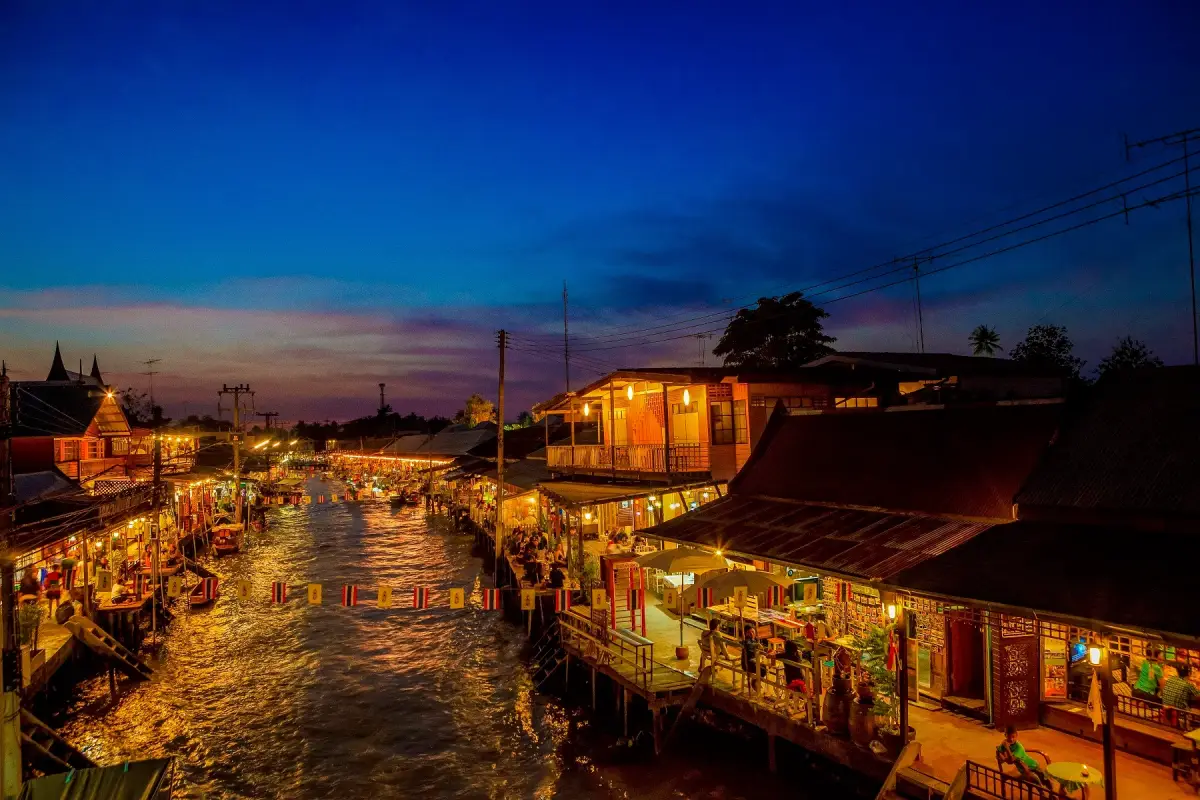
1. Amphawa Floating Market is one of the most famous attractions in Samut Songkhram. Located along Amphawa Canal in Amphawa Subdistrict, the market is particularly distinctive because its atmosphere becomes increasingly lively from late morning into the evening and night. Visitors can walk past historic wooden shophouses, restaurants, souvenir stalls, canal-side homes, and food boats that have become an enduring image of Amphawa.
Highlights: Historic wooden shophouses, local restaurants and snacks, food boats, evening atmosphere, canal cruises, Amphawa community life, and a location within easy walking distance of King Rama II Memorial Park.
Amphawa historically developed as a trading and agricultural community closely connected with the canal system. Before roads became the dominant form of transport, orchard owners in the surrounding area used boats to move produce, exchange goods, and travel between communities. Traces of this way of life remain visible in the wooden houses, canal-side walkways, landing steps, and trading activities that continue to use the waterway as a defining feature.
Food is one of the market’s main attractions. Visitors can try seafood, noodles, Thai sweets, drinks, local dishes, and orchard products from shops on land as well as vendors operating from boats. By evening, the area shifts from a daytime community market into a lively riverside destination illuminated by shop lights and filled with visitors strolling along the canal.
The old buildings and canal-side community are also valuable examples of vernacular architectural conservation. Many wooden houses continue to function as shops, guesthouses, restaurants, and private residences, allowing visitors to experience a living historic district rather than a tourism zone created solely for display.
Families can explore the market easily, although children should be supervised near canal edges and piers. Older travelers may prefer to arrive before the busiest evening period. For photography, late afternoon through sunset provides attractive natural light for wooden houses and canal scenes.
Amphawa Floating Market combines well with King Rama II Memorial Park, Wat Chulamanee, and Wat Bang Kung. Staying overnight in Amphawa allows more time to explore the market, canal communities, and nearby cultural attractions without rushing through the area.
Open Days: Friday – Sunday Opening Hours: 10:00 – 20:30
Getting There: From Bangkok, take Rama II Road toward Samut Songkhram, then Highway 325 toward Amphawa. Follow signs to the floating market and use one of the parking areas around the town before continuing on foot.
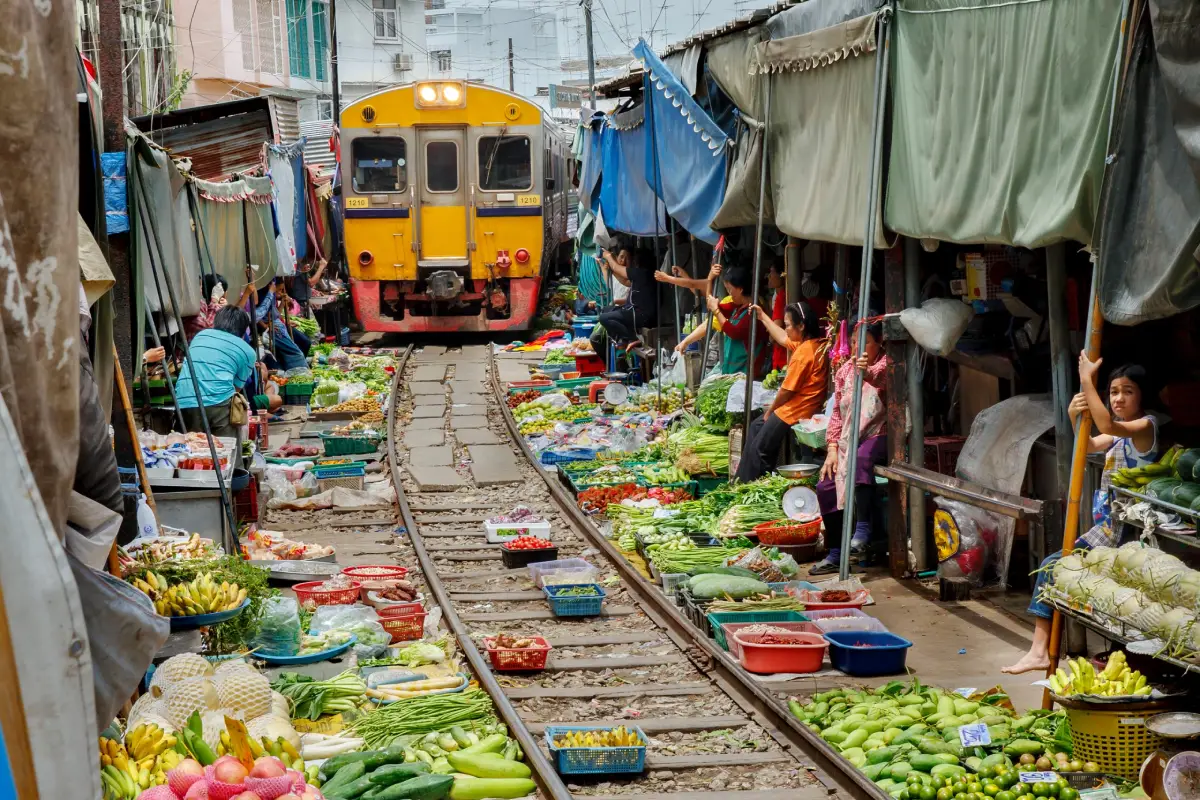
2. Mae Klong Railway Market (Rom Hoop Market), also known as the Umbrella Pulldown Market, is located beside Mae Klong Railway Station and is one of the most unusual markets in Thailand. Market stalls stand immediately beside the active railway tracks. When a train approaches, vendors quickly fold their umbrellas, retract awnings, and move goods away from the rails before returning everything to its original position almost immediately after the train has passed.
Highlights: Trains passing directly through the market, vendors folding umbrellas and moving displays, Mae Klong Railway Station, a working local fresh market, seafood, vegetables, fruit, snacks, and the Ban Laem–Mae Klong railway experience.
The market is interesting even when no train is passing because it remains a genuine fresh market serving Mae Klong residents. Stalls sell vegetables, fruit, meat, fresh seafood, cooking ingredients, and ready-to-eat food. Visitors therefore experience both an internationally famous railway spectacle and the everyday commercial life of the town.
The market stretches along the tracks close to Mae Klong Station. When a train warning is given, the entire atmosphere changes within moments. Vendors who perform the routine every day efficiently fold umbrellas and move goods while the train passes at extremely close range, creating the scene that has made the market internationally famous.
Safety is essential. Visitors must remain in areas indicated by vendors or railway staff, keep arms, phones, and cameras away from the train, and never stand on the tracks after an approaching-train warning has been given. Arriving before the train is due provides enough time to choose a safe viewing position without rushing.
Another memorable way to experience the market is by arriving on the train itself. Travelers can begin at Wongwian Yai, travel to Mahachai, cross by ferry to Ban Laem Station, and continue on the Ban Laem–Mae Klong line. As the train slowly enters Mae Klong, passengers see the market opening and closing around the carriage from a completely different perspective.
Mae Klong Railway Market is very close to Wat Phet Samut Worawihan and central Mae Klong. After seeing the train, visitors can walk to pay respect to Luang Pho Ban Laem, eat in the market, or continue to Amphawa. The area works well both as a half-day trip and as the starting point for a full-day Samut Songkhram itinerary.
Open Days: Daily Opening Hours: 06:00 – 18:00
Getting There: Drivers can enter central Samut Songkhram and park near Wat Ban Laem or other parking areas around the market. Travelers who want the railway experience can take the Wongwian Yai–Mahachai train, cross the river to Ban Laem, and continue by train to Mae Klong.

3. Don Hoi Lot is an important natural attraction at the mouth of the Mae Klong River in Bang Cha Kreng Subdistrict, Mueang Samut Songkhram District. It consists of extensive muddy-sandy tidal flats formed by sediment carried by the river and the sea. The area is famous for razor clams that live buried beneath the surface and is one of the province’s best-known coastal ecosystems.
Highlights: Mae Klong estuary tidal flats, razor clams, muddy-sandy ecosystem, seafood, fishing-community life, coastal scenery, and a visitor experience strongly influenced by the tides.
The landscape of Don Hoi Lot developed through the accumulation of fine sediment deposited at the river mouth. Unlike an ordinary sandy beach, the surface is composed of mud and fine sand that provide suitable habitat for many aquatic species, especially razor clams, which eventually became the defining symbol of the area.
Razor clams have long, narrow shells and remain buried beneath the surface. Traditional methods of collecting them rely on an understanding of natural conditions and tidal rhythms. Visitors should treat the area as a sensitive ecosystem, avoid unnecessary disturbance of wildlife habitats, and refrain from activities that could damage the tidal flats.
Many other coastal organisms also live in the area, making Don Hoi Lot valuable not only for tourism but also as a place to learn about estuarine ecology. Families can use a visit to explain tides, sediment deposition, and the relationship between coastal resources and local livelihoods.
Seafood restaurants and local-product shops are found around the area, making it convenient to eat after exploring the coast. The visibility and appearance of the tidal flats vary with the water level, so planning according to the tide is more useful than relying on fixed attraction-style opening hours.
Don Hoi Lot combines particularly well with the Khlong Khon mangrove conservation area because the two destinations reveal different aspects of Samut Songkhram’s coastal environment.
Open Days: Daily Opening Hours: Dependent on tidal conditions
Getting There: From Bangkok, take Rama II Road toward Samut Songkhram and follow signs into Bang Cha Kreng Subdistrict toward Don Hoi Lot. The coastal area is easily accessible by private car.
Map (GPS):Open Google Maps – Don Hoi Lot
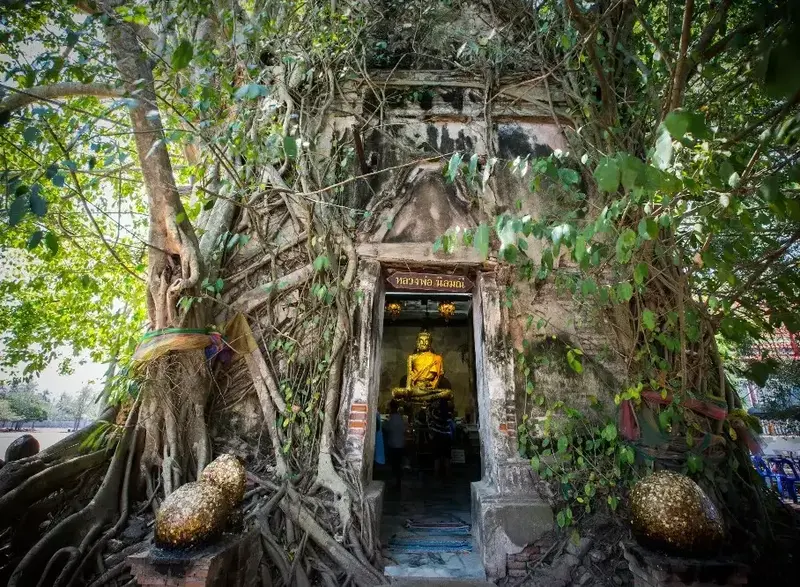
4. Wat Bang Kung is an old temple in Bang Kung Subdistrict, Bang Khonthi District, and one of the most visually distinctive landmarks in Samut Songkhram. Its best-known feature is an old ordination hall almost completely embraced by the roots and trunks of bodhi, banyan, and related trees, creating the famous tree-covered chapel known as the Bot Prok Pho.
Highlights: Tree-covered ordination hall, roots growing around the historic building, Luang Pho Nin Manee, the history of Bang Kung Camp, military heritage from the Thonburi period, and historical grounds surrounding the temple.
Wat Bang Kung is fascinating for both natural and historical reasons. Over time, large trees gradually grew around the old ordination hall, with roots and branches forming a natural framework around the architecture without completely obscuring the building. The hall remains an active place of worship visited continuously by devotees.
The temple is also closely connected with Bang Kung Camp, an important military site during the late Ayutthaya and Thonburi periods. The area was used for military positioning and is associated with conflict over control of the Mae Klong River corridor. A visit therefore reveals both a religious site and an important historical landscape.
Inside the ordination hall is Luang Pho Nin Manee, a revered Buddha image. Visitors commonly pay respect before walking around the exterior to view the tree roots. Photography should be done carefully without climbing on or touching the roots, and visitors should avoid disturbing people engaged in worship.
The temple is suitable for Buddhist travelers, history enthusiasts, families, and photographers. Weekends can be busy, so those who prefer a quieter atmosphere should visit in the morning or on a weekday.
Wat Bang Kung can easily be combined with King Rama II Memorial Park, Amphawa Floating Market, Bang Noi Floating Market, and Wat Chulamanee, making it a major stop on a full-day Amphawa–Bang Khonthi itinerary.
Open Days: Daily Opening Hours: 08:00 – 16:30
Getting There: From central Samut Songkhram or Amphawa, follow the road toward Bang Khonthi District and continue according to signs for Wat Bang Kung. A private car is the most convenient way to combine several Bang Khonthi attractions.
Map (GPS):Open Google Maps – Wat Bang Kung
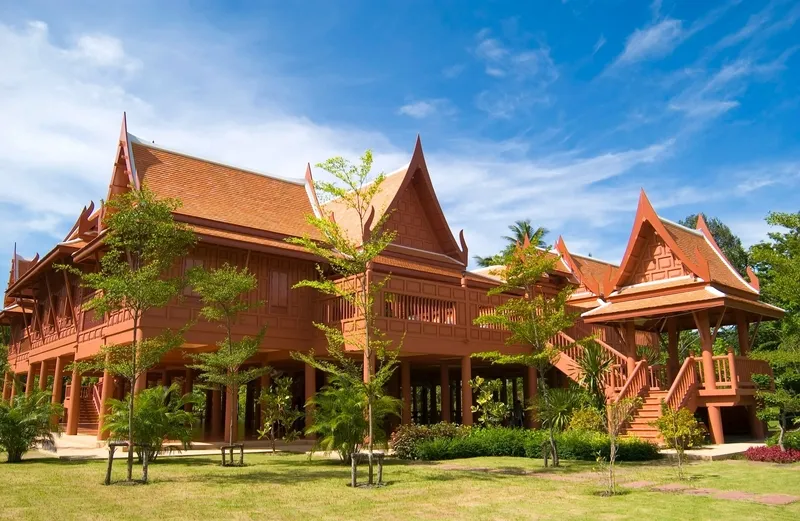
5. King Rama II Memorial Park is an important historical and cultural attraction in Amphawa, located beside the Mae Klong River near Amphawa Floating Market. The park introduces visitors to Amphawa through royal history, literature, traditional arts, and Thai-house architecture, adding far more depth to a visit than simply walking through the market and sampling food.
Highlights: Traditional Thai house complex, museum displays relating to King Rama II, early-Rattanakosin arts and culture, plants associated with Thai literature, Mae Klong riverside setting, and convenient location beside central Amphawa.
The park was established to honor King Buddha Loetla Nabhalai, Rama II, whose life and family history are deeply connected with Amphawa and the Bang Chang lineage. The king was highly accomplished in literature, music, and the arts, and his reign is remembered as an important period in the development of Thai culture.
Traditional Thai houses inside the park are used to display objects and stories related to historical lifestyles, allowing visitors to understand domestic architecture, spatial organization, and the customs of Central Thai communities through real architectural forms rather than text alone.
The landscaped grounds include plant species linked to Thai literature and the orchard culture of Amphawa, making the park interesting for visitors interested in literature, botany, and traditional riverside landscapes. The atmosphere is generally shaded and suitable for relaxed walking.
Families, students, and history enthusiasts can easily spend 1–2 hours here. On days when Amphawa Floating Market is operating, visitors can continue on foot into the market without repeatedly moving their vehicle.
A well-balanced route combines King Rama II Memorial Park with Amphawa Floating Market and Wat Chulamanee, or continues to Wat Bang Kung in Bang Khonthi for a full day of history, religion, and community life.
Open Days: Monday – Sunday, except Wednesday Opening Hours: 08:30 – 16:30
Getting There: The park is located in Amphawa Subdistrict close to Amphawa Floating Market. From Rama II Road, take Highway 325 toward Amphawa and follow signs to the memorial park.

6. Tha Kha Floating Market is located in Tha Kha Subdistrict, Amphawa District, and retains the atmosphere of an orchard community and traditional boat-based trade more clearly than many larger tourist-oriented floating markets. Some vendors still bring orchard produce, food, and everyday goods to the market by boat, giving Tha Kha a calm and authentic connection with local life.
Highlights: Paddle boats selling goods, orchard produce, canal-side agricultural lifestyle, local food, traditional wooden homes, peaceful atmosphere, and boat trips through coconut plantations and surrounding communities.
Tha Kha is an agricultural community characterized by coconut plantations and a dense canal network. In the past, boats were the main way to move produce from orchards to markets. Vendors brought coconuts, fruit, vegetables, food, and daily necessities together at the floating market, making it an important component of the local economy before roads reached every community.
The atmosphere is noticeably different from Amphawa because Tha Kha is focused on the morning and has a slower pace. Visitors can watch paddle boats, local vendors, and canal-side life without the density associated with larger evening markets.
Local food, sweets, and orchard produce are particularly worth trying. Travelers interested in agriculture can also take boat trips through coconut plantations and nearby communities to better understand how the floating market is connected with the surrounding orchard-and-canal system.
The market is suitable for families, older travelers, photographers, and visitors interested in local culture. Morning is the best time to come because temperatures are cooler and trading activity is still lively.
Tha Kha can be combined with Wat Chulamanee, King Rama II Memorial Park, and Amphawa Floating Market. A practical itinerary begins at Tha Kha in the morning and continues to Amphawa later in the day.
Open Days: Saturday – Sunday and public holidays Opening Hours: 06:00 – 14:00
Getting There: From Rama II Road, enter Amphawa District and follow local roads toward Tha Kha Subdistrict. A private car is the most practical way to connect Tha Kha with Amphawa and Bang Khonthi.

7. Wat Chulamanee is an old temple in Bang Chang Subdistrict, Amphawa District, with important connections to local history, Thai religious art, and Buddhist devotion. Today it is one of Thailand’s best-known temples for paying respect to Thao Wessuwan. The ordination hall is also distinguished by Thai decorative arts, carved details, and mother-of-pearl work that deserve careful attention.
Highlights: Thao Wessuwan, ordination hall, carved and mother-of-pearl decoration, Thai religious art, late-Ayutthaya temple history, and historical connections with Bang Chang and important families of the Mae Klong basin.
The temple was originally known as “Wat Mae Chao Thip.” It is a Mahayana? No—it is a Theravada Buddhist temple under the Maha Nikaya order, with a history reaching back to the late Ayutthaya period. Its story is linked with Bang Chang, a community that played an important role in the history of the Mae Klong basin and the Bang Chang lineage.
The temple grounds are also connected with stories from early Chakri Dynasty history. Bang Chang and Amphawa were important places in the biographies of members of the royal family during the early Rattanakosin era, giving Wat Chulamanee historical value beyond its modern reputation as a popular place of worship.
The ordination hall should not be overlooked. Interior decoration demonstrates the skill of Thai craftsmen through carving, inlay work, and symbolic religious elements, making the temple rewarding for visitors interested in art and architecture as well as worship.
Today, paying respect to Thao Wessuwan is one of the principal reasons people visit Wat Chulamanee. Devotees commonly pray for stability, success, work, and good fortune, and the temple can become especially busy during weekends and in the evening.
Wat Chulamanee is suitable for Buddhist travelers, spiritual visitors, history enthusiasts, and photographers. Visitors should dress respectfully and be considerate around active worship areas. The temple can easily be combined with Amphawa Floating Market, Tha Kha Floating Market, and King Rama II Memorial Park.
Open Days: Daily Opening Hours: 06:00 – 24:00
Getting There: The temple is located in Moo 9, Bang Chang Subdistrict, Amphawa District. From Rama II Road, take Highway 325 toward Amphawa and continue into Bang Chang following signs to the temple.
Map (GPS):Open Google Maps – Wat Chulamanee

8. Wat Phet Samut Worawihan (Wat Ban Laem) is a third-class royal monastery of the Worawihan type located in the center of Mae Klong and is one of Samut Songkhram’s most important spiritual centers. The temple houses Luang Pho Ban Laem, a highly revered Buddha image that attracts devotees from many provinces.
Highlights: Luang Pho Ban Laem, royal-monastery status, Mae Klong community history, devotion among fishermen and traders, central-town location, and easy walking access to Mae Klong Railway Market.
Wat Ban Laem has been closely connected with the Mae Klong community for generations, serving both as a religious center and a place of deep local devotion. Reverence for Luang Pho Ban Laem extends far beyond the province, making the temple a major destination for Buddhist visitors to Samut Songkhram.
Luang Pho Ban Laem is a distinctive Buddha image surrounded by stories connected with coastal communities and the Mae Klong basin. Devotees commonly pray for auspiciousness, safe travel, and success in life.
The temple’s central location also demonstrates the relationship between religion, markets, communities, and commerce in Mae Klong. This differs from rural temples that stand separately from commercial districts.
Older travelers and families can visit comfortably because the temple is close to roads and urban facilities. Weekends can be crowded, so additional time should be allowed. Visitors should dress appropriately for a royal Buddhist monastery.
Mae Klong Railway Market is very close to the temple, making the two attractions easy to visit together before continuing to Amphawa, Wat Chulamanee, or Don Hoi Lot.
Open Days: Daily Opening Hours: 06:00 – 18:00
Getting There: The temple is located in Mae Klong Subdistrict, Mueang Samut Songkhram District, close to Mae Klong Railway Market and Mae Klong Station. It can be reached easily on foot from the market area.

9. Samut Songkhram Mangrove Forest Conservation Center is located in Khlong Khon Subdistrict, Mueang Samut Songkhram District. It is an ecotourism and learning destination where visitors can explore mangrove ecology, coastal community life, and the restoration of natural resources in an area once affected by changes in the coastal environment.
Highlights: Mangrove forest, ecosystem learning areas, Khlong Khon community activities, mangrove planting, nature boat trips, coastal fishing lifestyles, and wildlife associated with estuarine ecosystems.
Khlong Khon is an important example of a community that has played an active role in restoring mangrove resources. After coastal activities placed pressure on the local environment, residents and organizations worked together to rehabilitate the forest, eventually developing the area into a learning and tourism destination that generates income while supporting conservation.
Mangrove forests are extremely important to coastal areas because they help reduce wave energy, function as nurseries for aquatic animals, and provide habitat for birds, benthic organisms, and many other species. A visit therefore demonstrates that mangroves are far more than simply green coastal scenery.
Popular activities include boat trips, community visits, mangrove education, and certain forms of mangrove planting. Visitors participating in outdoor activities should wear clothing suitable for wet or muddy conditions and follow community guidance.
The destination is suitable for families, students, study groups, and nature enthusiasts. Community-based tourism helps return income to local residents and strengthens incentives to continue protecting natural resources.
Khlong Khon combines well with Don Hoi Lot because both are located within Samut Songkhram’s coastal zone. Visiting both in one day reveals the relationship between mangrove forests and the tidal-flat ecosystem of the Mae Klong estuary.
Open Days: Daily Opening Hours: 08:30 – 17:00
Getting There: From Bangkok, take Rama II Road toward Samut Songkhram and follow signs into Khlong Khon Subdistrict and the conservation area. A private car is convenient for continuing to Don Hoi Lot on the same day.

10. Bang Noi Floating Market is an old waterside market community near the mouth of Bang Noi Canal, close to Wat Koh Kaew in Kradangnga Subdistrict, Bang Khonthi District. Its main appeal is a simple and quieter atmosphere than larger floating markets. Traditional wooden houses and community shops continue to line the canal, making Bang Noi suitable for travelers seeking an unhurried riverside experience.
Highlights: Historic market community, wooden canal-side houses, local restaurants and snacks, community products, Bang Khonthi lifestyle, and a quieter atmosphere than Amphawa Floating Market.
Bang Noi was historically an important water-based trading district because it stood at a connection point between canals and surrounding agricultural communities. Orchard produce and other goods were transported by boat to the market before expanding road networks changed transportation and commercial patterns.
Visitors can still see the community layout, wooden houses, landing steps, and shops that evoke the atmosphere of an older riverside market. Although commercial activity has changed over time, the area retains an identity very different from modern tourism-oriented markets.
Local dishes, sweets, and orchard products are good choices for tasting and souvenirs. The market itself does not require a long visit, but walking slowly allows visitors to appreciate architectural details and the atmosphere along both sides of the canal.
Bang Noi is suitable for families, older travelers, photographers, and visitors who enjoy old communities because it is generally calmer and less crowded than Amphawa in the evening.
From Bang Noi Floating Market, travelers can continue to Wat Bang Kung or return toward Amphawa and King Rama II Memorial Park, making it a practical stop on a Bang Khonthi–Amphawa weekend itinerary.
Open Days: Saturday – Sunday Opening Hours: 08:00 – 17:00
Getting There: The market is located near the mouth of Bang Noi Canal, close to Wat Koh Kaew in Kradangnga Subdistrict, Bang Khonthi District. From Amphawa, follow roads toward Bang Khonthi and signs for Bang Noi Floating Market.

11. Wat Amphawan Chetiyaram Worawihan is a second-class royal monastery of the Worawihan type in Amphawa Subdistrict, Amphawa District. It stands beside King Rama II Memorial Park and close to Amphawa Floating Market. The temple is highly significant to the history of the Bang Chang royal lineage and early Rattanakosin history, making it one of the places that adds historical depth to an Amphawa trip.
Highlights: Historic royal monastery, Bang Chang lineage, early-Rattanakosin architecture, murals related to the life of King Rama II, ordination hall, and a location directly beside King Rama II Memorial Park.
The temple is closely associated with the Bang Chang lineage, an important family in the Mae Klong basin. Amphawa was historically a center of orchard and riverside communities that played an important role in the history of the Chakri Dynasty. Visiting the temple therefore connects local history with Thailand’s national history.
The ordination hall is one of the temple’s most important structures. Interior artwork and murals relate to the life of King Rama II, giving the temple value as a place to learn about religion, art, and history simultaneously.
The architecture reflects the character of royal monasteries from the early Rattanakosin period. Its restrained but elegant design is useful for visitors who want to compare court-related religious architecture with smaller community temples along the canals of Amphawa.
The atmosphere is quieter than the nearby floating-market district, allowing visitors to pay respect and appreciate architectural details at a slower pace before continuing to King Rama II Memorial Park or Amphawa Floating Market.
A practical route begins at King Rama II Memorial Park, continues to Wat Amphawan Chetiyaram, and then enters Amphawa Floating Market, combining history, religion, and community life within a compact area.
Open Days: Daily Opening Hours: 08:00 – 17:00
Getting There: The temple is located in Amphawa Subdistrict beside King Rama II Memorial Park. From Rama II Road, take Highway 325 into Amphawa and follow signs to the memorial park and temple.

12. Ban Maeo Thai Boran is a traditional Thai cat conservation center in Khwae Om Subdistrict, Amphawa District. It was established by Thai cat enthusiasts who wanted to preserve native breeds and pass knowledge about traditional Thai cats to younger generations. The attraction offers a very different experience from the markets, temples, and natural sites that dominate most Samut Songkhram itineraries.
Highlights: Traditional Thai cat breeds, identification of Thai cat characteristics, breed conservation, responsible cat care, and a garden-house atmosphere in Amphawa.
Thai cats have a long history and appear in old manuscripts describing auspicious breeds and their distinctive physical characteristics. Ban Maeo Thai Boran therefore functions not merely as a place where cats are kept, but as a learning center covering appearance, coat colors, temperament, and beliefs associated with individual Thai breeds.
Visitors can observe individual cats at close range while learning about differences among breeds and appropriate animal care. Children and families in particular can learn more effectively through direct observation than by reading descriptions alone.
Thai cat conservation has both genetic and cultural importance. Some native breeds have become less common as imported breeds have grown in popularity, so maintaining and carefully breeding traditional cats plays a role in preserving Thailand’s living animal heritage.
Visitors should treat the animals gently, avoid picking up cats without permission, and keep noise levels low. The center focuses on conservation and animal care rather than functioning as an entertainment venue.
Ban Maeo Thai Boran can be combined with Wat Bang Khae Noi, Wat Phummarin Kudi Thong, Amphawa Floating Market, and King Rama II Memorial Park, making it useful for families seeking to add an animal-related educational stop to an Amphawa cultural route.
Open Days: Daily Opening Hours: 09:00 – 17:00
Getting There: The center is located in Khwae Om Subdistrict, Amphawa District. From Amphawa town, use local roads toward Khwae Om and follow signs for the Thai cat conservation center.
Map (GPS):Open Google Maps – Ban Maeo Thai Boran

13. Wat Intharam is an old temple in Mueang Mai Subdistrict, Amphawa District. It is known for Luang Pho To, marble architectural details, wood carving, and a riverside atmosphere that clearly reflects the character of Amphawa’s traditional communities.
Highlights: Luang Pho To, marble work, carved wood, ordination hall, religious structures, and the atmosphere of the Mae Klong riverside.
Wat Intharam has a long history and forms part of the network of temples established along waterways in Amphawa. Its riverside location reflects earlier settlement patterns in which rivers and canals served simultaneously as transportation routes and the central framework of community life.
Luang Pho To is an important sacred image at the temple and is regularly visited by local residents and Buddhist travelers. Devotion to the image has helped maintain the temple’s role as an active spiritual destination.
The marble work and carved wooden elements add significant artistic value. Visitors interested in craftsmanship should take time to examine decorative details rather than making only a brief stop for worship.
The riverside setting creates a peaceful atmosphere and makes the temple a good resting point on an Amphawa itinerary. Visitors can clearly see the relationship between religious buildings, houses, and the river, which is characteristic of Mae Klong basin communities.
Wat Intharam can be combined with Wat Pradu, Wat Phummarin Kudi Thong, and other attractions in Amphawa, making it suitable for a route focused on old temples and traditional art.
Open Days: Daily Opening Hours: 08:00 – 17:00
Getting There: The temple is located in Mueang Mai Subdistrict, Amphawa District. From Amphawa, follow local roads toward Mueang Mai and continue according to signs for the temple.
Map (GPS):Open Google Maps – Wat Intharam

14. Wat Phummarin Kudi Thong is a historic temple beside the Mae Klong River in Suan Luang Subdistrict, Amphawa District. Its important features include the ordination hall, principal Buddha image, Kudi Thong, museum displays, and connections with the transmission of Thai music. The temple therefore combines religion, architecture, community history, and cultural heritage within one site.
Highlights: Kudi Thong, ordination hall, museum, riverside temple arts, Thai music heritage, and the Suan Luang community beside the Mae Klong River.
The temple’s identity is closely associated with the Kudi Thong, an important structure that gives the site its distinctive name. The temple has the character of a riverside community monastery that developed alongside settlement in the Mae Klong basin.
Museum displays and objects inside the temple help visitors understand local community history and everyday life in earlier periods. A visit therefore extends beyond Buddhist worship into a broader exploration of Amphawa through objects and physical spaces.
Another distinctive aspect is the temple’s relationship with Thai music. The site has links with the transmission of musical knowledge and local cultural wisdom, making it interesting for visitors whose interests extend beyond religion and architecture.
The Mae Klong riverside setting is peaceful and clearly demonstrates the traditional pattern of religious buildings facing waterways. Photographers may prefer early morning or late afternoon for softer light around the temple architecture and river environment.
The temple can be combined with Ban Maeo Thai Boran, Wat Bang Khae Noi, and Amphawa Floating Market without long driving distances.
Open Days: Daily Opening Hours: 08:00 – 16:00
Getting There: Wat Phummarin Kudi Thong is located in Suan Luang Subdistrict, Amphawa District. From Amphawa, follow local roads into Suan Luang. A private car is convenient when visiting several temples in succession.

15. Wat Charoen Sukharam Worawihan is a third-class royal monastery in Bang Nok Khwaek Subdistrict, Bang Khonthi District. It is notable for an ordination hall whose interior form resembles the curved canopy of a traditional boat and for Luang Pho To, a Buddha image deeply respected by both Thai and Thai–Chinese communities.
Highlights: Royal-monastery status, Luang Pho To, ordination hall with a curved boat-canopy-like ceiling, historic temple art, and the Bang Nok Khwaek community.
The temple is important to Bang Nok Khwaek, an old community developed along rivers and canals. Its status as a royal monastery gives it both religious and historical significance, while it continues to serve as a center of community activity.
The ordination hall has an especially interesting architectural form. Its curved interior ceiling resembles the canopy of a boat, a detail that differs from more conventional temple architecture and reflects the community’s relationship with water-based culture.
Luang Pho To is an important Buddha image and a focus of local devotion. Visitors commonly pay respect to the image before exploring the temple’s architecture and surrounding grounds.
The temple lies close to Bang Nok Khwaek, an area known for religious and cultural diversity, making it suitable for itineraries focused on the heritage of Bang Khonthi.
Wat Charoen Sukharam Worawihan can be combined with Bang Nok Khwaek market areas, Bang Noi Floating Market, Wat Bang Khae Noi, or Wat Bang Kung for a day focused on temples and old communities.
Open Days: Daily Opening Hours: 08:00 – 17:00
Getting There: The temple is located in Moo 5, Bang Nok Khwaek Subdistrict, Bang Khonthi District. From Amphawa, take Highway 325 toward Bang Khonthi and continue into Bang Nok Khwaek.
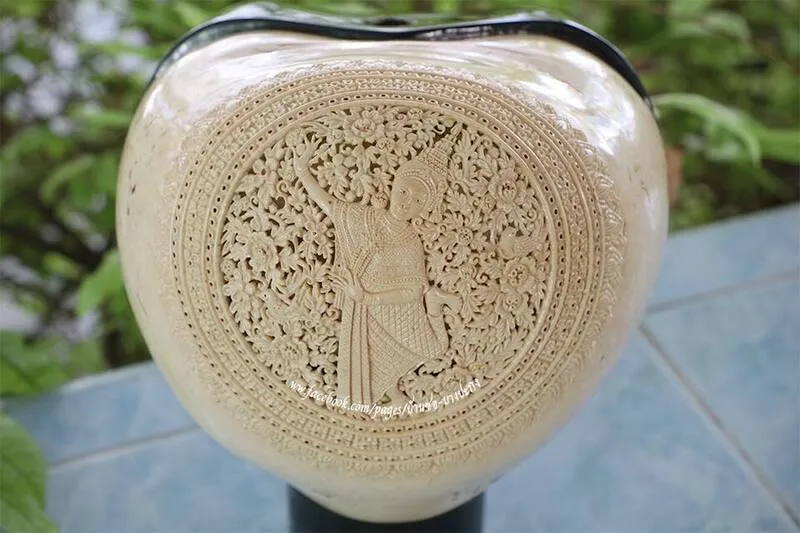
16. Ban Phraya Sor is a local cultural learning center in Bang Phrom Subdistrict, Bang Khonthi District, where visitors can learn about the traditional craft of making the saw u, a Thai bowed string instrument. The site clearly demonstrates the relationship between Thai music and skilled craftsmanship through carving, instrument assembly, and specialist knowledge that is becoming increasingly rare.
Highlights: Saw u making, wood carving, Thai musical instruments, instrument-construction processes, traditional craftsmanship, and transmission of Thai musical heritage.
The saw u is a low-pitched Thai bowed string instrument that plays an important role in several types of Thai ensembles. Producing a good instrument requires knowledge of acoustics, materials, proportions, and careful assembly.
Ban Phraya Sor allows visitors to understand that a musical instrument is not produced through ordinary woodworking alone. Experienced makers must select materials, shape components, carve decorative elements, and adjust the final sound with considerable precision.
This learning process is particularly valuable for children, students, musicians, and art enthusiasts because it connects musical performance with the craftsmanship behind the sound itself.
Supporting local knowledge centers also helps prevent specialist skills from disappearing as modern industrial production becomes more common. Visitors are encouraged to spend time learning from artisans rather than treating the location merely as a photography stop.
Ban Phraya Sor can be combined with Wat Kaenchan Charoen, Bang Noi Floating Market, and attractions around Bang Phrom, making it an excellent route for travelers interested in art and local knowledge.
Open Days: Daily Opening Hours: 08:00 – 17:00
Getting There: Ban Phraya Sor is located in Bang Phrom Subdistrict, Bang Khonthi District. It can be reached from Amphawa or Bang Khonthi via local roads into Bang Phrom.
Map (GPS):Open Google Maps – Ban Phraya Sor

17. Wat Kaenchan Charoen is an old community temple in Bang Phrom Subdistrict, Bang Khonthi District, surrounded by orchards and the canal network characteristic of the area. It is suitable for travelers who want to experience a quieter local temple closely connected with genuine community life.
Highlights: Historic Bang Phrom temple, religious structures, orchard and canal community atmosphere, and convenient connections with Wat Bang Phlap, Wat Bang Khae Noi, and Bang Noi Floating Market.
The temple has served as a religious center for the community for many years. In an area such as Bang Phrom, temples are not isolated from agricultural and canal-based life but form part of a settlement pattern in which homes, orchards, and religious buildings exist in close proximity.
A visit to Wat Kaenchan Charoen reveals a different side of Samut Songkhram from its major landmarks. Travelers can experience a quiet community atmosphere and better understand how settlements developed along waterways.
The temple is particularly suitable for Buddhist travelers, older visitors, and anyone planning a route through several temples in Bang Khonthi without repeatedly returning to Amphawa.
Visitors should dress respectfully and maintain a quiet atmosphere, especially when community religious ceremonies or merit-making activities are taking place.
The temple can be combined with Ban Phraya Sor, Wat Bang Khae Noi, Bang Noi Floating Market, and Wat Bang Kung as part of a varied Bang Khonthi cultural itinerary.
Open Days: Daily Opening Hours: 09:00 – 16:00
Getting There: The temple is located at 17 Moo 4, Bang Phrom Subdistrict, Bang Khonthi District. From Amphawa, travel toward Bang Khonthi and continue along local roads into Bang Phrom.
Map (GPS):Open Google Maps – Wat Kaenchan Charoen

18. Wat Koh Kaew is a Theravada Buddhist temple in Kradangnga Subdistrict, Bang Khonthi District, located close to Bang Noi Floating Market and the district’s network of riverside communities. It is a useful stop for travelers who want to extend their visit beyond the old market into nearby religious and community spaces.
Highlights: Historic community temple, Kradangnga atmosphere, canal-side lifestyle, religious buildings, and proximity to Bang Noi Floating Market.
Kradangnga is characterized by agricultural and riverside communities that developed along canals. Wat Koh Kaew is therefore part of a cultural landscape in which temples, homes, and orchard areas coexist within the same settlement system.
The temple is suitable for travelers who prefer quiet local religious sites to heavily visited attractions. Its peaceful atmosphere allows time for worship and a relaxed walk through the grounds.
Wat Koh Kaew remains connected with religious activities in the surrounding community and serves as a gathering place on important Buddhist occasions. Visitors should therefore respect local use of the space.
Its proximity to Bang Noi Floating Market makes the temple an easy stop before or after walking through the market and adds a religious dimension to a Bang Khonthi itinerary.
Travelers with a car can combine Wat Koh Kaew with Wat Kaenchan Charoen, Wat Bang Khae Noi, Wat Bang Kung, and Bang Noi Floating Market within the same day.
Open Days: Daily Opening Hours: 08:00 – 17:00
Getting There: Wat Koh Kaew is located in Moo 8, Kradangnga Subdistrict, Bang Khonthi District. It can be reached easily by local roads from Bang Noi Floating Market.
Map (GPS):Open Google Maps – Wat Koh Kaew

19. Wat Pradu is an old royal monastery in Wat Pradu Subdistrict, Amphawa District. It is particularly interesting because historic religious structures, museum collections connected with the royal court, contemporary museum displays, and traditional arts are all gathered within the same temple grounds.
Highlights: Royal monastery, historic religious structures, royal-court museum, contemporary museum, khon-mask art gallery, and the atmosphere of an old temple in Amphawa District.
Wat Pradu has a long history and reflects the close relationship between Buddhist temples and communities in the Mae Klong basin. The temple functions as a religious center, a place preserving traditional art, and a repository of local historical stories.
The museum collections make Wat Pradu different from many ordinary temples because visitors can see objects and displays connected with court history and local heritage in a tangible form.
The khon-mask gallery and other artistic displays add another layer involving Thai performing arts and craftsmanship. Art enthusiasts can therefore spend considerably more time here than would normally be required for a brief temple visit.
The temple is suitable for students, families, history enthusiasts, art lovers, and visitors who enjoy small museums embedded within local communities. Morning or afternoon visits allow enough time to examine the collections carefully.
Wat Pradu can be combined with Wat Intharam and rural routes through Amphawa District, making it suitable for days when travelers want to avoid the busiest floating-market areas.
Open Days: Daily Opening Hours: 08:00 – 17:00
Getting There: The temple is located at Ban Bang Kraphri, Moo 2, Wat Pradu Subdistrict, Amphawa District. From Amphawa, follow local roads west toward Wat Pradu Subdistrict.
Map (GPS):Open Google Maps – Wat Pradu
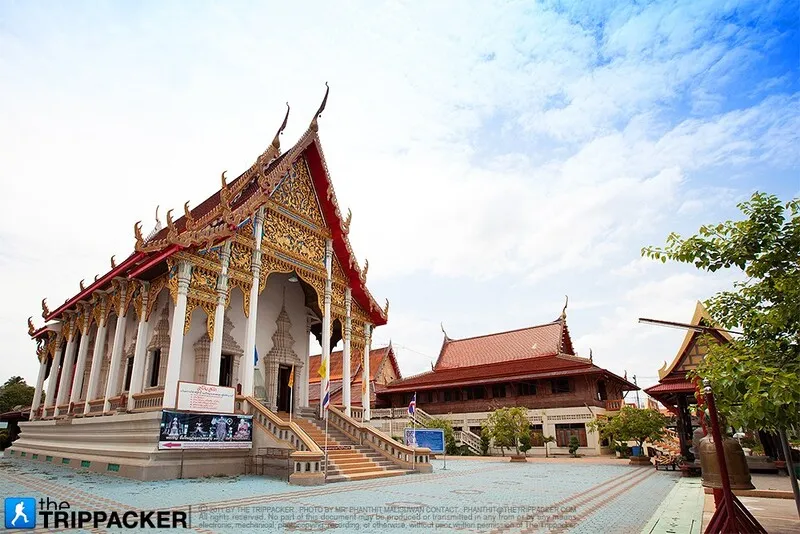
20. Wat Bang Khae Noi is a historic temple beside the Mae Klong River in Khwae Om Subdistrict, Amphawa District. It is particularly famous for the elaborate carved wooden interior of its ordination hall, making it one of the most rewarding temples in Samut Songkhram for visitors interested in traditional Thai craftsmanship.
Highlights: Carved wooden ordination hall, Buddhist-story carvings, large takhian wood flooring, principal Buddha image, and the atmosphere of an old temple beside the Mae Klong River.
The temple’s most distinctive feature is the interior of the ordination hall, where carved wood forms an important part of the decoration. Walls and architectural details are designed to narrate Buddhist stories, turning the interior into a large-scale artistic composition that can be studied from many angles.
Wood carving on this scale requires considerable skill and time. The continuity of the carved designs throughout the structure reflects both the abilities of the craftsmen and the community’s commitment to creating a distinctive religious building.
The large takhian wood floor is another detail that attracts attention because the scale and material create a different atmosphere from religious buildings constructed primarily with modern materials.
Photographers should rely on available light and avoid flash where restrictions apply. Visitors should also avoid touching carved surfaces unnecessarily in order to help preserve the artwork.
Wat Bang Khae Noi is close to Ban Maeo Thai Boran and not far from central Amphawa, making it easy to combine with Wat Phummarin Kudi Thong, Amphawa Floating Market, and King Rama II Memorial Park as part of a cultural itinerary.
Open Days: Daily Opening Hours: 08:00 – 17:00
Getting There: The temple is located in Khwae Om Subdistrict, Amphawa District. From central Amphawa, follow local roads toward Khwae Om and signs for Wat Bang Khae Noi.
Map (GPS):Open Google Maps – Wat Bang Khae Noi
| Category | Details |
| Mae Klong Zone | 1. Mae Klong Railway Market (Rom Hoop Market) 2. Wat Phet Samut Worawihan (Wat Ban Laem) Suitable for travelers who want to experience Mae Klong town, a working fresh market with trains passing through, urban trading life, and worship at Luang Pho Ban Laem, one of the province’s most important sacred images. |
| Amphawa Zone | 1. Amphawa Floating Market 2. King Rama II Memorial Park 3. Wat Chulamanee 4. Wat Amphawan Chetiyaram Worawihan 5. Ban Maeo Thai Boran 6. Wat Intharam 7. Wat Phummarin Kudi Thong 8. Wat Pradu 9. Wat Bang Khae Noi Best for floating markets, Bang Chang royal history, arts and culture, old temples, carved wood, riverside communities, and spiritual travel. |
| Bang Khonthi Zone | 1. Wat Bang Kung 2. Bang Noi Floating Market 3. Wat Charoen Sukharam Worawihan 4. Ban Phraya Sor 5. Wat Kaenchan Charoen 6. Wat Koh Kaew Suitable for travelers interested in Bang Kung Camp history, canal-side markets, old temples, traditional Thai music craftsmanship, and orchard communities. |
| Tha Kha Zone | 1. Tha Kha Floating Market Best for experiencing a traditional floating market, orchard life, paddle boats, coconut products, local food, and a peaceful morning atmosphere. |
| Khlong Khon–Coastal Zone | 1. Samut Songkhram Mangrove Forest Conservation Center 2. Don Hoi Lot Best for mangrove ecology, coastal ecosystems, the Mae Klong estuary, fishing communities, and natural resources of the inner Gulf of Thailand. |
| Best for First-Time Visitors | 1. Mae Klong Railway Market 2. Amphawa Floating Market 3. Wat Bang Kung 4. King Rama II Memorial Park 5. Wat Chulamanee 6. Don Hoi Lot Together these places provide a broad introduction to Samut Songkhram through markets, history, religion, riverside communities, and coastal nature. |
| Best for Families and Children | 1. Ban Maeo Thai Boran 2. King Rama II Memorial Park 3. Tha Kha Floating Market 4. Samut Songkhram Mangrove Forest Conservation Center 5. Don Hoi Lot 6. Amphawa Floating Market Suitable for learning through real places, including history, native animals, ecosystems, floating markets, and community life. |
| Best for History Lovers | 1. King Rama II Memorial Park 2. Wat Amphawan Chetiyaram Worawihan 3. Wat Bang Kung 4. Wat Phet Samut Worawihan 5. Wat Chulamanee 6. Wat Pradu 7. Wat Charoen Sukharam Worawihan 8. Mae Klong Railway Market and Mae Klong Station |
| Best for Buddhist and Spiritual Travel | 1. Wat Chulamanee 2. Wat Phet Samut Worawihan 3. Wat Bang Kung 4. Wat Amphawan Chetiyaram Worawihan 5. Wat Intharam 6. Wat Phummarin Kudi Thong 7. Wat Pradu 8. Wat Bang Khae Noi 9. Wat Charoen Sukharam Worawihan 10. Wat Kaenchan Charoen |
| Best for Art and Architecture | 1. Wat Bang Khae Noi 2. Wat Amphawan Chetiyaram Worawihan 3. King Rama II Memorial Park 4. Wat Chulamanee 5. Wat Phummarin Kudi Thong 6. Wat Pradu 7. Wat Charoen Sukharam Worawihan 8. Ban Phraya Sor |
| Best for Nature and Ecosystems | 1. Samut Songkhram Mangrove Forest Conservation Center 2. Don Hoi Lot 3. Orchard and canal areas around Tha Kha 4. Orchard communities around Amphawa and Bang Khonthi Suitable for learning about mangroves, estuarine tidal flats, canal systems, orchard lifestyles, and the relationship between natural resources and local communities. |
| Best for Floating Markets and Riverside Communities | 1. Amphawa Floating Market 2. Tha Kha Floating Market 3. Bang Noi Floating Market Amphawa is best from afternoon into the evening, Tha Kha is ideal in the morning for orchard-community life, and Bang Noi is well suited to travelers seeking a quieter old-market atmosphere. |
| Best for Photography | 1. Mae Klong Railway Market 2. Amphawa Floating Market 3. Wat Bang Kung 4. Tha Kha Floating Market 5. Bang Noi Floating Market 6. Don Hoi Lot 7. Wat Bang Khae Noi 8. Samut Songkhram Mangrove Forest Conservation Center |
| Best for Local Wisdom and Culture | 1. Ban Phraya Sor 2. Ban Maeo Thai Boran 3. King Rama II Memorial Park 4. Tha Kha Floating Market 5. Wat Phummarin Kudi Thong Suitable for learning about Thai music, traditional craftsmanship, native animals, orchard culture, and artistic history in the Mae Klong basin. |
| Food and Local Specialties to Try | 1. Razor clams and seafood around Don Hoi Lot 2. Seafood and snacks at Amphawa Floating Market 3. Local dishes at Tha Kha Floating Market 4. Thai sweets and community food at Bang Noi Floating Market 5. Coconut sugar and coconut products 6. Seasonal fruit from orchards around Amphawa and Bang Khonthi |
| Recommended Souvenirs | 1. Coconut sugar 2. Thai sweets from Amphawa communities 3. Dried seafood 4. Coconut products 5. Seasonal fruit and orchard produce 6. Community products and handicrafts from floating markets |
| Distinctive Culture and Local Identity | Floating-market culture and Amphawa orchard communities, the Bang Chang royal lineage, the life and cultural legacy of King Rama II, Mae Klong Railway Market, coconut-farming traditions, Thai music, saw-making craftsmanship, old riverside temples, Khlong Khon mangrove ecology, and the lifestyle of the Mae Klong estuary. |
| Recommended Areas to Stay | 1. Amphawa: Best for the floating market, King Rama II Memorial Park, Wat Chulamanee, Wat Amphawan Chetiyaram, and Wat Bang Khae Noi 2. Mae Klong: Best for Mae Klong Railway Market, Wat Ban Laem, and travelers continuing to Don Hoi Lot 3. Bang Khonthi: Best for travelers seeking a quieter atmosphere, Bang Noi Floating Market, Wat Bang Kung, and orchard communities For first-time visitors staying 1 night, Amphawa is generally the most convenient base. |
| 1-Day Samut Songkhram Itinerary – Mae Klong and Amphawa | Morning: Mae Klong Railway Market Late Morning: Wat Phet Samut Worawihan Lunch: Mae Klong or Amphawa Afternoon: King Rama II Memorial Park – Wat Amphawan Chetiyaram Worawihan Evening: Amphawa Floating Market |
| 1-Day Samut Songkhram Itinerary – Floating Markets and Famous Temples | Morning: Tha Kha Floating Market Late Morning: Wat Chulamanee Lunch: Amphawa Afternoon: King Rama II Memorial Park – Wat Amphawan Chetiyaram Worawihan Evening: Amphawa Floating Market |
| 1-Day Samut Songkhram Itinerary – Bang Khonthi | Morning: Bang Noi Floating Market Late Morning: Wat Koh Kaew – Ban Phraya Sor Lunch: Bang Khonthi Afternoon: Wat Bang Kung – Wat Charoen Sukharam Worawihan Wat Kaenchan Charoen can also be added if time allows. |
| 1-Day Samut Songkhram Itinerary – Coastal Nature | Morning: Samut Songkhram Mangrove Forest Conservation Center Lunch: Seafood in the Khlong Khon area Afternoon: Don Hoi Lot Evening: Return via Mae Klong town |
| 1-Day Samut Songkhram Itinerary – Amphawa Arts and Culture | Morning: Wat Bang Khae Noi Late Morning: Ban Maeo Thai Boran – Wat Phummarin Kudi Thong Lunch: Amphawa Afternoon: King Rama II Memorial Park – Wat Amphawan Chetiyaram Worawihan Evening: Amphawa Floating Market |
| 2 Days 1 Night in Samut Songkhram | Day 1: Mae Klong Railway Market – Wat Phet Samut Worawihan – King Rama II Memorial Park – Wat Amphawan Chetiyaram – Amphawa Floating Market – stay in Amphawa Day 2: Tha Kha Floating Market – Wat Chulamanee – Wat Bang Kung – Bang Noi Floating Market – Ban Phraya Sor |
| 3 Days 2 Nights in Samut Songkhram | Day 1: Mae Klong Railway Market – Wat Phet Samut Worawihan – Amphawa – King Rama II Memorial Park – Amphawa Floating Market Day 2: Tha Kha Floating Market – Ban Maeo Thai Boran – Wat Bang Khae Noi – Wat Chulamanee – Wat Bang Kung – Bang Noi Floating Market Day 3: Samut Songkhram Mangrove Forest Conservation Center – Don Hoi Lot, or alternatively Wat Pradu – Wat Intharam – Wat Phummarin Kudi Thong |
| Best Way to Get Around | A private car is the most convenient choice for visiting several zones in one day. Take Rama II Road into Samut Songkhram and Highway 325 toward Amphawa and Bang Khonthi. Travelers who prefer rail travel can take the Wongwian Yai–Mahachai train, cross by ferry to Ban Laem, and continue on the Ban Laem–Mae Klong line directly into Mae Klong Railway Market. |
| Best Time to Visit | Samut Songkhram can be visited throughout the year. November to February is generally more comfortable for walking through markets and outdoor attractions. Tha Kha Floating Market is best in the morning, Amphawa Floating Market is best from afternoon into the evening, and Don Hoi Lot should be planned with tidal conditions in mind. |
Frequently Asked Questions (FAQ)
Q: Where should first-time visitors go in Samut Songkhram?
A: First-time visitors should consider Mae Klong Railway Market, Amphawa Floating Market, King Rama II Memorial Park, Wat Chulamanee, Wat Bang Kung, and Wat Phet Samut Worawihan. Together they provide a broad introduction to the province through markets, history, religion, and riverside culture.
Q: Can Samut Songkhram be visited in one day?
A: Yes. One of the most practical first-time routes is Mae Klong Railway Market – Wat Phet Samut Worawihan – King Rama II Memorial Park – Wat Amphawan Chetiyaram Worawihan – Amphawa Floating Market. These places can be visited efficiently without excessive backtracking.
Q: Can Mae Klong Railway Market and Amphawa Floating Market be visited on the same day?
A: Yes. Begin at Mae Klong Railway Market in the morning, visit Wat Phet Samut Worawihan or other attractions in Mae Klong, then continue to Amphawa in the afternoon and finish the day at Amphawa Floating Market.
Q: When is Amphawa Floating Market open?
A: Amphawa Floating Market is open from Friday to Sunday, 10:00–20:30. Late afternoon through the evening is generally the liveliest period.
Q: How is Tha Kha Floating Market different from Amphawa Floating Market?
A: Tha Kha focuses on morning trade, orchard lifestyles, paddle boats, and local produce, with a calmer pace. Amphawa is an evening market with more restaurants, shops, and visitors.
Q: Where should history lovers go in Samut Songkhram?
A: Recommended places include King Rama II Memorial Park, Wat Amphawan Chetiyaram Worawihan, Wat Bang Kung, Wat Phet Samut Worawihan, and Mae Klong Railway Market. These locations relate to the Bang Chang lineage, the Thonburi period, Mae Klong town history, and the development of transportation in the province.
Q: Which temples in Samut Songkhram are especially popular for spiritual visits?
A: Wat Chulamanee is widely known for Thao Wessuwan, Wat Phet Samut Worawihan houses Luang Pho Ban Laem, and Wat Bang Kung contains Luang Pho Nin Manee inside its famous tree-covered ordination hall.
Q: What is special about Wat Bang Kung?
A: Its most distinctive feature is the historic ordination hall surrounded by the roots of large trees. Inside is Luang Pho Nin Manee, while the surrounding area is also connected with the history of Bang Kung Camp during the late Ayutthaya and early Thonburi periods.
Q: Which Samut Songkhram attractions are suitable for children?
A: Ban Maeo Thai Boran, King Rama II Memorial Park, the Khlong Khon mangrove conservation area, Tha Kha Floating Market, and Don Hoi Lot are good choices because children can learn about animals, history, ecosystems, and community life through real environments.
Q: Where should nature lovers go in Samut Songkhram?
A: The Khlong Khon mangrove conservation area and Don Hoi Lot are two major destinations for coastal ecosystems. Tha Kha and orchard communities around Bang Khonthi are also suitable for experiencing canal and orchard landscapes.
Q: What is the best time to visit Don Hoi Lot?
A: Check tidal conditions before visiting because the appearance and accessibility of the tidal flats vary with the water level. A visit should therefore be planned around natural conditions rather than fixed attraction-style hours.
Q: Which temple in Samut Songkhram is especially known for beautiful woodwork?
A: Wat Bang Khae Noi is particularly famous for its carved wooden ordination hall and large takhian wood floor. Wat Intharam and Wat Phummarin Kudi Thong also contain interesting craftsmanship and architectural details.
Q: Where can visitors learn about local craftsmanship and traditional knowledge?
A: Ban Phraya Sor is suitable for learning about saw u making, carving, and Thai musical-instrument craftsmanship. Ban Maeo Thai Boran focuses on the conservation and characteristics of traditional Thai cat breeds.
Q: What food is Samut Songkhram famous for?
A: Local specialties include razor clams, seafood, coconut sugar, Thai sweets, floating-market dishes, and orchard produce from Amphawa, Tha Kha, and Bang Khonthi.
Q: What souvenirs should I buy in Samut Songkhram?
A: Recommended souvenirs include coconut sugar, dried seafood, Thai sweets, coconut products, seasonal fruit, and community-made products from the floating markets.
Q: Where should I stay for a 2-day, 1-night trip to Samut Songkhram?
A: Amphawa is the most convenient base for first-time visitors because it is close to the floating market, King Rama II Memorial Park, Wat Chulamanee, Wat Amphawan Chetiyaram Worawihan, and routes continuing to Bang Khonthi, Tha Kha, and Mae Klong.
 Category: ●Travel Articles, Recipes
 Group: ●Travel Review, Food Review
Last Update : 3 WeekAgo
 Last Update : 3 WeekAgo
Recommend

 Art, Culture and Heritage
 Historical Sites and Monuments(2)
 Art, Craft Centres, Tradition(1)
 Museums(6)
 Historic Homes and Cities(1)
 Places of Worship
 Temple(34)
 Church(1)
 Other Sacred Sites(1)
 Research and Development
 Royal Project(2)
 Suburban Living
 Village, Community(6)
 Local Market(2)
 Floating Market(5)
 Nature and Wildlife
 River, Canal(1)
 Bays and Beaches(1)
 Other natural attractions(1)
 Entertainment and Agricultural
 Farms, Parks and Ecotourism(1)
 Waterpark(1)
Travel Review, Food Review(1)


