
lovethailand home >Central Travel Attractions >Samut Songkhram Travel Attractions >Am Phawa >Bang Chang > Wat Chulamanee
TL;DR: Wat Chulamanee is located at Bang Chang Subdistrict, Amphawa District, Samut Songkhram, open Open Daily, hours 06:00–00:00.
Wat Chulamanee

Open Days: Open Daily
Opening Hours: 06:00–00:00
Wat Chulamanee in Samut Songkhram is one of Amphawa’s most important temples for travelers who want more than a quick stop for merit-making. It combines an old Ayutthaya-era heritage site, a deeply rooted local spiritual center, and one of the country’s best-known places to pay respect to Thao Wessuwan. Visitors come here not only to pray, but also to experience a temple with strong historical associations, refined Thai craftsmanship, and a living atmosphere of faith that remains active throughout the day.
The temple is located in Bang Chang Subdistrict, Amphawa District, Samut Songkhram Province. It was formerly known as Wat Mae Chao Thip and is a Mahanikaya royal-community temple in the broad sense of local religious importance. Its foundation dates back to the late Ayutthaya period during the reign of King Prasat Thong, around 1630–1647 CE, and tradition links its establishment to Thao Kaeo Phalึก (Noi), the daughter of Phlai, a tax official and market head of Bang Chang, whose lineage later became associated with the Bang Chang royal family network. This historical background gives Wat Chulamanee significance far beyond its modern reputation as a famous prayer destination.
What makes Wat Chulamanee especially compelling is its connection to important episodes in Thai royal history. The area behind the temple is remembered in local tradition as a refuge during the Ayutthaya–Burmese wars. The site is associated with Lady Nak, later Queen Amarindra, who is said to have taken shelter there while pregnant, and with the birth-related memory of the future King Rama II in the nearby area. The temple is also linked with Queen Sri Suriyendra. Whether one arrives for devotion, architecture, or historical curiosity, the temple carries a layered sense of place that is difficult to find in ordinary sightseeing stops.
Wat Chulamanee has gone through both prosperity and decline over the centuries. It once flourished under Phra Athikan Niam, the temple’s second abbot, when a school for Thai and Khmer script was established within the temple grounds. After that period, the temple deteriorated badly and nearly became abandoned. Its revival began when the local community invited Phra Ajarn Chaem Solaso from Wat Bang Kapom to help restore the temple’s standing. The temple later regained strength under Phra Kru Kowit Samutkhun, widely known as Luang Pho Nuang, whose name remains central to the identity of the temple today.
Luang Pho Nuang played a major role in the temple’s development and spiritual reputation. A new ordination hall was built to replace the old deteriorated structure, and in the next phase the temple continued to expand under Luang Pho It, who became abbot at a young age and carried forward large-scale development works. Today, Luang Pho It remains the temple’s abbot and is one of the most respected monks associated with Wat Chulamanee. His role has helped shape the temple’s modern image as both a center of faith and a major pilgrimage destination in Samut Songkhram.
Architecturally, the temple is best known for its grand three-storey marble ordination hall with a cruciform plan. The building stands out for its large scale, intricate Thai decorative patterns, mother-of-pearl inlay, detailed doors and windows, symbolic floral motifs, and visual references to Buddhist narratives and royal emblems. Visitors who appreciate temple art will find that Wat Chulamanee offers far more than a quick photo stop. It is a place where Thai decorative craftsmanship is presented in a highly deliberate and visually impressive form.
Another important area is the Luang Pho Nuang Pavilion, built entirely of golden teak. Its inner walls are decorated with lacquer and gold scenes from the Ten Jataka tales, while the upper entrance area features traditional lai rod nam artwork depicting the ten incarnations of Narai. This part of the temple offers a quieter, more contemplative mood than the open worship courtyard. For visitors interested in Thai religious art, it is one of the most rewarding places within the compound.
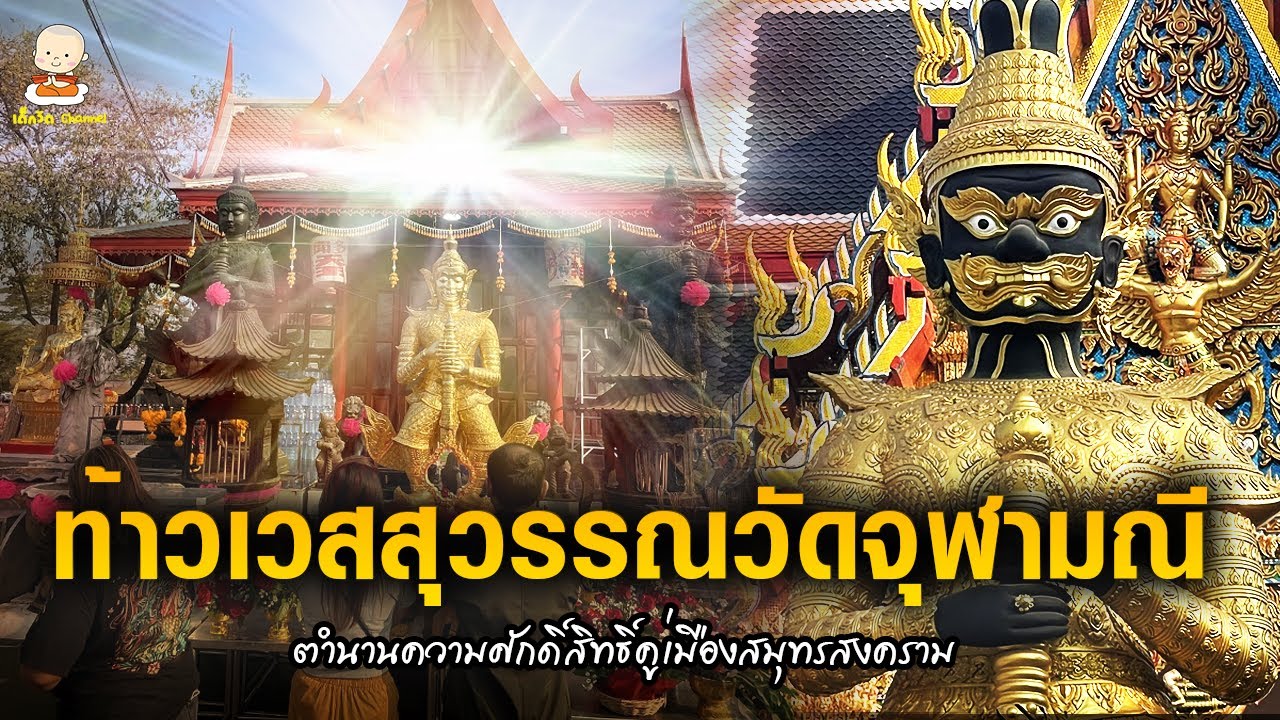
For many visitors today, however, the most famous feature of Wat Chulamanee is the open-air Thao Wessuwan worship area in front of the temple. This is the main reason the temple became nationally known in recent years. People travel here to pray for protection, stability, luck, and relief from obstacles. The strong devotional culture around Thao Wessuwan has transformed the temple into one of the best-known spiritual destinations in central Thailand. Even so, the temple’s historical weight and artistic identity remain just as important, making it attractive to both faith-based travelers and cultural visitors.
The atmosphere changes noticeably throughout the day. Morning hours are better for those who want a calmer visit, merit-making, and time to look closely at the buildings. Late afternoon and evening tend to be busier, especially on weekends and religious occasions, when many people come specifically to pay respect to Thao Wessuwan. Travelers interested in photography may prefer the earlier part of the day, while those who want to witness the temple’s living devotional energy may enjoy the evening crowd more.
Wat Chulamanee also works very well as part of a wider Amphawa itinerary. Because it is close to Amphawa Floating Market, King Rama II Memorial Park, the Amphawa Chaipattananurak Project, and other cultural stops, it can easily be combined with a one-day or overnight trip focused on canalside life, local history, and riverside dining. This makes the temple especially useful for travelers who want a balanced route that includes worship, heritage, food, and local atmosphere rather than a single-purpose visit.
Getting There is straightforward, especially by car. From Samut Songkhram town, follow Highway 325 toward Amphawa. After passing the Amphawa junction, continue for about 200 meters, cross the Amphawa Canal bridge, turn right, and continue for roughly 1 kilometer to the temple. Public transport is also possible. Local songthaews on routes 467, 6004, 6007, and 8378 stop near the entrance road, and van route 996 also serves the area. If you are already staying around Amphawa Floating Market, Wat Chulamanee is an easy add-on to the same trip.
What ultimately gives Wat Chulamanee its lasting appeal is the way it brings together faith, history, and local identity in one place. It is not only a famous temple for worship, and not only an old cultural monument. It is a living temple where architecture, memory, and devotion still function together. For foreign travelers exploring Amphawa and Samut Songkhram, Wat Chulamanee offers one of the clearest ways to understand how Thai religious sites can serve as both spiritual destinations and cultural landmarks at the same time.
| Name | Wat Chulamanee |
| Location | Bang Chang Subdistrict, Amphawa District, Samut Songkhram |
| Address | 93 Moo 9, Bang Chang, Amphawa, Samut Songkhram 75110, Thailand |
| Highlights | Ancient Ayutthaya-period temple, famous Thao Wessuwan worship site, three-storey marble ordination hall, Luang Pho Nuang teak pavilion |
| History | Founded in the late Ayutthaya period during the reign of King Prasat Thong, around 1630–1647 CE |
| Name Origin | Formerly known as Wat Mae Chao Thip before becoming widely known as Wat Chulamanee |
| Distinctive Features | Refined Thai decorative art, mother-of-pearl details, major Thao Wessuwan devotion site, strong links to local and royal history |
| Travel Information | Accessible by private car via Highway 325 and by local songthaews on routes 467, 6004, 6007, and 8378, plus van route 996 |
| Current Status | Open for worship as usual and continues to host religious activities regularly |
| Open Days | Open Daily |
| Opening Hours | 06:00–00:00 |
| Fees | No Admission Fee |
| Facilities | Parking Area, Restrooms, Worship Item Stalls, Outdoor Worship Space, Visitor Facilities |
| Main Areas / Zones | Ordination Hall, Luang Pho Nuang Pavilion, Thao Wessuwan Courtyard, General Worship Areas |
| Abbot / Caretaker | Phra Samut Wachirasophon Vi. (Luang Pho It Bhaddajaro) |
| Main Contact Number | 086-826-6655, 098-823-9595 |
| Official Website / Official Page | www.watjulamanee.com, Facebook: Wat Chulamanee Bang Chang Amphawa Samut Songkhram |
| Nearby Tourist Attractions | 1. Amphawa Floating Market – 3 km 2. King Rama II Memorial Park – 3 km 3. Amphawa Chaipattananurak Project – 3 km 4. Wat Bang Khae Noi – 5 km 5. Tha Kha Floating Market – 8 km |
| Nearby Restaurants | 1. Chalsamran Amphawa – 3 km Tel. 094-546-4562, 034-751-811 2. Baan Thong Boran – 3 km Tel. 081-944-3758 3. Kaomai Plamun Amphawa – 4 km Tel. 063-824-9996 4. The Pomelo Amphawa – 7 km Tel. 061-394-3136 5. Krua Namthip Rim Khlong – 10 km Tel. 086-666-7519 |
| Nearby Accommodations | 1. Juntima Place at Amphawa – 2 km 2. Amphawa Nanon Hotel – 3 km Tel. 082-444-2111, 034-752-111 3. Chuchai Buri Sri Amphawa – 3 km 4. Villa Amphawa – 4 km Tel. 086-471-5583, 02-054-3040 5. The Grace Amphawa – 8 km Tel. 034-712-244, 089-891-6802 |
Frequently Asked Questions (FAQ)
Q: Is Wat Chulamanee open every day?
A: Yes. The temple is open daily, with general visiting hours from 06:00 to 00:00.
Q: Is there an entrance fee at Wat Chulamanee?
A: No. There is no admission fee for general visits and worship.
Q: What is Wat Chulamanee most famous for?
A: It is best known for its Thao Wessuwan worship area, its Ayutthaya-era history, and its impressive marble ordination hall.
Q: When is the best time to visit Wat Chulamanee?
A: Morning is best for a quieter visit and better architectural viewing, while evening is popular for those who want to experience the temple’s stronger devotional atmosphere.
Q: How far is Wat Chulamanee from Amphawa Floating Market?
A: The distance is about 3 kilometers, so it is easy to combine both places in the same trip.
Q: Who is the current abbot of Wat Chulamanee?
A: The current abbot is Phra Samut Wachirasophon Vi., widely known as Luang Pho It Bhaddajaro.
 Category: ●Places of Worship
 Group: ●Temple
Last Update : 7 MonthAgo
 Last Update : 7 MonthAgo
 Click to Access the Navigation Map GPS
Wat Chulamanee Map
Recommend

 Art, Culture and Heritage
 Historical Sites and Monuments(2)
 Art, Craft Centres, Tradition(1)
 Museums(6)
 Historic Homes and Cities(1)
Temple(34)
 Church(1)
 Other Sacred Sites(1)
 Research and Development
 Royal Project(2)
 Suburban Living
 Village, Community(6)
 Local Market(2)
 Floating Market(5)
 Nature and Wildlife
 River, Canal(1)
 Bays and Beaches(1)
 Other natural attractions(1)
 Entertainment and Agricultural
 Farms, Parks and Ecotourism(1)
 Waterpark(1)
 Travel Articles, Recipes
 Travel Review, Food Review(1)


