
lovethailand home >Central Travel Attractions >Bangkok Travel Attractions >Sam Phan Tha Wong >Talat Noi > Talat Noi Neighborhood
TL;DR: Talat Noi Neighborhood, Bangkok attractions : Suburban Living, Village, Community.
Talat Noi Neighborhood
Open Days: Public Streets and Community Walking Routes Are Accessible Daily
Opening Hours: Public Streets Do Not Have Fixed Opening or Closing Sessions. Approximately 09:00–17:00 Is a Suitable Period for Exploring the Neighborhood, Shrines, Historic Buildings, and Businesses Operating During the Day.
Talat Noi Neighborhood, Bangkok, Thailand, is a historic riverside community with more than 200 years of history. Located in Talat Noi Subdistrict, Samphanthawong District, Bangkok, the neighborhood centers on Charoen Krung Road, Soi Charoen Krung 22, and Soi Wanit 2, extending through narrow lanes toward the Chao Phraya River. Its distinctive character comes from the coexistence of Thai-Chinese culture, ancient shrines, historic Chinese houses, traditional shophouses, workshops and businesses selling engine parts, colorful street art, local restaurants, and cafés established inside renovated heritage buildings. Visitors can explore the neighborhood on foot without paying an entrance fee and experience a side of Bangkok where traditional ways of life continue alongside the changing landscape of a modern city.
What makes Talat Noi particularly distinctive is that it remains a residential and working community rather than an attraction created to imitate historic Bangkok. Throughout the narrow streets, visitors encounter homes occupied by local families, longstanding businesses, shrines where worshippers continue to perform religious rituals, and workshops that maintain traditional trades. At the same time, contemporary cafés and creative spaces have adapted historic buildings for new purposes. Walking through Talat Noi therefore brings the past and present together through the architecture, commercial activity, and everyday lives of the people who continue to use the neighborhood.
Talat Noi lies immediately south of Sampeng and Yaowarat, close to Song Wat Road and the wider Charoen Krung district. These areas have long been important to Chinese settlement and trade in Bangkok. The western side of the neighborhood reaches the Chao Phraya River, while the eastern side connects with Charoen Krung Road. Its layout consists of principal streets and smaller lanes extending in different directions. The connections between the river, roads, and historic landing places helped establish the neighborhood as an important location for commerce and transportation before its role gradually changed with the development of Bangkok's modern transport system.
The traditional local name for Talat Noi is Talakkia, meaning a small market. The name is associated with the expansion of the Sampeng commercial community during the early Rattanakosin period. As Sampeng developed into a major Chinese trading center, a smaller market and community emerged to the south and became known as Talat Noi to distinguish its size and location from the larger marketplace. Despite the modest meaning of its name, the neighborhood went on to play a significant role in Bangkok's economy, trade, and multicultural settlement history.
The origins of Talat Noi are connected to riverside trading communities that existed before the establishment of Rattanakosin. As political power shifted from Ayutthaya to Thonburi and subsequently to Bangkok, the Chao Phraya River continued to support settlement and commerce involving merchants, craftspeople, and people from different cultural backgrounds. Expanding river trade made this location particularly suitable for piers, warehouses, and the residences of families engaged in shipping and commercial activities.
During the early Rattanakosin period, several Chinese communities established themselves in Talat Noi. Hokkien Chinese merchants were particularly important because of their connections with maritime trade. Teochew, Hakka, Cantonese, and other Chinese groups subsequently settled in the area. Their presence created networks of family businesses, shrines, and occupational traditions that reflected the cultural backgrounds of different communities. Talat Noi's Chinese heritage is therefore not the product of a single migration or cultural group, but the result of several communities with distinct dialects, customs, and religious practices living and trading in close proximity.
Besides the Chinese population, the wider Chao Phraya riverside around Talat Noi was associated with Portuguese, Vietnamese, and other Western communities that settled or conducted business in Bangkok. Proximity to river ports and international trading routes encouraged interaction among different cultures. Although some communities later relocated or changed considerably, evidence of this diversity remains visible in religious buildings, historic architecture, and the stories preserved throughout Talat Noi and the surrounding Charoen Krung area.
River trade was a major reason for Talat Noi's continued growth. The Chao Phraya served as a principal transportation corridor bringing goods from foreign countries and provincial trading centers into Bangkok. Chinese junks and other cargo vessels could unload goods at riverside landing places, from which merchandise was transferred to warehouses and nearby markets. This activity supported occupations connected with navigation, machinery repairs, transportation, storage, and the distribution of agricultural and commercial products throughout the developing capital.
When junk trading was especially important, Talat Noi contained several landing places and businesses associated with prominent Chinese merchant families. Piers and warehouses were not simply places where cargo moved between boats and the shore. They formed part of a wider commercial network connecting Bangkok markets with merchants and suppliers from different regions. River trade helped create a strong economic foundation for Talat Noi and contributed to its importance as Bangkok expanded rapidly during the Rattanakosin period.
Economic changes during the reigns of Kings Rama IV and Rama V brought further expansion in overseas trade and river transportation. Following the Bowring Treaty of 1855, commerce between Siam and Western countries increased significantly. Businesses along the Chao Phraya benefited from the movement of imported goods and the services required by commercial vessels. Talat Noi consequently experienced the influence of international economic development alongside the expansion of Chinese merchant communities and changes in Bangkok's urban environment.
The construction of Charoen Krung Road during the reign of King Mongkut, Rama IV, also had a major impact on Talat Noi. As one of Bangkok's earliest modern roads, Charoen Krung connected important commercial and residential districts along the Chao Phraya corridor. It provided a practical alternative to transportation by boat. As road travel became easier, shophouses and commercial establishments expanded along Charoen Krung while older residential neighborhoods and riverside landing places continued operating behind the main road.
Talat Noi's urban layout therefore demonstrates the coexistence of water-based and road-based transportation systems. Charoen Krung functions as the principal road connection, while smaller streets and lanes lead toward the river. Many buildings were originally used as merchants' residences, warehouses, or trading premises. Exploring the area reveals how its physical structure developed in response to the practical needs of commercial communities rather than following a uniform urban design.
As machinery and motor vehicles became increasingly important, Talat Noi developed businesses specializing in engine repairs, mechanical components, and secondhand automotive parts. These enterprises were associated with the broader Xiang Kong tradition of trading used engines and vehicle equipment. Stacks of machinery parts, metal components, and mechanical equipment became a characteristic part of the local streetscape. The neighborhood acquired an industrial identity that distinguished it from many other historic districts in Bangkok.
Automotive workshops and parts dealers in Talat Noi developed distinctive ways of using limited shophouse space to accommodate large quantities of merchandise. Engines, gears, wheels, and metal components were arranged on shelves or stacked inside and around workshops. Some premises combined retail space with repair benches and mechanical equipment. These businesses demonstrate the specialist knowledge and practical experience accumulated by local craftspeople and families over successive generations.
Repairing machinery and reusing secondhand components played an important role in the local economy. It allowed businesses and customers to obtain suitable parts without replacing entire machines or vehicles. Identifying components, evaluating their condition, and understanding their possible uses require specialist skills acquired through experience. Talat Noi became a neighborhood where mechanical knowledge was preserved alongside commercial traditions and family business practices.
Although cafés and creative businesses have become more prominent, the automotive-parts trade remains an important part of Talat Noi's identity. Visitors walking through Soi Wanit 2 can still encounter workshops and premises containing engines and metal components. Some businesses continue operating in their original form, while others have adapted old buildings for dining or recreational use. This coexistence creates a distinctive streetscape in which small-scale industrial activity stands alongside contemporary tourism and hospitality.
Soi Wanit 2 is one of the principal routes for exploring Talat Noi because it runs approximately parallel to the Chao Phraya River and connects with numerous smaller lanes. It contains historic houses, traditional businesses, shrines, restaurants, and murals. The atmosphere differs noticeably from the larger Charoen Krung Road. Buildings stand closer together, streets are narrower, and everyday residential and commercial activities remain clearly visible.
Soi Charoen Krung 22 is another important access route leading from the main road into Talat Noi. Visitors entering the lane encounter well-known cafés and workshops that reflect the neighborhood's industrial history. Continuing through the adjoining passages reveals older buildings and murals scattered throughout the area. The winding layout and numerous smaller intersections make exploration interesting because each section of the neighborhood offers different architectural details, artworks, and aspects of community life.
Some of the lanes around Soi Wanit 2 retain gateways and passageways associated with Bangkok's historic Chinese communities. Individual lanes may be named after shrines, families, or former commercial activities. These local place names form part of the neighborhood's history. During the era of river-based commerce, the lanes provided routes for moving goods between the waterfront and nearby shops. Although their transport function has changed, many continue serving local residents while also becoming memorable walking routes through historic Bangkok.
One of Talat Noi's most photographed landmarks is a small vintage orange car parked beside an old brick wall near Soi Wanit 2. The vehicle has become a recognizable symbol of the neighborhood because of its setting among weathered buildings and historic urban surfaces. Its bright orange body contrasts with the aged bricks and unpolished textures of the surrounding architecture. The scene creates a distinctive atmosphere that appeals to travelers interested in street photography and the visual character of older urban neighborhoods.
The orange car represents more than a popular photograph. It also connects visually with the area's history of automotive and machinery-related businesses. The presence of a vintage vehicle within a working neighborhood provides a reminder of the occupations that once dominated the surrounding streets. As an everyday object that became a recognizable feature of the district, it demonstrates how local history can be communicated through the ordinary material landscape rather than through formal museum displays alone.
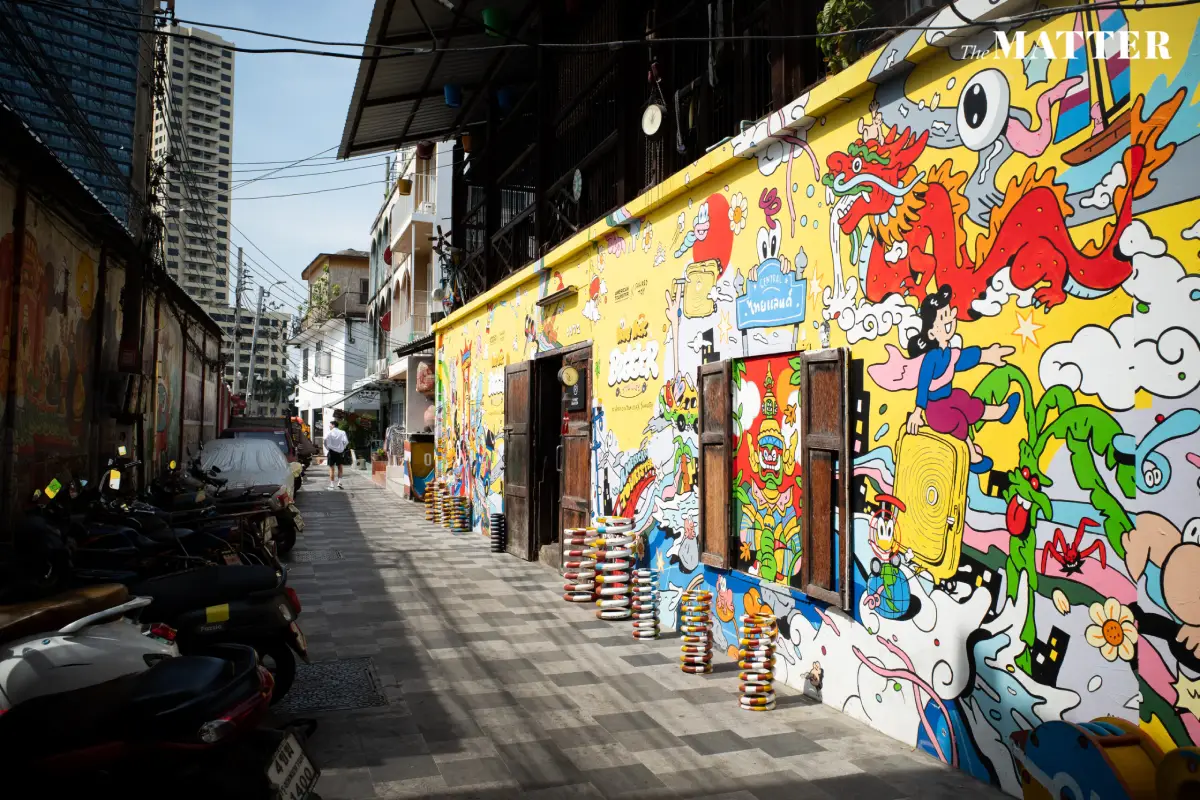
Street art is another major attraction in Talat Noi. Murals appear on walls and buildings throughout the narrow streets, with themes reflecting Thai-Chinese life, commercial activities, lion dancing, festivals, and neighborhood stories. Some works use contemporary graphic styles and vivid colors, while others incorporate the textures of old walls into their compositions. The contrast between painted images and weathered architecture gives the artwork a distinctive visual quality.
The growth of contemporary art in Talat Noi is connected with the development of Bangkok's Charoen Krung creative district and urban art initiatives that brought artists into public spaces. Murals introduced new visitors to streets once known primarily for workshops and mechanical businesses. They also provided a way to communicate community culture and history through an accessible visual medium. Public art has therefore contributed to changing perceptions of Talat Noi while remaining closely connected to its established urban environment.
One of the pleasures of exploring Talat Noi's art is that the murals are not concentrated in a single exhibition venue. Instead, they appear along different lanes, encouraging visitors to walk through the neighborhood and observe details along the way. A mural may stand beside a traditional restaurant, shrine, or working garage. The art becomes part of a broader experience of local history and daily life, rather than an isolated activity unrelated to the community.
So Heng Tai Mansion is one of the most significant heritage buildings in Talat Noi. Associated with a wealthy Hokkien Chinese merchant family and the Posayachinda lineage, the house is more than 200 years old and represents a rare surviving example of traditional Chinese courtyard architecture in Bangkok. Several buildings are arranged around a central open space, with large entrance doors and decorative Chinese details. The layout provided communal space for family activities while allowing the surrounding rooms to serve different residential and private purposes.
The history of So Heng Tai is associated with Phra Aphaiwanit, also known as Chao Sua Jad, an important figure in Chinese merchant networks during the early Rattanakosin period. The house provides evidence of the economic standing of merchant families who established themselves along the Chao Phraya. Its architecture reflects not only wealth and family organization but also the adaptation of Chinese building traditions to the climate and social environment of Bangkok.
Architecturally, So Heng Tai is distinguished by tiled roofs, large wooden doors, timber columns, and decorative elements influenced by Hokkien Chinese traditions. The buildings surround an inner courtyard that allows daylight and airflow to reach the interior. This arrangement is characteristic of traditional courtyard houses designed for extended families. The open central space supported shared activities, while the surrounding buildings provided living quarters and other functional rooms.
The central courtyard of So Heng Tai has been adapted to include a pool used for diving instruction, demonstrating how a historic family property can accommodate contemporary activities while retaining important architectural features. The mansion remains privately owned and used. Access to its interior and photography are subject to rules established by the occupants. It should not be treated as a public museum where visitors can freely enter every room. Its significance lies in the survival of traditional Chinese architecture and the history of the community surrounding it.
Chow Sue Kong Shrine is one of the most important religious landmarks of Talat Noi and a major center of devotion for Bangkok's Hokkien Chinese community. Established in 1804, the shrine stands close to the Chao Phraya River. Its principal deity is Seng Chui Cho Sue, also known as Chow Sue Kong, together with other figures respected within Chinese religious traditions. The shrine continues serving as a place of worship, prayer, and traditional ceremonies that have been maintained over many generations. It is consequently significant for its religious traditions, architecture, and continuing role in community life.
The architectural beauty of Chow Sue Kong Shrine is expressed through its Chinese tiled roof, dragon motifs, elaborate wood carving, and auspicious decorative designs. Inside, altars and religious images are arranged according to their ceremonial importance. The atmosphere differs from the commercial streets outside, with the worship area providing a quieter setting filled with artistic details preserved from Hokkien Chinese cultural traditions.
Many Thai-Chinese worshippers visit Chow Sue Kong Shrine to pray for blessings, particularly good health, family well-being, and prosperity. Worship practices at the shrine form part of religious traditions that Chinese communities have preserved in Thailand for generations. Additional deities are represented alongside the principal figure, making the shrine an important place for family ceremonies and religious observances throughout the year.
The annual Vegetarian Festival is one of the most important traditions associated with Chow Sue Kong Shrine and Talat Noi. It takes place during the ninth month of the Chinese lunar calendar. Activities include observing vegetarian dietary practices, making merit, honoring deities, and participating in religious ceremonies associated with Hokkien Chinese beliefs. Worshippers gather at the shrine throughout the festival, creating a lively atmosphere that demonstrates the continuing importance of religious traditions to the neighborhood.
In 2026, the Vegetarian Festival at Chow Sue Kong Shrine took place from October 9 to 19, lasting eleven days and nights. The program included welcoming the Nine Emperor Gods, making offerings of lamp oil, animal-release rituals, a lantern-floating ceremony, a charitable offering ritual, a dragon procession, and ceremonies marking the conclusion of the festival. These activities demonstrate the continued practice of Chinese religious traditions in Bangkok and bring together community members across generations at a site closely connected with family history and local identity.
Other important Chinese religious occasions, including Chinese New Year, are also observed within the Talat Noi community. Activities may include preparing offerings, making merit, and bringing family members together for worship. These recurring traditions mean that the local shrines are not simply historic attractions but active religious institutions. They continue providing spiritual and social connections for residents and descendants of families associated with the neighborhood.
Hon Wong Shrine, also known as Rong Kueak Shrine, is another historic religious landmark in Talat Noi. It is closely associated with the Hakka Chinese community that settled and traded along the Chao Phraya. The shrine developed during the reign of King Rama V after Hakka merchants brought the image of Hon Wong Kong from China as a focus of worship. The site subsequently developed into a formal shrine with buildings and ceremonial spaces reflecting the traditions of the community.
Rong Kueak Shrine is located in a small lane branching from Soi Wanit 2 near the river. Its religious images and decorative features reflect Hakka Chinese beliefs and traditions. The atmosphere is quieter than the nearby restaurants and cafés frequented by tourists. Visiting the shrine provides insight into the different Chinese communities that established their own places of worship while living within the same riverside neighborhood.
During Chinese New Year, Rong Kueak Shrine becomes important for prayers and offerings associated with Chinese traditions, including worship of the God of Wealth. These activities connect religious beliefs with family and community life. The continuing observance of ceremonies demonstrates that Talat Noi's cultural heritage is maintained through living practices rather than simply through the preservation of historic objects.
Wat Pathum Khongkha Ratchaworawihan is an important Buddhist temple in Samphanthawong District, located near Talat Noi. The temple has a long history associated with riverside settlement in Bangkok. Its ordination hall and other religious buildings reflect traditional Thai temple architecture within the historic city. Visiting the temple alongside the neighborhood's Chinese shrines highlights the diversity of religious institutions and demonstrates the relationship between Buddhist communities and the historic commercial districts along the Chao Phraya River.
Holy Rosary Church, commonly known in Thai as Wat Kalawar, is a Roman Catholic church located on Yotha Road near the river and River City Bangkok. The history of the Catholic community in this area is associated with settlement during the transition from the late Ayutthaya period to early Rattanakosin. The present church is notable for its Western architectural style, including a steeply pitched roof, stained-glass windows, and Gothic-inspired decorative elements. Its appearance contrasts with the Chinese shrines and Buddhist temples nearby.
The presence of Holy Rosary Church near Talat Noi reflects the religious diversity of the Chao Phraya riverside. Merchants and families from different cultural backgrounds settled in the area over several generations. Religious institutions served not only as places of worship but also as centers for education, community activities, and the preservation of cultural identity. Exploring the church's surroundings adds another dimension to the area's history beyond its Chinese commercial heritage.
The Siam Commercial Bank building in Talat Noi is another important historic landmark along the Chao Phraya River. Completed in 1910, the building served as a major office of Siam Commercial Bank after the institution expanded beyond its original premises in Ban Mo. Its architecture combines Beaux-Arts and Neoclassical influences, with a substantial river-facing facade. The design reflects the importance of the Chao Phraya as a commercial transportation corridor in Bangkok's early twentieth-century economy.
The Talat Noi bank building is significant in the history of Thailand's financial system. Siam Commercial Bank originated as the Siam Commercial Bank Company Limited, the country's first Thai commercial bank. Establishing a major office in Talat Noi reflected the commercial importance of the district during a period when river transport remained central to trade. The building consequently connects the history of architecture with the development of modern finance and banking in Thailand.
Talat Noi Museum is a community heritage institution located at Phanu Rangsi Pier beside the Chao Phraya River. Managed by Thailand's Treasury Department under the Ministry of Finance, the museum occupies a former industrial building connected with machining activities and the production of mechanical parts used in vessels and rice mills. The building has been adapted to present exhibitions about the history, economy, society, and culture of Talat Noi. Reusing this industrial structure preserves memories of the district's mechanical trades and commercial riverfront.
The museum's exhibitions explain the neighborhood's development from Chinese merchant settlement and river commerce to specialist crafts and later urban change. The displays connect historical information with surviving places nearby, allowing visitors to recognize aspects of the stories in Soi Wanit 2, the shrines, historic houses, and workshops that continue operating in the neighborhood.
Talat Noi Museum normally operates Tuesday through Friday from 08:30 to 16:30, and on Saturdays, Sundays, and public holidays from 10:00 to 18:00. It is closed on Mondays, and general admission is free. Building and landscape repairs took place during 2026, including an announced temporary closure from October 1 to 25, 2026. Access to the exhibition building and its grounds is governed by the Treasury Department's individual operating announcements, independently of the public streets of Talat Noi, which remain accessible to visitors.
Phanu Rangsi Pier is an important location for understanding the geography and history of Talat Noi because it provides a direct connection with the Chao Phraya River. The river formerly served as the principal route for Chinese junks, cargo vessels, and passenger boats entering Bangkok. From the waterfront, visitors can observe river traffic and the buildings along both banks. The scene demonstrates how the Chao Phraya continues supporting transportation and economic activity, even though the types of vessels and the nature of river commerce have changed considerably.
The Phanu Rangsi waterfront also provides space for community activities and public recreation. During organized local market events, the area may be used to present food, crafts, and products made by neighborhood businesses. Such activities connect contemporary community enterprise with the history of riverside trade. They also allow local residents to present their cultural identity in a setting that has been closely associated with the commercial development of Talat Noi for generations.
Talakkia Market is a community event that revives the neighborhood's traditional name. It has been organized around the first Saturday and Sunday of the month according to local activity calendars. The event focuses on community food, small businesses, crafts, and cultural stories associated with Talat Noi. It is distinct from the everyday neighborhood market and does not mean that the entire district becomes a large walking-street market every weekend.
Recent efforts to develop Talat Noi as a creative heritage district have involved the Bangkok Metropolitan Administration and community networks. Projects have included identifying the neighborhood's distinctive character and developing activities that connect local history with economic opportunities. Community consultations identified the area's Chinese heritage as a central element of its identity, expressed through the concept of Talat Noi as a historic Chinese community. The approach recognizes the importance of families, businesses, and traditions maintained along the Chao Phraya over many generations.
In 2024, the Samphanthawong District Office improved sections of the road surface along Soi Wanit 2, including the connection from Soi Charoen Krung 24 toward the area near building number 999. The work was intended to improve the streetscape and connections used by people exploring the community. These improvements helped make the historic commercial area more suitable for pedestrian visits while retaining its everyday function as a route for residents, traders, and local businesses.
Talat Noi's development as a creative district has not eliminated its older community functions. Instead, cafés and other modern businesses have appeared alongside traditional workshops and homes. A coffee shop may occupy a historic building next to an automotive parts dealer, while a mural may stand near a shrine where older residents continue worshipping. This combination makes Talat Noi an example of urban adaptation, with contemporary tourism and creative activity existing alongside elements of its original commercial and residential character.
Mother Roaster is one of Talat Noi's best-known specialty coffee shops. Located in Soi Charoen Krung 22, it occupies an upper floor of an older building associated with the neighborhood's workshop and machinery-trading atmosphere. Visitors enter through the lower level and climb stairs to the café above. The setting differs substantially from a modern shopping-mall coffee shop because the original industrial surroundings remain part of the experience. Mother Roaster is also known for its selection of coffee beans and brewing methods that highlight the individual characteristics of different origins.
The appeal of Mother Roaster lies partly in the adaptation of an old commercial building without completely removing its former identity. Wooden furniture, collected objects, and vintage details contribute to a welcoming atmosphere, while the original structure reveals the building's earlier uses. Visiting the café is therefore more than an opportunity to drink coffee. It demonstrates how a small modern business can occupy an established neighborhood and reinterpret a historic commercial space.
Hong Sieng Kong is a riverside café and creative venue located on Soi Wanit 2. Several old buildings have been adapted into a setting inspired by historic Chinese architecture, with antique-style furnishings, decorative objects, and open spaces overlooking the Chao Phraya River. It has become especially popular among travelers interested in heritage buildings, photography, and relaxing beside the water. Its riverfront setting provides opportunities to watch passing boats and experience a different atmosphere from the narrow streets farther inland.
The adaptation of historic buildings at Hong Sieng Kong illustrates how architectural heritage can be reused for contemporary activities. Original features have been combined with spaces for dining, drinks, exhibitions, and relaxation. Buildings once associated with residential or commercial activities have acquired new roles serving people from outside the neighborhood. Such reuse contributes to Talat Noi's attractiveness while also demonstrating the importance of preserving architectural character and respecting the surrounding community.
The Taiyuan Building offers another example of adaptive reuse in Talat Noi. Today, it contains accommodation and a café operating under the Photohostel and Photocafe names. The project occupies an old building whose historic character has been incorporated into its contemporary design. It combines short-stay accommodation, coffee, and creative activities, allowing visitors to experience the neighborhood's architectural heritage through an active business rather than a conventional historical exhibition.
Local food in Talat Noi reflects the neighborhood's Thai-Chinese heritage. Noodle dishes, rad na, made-to-order meals, and traditional Chinese-style snacks remain important parts of the food scene. Many eateries are small family businesses that served local workers and residents long before the neighborhood became a popular tourist destination. Eating at these establishments provides an introduction to ordinary community food culture rather than cuisine created specifically for visitors.
Thaworn Radna is a restaurant near Soi Charoen Krung 20 and the connections to Soi Wanit 2, specializing in rad na and other everyday Thai-Chinese meals. Rad na consists of stir-fried noodles, vegetables, and a choice of protein topped with a savory thickened gravy. The dish developed through the adaptation of Chinese cooking traditions to local Thai preferences and has become a familiar meal throughout Bangkok. Restaurants such as Thaworn Radna represent the continuity of this everyday culinary tradition.
Kuay Teow Kham Fak, Talat Noi Branch, is another neighborhood restaurant located on Soi Wanit 2. Its menu includes braised chicken noodles and other noodle dishes. Braised chicken is prepared by simmering meat with aromatic seasonings until tender, producing a distinctive broth and flavor. Small noodle shops like this are important to urban communities because they provide convenient meals for residents, workers, and people passing through the commercial area.
Soi Wanit 2 also contains small made-to-order restaurants and traditional snack businesses, including Lang Amphoe and the Talat Noi chive-dumpling stall associated with Je Kiao. Chinese chive dumplings are prepared using dough filled with chives or other ingredients and may be steamed or fried before being served with a savory dipping sauce. These snacks form part of the Thai-Chinese food tradition and remain popular in historic markets throughout Bangkok.
Riverside restaurants in the wider neighborhood provide additional dining experiences. Baan Rim Naam on Song Wat Road is an example of a restaurant using an older building and its Chao Phraya location as important parts of the dining atmosphere. Visitors can enjoy views of passing river traffic while experiencing a setting that differs from the smaller restaurants within Talat Noi's narrow lanes.
Talat Noi's dining scene consequently reflects both longstanding community food and changing preferences among contemporary Bangkok diners. Traditional restaurants emphasize familiar dishes and relationships with regular customers, while newer cafés often place greater attention on interior design and distinctive menu presentation. Their coexistence provides visitors with a variety of dining experiences and creates additional economic opportunities for neighborhood businesses.
Talat Noi is closely connected with Song Wat Road because both areas developed within Bangkok's historic Chinese trading network along the Chao Phraya River. Song Wat contains old commercial buildings and warehouses reflecting its earlier role in river-based commerce. More recently, cafés, restaurants, and creative businesses have opened in some of these properties. Walking between Talat Noi and Song Wat reveals different stages of commercial development, from historic shipping and warehouse operations to modern hospitality and creative enterprises.
Charoen Krung Road provides another important connection and contains numerous cultural attractions. The broader Charoen Krung district includes heritage buildings, exhibition venues, hotels, and restaurants situated along the main road and adjoining lanes. Walking from Talat Noi into Charoen Krung introduces a change in atmosphere, from narrow community streets with workshops and historic houses to a more extensively developed creative district with businesses associated with art, design, and contemporary services.
River City Bangkok is a riverside center for art, antiques, and exhibitions located on Soi Charoen Krung 24. It contains galleries, shops, and spaces for artistic and cultural activities. The center opens daily from 10:00 to 20:00 and can be reached on foot from Talat Noi. Visiting River City alongside the neighborhood's murals provides an interesting contrast between formally organized art exhibitions and artworks displayed directly on the walls of historic community buildings.
River City Bangkok also reflects the continued importance of the Chao Phraya as an economic and cultural setting. The center stands near Si Phraya Pier and Yotha Road, areas historically connected with the transportation of goods along the river. Combining contemporary art and antiques businesses in a former commercial waterfront area illustrates the evolution of urban economic activity while maintaining the river as a significant part of Bangkok's cultural landscape.
Walking from Talat Noi toward Yaowarat reveals an increasingly dense and energetic commercial environment. Yaowarat is one of Bangkok's most important Chinese trading districts and is particularly famous for its restaurants and evening food culture. Combining the two neighborhoods allows visitors to compare the narrower lanes, historic homes, and working workshops of Talat Noi with the larger commercial streets, illuminated shop signs, and busy dining atmosphere of Chinatown.
A history-focused walking route through Talat Noi can begin on Charoen Krung Road and continue into Soi Charoen Krung 22. From there, visitors can explore Soi Wanit 2 and the adjoining lanes leading toward Chow Sue Kong Shrine, Rong Kueak Shrine, and So Heng Tai Mansion. Along the way, historic homes and workshops demonstrate how different parts of the community were used. The route can then continue toward Phanu Rangsi Pier and Talat Noi Museum, connecting the neighborhood's commercial history with its riverside geography.
The route linking Chow Sue Kong Shrine with So Heng Tai Mansion is particularly valuable for understanding Hokkien Chinese heritage. The shrine represents the community's religious traditions, while the mansion illustrates residential architecture associated with merchant families in early Rattanakosin Bangkok. Their proximity demonstrates how homes, sacred places, and commercial activities combined to shape the organization of historic riverside communities.
For travelers interested in art and photography, the brick walls, orange vintage car, and murals throughout the lanes provide subjects unlike those found in modern shopping centers or conventional museums. The area's photographic character comes from real architectural surfaces, faded paint, weathered building materials, and details of daily community life appearing alongside contemporary art. Photographs can therefore communicate both the historic character of the streets and the changes taking place within them.
Historic buildings in Talat Noi also offer interesting architectural details, including wooden doors, windows, metal grilles, shop signs, and evidence of repairs made during different periods. Some properties have simple, practical designs, while others display decorative Chinese elements that reflect the social standing of the families who constructed them. These differences make a walk through the neighborhood a rewarding way to observe Bangkok's architectural history beyond its major monuments.
The Chao Phraya waterfront around Talat Noi is also suitable for observing Bangkok's riverside scenery. Passenger boats, cargo vessels, and buildings along the banks contribute to a constantly changing urban landscape. Morning light makes details of older structures and piers particularly visible, while late-afternoon and evening conditions can create an appealing atmosphere for riverside relaxation and photography. The continued movement of vessels illustrates the river's importance to Bangkok, even as the nature of transport has changed considerably.
Talat Noi is especially suited to pedestrian exploration because many significant places are located within a relatively compact area and connected by small lanes. Walking provides opportunities to observe architecture and local activities that would be missed when traveling by car. However, many streets remain narrow and are used by motorcycles, delivery vehicles, and local businesses. Visitors therefore share the space with residents and workers whose daily activities continue independently of tourism.
Late morning and afternoon are particularly appropriate for experiencing the historic community while traditional businesses are operating. Daylight makes it easier to appreciate architectural details and street art, while many restaurants and cafés open during these hours. Late afternoon offers opportunities to relax beside the Chao Phraya at riverside establishments. Individual businesses and shrines maintain their own schedules, however, and the neighborhood does not operate according to a single opening timetable.
Saturdays and Sundays often attract more leisure visitors to Talat Noi because people have time to explore the lanes and visit cafés. Community markets or art activities may occasionally take place according to local event calendars. Weekdays, by contrast, can offer clearer views of working workshops and the everyday commercial activities of residents. The neighborhood consequently presents different atmospheres depending on the day of the visit.
Bangkok's hot season can make extended outdoor walking uncomfortable, particularly in lanes with limited shade. Cafés and indoor resting places offer opportunities to take breaks during the day. During the rainy season, wet surfaces and occasional standing water can affect walking conditions. Weather therefore influences the comfort and practical pace of exploring Talat Noi, especially for visitors interested in walking through several adjoining streets.
Late in the year and during relatively cooler weather, outdoor exploration in historic Bangkok is often more comfortable. Visits coinciding with Chinese community festivals provide opportunities to observe cultural activities that differ from ordinary days. Shrines may be decorated for religious ceremonies and attract large numbers of worshippers. Because these occasions are active religious events, access to ceremonial areas is governed by the needs of the communities and people participating in worship.
Respect for residents is particularly important in Talat Noi because many historic buildings remain private homes or family-run businesses. An open doorway does not necessarily mean that visitors may enter or take photographs inside. Asking permission before photographing individuals and avoiding obstructions outside shops help maintain a respectful relationship with the community. These considerations are especially relevant in narrow lanes where there is little room for pedestrians and commercial deliveries to pass.
Visiting Chinese shrines also differs from entering a café or an ordinary tourist attraction. Shrines are active places of worship, and devotees may be carrying out religious practices throughout the day. Modest clothing, quiet behavior, and avoiding interference with prayers are important forms of respect. Some areas may restrict photography or visitor access during ceremonies, and these arrangements are determined by each shrine's caretakers.
Talat Noi can present difficulties for wheelchair users and visitors with limited mobility because some streets have narrow sidewalks, uneven surfaces, and changes in level. Many heritage buildings contain stairs and entrances that predate modern accessibility requirements. Staying on wider routes and selecting places with suitable entrances can make the neighborhood more manageable, without requiring visitors to enter every narrow lane or historic building.
Families with young children can use Talat Noi as a place to learn about history and urban culture through direct observation. Historic Chinese houses, automotive workshops, and community shrines demonstrate the relationships between occupations, architecture, and religious practices. However, some narrow streets remain active routes for motorcycles and deliveries. Children should therefore be supervised closely around crossings and lanes with moving vehicles.
Travelers can reach Talat Noi by taking the MRT Blue Line to Hua Lamphong Station and continuing on foot toward Charoen Krung Road and Soi Charoen Krung 22. The walking distance depends on the chosen route and destination within the neighborhood. Visitors beginning around Chinatown and Song Wat Road can use Wat Mangkon MRT Station and walk through the adjoining historic commercial streets. This alternative connects several neighborhoods associated with Bangkok's Chinese trading history.
Public buses provide another way to reach the area through Charoen Krung Road and nearby streets. Passengers can leave the bus at an appropriate stop and continue on foot into Talat Noi. Drivers can approach through Charoen Krung Road and Yotha Road, but parking is limited within the historic neighborhood. Authorized parking at nearby commercial premises is preferable to leaving vehicles in narrow lanes or blocking access to homes and workshops.
River transport is another option directly connected with Talat Noi's history. The neighborhood stands beside the Chao Phraya and near important landing places, including the Marine Department and Si Phraya piers. Travelers using operating passenger-boat services can disembark at an appropriate pier and continue toward Soi Wanit 2 or Charoen Krung Road. Arriving by river offers views of the buildings and waterfront that help explain the historical relationship between the community and Bangkok's main transportation artery.
Visitors approaching from the Thonburi side can also use river transportation and ferry connections operating along the Chao Phraya, depending on their starting point and the available service. Seeing Talat Noi and Charoen Krung from the water provides a different perspective before entering the narrow inland streets. Combining river transport with walking is particularly appropriate for an area whose historic development depended so heavily on navigation and waterfront trade.
A half-day visit to Talat Noi can begin at Charoen Krung Road and Soi Charoen Krung 22, where visitors can observe shops and murals before continuing into Soi Wanit 2. The vintage orange car beside the brick wall provides another recognizable stop. The route can then continue toward Chow Sue Kong Shrine, Rong Kueak Shrine, and the accessible exterior surroundings of So Heng Tai Mansion. A meal or coffee at a neighborhood establishment offers a convenient break before returning toward Charoen Krung or one of the nearby river piers.
With a full day available, the route can extend to Talat Noi Museum, River City Bangkok, Holy Rosary Church, and Song Wat Road. This wider itinerary combines Chinese shrines, historic homes, the former bank building, local community exhibitions, and contemporary art galleries. The day can conclude with dinner in Chinatown or Song Wat. Exploring these connected neighborhoods provides a broader understanding of the riverside commercial history that shaped several parts of Bangkok.
Accommodation near Talat Noi is suitable for visitors planning more than one day around Chinatown, Charoen Krung, and the Chao Phraya riverside. Talat Noi Subdistrict and the surrounding Hua Lamphong area contain boutique hotels, hostels, and properties adapted from older shophouses. Staying nearby provides convenient access to restaurants, shrines, and cultural attractions, while public railway and boat connections make it possible to explore other parts of Bangkok.
Talakkia Boutique Hotel is located on Charoen Krung Road near the entrance to the Talat Noi neighborhood. Its contemporary design takes inspiration from the surrounding Thai-Chinese commercial environment, and its location provides convenient walking access to Soi Charoen Krung 22 and nearby restaurants. Taladnoi 24 Hostel is another accommodation option on Charoen Krung Road, suitable for travelers seeking a base close to local attractions and short walking routes through the district.
Photohostel operates inside the restored Taiyuan Building, combining guest accommodation with a café and creative spaces. Its appeal lies in the atmosphere of a historic property adapted for contemporary use. Baan YentaFo–Pink House is another small accommodation property on Charoen Krung Road in Talat Noi, offering a compact and distinctive setting for travelers who enjoy staying in older urban neighborhoods.
The Unforgotten is a bed-and-breakfast-style property located on Soi Sukon 2 near Hua Lamphong and Talat Noi. Its interiors feature vintage furnishings and decorative objects that distinguish it from larger modern hotels. The location is convenient for travelers using the underground railway to reach Chinatown and other parts of Bangkok, while remaining within walking distance of local food businesses and the historic community.
Staying near Talat Noi allows travelers to experience the neighborhood at times that differ from a brief daytime excursion. In the morning, residents open shops, prepare food, and begin their working routines. During the afternoon, cafés and riverside establishments attract more leisure visitors. Overnight accommodation therefore provides opportunities to observe the contrast between everyday community activities and the tourism that has developed around the area.
Talat Noi remains economically important to its residents because many small businesses continue operating within family networks. Workshops, restaurants, retail shops, and service businesses all contribute to the local economy. Tourism has introduced new customers, while increasing demand for properties suitable for cafés and creative activities. These changes affect business practices and the use of neighborhood space. Talat Noi therefore illustrates the need to balance economic development with the continuing residential and commercial life of historic communities.
Preserving Talat Noi's historical value involves more than restoring old buildings. It also includes maintaining craftsmanship, religious beliefs, and community traditions. Workshops that remain in operation, shrines that continue hosting ceremonies, and historic houses still used by families make the area's history visible through everyday life. Sustainable cultural activity depends on allowing visitors to understand this continuity without replacing all traditional businesses with tourism-oriented establishments.
From an environmental perspective, Talat Noi is closely connected to the Chao Phraya River and a network of narrow streets shared by pedestrians, motorcycles, and delivery vehicles. Keeping the lanes and waterfront clean is essential to the quality of the neighborhood. Waste left near restaurants or public areas may be washed into drainage systems and the river during heavy rainfall. Maintaining orderly pedestrian access also helps the community accommodate visitors while preserving the everyday movement of residents and businesses.
Talat Noi is a valuable place to study anthropology and social history because of its stories of migration, settlement, and the development of family networks among different Chinese communities. The relationships between shrines, merchants' houses, and workshops reveal how urban communities organized religious and economic life. Exploring these places demonstrates that Bangkok developed not only through royal institutions and government buildings but also through the labor, craftsmanship, and commercial activities of people living along the river.
Cultural diversity is also expressed through food, language, and religious festivals. The Hokkien and Hakka communities have distinct traditions and occupational histories, while neighboring areas include Christian institutions and Buddhist temples. The close proximity of different religious places makes Talat Noi an informative location for understanding how diverse communities have lived alongside one another throughout Bangkok's history.
Within the wider urban landscape, Talat Noi forms part of an interconnected network of historic commercial neighborhoods that includes Sampeng, Song Wat, Yaowarat, and Charoen Krung. Each area has a different character shaped by its businesses and communities. Talat Noi is particularly associated with Chinese houses, automotive workshops, shrines, and street art. Song Wat retains strong connections with warehouses and riverfront trade, while Yaowarat is known for its larger markets and energetic food streets. These connections allow visitors to extend a Talat Noi excursion into a broader exploration of Bangkok's commercial history.
The defining quality of Talat Noi is that it remains a living historic community. Some buildings have stood for more than a century, certain shrines have maintained religious traditions for over 200 years, and specialist workshops continue practicing occupations closely connected with the neighborhood's past. Meanwhile, contemporary cafés and public art have introduced the area to new generations. This continuity creates an atmosphere that could not be recreated simply by constructing new buildings, because Talat Noi's value comes from the relationship between history, people, and places that have remained in use over time.
Visiting Talat Noi offers an experience of Bangkok that differs from large commercial attractions. Travelers can explore narrow lanes, see traditional Chinese courtyard architecture, pay respects at historic shrines, photograph the orange vintage car beside its brick wall, observe specialist workshops, enjoy local food, and relax in cafés occupying older buildings. Many of these experiences are connected by short walking routes. The neighborhood consequently offers important opportunities to discover Bangkok's history, architecture, religion, food culture, and contemporary urban transformation within a single district.
Getting There Talat Noi Neighborhood is located in Talat Noi Subdistrict, Samphanthawong District, Bangkok 10100, Thailand. The principal area for walking and sightseeing is around Soi Charoen Krung 22 and Soi Wanit 2. Travelers can take the MRT Blue Line to Hua Lamphong Station and walk along Charoen Krung Road into the neighborhood, or use Wat Mangkon Station and continue through Yaowarat and Song Wat Road. River access is available through operating boat services at nearby piers such as the Marine Department and Si Phraya. Drivers can approach through Charoen Krung or Yotha Road and use authorized parking, as many of the community's lanes are narrow and better suited to walking than private vehicles.
| Name | Talat Noi Neighborhood, Bangkok |
| Attraction Type | Historic Chao Phraya Riverside Neighborhood, Thai-Chinese Cultural Heritage Area, Street Art Destination, and Community Tourism District |
| Address | Soi Charoen Krung 22 and Soi Wanit 2, Talat Noi Subdistrict, Samphanthawong District, Bangkok 10100, Thailand |
| Reference Coordinates | 13.733327, 100.513110 |
| Public Area Management | Bangkok Metropolitan Administration through the Samphanthawong District Office, in Cooperation with Community Networks and the Authorities Responsible for Individual Sites |
| Samphanthawong District Office | +66 2 233 1224 to +66 2 233 1228 |
| Current Status | The Neighborhood and Public Streets Remain Open for Walking. Privately Owned Houses, Shrines, Museums, and Businesses Have Their Own Access Arrangements. |
| Open Days | Daily Access to Public Streets and Lanes |
| Opening Hours | Public Streets Have No Fixed Opening or Closing Sessions. Approximately 09:00–17:00 Is a Suitable Period for Exploring Daytime Businesses and Community Landmarks. |
| Admission Fee | Free Access to Talat Noi's Public Streets and Walkways. Private Properties and Special Activities May Have Separate Rules or Charges. |
| Neighborhood History | A Historic Riverside Trading Community That Grew South of Sampeng during the Early Rattanakosin Period. Settled by Several Chinese Groups and Associated with Maritime Commerce, Trading, and Specialist Crafts. |
| Name Origin | The Traditional Name Talakkia Means “Little Market,” Referring to a Smaller Trading Community South of the Larger Sampeng Market. |
| Cultural Communities | Thai-Chinese Communities of Hokkien, Hakka, Teochew, and Other Backgrounds, Together with Communities Historically Connected to the Chao Phraya Riverside. |
| Highlights | So Heng Tai Mansion, Chow Sue Kong Shrine, Rong Kueak Shrine, Street Art, Vintage Orange Car, Automotive Workshops, Historic Architecture, Thai-Chinese Food, and Heritage Cafés. |
| Main Areas / Zones | 1. Charoen Krung Road and Soi Charoen Krung 22 2. Soi Wanit 2 and Traditional Workshops 3. Street Art Lanes and the Vintage Orange Car 4. Chow Sue Kong Shrine and Rong Kueak Shrine 5. So Heng Tai Mansion and Historic Chinese Houses 6. Talat Noi Museum and Phanu Rangsi Pier 7. Riverside Cafés and Public Waterfront Areas 8. Routes Connecting Holy Rosary Church, River City Bangkok, and Song Wat Road |
| Important Religious Sites | Chow Sue Kong Shrine, Rong Kueak Shrine, Nearby Wat Pathum Khongkha Ratchaworawihan, and Holy Rosary Church |
| Major Traditions | The Vegetarian Festival at Chow Sue Kong Shrine, Chinese New Year, Local Shrine Ceremonies, and Community Cultural Events |
| 2026 Vegetarian Festival | October 9–19, 2026, at Chow Sue Kong Shrine, Featuring Merit-Making and Traditional Chinese Religious Ceremonies |
| Talat Noi Museum | Treasury Department Community History Museum at Phanu Rangsi Pier. Normal Schedule: Tuesday–Friday 08:30–16:30; Weekends and Public Holidays 10:00–18:00; Closed Mondays. Free Admission. A Temporary Repair Closure Was Announced for October 1–25, 2026. Tel. +66 2 233 7390. |
| Activities | Historic Neighborhood Walks, Architecture and Street Photography, Shrine Visits, Local Food Tasting, Heritage Cafés, and Walking Routes Linking Song Wat and Charoen Krung |
| Community Market | Talakkia Community Market, Organized According to Community Event Calendars, Traditionally around the First Saturday and Sunday of the Month |
| Best Time to Visit | Late Morning through Afternoon for Architecture, Street Art, Shrines, and Daytime Businesses |
| Facilities | Restaurants, Cafés, Nearby Art Venues, MRT Connections, River Passenger Piers, and Limited Authorized Private Parking |
| Getting There | Take the MRT Blue Line to Hua Lamphong and Walk toward Soi Charoen Krung 22, or Use Wat Mangkon Station and Walk via Song Wat Road. River Services at the Marine Department and Si Phraya Piers Provide Alternative Access. |
| Nearby Tourist Attractions | 1. Chow Sue Kong Shrine, Within Talat Noi, Approximately 0.5 km, Tel. +66 2 266 3768 2. Rong Kueak Shrine, Within Talat Noi, Approximately 0.5 km, Tel. +66 81 545 3991 3. So Heng Tai Mansion, Within Talat Noi, Approximately 0.5 km 4. Talat Noi Museum and Phanu Rangsi Pier, Approximately 0.6 km, Tel. +66 2 233 7390 5. River City Bangkok, Approximately 0.7 km, Tel. +66 2 237 0077 6. Holy Rosary Church, Approximately 0.8 km 7. Siam Commercial Bank Historic Talat Noi Building, Approximately 0.7 km 8. Wat Pathum Khongkha Ratchaworawihan, Approximately 1.1 km |
| Nearby Restaurants and Cafés | 1. Mother Roaster Talat Noi, Approximately 0.2 km, Tel. +66 61 216 2277 2. Hong Sieng Kong, Approximately 0.6 km, Tel. +66 95 998 9895 3. Thaworn Radna, Approximately 0.3 km, Tel. +66 83 618 1399 4. Kuay Teow Kham Fak, Talat Noi Branch, Approximately 0.4 km, Tel. +66 94 495 7880 5. Lang Amphoe Made-to-Order Restaurant, Approximately 0.4 km, Tel. +66 83 919 3701 6. Baan Rim Naam, Song Wat Road, Approximately 1.2 km, Tel. +66 85 904 6996 |
| Nearby Accommodations | 1. Talakkia Boutique Hotel, Approximately 0.3 km, Tel. +66 65 724 8988 2. Taladnoi 24 Hostel, Approximately 0.3 km, Tel. +66 96 923 2424 3. Photohostel, Taiyuan Building, Approximately 0.6 km, Tel. +66 98 916 8839 4. Baan YentaFo–Pink House, Approximately 0.3 km, Tel. +66 82 497 9499 5. The Unforgotten, Approximately 0.9 km, Tel. +66 97 164 2910 |
Frequently Asked Questions (FAQ)
Q: Where is Talat Noi Neighborhood located?
A: Talat Noi Neighborhood is located in Talat Noi Subdistrict, Samphanthawong District, Bangkok 10100, Thailand, around Charoen Krung Road, Soi Charoen Krung 22, and Soi Wanit 2 near the Chao Phraya River. It is a historic Thai-Chinese community with more than 200 years of history, connected to Chinatown, Song Wat Road, and Charoen Krung.
Q: Is Talat Noi Neighborhood still open to visitors?
A: Yes. Talat Noi remains an active residential and commercial neighborhood, and its public streets are accessible daily. Visitors can see historic buildings, murals, workshops, and local streets without purchasing tickets. Privately owned houses, shrines, museums, and restaurants maintain their own opening hours and visitor access rules.
Q: Is there an entrance fee for Talat Noi Neighborhood?
A: No. Walking through Talat Noi and exploring its public streets is free. Visitors can photograph accessible public areas without buying an admission ticket. Restaurants, cafés, privately owned venues, and certain organized activities have separate charges or access requirements.
Q: What is the best time to visit Talat Noi?
A: Approximately 09:00–17:00 is a suitable period for exploring Talat Noi. Daylight makes it easier to appreciate the historic architecture, street art, and local community atmosphere, while many restaurants and cafés operate during these hours. Individual shrines and privately managed venues have their own schedules.
Q: What are the main attractions in Talat Noi?
A: Important landmarks include So Heng Tai Mansion, Chow Sue Kong Shrine, Rong Kueak Shrine, Talat Noi Museum, Phanu Rangsi Pier, the historic Siam Commercial Bank building, street art throughout the lanes, and the vintage orange car beside an old brick wall. Heritage cafés, workshops, and local restaurants are also central to the experience.
Q: What is the history of Talat Noi Neighborhood?
A: Talat Noi developed as a smaller trading settlement south of Sampeng during the early Rattanakosin period. Several Chinese communities established businesses connected with maritime commerce, transportation, and trade. The area later became known for engine workshops and secondhand automotive parts before cafés, public art, and creative activities introduced new forms of tourism. Its traditional name, Talakkia, means “little market.”
Q: What important festivals are celebrated in Talat Noi?
A: The Vegetarian Festival at Chow Sue Kong Shrine is one of the neighborhood's major annual religious traditions. In 2026, the event took place from October 9 to 19, with merit-making and traditional Chinese ceremonies. Chinese New Year and other shrine observances are also important to the community's religious and cultural life.
Q: How do I get to Talat Noi by MRT or boat?
A: Take the MRT Blue Line to Hua Lamphong Station and walk along Charoen Krung Road toward Soi Charoen Krung 22. Alternatively, use Wat Mangkon Station and walk through Song Wat Road. Travelers using river transport can arrive at operating piers near the Marine Department or Si Phraya and continue on foot into Soi Wanit 2 and the surrounding Talat Noi streets.
 Category: ●Suburban Living
 Group: ●Village, Community
Last Update : 6 DayAgo
 Last Update : 6 DayAgo

 Click to Access the Navigation Map GPS
Talat Noi Neighborhood Map
Recommend

 Art, Culture and Heritage
 Historical Sites and Monuments(3)
 Landmarks and Memorials(25)
 Royal Palace(13)
 Art, Craft Centres, Tradition(36)
 Museums(63)
 Historic Homes and Cities(5)
 Art Gallery(18)
 Educational Places
 Museum for Study(6)
 Library(5)
 University
 Public university(8)
 Autonomous Universities(8)
 Rajamangala University of Technology(6)
 Rajabhat University(6)
 Private University(22)
 Places of Worship
 Temple(73)
 Church(2)
 Mosque(67)
 Other Sacred Sites(9)
 Research and Development
 Royal Project(1)
Village, Community(7)
 Local Market(19)
 Floating Market(4)
 Nature and Wildlife
 River, Canal(4)
 Bays and Beaches(1)
 Other natural attractions(3)
 Entertainment and Agricultural
 Zoos and Aquariums(5)
 Animal camps and shows(5)
 Stadium(9)
 Farms, Parks and Ecotourism(22)
 Amusement Park(2)
 Waterpark(4)
 Theater(7)
 Cinema(1)
 Shopping
 Shopping and Night Market(28)
 Department Store(44)
 Spas and Wellness
 Spas and Wellness(1)
 Restaurant
 Michelin Star(5)
 Accommodation
 Hotel(3)
 Call Customer Service in Tourism
 Call Customer Service in Tourism(1)
 Travel Articles, Recipes
 Travel Review, Food Review(52)
 Royal Thai Desserts and Recipes(56)


