
lovethailand home >Northeastern Travel Attractions >Surin Travel Attractions >Muang Surin >Ta Ong > Ban Chan Rom Silk Weaving Village
TL;DR: Ban Chan Rom Silk Weaving Village is located at Ban Chan Rom, Ta Ong Subdistrict, Mueang Surin District, Surin Province 32000, open Daily, hours 08.30 – 17.00.

Ban Chan Rom Silk Weaving Village
Open Days: Daily
Opening Hours: 08.30 – 17.00
Ban Chan Rom Silk Weaving Village Surin is an important community silk-weaving destination in Ban Chan Rom, Ta Ong Subdistrict, Mueang Surin District, Surin Province. Located east of Surin city along Highway 2077, the Surin – Sangkha route, around kilometer marker 12, the village is known for traditional silk weaving based on local mulberry cultivation, silkworm raising, silk reeling, dyeing, tying, and handloom weaving. The village preserves a local textile culture in which silk is not just a product, but a living body of knowledge connected with agriculture, family life, women’s craft skills, and the identity of Surin Province.
Ban Chan Rom is a suitable place for visitors who want to understand Surin silk at community level. The value of the village lies in the fact that the silk-making process begins close to the source. Local people grow mulberry, raise silkworms, reel silk thread, prepare yarn, dye silk, create tie-dye patterns, and weave the final fabric on traditional looms. These skills have been preserved through practice over generations. They are not only technical procedures, but also family wisdom that has been learned through observation, repetition, and hands-on work.
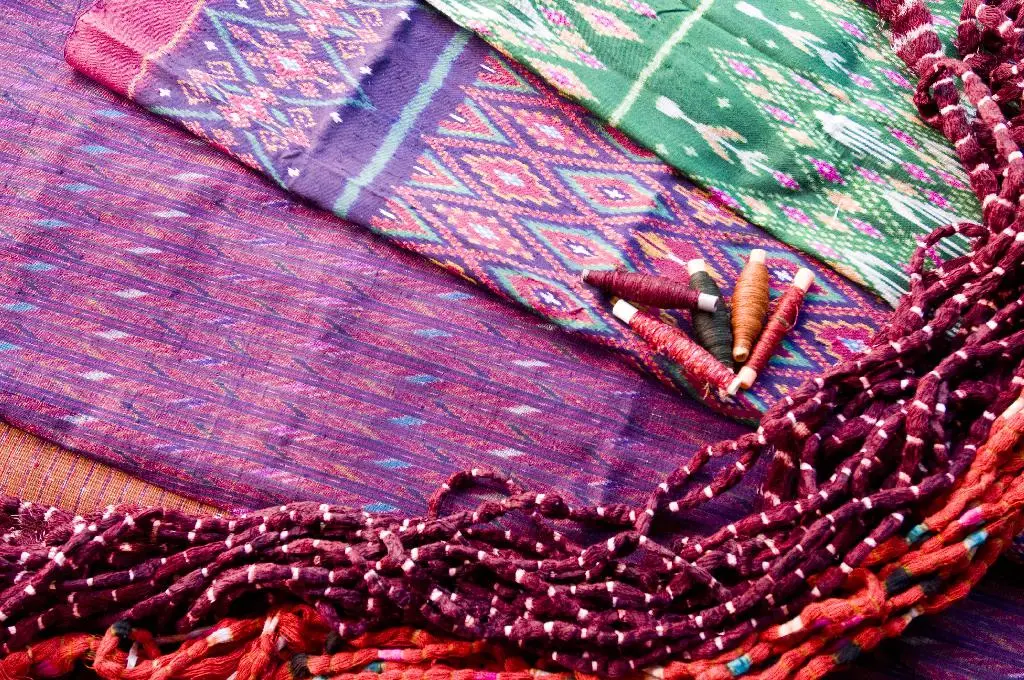
The main character of Ban Chan Rom silk is its traditional patterns and old-style color tones. Unlike industrial textiles, handmade silk carries the rhythm of human hands, the natural texture of silk thread, and the slight softness of colors that come from traditional weaving knowledge. The patterns on the fabric often reflect local memory, nature, community taste, and the visual language of Surin silk. Holding a piece of Ban Chan Rom silk is therefore like holding a woven story of the village itself.
Surin is one of Thailand’s most recognized provinces for silk. It is known for handwoven silk, matmi silk, raised-pattern silk, naturally dyed silk, and weaving traditions connected with many ethnic groups in lower northeastern Thailand. Ban Chan Rom is part of this wider textile landscape. Its location near Surin city makes it accessible, while its craft identity remains strongly rooted in village life. A visit here helps travelers understand that Surin is not known only for elephants, Khmer ruins, and local festivals, but also for living silk craftsmanship.
The silk-making process begins with mulberry cultivation. Mulberry leaves are the main food for silkworms, and their quality affects the strength and fineness of the silk. Villagers who raise silkworms must understand the seasonal rhythm, leaf quality, cleanliness of the raising area, and the right time to harvest leaves. When the silkworms form cocoons, the cocoons are boiled and reeled into silk thread. This thread then becomes the foundation for dyeing, tying patterns, and weaving.
Silk reeling requires skill and patience. The artisan must control heat, hand movement, and thread consistency. Good silk thread should be strong, smooth, glossy, and resistant to breakage. When woven, it gives the fabric a soft yet substantial feel. Watching silk reeling helps visitors understand why handmade silk takes time and why a finished silk cloth has higher cultural and material value than ordinary fabric.
Dyeing is another important stage. Traditional silk colors are often deep, calm, and refined rather than overly bright. These tones match older weaving patterns and the taste of Surin silk. Controlling color on silk thread is delicate because silk absorbs and reflects color differently from many other fibers. The dyer must understand yarn weight, color strength, dyeing time, washing, drying, and preparation before the thread is placed on the loom.
Matmi, or tie-dye patterning before weaving, is one of the most important techniques in northeastern Thai silk. The pattern is not printed on the fabric after weaving. It is created on the silk threads before the weaving begins. Artisans tie sections of the thread to resist dye, dye the threads, untie or retie them, and repeat the process according to the number of colors and complexity of the design. When the threads are finally woven, the pattern appears on the fabric. This requires precision, planning, and experience.
The loom is the heart of the weaving space. The sound of the beater, the movement of the shuttle, and the gradual appearance of cloth from warp and weft threads create the atmosphere of a living craft village. A single piece of silk may take days or longer depending on the fineness of the thread, the complexity of the pattern, and the size of the cloth. Every stage of weaving is an accumulation of time, focus, and inherited hand skill.
Ban Chan Rom produces many forms of silk products, including matmi silk, raised-pattern silk, traditional sarong cloth, pha sin, shawls, scarves, fabric for tailoring, ceremonial silk pieces, and fabric for collectors. Each product serves a different purpose. Sarong cloth and pha sin are used in daily life and ceremonies. Shawls and scarves are practical as gifts. Larger silk pieces are suitable for formal wear, weddings, auspicious occasions, and family heirlooms.
The charm of Ban Chan Rom silk is its authenticity as community-made textile. The fabric has natural texture, refined patterns, deep color, and the character of handwoven work. Buying silk directly from the village allows visitors to understand where the fabric comes from and how much work is involved. It also supports the income of local weavers and helps keep silk weaving active in the community.
Ban Chan Rom Women’s Silk Weaving Group plays an important role in producing, collecting, and selling silk products from the village. A community group is essential for the survival of local craft because it gives household weavers a shared space for presenting products, receiving orders, developing designs, and connecting with customers beyond the village. The group identity also makes it easier for travelers and buyers to find community-made silk products.
The main community caretaker of the craft destination is Ban Chan Rom Women’s Silk Weaving Group, with support from local and provincial trade networks. Individual visitors can usually visit during opening hours to buy silk and observe the community atmosphere. Groups who want formal demonstrations, study visits, or large product orders should coordinate in advance so that the community can prepare artisans, space, and explanation properly.
Ban Chan Rom is also important as a community-economy learning site. Silk is not only a beautiful product; it is supplementary income, family knowledge, and a cultural asset. When local people grow mulberry, raise silkworms, and weave silk themselves, knowledge and income remain within the community. This strengthens both the cultural and economic value of the village.
A visit to Ban Chan Rom is suitable for travelers interested in culture, textiles, design, silk, local economy, and rural community life. Visitors should allow around 1 to 2 hours for a meaningful visit. They can browse silk products, speak with local people, observe the weaving environment, and learn how silk is created from thread to cloth. When demonstrations are arranged, the visit becomes even more valuable because visitors can see the real skill behind each textile.
There is no admission fee for ordinary visits to Ban Chan Rom Silk Weaving Village. Costs depend on product purchases or pre-arranged group activities. Silk prices vary according to silk type, pattern complexity, weaving technique, size, and production time. A handmade silk piece should be understood as the price of time, skill, knowledge, and cultural continuity, not only as a piece of fabric.
When selecting silk, visitors should consider texture, pattern, color, weave density, edge finishing, and intended use. Fabric for tailoring should have suitable length and color for the occasion. Shawls and scarves are practical as gifts. Matmi silk and raised-pattern silk are valuable for collectors or formal uses. Buying directly from the village also allows visitors to ask artisans about silk care and proper use.
Silk care should be gentle. Hand-washing with mild detergent is recommended. Avoid strong rubbing, long soaking, bleach, and direct harsh sunlight. Dry the silk in shade with good airflow. If ironing is needed, use low heat or iron through a protective cloth. Proper care helps preserve the natural gloss, color, and softness of silk for many years. A good silk piece can become a family keepsake.
Visitors should respect the community environment. Ask permission before photographing people, avoid entering private household areas, do not touch looms or silk threads without permission, and speak politely with artisans. Bargaining should be done respectfully because handmade silk requires time and skill. Respect for craft labor is an essential part of responsible community travel.
Getting There to Ban Chan Rom Silk Weaving Village is most convenient by private car, rental car, or chartered vehicle. From Surin city, take Highway 2077, the Surin – Sangkha route, heading east for about 12 km, then continue into Ta Ong Subdistrict and Ban Chan Rom. The road is convenient and suitable for a half-day cultural trip from Surin city.
Visitors using navigation should search for “Ban Chan Rom Silk Weaving Village” or “Ban Chan Rom Women’s Silk Weaving Group, Ta Ong Subdistrict, Mueang Surin District.” Since Surin has many silk weaving villages, including the subdistrict name and the Surin – Sangkha route helps visitors reach the correct location.
Ban Chan Rom can be combined with several nearby attractions. For a handicraft-focused route, visitors can continue to Ban Butom Basketry Village and Ban Tha Sawang Ancient Gold-Brocade Silk-Weaving Village. For a city-culture route, they can return to Surin city to visit Surin City Pillar Shrine, Wat Burapharam, Phraya Surin Phakdi Si Narong Changwang Monument, and Surin National Museum.
A full-day itinerary can begin with Ban Chan Rom in the morning for silk learning and shopping, followed by lunch in Surin city, then a visit to the city shrine, Wat Burapharam, or Surin National Museum in the afternoon. This route gives visitors a balanced understanding of Surin through craft, faith, history, and urban culture.
Restaurants near Ban Chan Rom are available along the Surin – Sangkha route and in Surin city. The city offers the widest choice, including Thai food, Isan food, Vietnamese food, cafés, and hotel restaurants. Groups should plan meals in advance, especially when visiting the village as part of a study trip or community craft route.
Accommodation for visiting Ban Chan Rom is best found in Surin city because the village is only about 12 km away. Staying in the city gives travelers easy access to hotels, restaurants, markets, the railway station, local transport, and other attractions. Visitors arriving by train or bus can stay in central Surin and arrange a short trip to Ban Chan Rom by local transport, rental car, or chartered vehicle.
For international visitors, Ban Chan Rom Silk Weaving Village provides a clear introduction to Thai silk at community level. It shows that silk does not begin in a shop; it begins with mulberry trees, silkworms, silk thread, dyeing, hand skill, and family-based knowledge. The village demonstrates how textiles connect nature, agriculture, women’s work, local economy, and cultural identity in one continuous system.
International visitors should approach the village with respect and curiosity. Rather than seeing silk only as a souvenir, they should understand it as living cultural knowledge. Talking with artisans, asking about patterns, observing the weaving process, and buying with awareness will make the visit more meaningful. Ban Chan Rom is suitable for textile lovers, designers, students, craft entrepreneurs, and travelers who want to understand Thailand through real communities.
Overall, Ban Chan Rom Silk Weaving Village is valuable because it preserves mulberry cultivation, silkworm raising, silk reeling, traditional dyeing, matmi patterning, handloom weaving, and community-based silk sales in one place. Its simplicity is part of its strength. Visitors can see silk in its real context, not separated from the people and village life that create it.
In summary, Ban Chan Rom Silk Weaving Village Surin is an important silk craft village in Ta Ong Subdistrict, Mueang Surin District. Located about 12 km east of Surin city along Highway 2077, the village is known for locally raised silk and traditional weaving with old-style patterns and colors. Visitors can learn about silk production, buy directly from the community, and combine the trip with Surin City Pillar Shrine, Wat Burapharam, Surin National Museum, Ban Butom Basketry Village, and Ban Tha Sawang Ancient Gold-Brocade Silk-Weaving Village.
| Name | Ban Chan Rom Silk Weaving Village Surin / Ban Chan Rom Women’s Silk Weaving Group |
| Location | Ban Chan Rom, Ta Ong Subdistrict, Mueang Surin District, Surin Province 32000 |
| Address | Ban Chan Rom Women’s Silk Weaving Group, No. 2, Moo 4, Ban Chan Rom, Ta Ong Subdistrict, Mueang Surin District, Surin Province 32000 |
| Highlights | Traditional silk weaving village, local mulberry cultivation and silkworm raising, old-style patterns and colors, matmi silk, raised-pattern silk, direct purchase from weavers, and Surin textile wisdom learning destination |
| History | A local silk-weaving community of Ta Ong Subdistrict that has preserved mulberry cultivation, silkworm raising, silk reeling, dyeing, matmi patterning, and handloom weaving through family and community knowledge |
| Name Origin | The destination name comes from Ban Chan Rom, a community in Ta Ong Subdistrict known for local silk weaving in Surin Province |
| Distinctive Features | Villagers grow mulberry, raise silkworms, reel silk thread, dye yarn, tie matmi patterns, and weave silk with traditional colors and designs, making it suitable for community textile learning |
| Travel Information | From Surin city, take Highway 2077, the Surin – Sangkha route, eastward for about 12 km to Ta Ong Subdistrict and Ban Chan Rom. Private cars, rental cars, and chartered vans are convenient options |
| Current Status | Open for cultural visits, silk learning, and community silk product purchases. The village remains an active handicraft and cultural destination in Ta Ong Subdistrict |
| Open Days | Daily |
| Opening Hours | 08.30 – 17.00 |
| Fees | No Admission Fee For Ordinary Visits. Costs Depend On Product Purchases Or Pre-Arranged Group Activities |
| Facilities | Silk product sales area, community textile learning area, demonstration space when arranged in advance, parking according to village conditions, and basic services in Ta Ong Subdistrict and Surin city |
| Main Areas / Zones | 1. Ban Chan Rom Women’s Silk Weaving Group Area 2. Silk Display And Sales Area 3. Loom And Weaving Demonstration Area When Arranged In Advance 4. Mulberry And Silkworm Learning Area Within The Community 5. Silk Reeling, Yarn Preparation, And Dyeing Learning Area 6. Matmi And Traditional Pattern Learning Area 7. Household Weaving Areas Of Community Members 8. Ban Chan Rom And Ta Ong Community Route 9. Connection Area To Nearby Surin City Attractions |
| Important Products | Matmi silk, raised-pattern silk, traditional sarong cloth, pha sin, shawls, scarves, tailoring silk, ceremonial silk fabric, and local community silk products |
| Silk Care | Hand-wash gently with mild detergent, avoid strong rubbing and bleach, dry in shade with airflow, and iron with low heat or through a protective cloth to preserve silk fiber and color |
| Community Traditions / Lifestyle | Mulberry cultivation, silkworm raising, silk reeling, dyeing, matmi tying, handloom weaving, silk use in merit-making, weddings, auspicious ceremonies, and family-based textile knowledge transmission |
| Caretaker / Community Group | Ban Chan Rom Women’s Silk Weaving Group coordinates community silk products, sales, and local learning visits in Ban Chan Rom |
| Product Information / Coordination Contact | Surin Best / Surin Provincial Commercial Office, Tel. 0-4451-4385, 0-4451-2626 |
| Nearby Tourist Attractions | 1. Surin Government And City Center Area, about 12 km 2. Surin City Pillar Shrine, about 13 km 3. Wat Burapharam Royal Temple, about 13 km 4. Phraya Surin Phakdi Si Narong Changwang Monument, about 14 km 5. Ban Butom Basketry Village, Mueang Thi Subdistrict, about 18 km 6. Ban Tha Sawang Ancient Gold-Brocade Silk-Weaving Village, about 20 km, Tel. 0-4414-0015 7. Surin National Museum, about 17 km, Tel. 044-513-272, 044-513-274 8. Sikhoraphum Sanctuary, Sikhoraphum District, about 45 km |
| Nearby Restaurants | 1. Som Tam T.B. Ubon Surin Branch 1, Surin – Sikhoraphum Road, about 15 km, Tel. 081-977-4086 2. Starbeam Restaurant, Mueang Surin District, about 13 km, Tel. 044-519-629, 086-877-4447 3. Sawasdee Surin On Sirirat Road, about 13 km, Tel. 085-637-7707 4. Kon Khmer Namnueng Surin, about 13 km, Tel. 083-385-5599, 086-497-7958 5. Big Bite Restaurant At Thong Tarin Hotel, about 14 km, Tel. 088-103-2383 6. Restaurants And Cafés Around Surin Railway Station, about 13 km |
| Nearby Accommodations | 1. HOP INN Surin, about 13 km, Tel. 065-518-9784 2. Maneerote Hotel Surin, about 13 km, Tel. 044-514-569 3. Sorin Boutique Hotel, about 13 km, Tel. 044-060-188 4. The Wood Surin, about 14 km, Tel. 063-023-7999 5. Slive Hotel Surin, about 14 km, Tel. 044-060-322, 044-060-323 6. Thong Tarin Hotel, about 14 km, Tel. 044-514-281, 085-300-8858 |
Frequently Asked Questions (FAQ)
Q: Where Is Ban Chan Rom Silk Weaving Village Located?
A: Ban Chan Rom Silk Weaving Village is located in Ban Chan Rom, Ta Ong Subdistrict, Mueang Surin District, Surin Province 32000, about 12 km east of Surin city along Highway 2077 on the Surin – Sangkha route.
Q: When Is Ban Chan Rom Silk Weaving Village Open?
A: The village is open daily from 08.30 to 17.00 for visits and community silk product purchases.
Q: Is There An Admission Fee?
A: No. There is no admission fee for ordinary visits. Costs depend on silk purchases or pre-arranged group activities.
Q: What Is The Main Highlight Of Ban Chan Rom Silk Weaving Village?
A: The main highlight is traditional Surin silk weaving based on local mulberry cultivation, silkworm raising, silk reeling, dyeing, matmi tying, and handloom weaving with old-style patterns and colors.
Q: Who Oversees Ban Chan Rom Silk Weaving Village?
A: Ban Chan Rom Women’s Silk Weaving Group is the main community group coordinating silk products, sales, and local learning visits in Ban Chan Rom.
Q: What Products Can Visitors Buy At Ban Chan Rom?
A: Visitors can buy matmi silk, raised-pattern silk, traditional sarong cloth, pha sin, shawls, scarves, tailoring silk, ceremonial silk fabric, and other community-made silk products.
Q: What Nearby Places Can Be Visited With Ban Chan Rom Silk Weaving Village?
A: Nearby places include Surin City Pillar Shrine, Wat Burapharam Royal Temple, Phraya Surin Phakdi Si Narong Changwang Monument, Ban Butom Basketry Village, Ban Tha Sawang Ancient Gold-Brocade Silk-Weaving Village, Surin National Museum, and Sikhoraphum Sanctuary.
Q: How Should Visitors Prepare For A Visit?
A: Visitors should dress modestly, ask permission before photographing people, avoid private household areas, prepare cash for silk purchases, and contact the group in advance for demonstrations or study visits.
 Category: ●Suburban Living
 Group: ●Village, Community
Last Update : 2 MonthAgo
 Last Update : 2 MonthAgo
 Click to Access the Navigation Map GPS
Ban Chan Rom Silk Weaving Village Map
Recommend

 Art, Culture and Heritage
 Historical Sites and Monuments(11)
 Landmarks and Memorials(2)
 Art, Craft Centres, Tradition(5)
 Museums(1)
 Places of Worship
 Temple(15)
 Other Sacred Sites(1)
Village, Community(9)
Other Sacred Sites(1)
Village, Community(9)
 Local Market(1)
 Nature and Wildlife
 National Parks and Marine Reserves(2)
 Mountain (Doi)(2)
 Dam, Reservoir, Lake(6)
 Waterfalls(1)
 River, Canal(2)
 Other natural attractions(4)
 Entertainment and Agricultural
 Farms, Parks and Ecotourism(2)


