
lovethailand home >Central Travel Attractions >Bangkok Travel Attractions >Thon Buri >Hiran Ruchi > Bansomdejchaopraya Rajabhat University
TL;DR: Bansomdejchaopraya Rajabhat University is located at Hiranruchi, Thon Buri, Bangkok, Thailand, open Monday – Friday (University Administrative Offices), hours 08:30 – 16:30.
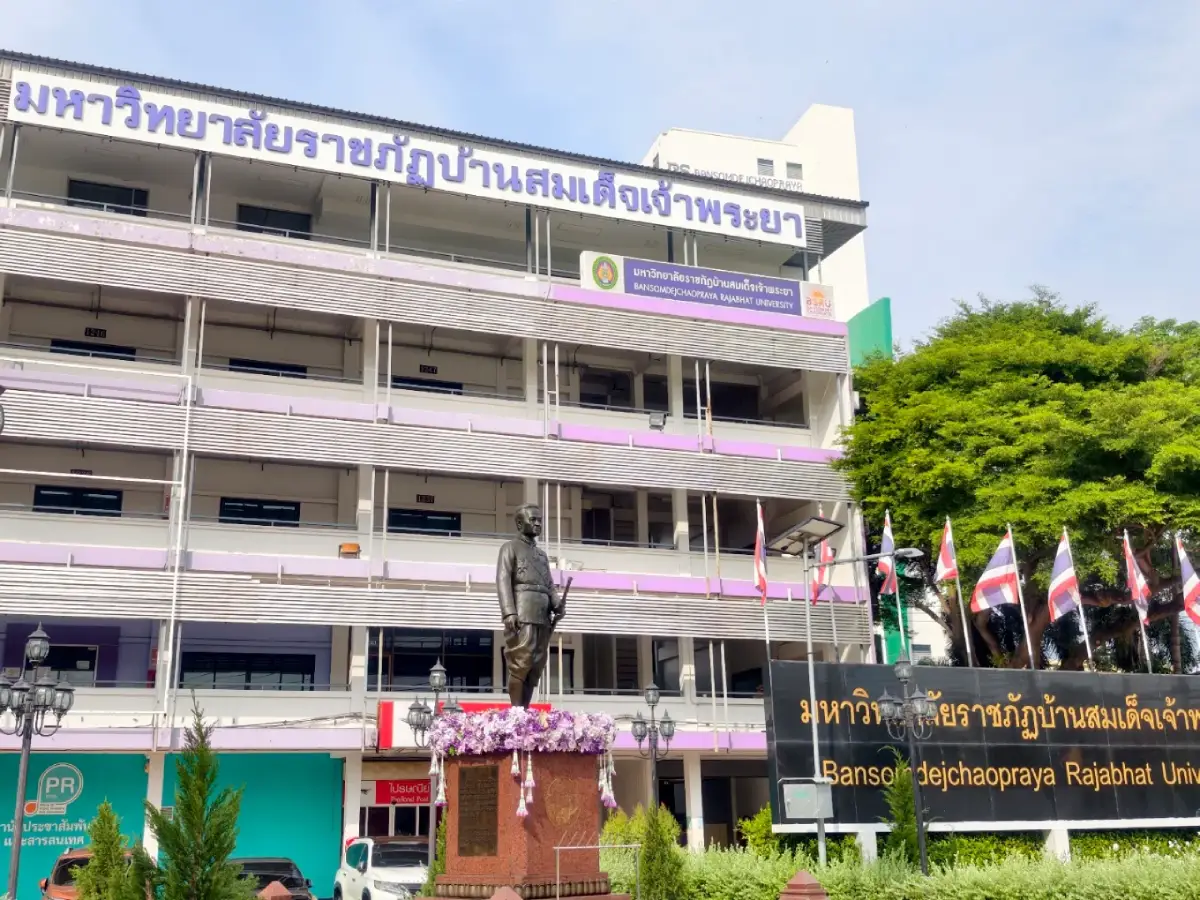
Bansomdejchaopraya Rajabhat University
Open Days: Monday – Friday (University Administrative Offices)
Opening Hours: 08:30 – 16:30
Bansomdejchaopraya Rajabhat University (BSRU), known in Thai as Mahawitthayalai Rajabhat Ban Somdet Chaophraya, is a public university in Bangkok with educational roots extending back 130 years. Located at 1061 Soi Itsaraphap 15, Itsaraphap Road, Hiranruchi, Thon Buri, Bangkok 10600, the university traces its origins to Rajavidhyalaya School, which opened on March 17, 1896, under the royal initiative of King Chulalongkorn (Rama V). It subsequently developed through several stages of teacher education, including a teacher-training school, teachers college, and Rajabhat institute, before officially attaining university status on June 15, 2004. Today, BSRU offers education in teacher training, humanities, social sciences, business, science, technology, engineering, music, allied health, and nursing. Its identity is closely connected with Somdet Chao Phraya Borom Maha Sri Suriwongse (Chuang Bunnag), one of Thailand's most significant historical statesmen, and with the cultural heritage of Bangkok's Thonburi district.
Bansomdejchaopraya Rajabhat University is more than a degree-granting institution. Its history reflects the development of modern education in Thailand, beginning with the educational reforms of the late nineteenth century and continuing through the expansion of teacher preparation, secondary education, and multidisciplinary higher education. The institution's evolution also illustrates how Thailand's teacher-training colleges gradually acquired broader responsibilities in research, professional development, community services, and cultural preservation.
The university occupies a historic urban setting on the western side of the Chao Phraya River. The surrounding Thonburi and Khlong San neighborhoods contain old temples, traditional communities, religious buildings, and sites associated with influential families from the early Rattanakosin period. This environment gives BSRU an unusually strong connection between academic learning and local history. Students and visitors can study the development of Thai education while encountering cultural and architectural landmarks that reveal how Thonburi has changed over generations.
The history of Bansomdejchaopraya Rajabhat University begins with the royal initiative of King Chulalongkorn to establish a school inspired by the British public-school model. During the late nineteenth century, Thailand was modernizing its administration, educational institutions, and professional training systems. King Chulalongkorn appointed a committee to consider establishing the new school, with Chao Phraya Phasakorawong, then Minister of Public Instruction, serving as its chairman.
The committee selected the former residence of Somdet Chao Phraya Borom Maha Sri Suriwongse (Chuang Bunnag) as a suitable location. The large estate had been presented to the Crown in 1890 by Phraya Siharaj Dechochai, a grandson of the distinguished statesman. Its extensive grounds and existing buildings provided an appropriate setting for the proposed educational institution. The decision transformed a historically important aristocratic residence into a place dedicated to learning.
On March 17, 1896, Rajavidhyalaya School officially opened, with A. C. Carter serving as its first headmaster. Although Rajavidhyalaya was its formal name, people in the surrounding area commonly called it the school across the river or Ban Somdet Chao Phraya School, referring to the historic residence in which it operated. This popular geographical name would prove remarkably enduring, eventually becoming a central part of the present university's identity.
Rajavidhyalaya School emerged during a period when formal education was becoming increasingly important to the modernization of the Thai state. The expansion of schools and administrative institutions required educated personnel capable of serving in government and public life. As the school developed, its facilities became insufficient for its growing requirements. Rajavidhyalaya consequently relocated to the Phai Singto area of Pathum Wan, near the present-day surroundings of Sa Pathum Palace, leaving the former residence of Somdet Chao Phraya available for another educational purpose.
The Ministry of Public Instruction subsequently recognized a major challenge in the national education system: schools in the provinces often lacked teachers with qualifications comparable to those available in Bangkok. To help address this disparity, the former residence was converted into a teacher-training institution known as the Western Bank Teacher Training School, which began teaching on May 1, 1903. Luang Bamnet Worayan was appointed its headmaster.
This teacher-training school was established to prepare qualified educators for service in provincial schools. At the time, Thailand was working to extend formal education beyond the capital, and teacher preparation was crucial to that process. The institution therefore became part of a wider national effort to strengthen provincial education and reduce differences in educational provision between Bangkok and other regions.
As teacher education expanded into provincial centers, the institution's organization and programs changed. It was subsequently associated with the name Western Bank Teacher Training College and later became known as Ban Somdet Chao Phraya Teacher Training School. These transitions reflected changes in educational administration and the continuing importance of teacher preparation, rather than the establishment of an entirely unrelated institution.
In 1913, King Vajiravudh (Rama VI) ordered the teacher-training institution to become part of the Civil Service School, an institution connected with the later development of Chulalongkorn University. The school remained at its original location until 1915, when its teacher-training operations moved to the Wang Mai area, where the National Stadium complex now stands. Its departure once again made the former Somdet Chao Phraya residence available for educational redevelopment.
On May 17, 1915, the premises were used to establish Ban Somdet Chao Phraya Secondary School. The school accepted boarding students and maintained relationships with several nearby educational institutions, including schools associated with Wat Anongkharam and Wat Phichaiyat. Phraya Pramuan Wichaphun served as its headmaster. This period strengthened the name Ban Somdet Chao Phraya as a recognized educational identity in Bangkok.
The secondary school developed its own institutional traditions and symbols. Purple and white became its school colors, the initials บ.ส. represented its Thai name, and its motto expressed the principle that truth is immortal. Historical symbols connected with Somdet Chao Phraya Borom Maha Sri Suriwongse were also adopted. These features provided the foundations for the cultural identity that later generations of students and university graduates would inherit.
A major relocation followed the construction of the Memorial Bridge, officially known as Phra Phuttha Yodfa Bridge. Road development associated with the bridge affected the school's original grounds and required a new educational site. Phraya Wisetsuphawat, then headmaster, worked through the Ministry of Public Instruction to arrange an exchange of premises with Suksanari School. Additional land was obtained in the Bang Sai Kai area for classrooms and student accommodation.
In 1932, Ban Somdet Chao Phraya Secondary School moved to the new site, which became part of the grounds occupied by Bansomdejchaopraya Rajabhat University today. This relocation established an important continuity between the secondary school period and the physical setting of the modern university. The development of new classrooms, boarding facilities, and other educational spaces enabled further expansion of the institution.
In 1941, the Ministry of Education adopted policies to increase the supply of teachers. A teacher-training division was consequently established alongside Ban Somdet Chao Phraya Secondary School under the name Ban Somdet Chao Phraya Teacher Training School. It admitted scholarship students from provincial areas and offered qualifications intended to prepare primary-school teachers. The revival of teacher training restored an educational mission that had been associated with the institution since the early twentieth century.
In 1956, the previous teacher-training course was discontinued and replaced by programs leading to certificates in education and higher education certificates. These developments formed part of the effort to strengthen teacher qualifications and improve professional preparation across Thailand.
In 1958, the teacher-training institution was upgraded to Ban Somdet Chao Phraya Teachers College. Meanwhile, the associated secondary school became a demonstration school of the college. This arrangement allowed the institution to combine higher-level teacher preparation with practical educational experience in a school setting. It also established a relationship between teacher education and demonstration-school teaching that remains important to Rajabhat universities.
During the 1970s, the college expanded its higher education programs. In 1973, it introduced bachelor's-level study through a higher education qualification program. The Teachers College Act of 1975 subsequently supported the development of Bachelor of Education programs, giving the institution a stronger role in preparing professionally qualified teachers.
In 1984, the college broadened its academic provision beyond education. It began offering bachelor's degree programs in science and liberal arts, alongside two-year diploma programs, and participated in the Rattanakosin United Colleges network. These changes marked a decisive step toward a multidisciplinary higher education institution, allowing students to pursue qualifications in fields other than teaching.
On February 14, 1992, King Bhumibol Adulyadej bestowed the name “Rajabhat” upon Thailand's teachers colleges. Under the Rajabhat Institute Act of 1995, Ban Somdet Chao Phraya became Bansomdejchaopraya Rajabhat Institute. The institution's responsibilities developed further to include undergraduate and graduate education, research, academic services, and the preservation of arts and culture.
On June 15, 2004, the institute received university status under the Rajabhat University Act of 2004 and became Bansomdejchaopraya Rajabhat University. The change represented the culmination of more than a century of educational development connected with the Ban Somdet Chao Phraya name. It also established the institution as a public university with a broad range of academic programs and administrative responsibilities.
The university celebrated the 130th anniversary of its historical foundation on March 17, 2026, calculated from the opening of Rajavidhyalaya School in 1896. Separately, June 15, 2026, marked 22 years since its elevation to university status. These dates refer to different stages in the institution's development and should not be confused. Its historical origins precede the establishment of the modern Rajabhat university by more than a century.
Somdet Chao Phraya Borom Maha Sri Suriwongse (Chuang Bunnag) is one of the most important historical figures associated with Bansomdejchaopraya Rajabhat University. Born on December 23, 1808, he was the eldest son of Somdet Chao Phraya Borom Maha Prayurawongse (Dit Bunnag) and Than Phuying Chan. He belonged to the influential Bunnag family, whose members had served in prominent administrative and political positions in Siam for generations.
Chuang Bunnag received a broad education and was noted for his knowledge of government, foreign affairs, and English. He maintained contacts with Western residents and diplomats in Siam and contributed to important diplomatic and administrative matters during the reigns of Kings Rama III and Rama IV. During the early reign of King Chulalongkorn, he served as Regent of Siam, placing him among the most influential statesmen of nineteenth-century Thai history.
His relationship with the modern university originates from its use of land formerly associated with his residence and estate. His memory is preserved in ceremonial traditions, commemorative displays, and historical learning spaces. Members of the university community also refer to themselves as Luk Suriya, meaning “Children of the Sun,” reflecting their connection with the Maha Suriyamonthon emblem historically associated with the statesman. This shared identity expresses the university community's respect for its historical heritage.
The origin of the university's name is therefore inseparable from the former residence of Somdet Chao Phraya Borom Maha Sri Suriwongse. Local residents used the name Ban Somdet Chao Phraya long before the institution became a university. The later addition of Rajabhat reflects the royal designation granted to Thailand's teacher-training institutions. Together, the two elements represent both the university's geographical and historical roots and its educational mission.
The university's symbols and identity include purple and white as its institutional colors. Purple is associated with the distinctive attire historically worn by Somdet Chao Phraya Borom Maha Sri Suriwongse, while white represents purity and integrity. The university's official emblem incorporates the royal seal associated with King Bhumibol Adulyadej, reflecting the shared symbolic tradition of Thailand's Rajabhat universities.
The university's symbolic tree is the Purple Orchid Tree, or Chong Kho in Thai (Bauhinia purpurea). Its purple blossoms correspond with the institution's colors and make it a distinctive natural symbol of university identity. The university's inherited motto, traditionally expressed in Pali, conveys the principle that truth is immortal, emphasizing honesty, knowledge, and moral responsibility.
University leadership in 2026 is headed by Assistant Professor Dr. Kanakorn Sawangcharoen, the Rector of Bansomdejchaopraya Rajabhat University. The university's academic structure encompasses faculties concerned with education, humanities, management, science, engineering, allied health, and nursing, together with its College of Music, Graduate School, and supporting academic services.
University traditions and cultural activities are strongly influenced by the institution's respect for Somdet Chao Phraya Borom Maha Sri Suriwongse, its teacher-training heritage, and its connection with the Thonburi community. A particularly important tradition is the commemorative ceremony honoring the statesman on the anniversary of his death. University administrators, lecturers, and staff participate in offerings and ceremonies that acknowledge his contributions to Siam and his enduring importance to the institution.
On January 19, 2026, the university held a commemorative ceremony at its Hall of Fame, including offerings before the statue of Somdet Chao Phraya Borom Maha Sri Suriwongse. The participation of university leaders and staff demonstrated how historical remembrance continues to form part of institutional life. Such ceremonies link the modern university community with a historical figure whose former estate played a central role in its origins.
Another major occasion is Rajabhat Foundation Day and the Royal Emblem Procession, associated with February 14, the anniversary of the royal naming of Rajabhat institutions. In 2026, the university held its Royal Emblem Procession on February 13 at Bansomdej Stadium, with the Rector presiding. The ceremony brought together administrators, faculty members, staff, and students to commemorate King Bhumibol Adulyadej's royal patronage of Rajabhat institutions.
The Royal Emblem Procession helps students understand the symbolism and history of the Rajabhat university system. Beyond its ceremonial role, it reinforces a shared institutional identity and encourages new students to recognize the historical responsibilities associated with their membership of a public university.
Cultural activities also take place through the University's Office of Arts and Culture. Its work includes promoting traditional Thai knowledge, interpreting local history, conserving historic architecture, and organizing educational programs for students and the public. The university's approach treats cultural preservation as an active form of learning rather than merely the maintenance of historical objects.
Important places within Bansomdejchaopraya Rajabhat University include heritage buildings, museums, commemorative sites, and academic facilities. Among the most historically significant is the 150-Year Mahaburut Rattanodom (Chuang Bunnag) Building, formerly associated with the Sri Suriwongse Building. Originally constructed in 1932, the structure has considerable architectural value and received an Outstanding Architectural Conservation Award in 2012 from the Association of Siamese Architects under Royal Patronage in the category of institutional and public buildings.
The building has been adapted to accommodate several important cultural facilities, including the Krung Thonburi Studies Learning Centre, the University Hall of Fame, and the Sri Suriwongse Theatre. Its conservation demonstrates how a historic building can continue to serve modern educational and cultural purposes while retaining its historical significance.
The Krung Thonburi Studies Learning Centre focuses on the history of Thonburi and the communities on the western side of the Chao Phraya River. Established within the 150-Year Mahaburut Rattanodom Building, the learning spaces present information about regional history, everyday life, society, cultural traditions, and the people who shaped this part of Bangkok. They provide an opportunity to connect documentary history with the urban environment surrounding the university.
The Bansomdejchaopraya Rajabhat University Hall of Fame preserves and interprets the institution's development from the Rajavidhyalaya period through the teacher-training era and its transition to a modern university. The displays also relate to important figures in its history. For students, graduates, educators, and cultural visitors, the Hall of Fame offers a meaningful introduction to the university's long educational heritage.
Sri Suriwongse Theatre, located within the historic building complex, provides a venue for performing arts and cultural activities. Its presence alongside exhibition rooms and historical learning spaces reflects the university's integrated approach to heritage and creativity. The theatre also contributes to the wider environment in which students can engage with music, performance, and artistic expression.
Baan Ekanak Museum is another valuable heritage site within the university. The conserved historic house provides a setting for learning about older residential architecture and the social history of the Thonburi area. Its preservation helps visitors understand how houses, local environments, and community life have changed over time.
Additional historical facilities include displays and commemorative areas dedicated to Somdet Chao Phraya Borom Maha Sri Suriwongse. His image and associated memorial spaces remain important symbols of respect within the university. Considered together, these sites reveal how historical persons, architectural heritage, and academic traditions form a continuous narrative across the campus.
The university also offers facilities supporting contemporary student life and academic work. These include library and learning resources, computer laboratories, fitness facilities, a swimming pool, tennis courts, pétanque areas, and sports grounds. Access for visitors and non-university users is subject to the rules and arrangements of the relevant departments.
Academic strengths at Bansomdejchaopraya Rajabhat University are rooted in teacher education but now extend across a wide range of fields. The institution has developed programs in music, humanities, digital media, business, applied sciences, engineering, allied health, and nursing. This multidisciplinary approach helps the university respond to changing professional requirements while preserving its educational heritage.
The Faculty of Education continues the university's historical role in preparing teachers. Its academic fields cover early childhood and elementary education, Thai and English, mathematics, science, social studies, computer education, educational measurement, psychology and guidance, art education, and physical education. Teacher preparation combines specialized subject knowledge with educational principles and professional practice.
The Faculty of Humanities and Social Sciences offers studies related to languages, culture, law, public administration, information studies, social development, and the creative arts. Programs listed in the university's academic database include Thai, English, Chinese, East Asian Languages and Cultures, Law, Public Administration, Social Sciences for Development, Library and Information Science, and Creative Graphics. These disciplines support careers and research in public service, cultural industries, education, and communication.
The Faculty of Management Science specializes in business, economics, communication, and service industries. Its program listings include Accounting, Logistics and Supply Chain Management, Creative Digital Marketing, Digital Business, Entrepreneurship, International Business Management, Tourism Innovation, Digital Content Communication, Film, and Entertainment Business. Such fields are relevant to an economy increasingly shaped by digital technologies, international commerce, and creative services.
The Faculty of Science and Technology provides education across applied science, agriculture, computing, information technology, food-related fields, materials, health-oriented sciences, and environmental management. Its programs support the development of scientific knowledge and technical capabilities needed by modern industries and services.
The Faculty of Engineering and Industrial Technology offers subjects associated with production management, logistics, industrial engineering, energy engineering, electrical engineering, automated control systems, product design, and related technologies. These academic areas connect engineering knowledge with industrial production and operational management.
The Faculty of Allied Health Sciences includes fields such as Traditional Thai Medicine, Public Health, Medical Technology, Medical Sciences, and health-related disciplines. Meanwhile, the Faculty of Nursing developed a new Bachelor of Nursing Science curriculum for 2026 and conducted undergraduate admissions through the TCAS system for that academic year. Together, these faculties strengthen the university's role in health professional education.
The College of Music is a distinctive academic unit of the university. It provides studies relating to Thai music, Western music, music education, and music production technology, including certain international-program options. The combination of traditional and contemporary musical disciplines supports students preparing for careers in performance, teaching, production, composition, and the creative industries.
The Graduate School supports advanced study through graduate diploma, master's, and doctoral programs. Its academic listings include Educational Administration, Curriculum and Instruction, Music Education, Counseling Psychology, Technology and Innovation Management, Thai Language, Public Management, and Traditional Thai Pharmacy. Graduate business administration programs are also listed in an international format.
The university's wider educational infrastructure includes its demonstration schools, academic resource services, research and development units, cultural office, and cooperative and work-integrated education facilities. These departments support teacher preparation, academic research, student development, and collaboration with communities and employers.
The U Thong Dvaravati Education Centre is another university location, situated at 95 Moo 1, Sa Yai Som Subdistrict, U Thong District, Suphan Buri Province 72220. Its activities focus on local learning and regional development, particularly the history of Dvaravati, cultural diversity, ethnic communities, and creative-economy initiatives connected with Suphan Buri.
One example of the centre's community engagement was the Five Ethnic Groups of Dvaravati Festival, held in April 2025. The program featured cultural exhibitions, performances, local food, and Songkran-related activities involving different ethnic communities. It illustrated how educational institutions can work with local organizations to preserve cultural heritage and develop community tourism.
Research and innovation at Bansomdejchaopraya Rajabhat University are closely linked with its mission to provide academic services and contribute to regional development. The Research and Development Institute supports scholarly work, innovation, and creative projects. The university also works to connect research outcomes with social needs through public engagement and partnerships.
In 2024, the university established its Learning Promotion and Innovation Transfer Centre to coordinate academic services, share technical knowledge, support innovation transfer, and assist local enterprises. This institutional development reflects a practical approach to higher education in which universities contribute expertise and resources to economic and social development beyond their own campuses.
The university's relationship with the Thonburi community is strengthened by its location among neighborhoods with diverse cultural histories. Traditional Thai communities, Chinese-Thai religious and commercial heritage, and areas associated with important Rattanakosin-era families can all be found nearby. This environment offers valuable opportunities to connect classroom learning with local research, cultural interpretation, and community projects.
Educational and cultural visits to Bansomdejchaopraya Rajabhat University can be particularly rewarding for people interested in Thai educational history, Thonburi heritage, historic architecture, and cultural preservation. Notable points of interest include the 150-Year Mahaburut Rattanodom Building, the Hall of Fame, the Krung Thonburi Studies Learning Centre, Baan Ekanak Museum, and Sri Suriwongse Theatre. Together, they illustrate both the institution's own history and the wider history of the surrounding district.
Group visits should be arranged in advance through the University's Office of Arts and Culture. Certain cultural facilities have specific access arrangements, and maintenance or institutional events may affect opening conditions. In 2026, the university announced a temporary systems-related closure of the Hall of Fame and Krung Thonburi Studies Learning Centre from March 16 to July 10. Visitors planning trips after that period should confirm the current service arrangements before arrival.
The university's surrounding neighborhood is also rich in historic landmarks associated with the Bunnag family and the early Rattanakosin period. Wat Anongkharam Worawihan, Wat Phichaiyat, Wat Prayurawongsawat, and Wat Kalayanamit are among the significant nearby temples. Visiting them helps illustrate the relationship between noble patronage, religious architecture, local communities, and the development of nineteenth-century Bangkok.
Santa Cruz Church and the historic Kudi Chin neighborhood provide another perspective on Thonburi's cultural heritage. The riverside Catholic community is particularly associated with Thai-Portuguese history and longstanding connections between religion, trade, and migration. These nearby destinations offer a complementary cultural experience for visitors exploring the university's historical setting.
Getting to Bansomdejchaopraya Rajabhat University is possible by private car, BTS Skytrain, MRT metro, and public bus. The university's main entrance is accessed through Soi Itsaraphap 15, off Itsaraphap Road in Thon Buri District. Drivers should use the official university address and follow the university's entrance and parking regulations.
For BTS travel, Wongwian Yai Station is a convenient connecting point. Visitors can use Exit 3 and continue by taxi or motorcycle taxi. For MRT travel, Itsaraphap Station offers another option, with onward transport by bus, taxi, or motorcycle taxi. Public bus routes listed by the university for the Itsaraphap Road area include routes 40, 56, 57, and 149. Travelers should check current bus routes and services before departure.
Other useful transport landmarks include Wongwian Yai and the Ban Khaek intersection, where travelers can connect with surrounding roads and transport services. Anyone planning a museum visit, academic appointment, or organized campus tour should distinguish general administrative office hours from the schedules of individual teaching buildings, exhibition facilities, and special events.
Bansomdejchaopraya Rajabhat University is therefore much more than a public university in Bangkok. Its story brings together King Chulalongkorn's educational reforms, provincial teacher preparation, the legacy of the Bunnag family, and the architectural and cultural heritage of Thonburi. From Rajavidhyalaya School in 1896 to a multidisciplinary Rajabhat university in the twenty-first century, the institution has retained its historical identity while expanding its academic programs and responsibilities. Its continuing contributions to education, research, professional training, and cultural preservation make it an important part of Thailand's higher education history.
| University Name | Bansomdejchaopraya Rajabhat University (มหาวิทยาลัยราชภัฏบ้านสมเด็จเจ้าพระยา) |
| Abbreviation | BSRU |
| University Type | Public University, Rajabhat University Network |
| Location | Hiranruchi, Thon Buri, Bangkok, Thailand |
| Full Address | 1061 Soi Itsaraphap 15, Itsaraphap Road, Hiranruchi, Thon Buri, Bangkok 10600, Thailand |
| Historical Foundation | March 17, 1896 — Rajavidhyalaya School |
| Teacher Training School Established | May 1, 1903 |
| University Status Granted | June 15, 2004 |
| Historical Age in 2026 | 130 Years |
| Royal Founder of the Original School | King Chulalongkorn (Rama V) |
| Important Historical Figures | 1. Somdet Chao Phraya Borom Maha Sri Suriwongse (Chuang Bunnag) 2. Chao Phraya Phasakorawong 3. Phraya Siharaj Dechochai 4. A. C. Carter 5. Luang Bamnet Worayan 6. Phraya Pramuan Wichaphun 7. Phraya Wisetsuphawat |
| Rector in 2026 | Assistant Professor Dr. Kanakorn Sawangcharoen |
| University Colors | Purple and White |
| Symbolic Tree | Purple Orchid Tree (Bauhinia purpurea) |
| Motto | Truth Is Immortal |
| Faculties and Colleges | 1. Faculty of Education 2. Faculty of Humanities and Social Sciences 3. Faculty of Management Science 4. Faculty of Science and Technology 5. Faculty of Engineering and Industrial Technology 6. Faculty of Allied Health Sciences 7. Faculty of Nursing 8. College of Music 9. Graduate School |
| Additional Educational Centre | U Thong Dvaravati Education Centre, 95 Moo 1, Sa Yai Som, U Thong, Suphan Buri 72220 |
| Academic Strengths | Teacher Education, Music, Arts and Culture, Humanities, Business, Digital Media, Science, Technology, Engineering, Allied Health, and Nursing |
| Important Places Within the University | 1. 150-Year Mahaburut Rattanodom (Chuang Bunnag) Building 2. BSRU Hall of Fame 3. Krung Thonburi Studies Learning Centre 4. Sri Suriwongse Theatre 5. Baan Ekanak Museum 6. Somdet Chao Phraya Borom Maha Sri Suriwongse Historical Exhibition 7. Bansomdej Stadium |
| Important Traditions | 1. Commemoration of Somdet Chao Phraya Borom Maha Sri Suriwongse 2. Rajabhat Foundation Day on February 14 3. Royal Emblem Procession 4. Arts and Culture Activities |
| Administrative Office Days | Monday – Friday, Except Public Holidays |
| Administrative Office Hours | 08:30 – 16:30 |
| Educational Visits | Contact the Relevant University Department in Advance, Particularly for Museum and Cultural Learning Facilities |
| Facilities | Library and Learning Resources, Computer Laboratories, Fitness Facilities, Swimming Pool, Tennis Courts, Pétanque Areas, and Sports Grounds |
| Getting There by Rail | BTS Wongwian Yai Station or MRT Itsaraphap Station, Followed by Local Transport to Soi Itsaraphap 15 |
| Getting There by Bus | Routes 40, 56, 57, and 149 in the Itsaraphap Road Area, as Listed in the University's Travel Information |
| Nearby Tourist Attractions | 1. Wat Anongkharam Worawihan 2. Wat Phichaiyat Worawihan 3. Wat Prayurawongsawat Worawihan 4. Wat Kalayanamit Woramahawihan 5. Santa Cruz Church and Kudi Chin Community |
| Nearby Restaurants and Cafés | 1. Ampol Potchana, Soi Itsaraphap 15, Tel. +66 2 465 6481 2. Café Amazon, Bansomdejchaopraya Rajabhat University, Tel. +66 99 190 7664 3. Noreeya, Soi Itsaraphap 24, Tel. +66 89 216 2443 4. Yum TriO, Soi Itsaraphap 20, Tel. +66 62 956 0759 5. Nobicha, Bansomdejchaopraya Area, Soi Itsaraphap 13, Tel. +66 64 718 9603 |
| Nearby Accommodation | 1. Adelphi Itsaraphap, Tel. +66 2 077 5171 2. Bangluang Boutique Hotel, Tel. +66 82 219 0774 3. Kasayapi Hotel, Tel. +66 98 279 5707 4. Amanah Bangkok, Tel. +66 2 466 6598 5. 51 Suanplu Residence, Tel. +66 95 164 7487 |
| University Contact | +66 2 473 7000 |
| Academic Affairs and Registration | +66 2 473 7000 Ext. 1710 |
| Office of Arts and Culture | +66 2 473 7000 Ext. 1500 or +66 2 466 6664 |
| Official Websites | www.bsru.ac.th course.bsru.ac.th admission.bsru.ac.th grad.bsru.ac.th |
| Current Status in 2026 | Active Public University Offering Academic Programs and Admissions for Academic Year 2026 |
Bansomdejchaopraya Rajabhat University Academic Programs and Fields of Study, Academic Year 2026 (B.E. 2569) The following table presents academic fields and qualifications published in the university's program catalog and admissions information available in 2026. It distinguishes undergraduate fields, majors, graduate certificates, master's programs, and doctoral programs. Some entries represent majors within the same degree qualification, while others appear in the catalog without confirmation that admissions are open in every 2026 intake. English titles are descriptive translations where an official English program title was not available.
| Faculty / College | Academic Programs and Fields of Study |
| Faculty of Education | Undergraduate — Bachelor of Education (Four Years) 1. Educational Measurement, Evaluation and Research 2. Psychology and Guidance 3. Digital Technology for Education 4. Elementary Education 5. Early Childhood Education 6. General Science Education 7. Chemistry Education 8. Physics Education 9. Art Education 10. Physical Education 11. Dance Education 12. Thai Language Education 13. English Language Education 14. Social Studies Education 15. Mathematics Education 16. Computer Education 17. Biology Education 18. Exercise and Sport Education |
| Faculty of Humanities and Social Sciences | Undergraduate 1. Law (LL.B.) 2. Public Administration (B.P.A.) 3. Creative Dramatic Arts and Performing Culture Management (B.F.A.) 4. Creative Graphics (B.F.A.) 5. Chinese (B.A.) 6. Thai Language (B.A.) 7. East Asian Languages and Cultures (B.A.) 8. English (B.A.) 9. Social Sciences for Development (B.A.) 10. Library and Information Science (B.A.) 11. ASEAN Studies (B.A.) |
| Faculty of Management Science | Undergraduate 1. Accounting (B.Acc.) 2. Logistics and Supply Chain Management (B.B.A.) 3. Creative Digital Marketing (B.B.A.) 4. Business and Human Resource Management (B.B.A.) 5. Entrepreneurship (B.B.A.) 6. Digital Business (B.B.A.) 7. International Business Management — International Program (B.B.A.) 8. Innovation in Economics, Finance and Investment (B.Econ.) 9. Tourism Innovation (B.A.) 10. Marketing Communication and Entertainment Business (B.Com.Arts) 11. Digital Content Communication (B.Com.Arts) 12. Broadcasting and Streaming Media (B.Com.Arts) 13. Film (B.Com.Arts) |
| Faculty of Science and Technology | Undergraduate 1. Agricultural Technology (B.Sc.) 2. Mathematics (B.Sc.) 3. Product Chemistry (B.Sc.) 4. Polymer Innovation and Technology (B.Sc.) 5. Information Technology and Data Science (B.Sc.) 6. Health Technology (B.Sc.) 7. Computer Electronics (B.Sc.) 8. Computer Science (B.Sc.) 9. Natural Resources and Environmental Management (B.Sc.) 10. Occupational Health and Safety (B.Sc.) 11. Animation, Games and Digital Media (B.Sc.) 12. Health and Beauty Business Science (B.Sc.) 13. Herbal and Cannabis Science (B.Sc.) 14. Cosmetic Science (B.Sc.) 15. Food Preparation and Service (B.Sc.) |
| Faculty of Allied Health Sciences | Undergraduate 1. Traditional Thai Medicine (B.TM.) 2. Public Health (B.P.H.) 3. Medical Science (B.Sc.) 4. Medical Biology (B.Sc.) 5. Medical Technology (B.Sc.) 6. Food Technology (B.Sc.) |
| Faculty of Engineering and Industrial Technology | Undergraduate 1. Production Engineering and Logistics Management — Production and Quality Management Major 2. Production Engineering and Logistics Management — Warehouse Management Major 3. Production Engineering and Logistics Management — Digital Logistics Management Major 4. Electric Vehicle Engineering (B.Eng.) 5. Industrial Engineering and Supply Chain Management (B.Eng.) 6. Energy Engineering (B.Eng.) 7. Electrical Engineering and Automatic Control Systems (B.Eng.) 8. Logistics Technology (B.Sc.) 9. Product Design and Innovation 10. Industrial Management Technology — Continuing Degree Program (B.Tech.) |
| College of Music | Undergraduate 1. Music Production Technology and Innovation (B.Tech.) 2. Bachelor of Music — Western Music Major 3. Bachelor of Music — Thai Music Major 4. Western Music — International Program (B.Mus.) 5. Western Music Education (B.Ed.) 6. Thai Music Education (B.Ed.) |
| Faculty of Nursing | Undergraduate 1. Bachelor of Nursing Science — New 2026 Curriculum |
| Graduate School — Graduate Certificates | Graduate Diploma 1. Graduate Diploma in Teaching Profession Higher Graduate Diploma 1. Innovative Learning Management |
| Graduate School — Master's Degrees | Master of Education 1. Educational Administration 2. Music Education 3. Curriculum and Instruction 4. Teaching English as an International Language 5. Educational Management and Learning Innovation 6. Digital Technology Management for Education 7. Art Education Master of Science 8. Counseling Psychology 9. Technology and Innovation Management 10. Herbal, Hemp and Cannabis Products Master of Public Administration 11. Modern Public Management Master of Traditional Thai Medicine 12. Traditional Thai Pharmacy Master of Arts 13. Thai Language Master of Business Administration 14. Business Administration — International Program |
| Graduate School — Doctoral Degrees | Doctor of Philosophy 1. Communication Management Innovation 2. Curriculum and Instruction 3. Music Education 4. Technology and Innovation Management 5. Educational Management for Sustainable Development 6. Digital Technology Management for Education 7. Public and Private Sector Management Innovation 8. Vocational Education Administration Doctor of Education 9. Educational Administration Doctor of Traditional Thai Medicine 10. Traditional Thai Pharmacy Doctor of Business Administration 11. Business Administration — International Program |
Frequently Asked Questions (FAQ)
Q: Where is Bansomdejchaopraya Rajabhat University located?
A: The university is located at 1061 Soi Itsaraphap 15, Itsaraphap Road, Hiranruchi, Thon Buri, Bangkok 10600, Thailand.
Q: When was Bansomdejchaopraya Rajabhat University founded?
A: Its historical foundation dates to March 17, 1896, when Rajavidhyalaya School opened. Teacher education began at the site on May 1, 1903, and the institution officially became a Rajabhat university on June 15, 2004.
Q: How old was Bansomdejchaopraya Rajabhat University in 2026?
A: The institution reached its 130th historical anniversary on March 17, 2026, calculated from Rajavidhyalaya School's opening in 1896. It also marked 22 years of university status on June 15, 2026.
Q: What faculties and colleges does Bansomdejchaopraya Rajabhat University have?
A: Its academic units include Education, Humanities and Social Sciences, Management Science, Science and Technology, Engineering and Industrial Technology, Allied Health Sciences, Nursing, the College of Music, and the Graduate School.
Q: What is Bansomdejchaopraya Rajabhat University known for?
A: The university is known for its long teacher-training history, music education, arts and culture, engineering, health sciences, and its connection with historic Thonburi and Somdet Chao Phraya Borom Maha Sri Suriwongse (Chuang Bunnag).
Q: What are the university's administrative office hours?
A: General administrative offices operate Monday to Friday from 08:30 to 16:30, excluding public holidays. Teaching facilities and specialized services may follow different schedules.
Q: Can I reach Bansomdejchaopraya Rajabhat University by MRT?
A: Yes. Visitors can travel to MRT Itsaraphap Station and continue to Soi Itsaraphap 15 by local transport. BTS Wongwian Yai Station is another connecting option.
Q: Can visitors enter the university's historical learning centres?
A: Educational visits can be arranged through the University's Office of Arts and Culture. Visitors should confirm current access and opening arrangements by calling +66 2 473 7000 Ext. 1500 or +66 2 466 6664.
 Category: ●University
 Group: ●Rajabhat University
Last Update : 1 WeekAgo
 Last Update : 1 WeekAgo

 Click to Access the Navigation Map GPS
Bansomdejchaopraya Rajabhat University Map
Recommend

 Art, Culture and Heritage
 Historical Sites and Monuments(3)
 Landmarks and Memorials(23)
 Royal Palace(13)
 Art, Craft Centres, Tradition(35)
 Museums(59)
 Historic Homes and Cities(3)
 Art Gallery(16)
 Educational Places
 Museum for Study(6)
 Library(4)
 Public university(8)
 Autonomous Universities(8)
 Rajamangala University of Technology(6)
Rajabhat University(6)
 Private University(22)
 Places of Worship
 Temple(72)
 Church(2)
 Mosque(67)
 Other Sacred Sites(8)
 Research and Development
 Royal Project(1)
 Suburban Living
 Village, Community(5)
 Local Market(9)
 Floating Market(2)
 Nature and Wildlife
 River, Canal(3)
 Bays and Beaches(1)
 Other natural attractions(1)
 Entertainment and Agricultural
 Zoos and Aquariums(5)
 Animal camps and shows(5)
 Stadium(9)
 Farms, Parks and Ecotourism(20)
 Amusement Park(1)
 Waterpark(4)
 Theater(7)
 Cinema(1)
 Shopping
 Shopping and Night Market(20)
 Department Store(7)
 Spas and Wellness
 Spas and Wellness(1)
 Restaurant
 Michelin Star(5)
 Accommodation
 Hotel(3)
 Call Customer Service in Tourism
 Call Customer Service in Tourism(1)
 Travel Articles, Recipes
 Travel Review, Food Review(46)
 Royal Thai Desserts and Recipes(56)


