
lovethailand home >Central Travel Attractions >Bangkok Travel Attractions >Watthana >Khlong Toei Nuea > Srinakharinwirot University (Prasanmit Campus)
TL;DR: Srinakharinwirot University (Prasanmit Campus), Bangkok attractions : University, Public university.
Srinakharinwirot University (Prasanmit Campus)
Open Days: Monday – Friday (Administrative Offices, Except Public and University Holidays)
Opening Hours: 08:30 – 16:30 (Administrative Office Hours, Not General Access Hours for All Campus Facilities)
Srinakharinwirot University, Prasarnmit Campus (SWU), commonly known in Thai as Mahawitthayalai Srinakharinwirot Prasarnmit, is the historic main campus and administrative headquarters of Srinakharinwirot University. Located at 114 Sukhumvit Soi 23, Khlong Toei Nuea, Watthana, Bangkok 10110, Thailand, the campus covers approximately 101 rai, 2 ngan, and 25 square wah. Its educational history began on April 28, 1949, with the establishment of the Advanced Teacher Training School. The institution developed into the College of Education on May 18, 1953, before becoming Srinakharinwirot University on June 29, 1974, following the bestowal of its name by King Bhumibol Adulyadej, Rama IX. In 2026, the university celebrates 77 years since its original establishment and 52 years since receiving university status. The current president is Professor Dr. Cholvit Jearajit. Guided by the philosophy "Education is Growth," the Prasarnmit campus serves as a center for educational studies, humanities, social sciences, creative arts, communication innovation, and university administration. The university also operates its Ongkharak campus in Nakhon Nayok Province, where many health science and specialized programs are based.
Srinakharinwirot University is an autonomous public university with a distinctive heritage in teacher education and the development of Thailand's modern educational system. Its importance extends beyond the preparation of graduates for professional employment. The university has contributed to educational theory, teaching practice, behavioral research, cultural preservation, creative industries, and community development. Its history reflects the transformation of Thai society from the period following the Second World War to the contemporary era of digital learning and multidisciplinary research.
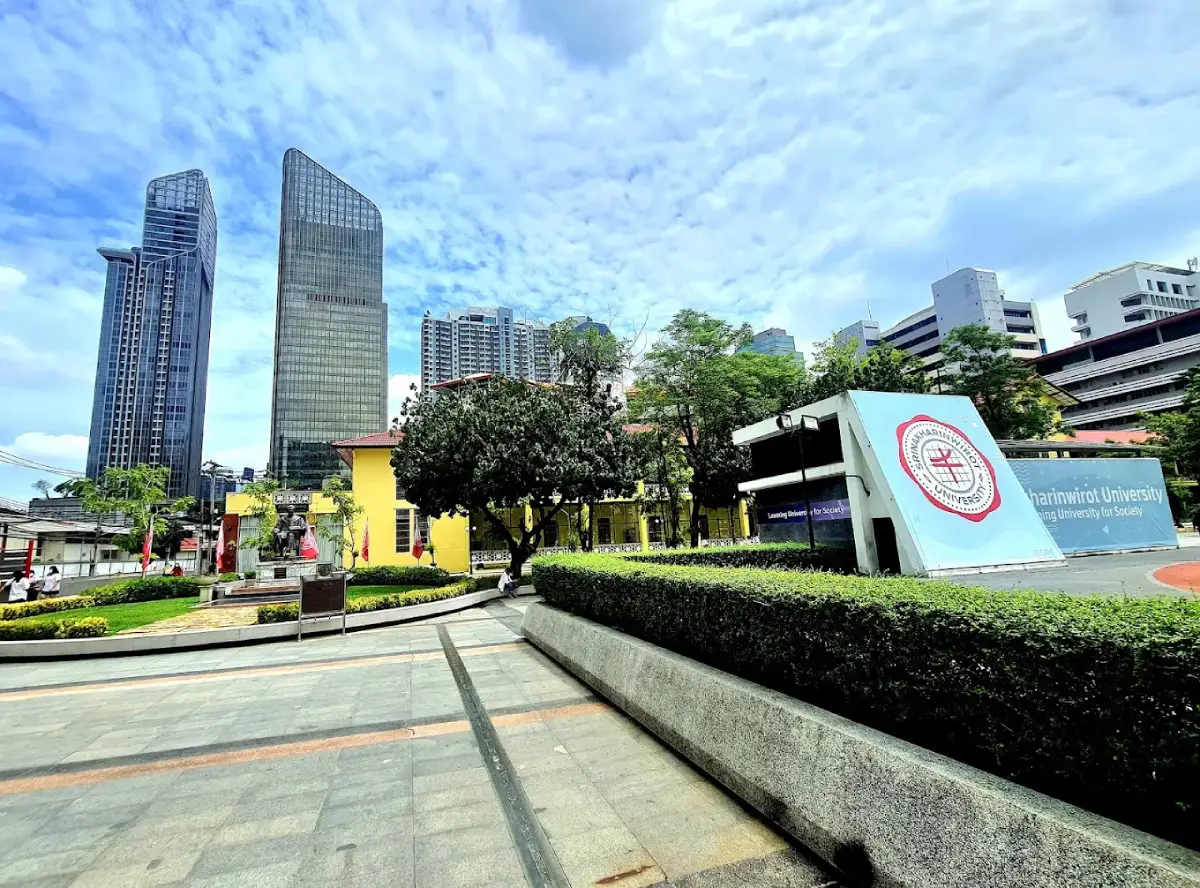
The Prasarnmit campus occupies a central position in Bangkok's Asok and Sukhumvit districts, one of the capital's most important commercial and transportation areas. It is accessible from Sukhumvit Soi 23, Asok Montri Road, and Phetchaburi Road. Within the university grounds are historic educational buildings, modern lecture facilities, innovation centers, the Central Library, university archives, galleries, demonstration schools, sports facilities, and public event spaces. These places make the campus both an academic institution and a destination for visitors interested in Thailand's educational and cultural history.
The atmosphere of Srinakharinwirot University, Prasarnmit Campus, differs from that of universities located outside major cities. It is surrounded by office towers, hotels, shopping centers, restaurants, and major urban rail networks. Yet the campus itself contains landscaped areas, pedestrian spaces, and trees that provide opportunities for students and staff to relax between classes. This contrast between the city's dense commercial environment and the university's academic grounds is an important part of the campus experience.
The university's history began with Thailand's need to improve teacher education after the Second World War. During this period, the number of schools and the demand for qualified teachers increased, while the country's capacity to train professional educators remained limited. Thailand required institutions capable of preparing teachers with strong subject knowledge, practical teaching skills, educational psychology, and an understanding of modern instructional methods.
Professor Mom Luang Pin Malakul was one of the principal figures involved in laying the foundations of the institution. As a prominent Thai educator and a senior official in the Ministry of Education, he recognized the importance of establishing advanced professional training for teachers. His work reflected the view that improving national education required not only more schools but also better-prepared teachers capable of developing students' intellectual and personal abilities.
The origins of the project are also linked to remarks made by King Ananda Mahidol, Rama VIII, to Mom Luang Pin Malakul on May 31, 1946, encouraging him to continue the important work of teacher training. On August 15, 1946, the Ministry of Education took steps to secure land along Prasarnmit Road for the proposed school. The area was then associated with Phra Khanong district in the former province of Phra Nakhon. These preparations were essential to the eventual establishment of the school.
On April 28, 1949, the Ministry of Education officially opened the Advanced Teacher Training School on Prasarnmit Road. The original site covered approximately 93 rai, 1 ngan, and 1.8 square wah. Luang Sawatsansatphutthi, also known as Sawat Sumit, was appointed as its first director. The school aimed to produce trained teachers for primary and secondary education at a time when expanding access to schooling had become a national priority.
In its early years, the institution admitted secondary-school graduates to professional teacher-training programs. Students studied toward qualifications for primary-school teaching and could continue toward secondary-school teaching qualifications. Instruction combined academic subjects with pedagogical knowledge, educational psychology, and practical teaching methods. The approach recognized that successful teaching depends not only on understanding a subject but also on knowing how people learn.
In 1952, the Prasarnmit School was established. This institution became the foundation of today's Srinakharinwirot University Prasarnmit Demonstration Secondary School. The creation of a demonstration school was important because it allowed trainee teachers to observe, practice, and evaluate teaching methods in actual classroom settings. It also provided a foundation for educational experimentation, curriculum development, and the study of student learning.
May 18, 1953, marked another major step when the College of Education was established on the same grounds as the Advanced Teacher Training School. Professor Dr. Saroj Buasri became its director. The new college was designed to offer higher education in educational sciences, strengthening the status of teaching and educational administration as fields supported by academic theories, research, and systematic professional knowledge.
Professor Dr. Saroj Buasri played a major role in advancing modern education in Thailand. His educational philosophy emphasized intellectual development, meaningful learning, rational thinking, and the relationship between education and society. Under his academic leadership, the College of Education developed into an institution capable of preparing teachers, educational researchers, and administrators through a more advanced academic structure.
On September 16, 1954, the College of Education Act B.E. 2497 provided the institutional framework for education at diploma, bachelor's, master's, and doctoral levels. This development transformed the former teacher-training institution into a higher education college capable of awarding degrees in education. Its importance lay in establishing educational science as a serious academic discipline rather than limiting teacher preparation to short professional courses.
The early College of Education developed academic units in education, educational research, humanities and social sciences, and science and mathematics. This multidisciplinary structure reflected the belief that educators should possess knowledge across several intellectual fields. Teachers were expected to understand scientific reasoning, human behavior, social conditions, and instructional practice rather than rely exclusively on classroom techniques.
The College of Education gradually expanded across Thailand. In 1955, new locations were established at Pathumwan in Bangkok and Bang Saen in Chon Buri Province. The Bang Saen institution played a pioneering role in providing degree-level higher education outside the capital. Further educational locations were developed in Phitsanulok, Maha Sarakham, Songkhla, Phra Nakhon, and other areas, contributing to a wider national network of educational institutions.
This expansion had lasting consequences for Thai higher education. Several former campuses later became independent universities, including Burapha University, Naresuan University, Mahasarakham University, and Thaksin University. Their shared historical origins illustrate the role played by the College of Education network in expanding access to university education across the country.
Before the institution gained university status, students and academic staff advocated changes that would better reflect the College of Education's growing academic and research functions. Discussions about its transformation took place over several years, and student demonstrations in 1973 formed part of the wider period of political and social change in Thailand. These events are an important element of the institution's history because they illustrate the relationship between university development and public participation.
On June 29, 1974, the College of Education was officially elevated to university status. King Bhumibol Adulyadej bestowed the name Srinakharinwirot University, and Professor Dr. Sutjai Laosunthorn became the first rector under the new institutional status. The transformation enabled the university to expand beyond teacher education and develop a broader range of academic and professional disciplines.
The name Srinakharinwirot is traditionally explained as meaning a university that grows and flourishes as a source of distinction for the great city. The Thai word "Wirot" is associated with growth and development, linking the name directly to the university's philosophy, "Education is Growth." The name is pronounced approximately See-na-kha-rin-wi-rot, and the institution uses the abbreviations มศว in Thai and SWU in English.
Following the granting of university status, Srinakharinwirot expanded into humanities, sciences, social sciences, physical education, and graduate studies. The establishment of additional academic faculties allowed the university to serve changing national requirements for scientific, professional, and cultural knowledge. Over time, the institution became a comprehensive university while retaining a distinctive educational heritage.
The establishment of the Faculty of Medicine in 1985 marked an important step in the university's development into health sciences. Faculties of Engineering, Fine Arts, Dentistry, Pharmacy, and Nursing were established in subsequent years. This expansion allowed the university to educate professionals in fields increasingly important to Thailand's public health system, industry, technological development, and creative economy.
As the university expanded, the Prasarnmit campus faced limitations in its ability to accommodate additional laboratories, academic buildings, and clinical training facilities. Its location in central Bangkok made large-scale physical expansion difficult. The university therefore developed the Ongkharak campus in Nakhon Nayok Province, providing more space for health sciences, engineering, practical teaching, and research.
Srinakharinwirot University's Ongkharak campus is located at 63 Moo 7, Rangsit–Nakhon Nayok Road, Khlong 16, Ongkharak, Nakhon Nayok 26120. It is geographically distinct from the Prasarnmit campus in Bangkok. Certain academic programs require students to study at different campuses during different years of their degrees. Prospective students and parents should therefore confirm teaching locations before applying rather than assume that every SWU program is delivered in Bangkok.
The separation of several former campuses into independent universities was another significant phase in the institution's development. Burapha University and Naresuan University were established independently in 1990, followed by Mahasarakham University in 1994 and Thaksin University in 1996. This transition reflected the growth of Thailand's higher education system from a centrally connected network into a collection of regional universities with their own governance and missions.
On May 21, 2016, Srinakharinwirot University formally became an autonomous public university under the Srinakharinwirot University Act B.E. 2559. The change introduced a governance framework distinct from that of a conventional government department, providing greater institutional flexibility in academic administration, personnel management, financial operations, and research development under the supervision of the University Council.
In 2026, Srinakharinwirot University is led by Professor Dr. Cholvit Jearajit. Its academic faculties, colleges, research institutes, administrative offices, and service units work together to provide education, research, professional services, and cultural programs. The university's contemporary mission emphasizes learning that addresses social needs, responsible research and innovation, student development, lifelong education, and the preservation of cultural knowledge.
The university's emblem is based on the mathematical exponential curve y = e^x, representing continual and potentially unlimited growth. Its meaning corresponds to the institutional philosophy, "Education is Growth." The symbol conveys the belief that education enables people to develop their intellectual capabilities throughout life and that knowledge should continue to advance rather than remain static.
The official university colors are grey and red. Grey symbolizes the brain, thought, and intellectual ability, while red represents blood and courage. Together, they express the courage to think and the willingness to use one's intellect boldly. The grey-and-red identity has been associated with the College of Education and Srinakharinwirot University for generations and remains visible in ceremonies, student activities, and institutional materials.
The university's symbolic tree is the Ratchaphruek, also known as the golden shower tree or Cassia fistula. Its bright yellow flowers are associated with prosperity and continuing growth. On January 9, 1986, the present King Vajiralongkorn, Rama X, then Crown Prince of Thailand, planted a Ratchaphruek tree near the original university football field. The site is now associated with the area beside the Faculty of Social Sciences.
Another important event took place on November 18, 2005, when Princess Maha Chakri Sirindhorn planted a Ratchaphruek tree in front of the Luang Sawatsansatphutthi Building, also known as Building 3. The occasion was associated with the opening of the university archives. The royal-planted tree therefore links the university's natural symbolism with the preservation of its educational heritage.
The university's official song is named "Srinakharinwirot." Its lyrics were written by Somsak Thepanon, with music composed by Thanit Phonprasoet. The song expresses pride in the university, the connections among generations of students and alumni, and the commitment to using knowledge for the benefit of society. Together with the grey-and-red colors, it plays a role in maintaining a sense of institutional identity.
April 28 is an important date associated with the establishment of the Advanced Teacher Training School in 1949. The university organizes commemorative activities that recognize its founding educators and honor individuals who contributed to the growth of the institution. In 2026, the commemoration marked 77 years of educational history, and arrangements for the campus market were adjusted to accommodate the university ceremonies.
June 29 marks the anniversary of the elevation of the College of Education to Srinakharinwirot University in 1974. It is distinct from the April 28 anniversary because the two dates commemorate different stages of institutional history. The first is the founding of the original teacher-training school, while the second celebrates the establishment of the university under its present name.
September 16 is connected with the legacy of Professor Dr. Saroj Buasri and the development of educational science at the institution. University activities commemorate his contributions to education and the academic foundations of the former College of Education. The statue of Professor Dr. Saroj Buasri on the Prasarnmit campus is an important place of remembrance for students, faculty members, and alumni.
Among the most historically significant places on the campus is the Luang Sawatsansatphutthi Building, originally known as the Prasarnmit Building or Building 3. Completed in 1952, it was one of the first administrative and teaching buildings of the Advanced Teacher Training School. The preserved building provides a physical connection with the university's earliest period and is associated with cultural, archival, and historical activities today.
The Srinakharinwirot University Archives preserve documents, photographs, records, and other materials relating to the institution's development. The collections cover the transition from the Advanced Teacher Training School to the College of Education and the modern university. They are valuable for studying changes in campus architecture, student uniforms, teaching activities, academic traditions, and the lives of individuals connected with the institution.
The statue of Professor Dr. Saroj Buasri is another important historical and cultural landmark. It commemorates his role in establishing a modern academic approach to teacher education and the study of learning. The monument encourages reflection on the relationship between education, intellectual development, and public service, and it is associated with commemorative activities organized by the university.
The Professor Dr. Saroj Buasri Innovation Building is a major facility for teaching, academic meetings, and organizational activities. Several university units use spaces within the building. Its name connects the intellectual heritage of one of the university's most influential educators with contemporary efforts to develop knowledge, new educational approaches, and innovation.
The university's Central Library is housed in the Princess Maha Chakri Sirindhorn Building. It provides academic resources for students, teaching staff, researchers, and eligible visitors, including books, textbooks, journals, electronic databases, and spaces for independent or collaborative study. The library supports the development of research skills and encourages students to extend their learning beyond lectures and classroom materials.
The Learning Tower is a major multi-story academic facility used for teaching and university activities at Prasarnmit. Another familiar campus building is Building 14, often nicknamed the "Egg Building" by students. It accommodates teaching-related activities and services, together with food and retail outlets in the surrounding area. These buildings demonstrate how the campus has adapted its facilities to accommodate a large student community within central Bangkok.
The Institute of Culture and Arts supports the preservation, study, and presentation of cultural heritage. It organizes exhibitions, cultural programs, and learning activities relating to Thai arts and traditions. The university also maintains the Art Center of Thailand, which supports contemporary artistic practice and provides opportunities for students, artists, and visitors to engage with exhibitions and creative discussions.
The Art Center of Thailand and the SWUNIPLEX complex contribute to the university's cultural life through galleries, exhibitions, music, and performance spaces. Facilities associated with the center include the g23 exhibition area and venues for cultural and creative activities. These spaces strengthen the university's links with the creative industries and provide opportunities for artistic exchange beyond ordinary classroom teaching.
The campus clock tower and Grey-Red Plaza are familiar meeting points and locations for student activities. Their importance extends beyond their physical appearance because they provide spaces where members of the university community gather and interact. The university has also used parts of these areas for temporary market arrangements and public events, demonstrating how campus space can serve both educational and community purposes.
Srinakharinwirot University Prasarnmit Demonstration Primary and Secondary Schools continue the university's original mission of improving education. In addition to educating schoolchildren, demonstration schools are important environments for developing teaching methods, conducting educational research, and supporting professional teacher training. Their work helps connect university-level educational knowledge with practical learning experiences for children and young people.
Academically, Srinakharinwirot University covers humanities, social sciences, science and technology, health sciences, education, fine arts, and creative industries. The university lists 16 faculties and five colleges, including the Graduate School. This structure includes academic units based at Prasarnmit, Ongkharak, and other specialized educational locations. It should not be interpreted as meaning that every faculty or degree program is physically located on the Bangkok campus.
The Faculty of Education is especially important to the university's identity because it developed from the Advanced Teacher Training School and College of Education. It offers teacher-education and graduate programs connected with educational science, learning management, and related fields. Teaching emphasizes the development of educators, researchers, and educational leaders capable of applying learning theories to real educational settings.
The Faculty of Humanities supports the study of languages, literature, psychology, philosophy, communication, and culture. These fields help students develop analytical thinking and cross-cultural understanding. The Faculty of Social Sciences examines relationships between people and society through disciplines including political science, geography, history, and related social studies. Together, the faculties prepare graduates to understand social change and communicate across different cultural and professional contexts.
The Faculty of Science provides education in mathematics, chemistry, physics, biology, computer science, and related scientific fields. Its programs develop skills in scientific inquiry, hypothesis testing, experimentation, data analysis, and research. Graduate-level education supports further specialization and contributes to research capacity relevant to industry, education, and scientific development.
The Faculty of Economics and Faculty of Business Administration for Society contribute to the preparation of graduates in economic analysis and organizational management. Economics examines production, consumption, financial systems, and policy. Business Administration for Society offers fields associated with accounting, marketing, finance, international business, tourism and hospitality, and social enterprise, reflecting the importance of connecting business skills with social responsibility and sustainable development.
The Faculty of Fine Arts and College of Creative Industry play important roles in the development of art, design, and the creative economy. Fine Arts supports artistic study and practice across visual arts, design, music, and performance. The College of Creative Industry connects creativity with product development, jewelry, fashion, textiles, branding, and industry-oriented innovation, helping students apply artistic and design knowledge in professional contexts.
The College of Social Communication Innovation specializes in communication and digital media. Its academic work includes cinema, digital media, media design, and communication innovation. Students develop skills in creative production, storytelling, project planning, and the use of technologies for communication. The International College for Sustainability Studies supports globally oriented education and learning connected with sustainable development and international cooperation.
The Faculty of Environmental Culture and Ecotourism offers education related to sustainable tourism, environmental technologies, resource management, and cultural development. For the 2026 academic year, the faculty advertised graduate programs in Sustainable Tourism Management and Environmental Technology and Resource Management. These fields connect tourism and organizational development with the responsible use of natural and cultural resources.
In health sciences, the university includes the Faculties of Medicine, Dentistry, Pharmacy, Nursing, and Physical Therapy. Many of their teaching and professional training activities are associated with the Ongkharak campus and affiliated medical facilities. These programs require practical skills, laboratory work, supervised professional experience, and compliance with health-related standards and ethical obligations.
The Faculty of Physical Therapy illustrates the university's development of several related healthcare disciplines. Its educational activities include physical therapy, health promotion, and occupational therapy, along with graduate studies in physical therapy. These programs develop professional skills in rehabilitation, movement, daily functioning, and preventive health. Certain teaching and training activities are conducted in cooperation with institutions under Thailand's Ministry of Public Health.
The Faculty of Engineering and Faculty of Agricultural Product Innovation and Technology contribute to education in applied science, industrial systems, and product development. Agricultural Product Innovation and Technology includes work in food science and nutrition, biotechnology and agricultural products, product innovation and business, and polymer materials technology. Such fields support the creation of higher-value products and the use of scientific knowledge to improve industrial and agricultural processes.
Bodhi Vichalai College supports education associated with community development, regional learning, and sustainable local development. The college has educational activities and facilities in Sa Kaeo and Tak provinces, connecting the university's mission with the needs of communities outside Bangkok and Nakhon Nayok. These activities illustrate how higher education can contribute to regional development and the responsible management of local resources.
The Graduate School supports master's and doctoral education in cooperation with the university's faculties and colleges. Students undertaking advanced degrees may specialize in particular fields through coursework, independent studies, and original research. Graduate education remains an important part of the university's role in preparing researchers, professional specialists, and academic leaders.
Undergraduate admission for the 2026 academic year is administered through Thailand's TCAS system according to each application round and program's requirements. Certain programs consider portfolios, while others use examination results, interviews, or specific professional criteria. Applicants should confirm their eligibility, degree requirements, teaching locations, and admission schedules through the official announcements rather than rely on information from previous academic years.
Research at Srinakharinwirot University spans education, behavioral sciences, natural sciences, healthcare, engineering, humanities, social sciences, and creative innovation. Important research units include the Behavioral Science Research Institute, the Institute of Strategic Intelligence and Research, and faculty-based research groups. Their work contributes to understanding learning, human behavior, health, technology, social relationships, and contemporary challenges facing Thailand.
The Behavioral Science Research Institute has a long association with the study of human behavior and social development. Its research provides knowledge relevant to learning, working environments, family relationships, personal development, and organizational behavior. Such findings can inform educational policies, counseling, human resource development, and programs intended to improve quality of life.
The university also supports healthcare education and professional training through the HRH Princess Maha Chakri Sirindhorn Medical Center and Panyananthaphikkhu Chonprathan Medical Center, together with clinical teaching facilities. These medical services contribute to professional preparation, public health, and clinical research. Their work also illustrates the university's continuing expansion from its original educational mission into a comprehensive range of public-service professions.
Lifelong learning is another growing part of the university's activities. Short courses, continuing education, and professional skills programs offer opportunities for people outside full-time degree education to acquire new knowledge. This reflects the changing role of universities as centers of learning for different age groups and professional needs, rather than institutions serving only students immediately after secondary school.
The relationship between Srinakharinwirot University and the Asok–Sukhumvit community is distinctive because the campus stands within one of Bangkok's busiest commercial districts. Exhibitions, cultural events, markets, performances, and public academic activities bring local residents and visitors into contact with the university. At the same time, the large student population supports neighborhood restaurants, cafés, shops, and transportation services.
The Srinakharinwirot University Market is a particularly recognizable part of campus life. Markets are organized on Tuesdays and Thursdays according to university arrangements, offering food, clothing, accessories, handmade products, and everyday goods. During part of 2026, the university temporarily moved the market before returning it to the SWU Plaza area beside Asok Montri Road. The activity demonstrates how the university uses its central Bangkok location to connect small businesses with students, staff, and local communities.
The university also developed an SWU Night Market arrangement for Fridays under the fiscal year 2027 market program, which began in October 2026. The project provides space for traders and visitors during afternoon and evening hours, creating another link between student life and the surrounding commercial neighborhood. Market locations, vendors, and schedules may change according to university announcements and the requirements of individual events.
For educational tourism, Srinakharinwirot University's Prasarnmit campus offers an unusual combination of historical educational buildings and contemporary cultural facilities. Visitors interested in the university's origins can explore the Luang Sawatsansatphutthi Building, the archive-related historical area, and the statue of Professor Dr. Saroj Buasri. The Art Center of Thailand and other exhibition venues offer opportunities to engage with contemporary creative work whenever public programs are scheduled.
The Central Library, innovation facilities, and spaces supporting educational technology also provide insight into the development of modern university learning. Organized visitors should contact the relevant departments in advance, particularly when visiting archives, classrooms, demonstration schools, laboratories, or other restricted facilities. The university remains an active teaching environment, and access requirements are designed to support safety and uninterrupted academic activities.
Nearby urban attractions include Terminal 21 Asok, Benjakitti Park, Benchasiri Park, Queen Sirikit National Convention Center, and the EmQuartier shopping complex. Together, these places illustrate Bangkok's development as a center of commerce, public transportation, environmental recreation, and international events. Visitors can combine university-related activities with an exploration of the surrounding urban environment.
Getting There to Srinakharinwirot University, Prasarnmit Campus, is convenient by public transportation. Visitors can use the BTS Skytrain to Asok Station and continue into Sukhumvit Soi 23 on foot or by local transport. The MRT Blue Line's Sukhumvit Station is another suitable option, with connections toward Asok Montri Road and the Sukhumvit 23 entrance. Travelers should select the entrance that best serves their destination because academic buildings are distributed across different parts of the campus.
Visitors using MRT Phetchaburi Station can approach the university from the Phetchaburi Road side through the pedestrian area near Khlong Saen Saep and Rutnin Eye Hospital. Passengers arriving by Airport Rail Link can get off at Makkasan Station and connect to MRT Phetchaburi or continue toward the campus using a taxi or other local service. These options may be especially useful for people traveling from Bangkok's eastern districts or areas connected to the Airport Rail Link.
The Khlong Saen Saep boat service provides another practical way to reach the university. Visitors can alight at the SWU Prasarnmit Pier, which connects directly with the campus, or at the Asok Pier and continue on foot. Traveling by boat can be useful during periods of heavy road traffic, although service schedules, weather conditions, and the operation of individual piers should be checked before departure.
Public buses traveling along Sukhumvit Road, Asok Montri Road, or Phetchaburi Road also provide access to the area. The university has three principal approach routes: Sukhumvit Soi 23, Asok Montri Road, and Phetchaburi Road. Visitors driving private vehicles should navigate to the specific campus building or university entrance and confirm parking arrangements in advance, as Prasarnmit is situated in a densely developed part of Bangkok where traffic congestion can be significant.
The Office of the President is located in Building 9 at the Prasarnmit campus. The university's main telephone number is +66 2 649 5000. General administrative offices operate Monday through Friday during office hours, while libraries, exhibition spaces, demonstration schools, and academic departments may have different schedules and access conditions. Visitors attending meetings, applying for admission, or requesting educational tours should contact the relevant unit before arriving.
Srinakharinwirot University, Prasarnmit Campus, is important both to Thailand's educational history and to the development of modern Bangkok. From its beginnings as the Advanced Teacher Training School in 1949, through its development as the College of Education in 1953, and its transformation into Srinakharinwirot University in 1974, the institution has expanded from teacher preparation into a comprehensive university. Throughout these changes, it has maintained the central idea that education should support intellectual development and the constructive use of knowledge for society.
In 2026, the university marks 77 years since its original establishment and 52 years since becoming Srinakharinwirot University. Prasarnmit continues to serve as a major center for education, research, arts, culture, and innovation in central Bangkok. Its historic buildings, monuments, demonstration schools, library, galleries, and public activities preserve the university's identity while supporting contemporary academic life. The enduring philosophy, "Education is Growth," remains a meaningful expression of the institution's educational mission.
| University Name | Srinakharinwirot University, Prasarnmit Campus (SWU) |
| Thai Name | มหาวิทยาลัยศรีนครินทรวิโรฒ ประสานมิตร |
| University Type | Autonomous Public University |
| Location | Khlong Toei Nuea, Watthana, Bangkok, Thailand |
| Address | 114 Sukhumvit Soi 23, Watthana, Bangkok 10110, Thailand |
| Prasarnmit Campus Area | 101 Rai, 2 Ngan, 25 Square Wah |
| Advanced Teacher Training School Founded | April 28, 1949 |
| College of Education Founded | May 18, 1953 |
| University Established | June 29, 1974 |
| Institutional Anniversaries in 2026 | 77 Years Since the Original School Was Established and 52 Years Since University Status Was Granted |
| Key Founding Figure | Professor Mom Luang Pin Malakul and the Ministry of Education's Early Leadership |
| First Director of the Advanced Teacher Training School | Luang Sawatsansatphutthi (Sawat Sumit) |
| Influential Director of the College of Education | Professor Dr. Saroj Buasri |
| First Rector Under University Status | Professor Dr. Sutjai Laosunthorn |
| President in 2026 | Professor Dr. Cholvit Jearajit |
| Name Origin | Bestowed by King Bhumibol Adulyadej, Rama IX; Traditionally Interpreted as a University That Flourishes as a Source of Distinction for the Great City |
| Abbreviations | มศว / SWU |
| University Philosophy | Education is Growth |
| Institutional Vision | Learning University for Society |
| University Emblem | Exponential Curve, y = e^x, Representing Continuous Intellectual Growth |
| University Colors | Grey and Red |
| University Tree | Ratchaphruek (Golden Shower Tree, Cassia fistula) |
| Official University Song | Srinakharinwirot; Lyrics by Somsak Thepanon and Music by Thanit Phonprasoet |
| Academic Structure | 16 Faculties and 5 Colleges, Including the Graduate School |
| Faculties and Colleges | 1. Faculty of Education 2. Faculty of Humanities 3. Faculty of Social Sciences 4. Faculty of Science 5. Faculty of Medicine 6. Faculty of Physical Education 7. Faculty of Engineering 8. Faculty of Fine Arts 9. Faculty of Dentistry 10. Faculty of Pharmacy 11. Faculty of Physical Therapy 12. Faculty of Nursing 13. Faculty of Economics 14. Faculty of Agricultural Product Innovation and Technology 15. Faculty of Environmental Culture and Ecotourism 16. Faculty of Business Administration for Society 17. College of Social Communication Innovation 18. Bodhi Vichalai College 19. International College for Sustainability Studies 20. College of Creative Industry 21. Graduate School |
| Educational Locations | 1. Prasarnmit Campus, Bangkok 2. Ongkharak Campus, Nakhon Nayok 3. Bodhi Vichalai College Educational Location, Sa Kaeo 4. Bodhi Vichalai College Educational Location, Tak |
| Important Prasarnmit Campus Landmarks | 1. Luang Sawatsansatphutthi Building (Building 3) 2. Professor Dr. Saroj Buasri Statue 3. Office of the President (Building 9) 4. Professor Dr. Saroj Buasri Innovation Building 5. Learning Tower 6. Building 14 (Egg Building) 7. Central Library 8. SWU Archives 9. Art Center of Thailand and SWUNIPLEX 10. Clock Tower and Grey-Red Plaza 11. Prasarnmit Demonstration Primary School 12. Prasarnmit Demonstration Secondary School |
| Major Events and Traditions | University Day on April 28, University Status Anniversary on June 29, Saroj Buasri Commemorations, Student Activities, SWU Prasarnmit Markets, and Cultural Exhibitions |
| SWU Prasarnmit Markets | Tuesday and Thursday Markets, Plus the Friday SWU Night Market Program According to University Announcements |
| Academic Strengths | Education, Humanities, Social Sciences, Fine Arts, Communication Innovation, Creative Industries, Science, Health Sciences, and Community-Oriented Research |
| Administrative Office Days | Monday – Friday, Except Public and University Holidays |
| Administrative Office Hours | 08:30 – 16:30 |
| Visitor Access | Public Events and Markets May Be Attended Under University Rules; Access to Classrooms, Archives, Libraries, Demonstration Schools, and Specialized Facilities Is Subject to Individual Regulations |
| Facilities | Central Library, Food Courts, Shops, Student Spaces, Sports Facilities, Meeting Rooms, Exhibition Venues, Internet Access, and Parking Under University Regulations |
| Main Campus Approaches | 1. Sukhumvit Soi 23 2. Asok Montri Road 3. Phetchaburi Road |
| Urban Rail Connections | BTS Asok, MRT Sukhumvit, MRT Phetchaburi, and Airport Rail Link Makkasan With Onward Connections |
| Canal Boat Service | Khlong Saen Saep Boat to SWU Prasarnmit Pier or Asok Pier |
| Nearby Attractions | 1. Terminal 21 Asok 2. Benjakitti Park 3. Benchasiri Park 4. Queen Sirikit National Convention Center 5. EmQuartier |
| Nearby Restaurants and Cafés | 1. Teaw Roo Noodles, SWU Campus, Tel. +66 98 565 9927 2. Bake Room, Building 14, SWU Campus, Tel. +66 2 260 0520 3. Baan Khanitha Sukhumvit 23, Tel. +66 2 128 0906 4. Bharani Sukhumvit 23, Tel. +66 2 664 4454 5. Harakama Sukhumvit 23, Tel. +66 98 252 9434 6. MAY VEGGIE HOME EXPRESS Sukhumvit 23, Tel. +66 63 919 4498 |
| Nearby Accommodation | 1. Somerset Maison Asoke Bangkok, Tel. +66 2 302 1999 2. Sukhumvit Suites Hotel, Tel. +66 2 661 7262 3. K Home Asok, Tel. +66 85 100 2296 4. Grand Mercure Bangkok Asoke Residence, Tel. +66 2 207 3333 5. Sofitel Bangkok Sukhumvit, Tel. +66 2 126 9999 |
| University Telephone | +66 2 649 5000 |
| Undergraduate Admissions Inquiries | +66 2 649 5000 Ext. 15716, 15665, 11545 |
| Official Website | https://www.swu.ac.th/ |
| Admissions Website | https://admission.swu.ac.th/ |
| Current Status | Operating as an Autonomous Public University, With Prasarnmit Serving as Its Historic Main Campus and Administrative Center |
Academic Programs and Fields of Study at Srinakharinwirot University, Academic Year 2026
| Faculty / College | Degree Programs and Fields of Study |
| Faculty of Education | Bachelor's Degree 1. Bachelor of Education Master's Degree 1. Master of Education in Educational Science and Learning Management Doctoral Degree 1. Ph.D. in Educational Science and Learning Management |
| Faculty of Humanities | Bachelor's Degrees 1. Bachelor of Arts in Thai 2. Bachelor of Arts in English 3. Bachelor of Arts in Chinese 4. Bachelor of Arts in Japanese 5. Bachelor of Arts in Psychology |
| Faculty of Social Sciences | Bachelor's Degrees 1. Bachelor of Political Science, With Majors in Politics and Government, Public Administration, and International Relations 2. Bachelor of Arts in Geography and Geoinformatics 3. Bachelor of Arts in History |
| Faculty of Science | Bachelor's Degrees 1. Bachelor of Science in Mathematics 2. Bachelor of Science in Chemistry 3. Bachelor of Science in Biology 4. Bachelor of Science in Physics 5. Bachelor of Science in Computer Science |
| Faculty of Medicine | Professional Degree 1. Doctor of Medicine Graduate Education 1. Medical Science Research and Continuing Professional Education Under Faculty and Graduate School Arrangements |
| Faculty of Physical Education | Undergraduate Fields 1. Physical Education 2. Sports and Exercise Science 3. Health Education and Health Promotion |
| Faculty of Engineering | Bachelor's Degrees 1. Bachelor of Engineering in Civil Engineering 2. Bachelor of Engineering in Electrical Engineering 3. Bachelor of Engineering in Mechanical Engineering 4. Bachelor of Engineering in Industrial Engineering 5. Bachelor of Engineering in Chemical Engineering |
| Faculty of Fine Arts | Undergraduate Fields 1. Visual Arts 2. Design 3. Music and Performing Arts |
| Faculty of Dentistry | Professional Degree 1. Doctor of Dental Surgery |
| Faculty of Pharmacy | Professional Degree 1. Doctor of Pharmacy |
| Faculty of Physical Therapy | Bachelor's Degrees 1. Bachelor of Science in Physical Therapy 2. Bachelor of Science in Health Promotion 3. Bachelor of Science in Occupational Therapy Master's Degree 1. Master of Science in Physical Therapy Doctoral Degree 1. Ph.D. in Physical Therapy |
| Faculty of Nursing | Professional Bachelor's Degree 1. Bachelor of Nursing Science |
| Faculty of Economics | Bachelor's Degree 1. Bachelor of Economics |
| Faculty of Agricultural Product Innovation and Technology | Undergraduate Fields 1. Product Innovation and Business 2. Food Science and Nutrition 3. Biotechnology and Agricultural Products 4. Polymer Materials Technology Graduate Study 1. Master of Science Programs Under Faculty Curriculum Arrangements |
| Faculty of Environmental Culture and Ecotourism | Bachelor's Degree 1. Bachelor of Arts in Tourism Management Innovation for Development Master's Degrees 1. Master of Arts in Sustainable Tourism Management 2. Master of Science in Environmental Technology and Resource Management Doctoral Degree 1. Ph.D. in Sustainable Tourism Management |
| Faculty of Business Administration for Society | Bachelor's Degrees 1. Bachelor of Accountancy 2. Bachelor of Business Administration in Marketing 3. Bachelor of Business Administration in Finance 4. Bachelor of Business Administration in International Business 5. Bachelor of Business Administration in Tourism and Hospitality 6. Bachelor of Business Administration in Social Enterprise |
| College of Social Communication Innovation | Undergraduate Programs and Fields 1. Bachelor of Arts in Cinema and Digital Media 2. Communication Innovation and Media Design 3. Communication for Business and the Digital Economy |
| Bodhi Vichalai College | Regional Education, Sa Kaeo and Tak 1. Community and Integrated Area Development Studies 2. Master of Arts in Integrated Area-Based Development |
| International College for Sustainability Studies | International Communication and Sustainability-Oriented Higher Education Under the College's Curriculum Arrangements |
| College of Creative Industry | Undergraduate and Graduate Fields 1. Gems and Jewelry 2. Fashion, Textiles, and Interior Decoration 3. Creative Products 4. Fashion Design Innovation 5. Creative Brand Management (International Program) 6. Industrial Management and Innovation |
| Graduate School | Administrative and Academic Support for Master's and Doctoral Degree Programs Offered in Cooperation With University Faculties and Colleges |
Frequently Asked Questions (FAQ)
Q: Where is Srinakharinwirot University, Prasarnmit Campus, located?
A: The campus is located at 114 Sukhumvit Soi 23, Watthana, Bangkok 10110, Thailand. It can be accessed from Sukhumvit Soi 23, Asok Montri Road, and Phetchaburi Road.
Q: When was Srinakharinwirot University founded?
A: The institution began as the Advanced Teacher Training School on April 28, 1949, became the College of Education on May 18, 1953, and was established as Srinakharinwirot University on June 29, 1974.
Q: Who founded Srinakharinwirot University?
A: Professor Mom Luang Pin Malakul was instrumental in establishing the original Advanced Teacher Training School. Professor Dr. Saroj Buasri played a leading role in developing the College of Education, and Professor Dr. Sutjai Laosunthorn became the university's first rector under its university status.
Q: What are the opening days and office hours of SWU Prasarnmit?
A: Administrative offices generally operate Monday through Friday from 08:30 to 16:30, except on public and university holidays. Libraries, exhibitions, events, and demonstration schools follow their own operating arrangements.
Q: What is the difference between Prasarnmit and Ongkharak campuses?
A: Prasarnmit is located in central Bangkok and serves as the university's administrative and historical main campus. Ongkharak is in Nakhon Nayok Province and accommodates substantial teaching and training activities in health sciences, engineering, and other specialized disciplines. Some degree programs require study at more than one campus.
Q: What faculties and colleges does Srinakharinwirot University have?
A: The university has 16 faculties and five colleges covering education, humanities, social sciences, science, fine arts, engineering, health sciences, business administration, economics, communication innovation, and other specialized fields.
Q: Can visitors enter Srinakharinwirot University's Prasarnmit campus?
A: Visitors can attend public markets, cultural exhibitions, and other university events according to the applicable rules and schedules. Access to archives, classrooms, demonstration schools, and specialized buildings may require permission from the responsible department.
Q: How can I reach SWU Prasarnmit by train or boat?
A: Take the BTS Skytrain to Asok Station or the MRT Blue Line to Sukhumvit or Phetchaburi Station. The campus is also accessible by Khlong Saen Saep boat service via SWU Prasarnmit Pier or Asok Pier.
 Category: ●University
 Group: ●Public university
Last Update : 1 WeekAgo
 Last Update : 1 WeekAgo
 Click to Access the Navigation Map GPS
Srinakharinwirot University (Prasanmit Campus) Map
Recommend

 Art, Culture and Heritage
 Historical Sites and Monuments(3)
 Landmarks and Memorials(23)
 Royal Palace(13)
 Art, Craft Centres, Tradition(35)
 Museums(59)
 Historic Homes and Cities(3)
 Art Gallery(16)
 Educational Places
 Museum for Study(6)
 Library(4)
Public university(8)
 Autonomous Universities(8)
 Rajamangala University of Technology(6)
 Rajabhat University(6)
 Private University(22)
 Places of Worship
 Temple(72)
 Church(2)
 Mosque(67)
 Other Sacred Sites(8)
 Research and Development
 Royal Project(1)
 Suburban Living
 Village, Community(5)
 Local Market(9)
 Floating Market(2)
 Nature and Wildlife
 River, Canal(3)
 Bays and Beaches(1)
 Other natural attractions(1)
 Entertainment and Agricultural
 Zoos and Aquariums(5)
 Animal camps and shows(5)
 Stadium(9)
 Farms, Parks and Ecotourism(20)
 Amusement Park(1)
 Waterpark(4)
 Theater(7)
 Cinema(1)
 Shopping
 Shopping and Night Market(20)
 Department Store(7)
 Spas and Wellness
 Spas and Wellness(1)
 Restaurant
 Michelin Star(5)
 Accommodation
 Hotel(3)
 Call Customer Service in Tourism
 Call Customer Service in Tourism(1)
 Travel Articles, Recipes
 Travel Review, Food Review(46)
 Royal Thai Desserts and Recipes(56)


