
lovethailand home >Central Travel Attractions >Bangkok Travel Attractions >Phra Nakhon >Wat Rat Bophit > Giant Swing (Sao Ching Cha)
TL;DR: Giant Swing (Sao Ching Cha) is located at In front of Wat Suthat Thepwararam, Bamrung Mueang Road, Phra Nakhon District, Bangkok, open Daily, hours Generally open for viewing all day (outdoor public landmark; best visited 08:00.
Giant Swing (Sao Ching Cha)
Open Days: Daily
Opening Hours: Generally open for viewing all day (outdoor public landmark; best visited 08:00 – 18:00 for comfortable walking and better light)
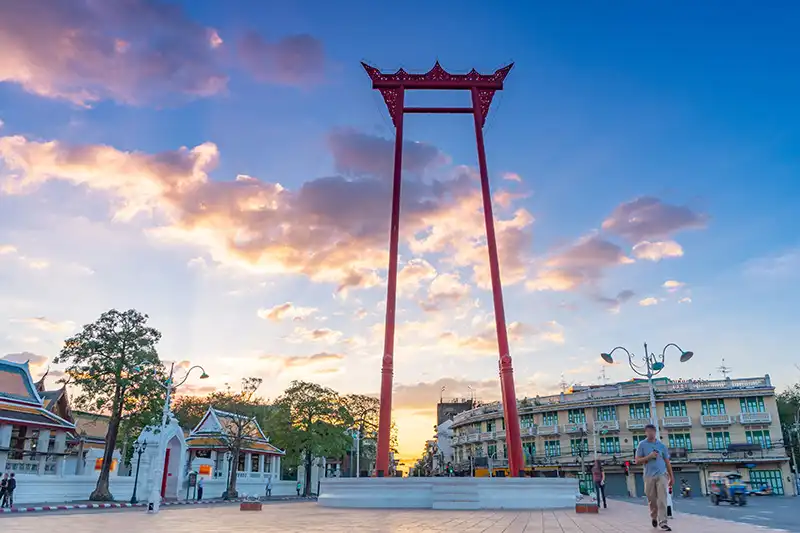
Giant Swing (Sao Ching Cha) is the iconic pair of towering red pillars standing in front of Wat Suthat Thepwararam on Bamrung Mueang Road in Phra Nakhon, Bangkok. It is one of the city’s most recognizable symbols—the kind of landmark that instantly says “old Bangkok” even in a single photo. But if you slow down and really look, you’ll feel that this is more than a quick photo stop: it is a piece of the city where belief, ritual, and urban history overlap in one public space.
The Giant Swing’s defining features are its massive twin pillars, painted in deep vermilion red and rising to roughly 21 meters. Visually, it stands out even amid busy streets and modern movement. For photography, it is “easy to shoot but full of story”: one side frames the elegance of Wat Suthat, while the other captures the living rhythm of the old city—pedestrians, buses, and everyday street life that make the scene feel unmistakably Bangkok rather than a static monument.
Its origins are commonly traced to the reign of King Rama I. After Bangkok was established as the capital, a Brahmin temple complex and the Giant Swing were constructed in line with Brahmin beliefs and royal ritual traditions. The swing was first built in 1784. Later, during the reign of King Rama V, it was relocated to its present position on Bamrung Mueang Road in front of Wat Suthat. Over time, the structure was renewed several times to maintain stability while preserving the original appearance—notably replacements occurred in 1920 (Rama VI era), again in 1970, and most recently in 2006 using teak wood sourced from Phrae Province.
Historically, the Giant Swing was not just a striking structure—it was associated with an important Brahmin ceremony known as the Triyampawai (often remembered as the “swinging ceremony”). The ritual included ceremonial performances offered to Lord Shiva, celebrating the belief that the deity visits the human world once a year. This royal ceremony was later abolished during the reign of King Rama VII in 1935. What remains today is a “monument in the middle of the street” that quietly tells you how deeply ritual and public space were once intertwined in the city.
If you want to make the visit feel more complete, treat the Giant Swing as a “start point that links to a bigger walk.” Begin by taking in the structure and its surroundings, then continue into Wat Suthat if you plan to enter the temple. After that, you can walk toward Dinso Road for well-known local eateries, or continue onward to Loha Prasat and the Golden Mount (Wat Saket) for a deeper old-town route. The area is very walkable, but bring water—midday sun can be strong.
Getting There The simplest way is by bus to the Wat Suthat/Giant Swing area. Common routes include regular buses 12 and 42, and air-conditioned bus 12. Another easy approach is to get off near Ratchadamnoen Avenue at Khok Wua Intersection, then walk along Dinso Road until you reach Wat Suthat. If you take a taxi or private car, allow extra time for traffic and parking—this is a busy historic district, and conditions change noticeably by time of day and special events.
A small but important safety note: the Giant Swing sits near a major intersection and central road islands. Use pedestrian crossings, watch turning traffic, and take extra care if you’re visiting with children or older family members—unhurried crossing makes the whole stop more relaxed.
| Name | Giant Swing (Sao Ching Cha) |
| Location | In front of Wat Suthat Thepwararam, Bamrung Mueang Road, Phra Nakhon District, Bangkok |
| Characteristics | Twin vermilion-red pillars about 21 meters tall; a key symbol of Bangkok’s old town; historically linked to Brahmin royal ritual; great for photos and as a starting point for a walking route around Rattanakosin |
| Period | First built in 1784; major renewals/replacements recorded in 1920, 1970, and 2006 |
| Key Evidence | Associated with the Triyampawai (swinging ceremony) in Brahmin tradition; the ceremony was abolished in 1935, leaving the structure as a historic landmark |
| Name Origin | Named after the historic “swing” used in the former ceremony; commonly known in English as the Giant Swing |
| Travel | Bus routes 12 and 42 (regular) / route 12 (air-conditioned), or get off near Ratchadamnoen (Khok Wua) and walk along Dinso Road to Wat Suthat |
| Fees | No fee (outdoor public landmark) |
| Nearby Tourist Attractions With Distance | Wat Suthat Thepwararam – 0.2 km Devasathan (Brahmin Shrine) – 0.7 km – 02 222 6951 Wat Ratchanatdaram (Loha Prasat) – 1.3 km Wat Saket (Golden Mount) – 1.8 km Museum Siam – 2.8 km – 02 225 2777 |
| Popular Restaurants Nearby | Kope Hya Tai Kee – 0.6 km Krua Apsorn (Dinso Road) – 1.1 km Pad Thai Fai Ta Lu (Dinso) – 1.3 km Thipsamai Pad Thai (Pratu Phi) – 1.7 km Kor Panich (Mango Sticky Rice) – 1.8 km |
| Popular Accommodations Nearby | Royal Rattanakosin Hotel – 1.9 km New Siam Palace Ville – 3.0 km – 02 282 4142 Nouvo City Hotel – 3.0 km Chillax Resort – 3.0 km – 02 629 4400 Riva Surya Bangkok – 3.2 km |
Frequently Asked Questions (FAQ)
Q: Where is the Giant Swing located in Bangkok?
A: It stands in front of Wat Suthat Thepwararam on Bamrung Mueang Road in Phra Nakhon—one of the most visible landmarks in Bangkok’s old town.
Q: What is the best time to visit?
A: Morning or late afternoon is best for softer light, easier walking, and more comfortable temperatures—especially if you plan to continue exploring the old town on foot.
Q: What was the “swinging ceremony” (Triyampawai)?
A: It was a historic Brahmin royal ritual that used the swing structure in ceremonial performances offered to Lord Shiva. The ceremony was abolished in 1935, leaving the Giant Swing as a symbolic historic landmark.
Q: Where are the best photo angles?
A: If you frame the Giant Swing with Wat Suthat behind it, you’ll get a classic Thai-temple mood. A wider angle from the public square/roadside captures the “old city in motion” feel with street life in the scene.
Q: If I have limited time, what should I visit next?
A: Continue to Wat Suthat first, then walk to Dinso Road for local food. If you want more historic landmarks, head toward Loha Prasat and the Golden Mount for a smooth old-town route.
 Category: ●Art, Culture and Heritage
 Group: ●Landmarks and Memorials
Last Update : 9 MonthAgo
 Last Update : 9 MonthAgo
 Click to Access the Navigation Map GPS
Giant Swing (Sao Ching Cha) Map
Gellery
Recommend

 Historical Sites and Monuments(3)
Landmarks and Memorials(23)
Historical Sites and Monuments(3)
Landmarks and Memorials(23)
 Royal Palace(13)
 Art, Craft Centres, Tradition(35)
 Museums(59)
 Historic Homes and Cities(3)
 Art Gallery(16)
 Educational Places
 Museum for Study(6)
 Library(4)
 Places of Worship
 Temple(72)
 Church(2)
 Mosque(67)
 Other Sacred Sites(8)
 Research and Development
 Royal Project(1)
 Suburban Living
 Village, Community(5)
 Local Market(9)
 Floating Market(2)
 Nature and Wildlife
 River, Canal(3)
 Bays and Beaches(1)
 Other natural attractions(1)
 Entertainment and Agricultural
 Zoos and Aquariums(4)
 Animal camps and shows(5)
 Stadium(9)
 Farms, Parks and Ecotourism(20)
 Amusement Park(1)
 Waterpark(1)
 Theater(7)
 Cinema(1)
 Shopping
 Shopping and Night Market(20)
 Department Store(7)
 Spas and Wellness
 Spas and Wellness(1)
 Restaurant
 Michelin Star(5)
 Accommodation
 Hotel(3)
 Call Customer Service in Tourism
 Call Customer Service in Tourism(1)
 Travel Articles, Recipes
 Travel Review, Food Review(21)
 Royal Thai Desserts and Recipes(56)


