
lovethailand home >Central Travel Attractions >Bangkok Travel Attractions >Phra Nakhon >Phra Borommaha Ratchawang > Thammasat University (Tha Prachan)
TL;DR: Thammasat University (Tha Prachan) is located at Phra Borom Maha Ratchawang, Phra Nakhon, Bangkok, Thailand, open Monday – Friday (University Offices), hours 08:30 – 16:30, Lunch Break 12:00 – 13:00.
Thammasat University (Tha Prachan)
Open Days: Monday – Friday (University Offices)
Opening Hours: 08:30 – 16:30, Lunch Break 12:00 – 13:00
Thammasat University, Tha Prachan Campus is one of Thailand's most historically significant universities, situated beside the Chao Phraya River at 2 Prachan Road, Phra Borom Maha Ratchawang, Phra Nakhon, Bangkok. Founded on June 27, 1934, by Professor Dr. Pridi Banomyong, the institution was originally known as the University of Moral and Political Sciences. Its establishment was driven by a vision of making higher education accessible to ordinary citizens while promoting an understanding of law, politics, economics, and democratic government. In 2026, Thammasat University marks its 92nd anniversary. The historic Tha Prachan Campus continues to serve as an important center for academic activities, cultural heritage, and public memory, featuring landmarks such as the Dome Building, Pridi Banomyong Memorial, Lan Pho, the Main Auditorium, and the university's historical sculpture garden dedicated to the struggle for democracy.
Located in Bangkok's historic Rattanakosin district, Tha Prachan Campus offers a university environment unlike that of a typical modern suburban institution. It stands near Sanam Luang, the Grand Palace, Wat Mahathat Yuwaratrangsarit, the National Museum Bangkok, and traditional riverside communities. The campus is closely connected to the life of the surrounding neighborhood, where education, local commerce, river transportation, historical architecture, and cultural traditions have developed together over several generations.
Visitors approaching Thammasat University encounter a distinctive combination of historic educational buildings and the atmosphere of Bangkok's old city. The landmark Dome Building is particularly recognizable from the surrounding streets and the Chao Phraya River. Nearby Prachan Road, Maharaj Road, and Na Phra That Road link the university with temples, museums, and important sites associated with the history of the Thai capital. This setting makes Tha Prachan an appealing destination for students, researchers, history enthusiasts, and visitors interested in Thailand's intellectual and political development.
The history of Thammasat University is closely connected to the Siamese Revolution of 1932, which transformed the country's political system into a constitutional form of government. At that time, access to higher education was limited, particularly for people from modest economic backgrounds and those already in employment. The creation of the University of Moral and Political Sciences reflected a broader ambition to provide citizens with the knowledge needed to understand the new political order and participate more meaningfully in public life.
Professor Dr. Pridi Banomyong, the university's founder and first major educational visionary, believed that knowledge should not remain the privilege of a narrow social elite. He regarded education as an essential opportunity for the public. As a result, Thammasat was established as an open university, often described through the Thai concept of talat wicha, meaning an open marketplace of knowledge. Eligible school graduates and working adults could pursue university education without the conventional competitive entrance examination used by other institutions at that time.
In its early years, the university charged relatively affordable tuition fees, made printed educational materials available at low cost, and did not require students to attend every lecture in person. Students could study independently and take examinations according to the university's schedule. This approach established Thammasat as Thailand's first open university and demonstrated an educational philosophy grounded in broader access, flexibility, and equality of opportunity.
The response to this educational experiment was remarkable. During its first year, the university received 7,094 student registrations. Many students came from families and occupational backgrounds that had previously faced difficulties accessing advanced education. The initial academic offerings included the Thammasat Bachelor program and accounting studies. The former combined legal, political, administrative, and economic knowledge, encouraging students to understand society through several interconnected disciplines rather than through a narrowly specialized field.
The Tha Prachan site soon became central to the university's identity. Existing government and military buildings were adapted for educational purposes, including four original buildings that were joined together to create what would become the iconic Dome Building. These architectural changes transformed the site into a modern center of learning while maintaining a distinct character within a historic district dominated by temples, royal buildings, and traditional public institutions.
During the Second World War, Thammasat University became associated with one of the most significant movements in modern Thai history: the Free Thai Movement, or Seri Thai. Pridi Banomyong played a leading role in this movement, which opposed Japanese wartime domination and worked to safeguard Thailand's independence. The Dome Building was connected with the movement's activities, giving it a historical significance extending well beyond its original academic function.
Following the war, the university experienced major political changes. In 1951, after the Manhattan Rebellion, military forces took control of the university grounds. Students organized demonstrations demanding the return of their institution, and the campus was subsequently returned that year. This episode remains an important chapter in Thammasat's institutional memory, reflecting the students' attachment to their university and their willingness to defend its existence as a place of learning.
In 1952, the institution's official name changed from the University of Moral and Political Sciences to Thammasat University. The new name has remained in use ever since. This transition occurred alongside changes in Thailand's political and educational environment, while the university continued to develop its academic structure and expand its fields of study.
Over time, Thammasat moved away from its original open-university model toward a structured system of student admission and specialized academic programs. The transition brought changes to teaching arrangements, faculty organization, and the range of qualifications offered. Law, political science, economics, accounting, business administration, social sciences, and humanities became important areas of academic development, building on the university's original emphasis on public affairs and interdisciplinary education.
The 1970s marked another defining period in the history of Tha Prachan Campus. Thammasat became a major gathering place for students and citizens calling for constitutional government and democratic reform. Lan Pho and the university's former football ground were important sites during the demonstrations that culminated in the events of October 14, 1973. Those events became a turning point in Thailand's modern political history and established a lasting association between the university and the struggle for democratic rights.
October 6, 1976, is remembered as one of the most tragic dates in the university's history. On that day, security forces and other groups carried out violent attacks against student and civilian demonstrators at and around Thammasat University. The deaths and suffering caused by the events had a profound impact on Thai society and its political development. The university continues to commemorate the tragedy through memorial activities, public discussions, and opportunities for historical learning, emphasizing the importance of human rights and respect for differences.
On October 6, 2026, Thammasat University held the 50th-anniversary commemoration of the October 1976 events at the Historical Sculpture Garden at Tha Prachan Campus. The program included ceremonies honoring the victims, floral tributes, commemorative speeches, and activities designed to encourage historical understanding. Such events demonstrate the university's continuing responsibility to preserve public memory and encourage future generations to reflect on the consequences of political violence.
As academic departments and student numbers expanded, the relatively compact Tha Prachan site could no longer accommodate all of the university's activities. Thammasat therefore developed its Rangsit Campus in Pathum Thani Province, creating a much larger educational and research environment. The university subsequently expanded through its Lampang and Pattaya centers, allowing academic programs and research activities to serve broader geographic and social needs.
Despite this expansion, Tha Prachan has retained its special role as the university's historic birthplace. It continues to accommodate important buildings, memorial spaces, selected academic programs, administrative functions, seminars, and public activities. The campus remains a powerful symbol of institutional continuity, connecting the university's original mission with its present-day responsibilities.
In 2015, the university's legal and administrative framework changed under the Thammasat University Act B.E. 2558. This legislation established Thammasat as an autonomous public university, shaping its management of personnel, finances, governance, and academic affairs. The institution nevertheless remained a public university with responsibilities in education, research, and service to society.
Professor Dr. Pridi Banomyong was born on May 11, 1900, in Phra Nakhon Si Ayutthaya Province. He became one of Thailand's most influential legal scholars, political thinkers, and public figures. After studying law and economics in France, he played an important role in the political transformation of 1932 and subsequently established the University of Moral and Political Sciences. His educational vision placed citizenship, public knowledge, and social responsibility at the center of university life.
Pridi's contribution to Thammasat extended beyond founding the institution. He believed that democratic society required citizens who could understand their rights and responsibilities and evaluate public affairs through informed reasoning. The university was therefore conceived not simply as a place of professional training but as an institution capable of developing thoughtful individuals with a commitment to the broader public good.
Other important figures associated with Thammasat include Professor Dr. Puey Ungphakorn, an economist and former rector recognized for his contributions to economic policy, education, and social development. Another notable figure is Kulap Saipradit, widely known by his pen name Siburapha, whose writing and journalism helped shape modern Thai literary and social thought. Their legacies illustrate the university's longstanding connections with intellectual life, public service, and social change.
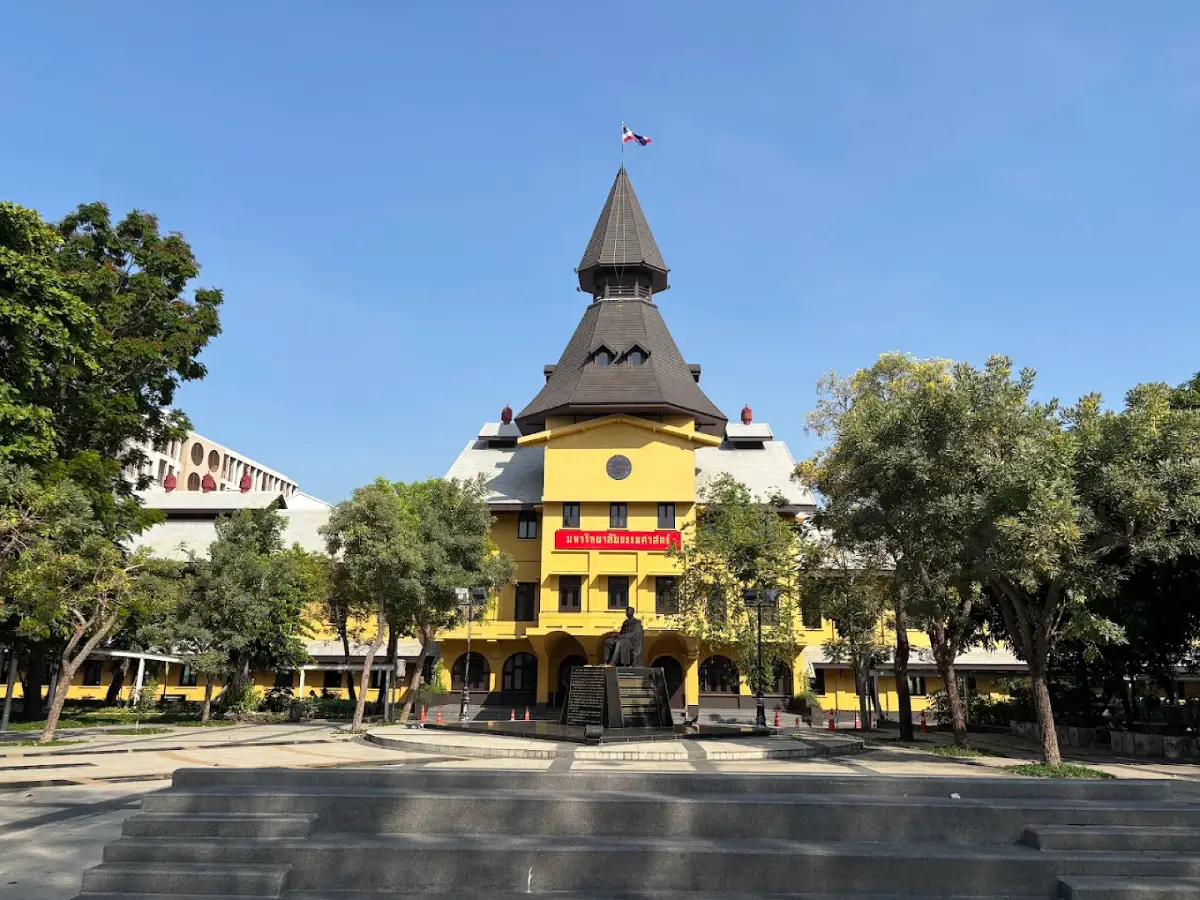
The Dome Building is the most recognizable architectural landmark at Tha Prachan. Designed through the adaptation of four existing structures under the direction of Jitsen, also known as Mew, Abhaiwongse, the complex features a central three-story section topped by an octagonal dome. Facing the Chao Phraya River, the building has come to represent the visual identity of Thammasat since its earliest period.
The shape of the dome is traditionally associated with an eight-sided pencil sharpened to a fine point, symbolizing intellectual development and the pursuit of knowledge. The Dome Building is therefore both an important architectural monument and a symbol of the university's educational philosophy. For generations of students and alumni, it has also served as a powerful expression of belonging and shared historical memory.
The Pridi Banomyong Memorial and the surrounding plaza commemorate the university's founder and his contributions to Thailand. The area provides an important place for reflection on the relationship between education, citizenship, freedom, and public responsibility. It is closely associated with the institutional identity of Thammasat and the continuing recognition of Pridi's educational vision.
Thammasat's Main Auditorium is another significant historical building. Construction began in connection with the university's 20th anniversary, with its foundation-stone ceremony held on June 27, 1954. The building was planned as a major venue for academic and ceremonial gatherings and has been used for lectures, university functions, and important public events. It also has a strong historical association with periods of political debate and social activism.
Siburapha Auditorium, named in honor of Kulap Saipradit's celebrated literary identity, further reflects the university's recognition of writers and intellectuals who contributed to Thai society. Its name creates a connection between Thammasat's physical environment and Thailand's development in journalism, literature, freedom of expression, and critical thought.
Lan Pho, or the Bodhi Tree Plaza, is among the most historically meaningful open spaces on campus. It is associated with student activism during the constitutional demonstrations of October 1973 and later political developments. The plaza illustrates how university grounds have served not only as educational spaces but also as places where students and members of the public have gathered to debate the direction of Thai society.
The Historical Sculpture Garden dedicated to Thammasat and the struggle for democracy provides a place for remembrance and historical education. Particularly associated with the October 6, 1976 events, it has become an important location for commemorative ceremonies and public reflection. Visitors should approach this area with respect for its historical significance and for those whose lives were affected by the events it commemorates.
The university's library system and faculty libraries also play important roles in academic life. They support teaching, independent study, and research through books, journals, databases, and scholarly materials. Access arrangements for external visitors are governed by the policies and opening schedules of the relevant library services.
Thammasat's distinctive identity is expressed through its Dharma Wheel emblem, the Constitution on a ceremonial tray, the yellow and red university colors, the Dome Building, and the royal poinciana tree. The Dharma Wheel represents the moral principles associated with the university, while the Constitution at its center highlights the institution's historical commitment to constitutional government and the rule of law.
Yellow and red are the university's official colors, traditionally associated with moral principles, justice, and dedication to society. The royal poinciana tree, known locally as yong thong, is the university's symbolic tree. Its association with Thammasat dates to February 9, 1963, when King Bhumibol Adulyadej visited the university to perform music and planted royal poinciana trees near the Main Auditorium.
The royal composition Yong Thong is Thammasat University's official song and an important expression of the university community's shared identity. Other university songs, including Dome Nai Duang Jai and Si Lueang Daeng, have also contributed to student life and alumni traditions over different generations.
Thammasat's annual traditions reflect both its founding ideals and the experiences of student life. June 27 is celebrated as the university's foundation anniversary and provides an opportunity to honor Pridi Banomyong and review the institution's development. Academic seminars, alumni activities, and commemorative events help strengthen connections between generations of students and university staff.
Student orientation and teacher-honoring ceremonies are also part of university life. Their organization varies according to faculty and campus. Such activities introduce new students to Thammasat's heritage, symbols, and expectations of academic responsibility while encouraging relationships within the university community.
Thammasat's academic reputation developed from its original emphasis on law, politics, economics, and public administration. The university has since expanded into humanities, social sciences, science, engineering, health sciences, technology, business, arts, communication, and innovation. Teaching and research are now distributed across several campuses, each supporting different academic needs and institutional responsibilities.
At Tha Prachan, important fields include law, political science, international relations, economics, accounting, business administration, communication studies, interdisciplinary studies, innovation, and specialized graduate education. Some programs are designed for working professionals, while others are international degree programs taught in English. Each program has its own academic structure and admission requirements.
One important feature of Thammasat's academic organization is that a faculty may offer programs at different campuses. For example, the Faculty of Law has academic activities at Tha Prachan, Rangsit, and Lampang. Likewise, selected programs administered by Thammasat Business School, the Faculty of Political Science, the College of Innovation, and the College of Interdisciplinary Studies specifically identify Tha Prachan as their place of study. Applicants should therefore verify the teaching location of a particular program rather than assuming that all programs in a faculty operate at the same campus.
Graduate education is an especially important part of academic activity at Tha Prachan. Programs include business administration, political science, law, economics, innovation, and technology management, among other areas. Some follow weekday schedules, while others are arranged for professionals through evening or weekend study. These arrangements allow the historic campus to serve both traditional students and individuals seeking advanced professional knowledge.
Research and academic activities at Thammasat address a wide range of national and international issues. Legal and political studies examine governance, institutions, human rights, and international relations. Economics and business research contribute to discussions about public policy, finance, organizations, and economic transformation. Innovation and interdisciplinary programs encourage the combination of knowledge from different fields to address complex contemporary challenges.
The university also contributes to society through seminars, professional training, scholarly publications, and cooperation with public agencies, businesses, and civil society organizations. These activities help translate academic knowledge into practical understanding and create opportunities for exchange between researchers, professionals, students, and the wider public.
Thammasat's relationship with the Tha Prachan community has evolved over many decades. Restaurants, bookshops, amulet markets, document services, and small businesses around the campus have long served generations of students and local residents. The neighborhood is therefore more than the university's physical surroundings. It is a living example of the interaction between a historic educational institution and the commercial and cultural traditions of riverside Bangkok.
The surrounding district also offers a rich everyday food culture, from Thai street food and noodle shops to traditional desserts, riverside restaurants, and cafés. These establishments contribute to the distinctive atmosphere of Tha Prachan and provide visitors with opportunities to experience local life beyond the formal university grounds.
For educational tourism, Thammasat University, Tha Prachan Campus, is particularly valuable to visitors interested in Thai history, architecture, democracy, and higher education. Seeing the Dome Building, learning about Lan Pho, and exploring the historical memorial areas can help connect written accounts of major events with the actual places where they occurred.
Visitors should remember that Tha Prachan remains an active university campus. Academic buildings, administrative offices, meeting rooms, and libraries may have specific access arrangements. Groups planning educational visits or requesting entry to particular buildings should contact the responsible university offices in advance and respect the normal activities of students and staff.
Getting There is possible by public bus, Chao Phraya riverboat, cross-river ferry, MRT with an onward connection, taxi, or private car. Public transportation is often convenient because Tha Prachan lies within Bangkok's busy historic center, where road traffic can be heavy during working hours and major public events.
Travelers using Chao Phraya riverboats can disembark at Tha Chang Pier and walk along Maharaj Road toward the campus. Another option is to cross the river from Wang Lang Pier on the Thonburi side to the Tha Prachan area. Boat routes and stopping arrangements depend on the operator and service type, so passengers should check the current route before departure.
Passengers on the MRT Blue Line can get off at Sanam Chai Station and use Exit 3 before continuing toward Tha Prachan on foot or by local transportation. The remaining distance is substantial enough that visitors should consider weather conditions, walking preferences, and available connections when planning their journey.
Visitors arriving by private car can navigate to Thammasat University on Prachan Road in Phra Nakhon district. Roads around Sanam Luang and the Grand Palace can be congested, particularly during ceremonies and major events. Parking within university grounds is subject to campus rules and availability, making advance arrangements advisable for those who need vehicle access.
A visit to Tha Prachan can be combined with a broader historical itinerary through Bangkok's old city, including Sanam Luang, the Grand Palace, Wat Mahathat Yuwaratrangsarit, the National Museum Bangkok, and Tha Maharaj. The area is especially rewarding for travelers interested in the architecture and cultural history of Rattanakosin.
As of 2026, Thammasat University is led by Rector Professor Dr. Supasawad Chardchawarn. Tha Prachan continues to operate as an important educational and administrative center, supporting selected academic programs, scholarly gatherings, commemorative activities, and public engagement in accordance with university policies.
Ninety-two years after its foundation, Thammasat University has grown from Thailand's first open university into a major multidisciplinary institution. Yet the lasting importance of Tha Prachan lies in its original mission of expanding educational opportunity, its close association with democratic development, and its role as a place where historical memory and learning meet. Thammasat University, Tha Prachan Campus, is therefore more than a historic riverside university: it is a significant part of Thailand's modern intellectual, political, and cultural heritage.
| Name | Thammasat University, Tha Prachan Campus |
| Thai Name | มหาวิทยาลัยธรรมศาสตร์ ศูนย์ท่าพระจันทร์ |
| University Type | Autonomous Public University |
| Location | Phra Borom Maha Ratchawang, Phra Nakhon, Bangkok, Thailand |
| Address | 2 Prachan Road, Phra Borom Maha Ratchawang, Phra Nakhon, Bangkok 10200, Thailand |
| Foundation Date | June 27, 1934 |
| Institutional Age | 92 Years in 2026 |
| Former Name | University of Moral and Political Sciences |
| Renaming | Renamed Thammasat University in 1952 |
| Founder | Professor Dr. Pridi Banomyong |
| Rector | Professor Dr. Supasawad Chardchawarn |
| University Symbols | Dharma Wheel Emblem, Constitution on a Ceremonial Tray, and Dome Building |
| University Colors | Yellow and Red |
| University Tree | Royal Poinciana (Yong Thong) |
| University Song | Yong Thong, a Royal Composition |
| Historical Significance | Thailand's First Open University and an Important Center of Educational and Democratic History |
| Campuses | Tha Prachan, Rangsit, Lampang, and Pattaya |
| Major Landmarks | Dome Building, Pridi Banomyong Memorial, Lan Pho, Main Auditorium, Siburapha Auditorium, and Historical Sculpture Garden |
| Major Commemorations | University Foundation Anniversary on June 27 and October 6, 1976 Remembrance Activities |
| Academic Strengths | Law, Political Science, Economics, Business, Accounting, Social Sciences, Interdisciplinary Studies, and Innovation |
| Office Days | Monday – Friday, Except University Holidays |
| Office Hours | 08:30 – 16:30, Lunch Break 12:00 – 13:00 |
| Visitor Access | Campus and Building Access Is Subject to University Regulations and Individual Facility Policies |
| Transportation | Chao Phraya Riverboat, Wang Lang Cross-River Ferry, Public Bus, MRT Sanam Chai with an Onward Connection, Taxi, and Private Car |
| Nearby Attractions | 1. Wat Mahathat Yuwaratrangsarit 2. National Museum Bangkok 3. Sanam Luang 4. Grand Palace and Temple of the Emerald Buddha 5. Tha Maharaj 6. National Gallery |
| Nearby Restaurants | 1. Lung Louise, Tel. +66 86 134 5445 2. Aew Tha Prachan, Tel. +66 2 221 4408 3. R-Roy Tha Prachan, Tel. +66 2 221 2252 4. New Yong Hua Restaurant 5. Khun Ek Tha Prachan 6. Thammasat 60-Year Building Food Court |
| Accommodation in the Surrounding Area | 1. Riva Surya Bangkok, Tel. +66 2 633 5000 2. Theatre Residence, Tel. +66 2 848 9488 3. Chillax Resort Bangkok, Tel. +66 2 629 4400 4. Phra Nakhon Poshtel 5. New Siam Palace Ville |
| University Telephone | +66 2 221 6111-20 |
| Tha Prachan Administration Telephone | +66 2 613 3333 |
| Official Website | https://tu.ac.th/ |
| Tha Prachan Campus Website | https://central.tu.ac.th/ |
| Current Status | Operating as an Important Academic and Administrative Campus of Thammasat University |
Academic Programs and Fields of Study at Thammasat University, Tha Prachan Campus, Academic Year 2026
| Faculty / College | Programs and Fields of Study |
| Faculty of Law | Bachelor's Degree 1. Bachelor of Laws, Graduate-Entry Program, Tha Prachan Master's Degree 1. Master of Laws Doctoral Degree 1. Doctor of Laws |
| Faculty of Political Science | Bachelor's Degree 1. Bachelor of Political Science in Politics and International Relations, International Program (BIR) Master's Degree 1. Master of Political Science, with Fields in Government, International Relations and Diplomacy, and Public Administration Doctoral Degree 1. Doctor of Philosophy in Political Science |
| Thammasat Business School | Bachelor's Degree 1. Integrated Accounting and Business Accounting Program 2. Integrated Business Management Program Master's Degree 1. Master of Business Administration (MBA) 2. Master of Science in Digital Technology for Business Management |
| Faculty of Economics | Graduate Studies 1. Economics Master's-Level Programs Administered at Tha Prachan Campus |
| Faculty of Journalism and Mass Communication | Bachelor's Degree 1. Bachelor of Arts in Journalism (Media Studies), International Program (BJM) |
| College of Innovation | Bachelor's Degree 1. Bachelor of Science in Digital Transformation and Innovation (dXI) 2. Bachelor of Arts in Service Innovation (BSI) 3. Bachelor of Arts in Cultural Heritage Management and Creative Industries Master's Degree 1. Innovation and Technology Management Program 2. Cultural Heritage Management and Creative Industries Program |
| College of Interdisciplinary Studies | Bachelor's Degree 1. Bachelor of Arts in Philosophy, Politics and Economics (PPE), Tha Prachan Master's Degree 1. Women, Gender and Sexuality Studies Program |
| Puey Ungphakorn School of Development Studies | Master's Degree 1. Graduate Program in Development Studies Conducted at Tha Prachan Campus |
Frequently Asked Questions (FAQ)
Q: Where is Thammasat University, Tha Prachan Campus?
A: The campus is located at 2 Prachan Road, Phra Borom Maha Ratchawang, Phra Nakhon, Bangkok 10200, near Sanam Luang and the Chao Phraya River.
Q: When was Thammasat University founded?
A: Thammasat University was established on June 27, 1934, originally as the University of Moral and Political Sciences. It celebrated its 92nd anniversary in 2026.
Q: Who founded Thammasat University?
A: Professor Dr. Pridi Banomyong founded the university with the aim of expanding higher education opportunities and promoting knowledge of democratic government.
Q: What are the opening days and hours of Thammasat University, Tha Prachan Campus?
A: University office hours under the 2026 announcement are Monday through Friday, 08:30 to 16:30, with a lunch break from 12:00 to 13:00. Access times for individual buildings and facilities may differ.
Q: Can members of the public visit Thammasat University's Tha Prachan Campus?
A: Access is governed by university regulations and daily campus operations. Visitors who wish to enter particular buildings or arrange group educational visits should contact the responsible university office beforehand.
Q: Why is the Dome Building important?
A: The Dome Building is the university's iconic historical landmark. It is associated with the university's foundation, the Free Thai Movement, and important chapters in Thailand's modern history.
Q: What can students study at Tha Prachan Campus?
A: Selected programs include law, political science, economics, business, accounting, journalism, interdisciplinary studies, and innovation. Program levels, admission requirements, and teaching locations vary.
Q: How can I get to Thammasat University, Tha Prachan Campus?
A: Visitors can travel by Chao Phraya riverboat, ferry from Wang Lang, public bus, or MRT to Sanam Chai followed by local transportation. Taxis and private cars are also options.
 Category: ●University
 Group: ●Public university
Last Update : 1 WeekAgo
 Last Update : 1 WeekAgo
 Click to Access the Navigation Map GPS
Thammasat University (Tha Prachan) Map
Recommend

 Art, Culture and Heritage
 Historical Sites and Monuments(3)
 Landmarks and Memorials(23)
 Royal Palace(13)
 Art, Craft Centres, Tradition(35)
 Museums(59)
 Historic Homes and Cities(3)
 Art Gallery(16)
 Educational Places
 Museum for Study(6)
 Library(4)
Public university(8)
 Autonomous Universities(8)
 Rajamangala University of Technology(6)
 Rajabhat University(6)
 Private University(22)
 Places of Worship
 Temple(72)
 Church(2)
 Mosque(67)
 Other Sacred Sites(8)
 Research and Development
 Royal Project(1)
 Suburban Living
 Village, Community(5)
 Local Market(9)
 Floating Market(2)
 Nature and Wildlife
 River, Canal(3)
 Bays and Beaches(1)
 Other natural attractions(1)
 Entertainment and Agricultural
 Zoos and Aquariums(5)
 Animal camps and shows(5)
 Stadium(9)
 Farms, Parks and Ecotourism(20)
 Amusement Park(1)
 Waterpark(4)
 Theater(7)
 Cinema(1)
 Shopping
 Shopping and Night Market(20)
 Department Store(7)
 Spas and Wellness
 Spas and Wellness(1)
 Restaurant
 Michelin Star(5)
 Accommodation
 Hotel(3)
 Call Customer Service in Tourism
 Call Customer Service in Tourism(1)
 Travel Articles, Recipes
 Travel Review, Food Review(43)
 Royal Thai Desserts and Recipes(56)


