
lovethailand home >Central Travel Attractions >Bangkok Travel Attractions >Sam Phan Tha Wong >Chakkrawat > Song Wat Road
TL;DR: Song Wat Road is located at Yaowarat and Sampheng Area, Samphanthawong District, Bangkok, near the Chao Phraya River and Ratchawong Pier, open Daily, hours Song Wat Road is a public street accessible 24 hours a day. Individual shops.
Song Wat Road
Open Days: Daily
Opening Hours: Song Wat Road is a public street accessible 24 hours a day. Individual shops, cafés, restaurants, and galleries follow their own operating schedules. Approximately 09:00 – 18:00 is generally a convenient period for exploring the neighborhood and visiting many of its businesses.
Song Wat Road, Bangkok, is a historic riverside street in Samphanthawong District, distinguished by its architecture, commercial heritage, Thai-Chinese communities, and the transformation of old buildings into contemporary creative spaces. Stretching approximately 1.2 kilometers near the Chao Phraya River, the road connects naturally with Sampheng, Yaowarat, and Talat Noi. Its surroundings bring together historic shophouses, former trading warehouses, religious landmarks, traditional wholesale businesses, restaurants, cafés, and street art. Visitors can explore the public street free of charge, spending approximately two to four hours discovering its main attractions or an entire day when dining and neighboring districts are included. Song Wat's appeal extends beyond its historic architecture. It remains a working neighborhood where people live, operate businesses, and maintain family traditions while adapting to the changing character of Bangkok.
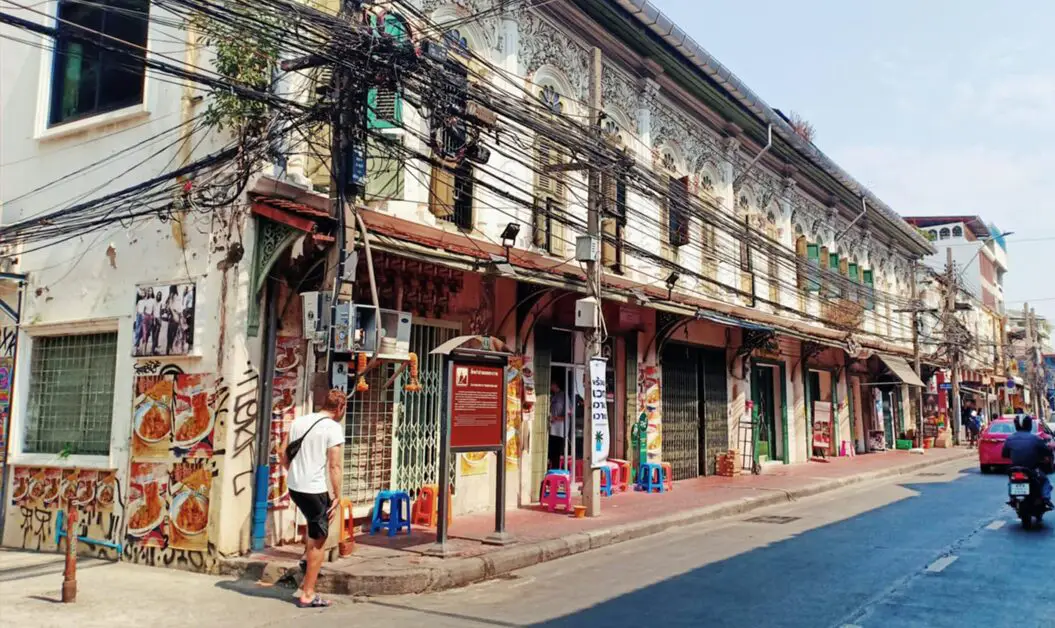
Walking onto Song Wat Road reveals a distinctive urban environment that differs from tourist attractions designed or reconstructed specifically for visitors. Many buildings retain visible traces of their earlier uses, including wooden doors, tall windows, decorative stucco, Chinese shop signs, and metal shutters opening onto active businesses. Traditional wholesalers continue to sell dried chilies, spices, agricultural products, and other merchandise, while neighboring buildings may house contemporary coffee shops or restaurants. These contrasts make Song Wat more than a picturesque place to photograph. The street offers a direct view of how historic trading occupations and newer economic activities coexist within the same neighborhood, often inside buildings that have served generations of merchants and residents.
Song Wat Road lies within Bangkok's historic riverside commercial district, close to the Chao Phraya River. Ratchawong Road, Song Sawat Road, Yaowa Phanit Road, and Charoen Krung Road form part of the surrounding street network. The area is also close to Yaowarat Road, one of Bangkok's most important centers of Thai-Chinese commerce and community life. Its proximity to the river and traditional markets gives Song Wat a distinctive urban character in both architecture and daily activity. Although modern visitors generally arrive by road, underground railway, or passenger boat, the layout of the neighborhood still reflects an earlier period when the Chao Phraya River was a principal transportation route for goods arriving from provincial towns and overseas trading partners.
The historical background of Song Wat can be traced to the establishment of Bangkok as the capital of the Rattanakosin Kingdom in 1782. During the reign of King Rama I, members of the Chinese community living near the site selected for the Grand Palace were relocated to areas outside the southern part of the old city walls. These settlements developed into what became the Sampheng commercial district. Chinese merchants and their families gradually established businesses along the Chao Phraya River, helping transform the area from a residential community with small shops into an important trading neighborhood. Over time, its commercial relationships extended beyond Bangkok to provincial markets, agricultural producers, and merchants participating in regional trade.
Sampheng became particularly significant in the commercial history of early Rattanakosin Bangkok. It concentrated merchants, shops, storage buildings, and transportation businesses associated with the river. As population and commercial activity increased, homes, warehouses, and shop premises became closely packed together. Narrow lanes, limited sanitation, and the risk of fire created challenges for the rapidly developing district. The later construction of Song Wat Road therefore represented more than a new transportation link. It formed part of a broader effort to reorganize the urban environment, improve circulation, and accommodate commercial growth as Bangkok developed into a more modern city.
The Bowring Treaty of 1855 contributed to the expansion of trade between Siam and foreign countries. Agricultural products and commodities from provincial areas became increasingly important exports, while imported merchandise entered through the river and networks of commercial intermediaries. Riverside neighborhoods, especially Sampheng and its surroundings, grew into collection and distribution centers for these goods. Chinese and Thai-Chinese merchants played a significant role in connecting river transportation with domestic markets. Their commercial networks helped shape the economic foundation that later characterized Song Wat Road, where storage, wholesale trade, and transportation operated as interconnected activities rather than separate businesses.
Song Wat Road was constructed during the reign of King Chulalongkorn, Rama V, in two major stages. The first stage began in 1892, extending from Chak Phet Road toward the area historically known as Trok Rong Kratha, associated with today's Yaowa Phanit Road. The second stage followed in 1907, extending from that area toward Charoen Krung Road. This later expansion took place amid efforts to reorganize Sampheng following a major fire in 1906. The chronology is important because Song Wat did not emerge entirely as a single response to the fire. Its development occurred over several years, reflecting continuing urban planning and the need to improve transportation within a growing commercial district.
The name "Song Wat" is associated with King Rama V personally drawing the proposed route onto a map as part of the effort to reorganize the neighborhood. The new street provided another connection between Sampheng, the river landing areas, and surrounding roads. It allowed vehicles and pedestrians to move through the district more efficiently and helped relieve congestion in the older network of narrow lanes. The road's name therefore preserves a direct connection with Bangkok's historical urban planning. Walking along Song Wat today provides an opportunity to experience a street whose alignment reflects the modernization of the capital more than a century ago.
Following the development of the road, commercial activity expanded because of its advantageous position near the Chao Phraya River. Cargo vessels carried rice, sugar, pepper, spices, coconut oil, and agricultural products from provincial areas to riverside warehouses. Goods were sorted, packed, stored, and redistributed to shops and trading networks. Some were prepared for export to foreign markets, while imported merchandise entered domestic distribution channels through the same commercial district. Song Wat consequently became an important connection between river transportation and overland trade during a period when Siam's commercial infrastructure was expanding and adapting to international exchange.
The physical arrangement of Song Wat's historic warehouses illustrates the street's original commercial function. Many storage buildings were designed with deep interiors and practical connections to riverside transportation routes. Some stood perpendicular to the river to facilitate movement between landing areas and storage spaces. Ground floors commonly supported commercial operations and merchandise handling, while upper levels could provide accommodation or additional working space for merchants and their families. This combination of workplace and residence was an important feature of historic trading districts. It allowed family businesses to operate close to their inventories, customers, and transportation networks, creating the mixed-use urban environment still recognizable in parts of Song Wat today.
Song Wat was particularly associated with agricultural commodities and food ingredients, including dried chilies, spices, sugar, and products suitable for storage and transportation in large quantities. Such businesses depended on expertise in selecting merchandise, maintaining quality, organizing inventories, negotiating prices, and preserving relationships with regular customers. Some merchants continued these activities through successive generations, developing specialized knowledge and long-standing commercial connections. Although retail businesses and tourism have become more prominent, traditional wholesalers remain an important part of the street's identity. Their presence demonstrates that Song Wat has not simply changed from a commercial district into a tourist destination; different generations of economic activity continue to operate side by side.
The prosperity of Song Wat was also connected with the development of major Thai commercial enterprises. Historically, businesses dealing in agricultural products and commodities established themselves in the surrounding trading district, and some developed into enterprises with national significance. One notable connection is the early history of Chia Tai, associated with the later development of the Charoen Pokphand business group. This relationship gives Song Wat importance beyond its surviving architecture. The neighborhood provides insight into the commercial networks, family businesses, and trading practices that contributed to the growth of private enterprise in Thailand, including the transition from small-scale merchant operations toward much larger business organizations.
The architecture along Song Wat Road is varied and cannot accurately be described as belonging to one uniform style. Certain historic shophouses display Western architectural influences through arches, cornices, decorative columns, and molded stucco. Other buildings feature timber doors, louvered shutters, and details adapted to Bangkok's tropical climate. Many shophouses have relatively narrow street frontages but extend farther into their plots, reflecting the practical requirements of commercial premises. These characteristics show how architectural appearance and everyday functionality developed together. Looking closely at the buildings reveals not only decorative craftsmanship but also the ways merchants organized work, storage, ventilation, and domestic life within limited urban spaces.
The significance of Song Wat's historic buildings extends beyond their age. They also preserve evidence of the people who used them as shops, warehouses, and homes. Old business signs, repaired wooden doors, altered openings, and changes to interior layouts reveal how buildings adapted to new requirements over time. Buildings still occupied by long-established merchants have a different historical value from those converted into contemporary businesses, yet both help explain the neighborhood's development. Preserving Song Wat therefore involves more than maintaining attractive façades. The continuity of community activities and commercial traditions is equally important to understanding why this district remains culturally meaningful.
One of Song Wat's most recognizable architectural landmarks is the Fruit Building, named for its ornamental fruit sculptures decorating the façade above the building's openings. These distinctive stucco details give the structure a character unlike that of purely functional commercial buildings. Decorative fruits and botanical motifs reflect artistic preferences of the period and demonstrate the craftsmanship involved in adapting elaborate ornamentation to trading premises. Visitors examining the building can appreciate its window arches, molded details, and façade composition. It is an especially interesting stop for those who enjoy architectural photography, as many of its smaller decorative features are easily overlooked when passing through the street quickly.
Another noteworthy landmark is the historic building commonly known as the Indian Building, or Tuek Khaek in Thai. Its architecture reflects the cultural diversity of the old riverside trading community. Pointed arches and Western-influenced decorative elements distinguish it from many neighboring shophouses, while ornamental woodwork recalls architectural traditions popular around the late nineteenth century. The building is a visual reminder that Song Wat was never exclusively the commercial territory of a single community. Merchants of different backgrounds participated in the neighborhood's trading economy, contributing to a built environment that still expresses Bangkok's multicultural history.
Luang Kocha Itsahak Mosque is another important landmark illustrating the coexistence of different religious communities around Song Wat. The mosque's architecture incorporates Western-influenced design elements, producing an appearance distinct from many conventional images of Islamic religious buildings. Its presence near trading premises, Chinese shrines, and Buddhist temples reflects the diversity of people who settled in Bangkok's historic river port districts. Visitors can appreciate the mosque's exterior architecture and its relationship with the surrounding neighborhood. As an active religious site, its prayer spaces and community activities require appropriate respect and consideration.
Chinese shrines have long been closely associated with the social and spiritual life of Song Wat. Among the area's notable landmarks are Lao Pun Tao Kong Shrine and Sia Ong Kong Shrine, which preserve traditions of worship within the Thai-Chinese community. Their presence near commercial premises reflects the connection between business life, religious belief, prayers for protection and prosperity, and respect for earlier generations. Beyond their spiritual roles, these shrines contain architectural and artistic features associated with Chinese traditions, including decorated roofs, altars, carved details, and Chinese inscriptions. Together, they illustrate the continuation of cultural practices within a neighborhood shaped by trade and migration.
Wat Pathum Khongkha Ratchaworawihan is an important Buddhist temple situated on Song Wat Road and associated with the historic riverside area of Bangkok. As a royal monastery with a long-standing connection to the surrounding community, it forms part of the neighborhood's religious and historical identity. The temple offers a different atmosphere from the nearby commercial streets and provides another perspective on the relationship between religious institutions and urban settlements. The proximity of Buddhist temples, Chinese shrines, a mosque, warehouses, and traditional businesses demonstrates how communities with different beliefs and occupations have shared this part of Bangkok for generations.
The surrounding street network is also historically significant. Song Sawat Road, which connects Charoen Krung Road with Song Wat Road, has a similar name but is a separate street. Its origins are linked to the redevelopment of the Sampheng district during the late reign of Rama V, while the name Song Sawat was formally adopted in 1932. The relationship between these roads illustrates how the wider Chinatown and Sampheng transportation network developed gradually in response to commercial growth. Interconnected streets and lanes continue to shape the way people move between Yaowarat, Sampheng, Song Wat, and the river today.
Changes in transportation transformed Song Wat's commercial role during the twentieth century. As road transport became increasingly important and modern distribution networks expanded, the earlier dependence on riverside warehouses and cargo boats gradually declined. Community historical records identify the period around 1974 as a significant stage in the growing importance of road transportation relative to river freight. Some riverside areas and buildings were adapted for new uses as the requirements of the city changed. Businesses requiring larger vehicle access moved toward other locations, while many wholesale merchants continued operating in Song Wat. The district therefore retained much of its commercial character even as the original transportation system that supported it changed.
Following the height of the riverside trading era, parts of Song Wat became quieter as certain commercial activities declined or relocated. Some older buildings deteriorated after decades of continuous use, while changing business patterns reduced demand for particular types of warehouses. Nevertheless, reduced commercial activity did not mean the neighborhood ceased to function. Family-run shops continued receiving orders, handling merchandise, and serving established customers. This continuity became an important characteristic of Song Wat's later revival. When creative businesses began entering the neighborhood, they joined a place that already had its own traditions, commercial networks, and daily routines rather than an abandoned district recreated entirely for tourism.
Song Wat's revival in recent years has been driven by growing interest in architectural heritage, design, food, art, and local history. Former warehouses and shophouses have been adapted into new businesses while retaining features such as old plaster walls, timber beams, folding doors, windows, and original building proportions. Such conversions allow historic architecture to accommodate contemporary economic activity without requiring complete demolition and reconstruction. Visitors can consequently experience old buildings through restaurants, cafés, art spaces, and shops. This process has introduced new uses into the neighborhood while preserving visible connections with its earlier role as a trading and storage district.
Local entrepreneurs and creative businesses have played a significant role in bringing Song Wat renewed public attention. The Made in Song Wat collective began with a small group of businesses in 2022 and subsequently expanded its membership. Through cooperation between newer enterprises and established local businesses, the collective has helped organize activities, promote local products, and strengthen the neighborhood's identity. Such collaboration has encouraged more visitors to experience Song Wat as a cultural district rather than simply a wholesale trading street. The contemporary neighborhood offers opportunities to explore historic buildings, sample food, encounter art, and discover independently developed businesses within a relatively compact area.
Street art is one of the features that has brought Song Wat considerable attention. Among its best-known works is a mural depicting two elephants on a wall overlooking a parking area, created by the Belgian street artist ROA. The large animal figures contrast with the weathered surfaces of the historic buildings, creating a memorable connection between contemporary art and the older urban landscape. Additional murals and smaller creative works can be found in nearby lanes, shopfronts, and on building walls. Discovering Song Wat's art is therefore more than a visit to one famous mural. It involves observing how artists have responded to the architecture and how local property owners and businesses have participated in the neighborhood's changing visual identity.
What distinguishes Song Wat's street art is its location within a working urban environment rather than a gallery separated from everyday life. Artwork may appear beside an active wholesale shop, a delivery route, or a business entrance. Visitors taking photographs share the street with merchants handling goods and residents carrying out daily activities. This creates an experience in which art is viewed in the context of real urban life. It also means that temporary installations and smaller murals may change as buildings are maintained and businesses adapt their premises. These changes are part of the evolving character of a creative neighborhood that remains actively used by its community.
PLAY art house is an important example of the adaptive reuse of historic buildings for contemporary cultural activities. The venue became known around late 2019 and has been associated with local artists and creative work in the Song Wat neighborhood. Such spaces demonstrate how art can contribute to the revitalization of older commercial areas. A building previously linked to storage or trade can acquire a new function as a place for presenting creative ideas while preserving parts of its original structure and materials. Exploring the surrounding area reveals the relationship between architectural conservation and cultural activity, providing an experience that goes beyond conventional café hopping.
Coffee shops and restaurants have become another defining part of contemporary Song Wat. Many occupy historic buildings whose old plaster, timber, shutters, and other features have been incorporated into modern interiors. Although these establishments may appear similar from outside, they often have very different concepts. Some specialize in carefully sourced and roasted coffee, others emphasize regional Thai ingredients, and some serve as meeting places for designers and creative communities. Their diversity means that Song Wat's café culture is not simply a collection of fashionable interiors. Each establishment can provide a different perspective on the reuse of old buildings and the creative reinterpretation of the neighborhood's commercial character.
FV is one of Song Wat's distinctive food and drink venues, known for its creative use of Thai ingredients. Located in a historic building, the café incorporates a traditional Thai wooden-house structure into its interior design, producing an atmosphere that differs from ordinary coffee shops. Its concept focuses on fruits, vegetables, herbs, traditional desserts, and drinks rather than a conventional espresso-based menu. Preparations combining sweetness, acidity, saltiness, and herbal aromas showcase familiar Thai flavors in contemporary forms. Visiting FV offers an opportunity to discover regional ingredients and culinary ideas while experiencing an imaginative approach to the interior design of a historic commercial building.
Song Wat Coffee Roasters is a well-known destination for specialty coffee enthusiasts. Operating within historic shophouse premises, it emphasizes coffee beans, roasting, and different brewing techniques. Its character illustrates how modern coffee culture has become established within a traditional wholesale district. Local Boys Coffee offers another style of contemporary café experience, with distinctive branding, drink presentation, and design. The presence of several independent coffee businesses within walking distance gives visitors a variety of experiences without leaving the neighborhood. For those interested in architecture and contemporary urban culture, the cafés also offer opportunities to observe how different designers and operators interpret the character of old Bangkok buildings.
Tay Song Wat is another example of a café functioning as a convenient resting point during a neighborhood walk. Situated on Song Wat Road, the venue offers a place to pause between visits to historic buildings and other attractions. Spending time in such establishments allows visitors to notice the rhythm of the street outside, where residents, shopkeepers, and tourists move through the same setting. Song Wat is especially well suited to a slower style of exploration that alternates walking with food, coffee, and time spent observing the surroundings. This approach reveals details of the neighborhood that can easily be missed during a hurried series of photography stops.
Song Wat's food scene ranges from long-established family recipes to contemporary interpretations of Thai cuisine. Rong Klan Nuea is a popular example, specializing in beef noodles and braised beef dishes. The restaurant operates in a renovated historic shophouse, combining elements of the original building with a contemporary dining environment. E-ga offers another experience, serving Thai dishes inspired by regional and home-style cooking traditions in a setting designed for shared meals. Together, these restaurants demonstrate the variety of dining experiences now available in the district and the ways food businesses have become part of the reuse of historic commercial premises.
For visitors interested in dining beside the Chao Phraya River, NAAM 1608 offers a setting closely connected to Song Wat's riverside identity. Located in a historic-style riverfront building, the restaurant provides views of the water and passing boats. Observing the river from this perspective makes it easier to imagine the period when cargo vessels were essential to the area's commercial economy. The restaurant serves Thai cuisine and offers a dining experience shaped by both food and the surrounding landscape. Its riverside location illustrates how one of Song Wat's oldest geographical advantages continues to influence the neighborhood's appeal in the present day.
Traditional Chinese-influenced food businesses also remain an important part of the wider Song Wat district. Dishes such as braised goose, noodles, and steamed buns reflect cooking techniques and family traditions maintained over generations. Urai Braised Goose is among the long-associated food names of Song Wat, while Gu Long Bao in the nearby Chinatown area is known for traditional Chinese-style buns. These businesses exist alongside newer restaurants and cafés, showing that the neighborhood's culinary identity is not defined exclusively by recent food trends. Instead, it reflects a long accumulation of recipes, preparation methods, commercial traditions, and community memories.
Beyond food and drink, Song Wat has shops selling handicrafts, decorative objects, household items, and products by Thai designers. Some retailers bring together craftsmanship from different parts of Thailand within historic shophouse settings. Road of Cinnamon is one example, presenting Thai crafts and locally inspired products. SAAN Song Wat combines retail, lifestyle products, and food-related experiences influenced by Thai materials and traditions. These businesses broaden the range of activities available in the neighborhood and connect Song Wat's contemporary commercial life with craft producers and creative communities in other parts of the country.
Spaces such as Soul Songwat illustrate the transformation of former commercial premises into gathering places where dining and creative activity can coexist. Repurposing old warehouses and shophouses allows visitors to experience historic riverside architecture in a new way. Such venues maintain a relationship with the neighborhood's physical heritage while introducing activities suited to contemporary urban life. Their importance lies in showing that the commercial history of Song Wat can be interpreted through both preservation and new use. Buildings that once supported storage and trade can become places for meeting, relaxing, and discovering the creative energy of the modern district.
Visiting Song Wat in the morning offers a different experience from exploring later in the day. Traditional shops begin business, goods are delivered, merchandise is organized, and wholesalers communicate with customers and other merchants. The sounds of opening shutters, delivery vehicles, and commercial conversations make it clear that many historic buildings remain active workplaces. Morning visits are particularly interesting for travelers focused on urban history and traditional trade, because they provide a closer view of the economic activities that helped define the neighborhood. Visitors share the narrow streets with people carrying out their daily work, reinforcing the fact that Song Wat remains an operating commercial district.
From late morning into the afternoon, Song Wat becomes increasingly active as a destination for visitors. Cafés, restaurants, design shops, and creative venues welcome customers, while photographers explore the historic façades and street art. Natural light reveals the textures of old stucco, the colors of weathered walls, and the details of historic windows. This period is suitable for combining architecture with food and shopping in one visit. However, shade is not continuous along the street, and Bangkok's heat can be intense during the middle of the day. Alternating short walks with stops inside open businesses allows visitors to experience more of the area without spending the entire afternoon outdoors.
Late afternoon and early evening bring another change in atmosphere. Some commercial deliveries slow down, while visitors spend more time at restaurants and riverside venues. The lower angle of sunlight changes the appearance of historic façades, bringing out their textures and architectural details. Riverside restaurants offer a different perspective, with the movement of boats and the changing light over the Chao Phraya. An evening in Song Wat can also be connected with dinner in Yaowarat, where many food businesses operate after dark. This makes it possible to begin a day with architectural and historical exploration and end it with the distinctive food culture of Bangkok's Chinatown.
Although Song Wat Road is a public street accessible throughout the day and night, its businesses do not operate on a single shared schedule. Many wholesalers focus on daytime trading, cafés commonly close in the afternoon or early evening, and some restaurants and other establishments remain open later. The atmosphere after dark is consequently different from the daytime experience. Certain premises will be closed, while selected dining and evening venues continue operating. Understanding these different rhythms is part of appreciating Song Wat as a living neighborhood rather than a purpose-built pedestrian attraction where every establishment follows the same opening hours.
One of the most convenient ways to reach Song Wat is by using the MRT Blue Line. Visitors can get off at Wat Mangkon Station and take Exit 1 toward Plaeng Nam Road, then walk through the Yaowarat area and Yaowa Phanit Road to Song Wat. The walk generally takes around 10–15 minutes, depending on the chosen route and the destination within the neighborhood. This option avoids much of the traffic congestion associated with the historic commercial district. It also allows visitors to begin exploring Chinatown before reaching Song Wat, combining contemporary urban rail transportation with the old street network of Bangkok.
Arriving by boat offers an experience especially relevant to the history of Song Wat. Travelers can use a passenger boat service that stops at Ratchawong Pier and then walk into the neighborhood. The river journey provides an opportunity to see the Chao Phraya as a transportation route that continues to serve Bangkok. It also creates a direct connection with the historical period when boats carried large volumes of commercial goods into the area's warehouses. From the pier, the relationship between Ratchawong Road, the surrounding trading streets, and the riverside buildings becomes easier to understand. Approaching Song Wat from the water therefore offers a different perspective from arriving by underground railway.
Visitors traveling by private car can approach the district through Yaowarat Road, Ratchawong Road, Charoen Krung Road, and surrounding routes. However, the area contains narrow streets shared by pedestrians, motorcycles, cars, and commercial delivery vehicles. Parking is generally provided through permitted private car parks or designated facilities in nearby areas, with fees and available spaces determined by individual operators. Public transportation is therefore particularly convenient for visitors planning to explore mainly on foot. Those arriving by car can organize their route around a suitable parking location to reduce unnecessary travel through the neighborhood's narrow lanes.
A walking itinerary can begin at Wat Mangkon MRT Station, continue through Yaowarat and Yaowa Phanit Road, and enter Song Wat to explore its historic buildings, traditional businesses, and street art. Visitors can then look for architectural landmarks such as the Fruit Building and Indian Building, together with other distinctive façades along the street. A meal or coffee break provides time to appreciate the interiors of adapted historic premises. This route is particularly suitable for people interested in architecture and urban history because it presents different types of buildings within a compact district. Following the main street also makes it easier to understand the neighborhood's layout before exploring smaller lanes.
An alternative walking route begins at Ratchawong Pier and follows the relationship between the river and Song Wat's former warehouse district. This approach is well suited to visitors interested in economic history and river transportation. Starting beside the water helps establish the geographical context of the cargo and trading networks that once supported the neighborhood. From there, the route can continue past historic shophouses, Chinese shrines, and religious landmarks before reaching Wat Pathum Khongkha Ratchaworawihan and the wider Talat Noi area. The sequence offers a coherent historical journey from river commerce and community life to architectural preservation and contemporary creative businesses.
Visitors with more than half a day can extend their walk into Sampheng, one of Bangkok's long-established wholesale market districts, and onward to Yaowarat Road. Exploring all three areas provides a fuller understanding of the city's commercial development. Sampheng is particularly associated with busy wholesale lanes, Yaowarat with Chinese businesses, restaurants, and a lively food scene, and Song Wat with riverside warehouses, historic architecture, and adaptive reuse. Their different characters make them complementary rather than interchangeable destinations. Together, they allow travelers to discover how Bangkok's economic and cultural history remains visible in streets that are still actively used.
Talat Noi is another neighborhood that connects naturally with Song Wat. Located within Samphanthawong District, it has its own long history of Thai-Chinese settlement and commercial activity. Its narrow lanes contain historic houses, older commercial buildings, metalworking businesses, mechanical parts shops, and street art. Walking from Song Wat into Talat Noi reveals both similarities and differences between the communities. Song Wat's historical identity is closely tied to riverside warehouses and wholesale trading, while Talat Noi preserves a wider variety of local industries and residential traditions. Both neighborhoods demonstrate how creative businesses and heritage architecture can exist alongside the daily work of established communities.
Travelers interested in religious history can combine Song Wat with Wat Mangkon Kamalawat, an important Chinese Buddhist temple in Yaowarat, and Wat Traimit Withayaram Worawihan, renowned for its Golden Buddha image. These visits provide additional perspectives on the cultural diversity of Bangkok's older neighborhoods. Thai Buddhist temples, Chinese Buddhist institutions, traditional shrines, and Islamic religious sites all form part of the wider area's heritage. This diversity developed through generations of migration, settlement, and commercial exchange. Visiting the religious landmarks as part of a neighborhood walk provides an opportunity to understand the city's cultural history rather than treating each site solely as a photography destination.
Song Wat also provides a valuable example of urban design and heritage conservation. The adaptation of historic buildings has depended partly on the efforts of business owners, designers, and members of the community. Retaining original features while introducing new activities can preserve the distinctive appearance of an area and generate economic opportunities. This approach is especially relevant in a fast-changing city such as Bangkok. It demonstrates that historic buildings do not necessarily have to lose their commercial usefulness in order to retain historical value. With appropriate adaptation, they can accommodate contemporary activities while preserving important connections to the past.
Nevertheless, Song Wat's significance cannot be measured only by the popularity of new restaurants, cafés, or cultural events. Its older communities and businesses remain essential to the identity of the district. Traditional spice sellers, dried chili wholesalers, agricultural merchants, and family-run enterprises preserve commercial practices that have developed over generations. Without their continued presence, Song Wat could become a collection of attractive historic façades detached from the activities that originally gave them meaning. The coexistence of old and new businesses is therefore one of the neighborhood's most important characteristics, preserving the continuity of community relationships alongside economic change.
Cultural tourism in Song Wat differs from visiting a monument or a protected historical site with controlled entry. Visitors share the streets with residents and people working in the neighborhood. A shopfront may function as a loading area, a doorway may be the entrance to a private home, and a narrow lane may be an important route for local families. The buildings are not all open to the public, and many remain privately occupied. Recognizing these conditions is part of understanding Song Wat as a living urban community. Its appeal comes from real activities and long-standing relationships, which are as important to the character of the place as its architecture and historic streetscape.
Photography enthusiasts will find many different subjects along Song Wat Road. These include long views of adjoining shophouses, window details, decorative stucco, old metal shutters, wooden doors, Chinese signs, and street art. Changing daylight gives the weathered walls and architectural surfaces different colors and textures. Repairs and alterations can also reveal how a building has been used over time. Interesting photographs are therefore not limited to the most familiar viewpoints. Smaller architectural details can communicate the history and character of the neighborhood just as effectively. Because many buildings remain active workplaces and homes, photographing the area also involves respecting privacy and avoiding obstruction of everyday business activities.
Pedestrian conditions are an important practical consideration. Song Wat Road continues to accommodate cars, motorcycles, and goods vehicles, and it is not permanently closed to traffic as a pedestrian-only street. Pavements are narrow in some sections and may contain obstacles associated with the older commercial environment. Visitors using wheelchairs, older travelers, and families with young children may encounter challenges in certain areas. Some historic buildings also have stairs and internal layouts that were not designed to contemporary accessibility standards. Understanding these conditions helps visitors choose suitable destinations and organize their experience around their individual mobility requirements.
Bangkok's weather also influences the experience of exploring Song Wat. Historic streets lined with buildings and concrete surfaces can become hot during the middle of the day. During the rainy season, sudden showers may leave walking surfaces wet and slippery. Morning and late-afternoon visits consequently provide different conditions from those encountered at midday. Extending the walk into Talat Noi or Yaowarat increases the total walking time, especially when meals and photography stops are included. The concentration of indoor and outdoor venues in Song Wat allows visitors to alternate between the street and open establishments according to the weather and the pace of their visit.
Song Wat appeals to several types of travelers for different reasons. History enthusiasts can examine the development of the street and its connection with river commerce. Architecture lovers can compare buildings and decorative styles from different periods. Food enthusiasts can explore both established culinary traditions and contemporary restaurants. Visitors interested in art and design can discover galleries, craft shops, and street art. Solo travelers can explore at their own pace, while couples and groups of friends can combine meals, riverside views, and photography. The neighborhood offers a variety of experiences without requiring visitors to organize their entire trip around one specific attraction.
For families with children, Song Wat can serve as an outdoor learning environment for Bangkok's urban history. Young visitors can compare modern delivery vehicles with the former importance of cargo boats, observe the shapes of old buildings, and learn how everyday ingredients such as spices were connected with regional and international trade. Seeing Buddhist temples, Chinese shrines, and a mosque within the same wider neighborhood can also introduce the idea of religious and cultural diversity. As the street remains open to traffic and some pavements are narrow, close supervision is important. Short walks combined with breaks may be more practical for younger children than a long uninterrupted itinerary.
The cost of visiting Song Wat depends largely on individual preferences. Exploring the public street, viewing historic buildings from outside, and seeing publicly accessible street art do not require an admission fee. Spending on meals, drinks, handicrafts, shopping, or special exhibitions is determined by individual businesses. Travelers focusing on history and photography can enjoy much of the neighborhood without substantial expense, while visitors choosing full restaurant meals or designer products may spend more. This range of options reflects the diversity of Song Wat's commercial life, from long-established local businesses to contemporary creative enterprises.
The relationship between tourism and the local economy is another important part of Song Wat's modern identity. Growing visitor interest has created opportunities for restaurants, cafés, designers, and independent retailers. At the same time, traditional businesses have gained exposure to customers who might not otherwise have encountered the neighborhood. Some visitors arrive because of a popular mural or café and subsequently become interested in the history of nearby buildings and merchants. These connections allow tourism to support the wider communication of local history and culture, particularly when contemporary activities are understood in relation to the neighborhood's original commercial role.
The continuing transformation of Song Wat also raises broader questions about the future of Bangkok's historic neighborhoods. Maintaining architectural and community value while accommodating new economic activity requires a balance between preservation and change. Popularity may alter business patterns, but Song Wat's distinctive appeal comes from the coexistence of historic merchants and new enterprises, religious landmarks, adapted buildings, and families with long-standing connections to the area. When these elements remain part of everyday life, the district can continue functioning both as a tourist destination and as a neighborhood with a meaningful historical foundation.
Song Wat Road makes Bangkok's history visible through buildings, activities, and spaces that can still be experienced today. Its story extends from the relocation and growth of Chinese communities in early Rattanakosin Bangkok to the expansion of trade following the Bowring Treaty, road construction during the reign of Rama V, the prosperity of riverside warehouses, and the emergence of contemporary creative businesses. Historic architecture, shrines, temples, a mosque, wholesale shops, and street art all contribute different parts of this story. Exploring Song Wat therefore offers an opportunity to understand the city through relationships between people, commerce, cultural traditions, and places that have continued to evolve across generations.
What makes Song Wat Road particularly memorable is that its history remains active rather than confined to the past. Along approximately 1.2 kilometers of street, visitors can encounter century-old architecture, established family businesses, multicultural religious landmarks, Thai and Chinese food, contemporary art, and new approaches to using historic buildings. This concentration of experiences makes Song Wat one of Bangkok's distinctive heritage neighborhoods. It offers an understanding of the city's commercial past alongside the energy of its present, bringing together tourism, architecture, cultural diversity, and community memory in a place that continues to change without entirely losing its identity.
Getting There Song Wat Road is located in Samphanthawong District, Bangkok. Visitors can take the MRT Blue Line to Wat Mangkon Station, use Exit 1, and walk through the Yaowarat area and Yaowa Phanit Road to reach Song Wat in approximately 10–15 minutes. Another option is to take a passenger boat service stopping at Ratchawong Pier and walk into the neighborhood. Travelers arriving by car can approach through Yaowarat, Ratchawong, or Charoen Krung Road and use a permitted parking facility in the surrounding district.
| Name | Song Wat Road, Bangkok |
| Attraction Type | Historic Street, Traditional Commercial District, Cultural Heritage Destination, and Architectural Walking Area Near the Chao Phraya River |
| Location | Yaowarat and Sampheng Area, Samphanthawong District, Bangkok, near the Chao Phraya River and Ratchawong Pier |
| Address | Song Wat Road, Chakkrawat and Samphanthawong Subdistricts, Samphanthawong District, Bangkok 10100, Thailand |
| Reference Coordinates | 13.737522, 100.508990 (Song Wat neighborhood) |
| Road Length | Approximately 1,196 meters |
| Current Status | Open as a public street and active commercial neighborhood with traditional businesses, restaurants, cafés, street art, and heritage attractions |
| Open Days | Daily |
| Opening Hours | The public street is accessible 24 hours a day. Individual businesses set their own operating hours. Approximately 09:00 – 18:00 is a convenient period for visiting many shops and attractions. |
| Admission Fee | Free access to the public street and public spaces. Food, drinks, shopping, special exhibitions, and other services are charged separately by individual businesses. |
| Public Area Administration | Bangkok Metropolitan Administration, through the Samphanthawong District Office and relevant public agencies. Individual buildings and businesses are managed by their respective owners or operators. |
| Official Contact | Samphanthawong District Office: +66 2 233 1224 to +66 2 233 1228 |
| Construction History | Developed during the reign of King Rama V, with the first construction stage beginning in 1892 and the second in 1907 to improve circulation and accommodate commercial growth |
| Name Origin | The name refers to King Chulalongkorn, Rama V, drawing the proposed road alignment onto a map as part of urban improvements in the Sampheng area. |
| Historical Significance | A major wholesale trading and warehousing district for agricultural commodities, spices, and imported and exported goods connected with transportation on the Chao Phraya River |
| Contemporary Significance | A historic neighborhood combining established wholesale businesses with restaurants, cafés, contemporary art, creative retail, and the adaptive reuse of historic buildings |
| Architectural Features | Historic Shophouses, Riverside Warehouses, Arched Windows, Decorative Stucco, Timber Doors, Louvered Shutters, and Buildings Incorporating Western and Local Architectural Influences |
| Historic Buildings and Landmarks | 1. Fruit Building and Its Ornamental Stucco Details 2. Indian Building and Its Historic Architectural Features 3. Luang Kocha Itsahak Mosque 4. Lao Pun Tao Kong Shrine 5. Sia Ong Kong Shrine 6. Wat Pathum Khongkha Ratchaworawihan 7. Elephant Mural by ROA 8. PLAY art house 9. Historic Shophouses and Former Warehouses Along Song Wat Road |
| Main Areas and Zones | 1. Traditional Wholesale Shops and Historic Shophouses 2. Historic Architecture and Heritage Building Areas 3. Chinese Shrines and Religious Landmarks 4. Street Art and Contemporary Galleries 5. Restaurants and Cafés 6. Handicraft, Design, and Lifestyle Shops 7. Riverside Restaurants and Former Commercial Buildings |
| Popular Activities | Walking Among Historic Buildings, Learning About Bangkok's Trading History, Photographing Architecture and Street Art, Exploring Traditional Shops, Enjoying Thai and Chinese Cuisine, Visiting Cafés, Shopping for Creative Products, and Experiencing the Chao Phraya Riverside Atmosphere |
| Suggested Visit Duration | Approximately 2–4 hours for Song Wat itself, or half a day to a full day when visiting Sampheng, Yaowarat, and Talat Noi as well |
| Best Time to Visit | Morning for observing traditional wholesale activities; late morning to late afternoon for historic architecture, food, cafés, shops, and street art |
| Facilities | Restaurants, Cafés, Shops, Handicraft Retailers, Accommodation, and Services in Surrounding Areas. Restrooms, Seating, and Accessibility Facilities Vary by Establishment. |
| Getting There by MRT | MRT Blue Line to Wat Mangkon Station, Exit 1, followed by approximately 10–15 minutes of walking via Plaeng Nam Road and Yaowarat toward Song Wat Road |
| Getting There by Boat | Take a passenger boat service stopping at Ratchawong Pier, then walk along the Ratchawong area into Song Wat Road. |
| Getting There by Car | Approach via Yaowarat Road, Ratchawong Road, Charoen Krung Road, or nearby streets, and use a permitted parking facility in the surrounding district. |
| Nearby Tourist Attractions | 1. Ratchawong Pier – Approximately 0.5 km 2. Sampheng Market – Approximately 0.5 km 3. Yaowarat Road – Approximately 0.6 km 4. Wat Pathum Khongkha Ratchaworawihan – Approximately 0.8 km 5. Wat Mangkon Kamalawat – Approximately 0.9 km 6. Talat Noi Neighborhood – Approximately 1 km 7. Wat Traimit Withayaram Worawihan – Approximately 1.5 km 8. River City Bangkok – Approximately 1.5 km |
| Nearby Restaurants and Cafés | 1. E-ga, Song Wat Road – Approximately 0.3 km, Tel. +66 81 565 2028 2. FV, Song Wat Road – Approximately 0.3 km, Tel. +66 81 866 0533 3. Rong Klan Nuea, Song Wat Road – Approximately 0.3 km, Tel. +66 63 830 6335 4. Local Boys Coffee, Song Wat Road – Approximately 0.4 km, Tel. +66 62 597 9594 5. NAAM 1608, Song Wat Road – Approximately 0.7 km, Tel. +66 91 936 1632 6. Tay Song Wat – Approximately 0.6 km, Tel. +66 61 635 6454 7. Song Wat Coffee Roasters – Approximately 0.6 km, Tel. +66 65 858 5229 |
| Nearby Accommodations | 1. PIER 808 Hostel, Song Wat Road – Approximately 0.4 km, Tel. +66 84 082 0798 2. Luk Hostel, Sampheng Area – Approximately 0.7 km, Tel. +66 92 280 3385 3. River View Residence, Talat Noi Area – Approximately 0.9 km, Tel. +66 2 234 5429 4. Grand China Bangkok – Approximately 0.9 km, Tel. +66 2 224 9977 5. Shanghai Mansion Bangkok – Approximately 1.2 km, Tel. +66 2 221 2121 6. ASAI Bangkok Chinatown – Approximately 1.3 km, Tel. +66 2 220 8999 |
| Distance Information | Distances are approximate from the central section of Song Wat Road. Actual walking distances depend on the starting point and route taken. |
Frequently Asked Questions (FAQ)
Q: Where is Song Wat Road, and what makes it worth visiting?
A: Song Wat Road is located in Samphanthawong District, Bangkok, close to the Chao Phraya River and Yaowarat. The historic street is approximately 1.2 kilometers long and features old commercial buildings, former warehouses, Chinese shrines, a mosque, Buddhist temples, traditional businesses, restaurants, cafés, and street art. It is an excellent destination for exploring Bangkok's historic trading culture and architecture on foot.
Q: What are the opening days and hours of Song Wat Road?
A: Song Wat is a public street accessible daily, 24 hours a day. Shops, cafés, galleries, and restaurants operate on individual schedules. Approximately 09:00 to 18:00 is generally a convenient period for exploring many of the neighborhood's businesses and historic buildings, while selected restaurants remain open later in the evening.
Q: Is there an entrance fee for Song Wat Road?
A: No. Walking along Song Wat Road and exploring its public spaces is free. Visitors can admire historic building façades and publicly accessible street art without paying an entrance fee. Food, drinks, shopping, and activities or special exhibitions within private establishments are charged separately.
Q: What is the history of Song Wat Road?
A: Song Wat Road was developed during the reign of King Chulalongkorn, Rama V. Construction began in two major stages, in 1892 and 1907, to improve access through the crowded Sampheng commercial district and accommodate its expanding trade. The road's name is associated with King Rama V drawing its route on a map. Song Wat later became a major riverside wholesale trading and warehousing district connected to cargo transportation on the Chao Phraya River.
Q: Which MRT station is closest to Song Wat Road?
A: Wat Mangkon Station on the MRT Blue Line is one of the most convenient stations for reaching Song Wat Road. Take Exit 1 toward Plaeng Nam Road and walk through Yaowarat and Yaowa Phanit Road. The journey on foot generally takes approximately 10–15 minutes, depending on the destination within Song Wat.
Q: What are the main landmarks and photography spots on Song Wat Road?
A: Notable landmarks include the Fruit Building, Indian Building, Luang Kocha Itsahak Mosque, Lao Pun Tao Kong Shrine, Wat Pathum Khongkha Ratchaworawihan, and the elephant mural created by Belgian artist ROA. Historic shophouses, former warehouses, and contemporary art spaces throughout the neighborhood also provide distinctive architectural and photography subjects.
Q: How long should visitors spend on Song Wat Road, and what other attractions are nearby?
A: Allow approximately two to four hours to explore Song Wat's principal buildings and landmarks. A half-day or full-day visit is suitable when restaurants, cafés, and shopping are included. Nearby destinations include Sampheng Market, Yaowarat Road, Wat Mangkon Kamalawat, Wat Traimit Withayaram Worawihan, and Talat Noi, allowing visitors to create a longer walking itinerary through historic Bangkok.
Q: Is Song Wat Road suitable for an evening visit?
A: Song Wat Road remains accessible as a public street throughout the night, but many wholesale shops and cafés mainly operate during the day. Selected restaurants and other establishments continue serving customers into the evening. The atmosphere therefore differs from daytime visits, and the nearby Yaowarat district provides additional evening dining options within walking distance.
 Category: ●Art, Culture and Heritage
 Group: ●Historic Homes and Cities
Last Update : 2 WeekAgo
 Last Update : 2 WeekAgo
 Click to Access the Navigation Map GPS
Song Wat Road Map
Recommend

 Historical Sites and Monuments(3)
 Landmarks and Memorials(25)
 Royal Palace(13)
 Art, Craft Centres, Tradition(36)
 Museums(63)
Historic Homes and Cities(5)
 Art Gallery(18)
 Educational Places
 Museum for Study(6)
 Library(5)
 University
 Public university(8)
 Autonomous Universities(8)
 Rajamangala University of Technology(6)
 Rajabhat University(6)
 Private University(22)
 Places of Worship
 Temple(73)
 Church(2)
 Mosque(67)
 Other Sacred Sites(9)
 Research and Development
 Royal Project(1)
 Suburban Living
 Village, Community(7)
 Local Market(20)
 Floating Market(4)
 Nature and Wildlife
 River, Canal(4)
 Bays and Beaches(1)
 Other natural attractions(3)
 Entertainment and Agricultural
 Zoos and Aquariums(5)
 Animal camps and shows(5)
 Stadium(9)
 Farms, Parks and Ecotourism(22)
 Amusement Park(2)
 Waterpark(4)
 Theater(7)
 Cinema(1)
 Shopping
 Shopping and Night Market(29)
 Department Store(248)
 Spas and Wellness
 Spas and Wellness(1)
 Restaurant
 Michelin Star(5)
 Accommodation
 Hotel(3)
 Call Customer Service in Tourism
 Call Customer Service in Tourism(1)
 Travel Articles, Recipes
 Travel Review, Food Review(52)
 Royal Thai Desserts and Recipes(56)


