
lovethailand home >Northeastern Travel Attractions >Bueng Kan Travel Attractions >Pak Khat >Pak Khat > Wat Sawang Arom (Wat Tham Si Thon)
TL;DR: Wat Sawang Arom (Wat Tham Si Thon) is located at Non Sila Subdistrict, Pak Khat District, Bueng Kan Province, open Daily, hours 08.00 – 17.00.
Wat Sawang Arom (Wat Tham Si Thon)
Open Days: Daily
Opening Hours: 08.00 – 17.00
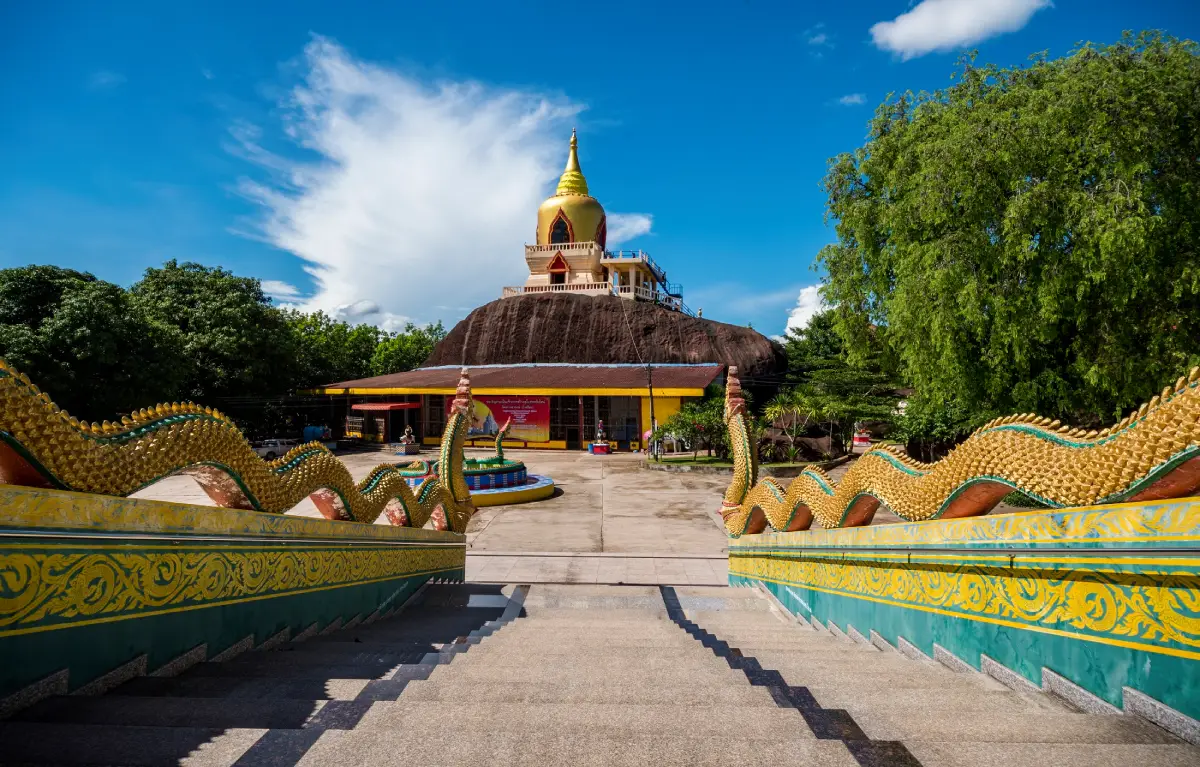
Wat Sawang Arom, also known as Wat Tham Si Thon, is an important temple in Pak Khat District, Bueng Kan Province. It is located on a rocky hill surrounded by trees, natural stone formations, and a small stream. The temple is best known for its reclining Buddha image enshrined beneath a massive boulder, its inverted-bell-shaped ordination hall built on top of a large rock, its unique bell tower made from earthen jars, and its viewpoint overlooking the Mekong River and the Lao side. This peaceful temple is ideal for worship, cultural exploration, photography, slow travel, and learning the local legend of Thao Si Thon.
Wat Sawang Arom, or Wat Tham Si Thon, is located in Pak Khat District, Bueng Kan Province. It is a distinctive Buddhist temple set among rocky hills, large boulders, trees, and a small natural stream. The temple has a quiet atmosphere that feels closer to a forest meditation site than to a busy urban temple. Visitors come here to worship, walk through the rocky temple grounds, enjoy the natural scenery, and see one of the most unusual temple landscapes in Bueng Kan.
The appeal of Wat Sawang Arom lies in the harmony between nature, Buddhism, and local legend. As visitors enter the temple grounds, they encounter natural stone formations scattered across the area. Some rocks have been adapted into walking paths and worship spaces, while others remain part of the original landscape. This gives the temple a strong sense of place. The experience is not limited to viewing religious buildings; it is also about walking through a living landscape where rock, forest, stream, sacred images, and local stories exist together.
The temple is also known as Wat Tham Si Thon because of its connection with the local legend of Thao Si Thon. According to the story, Thao Si Thon, the son of King Athit Wong of Mueang Panchanakhon, traveled in search of his beloved wife, Nang Manora. When he arrived at the cave of the hermit Kassapa, he stopped to study magical knowledge and spiritual disciplines because he believed that his skill in archery alone was not enough for the difficult journey ahead. This story gives the cave and rock formations at the temple a deeper cultural meaning.
Local tradition continues that after learning magical knowledge, Thao Si Thon wished to test his new power. He chose a large rock behind the cave, enchanted his sword, and struck the rock three times. The sound echoed through the area, and the rock was said to have split into three pieces. This story is part of the reason local people call the area Tham Si Thon. The name is therefore not only a geographical label; it is also a doorway into a world of love, perseverance, magic, and memory that remains alive in the communities along the Mekong.
The history of the area also reflects the movement of people along the Mekong River. Local accounts say that the area was once connected with villagers from Pak Khat whose ancestors had migrated from Ban Pak Kluai in Pakxan, Laos. In earlier times, the land was covered by dense forest and full of wild animals. Monks on pilgrimage regularly came to stay here because the area was quiet and suitable for meditation. Later, Phra Athikan Don Inthasaro, also known as Luang Pu Don, a respected monk of the Pak Khat community, developed the site into a more established temple.
Because Wat Sawang Arom grew from a forested meditation area, it still retains a peaceful character. Although it has become one of the notable attractions of Pak Khat District, the temple has not lost its quiet atmosphere. Visitors can still experience shade from trees, natural stone surfaces, small water channels, and walking routes that lead gently through different parts of the temple. This makes the temple especially suitable for travelers who prefer calm, meaningful places rather than crowded attractions.
One of the most important sacred points in the temple is the reclining Buddha image in the parinirvana posture, enshrined beneath a massive boulder. The natural rock overhead creates a cave-like shelter that gives the Buddha image a calm and powerful presence. Many visitors begin their visit at this point because it represents the identity of the temple clearly. It brings together faith, natural protection, stillness, and the feeling of a sacred cave.
The reclining Buddha in the parinirvana posture represents the final moments before the Buddha’s passing into complete nirvana. Seeing this image beneath a large natural rock encourages reflection on impermanence, peace, and letting go. Even visitors who are not familiar with Buddhist symbolism can feel the contemplative atmosphere of the place. The setting itself communicates calmness without the need for long explanation.
Above the large boulder stands the temple’s inverted-bell-shaped ordination hall. This structure is one of the most recognizable features of Wat Sawang Arom. Its form differs from a typical Thai ordination hall because it resembles an inverted bell and is built directly on top of a large rock. The climb toward the upper level gradually changes the visitor’s perspective, moving from the cave-like lower area of the reclining Buddha to the open upper area where the ordination hall and viewpoint are located.
The viewpoint above the rock is another highlight of the temple. From the top, visitors can see far across the landscape, including the Mekong River and the Lao side on clear days. This view helps travelers understand Pak Khat as a riverside district connected with the Mekong, Laos, and cross-border cultural history. The viewpoint is especially attractive for photography, quiet observation, and appreciating the open scenery of northeastern Thailand.
Another memorable feature is the bell tower made from earthen jars. The use of jars as architectural elements makes the structure unusual and visually distinctive. It shows how ordinary local materials can be transformed into a creative religious feature. The bell tower is popular among visitors because it is both beautiful and unexpected. It also reflects a practical and imaginative local approach to temple design.
The temple grounds include several points of interest, and signs help visitors walk to different areas. Important points include the reclining Buddha beneath the massive rock, the inverted-bell-shaped ordination hall, the jar bell tower, Tham Si Thon Cave, the hermit cave, natural stone courtyards, the stream area, and the Mekong viewpoint. Each point has a different mood. The reclining Buddha offers peace and devotion, the ordination hall offers architectural distinction, the viewpoint offers openness, and the cave areas connect the visit with legend and imagination.
Tham Si Thon Cave and the hermit cave make the legend of Thao Si Thon more tangible. As visitors walk through rocks and cave areas, they can imagine the story of a prince studying magical knowledge, testing his power, and continuing his search for Nang Manora. These stories turn the temple into more than a place of worship. They make it a cultural landscape where local memory, storytelling, and natural geography come together.
Mueang Peng Chan Nakhon Ratch, or Mueang Panchanakhon, is also mentioned in connection with the Thao Si Thon legend. The association between an ancient city, the cave, and the temple makes Wat Sawang Arom interesting for travelers who enjoy folklore, local history, and Mekong cultural connections. The temple is therefore not only a Buddhist site, but also a place where oral tradition and landscape preserve the identity of the local community.
The natural environment is one of the temple’s strongest attractions. Trees growing among rocks provide shade, the small stream adds freshness, and the large boulders create the feeling of a small stone park. In the morning or late afternoon, natural light falls beautifully on the rock surfaces and temple structures. The scenery changes with the time of day, making the temple rewarding for travelers who enjoy slow observation and photography.
The best time to visit is in the morning or late afternoon. Morning offers a quiet atmosphere suitable for worship and walking, while late afternoon provides softer light for photography and views. During the rainy season, some stone surfaces may become slippery, so visitors should wear shoes with good grip and walk carefully. Families with children and elderly visitors should move slowly, especially around stairs, natural rocks, and elevated viewpoints.
Wat Sawang Arom is suitable for many types of travelers. Worshippers can pay respect to the reclining Buddha and visit the ordination hall. Nature lovers can enjoy the trees, rocks, stream, and viewpoint. Cultural travelers can learn about the legend of Thao Si Thon. Photographers can find many interesting angles, including the reclining Buddha under the boulder, the bell-shaped ordination hall, the jar bell tower, Naga stairway details, and the Mekong view from the upper area.
A typical visit takes about 1 to 2 hours. Visitors who come mainly to worship and see the main points may spend around 1 hour. Those who want to explore the cave areas, walk through the rock landscape, take photos, and rest in the shade should allow 2 hours or more. The temple is best experienced slowly because its value lies not only in one landmark, but in the relationship between faith, nature, and legend throughout the grounds.
Getting There is convenient by private car, rental car, or local hired transport. From Bueng Kan town, take Highway 212 toward Pak Khat District. When reaching Pak Khat, turn right at the junction leading to the temple and continue for about 500 meters. The route follows one of the main roads along the Mekong-side districts of Bueng Kan. Visitors with private vehicles can easily combine the temple with other attractions in Pak Khat and nearby areas.
Travelers staying in Pak Khat town can reach the temple quickly because it is close to the district center and nearby accommodations. Those staying in Bueng Kan town can drive to Pak Khat in around 40 minutes or more depending on traffic and route conditions. A morning visit is recommended for those who want to avoid strong midday heat and enjoy a calmer temple atmosphere.
Wat Sawang Arom fits well into a half-day Pak Khat itinerary. Visitors can begin with the temple, then continue to the Naga courtyard by the Mekong, riverside restaurants, and viewpoints around Pak Khat. With a full day, travelers can extend the route to places connected with the Thao Si Thon legend, Mueang Peng Chan Nakhon Ratch, Wat Sutthiwanaram, Wat Ahong Silawat, or other Mekong-side attractions.
For cultural travelers, the temple helps explain the relationship between Thailand and Laos along the Mekong. The community history includes migration from the Lao side, and the legend of Thao Si Thon is connected with the wider cultural world of the Mekong region. Visiting this temple reveals that present-day borders do not fully separate the shared stories, beliefs, and memories of people on both sides of the river.
For foreign travelers, Wat Sawang Arom offers a different kind of Thai temple experience. It is not focused only on grand buildings. Instead, it shows how Buddhist worship can live together with caves, rocks, trees, local legends, and river viewpoints. Visitors can see a reclining Buddha beneath a boulder, an ordination hall on top of a rock, a cave connected with folklore, and a viewpoint toward Laos in one compact temple landscape.
Visitors should dress respectfully, speak quietly, avoid climbing on rocks or religious structures outside designated areas, keep the temple clean, and be careful when walking on natural stone surfaces. The temple remains both a sacred site and a community place, so respectful behavior helps preserve its peaceful atmosphere for monks, local residents, and future travelers.
Overall, Wat Sawang Arom, or Wat Tham Si Thon, is one of the most worthwhile cultural and natural attractions in Bueng Kan. It combines a reclining Buddha image in the parinirvana posture, a distinctive ordination hall on a large rock, a jar bell tower, rocky courtyards, caves, a small stream, a Mekong viewpoint, and the legend of Thao Si Thon. It is a meaningful destination for travelers who want a quiet temple with real character, strong local stories, and a close connection to the natural landscape of Pak Khat and the Mekong River.
| Name | Wat Sawang Arom, or Wat Tham Si Thon |
| Location | Non Sila Subdistrict, Pak Khat District, Bueng Kan Province |
| Address | Non Sila Subdistrict, Pak Khat District, Bueng Kan 38190, Thailand |
| Highlights | Reclining Buddha beneath a massive boulder, inverted-bell-shaped ordination hall on a large rock, earthen-jar bell tower, natural stone landscape, small stream, and Mekong River viewpoint overlooking the Lao side |
| History | The area was once dense forest and a place for wandering monks to practice meditation. Phra Athikan Don Inthasaro, or Luang Pu Don, later developed the site into an established temple respected by the Pak Khat community. |
| Name Origin | The name Wat Tham Si Thon is connected with the local legend of Thao Si Thon and Mueang Peng Chan Nakhon Ratch, an important folklore tradition in the Pak Khat and Rattanawapi area. |
| Distinctive Features | A rocky hill temple combining Buddhist worship, caves, natural boulders, a small stream, a Mekong viewpoint, and local folklore in one setting |
| Main Sacred Points | Reclining Buddha in the parinirvana posture, inverted-bell-shaped ordination hall, jar bell tower, Tham Si Thon Cave, and hermit cave |
| Travel Information | From Bueng Kan town, take Highway 212 toward Pak Khat District. At Pak Khat, turn right into the temple road for about 500 meters. The temple is best reached by private car, rental car, or hired local transport. |
| Current Status | Open for visitors and worshippers |
| Open Days | Daily |
| Opening Hours | 08.00 – 17.00 |
| Fees | No admission fee. Visitors may make merit according to their faith. |
| Facilities | Parking area, worship areas, temple walkways, viewpoints, photo spots, directional signs, and resting areas within the temple grounds |
| Main Areas / Zones | 1. Reclining Buddha Beneath The Massive Boulder 2. Inverted-Bell-Shaped Ordination Hall On The Rock 3. Tham Si Thon Cave And Hermit Cave 4. Earthen-Jar Bell Tower 5. Stone Courtyard And Small Stream 6. Mekong River And Lao-Side Viewpoint 7. Nature Walk And Photo Spots |
| Caretaker | The monastic community of Wat Sawang Arom and the local community in Pak Khat District |
| Important Visitor Etiquette | Dress respectfully, speak quietly, walk carefully on stone surfaces, avoid climbing outside designated areas, and help keep the temple clean. |
| Nearby Tourist Attractions | 1. Naga Courtyard, Pak Khat Municipality, about 2 km 2. Pak Khat Mekong Riverside Viewpoint, about 2 km 3. Mueang Peng Chan Nakhon Ratch / Thao Si Thon Legend Area, about 10 km 4. Wat Sutthiwanaram, Pak Khat District, about 12 km 5. Wat Pha Tak Suea, Nong Khai Province, about 55 km 6. Wat Ahong Silawat, or Kaeng Ahong, about 60 km |
| Nearby Restaurants | 1. Kin Lom Chom Khong, Pak Khat, about 2 km, Tel. 042-086-686 2. Krua Rim Khong Pak Khat, about 2 km, Tel. 091-064-6468 3. Mr House Resort & Italian Restaurant, about 3 km, Tel. 093-464-4944, 084-448-4229 4. Have A Nice Day Bar, about 3 km, Tel. 096-048-5635 5. Techin Made-To-Order Food, about 12 km, Tel. 096-919-6635 6. Good For You Resort & Restaurant, about 3 km, Tel. 088-306-5968 |
| Nearby Accommodations | 1. Pak Khat Grand Resort, about 1 km, Tel. 084-849-6311 2. Good For You Resort Pak Khat, about 2 km, Tel. 098-280-7099, 098-280-7100 3. Kongkhamkoon Hotel, about 3 km, Tel. 089-712-8598 4. Mr House Resort & Italian Restaurant, about 3 km, Tel. 093-464-4944, 084-448-4229 5. Nuchada Resort Pak Khat, about 4 km 6. Omsin Daily And Monthly House, about 4 km |
Frequently Asked Questions (FAQ)
Q: Where is Wat Sawang Arom, or Wat Tham Si Thon, located?
A: Wat Sawang Arom, or Wat Tham Si Thon, is located in Non Sila Subdistrict, Pak Khat District, Bueng Kan Province. It is a rocky hill temple near Pak Khat town.
Q: What are the opening hours of Wat Sawang Arom?
A: The temple is open daily from 08.00 to 17.00.
Q: Is there an entrance fee for Wat Sawang Arom?
A: There is no admission fee. Visitors may make merit or donate according to their faith.
Q: What are the main highlights of Wat Sawang Arom?
A: The highlights include the reclining Buddha beneath a large boulder, the inverted-bell-shaped ordination hall on a rock, the earthen-jar bell tower, Tham Si Thon Cave, natural stone courtyards, a small stream, and the Mekong viewpoint overlooking Laos.
Q: Why is Wat Sawang Arom also called Wat Tham Si Thon?
A: The name is connected with the local legend of Thao Si Thon, who is believed to have studied magical knowledge at the hermit cave in this area while searching for Nang Manora.
Q: How long should visitors spend at Wat Sawang Arom?
A: Visitors should allow around 1 to 2 hours to worship, see the reclining Buddha, explore the ordination hall, visit the cave areas, walk through the rock landscape, and enjoy the viewpoint.
Q: How can visitors travel to Wat Sawang Arom?
A: From Bueng Kan town, take Highway 212 toward Pak Khat District. At Pak Khat, turn right into the temple road for about 500 meters. Private car, rental car, or local hired transport is the most convenient option.
Q: What attractions can be visited after Wat Sawang Arom?
A: Nearby and onward attractions include the Pak Khat Naga Courtyard, Pak Khat Mekong Riverside Viewpoint, Mueang Peng Chan Nakhon Ratch, Wat Sutthiwanaram, Wat Pha Tak Suea, and Wat Ahong Silawat.
 Category: ●Places of Worship
 Group: ●Temple
Last Update : 2 MonthAgo
 Last Update : 2 MonthAgo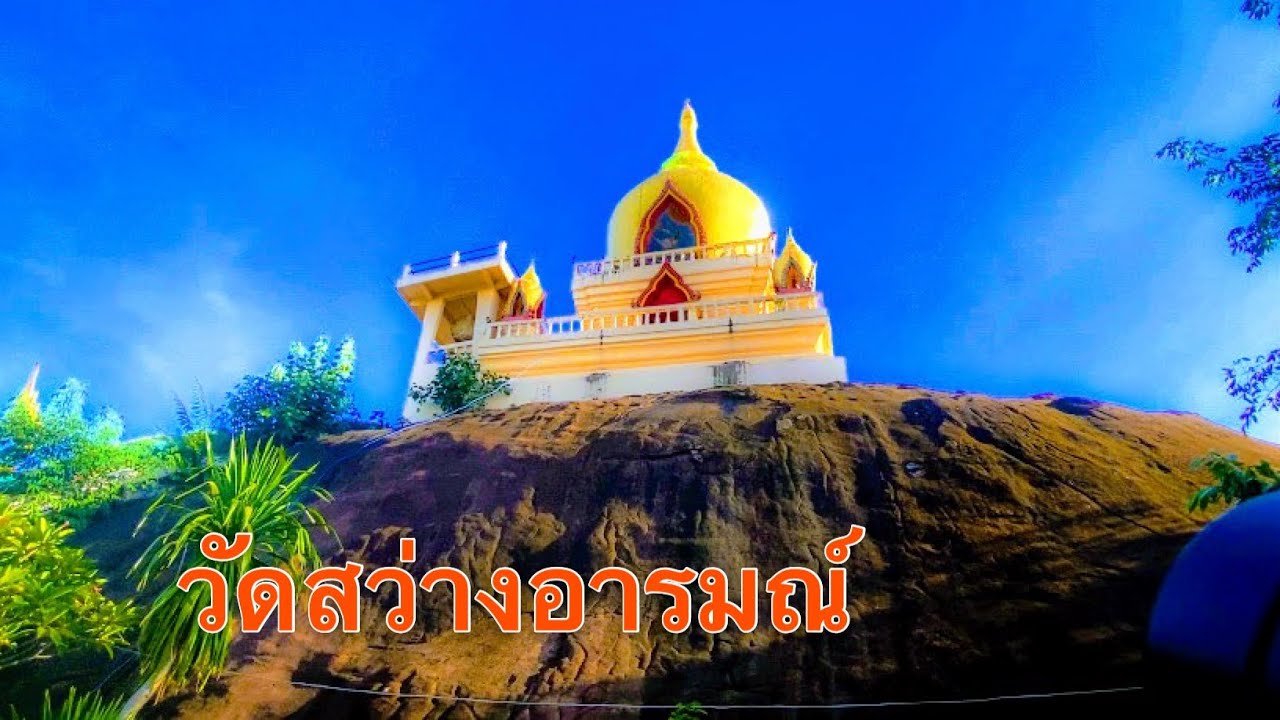
 Click to Access the Navigation Map GPS
Wat Sawang Arom (Wat Tham Si Thon) Map
Recommend

 Art, Culture and Heritage
 Landmarks and Memorials(1)
 Museums(1)
Temple(12)
Museums(1)
Temple(12)
 Other Sacred Sites(3)
 Suburban Living
 Local Market(1)
 Nature and Wildlife
 National Parks and Marine Reserves(1)
 Mountain (Doi)(3)
 Waterfalls(5)
 Caves(1)
 River, Canal(4)
 Bays and Beaches(1)
 Islands(1)
 Entertainment and Agricultural
 Waterpark(1)
 Shopping
 Shopping and Night Market(1)
 Travel Articles, Recipes
 Travel Review, Food Review(1)


