
lovethailand home >South Travel Attractions >Phatthalung Travel Attractions >Bang Kaeo >Na Pa Kho > Royal-Initiated Demonstration Farm
TL;DR: Royal-Initiated Demonstration Farm is located at Moo 1, Moo 8, and Moo 10, Ban Khrong Cheep, Na Pakho Subdistrict, Bang Kaeo District, Phatthalung Province, open Daily, hours 08.00 – 17.00.

Royal-Initiated Demonstration Farm
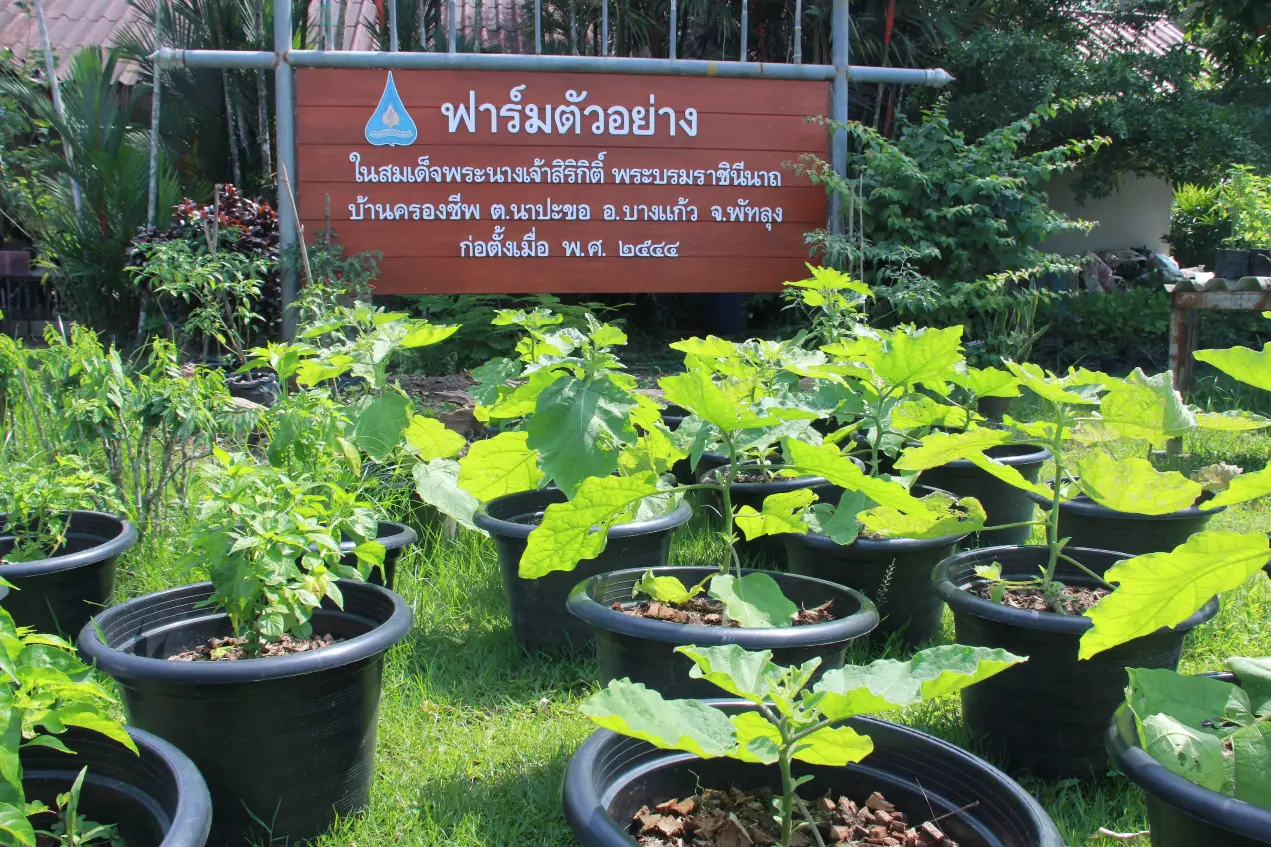
Open Days: Daily
Opening Hours: 08.00 – 17.00
The Royal-Initiated Demonstration Farm in Phatthalung, also known as Ban Khrong Cheep Demonstration Farm, is located in Moo 1, Moo 8, and Moo 10 of Ban Khrong Cheep, Na Pakho Subdistrict, Bang Kaeo District, Phatthalung Province. The project was established under the royal initiative of Her Majesty Queen Sirikit The Queen Mother to provide employment, food production, agricultural training, and practical learning opportunities for local villagers. It is not only an agricultural attraction, but also a living learning site where visitors can understand how royal-initiative development supports rural livelihoods through real work, food production, and community-based knowledge.
Ban Khrong Cheep is an agricultural community in Na Pakho Subdistrict, Bang Kaeo District, in the southern part of Phatthalung Province. The area is connected with rice fields, waterways, local farming, small-scale fishing, and communities around the Songkhla Lake basin. In the past, many villagers depended on seasonal farming, small-scale fishing, and daily labor. Income was uncertain because it depended on weather, harvests, water levels, and land conditions. The demonstration farm was created to give villagers employment, practical agricultural skills, and a model they could adapt to their own land and households.
The project grew from royal concern for villagers in Phatthalung after Her Majesty Queen Sirikit The Queen Mother learned of their poverty and lack of stable work. A suitable site was later selected at Thung Khrong Cheep public land in Na Pakho Subdistrict, Bang Kaeo District. Local people who had formerly occupied the land donated a total of 254 rai, 3 ngan, and 12 square wah for the project. This transformed the area into a public-benefit farm for agricultural learning, food production, and community livelihood development.
The key idea of the farm is practical learning. Villagers do not only receive classroom-style training; they learn by working inside the farm. They take part in growing vegetables, raising animals, producing organic fertilizer, cultivating mushrooms, managing fish ponds, growing fruit trees, and maintaining farm facilities. While working, they earn income and gain knowledge that can be applied at home. This makes the farm a practical school for rural livelihoods.
The main objectives of the project are to provide local employment, produce food, transfer knowledge through hands-on work, serve as a learning and study-visit site, and support essential infrastructure such as electricity for farm operations. These objectives make the project important not only for agriculture, but also for community economy, food security, education, and rural resilience.
The farm includes several learning zones. The vegetable area demonstrates the cultivation of local vegetables, climbing vegetables, kale, Chinese mustard, morning glory, radish, bok choy, sweet corn, watermelon, and Chinese cabbage. This area helps visitors understand the full cycle of vegetable production, from soil preparation and planting to care, harvesting, and practical use of limited space.
The organic fertilizer zone is important for reducing production costs and using local materials efficiently. The farm produces compost from materials such as palm fiber and coconut fiber, and also works with biological fertilizer and biological pest-control substances. Plants such as boraphet, neem, tobacco, Siam weed, citronella, and other useful species are used as part of a learning system for natural pest control and low-chemical farming.
The economic crop and seasonal crop areas show how farmers can manage risk by growing different kinds of crops across seasons. The farm has included field crops, aquatic crops, watermelon, bananas, pineapple, and other rotating crops. This helps local farmers see that relying on a single crop can be risky, while mixed production can create more stable income and food supply.
The livestock area includes native chickens, Muscovy ducks, laying ducks, native pigs, and goats. The source information also describes a chick nursery where lights are used to keep chicks warm, with grain spread on the floor. This area helps learners understand the care of young animals, temperature control, cleanliness, and basic livestock management for household or community-level farming.
Mushroom cultivation is one of the farm’s important learning activities because it does not require large land area and can generate continuing income. The farm has included a mushroom block preparation building, steaming equipment, a mushroom fruiting house, and straw mushroom cultivation. Mushroom production teaches learners how to prepare growing materials, maintain humidity, harvest products, and calculate production costs.
The fishery area demonstrates fish and aquatic animal production in canals, garden ditches, earthen ponds, and cages. Species mentioned in project records include red tilapia, black tilapia, Taiwanese tilapia, Chitralada tilapia, giant gourami, frogs, and marble goby in cages. This makes the farm a model of integrated food production that includes both vegetables and animal protein.
The fruit-tree area demonstrates longer-term planning. Fruit trees such as oranges, guava, aromatic coconut, santol, and mango varieties have been planted together with intercrops such as bananas, pumpkin, vetiver grass, and sugarcane. Water channels in the orchard are also used for aquatic plants and fish. This shows how land, water, and crops can be managed together for multiple benefits.
Ban Khrong Cheep Demonstration Farm is therefore a clear example of integrated agriculture. Visitors can see vegetable plots, organic fertilizer production, livestock, mushroom cultivation, fishery activities, fruit trees, multipurpose buildings, and supporting infrastructure within one learning landscape. The project shows that rural development requires many connected elements rather than one isolated activity.
In later years, the farm also supported activities connected with the New Theory agriculture approach and emergency employment during the COVID-19 period. Part of the farm area was used to create work, plant home-garden vegetables, cultivate mushrooms, grow Sangyod rice, and apply ideas related to the Khok Nong Na model. This shows that the farm continues to function as a flexible livelihood-support area for the community.
For travelers, the farm is suitable for those interested in sufficiency agriculture, integrated farming, community development, food security, and royal-initiative projects. It is especially useful for students, farmers, study groups, and visitors who want to understand Phatthalung through agriculture and livelihood development rather than only through temples, mountains, and wetlands.
The atmosphere of the farm is open, practical, and agricultural. Visitors should not expect a theme-park style attraction. The value of the place lies in real farming work, real production areas, and real learning. A visit here allows travelers to see how food, work, training, and community development are connected in one place.
Getting There is easiest by private car or rental car. From Phatthalung town, travel toward Bang Kaeo District, then continue to Na Pakho Subdistrict and Ban Khrong Cheep. The project is located within Moo 1, Moo 8, and Moo 10 of Ban Khrong Cheep. Travelers coming from the Mae Khari or Khao Chai Son area can also connect to Bang Kaeo and Na Pakho by local roads.
Visitors without a private vehicle should first travel to Phatthalung town, Khao Chai Son, Bang Kaeo, or Mae Khari, then arrange local transport to Ban Khrong Cheep. A private vehicle is recommended because nearby attractions are spread across Bang Kaeo and Khao Chai Son, including Wat Khian Bang Kaeo, Hat Khai Tao, Kaeng Hu Rae, Laem Chong Thanon, and Khao Chai Son Hot Spring.
The best time to visit is from morning to afternoon, when it is easier to walk around the farm zones. Groups planning a detailed study visit should coordinate in advance with the relevant local or provincial offices. This helps ensure that the visit matches the farm’s activities and does not interrupt normal work.
Visitors should behave respectfully because the farm is a working agricultural site. They should not enter crop plots, animal houses, fishery areas, or work zones without permission. They should not touch produce, tools, or animals without guidance, and should not feed animals by themselves. Photography should be done politely, especially when local workers are present.
The farm can be combined with several nearby places. Wat Khian Bang Kaeo is one of Phatthalung’s most important historic temples, with an ancient stupa and museum. Hat Khai Tao is a quiet lakeside area in Na Pakho Subdistrict. Kaeng Hu Rae is a clear-water stream area with local restaurants, while Khao Chai Son Hot Spring offers a natural hot-spring experience. Together, these places create a route that combines agriculture, royal-initiative learning, history, water scenery, and local food.
A good one-day itinerary can begin at Ban Khrong Cheep Demonstration Farm in the morning, continue to Wat Khian Bang Kaeo for local history, stop for lunch in Bang Kaeo or Kaeng Hu Rae, and end the afternoon at Hat Khai Tao or Khao Chai Son Hot Spring. This route gives visitors a more complete view of southern Phatthalung through farming, community, history, and nature.
The value of Ban Khrong Cheep Demonstration Farm lies in the transformation of public land and community participation into a practical learning and livelihood center. It shows that rural development can begin with listening to people’s real problems, creating work, producing food, and allowing villagers to learn through their own hands. Visiting the farm is therefore not only about seeing agricultural plots, but about understanding how knowledge, work, and food security can improve community life.
This farm helps explain another important side of Phatthalung. The province is not only known for Thale Noi, Khao Ok Thalu, and historic temples; it also has royal-initiative agricultural sites that function as open-air classrooms for villagers and visitors. Ban Khrong Cheep Demonstration Farm remains a meaningful place for understanding agriculture, employment, community resilience, and the long-term impact of royal-initiative development in southern Thailand.
| Name | Royal-Initiated Demonstration Farm, Phatthalung / Ban Khrong Cheep Demonstration Farm |
| Location | Moo 1, Moo 8, and Moo 10, Ban Khrong Cheep, Na Pakho Subdistrict, Bang Kaeo District, Phatthalung Province |
| Address | Ban Khrong Cheep, Na Pakho Subdistrict, Bang Kaeo District, Phatthalung Province, Thailand |
| Highlights | Royal-initiative project, integrated agriculture, vegetable plots, organic fertilizer, livestock, mushroom cultivation, fishery areas, fruit orchards, and hands-on agricultural learning. |
| History | Developed after royal guidance to find a suitable site for a demonstration farm to help Phatthalung villagers gain employment, food security, and practical agricultural knowledge. |
| Project Area | Approximately 254 rai, 3 ngan, and 12 square wah of land donated by local people for the public-benefit project. |
| Main Objectives | Employment, food production, hands-on agricultural training, study visits, and community self-reliance. |
| Distinctive Features | A practical integrated-farming model that connects food production, job creation, vocational training, and knowledge transfer for local villagers. |
| Travel Information | Best reached by private car or rental car from Phatthalung town toward Bang Kaeo District, then onward to Na Pakho Subdistrict and Ban Khrong Cheep. |
| Current Status | Open as a demonstration farm, agricultural learning site, and royal-initiative project area in Phatthalung Province. |
| Open Days | Daily |
| Opening Hours | 08.00 – 17.00 |
| Facilities / Activity Areas | Multipurpose building, toilets, storage building, demonstration plots, mushroom houses, livestock houses, fishery areas, and study-visit zones. |
| Main Areas / Zones | Vegetable plots, organic fertilizer area, economic crop plots, livestock area, seasonal crop plots, mushroom cultivation area, multipurpose building, fishery area, fruit orchards, and farm-support systems. |
| Related Agencies | Royal-initiative project agencies, Bureau of the Royal Household / Royal Secretariat, Phatthalung Agricultural Research and Development Center, Fourth Army Region, and Phatthalung provincial government agencies. |
| Provincial Coordination Contact | Phatthalung Provincial Agriculture and Cooperatives Office, Tel. 0-7461-4203 |
| Key Activities | Vegetable production, mushroom cultivation, organic fertilizer production, livestock raising, fishery activities, fruit-tree cultivation, Sangyod rice farming, technology transfer, vocational training, employment, and study visits. |
| Nearby Tourist Attractions | 1. Hat Khai Tao, Na Pakho Subdistrict, about 10 km 2. Wat Khian Bang Kaeo, about 14 km 3. Kaeng Hu Rae, about 18 km 4. Laem Chong Thanon, about 20 km 5. Khao Chai Son Hot Spring, about 22 km |
| Nearby Restaurants | 1. Krua Je Nut Bang Kaeo, about 9 km, Tel. 093-619-8419 2. Ded Bai Cha, Hat Khai Tao Branch, about 10 km, Tel. 083-704-8992 3. Kuai Tiao Hang Mu Branch 3 Mae Khari, about 18 km, Tel. 085-670-0286 4. Ton Nam Cafe, Kaeng Hu Rae, about 18 km, Tel. 085-587-9195 5. Than Thip Kaeng Hu Rae, about 18 km, Tel. 086-350-8228 |
| Nearby Accommodations | 1. Thiwthat Resort, about 16 km 2. Ozone Resort & Pool Villa, about 20 km 3. Sanfhan Resort Phatthalung, about 21 km, Tel. 085-914-5662 4. Wang Chan Resort, about 24 km, Tel. 086-295-2176 5. Rimlay Park Resort, about 32 km, Tel. 061-381-2564, 093-719-5686 |
Frequently Asked Questions (FAQ)
Q: Where is the Royal-Initiated Demonstration Farm in Phatthalung located?
A: It is located in Moo 1, Moo 8, and Moo 10 of Ban Khrong Cheep, Na Pakho Subdistrict, Bang Kaeo District, Phatthalung Province.
Q: Why is Ban Khrong Cheep Demonstration Farm important?
A: It is a royal-initiative project created to provide employment, food production, vocational training, and hands-on agricultural knowledge for local villagers.
Q: What can visitors learn at the farm?
A: Visitors can learn about vegetable growing, organic fertilizer, economic crops, livestock, mushroom cultivation, fishery activities, fruit orchards, and integrated farming systems.
Q: What are the opening days and hours?
A: The farm is open daily from 08.00 to 17.00.
Q: Who is the farm suitable for?
A: It is suitable for farmers, students, study groups, families, and travelers interested in sufficiency agriculture, integrated farming, rural development, and royal-initiative projects.
Q: Should groups coordinate before visiting?
A: Yes. Groups or visitors planning a detailed study visit should coordinate in advance with related local or provincial agencies so the visit matches the farm’s activities.
Q: What nearby places can visitors combine with the farm?
A: Nearby places include Hat Khai Tao, Wat Khian Bang Kaeo, Kaeng Hu Rae, Laem Chong Thanon, and Khao Chai Son Hot Spring.
 Category: ●Research and Development
 Group: ●Royal Project
Last Update : 1 MonthAgo
 Last Update : 1 MonthAgo
 Click to Access the Navigation Map GPS
Royal-Initiated Demonstration Farm Map
Recommend

 Art, Culture and Heritage
 Historical Sites and Monuments(1)
 Landmarks and Memorials(1)
 Art, Craft Centres, Tradition(6)
 Historic Homes and Cities(1)
 Educational Places
 Educational Gardens, Farm(1)
 Places of Worship
 Temple(25)
 Other Sacred Sites(3)
Royal Project(2)
Other Sacred Sites(3)
Royal Project(2)
 Suburban Living
 Village, Community(3)
 Nature and Wildlife
 National Parks and Marine Reserves(3)
 Mountain (Doi)(4)
 Dam, Reservoir, Lake(7)
 Waterfalls(16)
 Hot Springs(2)
 Caves(12)
 River, Canal(5)
 Bays and Beaches(6)
 Islands(2)
 Other natural attractions(4)
 Entertainment and Agricultural
 Farms, Parks and Ecotourism(4)
 Travel Articles, Recipes
 Travel Review, Food Review(1)


