
lovethailand home >South Travel Attractions >Pattani Travel Attractions >Pa Na Re >Ban Klang > Maruat Beach
TL;DR: Maruat Beach is located at Ban Klang Subdistrict, Panare District, Pattani Province, open Daily, hours 24 Hours. Highlights include Large Mountain-Like Rock Formations, Viewpoint Walking Path, Sandy Beach, Rocky Beach, Headland, And Panare Coastal Scenery.

Maruat Beach
Open Days: Daily
Opening Hours: 24 Hours
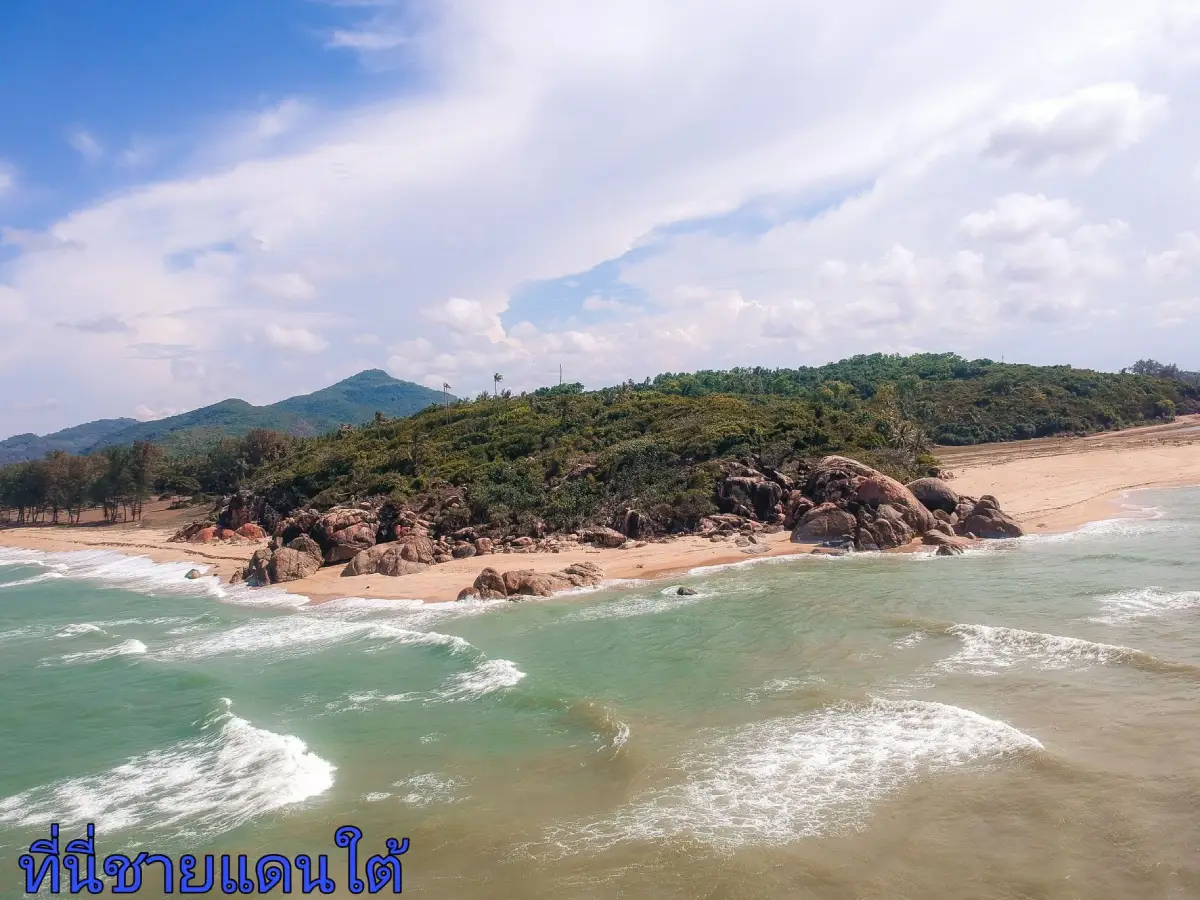
Maruat Beach, also found in some sources as Bang Maruat Beach, is a distinctive coastal attraction in Ban Klang Subdistrict, Panare District, Pattani Province. It is located about 2 km beyond Chalalai Beach and can be reached by following the same route to Chalalai, continuing to the junction from the Panare–Sai Buri road, and turning left toward the beach. The most memorable feature of Maruat Beach is its unusual cluster of small mountain-like rocks stacked along the coast, extending toward the sea, with a walking path that allows visitors to climb up for wider coastal views.
Maruat Beach has a stronger landscape identity than many ordinary beaches. It is not only a strip of sand beside the sea; it combines sandy beach, rocky beach, headland, large rock formations, shoreline vegetation, and a curving coastal view. From the lower beach, visitors can see the layered rocks rising like a small coastal hill. From the top of the rock path, the view opens toward the sea, the curve of the shoreline, and the surrounding coast of Panare District. This makes Maruat Beach especially suitable for sightseeing, photography, and coastal landscape appreciation.
The beach is part of a continuous coastal route in Panare District, where several beaches can be visited in one trip. Chalalai Beach is known for pine shade and a large pond near the beach. Maruat Beach stands out for its rock formations and viewpoint path. Nearby Ratcharak Beach and Khae Khae Beach offer wider sandy areas, low hills, and impressive rock scenery. This makes Panare a strong coastal route for visitors who want to see several different beach characters within a short distance.
From a coastal-geomorphology perspective, Maruat Beach lies within the Laem Pho–Bang Maruat beach system. According to marine and coastal authorities, the Bang Maruat area includes about 630 meters of sandy beach and about 170 meters of rocky beach. Its coastal form resembles a pocket beach, with one side formed by rock or headland and the other influenced by a jetty structure. This physical character makes the beach valuable not only for recreation but also for understanding how natural rock headlands, sand movement, and coastal structures shape the shoreline.
Recent coastal survey information available from the Department of Marine and Coastal Resources states that no coastal erosion problem was found at Bang Maruat Beach during the survey. The area also showed significant sand accumulation, forming a sand-spit-like feature. This supports the current use of the area as a beach tourism and recreation site while also showing that the beach is part of a dynamic coastal system that should be used with care.
The beauty of Maruat Beach comes in layers. From the beach level, visitors see sand, rock, sea, and greenery. From the rock path and higher points, visitors can see a broader coastal view, including the shoreline curve and the sea stretching outward. The walking path over the rock area is a major attraction, but it should be used carefully. Natural rock surfaces can be uneven, hot, or slippery after rain or wave spray. Visitors should avoid climbing during heavy rain, strong wind, or rough sea conditions.
The best times to visit are morning and late afternoon. Morning light is suitable for sea views, rock detail, and cooler walking conditions. Late afternoon offers a softer atmosphere and better light for photography. Visitors planning to walk on the rocks should avoid the hottest part of the day and should not climb after rain. Choosing the right time makes the visit safer and more enjoyable.
Maruat Beach is ideal for travelers who enjoy coastal scenery rather than heavy beach activities. Recommended activities include walking along the beach, taking photos of the rock formations, viewing the coastline from safe points, resting by the sea, and linking the visit with nearby beaches. The beach is best appreciated slowly, by observing the relationship between the rocks, sand, sea, headland, and coastal structures.
Compared with Panare Beach, which is more strongly known as a fishing-village beach with kolek boats and fishing boats, Maruat Beach is more of a coastal-view and geomorphology beach. Visitors should not expect the same fishing-village atmosphere as Panare Beach. Instead, the main experience here is the dramatic rock formation, open coastal view, and natural beach setting. This contrast is one of the strengths of Panare District because each beach offers a different story.
The wider Panare area is deeply connected with the sea and traditional fishing. The name Panare itself comes from local Malay words associated with a beach and drying fishing nets. Even though Maruat Beach is best known for rocks and scenery, it remains part of a district shaped by coastal livelihoods, fishing knowledge, and community use of the sea. Understanding this context helps visitors see the beach not only as scenery but also as part of a living coastal culture.
Visitors should protect the natural setting by keeping the beach clean, avoiding graffiti or markings on rocks, not damaging coastal plants, and not disturbing nearby communities. If local residents are using the area for daily work or fishing-related activities, visitors should give them space. Photography should be done respectfully, especially if people, homes, or working areas are nearby.
Maruat Beach can be visited by families, but activities should match safety conditions. Children and elderly visitors may enjoy the lower beach and easier walking areas, while the rock viewpoint path should be considered carefully. Adults should not allow children to run on rocks or approach cliff-like edges. Natural rock surfaces are uneven and may become slippery, so footwear with good grip is recommended.
For photographers, Maruat Beach offers strong visual subjects: stacked rocks, the path leading up to the viewpoint, sandy beach below, wide sea views, shoreline vegetation, and the contrast between rock and water. Morning light highlights rock texture, while late afternoon light creates a warmer and calmer scene. Safety should always come before photography; visitors should not stand near dangerous edges or waves just to get a better angle.
Suitable activities include beach walking, viewpoint photography, resting by the sea, learning about coastal forms, and combining the beach with nearby attractions. Swimming should depend on actual wave, tide, and safety conditions on the day. Because the beach includes both sandy and rocky sections, visitors should be more careful than they would be on a flat swimming beach.
Maruat Beach works well as a central point in a Panare coastal route. Visitors can begin at Chalalai Beach to enjoy pine shade and a pond near the beach, continue to Maruat Beach for rock formations and views, then proceed to Ratcharak Beach, which is about 1 km beyond Maruat, and Khae Khae Beach, about 2 km beyond Ratcharak. This route gives travelers a compact but varied experience of Panare’s coastline.
Ratcharak Beach offers a broad sandy beach, unusual rocks, and a low-hill viewpoint. Khae Khae Beach is known for large granite rocks and a visually different shoreline. When combined with Maruat Beach, these places create a strong coastal-photography route for travelers who want different beach landscapes in one trip.
Panare Beach and Palas Market also help complete the itinerary. Panare Beach shows the fishing-village identity of the district, including kolek boats and working fishing boats, while Palas Market offers local food, daily-life scenes, and Thai Muslim community atmosphere. A full-day route can combine market life, fishing culture, rock scenery, and sunset views along the Panare coast.
Food options in Panare District include halal restaurants, local eateries, cafés, and seafood or beach-route restaurants depending on operating hours. Smaller local businesses may have variable opening times, so visitors should check ahead when planning meals. Those who want more choices can continue toward Palas or Pattani city after visiting the beach.
Accommodation options are available in Panare District, nearby coastal areas, and Pattani city. Travelers who want to stay near the sea can choose local beach accommodation, while those who prefer more urban convenience may stay in Pattani city and visit Maruat Beach as a day trip. Because the beach is linked with several nearby attractions, it works well for both short and longer coastal itineraries.
Visitors should be careful with natural rock surfaces and changing coastal conditions. Rocks may be uneven, wet, slippery, or exposed to strong sunlight. During monsoon periods, heavy rain, or strong waves, visitors should stay in safer lower areas and avoid climbing the rocks. Footwear with good grip is recommended for anyone walking on the viewpoint path.
The best season to visit is during clear weather when winds and waves are not strong. The lower Gulf coast changes with monsoon conditions, so checking the weather before traveling is important. If conditions are rough, it is better to enjoy the beach from safe areas and avoid the waterline, cliff-like edges, and wet rock surfaces.
Getting There to Maruat Beach: follow the same route used for Chalalai Beach, then continue to the junction from the Panare–Sai Buri road and turn left toward the beach. From Pattani city, travel by the Pattani–Narathiwat road toward Panare District, then continue along the coastal route. Private cars and motorcycles are the most convenient options because visitors can continue to Chalalai Beach, Ratcharak Beach, Khae Khae Beach, Panare Beach, and Palas Market in one trip. Public-transport users should reach Panare town first and then use local hired transport.
In summary, Maruat Beach is one of the most distinctive coastal attractions in Panare District, Pattani Province. Its main highlights are the unusual stacked rock formations, the walking path to a coastal viewpoint, the combination of sandy and rocky beach, and its status as a public beach recreation area. It is best for sightseeing, photography, coastal walking, and route planning with Chalalai Beach, Ratcharak Beach, Khae Khae Beach, Panare Beach, and Palas Market. With careful walking, respect for nature, and good timing, Maruat Beach offers one of the most visually memorable seaside experiences in Panare.
| Name | Maruat Beach / Bang Maruat Beach |
| Location | Ban Klang Subdistrict, Panare District, Pattani Province |
| Address | Coastal Area Of Ban Klang Subdistrict, Panare District, Pattani Province 94130 |
| Highlights | Large Mountain-Like Rock Formations, Viewpoint Walking Path, Sandy Beach, Rocky Beach, Headland, And Panare Coastal Scenery |
| History | A Beach In The Laem Pho–Bang Maruat Coastal System, With A Pocket-Beach-Like Form Created By Rock Headland And Jetty-Influenced Shoreline Conditions |
| Name Origin Of The Area | The Name Maruat Is Associated With Ban Bang Maruat And The Coastal Landscape Of Ban Klang Subdistrict In Panare District |
| Distinctive Features | About 630 Meters Of Sandy Beach And About 170 Meters Of Rocky Beach, With Large Rock Formations As The Main Visual Landmark |
| Travel Information | Follow The Same Route To Chalalai Beach, Continue To The Junction From The Panare–Sai Buri Road, Then Turn Left Toward The Beach |
| Current Status | Open As A Public Beach Tourism And Recreation Area For Residents And Visitors In Panare District |
| Open Days | Daily |
| Opening Hours | 24 Hours |
| Facilities | Public Beach Area, Rock Viewpoint Walk, Seaside Rest Area, And Road Connections To Nearby Beaches In Panare District |
| Main Areas / Zones | Sandy Beach, Rocky Beach, Large Rock Formations, Viewpoint Path, Headland, And Sand-Spit-Like Coastal Area |
| Caretaker | Ban Klang Subdistrict Administrative Organization And Local Authorities In Panare District |
| Main Contact Number | 073-499-376 |
| Nearby Tourist Attractions | 1. Chalalai Beach, About 2 Km 2. Ratcharak Beach, About 1 Km 3. Khae Khae Beach, About 3 Km 4. Panare Beach, About 5 Km 5. Palas Market, About 10 Km 6. Yaring Palace, About 25 Km 7. Krue Se Mosque, About 30 Km |
| Nearby Restaurants | 1. Pantai Restaurant, Panare Beach, About 5 Km, Tel. 098-740-7161 2. HIGHER GROUND Panare, About 6 Km, Tel. 093-597-5652 3. OWL CHA PTT Palas 1 Branch, About 10 Km, Tel. 089-869-1771 4. Black House Restaurant Palas, About 11 Km, Tel. 080-934-3055, 089-463-6935 5. The Tree Cafe In Panare, About 15 Km, Tel. 081-478-9341 |
| Nearby Accommodations | 1. Chaolay Resort Panare, About 5 Km, Tel. 090-421-9961 2. Takadum Beach Resort, About 12 Km, Tel. 093-579-6084, 098-707-1223 3. Forest Beach Resort, About 20 Km, Tel. 084-966-2043, 090-281-9455 4. Southern View Hotel Pattani, About 31 Km, Tel. 073-450570-72 5. C.S. Pattani Hotel, About 33 Km, Tel. 073-335093 6. The Rooms Residence, About 34 Km, Tel. 088-4478407 |
Frequently Asked Questions (FAQ)
Q: Where Is Maruat Beach Located?
A: Maruat Beach, also known as Bang Maruat Beach, is located in Ban Klang Subdistrict, Panare District, Pattani Province, about 2 km beyond Chalalai Beach.
Q: What Is Special About Maruat Beach?
A: The beach is known for large mountain-like rock formations, a walking path up to a coastal viewpoint, and a landscape that combines sandy and rocky beach sections.
Q: What Are The Opening Hours Of Maruat Beach?
A: Maruat Beach is a public beach area open daily, 24 hours. Morning and late afternoon are the best times for visiting and photography.
Q: Is There An Entrance Fee For Maruat Beach?
A: There is no confirmed information about an entrance fee. Visitors should prepare for transport, food, and personal expenses.
Q: Is Maruat Beach Suitable For Swimming?
A: Maruat Beach is best for sightseeing, walking, photography, and resting. Visitors who want to enter the water should check wave and weather conditions and use only safe areas.
Q: How Do I Get To Maruat Beach?
A: Follow the same route to Chalalai Beach, continue to the junction from the Panare–Sai Buri road, then turn left toward the beach.
Q: What Nearby Places Can I Visit With Maruat Beach?
A: Nearby places include Chalalai Beach, Ratcharak Beach, Khae Khae Beach, Panare Beach, Palas Market, Yaring Palace, and Krue Se Mosque.
Q: What Should Visitors Be Careful About On The Rocks At Maruat Beach?
A: Visitors should wear shoes with good grip, avoid climbing during rain or strong waves, stay away from risky edges, and supervise children closely on the rock path.
 Category: ●Nature and Wildlife
 Group: ●Bays and Beaches
Last Update : 3 MonthAgo
 Last Update : 3 MonthAgo
 Click to Access the Navigation Map GPS

 Art, Culture and Heritage
 Historical Sites and Monuments(3)
 Landmarks and Memorials(7)
 Royal Palace(2)
 Art, Craft Centres, Tradition(7)
 Historic Homes and Cities(1)
 Educational Places
 Museum for Study(1)
 Training Center(1)
 University
 Public university(1)
 Private University(1)
 Places of Worship
 Temple(13)
 Mosque(5)
 Other Sacred Sites(4)
 Research and Development
 Royal Project(2)
 Suburban Living
 Village, Community(5)
 Local Market(2)
 National Parks and Marine Reserves(2)
 Mountain (Doi)(3)
 Waterfalls(3)
 River, Canal(2)
Bays and Beaches(13)
 Islands(2)
 Other natural attractions(1)
 Entertainment and Agricultural
 Farms, Parks and Ecotourism(1)
 Travel Articles, Recipes
 Travel Review, Food Review(1)
 Southern Food Menu, Southern Food Recipes(3)


