
lovethailand home >South Travel Attractions >Pattani Travel Attractions >Muang Pattani >Tan Yong Lu Lo > Krue Se Mosque
TL;DR: Krue Se Mosque is located at Ban Krue Se, Tanyong Lulo Subdistrict, Mueang Pattani District, Pattani Province 94000, open Daily, hours 08.00 – 17.00.
Krue Se Mosque
Open Days: Daily
Opening Hours: 08.00 – 17.00
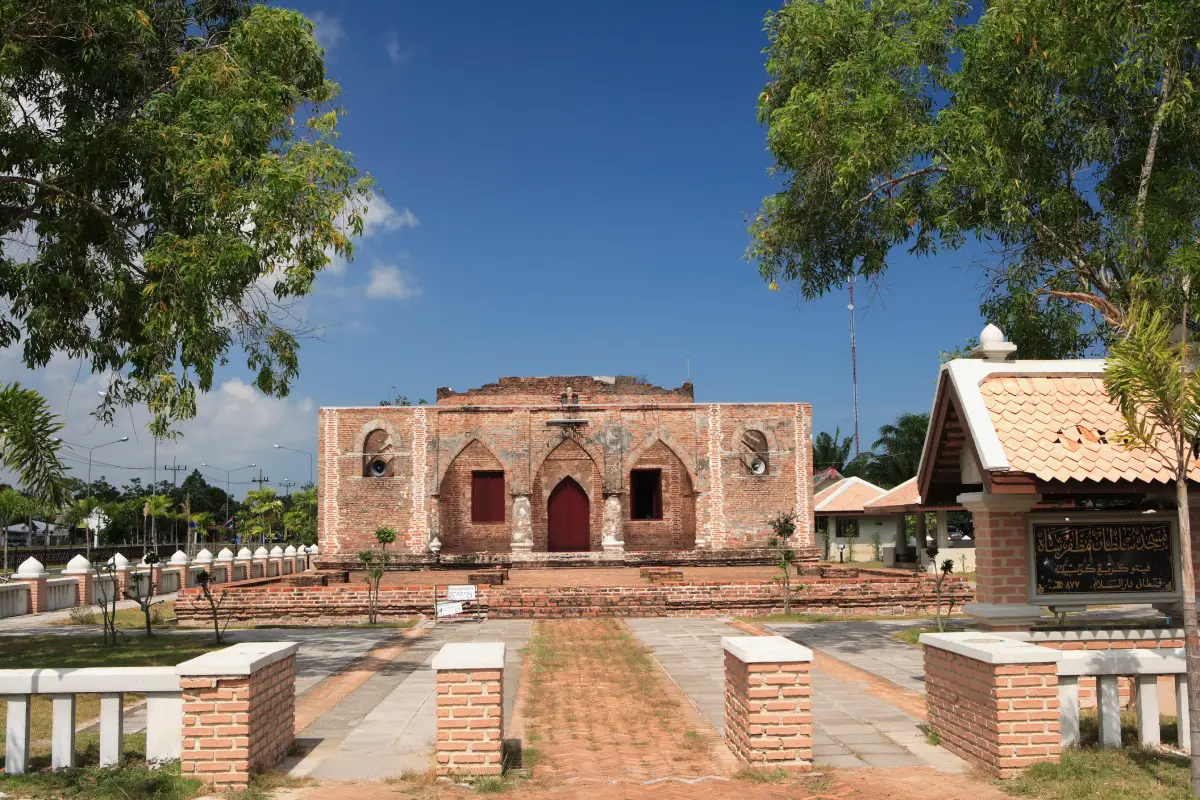
Krue Se Mosque is one of Pattani Province’s most important Islamic heritage sites and historical landmarks. Located in Ban Krue Se, Tanyong Lulo Subdistrict, Mueang Pattani District, beside Highway 42 on the Pattani–Narathiwat route, the mosque stands about 7 km from Pattani city center. Its most recognizable features are the massive red-brick walls, round pillars, pointed arches, and an unfinished roof and dome that have become part of the mosque’s identity. For travelers, Krue Se Mosque is not only a photogenic historic site but also a living religious space that reflects the deep Islamic, Malay, Chinese, and local cultural layers of Pattani.
Krue Se Mosque is still used as a place of worship by the local Muslim community, so visitors should understand it as both an ancient monument and an active religious site. The atmosphere is calm, dignified, and historically rich. The mosque’s red-brick structure stands on an open brick courtyard, giving visitors a clear view of the thick walls, arches, interior pillars, and the unfinished upper structure. This unfinished form is one of the reasons the mosque remains so memorable. Rather than appearing incomplete in a negative way, it gives the site a strong sense of time, memory, and endurance.
The mosque is located in the old community of Ban Krue Se, an area closely connected with the earlier historical landscape of Pattani. In the past, this zone formed part of a wider cultural and trading environment linked to Pattani Bay, the old town, maritime routes, Islamic scholarship, and local settlement. Today, the site is easy to reach from the city by road, yet it still retains a quieter atmosphere than central Pattani. Visitors arriving at the mosque will first notice the open courtyard, the low horizontal mass of the brick building, and the strong rhythm created by the repeated arches along the façade.
The name “Krue Se Mosque” comes from Ban Krue Se, the village where the mosque is located. Another traditional name is “Pitu Krue Ban Mosque,” a name associated with the mosque’s arched doorways. In local usage, “pitu” refers to a door, while “krue ban” refers to an arched opening. This name points directly to one of the mosque’s most distinctive architectural features: the pointed and rounded arches seen in its doors and windows. These arches show a blend of Middle Eastern, Persian, and European Gothic-inspired forms adapted into the cultural setting of old Pattani.
Architecturally, Krue Se Mosque is a brick-and-mortar structure measuring approximately 15.10 meters wide, 29.60 meters long, and 6.50 meters high. The building has thick brick walls, round pillars, pointed arches, rounded openings, and a roof structure that was never fully completed. The visible brickwork gives the mosque a raw and powerful character. Visitors can study the mosque almost like an architectural document: the thickness of the walls, the rhythm of the pillars, the shape of the arches, and the open roofline all help explain how ambitious the original structure was intended to be.
The mosque is associated with the history of the old Patani kingdom and the Ayutthaya period. Local historical narratives connect the site with the 22nd–23rd Buddhist centuries, while some accounts link it with the era of King Naresuan between 1578 and 1593. Other traditions connect the mosque with Patani sultans and later political changes in the old city. Because of these layered traditions, Krue Se Mosque should be understood through several lenses: architecture, local chronicles, oral history, community memory, and religious continuity. What remains consistent across these layers is the mosque’s status as one of Pattani’s most important Islamic heritage landmarks.
One of the best-known stories connected with Krue Se Mosque is the legend of Lim To Khiam and Chao Mae Lim Ko Niao. According to local tradition, Lim Ko Niao traveled from China to bring her elder brother home. Her brother had settled in Pattani, embraced Islam, married locally, and became associated with the building of Krue Se Mosque. When she could not persuade him to return, she died in grief and later became an important figure in the memory of Pattani’s Chinese community. Her tomb is located near Krue Se Mosque, and her main shrine, Leng Chu Kiang Shrine, is located in Pattani’s old town. This connection makes the Krue Se area an important place for understanding Pattani’s multi-faith and multicultural history.
The area around the mosque is therefore more than a single religious monument. It brings together an old mosque, a Chinese-related legend, a nearby tomb, and the memory of communities that have lived side by side for generations. This is one of the reasons Krue Se Mosque is so meaningful for cultural travelers. It allows visitors to see how Islam, Chinese belief, local Pattani identity, and older urban history overlap in one small area. The site is a powerful reminder that Pattani’s history cannot be reduced to one cultural stream; it is the result of many communities, languages, beliefs, and trade routes meeting over time.
Krue Se Mosque was registered as a historical monument by the Fine Arts Department in 1935. It later underwent restoration work in 1957, 1982, and 2004 to help preserve the structure and maintain its role as an important historical and religious site. Visitors should treat the building with care. Do not climb on the brick walls, touch fragile surfaces unnecessarily, or enter restricted areas without permission. The mosque is a heritage site that has survived for centuries, and responsible visitor behavior helps protect it for future generations.
The best time to visit is usually in the morning or late afternoon, when the light brings out the warm tones of the brickwork and the weather is more comfortable. The open courtyard can be hot around midday, so travelers should bring water and sun protection. Photography is best done from the courtyard and the exterior areas. If you wish to photograph inside the mosque, ask permission or avoid doing so during prayer times. This is especially important on Fridays around midday, when the mosque may be used more intensively for religious activities.
Visitors should dress modestly. Men should wear long trousers or other respectful clothing. Women should wear tops with sleeves and long skirts or loose-fitting trousers. Clothing that is too revealing should be avoided. Keep your voice low, do not disturb worshippers, and do not walk in front of people who are praying. These simple practices make the visit respectful and comfortable for both travelers and the local community.
Getting There is straightforward from Pattani city center. Take Highway 42 toward Narathiwat and head to Ban Krue Se in Tanyong Lulo Subdistrict. The mosque is about 7 km from the city center and can be reached by private car, hired vehicle, or local transport along the Pattani–Narathiwat route. If using public or local transport, tell the driver you want to stop at Krue Se Mosque. Travelers planning to continue to coastal areas or nearby districts should check transport availability in advance.
A good half-day cultural route can begin at Krue Se Mosque and the nearby tomb of Chao Mae Lim Ko Niao, then continue into Pattani city to visit Leng Chu Kiang Shrine, the old Chinese quarter, and Pattani Central Mosque. This route helps travelers understand the contrast between an ancient red-brick Islamic site and later urban religious landmarks. With more time, visitors can also add Somdet Phra Srinagarindra Park or continue toward the coast, including Talo Kapo Beach in Yaring District.
The mosque is also a useful starting point for learning about Pattani beyond standard sightseeing. Its walls reflect Islamic history, its unfinished roof raises questions about local legends and political change, and its surroundings connect the traveler with Chinese Pattani memory through the story of Lim Ko Niao. In this sense, Krue Se Mosque is not a place to visit quickly and leave. It rewards slower observation. Notice the brickwork, the arches, the courtyard, the direction of the prayer space, and the relationship between the mosque and the surrounding community.
For travelers staying overnight, Pattani city center is the most convenient base. Accommodation, restaurants, and transport options are more concentrated in town, while Krue Se Mosque is only a short drive away. Around the mosque, there are local cafés, halal eateries, and small community businesses, but travelers looking for more dining choices may prefer to eat in the city around Charoen Pradit Road, Nong Chik Road, or areas near Prince of Songkla University Pattani Campus.
Krue Se Mosque remains one of the most important places to visit in Pattani because it brings together history, architecture, religion, local legend, and cultural coexistence in one site. The building’s unfinished form is part of its power. It invites visitors to ask what happened, who built it, why it was left incomplete, and how it continued to matter to the people of Pattani. For anyone interested in Thailand’s deep south, Islamic heritage, or multicultural history, Krue Se Mosque is an essential stop.
| Name | Krue Se Mosque |
| Location | Ban Krue Se, Tanyong Lulo Subdistrict, Mueang Pattani District, Pattani Province 94000 |
| Address | Beside Highway 42 on the Pattani–Narathiwat route, Ban Krue Se, Tanyong Lulo Subdistrict, Mueang Pattani District |
| Coordinates | 6.873157, 101.303172 |
| Highlights | Ancient red-brick mosque with round pillars, pointed arches, and an unfinished roof and dome |
| History | Connected with the history of the old Patani kingdom and the Ayutthaya period, with historical layers linked to the 22nd–23rd Buddhist centuries and local narratives from the era of King Naresuan |
| Name Origin | Named after Ban Krue Se, the village where the mosque is located; another name, Pitu Krue Ban Mosque, refers to its arched doorways |
| Distinctive Features | Brick-and-mortar structure approximately 15.10 meters wide, 29.60 meters long, and 6.50 meters high, with round pillars and pointed and rounded arches |
| Travel Information | From Pattani city center, take Highway 42 toward Narathiwat for about 7 km. The mosque can be reached by private car, hired vehicle, or local transport along the Pattani–Narathiwat route |
| Current Status | Open to visitors and still used as a place of worship by the local Muslim community |
| Open Days | Daily |
| Opening Hours | 08.00 – 17.00 |
| Facilities | Mosque courtyard, nearby parking area, and local food and drink shops in the surrounding community |
| Main Areas / Zones | Ancient brick mosque building, front brick courtyard, prayer area, architectural viewing area, and the nearby tomb of Chao Mae Lim Ko Niao |
| Main Contact Number | 073-413402, 087-2878780 |
| Nearby Tourist Attractions | 1. Tomb of Chao Mae Lim Ko Niao, about 0.1 km 2. Ban Krue Se Community, about 0.5 km 3. Leng Chu Kiang Shrine, about 7 km 4. Kue Da Chino Old Town Area, about 7 km 5. Pattani Central Mosque, about 7 km 6. Somdet Phra Srinagarindra Park Pattani, about 8 km 7. Talo Kapo Beach, about 17 km |
| Nearby Restaurants | 1. Hometown Pattani, about 0.1 km, Tel. 081-325-3833 2. Black Cafe Krue Se Branch, about 0.5 km, Tel. 089-659-8270, 086-310-6692 3. De Krue Se Boat Noodles, about 1 km, Tel. 064-939-0244 4. Krua Kaksu Halal Restaurant, about 7 km, Tel. 082-822-0943, 086-963-1228 5. Phetra Halal Boat Noodles Pattani, about 7 km, Tel. 082-832-4044 6. Krua Kalah Pattani, about 7 km, Tel. 063-473-0687 |
| Nearby Accommodations | 1. River Hotel Pattani, about 6 km, Tel. 073-333-333 2. Pattani Pirom Boutique Hotel, about 6 km, Tel. 081-698-3877 3. The Rooms Residence, about 6 km, Tel. 073-335-999 4. The Wood Pattani Hotel, about 7 km, Tel. 091-479-0666 5. C.S. Pattani Hotel, about 8 km, Tel. 073-335-093 6. Southern View Hotel Pattani, about 10 km, Tel. 073-450-570 |
Frequently Asked Questions (FAQ)
Q: Where is Krue Se Mosque located?
A: Krue Se Mosque is located in Ban Krue Se, Tanyong Lulo Subdistrict, Mueang Pattani District, Pattani Province, beside Highway 42 on the Pattani–Narathiwat route.
Q: What are the opening hours of Krue Se Mosque?
A: Krue Se Mosque is open daily from 08.00 to 17.00. Visitors should avoid disturbing worshippers during prayer times.
Q: Why is Krue Se Mosque important?
A: It is an important Islamic religious site and historical monument of Pattani, reflecting the history of the old Patani kingdom, ancient brick architecture, and the province’s multicultural heritage.
Q: What makes Krue Se Mosque architecturally distinctive?
A: The mosque is known for its red-brick structure, round pillars, pointed and rounded arches, and the unfinished roof and dome that have become its signature visual identity.
Q: How is Krue Se Mosque connected with Chao Mae Lim Ko Niao?
A: The tomb of Chao Mae Lim Ko Niao is located near the mosque, and local legends connect Lim To Khiam, Lim Ko Niao, and the construction of Krue Se Mosque.
Q: What should visitors wear when visiting Krue Se Mosque?
A: Visitors should dress modestly. Men should wear long trousers, and women should wear sleeved tops with long skirts or loose-fitting trousers. Quiet and respectful behavior is expected.
Q: What attractions can be visited together with Krue Se Mosque?
A: Nearby and related places include the tomb of Chao Mae Lim Ko Niao, Leng Chu Kiang Shrine, Kue Da Chino Old Town, Pattani Central Mosque, and Somdet Phra Srinagarindra Park Pattani.
Q: Can travelers reach Krue Se Mosque by public transport?
A: Yes. Travelers can use local transport, shared vehicles, or hired vehicles from Pattani city center along the Pattani–Narathiwat route and ask to stop at Krue Se Mosque.
 Category: ●Places of Worship
 Group: ●Mosque
Last Update : 3 WeekAgo
 Last Update : 3 WeekAgo
 Click to Access the Navigation Map GPS
 Art, Culture and Heritage
 Historical Sites and Monuments(3)
 Landmarks and Memorials(7)
 Royal Palace(2)
 Art, Craft Centres, Tradition(7)
 Historic Homes and Cities(1)
 Educational Places
 Museum for Study(1)
 Training Center(1)
 Temple(13)
Mosque(5)
Temple(13)
Mosque(5)
 Other Sacred Sites(4)
 Research and Development
 Royal Project(2)
 Suburban Living
 Village, Community(5)
 Local Market(2)
 Nature and Wildlife
 National Parks and Marine Reserves(2)
 Mountain (Doi)(3)
 Waterfalls(3)
 River, Canal(2)
 Bays and Beaches(13)
 Islands(2)
 Other natural attractions(1)
 Entertainment and Agricultural
 Farms, Parks and Ecotourism(1)
 Travel Articles, Recipes
 Travel Review, Food Review(1)
 Southern Food Menu, Southern Food Recipes(3)


