
lovethailand home >South Travel Attractions >Narathiwat Travel Attractions >Muang Narathiwat >Ka Lu Wo Nuea > The Tradition of Gondola and Rowboat Racing
TL;DR: The Tradition of Gondola and Rowboat Racing.
The Tradition of Gondola and Rowboat Racing
Event Period: The 2026 Event Is Scheduled For 17–20 September 2026
Visiting Hours: According To The Annual Race And Provincial Ceremony Schedule
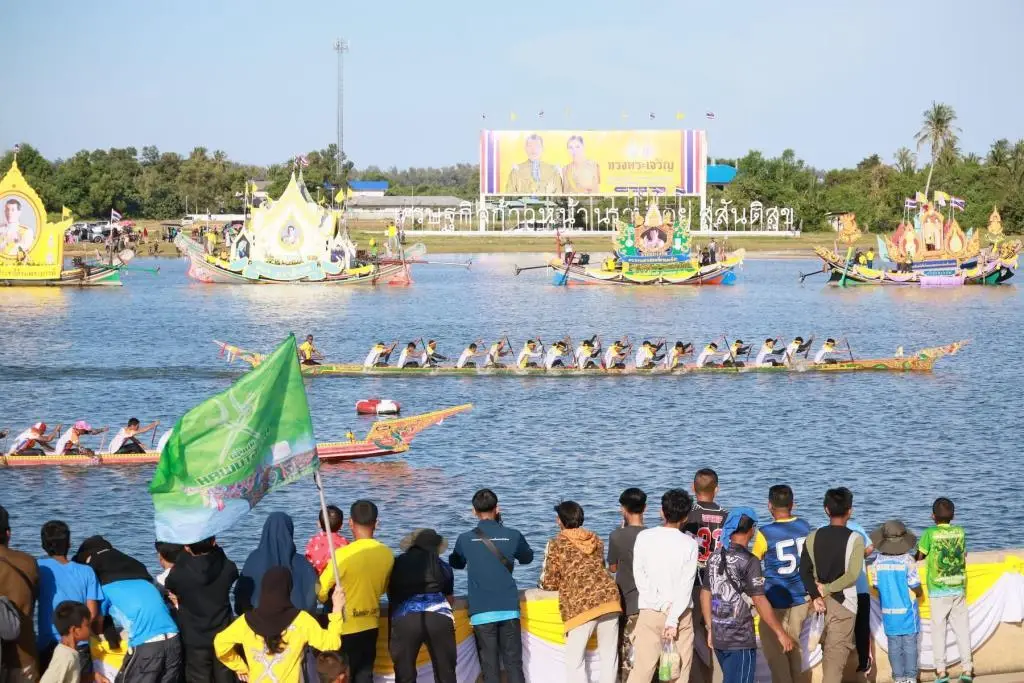
The Kolae Boat Race With Paddlers Before The Royal Pavilion in Narathiwat is one of Southern Thailand’s most meaningful river traditions. It is held during the annual Khong Di Mueang Nara festival at the Royal Pavilion commemorating the 50th anniversary of His Majesty King Bhumibol Adulyadej The Great’s accession to the throne, along Tha Phraya Sai Dam on the Bang Nara River in Mueang Narathiwat District. Today, the official competition is known as the Kolae, Yokong, and Kodchasri Boat Race for the Royal Trophy before the Royal Pavilion. It brings together royal gratitude, local boat artistry, fishing-community identity, teamwork, and the festive atmosphere of Narathiwat.
The Kolae Boat Race With Paddlers in Narathiwat Province is one of the clearest cultural expressions of Thailand’s southern border coast. A kolae boat is not merely a fishing boat. It is a floating work of folk art that carries the life, belief, craftsmanship, color, and local pride of Malay Muslim coastal communities in the lower South. The Narathiwat royal trophy race is therefore more than a speed contest. It is a cultural stage where traditional boats, paddlers, community pride, and royal gratitude meet on the Bang Nara River.
The race is held annually in September as part of Khong Di Mueang Nara, Narathiwat’s major provincial festival. This festival gathers the province’s local strengths, including special SUPPORT Foundation products, krajood craft activities, longkong fruit activities, cultural performances, singing bird contests, and the royal trophy boat race. Because of this connection, the boat race is not an isolated sporting event. It is part of a wider celebration of Narathiwat’s cultural identity, local economy, community skills, and tourism.
The main venue is the Royal Pavilion commemorating the 50th anniversary of His Majesty King Bhumibol Adulyadej The Great’s accession to the throne, located along Tha Phraya Sai Dam on the Bang Nara River in Bang Nak Subdistrict, Mueang Narathiwat District. This riverfront area is one of the most important public spaces in Narathiwat town. Tha Phraya Sai Dam provides a scenic embankment, river views, city views, public recreation space, and a long-standing venue for the annual boat race during the September festival.
The origin of the tradition is closely connected with royal visits to Taksin Ratchaniwet Palace. When His Majesty King Bhumibol Adulyadej The Great, Her Majesty Queen Sirikit The Queen Mother, and members of the Royal Family stayed at the palace during royal duties in Narathiwat, they visited local people and listened to their difficulties. Many royal-initiative development projects followed from these visits. The people of Narathiwat therefore revived the old kolae boat race to present before Their Majesties and to express gratitude for royal compassion toward the people of the southern border provinces.
The race received royal permission on 10 March 1976, and royal trophies were granted to winning teams. This transformed a local fishing-community pastime into a major provincial tradition. The race was first organized in Narathiwat in 1975 and has continued as an annual cultural event. In 2025, it was organized as the 47th race and became one of the main activities of the 48th Khong Di Mueang Nara festival.
The kolae boat is the heart of the event. It is a small coastal fishing boat widely associated with the lower southern provinces, especially Narathiwat and Pattani. Its raised bow and stern, slender body, vivid colors, and intricate painted patterns make it instantly recognizable. The boat combines Thai, Chinese, Malay, and Muslim artistic influences. It is at once a working boat, a livelihood tool, a piece of woodworking, a painting surface, and a cultural symbol of coastal communities.
The painted patterns on kolae boats are essential to their identity. They are not only decorative. They also carry beliefs, blessings, and the personality of the boat owner and community. Bow patterns often include mythical or imaginative creatures such as naga, birds, Hanuman, Rahu, Mekhala, Ramasura, or Burong Si-ngo. The body and stern may include Thai motifs, vine patterns, flowers, folk patterns, Chinese designs, Arabic-inspired geometric forms, batik-inspired patterns, and contemporary adaptations. Watching the race is therefore like seeing a moving folk-art gallery on the river.
Her Majesty Queen Sirikit The Queen Mother gave a royal initiative to promote, preserve, and continue the artistic wisdom of kolae boats after seeing the beauty of their form and patterns. This also encouraged the making of miniature kolae boats as souvenirs, the organization of community production groups, and the holding of miniature kolae boat contests to preserve traditional forms and designs.
Today, the Narathiwat competition consists of 3 main boat categories: kolae boats, yokong boats, and kodchasri boats. Kolae boats race over 650 meters, while yokong and kodchasri boats race over 300 meters. This combination gives the event both traditional depth and variety. The core of the race remains speed, rhythm, control, teamwork, and paddling strength.
In the traditional kolae race format, each kolae boat has 1 controller, with paddlers including the steersman not exceeding 23 people per boat and reserve paddlers not exceeding 5 people. Substitution in each heat is limited to 5 people, and the team controller must inform the starting committee. Boats must arrive at the starting point before the scheduled race time. If a team is more than 15 minutes late, it may be treated as having withdrawn and lose that round.
At the start, all paddlers must lift their paddles above the water, except the steersman who uses the paddle to keep the boat steady. After the start signal, the paddlers move together at full rhythm. Each boat must stay in its lane or assigned water course. A boat running outside its lane or wrong water line violates the rules and may lose that heat. The winner is decided by the bow of the boat crossing the finish line first.
The competition is divided into rounds. The first and second rounds serve as qualifying stages, followed by the semifinal round and the final round. The excitement grows as the field narrows. Spectators see local teams, experienced crews, and strong community representatives race one another, while cheering crowds along the riverbank add energy to the event.
The atmosphere of the race is vivid and powerful. Paddlers move in synchronized strokes, spectators cheer from the embankment, announcements echo across the river, floral boat processions pass before the crowd, and colorful boats line up at the starting point. The raised bows, painted patterns, and teams of paddlers transform the Bang Nara River into a living cultural stage.
In 2025, the event featured 58 teams: 27 kolae boat teams, 13 yokong boat teams, and 18 kodchasri boat teams. Three teams from Malaysia also joined the kodchasri category. This shows that the event is more than a local tradition. It also carries a cross-border cultural and tourism dimension between southern Thailand and Malaysia.
Culturally, the race revives a tradition that once began to fade. In the past, fishermen used kolae boats for coastal fishing. During free periods or community festivals, boats that served daily livelihoods became boats of competition, entertainment, and village pride. As the tradition became a formal provincial event, it helped preserve the real kolae boat, boat-painting knowledge, boatbuilding skills, and the collective memory of fishing communities.
The uniqueness of the event lies in the connection between livelihood art and festive art. A kolae boat begins as a tool of life for fishermen who depend on the sea, wind, weather, and river. In the race, the same boat becomes a symbol of community honor. The painted pattern becomes identity, the paddlers become collective strength, and the Bang Nara River becomes a stage for telling the life of southern coastal communities.
Visitors should plan ahead because the Tha Phraya Sai riverside area can become crowded during major race days. Arriving early is recommended. Choose a safe viewing area, do not cross barriers, do not enter restricted water-control or river-traffic areas, and do not interfere with officials, marine authorities, rescue teams, or race committees. During the race, many boats operate on the river, including racing boats, procession boats, support boats, and official boats.
Good viewing areas include the Tha Phraya Sai embankment, public riverside steps, the Royal Pavilion area, and spaces arranged by officials. Photographers should choose a spot with a clear line of sight along the river and the racing lanes. Morning and late afternoon usually provide softer light, while ceremony periods and final rounds attract the largest crowds.
The event can be combined with nearby attractions in Narathiwat town, such as the Hornbill Landmark at Tha Phraya Sai Dam, Narathiwat City Museum, Narathat Beach, Ko Leng Chi Shrine, the royal commemorative public park, Narathiwat Central Mosque, and Yakang 100-Year Dessert Floating Market. This route allows visitors to experience the boat race, old town, riverside communities, religious landmarks, local food, and seaside recreation in one trip.
Getting There is straightforward from central Narathiwat. Head toward Phupha Phakdi Road and the Tha Phraya Sai Dam riverside area along the Bang Nara River. The venue is in Mueang Narathiwat District near the Royal Pavilion and the Hornbill Landmark. Visitors using private cars should allow extra time for traffic and parking during the festival. Those staying in town can use local transport from hotel areas in Bang Nak Subdistrict.
Visitors should dress appropriately, respect ceremonial areas, avoid restricted spaces, keep the river clean, stay away from unsafe riverbank points, avoid loud behavior during formal ceremonies, and take care of children and elderly companions. The event is joyful, but it is also a tradition with royal and cultural significance. Respectful attendance helps preserve the dignity of the occasion.
In summary, the Kolae Boat Race With Paddlers before the Royal Pavilion is one of Narathiwat’s most complete cultural experiences. It brings together royal gratitude, the history of Taksin Ratchaniwet Palace, the life of fishermen, kolae boat artistry, folk craftsmanship, paddler unity, and the atmosphere of the Bang Nara River. Visitors do not merely watch a race. They witness a living heritage of the southern border region.
| Event Name | Kolae Boat Race With Paddlers Before The Royal Pavilion / Kolae, Yokong, And Kodchasri Boat Race For The Royal Trophy Before The Royal Pavilion |
| Event Type | Southern Thai Tradition / River Festival / Traditional Boat Race / Narathiwat Provincial Cultural Event |
| Venue | Royal Pavilion Commemorating The 50th Anniversary Of The Accession To The Throne, Tha Phraya Sai Dam, Bang Nara River, Bang Nak Subdistrict, Mueang Narathiwat District, Narathiwat Province |
| Map Reference | Tha Phraya Sai Dam Riverside, Phupha Phakdi Road, Bang Nak Subdistrict, Mueang Narathiwat District, Narathiwat Province |
| Event Period | Held annually in September. The 2026 event is scheduled for 17–20 September 2026. |
| Visiting Hours | According to the annual race and provincial ceremony schedule |
| Significance | Held to honor and express gratitude for royal compassion toward the people of Narathiwat and to preserve kolae boat artistry and local fishing-community culture |
| History | The race received royal permission on 10 March 1976, with royal trophies granted to winning teams. Narathiwat first organized the race in 1975, and it has continued as an annual provincial tradition. |
| Boat Categories | 1. Kolae Boat 2. Yokong Boat 3. Kodchasri Boat |
| Race Distance | Kolae Boat 650 Meters / Yokong And Kodchasri Boats 300 Meters |
| Kolae Boat Crew | 1 Controller, paddlers including steersman not exceeding 23 people per boat, and reserve paddlers not exceeding 5 people |
| Race Format | Qualifying rounds, semifinal round, and final round. The boat whose bow crosses the finish line first wins the heat. |
| Main Areas / Zones | 1. Royal Pavilion 2. Tha Phraya Sai Embankment 3. Racing Lanes On The Bang Nara River 4. Starting Point And Finish Line 5. Public Viewing Areas Along The Riverbank 6. Floral Boat Procession Area 7. Hornbill Landmark And Riverside Recreation Area |
| Organizer / Related Agencies | Narathiwat Province, government agencies, local administrative organizations, security agencies, marine authorities, and Narathiwat communities |
| Main Contact Number | Narathiwat Provincial Office Tel. 073-642616-20 |
| Visitor Guidance | Arrive early, choose safe viewing areas, do not cross barriers, avoid restricted river-traffic areas, keep the river clean, respect ceremonies, and follow official instructions |
| Nearby Tourist Attractions | 1. Hornbill Landmark / Tha Phraya Sai Dam, about 0 km 2. Tha Phraya Sai Riverside Market, about 0.5 km 3. Narathiwat City Clock Tower, about 1 km 4. Narathiwat City Museum, about 2 km 5. Ko Leng Chi Shrine, about 2 km 6. Narathat Beach, about 3 km 7. Narathiwat Central Mosque, about 3 km |
| Nearby Restaurants | 1. Mantra Restaurant, about 1 km, Tel. 073-516-747, 083-193-9385 2. Ayu Sushi & Cafe Narathiwat, about 1 km, Tel. 083-534-8004 3. Ayu Menaro Local Food, about 1 km, Tel. 081-479-6479 4. Lang Baan / Phak Restaurant, about 1 km, Tel. 097-354-2718 5. Pornprasert Restaurant, about 1 km, Tel. 073-511-682 6. Pramongphan Narathiwat, about 1 km, Tel. 073-511-438 |
| Nearby Accommodations | 1. Tanyong Hotel Narathiwat, about 1 km, Tel. 073-511-477 2. The Imperial Narathiwat Hotel, about 1 km, Tel. 073-515-041 3. Paksina Hotel Narathiwat, about 1 km, Tel. 073-511-800 4. Suptawee Home @ Narathiwat, about 2 km 5. Ruean Ram Resort, about 5 km, Tel. 089-869-4141 6. Hotels And Guesthouses In Bang Nak And Narathiwat City Center, about 1–3 km |
Frequently Asked Questions (FAQ)
Q: Where is the Kolae Boat Race in Narathiwat held?
A: It is held at the Royal Pavilion commemorating the 50th anniversary of the accession to the throne, along Tha Phraya Sai Dam on the Bang Nara River in Mueang Narathiwat District.
Q: When is the Narathiwat Kolae Boat Race held?
A: It is generally held in September during the Khong Di Mueang Nara festival. The 2026 event is scheduled for 17–20 September 2026.
Q: What is the race distance for kolae boats?
A: Kolae boats race over 650 meters. Yokong and kodchasri boats race over 300 meters.
Q: How many paddlers are allowed in a kolae boat?
A: A kolae boat has 1 controller, paddlers including the steersman not exceeding 23 people, and reserve paddlers not exceeding 5 people.
Q: Why is this event important to Narathiwat?
A: It honors royal compassion toward the people of Narathiwat while preserving kolae boat artistry, fishing-community heritage, and southern local culture.
Q: What boat categories are included in the current event?
A: The main categories are kolae boats, yokong boats, and kodchasri boats.
Q: How should visitors prepare for the event?
A: Visitors should arrive early, choose safe viewing areas, prepare sun protection and drinking water, avoid restricted river areas, and follow official instructions.
Q: What attractions are near the boat race venue?
A: Nearby attractions include the Hornbill Landmark, Tha Phraya Sai Dam, Narathiwat City Museum, Ko Leng Chi Shrine, Narathat Beach, and Narathiwat Central Mosque.
 Category: ●Art, Culture and Heritage
 Group: ●Art, Craft Centres, Tradition
Last Update : 1 MonthAgo
 Last Update : 1 MonthAgo

 Landmarks and Memorials(8)
 Royal Palace(1)
Art, Craft Centres, Tradition(7)
Royal Palace(1)
Art, Craft Centres, Tradition(7)
 Museums(4)
 Art Gallery(1)
 Places of Worship
 Temple(16)
 Mosque(23)
 Other Sacred Sites(4)
 Research and Development
 Royal Project(1)
 Suburban Living
 Village, Community(9)
 Local Market(1)
 Nature and Wildlife
 National Parks and Marine Reserves(5)
 Mountain (Doi)(2)
 Dam, Reservoir, Lake(2)
 Waterfalls(16)
 River, Canal(3)
 Bays and Beaches(5)
 Islands(1)
 Other natural attractions(4)
 Entertainment and Agricultural
 Stadium(1)
 Farms, Parks and Ecotourism(7)
 Shopping
 Shopping and Night Market(1)
 Travel Articles, Recipes
 Travel Review, Food Review(1)


