
lovethailand home >South Travel Attractions >Chumphon Travel Attractions >Sawi >Napho > Wat Phra That Tham Kwan Mueang
TL;DR: Wat Phra That Tham Kwan Mueang is located at Na Pho Subdistrict, Sawi District, Chumphon Province, open Daily, hours 08.00 – 17.00.
Wat Phra That Tham Kwan Mueang
Open Days: Daily
Opening Hours: 08.00 – 17.00
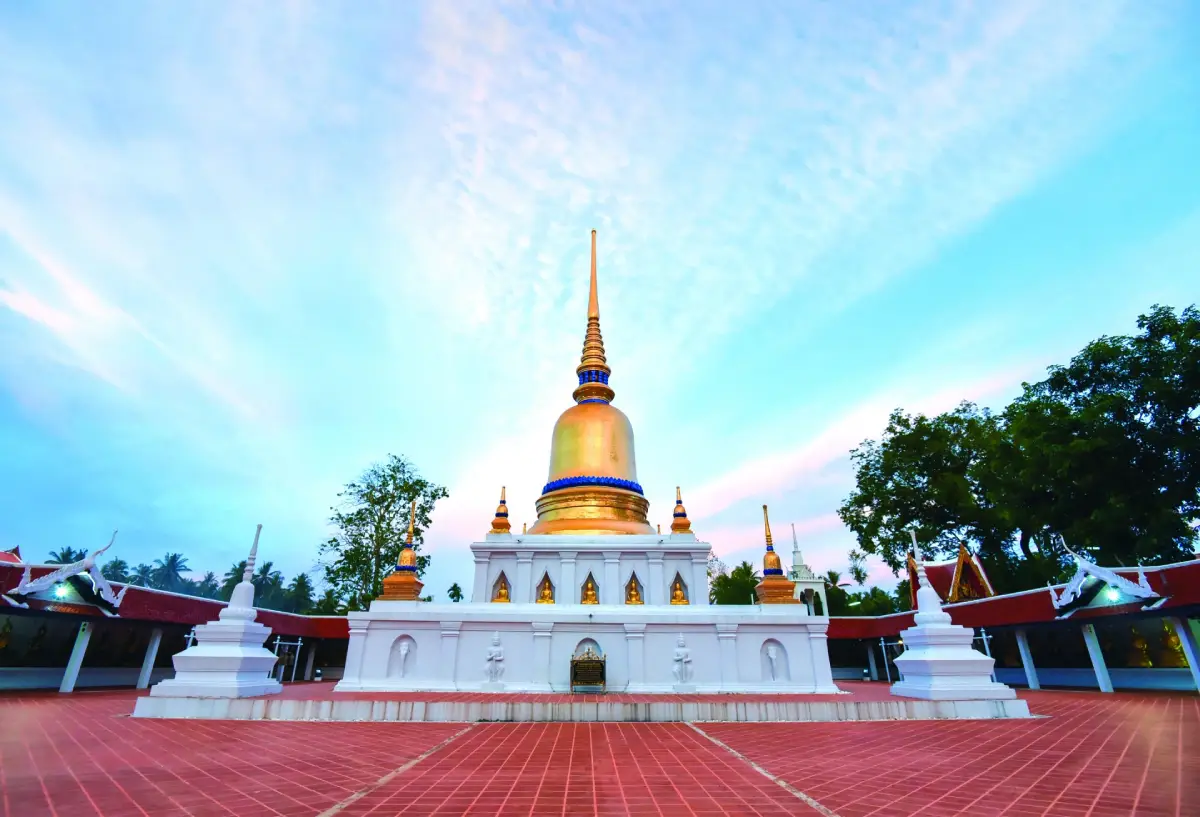
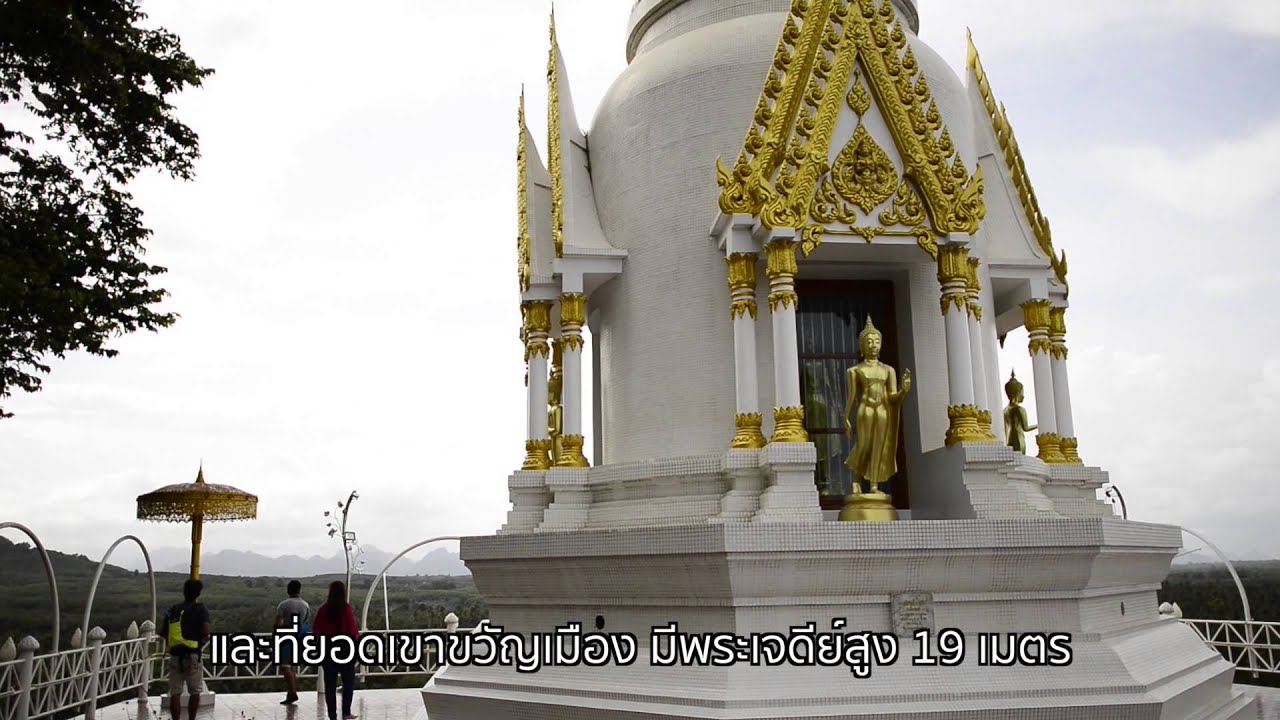
Wat Phra That Tham Khwan Mueang, also known in official temple records as Wat Tham Khwan Mueang, is located in Na Pho Subdistrict, Sawi District, Chumphon Province. It is one of the most meaningful religious places in Sawi, combining a hilltop relic pagoda, natural caves, meditation heritage, and a panoramic viewpoint over Sawi town. The temple is best known for its white bell-shaped pagoda standing on an octagonal base, about 20 meters high, enshrining sacred Buddhist relics inside.
The temple’s appeal lies not only in the pagoda itself but also in the journey to reach it. Visitors climb about 200 steps to the hilltop, where the pagoda stands prominently above the surrounding landscape. This ascent gives the visit a quiet sense of devotion. It is both a physical walk and a spiritual pause, leading visitors from the lower temple area to a sacred space overlooking Sawi.
Wat Phra That Tham Khwan Mueang is about 2 kilometers from Sawi town. From Highway 41, cross the Sawi River bridge and continue about 500 meters past the Sawi junction. The temple entrance is on the right-hand side, so drivers need to make a U-turn and then turn left into the temple road for about 500 meters. Its location near the main highway makes it a practical stop for travelers passing through Chumphon as well as those exploring Sawi District.
In religious terms, Wat Tham Khwan Mueang belongs to the Dhammayut order, Region 16, and is recognized as the first provincial meditation center of Chumphon. This makes the temple more than a scenic attraction. It is a place connected with meditation practice, Buddhist discipline, and quiet mental cultivation. Visitors can sense that the atmosphere here is calmer and more contemplative than at many ordinary sightseeing temples.
The temple’s history is closely linked with the local community. Historical records state that Kamnan Khun Phromkaeo Thongkham and village headman Son Chankaew donated land for the temple, with Phra Thammarama Khuni of Wat Tanot, the Dhammayut ecclesiastical head of Lang Suan Province at the time, receiving the donation. The name Tham Khwan Mueang has been used for the cave and temple since earlier times and was not originally named after a family surname.
The temple area contains several caves. On the eastern side is a large cave where Buddha images are enshrined. The cave environment is cool, quiet, and suitable for meditation. The presence of caves gives the temple a distinctive character, combining natural landscape and Buddhist devotion in a way often found in southern Thai forest and cave temples.
The white pagoda on the hilltop is the visual highlight of Wat Phra That Tham Khwan Mueang. Its bell-shaped form on an octagonal base is simple, balanced, and dignified. Against the sky and greenery, the white structure stands out clearly. Inside the pagoda are Buddhist relics, making the site an important place of worship for local devotees and visitors.
The 200-step climb is an essential part of the visit. It is not extremely long, but it requires care and steady walking. Visitors should wear suitable footwear, avoid rushing, and take breaks when needed. Elderly visitors or those with knee or balance issues should assess their condition before going up to the hilltop.
From the upper area, visitors can see Sawi town and the surrounding landscape from above. The viewpoint reveals the relationship between the town, river, hills, farming areas, and religious sites. It is a good place to appreciate Sawi not only as a district on the highway, but as a community shaped by Buddhism, geography, and local life.
Tham Khwan Mueang Cave is another important area inside the temple. The cave contains Buddha images and has a calm atmosphere suitable for quiet reflection. Visitors entering the cave should move carefully, speak softly, and be mindful of slippery or damp surfaces. The cave should be treated as a sacred space rather than only a natural attraction.
Wat Tham Khwan Mueang has been associated with meditation practice since 1967. Phra Khru Phawana Phirom helped pioneer meditation teaching at the temple. Later, Phra Khru Sutham Wirachan, also known as Phra Ajarn Somchai Dhammasaro, continued this tradition. The temple’s meditation identity remains one of its most important qualities.
As the first provincial meditation center of Chumphon, the temple should be understood in three connected ways: as a relic pagoda temple, as a cave temple, and as a meditation center. These layers make the visit deeper than a simple scenic stop. Visitors come to pay respect, climb to the pagoda, see the cave, and experience a calm religious atmosphere.
The temple is located in Na Pho Subdistrict, an area close to other important religious sites in Sawi. Wat Phra Borommathat Sawi is located nearby and is one of the major sacred places of Chumphon. Travelers interested in Buddhist heritage should combine both temples in one route to understand the religious identity of Sawi more completely.
Wat Phra Borommathat Sawi has a strong legend connected with Buddhist relics and the origin of the name Sawi. Visiting it together with Wat Phra That Tham Khwan Mueang creates a meaningful pilgrimage-style route. One temple represents the old sacred relic tradition of Sawi, while the other combines a hilltop relic pagoda, cave setting, and meditation heritage.
Other nearby places include Khao Muen Chani Viewpoint, the Prince of Chumphon Shrine at Hua Khao Than, Ban Thong Tom Yai, and Hat Sai Ri Sawi. These places allow travelers to combine temples, viewpoints, coastal communities, and seaside scenery within the same Sawi itinerary.
For a half-day visit, travelers can start in Sawi town, visit Wat Phra Borommathat Sawi, continue to Wat Phra That Tham Khwan Mueang, and then stop for a meal in Sawi. For a full-day route, add Khao Muen Chani Viewpoint, Ban Thong Tom Yai, or Hat Sai Ri Sawi to include both inland and coastal sides of the district.
The best time to visit is in the morning or late afternoon, when the weather is more comfortable for climbing the steps and enjoying the viewpoint. Midday visits are possible, but visitors should bring drinking water and sun protection. After rain, the steps and cave areas may be damp, so extra caution is needed.
As this is an active temple and meditation place, visitors should dress modestly and behave respectfully. Loud behavior, music, and inappropriate photography should be avoided. Near the pagoda, Buddha images, cave shrine, and meditation areas, visitors should maintain a quiet and respectful manner.
Getting There is straightforward from Sawi town. Take Highway 41, cross the Sawi River bridge, continue about 500 meters past the Sawi junction, make a U-turn when appropriate, then turn left into the temple road for about 500 meters. Travelers arriving by train can get off at Sawi Railway Station and continue by local transport or hired vehicle.
Travelers using a navigation map can search for Wat Tham Khwan Mueang or Wat Phra That Tham Khwan Mueang, Na Pho, Sawi, Chumphon. The approximate coordinates are 10.22597, 99.09497. Drivers should be careful around the highway junction and U-turn point because the temple entrance is accessed from a main road corridor.
Food options are available in Na Pho, Sawi town, the Sawi-Bor Kha route, and Hat Sai Ri Sawi. Several small hotels and resorts are also located in Na Pho and nearby areas, making it convenient for travelers who want to stay overnight and continue exploring Sawi the next day.
Wat Phra That Tham Khwan Mueang is ideal for travelers seeking both devotion and nature. Its key features are the white hilltop pagoda, sacred relics, approximately 200 steps, cave shrine, meditation atmosphere, and Sawi viewpoint. These elements make the temple one of the most worthwhile cultural and religious stops in Sawi District.
Overall, Wat Phra That Tham Khwan Mueang reveals several layers of Sawi’s identity: Buddhist faith, cave and hill geography, meditation practice, and townscape views. Visitors who come here receive more than a short temple visit. They experience a quiet climb, a sacred relic pagoda, a cave temple, and a panoramic view that connects faith, landscape, and local life in Chumphon.
| Name | Wat Phra That Tham Khwan Mueang / Wat Tham Khwan Mueang |
| Location | Na Pho Subdistrict, Sawi District, Chumphon Province |
| Address | 100/2 Moo 4, Na Pho Subdistrict, Sawi District, Chumphon 86130, Thailand |
| Coordinates | 10.22597, 99.09497 |
| Highlights | White bell-shaped pagoda on an octagonal base, about 20 meters high, enshrining Buddhist relics; around 200 steps to the hilltop; cave shrine; Sawi viewpoint |
| Temple Type | Dhammayut Buddhist temple, Region 16, and the first provincial meditation center of Chumphon |
| History / Significance | Historic cave temple in Na Pho with land originally donated by Kamnan Khun Phromkaeo Thongkham and village headman Son Chankaew; associated with meditation practice since 1967 |
| Sacred Objects | Buddhist relics inside the pagoda, Buddha images inside the cave, standing Buddha images, and other Buddha images in the temple area |
| Main Areas / Zones | Hilltop relic pagoda Stairway to the pagoda Sawi viewpoint Tham Khwan Mueang Cave Cave Buddha image area Meditation area Merit-making and worship area |
| Abbot / Caretaker | Phra Khru Sutham Wirachan / Phra Ajarn Somchai Dhammasaro |
| Travel Information | From Sawi town, take Highway 41, cross the Sawi River bridge, continue about 500 meters past the Sawi junction, make a U-turn, then turn left into the temple road for about 500 meters |
| Current Status | Active temple and meditation site open for worship, merit-making, and visiting |
| Open Days | Daily |
| Opening Hours | 08.00 – 17.00 |
| Nearby Tourist Attractions | 1. Wat Phra Borommathat Sawi, about 1 km 2. Khao Muen Chani Viewpoint, about 9 km 3. Prince of Chumphon Shrine at Hua Khao Than, about 10 km 4. Ban Thong Tom Yai, about 12 km 5. Hat Sai Ri Sawi, about 25 km |
| Nearby Restaurants | 1. Ban Faifa Sawi, about 2 km, Tel. 062-242-6605 2. Krua Mae Soi, about 8 km, Tel. 077-531-526 3. Krua Ban Rim Nam Rai Lang, about 12 km, Tel. 093-589-2944 4. Lung Auan Hat Sai Ri Sawi, about 25 km, Tel. 081-383-7526 5. Krua Nong Mai, about 3 km, Tel. 085-787-6448 |
| Nearby Accommodations | 1. Phiman Sawi Hotel, about 2 km, Tel. 077-583-444, 086-279-3132 2. Inlove Resort Sawi Chumphon, about 3 km, Tel. 077-531-485 3. Palm View Resort Sawi Chumphon, about 3 km, Tel. 077-531-799 4. Thong Uthai Resort Hotel, about 3 km, Tel. 081-078-9102 5. Mukda Resort, about 4 km |
Frequently Asked Questions (FAQ)
Q: Where is Wat Phra That Tham Khwan Mueang located?
A: Wat Phra That Tham Khwan Mueang is located in Na Pho Subdistrict, Sawi District, Chumphon Province, about 2 kilometers from Sawi town.
Q: What is the temple known for?
A: The temple is known for its white bell-shaped hilltop pagoda, Buddhist relics, approximately 200 steps to the top, Tham Khwan Mueang Cave, and a viewpoint over Sawi town.
Q: What Buddhist order does the temple belong to?
A: Wat Tham Khwan Mueang belongs to the Dhammayut order, Region 16, and is recognized as the first provincial meditation center of Chumphon.
Q: How many steps lead to the pagoda?
A: Visitors climb about 200 steps to reach the hilltop pagoda.
Q: What are the opening days and hours?
A: The temple is open daily from 08.00 to 17.00.
Q: How can travelers get to the temple?
A: From Sawi town, take Highway 41, cross the Sawi River bridge, continue about 500 meters past the Sawi junction, make a U-turn, and turn left into the temple road for about 500 meters.
Q: What nearby attractions can be combined with a visit?
A: Nearby attractions include Wat Phra Borommathat Sawi, Khao Muen Chani Viewpoint, the Prince of Chumphon Shrine at Hua Khao Than, Ban Thong Tom Yai, and Hat Sai Ri Sawi.
Tel : 077531100, 077532078
 Tel : 077531100, 077532078
 Category: ●Places of Worship
 Group: ●Temple
Last Update : 3 MonthAgo
 Last Update : 3 MonthAgo
 Click to Access the Navigation Map GPS
Wat Phra That Tham Kwan Mueang Map
Recommend

 Art, Culture and Heritage
 Historical Sites and Monuments(1)
 Landmarks and Memorials(2)
 Art, Craft Centres, Tradition(3)
 Museums(2)
 Educational Places
 Educational Gardens, Farm(1)
 University
 Public university(2)
Temple(31)
 Other Sacred Sites(10)
 Research and Development
 Royal Project(1)
 Suburban Living
 Village, Community(5)
 Local Market(1)
 Nature and Wildlife
 National Parks and Marine Reserves(7)
 Mountain (Doi)(5)
 Dam, Reservoir, Lake(1)
 Waterfalls(26)
 Hot Springs(1)
 Caves(21)
 River, Canal(7)
 Bays and Beaches(30)
 Islands(13)
 Other natural attractions(7)
 Entertainment and Agricultural
 Farms, Parks and Ecotourism(3)
 Outdoor and Adventure Activities(4)
 Shopping
 Shopping and Night Market(1)
 Department Store(1)
 Travel Articles, Recipes
 Travel Review, Food Review(1)


