
lovethailand home >South Travel Attractions >Chumphon Travel Attractions >Muang Chumphon >Tak Daet > Wat Pradoem
TL;DR: Wat Pradoem is located at Tak Daet Subdistrict, Mueang Chumphon District, Chumphon Province, open Daily, hours 08.00 – 16.30.
Wat Pradoem
Open Days: Daily
Opening Hours: 08.00 – 16.30
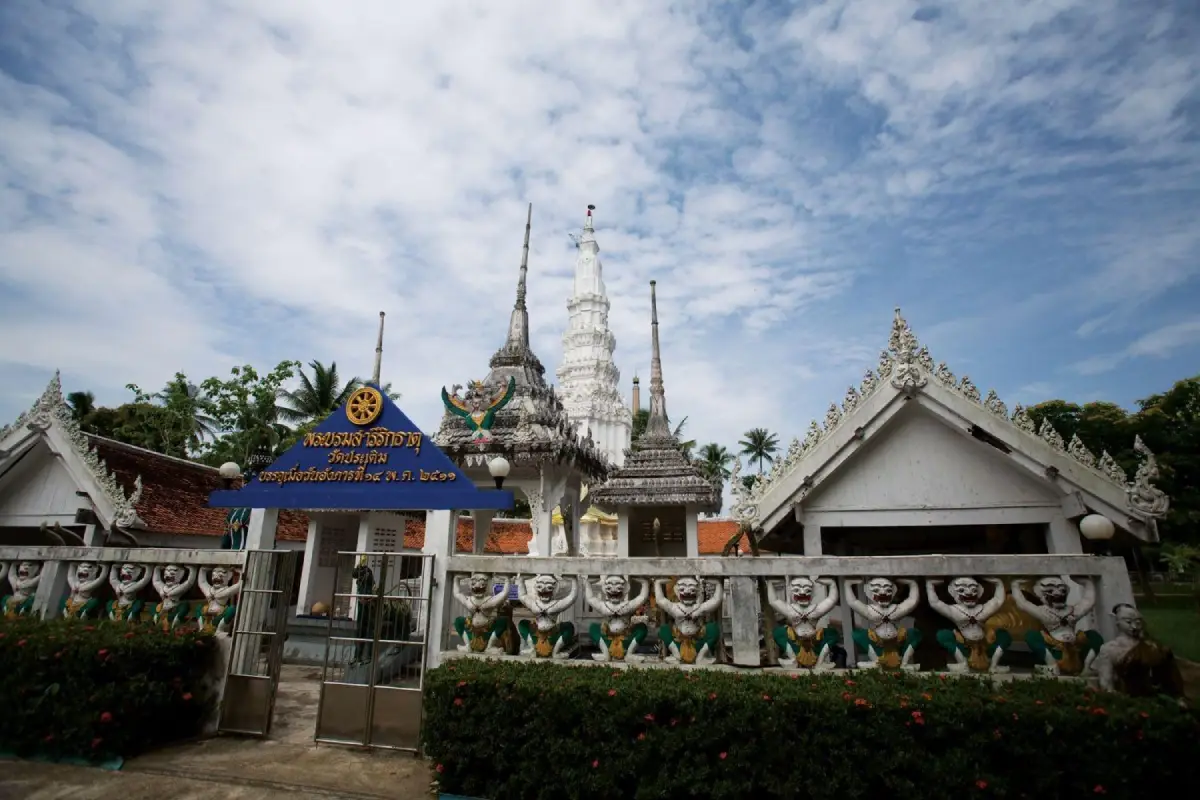
Wat Pradoem In Chumphon, also known as Wat Sutthawat Tharam, is one of the oldest and most historically important temples in Chumphon Province. It is located at 108 Moo 2, Tak Daet Subdistrict, Mueang Chumphon District, Chumphon 86000. The temple is significant as a Buddhist place of worship, an archaeological site, a historic landmark associated with old Chumphon town, and a sacred place where Buddha relics are enshrined. Its most important features include the main prang, ancient Buddha heads, sandstone boundary stones, a small bell-shaped chedi, a local-style Buddhist school building, and the Wat Pradoem House Museum or Tak Daet Local Museum.
Wat Pradoem is suitable for travelers who want to understand Chumphon beyond beaches, viewpoints, and coastal attractions. The temple is linked with the local historical belief that this area may have been part of old Chumphon town on the left bank of the Chumphon River. Local scholars have suggested that the area around Wat Pradoem and nearby sacred sites may once have formed an early settlement before the town shifted to Tha Yang and later to Tha Taphao. This makes Wat Pradoem an important starting point for understanding the historical roots of Chumphon.
The name “Pradoem” carries the sense of beginning or firstness. Local tradition explains that the temple was regarded as the first temple in the old Chumphon town area, giving rise to the name Wat Pradoem. Its older name, Wat Sutthawat Tharam, appears in cultural-heritage records. Although there is no clear evidence identifying the exact period when the temple was first built, its location, archaeological remains, and long-standing local memory all support its importance as one of Chumphon’s oldest religious and cultural sites.
The main prang is the most important monument inside the temple. The current prang has a square base with layered lotus-moulding tiers and a slender vertical form. It is surrounded by a cloister-like structure and a circumambulatory area where visitors can walk around the sacred monument. Although the original form of the prang has been heavily restored over time, it remains the spiritual center of the temple because Buddha relics are enshrined inside. It is also the focus of the annual cloth-offering ceremony held around Visakha Bucha Day.
The importance of the prang lies not only in its architecture but also in its religious and historical meaning. Some older local beliefs associated the original prang with Srivijaya-style art, but available sources do not provide firm evidence for that conclusion. What can be clearly stated is that Wat Pradoem contains many old objects and architectural traces, including Buddha heads, boundary stones, chedi remains, and old wall foundations. Together, these remains show that the temple area was once an important Buddhist site within an early community.
One important story concerns the discovery of a stone object near the temple. It was first thought to be a city pillar, but later interpretation identified it as a weathered sandstone Buddha image known locally as Phra Khoi. This story is significant because it shows how local memory of an old town and Buddhist devotion overlap in the same place. Even though the interpretation changed from city pillar to weathered Buddha image, the discovery still confirms the religious and archaeological value of the Wat Pradoem area.
The ancient objects preserved at the temple include sandstone boundary stones, sandstone Buddha heads, stucco Buddha heads, and other archaeological materials found within the temple and surrounding community. Several sources mention almost 20 Buddha heads, some associated with Ayutthaya-period artistic features. These objects help visitors understand that Wat Pradoem was once a thriving temple. Although time, decay, conflict, and later changes damaged many original structures, the surviving objects continue to show the depth of the temple’s history.
The small bell-shaped chedi inside the temple is another important trace of the old religious landscape. Only one small chedi is clearly visible today, but local accounts suggest that there may once have been several minor chedis around the temple. The remaining chedi should be viewed together with the prang, Buddha heads, boundary stones, and old wall foundations. Together they suggest that the temple complex was once larger and more complex than what is visible today.
The Buddhist school building is also worth attention. Its gable decoration and local architectural character reflect Chumphon’s regional craftsmanship. This building shows that Wat Pradoem was not only important in the distant past but also continued to serve the living Buddhist community. It functioned as a place for religious education, monastic activity, and community gathering. Visitors should look carefully at the roof form, gable details, wooden decorative elements, and the way the building sits within the temple compound.
The Wat Pradoem House Museum, also known as Tak Daet Local Museum, adds an important learning dimension to the visit. The museum uses the old residence of Luang Pho Wet Phuripanyo, a historic building within the temple. Its collections include sandstone boundary stones, photographs of former abbots, window panels from the old ordination hall, pottery fragments, tripod-pot fragments, jars, European ceramics, Chinese ceramics, palm-leaf manuscripts, paper manuscripts, Buddha images, and local household objects. This makes Wat Pradoem not only a sacred temple but also a local archive of Tak Daet Subdistrict.
The museum is valuable because it presents real objects connected with local life. Ceramics, manuscripts, baskets, ritual objects, and old temple materials reveal religion, education, healing knowledge, local belief, trade, and everyday life. When visitors view the museum together with the prang and archaeological remains, Wat Pradoem becomes easier to understand as a living settlement landscape rather than only a collection of monuments.
An important living tradition at the temple is the annual ceremony of offering a royal cloth to wrap the prang. The ceremony is held in connection with Visakha Bucha Day and honors the Buddha relics enshrined in the prang. It continues to be organized with participation from monks, government agencies, and local Buddhists. The ceremony was still held in 2026 at Wat Sutthawat Tharam or Wat Pradoem in Tak Daet Subdistrict. This shows that Wat Pradoem remains an active religious and cultural site, not merely an archaeological location from the past.
The cloth-wrapping ceremony shows the relationship between Buddhism, heritage, and community devotion. The prang is both an ancient monument and a relic shrine. When the community joins the ceremony, it expresses reverence toward the Buddha relics and respect for a temple that represents the historical roots of Chumphon. Because the ceremony is linked with Visakha Bucha Day, it also connects the local tradition with one of the most important days in the Buddhist calendar.
A good visit to Wat Pradoem should begin with paying respect at the prang, then walking around the circumambulatory area, the small bell-shaped chedi, the Buddhist school building, and the Wat Pradoem House Museum if it is open. Visitors who want to understand the site fully should take time to read signs, observe objects, and speak with local caretakers when available. Many parts of the temple’s story remain connected with local memory.
Wat Pradoem is open daily from 08.00 to 16.30 according to travel information sources. There is no admission fee, though visitors may make donations. Those who specifically want to visit the local museum should contact the temple in advance because local temple museums may not have full-time staff available throughout all opening hours. Advance coordination improves the chance of seeing the museum properly and receiving accurate explanations.
Getting There is convenient from Chumphon town by private car or local transport. Travel toward Tak Daet Subdistrict in Mueang Chumphon District. The temple is located at 108 Moo 2, Tak Daet Subdistrict. In a map application, search for “Wat Pradoem Chumphon” or “Buddha Relics Chumphon Wat Pradoem.” The temple can be combined with nearby historical and cultural places such as Chumphon City Pillar Shrine, Chumphon National Museum, the Youth Soldiers Monument, Nong Yai Royal Development Project, and Khao Matsee Viewpoint.
Visitors should dress respectfully because Wat Pradoem is both an active Buddhist temple and a registered historic site. Do not climb on ancient structures, touch artifacts without permission, write on walls, or move displayed objects. If visiting the museum, keep quiet, follow caretaker instructions, and photograph respectfully. Careful behavior helps protect both the sacred atmosphere and the historical value of the temple.
Wat Pradoem is suitable for history lovers, cultural travelers, students, families, archaeology enthusiasts, and visitors who want to understand Chumphon in depth. A short worship visit may take about 30 to 45 minutes, while a more complete visit including the prang, museum, and historical interpretation should take one to two hours. Morning and late afternoon are good times to visit because the temple compound includes open areas exposed to sunlight.
From a travel-planning perspective, Wat Pradoem belongs in a “historic Chumphon” route. Visitors can begin at Chumphon National Museum to understand the province’s broader history, continue to Wat Pradoem to see old religious and archaeological remains, then visit the Youth Soldiers Monument for World War II history, and end at Khao Matsee Viewpoint or Pak Nam Chumphon to understand the relationship between old town, river, and sea. This route gives Chumphon a much deeper meaning than a standard sightseeing trip.
Overall, Wat Pradoem is one of Chumphon’s most important heritage temples. Its value lies in religion, history, archaeology, architecture, and community memory. The prang with Buddha relics, ancient Buddha heads, boundary stones, minor chedi, local Buddhist school building, Wat Pradoem House Museum, and the annual royal-cloth prang-wrapping ceremony make the temple a key site for understanding old Chumphon. For travelers who want to know the historical roots of the province, Wat Pradoem is a place that should not be missed.
| Name | Wat Pradoem |
| Former / Official Name Found In Sources | Wat Sutthawat Tharam Or Wat Pradoem |
| Place Type | Buddhist Temple / Religious Site / Historic Site / Old Chumphon Heritage Learning Area |
| Location | Tak Daet Subdistrict, Mueang Chumphon District, Chumphon Province |
| Address | 108 Moo 2, Tak Daet Subdistrict, Mueang Chumphon District, Chumphon 86000, Thailand |
| Coordinates | 10.482137, 99.154953 |
| Highlights | Main prang enshrining Buddha relics, ancient Buddha heads, boundary stones, small bell-shaped chedi, Buddhist school building, and Wat Pradoem House Museum |
| History | An old temple believed to be connected with old Chumphon town, preserving ancient religious objects and monuments that reflect the early settlement history of Tak Daet Subdistrict |
| Historic Registration | The prang, Luang Pho Wet Phuripanyo residence, and bell-shaped chedi at Wat Pradoem were registered as historic monuments on September 27, 1936 |
| Name Origin | The name “Pradoem” suggests beginning or firstness, reflecting local belief that the temple was the first temple in the old Chumphon town area |
| Prang Features | Square-base prang with layered lotus-moulding tiers, slender vertical form, surrounding gallery, and a circumambulatory court for worship |
| Open Days | Daily |
| Opening Hours | 08.00 – 16.30 |
| Admission Fee | No admission fee; donations are accepted |
| Current Status | An active Buddhist temple and heritage site in Chumphon, with religious activities and the annual prang-wrapping ceremony on Visakha Bucha Day |
| Caretaker / Related Agencies | Wat Pradoem / Local Sangha / Tak Daet Subdistrict Administrative Organization / Chumphon cultural and Buddhist agencies |
| Contact Numbers | Wat Pradoem, Tel. 077-574-271 / Tak Daet Subdistrict Administrative Organization, Tel. 077-613-432 |
| Abbot Found In Database | Phra Maha Chusin Thitamano |
| Facilities | Temple courtyard, prang worship area, Buddhist school building, Wat Pradoem House Museum, parking area, and merit-making spaces inside the temple |
| Main Areas / Zones | Main prang enshrining Buddha relics, surrounding gallery, circumambulatory court, bell-shaped chedi, Luang Pho Wet Phuripanyo residence, Wat Pradoem House Museum, Buddhist school building, ordination hall, and artifact-preservation areas |
| Important Annual Tradition | Royal-cloth offering and prang-wrapping ceremony on Visakha Bucha Day, held annually as a Buddhist act of devotion |
| Travel Information | Travel from Chumphon town to Tak Daet Subdistrict. Search “Wat Pradoem Chumphon” or “Buddha Relics Chumphon Wat Pradoem” in a map application. |
| Nearby Tourist Attractions | 1. San Suea Mueang Shrine, About 1 km 2. Wat Phra Khwang, About 3 km 3. Chumphon City Pillar Shrine, About 5 km 4. Youth Soldiers Monument, About 6 km 5. Chumphon National Museum, About 8 km 6. Nong Yai Royal Development Project, About 9 km 7. Khao Matsee Viewpoint, About 14 km |
| Nearby Restaurants | 1. Suk Dee Tae Home Cooking & Garden, About 2 km, Tel. 066-152-6241 2. Lung Wanit Traditional Bak Chang, About 3 km, Tel. 082-952-2040, 088-393-1935 3. Krua A-Te, About 5 km, Tel. 088-758-2868 4. Villa Tha Taphao, About 6 km, Tel. 093-650-9797, 077-630-222 5. Krua Je Ang Chumphon, About 11 km, Tel. 077-521-087, 063-446-0872 |
| Nearby Accommodations | 1. OK Hotel, About 2 km 2. The Mercy Hotel, About 2 km 3. Chalicha Resort, About 3 km, Tel. 077-502-888 4. Chumphon Park Resort, About 3 km 5. A-Te Hotel Chumphon, About 4 km, Tel. 077-503-222 6. Loft Mania Boutique Hotel, About 5 km, Tel. 077-501-789, 087-158-6789 |
Frequently Asked Questions (FAQ)
Q: Where is Wat Pradoem in Chumphon located?
A: Wat Pradoem is located at 108 Moo 2, Tak Daet Subdistrict, Mueang Chumphon District, Chumphon 86000, Thailand.
Q: What are the opening hours of Wat Pradoem?
A: Wat Pradoem is open daily from 08.00 to 16.30.
Q: Is there an admission fee?
A: No admission fee is charged. Visitors may make donations according to their faith.
Q: Why is Wat Pradoem important?
A: Wat Pradoem is an old temple linked with the historical memory of old Chumphon town. It contains a prang with Buddha relics, ancient Buddha heads, boundary stones, a minor chedi, and the Wat Pradoem House Museum.
Q: What is important about the prang at Wat Pradoem?
A: The prang is a major historic monument and sacred relic shrine. It enshrines Buddha relics and is the focus of the annual royal-cloth prang-wrapping ceremony on Visakha Bucha Day.
Q: Is there a museum inside Wat Pradoem?
A: Yes. The Wat Pradoem House Museum, also known as Tak Daet Local Museum, uses the old residence of Luang Pho Wet Phuripanyo to display ancient objects, art objects, manuscripts, ceramics, and local household items.
Q: How should visitors prepare before visiting?
A: Visitors should dress respectfully, avoid touching ancient objects without permission, behave calmly, and contact the temple in advance if they specifically want to visit the local museum.
Q: Which nearby places can be visited on the same trip?
A: Nearby places include San Suea Mueang Shrine, Wat Phra Khwang, Chumphon City Pillar Shrine, the Youth Soldiers Monument, Chumphon National Museum, Nong Yai Royal Development Project, and Khao Matsee Viewpoint.
Tel : 077574271
 Tel : 077574271
 Category: ●Places of Worship
 Group: ●Temple
Last Update : 3 MonthAgo
 Last Update : 3 MonthAgo

 Click to Access the Navigation Map GPS
Wat Pradoem Map
Recommend

 Art, Culture and Heritage
 Historical Sites and Monuments(1)
 Landmarks and Memorials(2)
 Art, Craft Centres, Tradition(3)
 Museums(2)
 Educational Places
 Educational Gardens, Farm(1)
 University
 Public university(2)
Temple(31)
 Other Sacred Sites(10)
 Research and Development
 Royal Project(1)
 Suburban Living
 Village, Community(5)
 Local Market(1)
 Nature and Wildlife
 National Parks and Marine Reserves(7)
 Mountain (Doi)(5)
 Dam, Reservoir, Lake(1)
 Waterfalls(26)
 Hot Springs(1)
 Caves(21)
 River, Canal(7)
 Bays and Beaches(30)
 Islands(13)
 Other natural attractions(7)
 Entertainment and Agricultural
 Farms, Parks and Ecotourism(3)
 Outdoor and Adventure Activities(4)
 Shopping
 Shopping and Night Market(1)
 Department Store(1)
 Travel Articles, Recipes
 Travel Review, Food Review(1)


