
lovethailand home >South Travel Attractions >Chumphon Travel Attractions >Pa Thiu >Chum Kho > Wat Tham Khao Phlu
TL;DR: Wat Tham Khao Phlu is located at Ban Na Tham, Village No. 3, Chum Kho Subdistrict, Pathio District, Chumphon Province, open Daily, hours 08.00 – 16.30.
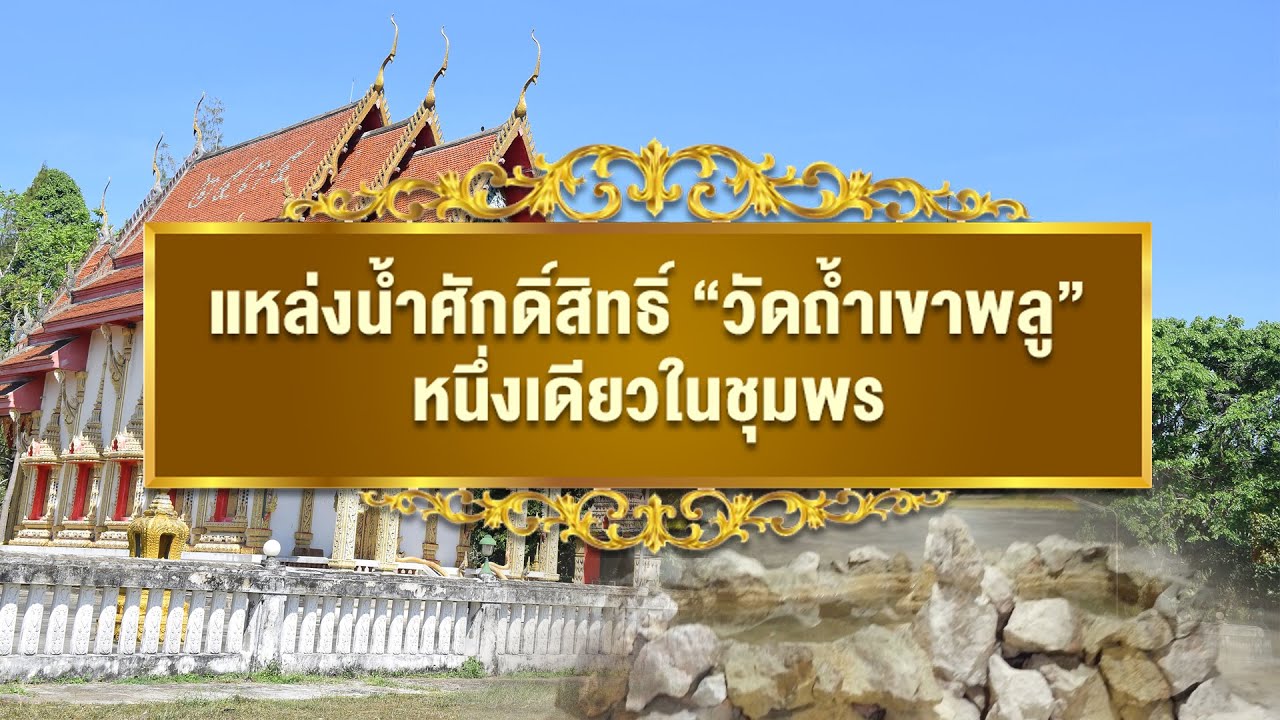
Wat Tham Khao Phlu
Open Days: Daily
Opening Hours: 08.00 – 16.30
Wat Tham Khao Phlu is a historic cave temple in Ban Na Tham, Village No. 3, Chum Kho Subdistrict, Pathio District, Chumphon Province. The temple is important for its Buddhist heritage, limestone cave setting, sacred Buddha image known locally as Phor Pu Lak Mueang or Phra Lak Mueang, holy water basin, the memory of Luang Pu Jeet Punyasaro, and the southern spectacled langurs that live on the hill near the temple. It is an ideal place for travelers who want to pay respect, make merit, explore a cave temple, learn about local faith, and experience the natural side of Pathio District.
Wat Tham Khao Phlu is located at No. 121, Ban Na Tham, Village No. 3, Chum Kho Subdistrict, Pathio District, Chumphon Province. It belongs to the Mahanikaya monastic order and covers 63 rai, 2 ngan, and 39 square wah of land. The temple compound includes both flat ground and a limestone hill. Its northern and southern boundaries border private land, the eastern boundary borders reserved forest, and the western boundary borders private land. This landscape gives the temple a quiet natural atmosphere and keeps it closely connected with Ban Na Tham community.
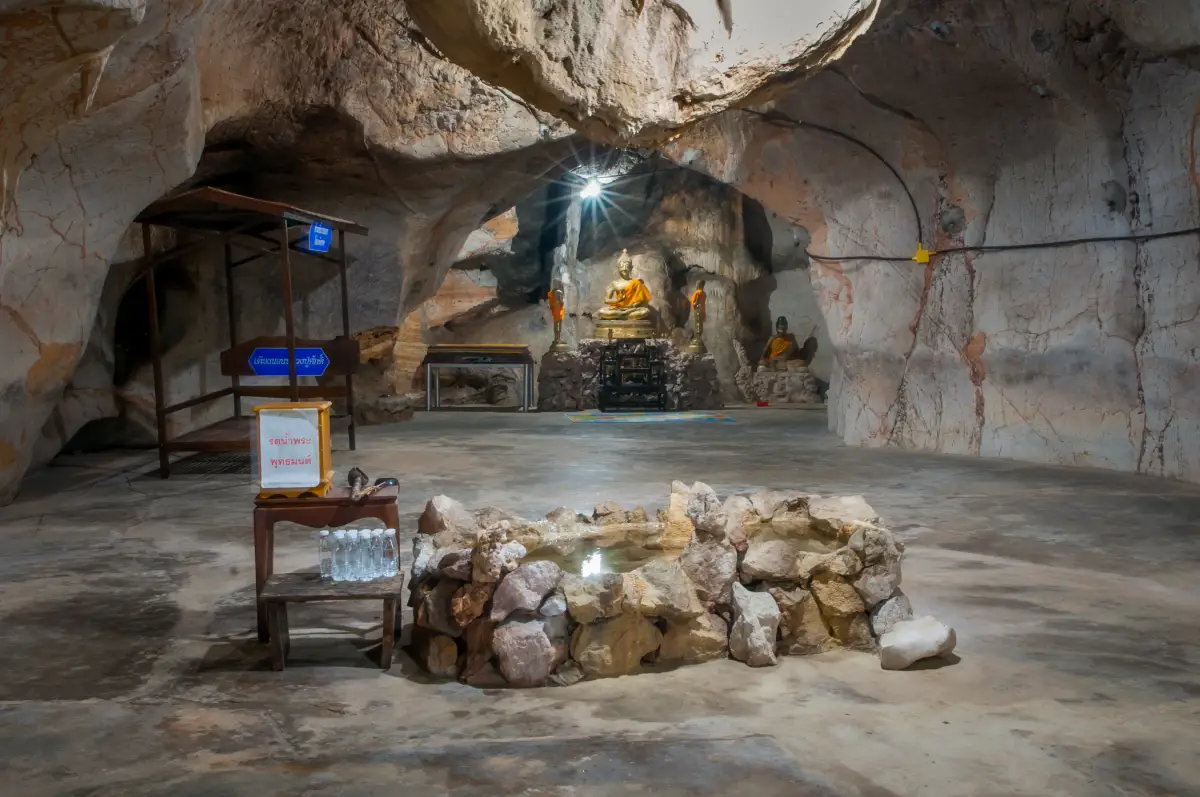
The name Wat Tham Khao Phlu comes from the temple’s cave and hill setting. The word “tham” means cave, while “khao” means mountain. Local accounts explain that phlu plants once grew along the hillside, giving rise to the temple’s name. Inside the cave is a natural stone basin with water dripping from the cave ceiling. Local people regard this water as sacred, and it has been used in important official ceremonies. This belief gives the temple a deep spiritual meaning beyond its natural cave scenery.
Temple records state that Wat Tham Khao Phlu was established in 1782. This date is connected with the ancient Buddha image enshrined inside the cave, known by local people as Phor Pu Lak Mueang or Phra Lak Mueang. The image is in the Maravijaya posture, with a lap width of 39 inches and a height of 49 inches, and is believed to be about 200 years old. For the people of Pathio, this Buddha image is an important sacred object associated with protection, blessing, and the spiritual identity of the community.
Wat Tham Khao Phlu was once an abandoned temple, with remains of an old ordination hall still remembered in temple history. Later, during the time of Phra Jeet Punyasaro, widely known as Luang Pu Jeet, the temple was restored and a new ordination hall was built. Luang Pu Jeet is one of the most revered monks associated with Pathio and Chumphon. He was known for his strict practice and for using the peaceful cave environment of Wat Tham Khao Phlu as a place for monastic discipline and meditation. His memory remains central to the identity of the temple.
After the time of Luang Pu Jeet, the temple continued to develop. In 1989, Typhoon Gay caused severe damage to Wat Tham Khao Phlu, destroying most of the monastic buildings and leaving only the sermon hall standing. Phra Khru Adun Panyathon and the people of Ban Na Tham then worked together to rebuild the temple, including monks’ residences, pavilions, the bell tower, and the ordination hall. This rebuilding reflects the strong relationship between the temple and the local community.
Wat Tham Khao Phlu received its royal consecrated boundary on 23 January 1999. The boundary measures 30 metres wide and 45 metres long. In Thai Buddhism, a consecrated boundary allows the ordination hall to be used properly for formal monastic ceremonies. This confirms the temple’s formal religious status and its continuing role as an active Buddhist temple in Pathio District.
Important structures inside the temple include the ordination hall, sermon hall, monks’ residences, multipurpose pavilion, funeral pavilions, crematorium, bell tower, storage building, and kitchen. The ordination hall is 9 metres wide and 24 metres long, built in 1992 as a reinforced concrete building. The sermon hall is 14 metres wide and 24 metres long, built in 1972 in Thai architectural style. The multipurpose pavilion is 10 metres wide and 15 metres long, built in 2003. These structures support merit-making, Buddhist ceremonies, funeral rites, and local religious activities.
The temple’s main sacred objects include the principal Buddha image in the ordination hall, in the Maravijaya posture, with a lap width of 59 inches and a height of 85 inches, created in 1990. The principal Buddha image in the sermon hall is in the meditation posture, with a lap width of 32 inches and a height of 47 inches, created in 1982. The most distinctive sacred object is the ancient Buddha image inside the cave known as Phor Pu Lak Mueang. Together, these sacred images make Wat Tham Khao Phlu an important place of worship for both local residents and visitors.
The cave is the heart of Wat Tham Khao Phlu. It has a quiet, cool atmosphere and is closely associated with Luang Pu Jeet, Phra Lak Mueang, and the sacred water basin. Visitors entering the cave should walk carefully, wear suitable shoes, avoid touching cave formations, avoid writing on cave walls, avoid leaving rubbish, and never move objects inside the cave. The cave is both a natural space and a sacred religious site, so respectful behaviour is essential.
Another memorable feature of Wat Tham Khao Phlu is the group of southern spectacled langurs living on the hill near the temple. These langurs are part of the local conservation landscape and can sometimes be seen around the lower hill area and near the temple. Visitors should observe them calmly, avoid chasing or touching them, avoid making loud noises, and follow the guidance of temple staff or local residents. This helps protect both visitors and wildlife.
The temple’s major annual tradition is the Khao Phlu Cave pilgrimage, known locally as Ngan Khuen Tham Khao Phlu. It is held on the 1st waning moon of the 6th lunar month each year. The event was formerly known as the annual merit-making and vow-fulfilment gilding ceremony of Wat Tham Khao Phlu. During the event, people make merit, gild Phra Lak Mueang, gild Luang Pu Jeet, honour respected former abbots, and take part in local cultural performances such as Nora, Ram Wong, shadow puppetry, and other community activities.
The importance of this annual tradition lies in the way it connects faith with community life. Local people believe that climbing to the cave and gilding Phra Lak Mueang brings great merit and blessing. The ceremony helps maintain the relationship between the temple, the sacred Buddha image, Luang Pu Jeet, and Chum Kho community. It also allows younger generations to understand why Wat Tham Khao Phlu remains a major spiritual landmark of Pathio District.
Today, Wat Tham Khao Phlu remains an active local Buddhist temple. Recent religious activity information lists it as a local temple with resident monks and identifies Phra Khru Sangharak Suphachai Suchinno as the abbot. The temple is therefore not only a tourist destination or a cave site, but also a living religious place used by monks and laypeople. Visitors should dress modestly, speak quietly, and respect any ceremonies taking place during their visit.
Getting There is easiest by private car, rental car, or local transport. From Highway 4, Phet Kasem Road, on the Chumphon – Pathio route near Pathio Junction, take Highway 3201, the same route leading toward Chumphon Airport. When reaching Chum Kho Subdistrict, continue straight at the local intersection and follow the signs to Wat Tham Khao Phlu for about 2 kilometres. The temple is also suitable as a stop before continuing to Ao Bo Mao, Chumphon Airport, Cape Pathio, or other coastal attractions in Pathio District.
The best time to visit is in the morning or late afternoon. Morning is suitable for paying respect and exploring the cave before the weather becomes hot. Late afternoon offers a calmer atmosphere around the hill and may provide a better chance of seeing langurs near the temple area. During heavy rain, visitors should be careful because cave floors and walking paths can become damp or slippery.
Wat Tham Khao Phlu can be included in several Pathio travel routes. Visitors interested in temples can continue to Wat Khao Chedi or Phra Yai Pathio. Those interested in nature and the sea can travel onward to Ao Bo Mao, Cape Pathio, Thung Sang Beach, or Thung Wua Laen Beach. Visitors interested in viewpoints and nature trails can continue to Khao Dinso, a well-known viewpoint and migratory raptor-watching site in Pathio District. This makes Wat Tham Khao Phlu a useful starting point for a route combining temple, cave, wildlife, mountain, and coastal scenery.
In summary, Wat Tham Khao Phlu is one of the most meaningful cave temples in Chumphon Province. Its value comes from its long history, Phra Lak Mueang inside the cave, sacred water basin, Luang Pu Jeet Punyasaro, annual cave pilgrimage, and the southern spectacled langurs living in the surrounding hill area. Travelers who want to understand Chumphon through faith, local culture, cave landscapes, and wildlife conservation should include Wat Tham Khao Phlu in their Pathio itinerary.
| Name | Wat Tham Khao Phlu |
| Location | Ban Na Tham, Village No. 3, Chum Kho Subdistrict, Pathio District, Chumphon Province |
| Address | No. 121, Ban Na Tham, Village No. 3, Chum Kho Subdistrict, Pathio District, Chumphon 86160, Thailand |
| Coordinates | 10.73044, 99.32214 / P8JC+5VC, Chum Kho, Pathio District, Chumphon |
| Highlights | Historic cave temple in a limestone hill, with Phra Lak Mueang, sacred water basin, Luang Pu Jeet Punyasaro, the annual Khao Phlu Cave pilgrimage, and southern spectacled langurs in the surrounding conservation area |
| History | Established in 1782, once abandoned, later restored during the time of Luang Pu Jeet Punyasaro, and granted its royal consecrated boundary on 23 January 1999 |
| Monastic Order | Mahanikaya |
| Temple Type | Local Buddhist Temple |
| Temple Area | 63 rai, 2 ngan, 39 square wah |
| Boundaries | North and South: Private Land; East: Reserved Forest; West: Private Land |
| Main Areas / Zones | Ordination Hall, Sermon Hall, Monks’ Residences, Multipurpose Pavilion, Funeral Pavilions, Crematorium, Bell Tower, Storage Building, Kitchen, Cave Shrine, Phra Lak Mueang Area, and Southern Spectacled Langur Conservation Area |
| Sacred Objects | Phra Lak Mueang or Phor Pu Lak Mueang in the cave, Principal Buddha Image in the Ordination Hall, Principal Buddha Image in the Sermon Hall, and Sacred Water Basin |
| Important Tradition | Khao Phlu Cave pilgrimage, held on the 1st waning moon of the 6th lunar month, with merit-making, gilding Phra Lak Mueang, honouring Luang Pu Jeet, and local cultural activities |
| Abbot / Caretaker | Phra Khru Sangharak Suphachai Suchinno |
| Open Days | Daily |
| Opening Hours | 08.00 – 16.30 |
| Main Contact Number | +66 77 591 383 |
| Travel Information | From Highway 4 on the Chumphon – Pathio route near Pathio Junction, take Highway 3201 toward Chumphon Airport. In Chum Kho Subdistrict, continue straight and follow signs to Wat Tham Khao Phlu for about 2 km. |
| Current Status | Open as a local Buddhist temple, cave learning site, and southern spectacled langur conservation area in Pathio District |
| Nearby Tourist Attractions | 1. Tham Khao Phlu Wildlife Conservation Area, within the same area 2. Wat Khao Chedi / Phra Yai Pathio, about 5 km 3. Cape Pathio, about 8 km 4. Ao Bo Mao, about 9 km 5. Chumphon Airport, about 12 km 6. Khao Dinso Viewpoint, about 18 km 7. Thung Wua Laen Beach, about 20 km |
| Nearby Restaurants | 1. Local Made-To-Order Restaurant, Chum Kho, about 4 km, Tel. +66 92 889 5847 2. Nubnab.croffle, about 5 km, Tel. +66 91 274 2470 3. Fly Robusta, about 6 km, Tel. +66 82 636 5196 4. Sri Pathio, about 8 km, Tel. +66 82 274 9062 5. Chalerm Chill Lay, about 16 km, Tel. +66 92 276 8463 |
| Nearby Accommodations | 1. Pawarisa Resort, about 7 km, Tel. +66 65 428 2324 2. Lung Pod Kao Resort, about 9 km, Tel. +66 65 040 3237 3. Paifha Beach Resort, about 10 km, Tel. +66 77 512 271 4. The Beach Resort & Residence, about 12 km, Tel. +66 65 431 3005 5. Kedsila Hometel, about 22 km, Tel. +66 61 628 7419 |
Frequently Asked Questions (FAQ)
Q: Where is Wat Tham Khao Phlu located?
A: Wat Tham Khao Phlu is located at No. 121, Ban Na Tham, Village No. 3, Chum Kho Subdistrict, Pathio District, Chumphon 86160, Thailand.
Q: What are the opening days and hours of Wat Tham Khao Phlu?
A: The temple is open daily from 08.00 to 16.30.
Q: What are the main highlights of Wat Tham Khao Phlu?
A: The main highlights include the limestone cave, Phra Lak Mueang inside the cave, sacred water basin, Luang Pu Jeet Punyasaro, the annual Khao Phlu Cave pilgrimage, and southern spectacled langurs around the temple hill.
Q: Why is Luang Pu Jeet Punyasaro important?
A: Luang Pu Jeet was a revered former abbot of Wat Tham Khao Phlu. He restored the temple from its abandoned state and is deeply respected by people in Pathio and Chumphon.
Q: What is Phra Lak Mueang at Wat Tham Khao Phlu?
A: Phra Lak Mueang, also known locally as Phor Pu Lak Mueang, is an ancient Maravijaya Buddha image enshrined inside the cave and revered as a sacred protective image of Pathio District.
Q: When is the Khao Phlu Cave pilgrimage held?
A: The Khao Phlu Cave pilgrimage is held on the 1st waning moon of the 6th lunar month each year, with merit-making, gilding Phra Lak Mueang, honouring Luang Pu Jeet, and local cultural activities.
Q: How should visitors behave around the langurs?
A: Visitors should observe the langurs calmly, avoid chasing or touching them, avoid making loud noises, and follow temple or local guidance for safety.
Q: How can travelers get to Wat Tham Khao Phlu?
A: From Highway 4 near Pathio Junction, take Highway 3201 toward Chumphon Airport. In Chum Kho Subdistrict, follow signs to Wat Tham Khao Phlu for about 2 kilometres.
 Category: ●Places of Worship
 Group: ●Temple
Last Update : 3 MonthAgo
 Last Update : 3 MonthAgo
 Click to Access the Navigation Map GPS
Wat Tham Khao Phlu Map
Recommend

 Art, Culture and Heritage
 Historical Sites and Monuments(1)
 Landmarks and Memorials(2)
 Art, Craft Centres, Tradition(3)
 Museums(2)
 Educational Places
 Educational Gardens, Farm(1)
 University
 Public university(2)
Temple(31)
 Other Sacred Sites(10)
 Research and Development
 Royal Project(1)
 Suburban Living
 Village, Community(5)
 Local Market(1)
 Nature and Wildlife
 National Parks and Marine Reserves(7)
 Mountain (Doi)(5)
 Dam, Reservoir, Lake(1)
 Waterfalls(26)
 Hot Springs(1)
 Caves(21)
 River, Canal(7)
 Bays and Beaches(30)
 Islands(13)
 Other natural attractions(7)
 Entertainment and Agricultural
 Farms, Parks and Ecotourism(3)
 Outdoor and Adventure Activities(4)
 Shopping
 Shopping and Night Market(1)
 Department Store(1)
 Travel Articles, Recipes
 Travel Review, Food Review(1)


