
lovethailand home >Northeastern Travel Attractions >Ubon Ratchathani Travel Attractions >Muang Ubon Ratchathani >Nai Muang > Eastern University of Management and Technology
TL;DR: Eastern University of Management and Technology is located at Nai Mueang Subdistrict, Mueang Ubon Ratchathani District, Ubon Ratchathani Province, Thailand.
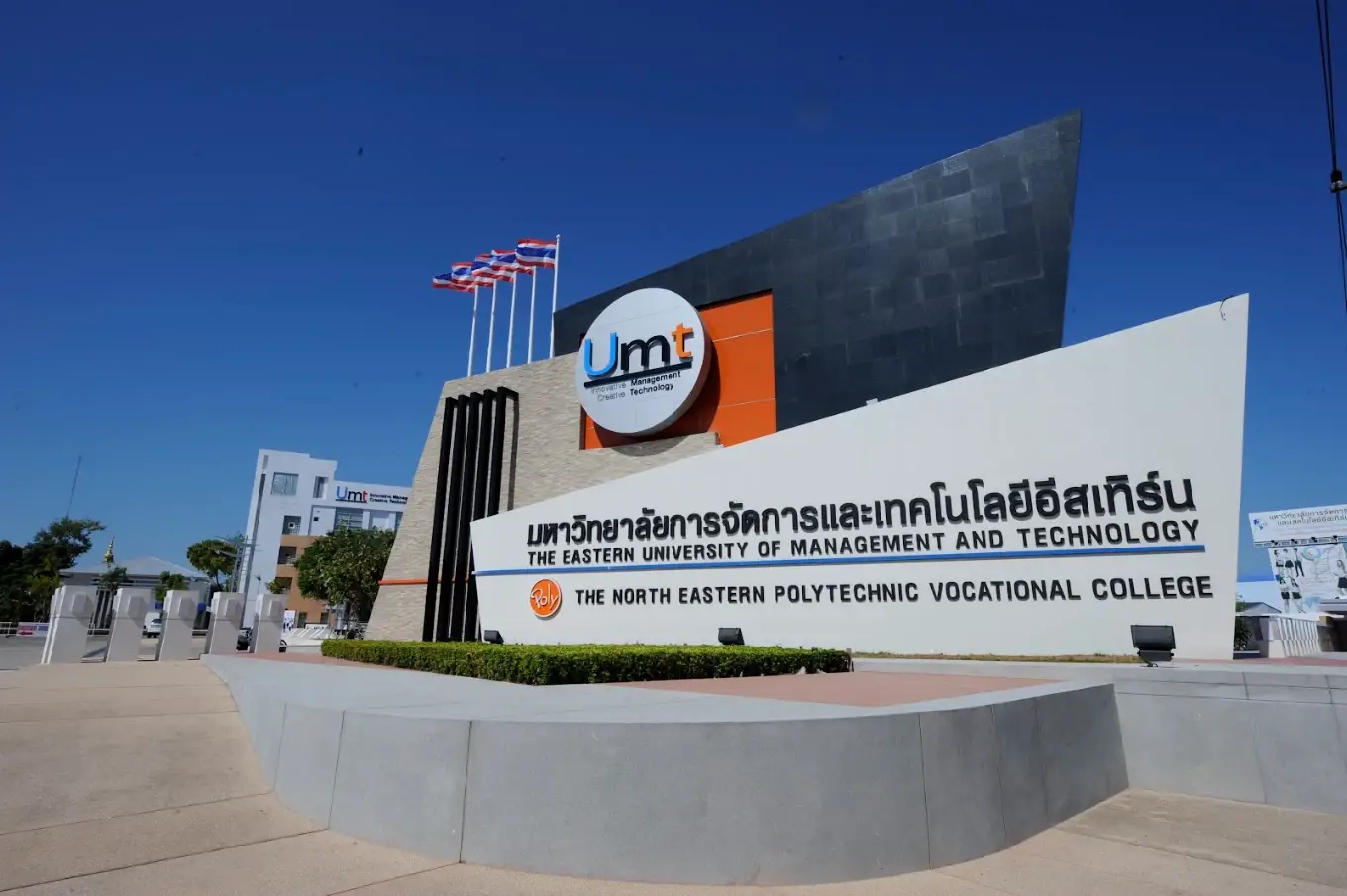
Eastern University of Management and Technology
Office Days: Monday – Sunday, except public holidays
Office Hours: 08:00 – 16:30
The Eastern University of Management and Technology (UMT), known in Thai as มหาวิทยาลัยการจัดการและเทคโนโลยีอีสเทิร์น, is a private university located at 749/1 Chayangkun Road, Nai Mueang Subdistrict, Mueang Ubon Ratchathani District, Ubon Ratchathani Province, northeastern Thailand. Its educational heritage is associated with Sitthitham Technical School and the North Eastern Polytechnic School, established in 1983. The institution expanded into higher education with the establishment of the North Eastern Polytechnic College in February 1999 before receiving authorization to operate under its present university name on 21 July 2009. In 2026, this educational heritage extended across 43 years, including 17 years under university status. UMT offers undergraduate degrees, a graduate diploma, master's degrees, and doctoral degrees in fields involving business administration, management, accounting, law, political science, information technology, and education. Its educational philosophy emphasizes practical learning, professional competence, innovation, entrepreneurship, and the application of knowledge to benefit communities and society.
UMT is one of the private higher education institutions located within Ubon Ratchathani city, a regional center for commerce, transportation, education, and public services in lower northeastern Thailand. Its educational responsibilities are closely associated with the development of professionals for private businesses, government organizations, educational institutions, and communities in Ubon Ratchathani and nearby provinces. An important part of its academic approach is the belief that education should extend beyond the acquisition of theoretical knowledge and enable students to solve problems, create career opportunities, and improve their professional abilities.
The university's name reflects its emphasis on integrating management skills with technological knowledge. In an economic environment shaped by rapid changes in digital systems, business models, and professional practices, management provides the ability to organize resources, analyze problems, plan operations, and make decisions. Technology, meanwhile, provides the tools needed to improve working processes, develop innovations, and create new opportunities. UMT seeks to bring these capabilities together in an educational environment focused on practical applications.
The main campus is located along Chayangkun Road, an important transportation route connecting Ubon Ratchathani with Amnat Charoen, Mukdahan, and Nakhon Phanom. The surrounding area contains educational institutions, residential neighborhoods, restaurants, shopping facilities, businesses, and other urban services. This location provides practical access to daily amenities and transportation connections, including the provincial bus terminal and Ubon Ratchathani International Airport.
The institution's history began with efforts to improve technical and vocational education for young people and working residents of Ubon Ratchathani. Before becoming a higher education institution, its educational background was associated with Sitthitham Technical School, an earlier part of the local private education tradition. In 1983, the North Eastern Polytechnic School was established to provide further educational opportunities emphasizing professional knowledge and technical skills.
The development of the North Eastern Polytechnic School reflected the changing needs of Thailand's economy during a period when manufacturing, commercial services, and technical occupations were becoming increasingly important. Students needed a combination of academic knowledge, technical competence, and practical experience. Vocational education helped prepare people for employment while offering opportunities for those seeking to improve their qualifications or develop new skills.
In February 1999, the North Eastern Polytechnic College was established to expand educational services into the higher education sector of Ubon Ratchathani. This development marked the institution's entry into private higher education and broadened the options available to people wishing to pursue degree-level study in lower northeastern Thailand. It also provided the foundations for a new academic structure covering business, management, technology, and related professional fields.
Moving from vocational education into higher education required more than simply creating additional courses. The institution needed to develop academic administration, university-level teaching resources, faculty qualifications, laboratories, student services, and quality assurance systems. These developments allowed it to expand its educational responsibilities while maintaining the practical learning orientation associated with its polytechnic background.
On 18 November 2005, the college council submitted documentation to the Office of the Higher Education Commission requesting a change of institutional status to a university. The application formed part of a broader process of demonstrating readiness in academic administration, educational facilities, personnel, and institutional management. It represented an important step in the development of the college into a university-level institution.
On 21 July 2009, the college received authorization to change its institutional category and name to The Eastern University of Management and Technology. This marked the formal beginning of the institution under its current university designation. The transition preserved its commitment to providing educational opportunities, developing professional skills, and serving society while enabling the university to broaden its academic provision.
Three periods are especially important in understanding UMT's history: the establishment of the North Eastern Polytechnic School in 1983, the expansion into higher education in 1999, and the authorization to operate as The Eastern University of Management and Technology in 2009. These events represent distinct stages and should not be confused with one another when considering the institution's original educational heritage or the beginning of its university status.
As the institution developed, academic offerings expanded across undergraduate and postgraduate levels. Fields associated with its higher education provision have included accounting, business administration, political science, law, information technology, and education. This diversity allowed the university to serve students entering higher education for the first time, vocational graduates seeking further qualifications, and working professionals interested in more advanced academic study.
The role of a private university in regional education is especially meaningful because students enter higher education with different backgrounds, professional experiences, financial circumstances, and career plans. Programs at different academic levels can create opportunities for students to progress from undergraduate study to advanced professional qualifications and research. Such education is relevant to those seeking employment, planning entrepreneurial activities, or preparing for leadership roles in organizations.
In 2026, Dr. Jintiya Jinarat served as President of The Eastern University of Management and Technology. Her published educational message emphasizes the development of graduates who can use knowledge to solve problems, create new solutions, and respond effectively to changing technologies and social conditions. The university describes this objective through the concept of high-competency graduates, combining professional knowledge, creative thinking, practical skills, and the ability to contribute positively to society.
An important principle of UMT's educational philosophy is Imagine Beyond Knowledge, expressed in Thai as จินตนาการนำความรู้. It reflects the belief that knowledge acquires greater value when people can apply it creatively and use it to solve real problems. This approach encourages learning through experience, the integration of management and technology, entrepreneurship, and the development of innovations that contribute to local communities.
The university describes itself as a learning center for people of all ages, emphasizing practical experience, entrepreneurial development, and the application of technology in professional and community contexts. Lifelong learning is increasingly important as workers and organizations adapt to new digital systems, business practices, and employment demands. Education therefore involves continuous skill development rather than ending with the completion of a degree.
UMT's vision is to become an innovative university of management and technology dedicated to creating positive social outcomes, expressed through the concept Innovative Management Creative Technology University. Its mission includes preparing graduates for entrepreneurship, developing commercially and socially useful innovations from research, providing academic services for local communities, preserving cultural traditions, and strengthening cooperation with domestic and international organizations.
The university's stated student identity emphasizes graduates equipped with management and technology skills. Its institutional distinction is that of a university dedicated to management and technology. These principles influence its approach to curriculum development and professional preparation: management education supports planning, analysis, and decision-making, while technological competence helps students apply digital tools and innovations to improve their work.
UMT identifies three official university colors: orange, light blue, and black. These colors appear in the institution's visual identity and communications, contributing to its recognizable presentation. They are consistent with a contemporary institutional image emphasizing professional development, management, creativity, and technology-oriented education.
Undergraduate academic offerings at UMT cover business administration, accounting, law, political science, science and information technology, and education. The university's published curriculum database identifies the Faculty of Business Administration, Faculty of Accountancy, Faculty of Law, Faculty of Political Science, Faculty of Science, and Faculty of Education. Graduate-level provision is coordinated through the Graduate School.
The Faculty of Business Administration offers the Bachelor of Business Administration in Management. Its academic content develops knowledge of business planning, resource management, marketing, finance, organizational operations, and information technology for business. Management education is relevant both to graduates planning to work in established organizations and to those interested in starting and developing their own businesses.
The study of management also involves understanding how contemporary businesses use data, technology, and organizational strategies. Analyzing information, improving operational processes, and making informed decisions are important skills across commercial services, manufacturing organizations, and small enterprises. Students therefore benefit from connecting management theory with practical situations and the challenges faced by modern businesses.
The Faculty of Accountancy offers the Bachelor of Accountancy degree, providing education in financial accounting, management accounting, auditing, taxation, financial analysis, and digital accounting systems. Its curriculum emphasizes the integration of accounting knowledge and information technology. Graduates are prepared to work with financial information, understand professional standards, and support organizational decision-making through accurate accounting data.
Accounting plays an essential role in all types of organizations because business performance must be documented, evaluated, and managed. Digital accounting systems and analytical tools can improve operational efficiency and provide useful information for planning and decision-making. Professional ethics, accuracy, accountability, and the ability to adapt to changing technologies are consequently important elements of accounting education.
The Faculty of Law offers the Bachelor of Laws degree. Its academic focus includes legal principles, the Thai legal system, the administration of justice, individual rights, legal responsibilities, and the application of law in real situations. Legal education encourages critical reading, analysis, interpretation, and systematic reasoning, enabling students to understand the role of law in relationships among individuals, organizations, businesses, and public institutions.
The Faculty of Political Science offers the Bachelor of Political Science degree. Its academic responsibilities involve political institutions, government, public administration, and the relationships between governance and society. The program emphasizes analytical thinking, management knowledge, and the use of technology to understand public issues and community challenges. Such education is relevant to students interested in public organizations, policy, political studies, and civic affairs.
The Faculty of Science offers two information technology degree pathways: a two-year Bachelor of Science in Information Technology and a four-year Bachelor of Technology in Information Technology. The two pathways provide different academic structures for students with different prior qualifications and educational objectives. Information technology education is increasingly significant in preparing professionals who can work with computer systems, organizational information, software applications, and digital services.
Technological skills have become essential across many sectors as businesses and public organizations adopt digital platforms, data-driven systems, and automated processes. Understanding information systems, data management, software, and digital applications provides graduates with abilities relevant to a broad range of professional environments. These degree pathways also reflect the university's emphasis on combining technical expertise with effective management.
The Faculty of Education offers the Bachelor of Education with major fields in Early Childhood Education, English Language Teaching, Mathematics, Physical Education, and Primary Education. These fields prepare students for educational responsibilities involving children and young people. Teacher education requires both subject knowledge and an understanding of educational psychology, learning design, classroom management, assessment, and supervised professional experience.
The preparation of effective teachers must respond to changes in society, education, and technology. Students in contemporary schools have diverse learning needs and increasing exposure to digital information. Teachers therefore need professional competence in their subject areas together with the ability to use appropriate learning technologies, communicate effectively, and support students' intellectual, physical, and social development.
For graduates seeking professional preparation in teaching, UMT offers a Graduate Diploma in Teaching Profession. This program provides further education in professional teaching knowledge and practice. Eligibility for professional licensing and teaching employment is subject to the rules of the relevant professional authorities, making it important for applicants to review the program's official requirements and professional recognition provisions.
At the master's degree level, the university offers Master of Education programs in Educational Administration and Curriculum and Instructional Innovation, together with a Master of Political Science and a Master of Business Administration. These programs are intended to strengthen professional knowledge, advanced analysis, research capability, and the application of specialized expertise in educational institutions, organizations, and public life.
UMT also offers doctoral studies through the Doctor of Political Science, Doctor of Business Administration, and Doctor of Education in Educational Administration. Doctoral education supports advanced research, the development of specialized knowledge, and the ability to investigate complex academic or professional questions. It is particularly relevant to experienced professionals, researchers, and those pursuing advanced leadership responsibilities.
In the 2026 academic year, the university's published curriculum database displayed 19 entries: 11 undergraduate entries, one graduate diploma, four master's degree programs, and three doctoral degree programs. Several undergraduate entries represent different majors within the Bachelor of Education, so the listed entries should not automatically be interpreted as separate independently accredited degree programs. Prospective students should examine each degree title, major, course structure, study duration, and admission requirements before applying.
Research activities at UMT are supported through units responsible for research administration and innovation, academic conferences, and scholarly publications. Research in management and technology is relevant to improving organizational performance, supporting technological applications, and developing practical solutions to social and economic challenges. The university's approach emphasizes the connection between academic knowledge and its usefulness in professional and community settings.
On 1 August 2026, UMT organized the 17th National Conference on Quality Management and Technology Innovation, with conference proceedings publicized later that month. The event provided an academic platform for sharing research and knowledge relating to management quality, organizational practices, and technological innovation. Conferences of this kind contribute to academic exchange and encourage collaboration among researchers and professional communities.
The university also publishes the UMT POLY Journal, a scholarly publication associated with its academic and research activities. The journal provides an additional channel for disseminating academic work and research findings. Scholarly publications support the development of research culture and encourage communication of new knowledge to readers beyond the university.
Academic staff development is another important element of institutional quality. On 11 September 2026, UMT organized a professional development workshop for lecturers preparing for academic promotion. The event was held in the Kanda Conference Room on the third floor of the President Building, with Professor Dr. Kosin Chamnongthai as the guest speaker. Such activities support the development of teaching, research, and academic professional standards.
The university also participated in external educational quality assessment activities. On 18–19 September 2026, it underwent an external quality assessment conducted by Thailand's Office for National Education Standards and Quality Assessment. External evaluation plays a role in examining educational processes, institutional management, and approaches to improvement, contributing to the wider quality assurance framework of higher education.
UMT promotes student development beyond degree-specific knowledge. An example was the UMT LIFE DESIGN Exhibition held on 26 September 2026 in Room C205 on the second floor of the Chutima Building. President Dr. Jintiya Jinarat presided over the event, which included student projects under the theme of designing a fulfilling life, along with practical workshops. The activity encouraged students to connect their education with personal goals and future development.
The LIFE DESIGN approach emphasizes self-understanding, goal setting, creativity, and the ability to make informed choices about education, careers, and personal wellbeing. Incorporating these subjects into general education helps students recognize that university learning contributes not only to employment but also to the development of independent thinking and a meaningful approach to life.
Orientation activities are important for welcoming new students and introducing them to university life. On 2 June 2026, UMT publicized its orientation activities for incoming students in the 2026 academic year. Such programs help students learn about registration procedures, academic services, university information systems, and the activities available to them during their studies.
UMT-POLY GAMES is a sports tradition connecting the university with educational institutions sharing a broader historical background. On 3 October 2026, the 46th UMT-POLY GAMES was held as a sports festival involving three institutions. The event promoted physical activity, cooperation, teamwork, discipline, and relationships among students and staff from participating educational organizations.
The importance of inter-institutional sports events extends beyond athletic competition. They provide opportunities for students to practice leadership, cooperation, respect for rules, and mutual understanding. Activities of this kind can strengthen a shared sense of identity while preserving relationships among institutions associated with the same educational tradition.
Cultural preservation also forms part of UMT's official mission. The university has a unit supporting arts and culture within its student development structure and emphasizes the value of local traditions and community knowledge. Ubon Ratchathani provides a particularly rich cultural setting, with important Buddhist sites, historical communities, traditional craftsmanship, and festivals reflecting the cultural heritage of northeastern Thailand.
The Ubon Ratchathani Candle Festival is one of the province's best-known cultural traditions. Associated with the beginning of Buddhist Lent, the festival combines religious devotion with elaborate candle carving, artistic performance, and community cooperation. Its importance illustrates how culture, religious practice, craftsmanship, tourism, and the local economy can be closely connected. It also provides a meaningful cultural context for students attending university in the province.
Important facilities at UMT include the Office of the Chancellor, President Building, Chutima Building, Kanda Conference Room, Fongchan Conference Room, Veerasak Library, academic classrooms, laboratories, and sports facilities. These spaces support lectures, research, student development, professional training, university administration, and academic gatherings.
The Office of the Chancellor serves as a central administrative facility, while other campus buildings accommodate academic and professional development activities. Modern classrooms, meeting spaces, and laboratory facilities support different approaches to learning, including lectures, group discussions, practical study, and the use of technology in educational activities.
Veerasak Library is one of the university's learning resources, providing a space associated with independent study and academic information services. University-level education requires students to learn beyond classroom instruction through reading, analysis, research, and self-directed exploration. Library resources and information services therefore contribute to the development of independent learning and academic skills.
The Fongchan and Kanda conference rooms are used for academic meetings and training activities. In September 2026, these spaces hosted events related to student educational support systems and the development of academic staff. Their use illustrates the importance of having suitable facilities for knowledge exchange among students, lecturers, administrative personnel, and visiting specialists.
UMT's supporting offices cover registration, curriculum development, research and academic services, digital technology and innovation, student development, health promotion, and sports activities. Together, these units help maintain the broader university experience, supporting students from their admission applications through academic study and professional preparation.
The university's relationship with local communities is central to its educational philosophy. Improving regional development requires cooperation among educational institutions, businesses, government agencies, and residents. Knowledge of business administration, accounting, law, political science, and technology can support entrepreneurs and organizations as they plan activities, improve operations, and respond to changing economic and social conditions.
For educational tourism, UMT provides an opportunity to explore the environment of a private university specializing in management and technology. Prospective students and families may find campus visits helpful when evaluating academic facilities and the educational atmosphere. Organized group visits, laboratory tours, and specialized academic activities should be arranged with the university in advance.
Applicants interested in the 2026 academic year can consult the university's official admissions services. UMT publicized undergraduate admissions in May 2026 and issued additional information about information technology programs in August. The Graduate Diploma in Teaching Profession also had a separate selection process publicized in June. These announcements illustrate why applicants should check the specific requirements and timelines of the program they wish to enter.
Students with vocational qualifications should examine the structure and entry requirements of their intended courses, especially when comparing the two-year and four-year information technology pathways. Any credit transfer, prior qualification recognition, or admission arrangement depends on the university's applicable rules. Understanding the correct pathway can help applicants choose a course consistent with their educational background and professional objectives.
Prospective postgraduate students should also consider their research interests, professional experience, and degree requirements. Master's and doctoral education place greater emphasis on advanced analysis, independent study, and the development of scholarly work. Selecting a program that aligns with personal and professional objectives is important for successful advanced study.
Getting There is straightforward from central Ubon Ratchathani via Chayangkun Road. The university's main address is 749/1 Chayangkun Road, Nai Mueang Subdistrict, Mueang Ubon Ratchathani District. Visitors traveling by private car can search for The Eastern University of Management and Technology or UMT in a digital navigation service and follow directions to the campus entrance.
Visitors arriving from other provinces may fly to Ubon Ratchathani International Airport and continue by taxi or other local transport. Interprovincial bus passengers can arrive at Ubon Ratchathani Bus Terminal and travel onward along the Chayangkun Road area. Rail passengers can use Ubon Ratchathani Railway Station in Warin Chamrap District before arranging transportation into Ubon Ratchathani city.
It is important to use the university's full name when arranging transportation. Ubon Ratchathani Province also has Ubon Ratchathani Rajabhat University and Ubon Ratchathani University, both of which are separate institutions at different locations. Providing the full UMT address helps ensure visitors arrive at the correct campus.
A visit to UMT can be combined with cultural sightseeing in Ubon Ratchathani city. Places of interest include Wat Phra That Nong Bua, Thung Si Mueang, Ubon Ratchathani National Museum, Wat Maha Wanaram, and Wat Thung Si Mueang. Wat Phra That Nong Bua is especially known for its striking stupa, while Wat Thung Si Mueang preserves a remarkable traditional scripture hall built over water. Together, these places provide insights into the historical, artistic, and religious identity of the province.
From its educational roots in 1983 through the establishment of a higher education college in 1999 and the granting of university status in 2009, The Eastern University of Management and Technology has continued to develop as a private educational institution serving Ubon Ratchathani and surrounding communities. Its evolution reflects the increasing importance of professional skills, educational choice, and advanced knowledge in a changing economy.
Today, UMT's defining role lies in connecting education with professional practice, management, technology, research, and lifelong learning. Its educational identity emphasizes applying knowledge creatively, developing professional competence, and preparing students for meaningful participation in the workplace and society. The institution remains part of the diverse higher education landscape of northeastern Thailand and continues to provide academic opportunities for students pursuing professional and personal development.
| University Name | The Eastern University of Management and Technology (UMT) |
| Thai Name | มหาวิทยาลัยการจัดการและเทคโนโลยีอีสเทิร์น |
| Institution Type | Private University |
| Location | Nai Mueang Subdistrict, Mueang Ubon Ratchathani District, Ubon Ratchathani Province, Thailand |
| Full Address | 749/1 Chayangkun Road, Nai Mueang, Mueang Ubon Ratchathani, Ubon Ratchathani 34000, Thailand |
| Historical Educational Roots | Sitthitham Technical School and North Eastern Polytechnic School |
| Polytechnic School Established | 1983 (B.E. 2526) |
| Higher Education College Established | February 1999, as North Eastern Polytechnic College |
| University Status Granted | 21 July 2009 |
| Institutional Age in 2026 | 43 years since the establishment of the polytechnic school in 1983, including 17 years under university status since 2009 |
| University President in 2026 | Dr. Jintiya Jinarat |
| Educational Philosophy | Imagine Beyond Knowledge |
| Vision | Innovative Management Creative Technology University |
| Student Identity | Graduates Equipped with Management and Technology Skills |
| Institutional Distinction | University of Management and Technology |
| University Colors | Orange, Light Blue, and Black |
| Academic Units Listed in the Curriculum Database | 1. Faculty of Business Administration 2. Faculty of Accountancy 3. Faculty of Law 4. Faculty of Political Science 5. Faculty of Science 6. Faculty of Education 7. Graduate School, coordinating postgraduate studies |
| Academic Levels | Bachelor's Degrees, Graduate Diploma, Master's Degrees, and Doctoral Degrees |
| Curriculum Database Entries | 19 entries: 11 undergraduate entries, 1 graduate diploma, 4 master's degree programs, and 3 doctoral programs |
| Academic Strengths | Business Management, Accounting, Political Science, Law, Information Technology, Teacher Education, Educational Administration, and Innovation for Local Development |
| Important Campus Facilities | 1. Office of the Chancellor 2. President Building 3. Chutima Building 4. Kanda Conference Room 5. Fongchan Conference Room 6. Veerasak Library 7. Academic Buildings and Laboratories 8. Sports Facilities and Student Activity Areas |
| Important Activities in 2026 | 1. New Student Orientation 2. 17th National Conference on Quality Management and Technology Innovation 3. UMT LIFE DESIGN Exhibition 4. 46th UMT-POLY GAMES 2026 5. Academic Staff Development Workshop 6. Student Educational Support Systems Training |
| Research and Academic Publications | Research and Innovation Administration, National Academic Conferences, and UMT POLY Journal |
| Administrative Office Days and Hours | Monday – Sunday, 08:00 – 16:30, except public holidays |
| Educational Visits | Contact the university in advance for organized group visits, laboratory tours, and academic activities |
| Facilities | Classrooms, Laboratories, Library, Conference Rooms, Sports Facilities, Student Information Systems, and Parking Areas |
| Getting There | Located on Chayangkun Road in central Ubon Ratchathani, with local transport connections from Ubon Ratchathani International Airport, Ubon Ratchathani Bus Terminal, and Ubon Ratchathani Railway Station |
| Attractions in Mueang Ubon Ratchathani District | 1. Wat Phra That Nong Bua 2. Thung Si Mueang Park 3. Ubon Ratchathani National Museum 4. Wat Maha Wanaram Royal Temple 5. Wat Thung Si Mueang |
| Restaurants and Cafés in Ubon Ratchathani City | 1. Waan-Moo & Co, Tel. +66 81 416 4029 2. Double U Coffee & Eatery, Tel. +66 81 699 6247 3. Agave Vietnamese Cuisine & Cafe, Tel. +66 65 414 6453 4. Krua Suan Pla, Tel. +66 63 450 2424 5. GeonbaePocha Korean Restaurant, Tel. +66 90 973 9559 |
| Accommodation in Ubon Ratchathani City | 1. De' Proud Hotel, Tel. +66 95 620 1919 2. Excella Hotel, Tel. +66 45 313 314 3. Fundee 1 Mansion, Tel. +66 45 312 318 4. Sunee Grand Hotel, Tel. +66 81 265 3388 5. De Lit, Tel. +66 98 279 9476 |
| University Telephone | +66 45 283 772 |
| Official Website | www.umt.ac.th |
| Current Status | Active Private University offering degree programs, research, student development, and academic services in the 2026 academic year |
Academic Programs and Fields of Study at The Eastern University of Management and Technology, Academic Year 2026 (B.E. 2569)
| Faculty / Academic Unit | Academic Programs and Fields of Study |
| Faculty of Business Administration | Bachelor's Degree 1. Bachelor of Business Administration in Management (4 years) |
| Faculty of Accountancy | Bachelor's Degree 1. Bachelor of Accountancy (4 years) |
| Faculty of Law | Bachelor's Degree 1. Bachelor of Laws (4 years) |
| Faculty of Political Science | Bachelor's Degree 1. Bachelor of Political Science (4 years) |
| Faculty of Science | Bachelor's Degrees 1. Bachelor of Science in Information Technology (2-year program) 2. Bachelor of Technology in Information Technology (4-year program) |
| Faculty of Education | Bachelor of Education — Major Fields 1. Early Childhood Education 2. English Language Teaching 3. Mathematics 4. Physical Education 5. Primary Education |
| Graduate School | Graduate Diploma 1. Graduate Diploma in Teaching Profession (1 year) 1. Master of Education in Educational Administration 2. Master of Education in Curriculum and Instructional Innovation 3. Master of Political Science 4. Master of Business Administration 1. Doctor of Political Science 2. Doctor of Business Administration 3. Doctor of Education in Educational Administration |
Frequently Asked Questions (FAQ)
Q: Where is The Eastern University of Management and Technology located?
A: It is located at 749/1 Chayangkun Road, Nai Mueang Subdistrict, Mueang Ubon Ratchathani District, Ubon Ratchathani Province 34000, Thailand.
Q: Is The Eastern University of Management and Technology a public or private university?
A: UMT is a private university in Ubon Ratchathani Province.
Q: When was The Eastern University of Management and Technology established?
A: Its polytechnic educational heritage dates to 1983. The higher education college was established in 1999, and university status was granted on 21 July 2009.
Q: How old is the university in 2026?
A: Its polytechnic educational heritage spans 43 years, and it has held university status for 17 years.
Q: Who was the President of UMT in 2026?
A: Dr. Jintiya Jinarat served as President in 2026.
Q: What academic subjects does UMT offer?
A: Its programs cover business administration, accounting, law, political science, information technology, and education, together with a graduate diploma in teaching and master's and doctoral degrees.
Q: How many academic program entries were listed in the 2026 curriculum database?
A: The university listed 19 entries: 11 undergraduate entries, one graduate diploma, four master's degree programs, and three doctoral programs. Several undergraduate entries represent major fields within the Bachelor of Education.
Q: What are the university's educational identity and official colors?
A: The university emphasizes management and technology skills through its Imagine Beyond Knowledge philosophy. Its official colors are orange, light blue, and black.
Q: What important student and academic activities took place in 2026?
A: Activities included new student orientation, the 17th National Conference on Quality Management and Technology Innovation, the UMT LIFE DESIGN Exhibition, and the 46th UMT-POLY GAMES.
Q: How can visitors travel to The Eastern University of Management and Technology?
A: Visitors can travel along Chayangkun Road in central Ubon Ratchathani or arrange local transport from Ubon Ratchathani International Airport, the provincial bus terminal, or Ubon Ratchathani Railway Station.
 Category: ●University
 Group: ●Private University
Last Update : 6 DayAgo
 Last Update : 6 DayAgo
 Click to Access the Navigation Map GPS
Eastern University of Management and Technology Map
Recommend

 Art, Culture and Heritage
 Historical Sites and Monuments(5)
 Landmarks and Memorials(2)
 Royal Palace(1)
 Art, Craft Centres, Tradition(7)
 Museums(3)
 Public university(1)
 Autonomous Universities(1)
 Rajabhat University(1)
Private University(2)
 Places of Worship
 Temple(37)
 Other Sacred Sites(4)
 Research and Development
 Royal Project(2)
 Suburban Living
 Village, Community(2)
 Local Market(4)
 Nature and Wildlife
 National Parks and Marine Reserves(5)
 Mountain (Doi)(6)
 Dam, Reservoir, Lake(8)
 Waterfalls(12)
 Hot Springs(1)
 Caves(2)
 River, Canal(11)
 Bays and Beaches(8)
 Islands(2)
 Other natural attractions(6)
 Entertainment and Agricultural
 Zoos and Aquariums(2)
 Animal camps and shows(1)
 Farms, Parks and Ecotourism(1)
 Waterpark(1)
 Travel Articles, Recipes
 Travel Review, Food Review(1)


