
lovethailand home >Northeastern Travel Attractions >Ubon Ratchathani Travel Attractions >Sirinthon >Kham Khuean Kaeo > Sirindhorn Folk Horse Conservation Club
TL;DR: Sirindhorn Folk Horse Conservation Club is located at Ban Nong Chad, Kham Khuean Kaeo Subdistrict, Sirindhorn District, Ubon Ratchathani Province, open Daily, hours 08:00 – 17:00.

Sirindhorn Folk Horse Conservation Club
Open Days: Daily
Opening Hours: 08:00 – 17:00
Sirindhorn Folk Horse Conservation Club in Ubon Ratchathani is a community-based conservation and learning attraction located at Ban Nong Chad, Kham Khuean Kaeo Subdistrict, Sirindhorn District, Ubon Ratchathani Province. It lies along the route toward Chong Mek and not far from Khong Chiam District. The club is important because it preserves local Thai horses, often called “ma klaep” or small native horses, which were once essential to rural life before cars and modern vehicles replaced animal transport. These horses were not only animals used for riding; they were part of travel, work, communication, local trade, village mobility, and the memory of rural society in the period when horses were still closely connected with everyday life.
The club was developed through the dedication of Ajarn Chuchat Warapridi, a key figure in conserving native horses in the Sirindhorn and Khong Chiam area. The purpose of the club was not simply to create a tourist stop. It began with a strong intention to protect local horse breeds, horse-raising knowledge, and the memory of a way of life that was disappearing from the community. As cars and machines became more common, the practical need for horses declined, and the number of local horses decreased. The establishment of Sirindhorn Folk Horse Conservation Club therefore helped keep the horse breed, local skills, and cultural memory alive in a form that younger generations and visitors can still see and experience directly.
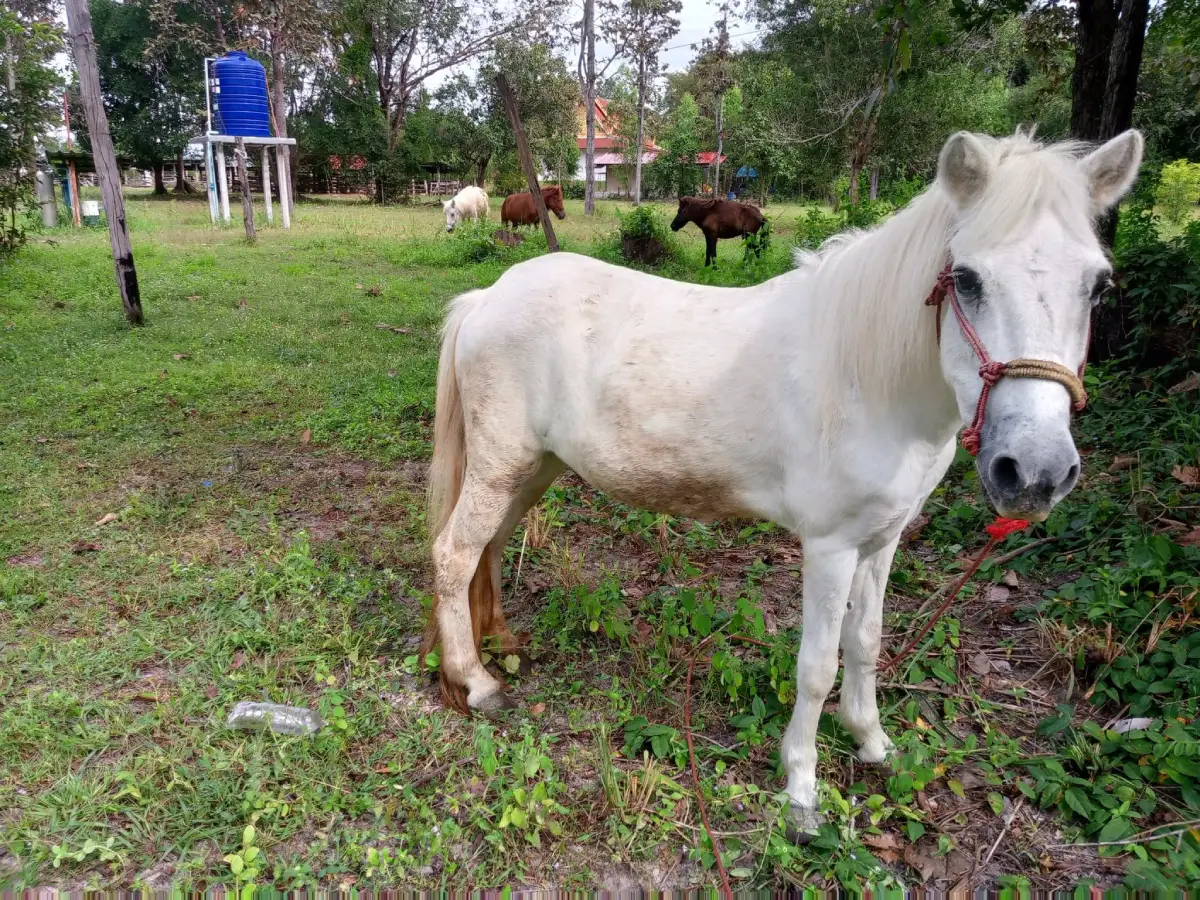
The native horses preserved here are small, compact, and practical. Fully grown horses generally stand around 120–130 centimeters tall. They are not as large as many foreign horse breeds, but they are agile, sturdy, and well suited to rural paths, forest routes, dirt roads, and natural terrain where large vehicles are less practical. This is why local horses were once useful in the southern Isan landscape, especially around forests, hills, river areas, rapids, and remote villages. Preserving these horses also means preserving knowledge about animals that were adapted to the local geography and rural way of life.
In the past, horses were important companions in Thai rural communities. They were used for travel, carrying goods, visiting nearby villages, pulling carts, and supporting local mobility before road networks became fully developed. In today’s terms, a horse once performed a role similar to a personal vehicle. However, unlike a vehicle, a horse is a living being that requires care, training, patience, and a relationship with its rider. This makes the history of local horses more meaningful. The club allows visitors to look back at how people once traveled and worked before the age of cars, motorcycles, and paved roads.
When visitors arrive, they encounter a horse-raising and learning area with a simple rural atmosphere near nature routes. The appeal of the place does not come from luxury or large-scale entertainment. It comes from direct contact with local horses and the sincerity of the conservation work. Visitors can observe the horses in a setting connected with real care and daily management. They can see body shape, walking style, posture, responses to people, and the individual character of each horse. This turns the visit into a learning experience rather than only a quick photo stop.
The heart of the club is knowledge transfer. Visitors can learn about horse care, horse training, horse behavior, and basic riding in a safe and controlled way. Each horse has its own character. Some are calm, some are more alert, some are used to people, and some need more time to build trust. Learning about horses begins with understanding that they are not machines. They are sensitive animals with emotions, fear, memory, and responses to movement and sound. People who learn with horses also learn calmness, balance, body control, voice control, and the importance of communication between rider and animal.
Horseback riding through nature is one of the club’s main activities. The experience of moving with a horse is very different from walking or sitting in a car. The rhythm of the horse’s steps makes the rider feel the ground, distance, sound, and surrounding environment more clearly. The natural routes around Ban Nong Chad and the area near Kaeng Tana National Park add meaning to the activity. Riders do not only enjoy the experience; they also learn how horses move through real rural terrain and why these animals were once practical companions for local people.
For first-time riders, the club is a suitable place to begin because local horses are not too tall. This makes them easier for beginners to approach compared with larger breeds. Basic riding begins with getting to know the horse, mounting and dismounting, sitting in balance, holding the reins, using voice and body signals, controlling direction, and stopping the horse. Riders gradually learn that horse riding is not about forcing an animal. It is a form of communication that depends on timing, calmness, and trust. This type of learning can build courage, responsibility, patience, and awareness.
The club also has a strong youth and community learning role. It has been used for youth guide activities under the concept of “Acha Pha Thiao,” meaning horse-led local guiding. Through this model, local children and young people learn horse skills, local guiding, storytelling, nature conservation, and community-based tourism. Young people are not only spectators. They become interpreters of their own community and help visitors understand the local identity. Horses therefore become a bridge connecting children with nature, history, local wisdom, and pride in their hometown.
Another special value of the club is the connection between horses and nature conservation. Those who learn about horses also learn about forests, trails, grass, water, animal feed, and responsible land use. Horse care cannot be separated from the environment because horses need food, water, space, exercise, shade, and a safe setting. Caring for horses helps learners understand basic ecological relationships among people, animals, plants, soil, water, and community space. The visit therefore becomes an ecological learning experience through a local domestic animal, not simply a recreational riding activity.
The club is also meaningful as a space associated with horse therapy and youth development. The movement of a horse can help riders practice balance, body control, confidence, attention, and response. Horse-assisted activities can be valuable for children who need special types of practice, although any therapeutic activity should be managed by knowledgeable people. This role gives the conservation club deeper importance. Horses here are not only cultural symbols; they can also help create learning, confidence, and personal development.
Visitors should allow at least 1–2 hours for a basic visit, including seeing the horses, listening to explanations, and learning the fundamentals. Those who want to ride, join a nature route, camp, or visit as a group should make arrangements in advance. Horse-related activities require preparation: horses, routes, handlers, timing, and safety checks. Advance coordination helps the club select horses that match each rider, especially for children, beginners, or visitors without horse experience.
Safety is essential when visiting the club. Visitors should follow instructions from handlers at all times. They should not approach horses from behind, make loud noises, run near horses, feed horses without permission, touch equipment without guidance, or climb onto a horse without a handler. A horse should be approached slowly from a visible angle so it can recognize the person coming near. Horses are sensitive to movement and sound, and respectful distance helps both people and animals feel more comfortable.
Suitable clothing makes the visit easier and safer. Visitors should wear clothes that allow movement and shoes with good grip. Closed shoes are better than sandals. Loose or flowing clothing should be avoided if riding, because it can catch on equipment. Drinking water, a hat, and sun protection are useful because the southern Isan climate can be hot. Families with children should supervise them closely and choose activities according to age, weight, confidence, and readiness.
Getting There is most convenient by private car, rental car, or local transport. From Ubon Ratchathani city, travelers can drive toward Phibun Mangsahan, Sirindhorn District, or the Khong Chiam route, then continue to Kham Khuean Kaeo Subdistrict and Ban Nong Chad. The club is located near the route toward Chong Mek. From Khong Chiam, the distance is about 9–10 kilometers. The location also connects conveniently with Kaeng Tana National Park, Wat Tham Khuha Sawan, the Two-Colored River viewpoint, Sirindhorn Dam, and Chong Mek border market.
For travelers staying in Khong Chiam, the club works well as a half-day stop. A route can begin with the Two-Colored River and Wat Tham Khuha Sawan in the morning, followed by the horse conservation club at Ban Nong Chad, then Kaeng Tana National Park or the Kaeng Tana suspension bridge in the afternoon. This route combines river scenery, horses, forest, rapids, and community learning in a single day.
For travelers coming from Chong Mek or Sirindhorn District, the club can be visited before or after the border market and Sirindhorn Dam. This route is suitable for visitors who want to combine community-based learning with reservoir views, border travel, and local nature. A stop at the horse conservation club adds cultural and animal conservation value to a trip that might otherwise focus only on scenery or shopping.
The main areas of the club can be understood as the horse-raising zone, horse learning zone, beginner riding area, nature riding route, camping or homestay area according to the services arranged, youth activity area, and connection routes toward surrounding nature. Each area has a different purpose. The horse-raising area is good for observing appearance and behavior. The training area is suitable for beginners. The nature riding route gives a deeper outdoor experience. The camping and activity areas are useful for groups that want longer learning programs.
The club is best experienced slowly. Its value does not come from rushing through every corner but from taking time to understand the horses and the story of local horse culture. Watching a horse graze, walk, respond to its handler, or interact calmly with people can be more meaningful than taking only a few photos. Visitors who spend time observing will notice that each horse has its own expression, movement, pace, and personality. This gives the experience emotional depth and makes animal learning feel more personal.
For families with children, the club is a good place to build kindness toward animals. Children learn that animals need food, water, space, cleanliness, patience, and care. They can understand how horses once helped people travel, why native horses need conservation, and why approaching animals must be done respectfully. Direct experience helps children understand responsibility more clearly than a short classroom explanation.
For students, the site supports learning in many fields at the same time: local history, animal biology, animal behavior, community wisdom, conservation tourism, and local learning-center management. Students can study why native animals may disappear from modern society, what conservation requires, and how tourism can help support preservation without erasing original cultural value.
For foreign travelers, Sirindhorn Folk Horse Conservation Club offers a view of Ubon Ratchathani that is different from temples, Pha Taem, Sam Phan Bok, or the Mekong River. It shows how animals were used in rural Thai society, how people and horses once depended on one another, and how a community tries to preserve a local breed in the modern age. Visitors interested in rural culture, animal conservation, horseback riding, or community tourism will find this place distinctive and memorable.
The club is also valuable because it supports youth roles and local income. Youth guide activities and horse-based community tourism allow local children and young people to participate in tourism rather than stand outside it. They can learn horse care, guiding, storytelling, and pride in local knowledge. These skills can create confidence and income while keeping the community connected with its own heritage.
Several nearby attractions can be included in the same route. Kaeng Tana National Park is close to the club and is an important nature area of Sirindhorn and Khong Chiam Districts. Wat Tham Khuha Sawan and the Two-Colored River viewpoint are major places in Khong Chiam. Sirindhorn Dam and Pattaya Noi offer reservoir scenery and relaxation, while Chong Mek is a border market and crossing point connected with Laos. Combining these places with the horse conservation club creates a journey that includes nature, culture, border travel, and local horse heritage.
Restaurants near the club are mostly located in Khong Chiam, Chong Mek, and the Sirindhorn travel route. Khong Chiam restaurants are good for Mekong and Mun River fish dishes, Isan food, and riverside views. Restaurants near Chong Mek are convenient for visitors continuing toward the border market or Sirindhorn Dam. Since the club is a learning and horse-raising site rather than a major food center, visitors should plan meals before or after the activity.
Accommodation options are available in Khong Chiam, along the Mekong River, near Chong Mek, and in the Sirindhorn route. Travelers who want to combine the club with the Two-Colored River, Wat Tham Khuha Sawan, and Pha Taem should stay in Khong Chiam. Those who want to combine the club with Chong Mek and Sirindhorn Dam may choose accommodation near Chong Mek or Sirindhorn. Travelers who prefer more hotel choices can stay in Ubon Ratchathani city and visit as a road trip, but they should allow enough driving time.
The best time to visit is in the morning or later afternoon when the heat is less intense. Morning is good for learning and beginner riding. Later afternoon is suitable for nature atmosphere and photography. During the rainy season, travelers should check road and weather conditions because outdoor activities and natural routes may be affected by rain, wet ground, or slippery paths. Seasonal preparation makes the trip safer and more comfortable.
Visitor manners are important. Guests should respect the place, avoid loud noise, not enter horse areas without permission, not feed horses by themselves, not pull the tail, mane, or reins, not use flash close to animals, and not frighten horses for photos or videos. Native horses are the heart of this conservation club. Gentle treatment of the animals is part of the conservation experience.
In conclusion, Sirindhorn Folk Horse Conservation Club in Ubon Ratchathani is a valuable conservation-based attraction at Ban Nong Chad, Kham Khuean Kaeo Subdistrict, Sirindhorn District. Its main role is to preserve small native horses that were once important in rural travel and local life. The club offers learning about horse care, horse behavior, riding, and nature-based horse activities. It is suitable for families, students, community-based travelers, foreign visitors, and anyone who wants to understand Ubon Ratchathani through local animals, rural wisdom, and conservation. Visitors should arrange activities in advance, dress properly, follow handler instructions, and take time to experience the place calmly and respectfully.
| Name | Sirindhorn Folk Horse Conservation Club |
| Thai Name | ชมรมอนุรักษ์ม้าพันธุ์พื้นบ้านสิรินธร |
| Other Names | Ban Nong Chad Folk Horse Conservation Club, Ban Nong Chad Native Horse Riding Site |
| Location | Ban Nong Chad, Kham Khuean Kaeo Subdistrict, Sirindhorn District, Ubon Ratchathani Province |
| Address | 111 Ban Nong Chad, Kham Khuean Kaeo Subdistrict, Sirindhorn District, Ubon Ratchathani 34350, Thailand |
| Highlights | A native horse conservation site offering learning about local horses, horse care, beginner riding, and horseback nature routes around Ban Nong Chad and the Kaeng Tana area |
| History / Establishment | Established on 1 September 1998 to conserve native horses, support horse-riding learning, create local income, and preserve community wisdom |
| Horse Characteristics | Small native horses, generally around 120–130 centimeters tall when fully grown, agile, sturdy, and suitable for rural and natural routes |
| Place Type | Conservation attraction, community learning site, horseback riding activity, agricultural and nature-based tourism site |
| Travel Information | Located along the route toward Chong Mek. From Khong Chiam, the club is about 9–10 km away and about 4 km before Kaeng Tana National Park. A private car, rental car, or local transport is recommended. |
| Current Status | Open as a tourism and learning site in Kham Khuean Kaeo Subdistrict, Sirindhorn District |
| Open Days | Daily |
| Opening Hours | 08:00 – 17:00 |
| Activity Fees | Horseback riding, riding lessons, camping, and guided activities are arranged by the club. Visitors should make advance reservations before traveling. |
| Facilities | Horse-raising area, learning area, basic riding area, nature riding route, camping or homestay area according to arranged services, and youth activity area |
| Main Areas / Zones | Native horse zone, horse care and behavior learning zone, beginner riding zone, horseback nature route, camping and homestay area according to arranged services, youth guide activity area, and route connection to Kaeng Tana National Park |
| Caretaker | Sirindhorn Folk Horse Conservation Club, led by Ajarn Chuchat Warapridi, president of the folk horse conservation club |
| Local Administrative Contact | Kham Khuean Kaeo Subdistrict Administrative Organization, Tel. 045-210-741 |
| Nearby Tourist Attractions | 1. Kaeng Tana National Park, about 4 km 2. Kaeng Tana Suspension Bridge, about 5 km 3. Two-Colored River, Khong Chiam, about 10 km 4. Wat Tham Khuha Sawan, Khong Chiam, about 11 km 5. Bo Nam Phra In, Kham Khuean Kaeo Subdistrict, about 12 km 6. Sirindhorn Dam and Pattaya Noi, about 25 km 7. Chong Mek Border Market, about 28 km 8. Wat Sirindhorn Wararam Phu Prao, about 32 km |
| Nearby Restaurants | 1. Khrua Khong Chiam, about 10 km, Tel. 045-351027, 062-829-3697 2. Phae Lam Khong, Khong Chiam, about 10 km, Tel. 091-918-9168 3. Pornnapa Pla Chum, Khong Chiam, about 11 km, Tel. 080-162-2469 4. Chandara Khong Chiam, about 11 km, Tel. 098-242-4464 5. Tong 999 Khong Chiam, about 11 km, Tel. 066-137-1462 6. Kuk Kik Restaurant Chong Mek, about 25 km, Tel. 094-978-2882, 045-476-055 |
| Nearby Accommodations | 1. Baan Kiang Tawan Khong Chiam, about 10 km, Tel. 099-039-4290 2. Khong Chiam Orchid Riverside Resort, about 12 km, Tel. 098-916-8771 3. Tohsang Heritage Khongjiam, about 12 km, Tel. 045-351-174 4. Bankoncom Khongchiam, about 12 km, Tel. 087-869-0079 5. Khong Chiam 2 Hotel, about 12 km, Tel. 094-708-9822 6. Got Baan Suan Resort Chong Mek, about 25 km, Tel. 086-244-1129 |
Frequently Asked Questions (FAQ)
Q: Where is Sirindhorn Folk Horse Conservation Club located?
A: It is located at Ban Nong Chad, Kham Khuean Kaeo Subdistrict, Sirindhorn District, Ubon Ratchathani Province, along the route toward Chong Mek and not far from Khong Chiam District.
Q: What are the opening days and hours?
A: The club is open daily from 08:00 to 17:00.
Q: What is the main highlight of the club?
A: The main highlight is the conservation of small native horses, with learning activities about horse care, horse behavior, basic riding, and horseback nature routes.
Q: What are the native horses like?
A: They are small local horses, generally around 120–130 centimeters tall when fully grown. They are agile, sturdy, and well suited to rural and natural routes.
Q: Should visitors book activities in advance?
A: Yes. Horseback riding, riding lessons, camping, and guided activities should be arranged in advance because the club needs to prepare horses, routes, and handlers properly.
Q: Is the club suitable for children and families?
A: Yes. It is suitable for families who want children to learn about horses, local animals, animal care, responsibility, and conservation tourism. Children should always be supervised by adults.
Q: What should visitors wear?
A: Visitors should wear comfortable clothing and closed shoes with good grip. Drinking water, a hat, and sun protection are recommended, especially for riding or outdoor activities.
Q: What nearby places can be visited after the club?
A: Nearby places include Kaeng Tana National Park, Kaeng Tana Suspension Bridge, the Two-Colored River, Wat Tham Khuha Sawan, Sirindhorn Dam, Chong Mek Border Market, and Wat Sirindhorn Wararam Phu Prao.
 Category: ●Entertainment and Agricultural
 Group: ●Animal camps and shows
Last Update : 1 WeekAgo
 Last Update : 1 WeekAgo
 Click to Access the Navigation Map GPS
Sirindhorn Folk Horse Conservation Club Map
Recommend

 Art, Culture and Heritage
 Historical Sites and Monuments(5)
 Landmarks and Memorials(2)
 Royal Palace(1)
 Art, Craft Centres, Tradition(7)
 Museums(3)
 Places of Worship
 Temple(37)
 Other Sacred Sites(4)
 Research and Development
 Royal Project(2)
 Suburban Living
 Village, Community(2)
 Local Market(4)
 Nature and Wildlife
 National Parks and Marine Reserves(5)
 Mountain (Doi)(6)
 Dam, Reservoir, Lake(8)
 Waterfalls(12)
 Hot Springs(1)
 Caves(2)
 River, Canal(11)
 Bays and Beaches(8)
 Islands(2)
 Other natural attractions(6)
 Zoos and Aquariums(1)
Animal camps and shows(1)
Zoos and Aquariums(1)
Animal camps and shows(1)
 Farms, Parks and Ecotourism(1)


