
lovethailand home >Northeastern Travel Attractions >Ubon Ratchathani Travel Attractions >Warin Chamrap >Nong Kin Phen > Ban Khampun
TL;DR: Ban Khampun is located at Warin Chamrap District, Ubon Ratchathani Province, open Open To Outside Visitors During The Annual “Open House At Ban Khampun” Event, hours 09.00 – 17.00 During The Open-House Event.

Ban Khampun
Open Days: Open To Outside Visitors During The Annual “Open House At Ban Khampun” Event Held Around The Ubon Ratchathani Candle Festival
Opening Hours: 09.00 – 17.00 During The Open-House Event
Ban Khampun in Ubon Ratchathani is one of the most respected handwoven textile houses and private textile museums in northeastern Thailand. Located in Warin Chamrap District, Ubon Ratchathani Province, Ban Khampun is not only a place where fine silk textiles are produced and collected; it is a cultural space where Isan weaving knowledge, traditional architecture, family heritage, artistic discipline and local identity come together. The house is best known for its valuable collection of antique textiles, its hand-weaving workshops, its Thai-Isan wooden buildings and its close connection with two major national artists: Mae Khampun Srisai and Mechai Taesujariya. For foreign travelers who want to understand Ubon Ratchathani beyond the Candle Festival, temples and night markets, Ban Khampun offers a rare and meaningful introduction to the world of Thai-Isan textiles.
Ban Khampun is a semi-museum and private craft house. It does not function like a regular public museum that travelers can freely enter every day throughout the year. Its weaving production house is opened to outside visitors during the annual “Open House At Ban Khampun” event, usually held around the Ubon Ratchathani Candle Festival. This limited opening is part of what makes the place special. Visitors who enter during the event can see the weaving house, textile exhibitions, craft demonstrations, local performances and cultural activities in an atmosphere that feels both intimate and carefully curated. The experience is not about fast sightseeing; it is about entering a living textile world where every thread carries memory, skill and cultural meaning.
The heart of Ban Khampun is handwoven silk. Its textiles are known for their refinement, complexity and strong regional character. The most famous works include mudmee silk woven with chok technique, a demanding form of weaving that combines tied-dye patterning with supplementary decorative work. The process begins long before the cloth appears on the loom. Silk threads must be selected, prepared, dyed, tied, arranged and woven with precision. Every decision affects the final result: the colour, the rhythm of the pattern, the balance between warp and weft, the density of the fabric and the movement of light across the surface. A finished Ban Khampun textile is therefore not simply a decorative fabric; it is the result of time, discipline, memory and deep technical skill.
The name Ban Khampun is inseparable from Mae Khampun Srisai, a master weaver who was named a National Artist of Thailand in Visual Arts, specifically fine art weaving, in 2018. Mae Khampun inherited weaving knowledge from her family and developed it into an extraordinary body of work rooted in Isan tradition. She learned and practiced different silk-weaving techniques from a young age, including mudmee, silver-brocaded silk, gold-brocaded silk and methods based on the essential Isan textile vocabulary of mee, khit, yok and chok. Her work became admired because it combined technical excellence with cultural depth. Under her influence, Ban Khampun became a place where traditional textile knowledge was not only preserved, but refined and elevated into a recognized art form.
Another key figure in the history of Ban Khampun is Mechai Taesujariya, Mae Khampun’s son, founder of Ban Khampun and Khampun Museum, and a National Artist in Visual Arts, weaving, in 2021. Mechai inherited the textile knowledge of his mother and grandmother and transformed it into a wider cultural project. He is closely associated with the development of pha kab bua, the signature textile of Ubon Ratchathani Province. Through Ban Khampun, he helped turn family weaving knowledge into a recognized symbol of the province. The house is therefore not only a production site, but also a family archive, a creative workshop, a museum and a cultural landmark within the broader history of Thai textiles.
Pha kab bua is one of the most important reasons why Ban Khampun matters. This textile reflects the identity of Ubon Ratchathani, a province whose name is closely associated with the lotus. The fabric combines several weaving techniques within one piece, including striped warp arrangements, mudmee patterning, twisted silk effects and khit or chok decorative techniques. The result is a textile with depth, rhythm, colour variation and a distinctive surface. Pha kab bua is more than a local design; it is a carefully developed cultural statement. It shows how traditional knowledge can be interpreted, refined and presented as the identity of a modern province while still remaining faithful to its roots.
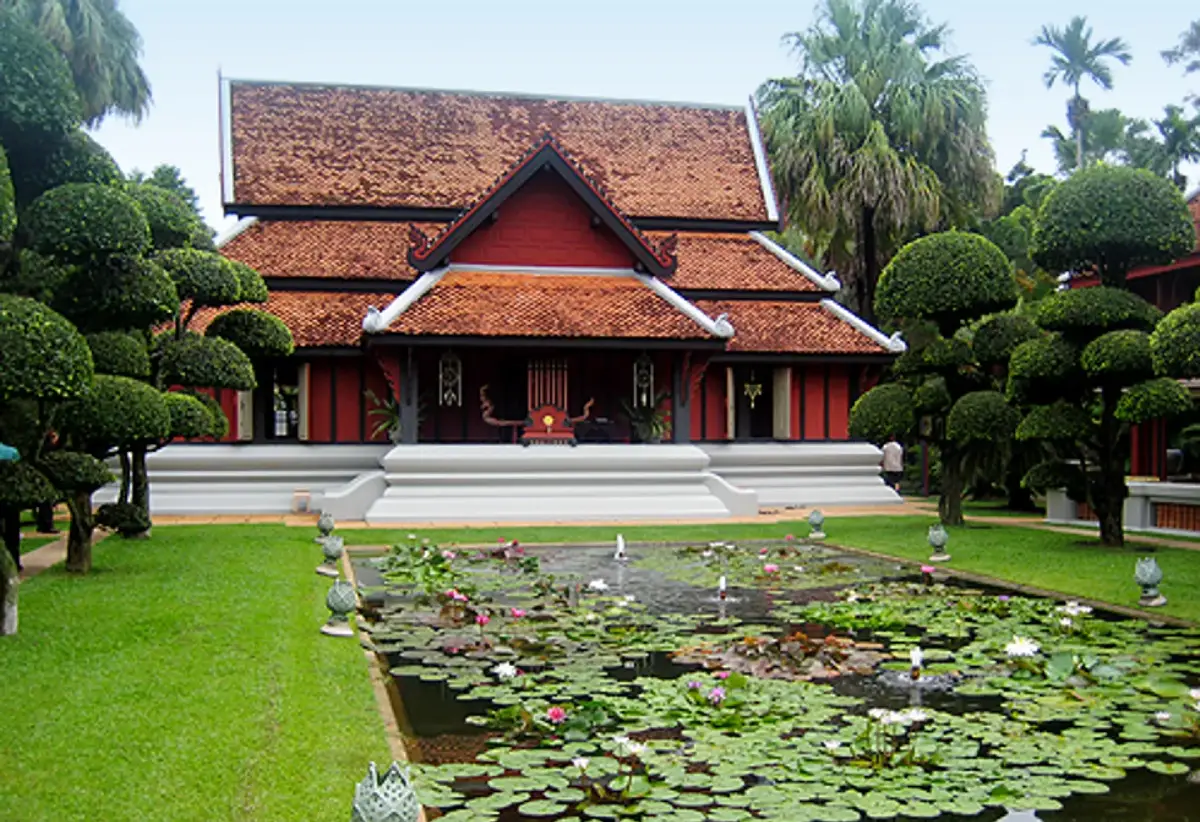
The physical setting of Ban Khampun enhances the textile experience. Visitors entering the compound during an open-house event encounter a group of Thai-Isan wooden buildings arranged with calm and dignity. The red wooden structures, open lawn, shaded corners and traditional architectural details create an atmosphere that feels like both a home and a museum. The buildings are not merely decorative. They support the life of the textiles: storage, display, weaving, demonstration, reception and cultural presentation. This setting allows visitors to understand that the cloth belongs to a larger world of architecture, family, craft, memory and community.
The annual opening of Ban Khampun during the Ubon Ratchathani Candle Festival is especially meaningful. The Candle Festival is the province’s most important cultural season, bringing together Buddhist devotion, wax carving, parades, local performance, music, craftsmanship and community participation. Visiting Ban Khampun during the same period allows travelers to see another side of Ubon Ratchathani’s artistic identity. The festival shows the city’s public ceremonial art, while Ban Khampun reveals the quieter and more intimate art of the loom. Together, candle carving and silk weaving demonstrate the strength of Ubon Ratchathani as a city of craftsmanship.
During the open-house event, visitors may see the weaving production area, exhibitions of antique and contemporary textiles, displays related to Mae Khampun Srisai and Mechai Taesujariya, and demonstrations of traditional arts. Activities may include silk preparation, mudmee tying, weaving, flower arrangement, wax-flower craft, traditional music and Isan cultural performance. These activities help visitors understand that Ban Khampun is not only about cloth. It is about a complete cultural environment where textiles, architecture, music, ritual objects, performance and community memory are connected.
The weaving house is one of the most important areas for anyone interested in craft. Watching weavers at work helps visitors understand that a woven pattern is not painted onto the fabric. It is planned long before weaving begins. Threads are tied, dyed, arranged and controlled by hand. The weaver must remember patterns, manage tension, follow rhythm and make precise movements repeatedly. Even a small error can affect the entire fabric. Seeing this process directly changes the way travelers look at Thai silk. A finished textile becomes more than a beautiful object; it becomes visible time, labour and intelligence.
The antique textiles preserved at Ban Khampun are valuable cultural documents. Each piece records information about period, region, technique, social meaning and taste. Some textiles reflect the dress traditions of Isan communities. Others reveal refined mudmee patterns, brocade techniques or influences from neighbouring cultural worlds. These textiles function like historical records written in silk, colour and pattern. Looking closely at them allows visitors to read local history through material culture rather than through written documents alone.
Ban Khampun also shows how craft supports community life. More than 30 weavers have been associated with the house, producing handwoven silk through traditional looms. Their work preserves inherited knowledge while also creating income, dignity and local pride. Ban Khampun demonstrates that local craft does not need to remain frozen in the past. When it is handled with knowledge, integrity and creativity, it can move into formal ceremonies, art collections, fashion, cultural exhibitions and national recognition while still retaining the character of the community that produced it.
Architecturally, Ban Khampun is memorable because its wooden Thai-Isan buildings give the textiles a natural cultural setting. The houses, verandas, roofs, pillars and open spaces create a sense of quiet order. The architecture does not compete with the cloth; it frames it. The visitor sees the textiles not as isolated objects in a neutral gallery, but as works connected to home, climate, craft and local aesthetics. This makes the experience feel more personal than a conventional museum visit.
For travelers attending the Ubon Ratchathani Candle Festival, Ban Khampun can be included as a half-day cultural visit. A practical route is to watch the Candle Festival activities around Thung Si Mueang and Upparat Road, then travel across the Mun River to Warin Chamrap District to visit Ban Khampun during the open-house period. This combination creates a richer understanding of Ubon Ratchathani: wax carving, Buddhist procession, Isan music, traditional dance and handwoven silk all appear as parts of the same cultural landscape.
Ban Khampun is best suited for visitors who appreciate textiles, design, traditional craft, cultural heritage, Thai architecture and stories of national artists. It is not a place to rush through. The important details are subtle: the texture of silk, the precision of pattern, the colour transitions, the movement of hands at the loom, the arrangement of the wooden buildings and the stories behind the cloth. Visitors should allow at least 1 to 2 hours during the open-house event, and serious textile lovers may want to spend more time observing the exhibitions and demonstrations.
Visitor etiquette is important. Ban Khampun is a private cultural house, a working craft space and a museum-like environment. Visitors should follow the designated route, avoid touching antique textiles or weaving tools without permission, keep noise low, and respect any photography rules announced by the organizers. Many of the textiles are valuable cultural objects, and the working areas require concentration from the weavers. A respectful visit helps preserve the quality of the experience for both visitors and hosts.
For foreign travelers, Ban Khampun is one of the best places in Ubon Ratchathani to understand Thai textiles beyond the idea of souvenirs. The silk here should be viewed as cultural art. Each textile contains technique, memory, regional identity, personal devotion and the accumulated knowledge of many hands. Visitors interested in design, handmade objects, intangible cultural heritage or Southeast Asian material culture will find Ban Khampun especially rewarding.
The latest publicly published open-house information listed the admission ticket at 100 baht and the visiting hours from 09.00 to 17.00 during the annual event. Travelers should plan around the specific annual announcement because Ban Khampun’s weaving production house is not a public walk-in museum open every day throughout the year. Checking the yearly open-house dates is essential, especially for travelers coming from outside Ubon Ratchathani or from overseas.
Getting There is straightforward from central Ubon Ratchathani. Travelers cross the Mun River toward Warin Chamrap District and continue toward the Si Sa Ket Road or Nong Kin Phen area. The distance from Thung Si Mueang and Ubon Ratchathani old town is about 8 km, normally taking around 15 to 25 minutes depending on traffic. Taxis, rental cars and ride-hailing services are practical options. Travelers arriving by train may find access convenient because Ubon Ratchathani Railway Station is located in Warin Chamrap District.
Ban Khampun can be combined with several nearby cultural sites. Travelers interested in history and museums can pair it with Ubon Ratchathani National Museum, Thung Si Mueang, Wat Si Ubon Rattanaram and Wat Thung Si Mueang. Those staying in Warin Chamrap may also visit Wat Nong Pah Pong or explore local restaurants in the district. During the Candle Festival, Ban Khampun works especially well as a daytime visit before returning to the city for evening festival activities.
Ban Khampun gives Ubon Ratchathani another identity beyond the Candle Festival. It shows the province as a centre of high-level Isan textiles, refined handwork and living heritage. The place is a home, a museum, a weaving house, a family archive and a cultural landmark at the same time. A visit during the annual open-house event allows travelers to see time transformed into pattern, devotion transformed into silk, and local knowledge transformed into national art. For anyone who wants to understand the cultural depth of Ubon Ratchathani, Ban Khampun is one of the most meaningful places to know.
| Name | Ban Khampun Ubon Ratchathani / Ban Khampun Museum |
| Location | Warin Chamrap District, Ubon Ratchathani Province |
| Address | 331 Si Sa Ket Road, Warin Chamrap District, Ubon Ratchathani Province / Ban Khampun Community, Moo 9, Nong Kin Phen Subdistrict, Warin Chamrap District, Ubon Ratchathani 34190, Thailand |
| Coordinates | 15.195682, 104.827141 |
| Highlights | A private Isan textile museum and handwoven silk production house with antique textiles, traditional weaving workshops, Thai-Isan wooden architecture, and the legacy of Mae Khampun Srisai and Mechai Taesujariya |
| History | Ban Khampun preserves and develops Thai-Isan silk weaving knowledge passed down through generations. It is closely associated with Mae Khampun Srisai, National Artist 2018, and Mechai Taesujariya, National Artist 2021. |
| Name Origin | The name honours Mae Khampun Srisai, the master weaver whose work shaped the identity of Ban Khampun. |
| Distinctive Features | Thai-Isan wooden buildings, handloom silk production, mudmee silk combined with chok technique, Ubon-style gold brocade, contemporary woven works, and pha kab bua, the signature textile of Ubon Ratchathani Province |
| Travel Information | From central Ubon Ratchathani, cross the Mun River to Warin Chamrap District and continue toward Si Sa Ket Road or Nong Kin Phen Subdistrict. The distance from Thung Si Mueang is about 8 km and normally takes 15 – 25 minutes. |
| Current Status | Open To Outside Visitors During The Annual Open-House Event Around The Ubon Ratchathani Candle Festival; The Weaving Production House Is Not A Regular Daily Public Museum |
| Open Days | During The Annual “Open House At Ban Khampun” Event Around The Ubon Ratchathani Candle Festival |
| Opening Hours | 09.00 – 17.00 During The Open-House Event |
| Fees | Latest Published Open-House Admission: 100 Baht |
| Facilities | Visitor reception area during the open-house event, weaving workshops, textile display areas, Thai-Isan wooden buildings, cultural demonstration areas and open lawns within the Ban Khampun compound |
| Main Areas / Zones | Handwoven Textile Production House Antique And Contemporary Textile Exhibition Area Thai-Isan Wooden Building Cluster Mae Khampun Srisai Exhibition Area Mechai Taesujariya Exhibition Area Craft Demonstration Area During The Open-House Event Pha Kab Bua And Ubon Textile Display Area |
| Caretaker | Ban Khampun And The Taesujariya Family |
| Key Figures | Mae Khampun Srisai, National Artist In Visual Arts, Fine Art Weaving, 2018 Mechai Taesujariya, National Artist In Visual Arts, Weaving, 2021 |
| Community Contact Number | Nong Kin Phen Subdistrict Administrative Organization: 045-251-824 |
| Nearby Tourist Attractions | 1. Ubon Ratchathani Railway Station, About 5 km 2. Wat Si Ubon Rattanaram, About 7 km 3. Ubon Ratchathani National Museum, About 8 km 4. Thung Si Mueang, About 8 km 5. Wat Thung Si Mueang, About 8 km 6. Wat Nong Pah Pong, About 14 km |
| Nearby Restaurants | 1. Khampun Museum Cafe, About 0.1 km 2. Chamchuri Restaurant, Baan Suan Khun Ta Hotel, About 3 km, Tel. 093-498-8811, 045-251-288 3. Pak Mor Khang Sra Wai Nam Warin, About 4 km, Tel. 083-682-8059 4. Nom Hok Warin Restaurant, About 5 km, Tel. 045-322-378, 086-471-0578 5. Aroy Warin, About 5 km, Tel. 087-444-0618 6. Jane Moo Kratha Warin Chamrap, About 5 km, Tel. 094-225-9509 |
| Nearby Accommodations | 1. Baan Suan Khun Ta Golf & Resort, About 3 km, Tel. 045-251-288, 093-498-8811 2. U Duay Gan Garden Home, About 5 km, Tel. 091-835-9784 3. @UBON HOTEL, About 5 km, Tel. 045-995-199, 081-393-9995 4. V Hotel Ubon, About 10 km, Tel. 097-334-4480, 045-285-757 5. Laithong Hotel, About 9 km, Tel. 045-264-271-3 |
Frequently Asked Questions (FAQ)
Q: Where is Ban Khampun located?
A: Ban Khampun is located in Warin Chamrap District, Ubon Ratchathani Province, in the Ban Khampun community of Nong Kin Phen Subdistrict.
Q: Is Ban Khampun open every day?
A: The weaving production house is not a regular daily public museum. It opens to outside visitors during the annual “Open House At Ban Khampun” event around the Ubon Ratchathani Candle Festival.
Q: Is there an admission fee for Ban Khampun?
A: The latest published open-house admission fee was 100 baht for the annual special event.
Q: What is Ban Khampun famous for?
A: Ban Khampun is famous for its Isan textile museum, antique textiles, handwoven silk, Thai-Isan wooden architecture, mudmee silk with chok technique, Ubon-style brocade and pha kab bua, the signature textile of Ubon Ratchathani Province.
Q: Who was Mae Khampun Srisai?
A: Mae Khampun Srisai was a master weaver of Ban Khampun and a National Artist of Thailand in Visual Arts, Fine Art Weaving, in 2018.
Q: What is pha kab bua?
A: Pha kab bua is the signature textile of Ubon Ratchathani Province developed through Ban Khampun. It combines several weaving techniques, including mudmee, twisted silk, khit and chok, to create depth, colour and distinctive patterns.
Q: When is the best time to visit Ban Khampun?
A: The best time is during the Ubon Ratchathani Candle Festival period, when the annual open-house event allows outside visitors to enter the weaving production area and special exhibitions.
Q: What nearby attractions can be visited after Ban Khampun?
A: Nearby attractions include Ubon Ratchathani National Museum, Thung Si Mueang, Wat Si Ubon Rattanaram, Wat Thung Si Mueang, Ubon Ratchathani Railway Station and Wat Nong Pah Pong.
 Category: ●Art, Culture and Heritage
 Group: ●Museums
Last Update : 2 MonthAgo
 Last Update : 2 MonthAgo
 Click to Access the Navigation Map GPS
Ban Khampun Map
Recommend

 Historical Sites and Monuments(5)
 Landmarks and Memorials(2)
 Royal Palace(1)
 Art, Craft Centres, Tradition(7)
Museums(3)
Art, Craft Centres, Tradition(7)
Museums(3)
 Places of Worship
 Temple(37)
 Other Sacred Sites(4)
 Research and Development
 Royal Project(2)
 Suburban Living
 Village, Community(2)
 Local Market(4)
 Nature and Wildlife
 National Parks and Marine Reserves(5)
 Mountain (Doi)(6)
 Dam, Reservoir, Lake(8)
 Waterfalls(12)
 Hot Springs(1)
 Caves(2)
 River, Canal(11)
 Bays and Beaches(8)
 Islands(2)
 Other natural attractions(6)
 Entertainment and Agricultural
 Zoos and Aquariums(1)
 Animal camps and shows(1)
 Farms, Parks and Ecotourism(1)


