
lovethailand home >Northeastern Travel Attractions >Surin Travel Attractions >Lam Duon >Tra Pia Tia > Wat Prasat Thep Nimit
TL;DR: Wat Prasat Thep Nimit is located at Ban Nong Ko, Trapiang Tia Subdistrict, Lamduan District, Surin Province 32220, open Daily, hours 08.00 – 17.00.
Wat Prasat Thep Nimit
Open Days: Daily
Opening Hours: 08.00 – 17.00
Wat Prasat Thep Nimit Surin is an old and culturally significant temple located in Ban Nong Ko, Trapiang Tia Subdistrict, Lamduan District, Surin Province. The temple is important not only as a Buddhist place of worship for the local community, but also as the site of Prasat Trapiang Tia, an ancient sanctuary that connects the present village temple with the deeper historical layers of lower northeastern Thailand. Visitors who come here can experience a living Buddhist temple, a local archaeological site, community traditions, and the memory of respected monastic teachers in one place.
The main highlight of Wat Prasat Thep Nimit is Prasat Trapiang Tia, an ancient site located within the temple grounds. This sanctuary gives the temple a historical depth that ordinary village temples do not always have. It reflects the long cultural connection between Surin, Khmer-influenced heritage, local sacred landscapes, and present-day Buddhist practice. The temple therefore represents more than a place for merit-making. It is a cultural landscape where ancient belief, local memory, Buddhist devotion, and community life continue to coexist.
Trapiang Tia Subdistrict has a distinctive cultural identity. In the context of lower-Isan and Khmer-influenced local language, the word “trapiang” is often associated with a pond or water source, while “Tia” is preserved as part of the local place name. The name of the subdistrict, the name of the ancient sanctuary, and the name of the temple all connect the site with its local environment and historical memory. A visit to Wat Prasat Thep Nimit therefore introduces travelers to the cultural geography of Lamduan District, not only to a single temple building.
The atmosphere of Wat Prasat Thep Nimit is calm and closely tied to the local community. It is not a large commercial tourist attraction. It is a village temple where local people still come to make merit, perform Buddhist ceremonies, gather for community activities, and maintain respect for the ancient site within the temple grounds. This gives the temple an authentic character. Visitors can see how Buddhism and local heritage continue to function in a real rural community rather than as a staged display.
Wat Prasat Thep Nimit is also associated with Phra Khru Suthep Chantasarn, also known as Luang Pho Charin Chantasaro, a respected monk remembered by local people and disciples. He was an important former abbot of Wat Prasat Thep Nimit and a former district ecclesiastical leader of Lamduan. His name remains connected with the temple through local memory, sacred objects, merit-making events, and the construction of Cintāsāro Chedi. For many people in the area, his legacy adds a strong spiritual dimension to the temple.
Cintāsāro Chedi is one of the important features of the temple because it preserves the memory of a revered teacher. In Thai Buddhist culture, a chedi is not merely a structure. It is a symbolic place of remembrance, gratitude, and spiritual continuity. At Wat Prasat Thep Nimit, the chedi connects the devotion of local people to Luang Pho Charin Chantasaro with the temple and its community. Visitors can pay respect, make merit, and reflect on the role of monastic teachers in local Buddhist life.
The main areas of the temple include the primary worship area, the ancient sanctuary of Prasat Trapiang Tia, the chedi area, halls or merit-making spaces, the temple courtyard, monastic areas, and community activity spaces. A respectful visit should begin at the main worship area before walking to the ancient site and other important zones. This order allows visitors to approach the temple both as a Buddhist place and as a cultural heritage site.
Prasat Trapiang Tia is the historical heart of the temple area. Ancient sanctuaries in lower northeastern Thailand were often built as sacred religious spaces linked to the beliefs, settlements, and cultural networks of earlier communities. Although the site has passed through centuries of change, its remaining traces still show that this area once held religious and cultural significance. Its presence within a living Buddhist temple makes the site especially meaningful because past and present remain physically connected.
The charm of Prasat Trapiang Tia lies in the fact that it remains connected with community life. It is not isolated as a silent ruin without local meaning. It stands within a temple where monks, villagers, Buddhist ceremonies, and cultural activities continue today. The ancient site speaks of the past, while the temple around it shows that sacred space remains active in the present. This makes Wat Prasat Thep Nimit valuable for travelers interested in living heritage.
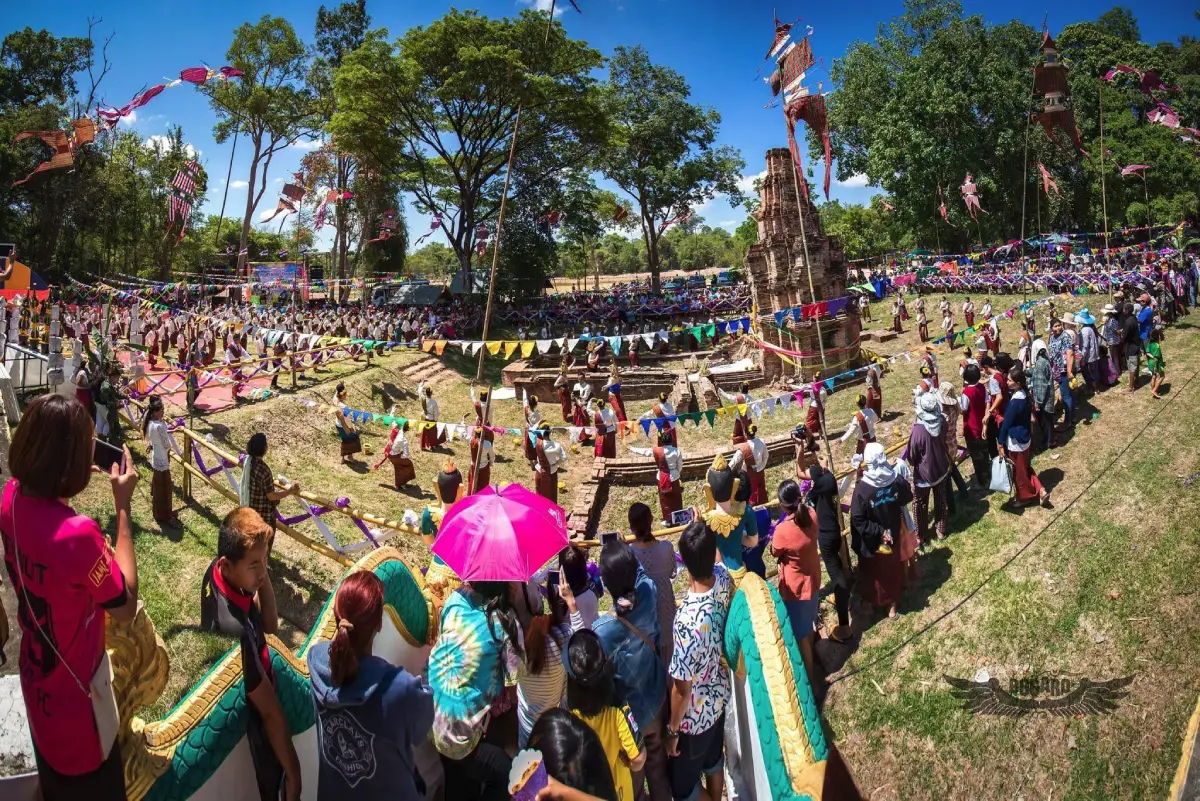
Wat Prasat Thep Nimit has a role in the local cultural tradition connected with Prasat Trapiang Tia. Community activities are organized to preserve and communicate the story of the ancient sanctuary. These events may include rituals, cultural performances, processions, traditional dance, and activities that allow local people to honor the site. When such activities are held at the temple, the temple becomes a cultural stage for the community as well as a place of worship.
The ritual honoring Prasat Trapiang Tia reflects the blending of Buddhism, respect for ancient sacred places, and local belief. Communities with old sanctuaries often maintain ceremonies to honor ancestors, guardian spirits, and the sacredness of the land. Such ceremonies preserve the relationship between people and place. They prevent the ancient sanctuary from becoming only an archaeological object and allow it to remain a meaningful part of local identity.
The cultural activities at Wat Prasat Thep Nimit also help younger generations understand their roots. Children, students, and local residents can learn about the ancient sanctuary through performances, local storytelling, community participation, and traditional ceremonies. This kind of learning is different from reading a textbook. It happens through living participation, which helps heritage remain present in daily life.
As a Buddhist temple, Wat Prasat Thep Nimit continues to serve its local community. Villagers visit the temple for Buddhist holy days, merit-making, food offerings to monks, Dhamma listening, Kathin, forest-robe offerings, ordinations, funerary rites, and family ceremonies. The temple supports both joyful occasions and moments of loss. It is therefore a religious, social, and emotional center for Ban Nong Ko and nearby communities.
Buddhist holy days are especially important in village temple life. Local people come to the temple to make merit, observe precepts, listen to chanting, and reflect on Buddhist values. In a rural community, Buddhist holy days help create a rhythm of spiritual awareness amid ordinary work, family responsibilities, and agriculture. Wat Prasat Thep Nimit provides a place where people can return to generosity, moral conduct, and calmness.
Kathin and forest-robe offering ceremonies reveal the strength of community devotion. During these events, villagers and former residents return to support the temple. Donations, food, robes, and necessary items are offered to the Sangha. These ceremonies help maintain temple buildings, support monastic life, and strengthen the bonds between monks and laypeople. In this way, the temple remains alive through the shared care of the community.
Ordination ceremonies are also meaningful at a community temple like Wat Prasat Thep Nimit. In Thai Buddhist culture, ordination connects sons, parents, relatives, monks, and villagers. The temple becomes the center of the ceremony, creating merit and reinforcing Buddhist identity. Such ceremonies show how temples continue to play a central role in family and village life.
Funerary rites and memorial ceremonies are another important role of the temple. When a family experiences loss, the temple becomes a place for chanting, merit dedication, remembrance, and community support. Monks lead the rites, relatives gather, and neighbors help one another. This shows that the temple is present not only in moments of celebration but also in the difficult passages of life.
Wat Prasat Thep Nimit has also functioned as a public and educational space for the local community. Like many Thai village temples, it is more than a religious site. It can serve as a meeting place, learning space, and venue for local activities. This broader role reflects the traditional place of temples in Thai society, where religion, education, social welfare, and community identity are closely linked.
For visitors interested in Surin history, Wat Prasat Thep Nimit offers an important local perspective. Surin is not made up only of famous large sanctuaries and major tourist sites. It also contains smaller local heritage places embedded within villages and temples. Prasat Trapiang Tia is one of these local heritage sites. Its value lies not in monumental scale, but in its relationship with the community and the continuity of sacred space.
The temple is also a good stop in a Lamduan cultural route. Lamduan District has local temples, agricultural communities, town shrines, and access to important cultural sites nearby. Visitors can combine Wat Prasat Thep Nimit with Lamduan City Pillar Shrine, Wat Pa Dong Khu, Wat Tri Sawat Rattanaram, Sikhoraphum Sanctuary, Surin National Museum, and temples in Surin city. This route connects village faith, ancient remains, monastic memory, and provincial history.
A practical route is to visit Wat Prasat Thep Nimit and Prasat Trapiang Tia in the morning or early afternoon, then continue to Lamduan City Pillar Shrine or Wat Pa Dong Khu. With more time, visitors can travel to Sikhoraphum Sanctuary or return to Surin city for Wat Burapharam, Surin National Museum, and Surin City Pillar Shrine. This route is suitable for travelers who want to understand Surin through temples, ancient sites, and local communities.
Visitors should allow at least 45 minutes to 1 hour at Wat Prasat Thep Nimit. This is enough time to pay respect, walk around the temple, see Prasat Trapiang Tia, and observe the atmosphere quietly. Travelers interested in local history should allow more time, especially if they have the opportunity to speak respectfully with monks or local residents. Some stories about the temple and the ancient site remain in community memory rather than in formal signs.
Because the site is both a Buddhist temple and an ancient monument area, respectful behavior is essential. Visitors should dress modestly, speak quietly, avoid climbing on ancient structures, never move stones or fragments, keep the temple clean, and avoid disturbing monks or worshippers. If ceremonies or community events are taking place, visitors should give priority to the ritual area and follow instructions from temple caretakers or local staff.
Photography should also be done respectfully. A temple and an ancient sanctuary are not ordinary photo backdrops. They are sacred places for local people. Visitors should not step on ancient bases, pose in disrespectful ways, photograph monks or ceremony participants intrusively, or use noisy equipment near worship areas. Responsible photography helps preserve both the dignity and the atmosphere of the place.
Getting to Wat Prasat Thep Nimit is most convenient by private car, rental car, or chartered vehicle. From Surin city, travel toward Lamduan District, then continue to Trapiang Tia Subdistrict and Ban Nong Ko. The distance from Surin city is about 38 km, depending on the route. From Lamduan town, the trip is shorter and can easily be combined with nearby temples and local restaurants.
Getting There is easiest by navigating to “Wat Prasat Thep Nimit, Trapiang Tia Subdistrict, Lamduan District, Surin Province” or “Prasat Trapiang Tia.” The place name may appear in different spellings, including Trapiang Tia, Tapiang Tia, or Trawpiang Tia. Including Ban Nong Ko and Lamduan District in the destination helps prevent confusion and ensures that travelers reach the correct temple.
There is no admission fee for general worship and ordinary visits to Wat Prasat Thep Nimit. Visitors may make donations according to their faith through the proper temple donation points. If visitors wish to organize a group ceremony, film inside the site, or use the area around the ancient monument for an activity, they should contact the temple, local authorities, or relevant cultural agencies in advance.
Facilities at the temple are typical of a local community temple. Visitors can expect a worship area, temple courtyard, halls or merit-making spaces, the ancient sanctuary area, toilets, and parking according to site conditions. Travelers should prepare as they would for a rural temple and local heritage site: bring drinking water on hot days, wear comfortable shoes, and plan the visit during morning or afternoon hours.
Restaurants near the temple are found in Lamduan District and Surin city. Visitors who want the closest meal options can stop in Lamduan before or after the temple visit. Those who prefer a wider choice of restaurants and cafés can return to Surin city. Planning meals according to the route is useful, especially for families, elderly travelers, or groups.
Accommodation is most convenient in Surin city because the city has more hotels, restaurants, markets, transport, and services. Small local accommodations may also be available around Lamduan and nearby districts. Travelers who plan to visit several sites in one trip may find Surin city the most practical base, while those focusing on Lamduan can choose a smaller local place if suitable.
For international visitors, Wat Prasat Thep Nimit offers a clear view of Surin beyond elephants, silk, and major Khmer ruins. It shows how local communities preserve ancient places within active Buddhist temple grounds. Visitors can see a living temple, an ancient sanctuary, community tradition, and local Buddhist devotion in one site. This makes the temple especially valuable for travelers interested in authentic cultural landscapes.
Wat Prasat Thep Nimit is suitable for Buddhist pilgrims, cultural travelers, students, researchers, families, and international visitors who want to understand local Surin heritage. Its importance lies in the combination of a village temple, Prasat Trapiang Tia, Cintāsāro Chedi, the memory of Luang Pho Charin Chantasaro, and cultural activities maintained by the local community.
Overall, Wat Prasat Thep Nimit is more than an old and famous temple in Surin. It is a place where layers of sacred meaning continue from the ancient sanctuary to the present Buddhist temple and to the memory of respected teachers. It allows visitors to understand how local heritage survives not only through monuments, but also through faith, ceremonies, community participation, and daily temple life.
A meaningful visit to Wat Prasat Thep Nimit requires time and attention. Visitors should walk slowly, observe the temple and ancient site with respect, and notice how the place remains alive through monks, villagers, rituals, ceremonies, and local memory. The beauty of this temple is not based on grandeur. It lies in the deep relationship between people and place, and in the community’s ability to preserve its heritage through changing times.
In summary, Wat Prasat Thep Nimit Surin is a temple of religious, historical, and cultural value. It is home to Prasat Trapiang Tia, connected with local cultural traditions, associated with Phra Khru Suthep Chantasarn or Luang Pho Charin Chantasaro, and serves as a spiritual center of Ban Nong Ko. Visitors can make merit, pay respect, see an ancient sanctuary, learn about local tradition, and experience a quieter, deeper side of Surin Province.
| Name | Wat Prasat Thep Nimit Surin / Wat Prasat Thep Nimit Ban Nong Ko |
| Location | Ban Nong Ko, Trapiang Tia Subdistrict, Lamduan District, Surin Province 32220 |
| Address | Wat Prasat Thep Nimit, Ban Nong Ko, Trapiang Tia Subdistrict, Lamduan District, Surin Province 32220 |
| Coordinates | 14.74515, 103.77054 |
| Highlights | Old temple in Lamduan District, Prasat Trapiang Tia ancient sanctuary, Cintāsāro Chedi, the memory of Phra Khru Suthep Chantasarn or Luang Pho Charin Chantasaro, local cultural tradition of Prasat Trapiang Tia, and the atmosphere of a living lower-Isan community temple |
| History | An old temple in Trapiang Tia Subdistrict located together with Prasat Trapiang Tia, an ancient site in Ban Nong Ko, Lamduan District. The temple serves Buddhist, community, and local cultural preservation roles |
| Name Origin | The temple name is connected with Prasat Trapiang Tia and the sacred meaning of the place. “Thep Nimit” conveys auspiciousness and a sacred place respected by the local community |
| Distinctive Features | A living community temple with an ancient sanctuary inside the same grounds, showing the continuity of sacred space from the past to the present |
| Travel Information | From Surin city, travel toward Lamduan District, then continue to Trapiang Tia Subdistrict and Ban Nong Ko. The distance is about 38 km and is suitable for private cars, rental cars, or chartered vehicles |
| Current Status | Open for worship, merit-making, temple visits, and visits to the Prasat Trapiang Tia ancient site. The temple remains active in Ban Nong Ko and Trapiang Tia Subdistrict |
| Open Days | Daily |
| Opening Hours | 08.00 – 17.00 |
| Fees | No Admission Fee For General Worship And Ordinary Visits. Donations May Be Made According To Faith |
| Facilities | Worship area, hall or merit-making space, temple courtyard, Prasat Trapiang Tia ancient sanctuary, community activity area, toilets, and parking according to local temple conditions |
| Main Areas / Zones | 1. Main Worship Area 2. Prasat Trapiang Tia Ancient Sanctuary Inside The Temple Grounds 3. Cintāsāro Chedi 4. Hall Or Community Merit-Making Area 5. Temple Courtyard And Local Cultural Event Area 6. Monastic Residence Area 7. Learning Area For Ban Nong Ko And Trapiang Tia Local History |
| Important Rituals / Traditions | Buddhist holy day merit-making, Dhamma listening, food offerings to monks, Kathin, forest-robe offerings, ordinations, funerary rites, and the local cultural tradition of Prasat Trapiang Tia, including ritual honoring and community cultural activities |
| Abbot / Caretaker | An important former abbot was Phra Khru Suthep Chantasarn, also known as Luang Pho Charin Chantasaro, former ecclesiastical district chief of Lamduan. The temple grounds are maintained by the Wat Prasat Thep Nimit monastic community and Ban Nong Ko residents; activities involving the Prasat Trapiang Tia ancient site are coordinated with local and cultural authorities according to their responsibilities |
| Local Information Contact | Trapiang Tia Subdistrict Administrative Organization, Tel. 044-069-750 |
| Nearby Tourist Attractions | 1. Prasat Trapiang Tia, inside the temple grounds 2. Lamduan City Pillar Shrine, about 12 km 3. Wat Pa Dong Khu, Lamduan District, about 13 km 4. Wat Tri Sawat Rattanaram, Lamduan District, about 14 km 5. Ban Nong Ko And Trapiang Tia Community Route, about 1 km 6. Sikhoraphum Sanctuary, Sikhoraphum District, about 28 km 7. Surin National Museum, about 36 km, Tel. 044-513-272, 044-513-274 |
| Nearby Restaurants | 1. Map Phochana Restaurant, Lamduan, about 14 km, Tel. 086-866-7869 2. Craft Cafe Surin, about 35 km, Tel. 095-605-4281 3. Mozern Restaurant Surin, about 34 km, Tel. 084-995-6492 4. Chertom Surin, about 36 km, Tel. 098-997-7916 5. Sawasdee Surin, about 37 km, Tel. 085-637-7707 6. Seoul Bar - Cafe & Bistro Surin, about 37 km, Tel. 080-959-7942 |
| Nearby Accommodations | 1. Martina Hotel Surin, about 32 km, Tel. 044-713-555, 044-713-655, 086-469-6545 2. The Wood Surin, about 36 km, Tel. 063-023-7999 3. Thong Tarin Hotel, about 37 km, Tel. 044-514-281, 085-300-8858 4. Maneerote Hotel Surin, about 37 km, Tel. 044-514-569 5. Slive Hotel Surin, about 38 km, Tel. 044-060-322, 044-060-323 6. Small Local Accommodations Around Lamduan District, about 10 – 15 km |
Frequently Asked Questions (FAQ)
Q: Where Is Wat Prasat Thep Nimit Located?
A: Wat Prasat Thep Nimit is located in Ban Nong Ko, Trapiang Tia Subdistrict, Lamduan District, Surin Province 32220.
Q: When Is Wat Prasat Thep Nimit Open?
A: The temple is open daily from 08.00 to 17.00.
Q: Is There An Admission Fee?
A: No. There is no admission fee for general worship and ordinary visits. Visitors may donate according to their faith.
Q: What Is The Main Highlight Of Wat Prasat Thep Nimit?
A: The main highlight is the combination of an old community temple, Prasat Trapiang Tia ancient sanctuary, Cintāsāro Chedi, and the memory of Phra Khru Suthep Chantasarn or Luang Pho Charin Chantasaro.
Q: Why Is Prasat Trapiang Tia Important?
A: Prasat Trapiang Tia is an ancient sanctuary inside the temple grounds. It reflects Khmer-influenced heritage and the long sacred history of Trapiang Tia Subdistrict.
Q: How Is The Temple Connected With Luang Pho Charin Chantasaro?
A: Luang Pho Charin Chantasaro, also known as Phra Khru Suthep Chantasarn, was an important former abbot of Wat Prasat Thep Nimit and former ecclesiastical district chief of Lamduan. The temple has Cintāsāro Chedi connected with the remembrance of him.
Q: What Nearby Places Can Be Visited With Wat Prasat Thep Nimit?
A: Nearby places include Lamduan City Pillar Shrine, Wat Pa Dong Khu, Wat Tri Sawat Rattanaram, Sikhoraphum Sanctuary, Surin National Museum, and Wat Burapharam Royal Temple.
Q: What Should Visitors Wear To Wat Prasat Thep Nimit?
A: Visitors should dress modestly, wear appropriate trousers or skirts, speak quietly, avoid climbing on ancient structures, avoid disturbing monks or worshippers, and keep the temple clean.
 Category: ●Places of Worship
 Group: ●Temple
Last Update : 2 MonthAgo
 Last Update : 2 MonthAgo
 Click to Access the Navigation Map GPS
Wat Prasat Thep Nimit Map
Recommend

 Art, Culture and Heritage
 Historical Sites and Monuments(11)
 Landmarks and Memorials(2)
 Art, Craft Centres, Tradition(5)
 Museums(1)
Temple(15)
Museums(1)
Temple(15)
 Other Sacred Sites(1)
 Suburban Living
 Village, Community(9)
 Local Market(1)
 Nature and Wildlife
 National Parks and Marine Reserves(2)
 Mountain (Doi)(2)
 Dam, Reservoir, Lake(6)
 Waterfalls(1)
 River, Canal(2)
 Other natural attractions(4)
 Entertainment and Agricultural
 Farms, Parks and Ecotourism(2)


