
lovethailand home >Northeastern Travel Attractions >Surin Travel Attractions >Kap Choeng >Naeng Mut > Khao Laem
TL;DR: Khao Laem is located at Nang Mud Subdistrict, Kap Choeng District, Surin Province, near the Thai – Cambodian border, open Daily, hours 08.00 – 17.00.
Khao Laem
Open Days: Daily
Opening Hours: 08.00 – 17.00
Khao Laem Surin, also known as Khao Laem Rattanamuni Buddhist Park and Khao Laem Rattanamuni Monastic Residence, is a meaningful nature and spiritual destination in Kap Choeng District, Surin Province. Located in Nang Mud Subdistrict near the Thai – Cambodian border, the site is surrounded by natural forest, sandstone formations, quiet woodland, and a peaceful monastic atmosphere. It is a place for travelers who want to experience Surin through nature, faith, borderland scenery, and local history rather than only through the province’s better-known elephant, silk, and Khmer heritage routes.
Khao Laem brings together several layers of experience in one destination. Visitors come to walk through a natural forest trail, climb toward Pha Rattanamuni, pay respect at sacred Buddhist points, see the Amarit sacred pools, visit the Buddha’s footprint, and look out across the landscape toward Cambodia. The atmosphere is not that of a busy sightseeing stop; it is quieter, more contemplative, and closely connected with local devotion. For international travelers, this is one of the places that reveals the spiritual geography of southern Surin.
The site is located between Ban Nang Mud and Ban Khok Beng in Nang Mud Subdistrict, Kap Choeng District, Surin Province. It lies about 4 km from the Cambodian border and around 6 km south of the Hin Khon – Ta Miang local route. The mountain itself is a solitary sandstone hill with a pointed summit, covered by natural forest and rocky formations. The upper area has a relatively flat section used for worship, meditation, and viewing the surrounding landscape. This setting gives Khao Laem a strong sense of place as both a natural landmark and a sacred hill.
The name “Khao Laem” comes from the shape of the hill, whose pointed form makes it visually distinctive. The name “Khao Laem Rattanamuni” carries a more spiritual meaning. It is associated with the monastic residence and with Luang Pho Rim Rattanamuni, an important monk linked with the early development of the site as a meditation place. The name therefore reflects both geography and devotion: a pointed hill, a forest retreat, and a place where Buddhist practice became rooted in a borderland landscape.
Khao Laem became widely known as a spiritual site around 1970, when Luang Pho Rim Rattanamuni, the abbot of Wat Thung Mon, came to establish a temporary monastic retreat on the hill for meditation and spiritual practice. At that time, access was difficult and the border area was far less settled than it is today. The road was not convenient, and reaching the mountain required considerable effort. Yet the quietness of the site, its isolation, and its natural power made it suitable for Buddhist practice, attracting local devotees and supporters over time.
Around 1974, Luang Pho Rim and local devotees organized the first Khao Laem climbing tradition. Even though transportation was difficult and the route was still primitive, many people joined the event. This shows that local faith in Khao Laem had already become strong in the early period. The tradition was not simply a hill walk; it was a communal act of merit-making and devotion, connecting local people with a sacred mountain that had become part of their spiritual identity.
Later, the area was affected by instability along the Cambodian border. For a period, Khao Laem was abandoned and could not be maintained normally. Local people were unable to use the area freely, and the site became overgrown. In 1993, Phra Khru Phanom Silachan, also known as Phra Ajarn Wasan of Wat Pa Khao To, led monks on a forest pilgrimage and rediscovered the hill as a quiet, secluded, and suitable place for meditation. He then discussed with local leaders, villagers, and monks about restoring the place as a monastic residence.
Phra Wasana, known locally as Luang Ta Aed, was assigned to care for and develop the monastic residence. He played an important role in improving the area, making access easier, and encouraging visitors to preserve the forest. His message emphasized that Khao Laem should remain a complete forest and that visitors should not damage trees, disturb wildlife, or remove natural materials from the mountain. This conservation-minded approach helped Khao Laem return as both a sacred place and an eco-cultural destination of Kap Choeng District.
The most memorable part of visiting Khao Laem is the walk up to Pha Rattanamuni. The natural trail is around 1 km long and usually takes about 30 minutes on foot, depending on fitness and walking pace. The route includes sandy soil, natural slopes, and rocky sections, so visitors should wear shoes with good grip and carry a small bottle of drinking water. The climb is not extremely long, but it requires care and a steady pace, especially during hot weather or after rain.
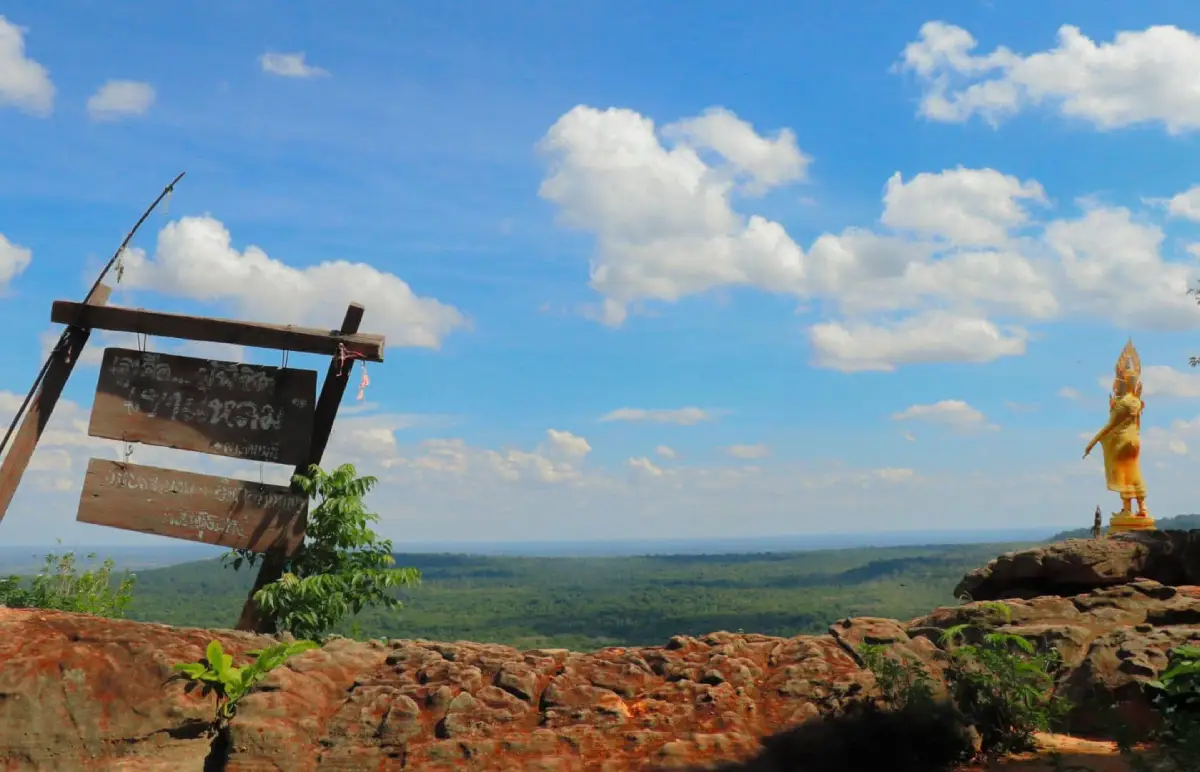
Pha Rattanamuni is the main scenic point of Khao Laem. From the cliff area, visitors can enjoy fresh air and a wide view toward the Cambodian side of the border. The surrounding landscape includes forest, rock formations, slopes, and natural ridges, giving the site a strong borderland atmosphere. Standing at the viewpoint helps travelers understand Kap Choeng not merely as a border district, but as an area where nature, faith, community memory, and regional history meet.
The cliff has its own distinctive character. It opens onto a wide view, yet the presence of trees and natural features helps soften the sense of exposure. Visitors should still remain careful and avoid climbing beyond safe areas. The site is best experienced slowly: pausing to look at the forest, observing the rock formations, taking photographs with caution, and appreciating the quiet atmosphere rather than treating it as a quick viewpoint stop.
Another important highlight is the 2 Amarit pools, also called sacred water pools. These pools are located near the cliff among large rocks. They are known locally for holding water throughout the year, creating a sense of wonder because of their location close to a high rocky area. Local belief connects the pools with sacred power and naga-related folklore. Many visitors make sure to see both pools when they reach the upper area of Khao Laem.
The Buddha’s footprint at Khao Laem is another important worship point. Although the structure is a later addition, its meaning is clear: it marks the mountain as a Buddhist place and reinforces the idea that the hill is not merely a natural viewpoint. It is a space for merit-making, prayer, contemplation, and respect. For Thai visitors, such a place carries spiritual significance; for foreign travelers, it provides insight into how local communities sanctify landscapes through Buddhist symbols.
Khao Laem Rattanamuni Monastic Residence stands within a natural forest setting, so the atmosphere is quieter and more modest than a large urban temple. Visitors should dress respectfully, avoid loud behavior, and keep the area clean. The site should be approached as both a religious place and a conservation area. Respect here includes not only paying respect to Buddhist sites but also protecting trees, rocks, water sources, wildlife, and the surrounding ecosystem.
The forest around Khao Laem is one of the main reasons the place remains attractive. Trees cover much of the hill, creating shade along the walking route and giving the area a cool, calm character. Visitors will see natural rocks, woodland textures, and borderland forest scenery. The simplicity of the place is its strength. It is not heavily developed, and that natural quality helps preserve the feeling of a forest retreat.
Culturally, the annual Khao Laem climbing tradition is one of the most important living connections between the mountain and the local community. Held on the fifteenth waxing moon day of the fifth lunar month, the event brings villagers and devotees together to climb the hill, make merit, and pay respect to sacred sites. This tradition keeps Khao Laem alive as a community landscape rather than a forgotten mountain. Each year, the climb renews the bond between faith, nature, and local identity.
For travelers interested in border geography, Khao Laem provides a strong sense of the Thai – Cambodian frontier. The mountain stands close to Cambodia and belongs to the broader natural landscape associated with the Phanom Dong Rak range. From Pha Rattanamuni, visitors can imagine how hills, forests, local paths, religious sites, and border history are connected. This makes Khao Laem especially meaningful for those who want to understand Surin’s southern districts in depth.
Khao Laem is suitable for a half-day trip, especially for travelers staying in Kap Choeng or passing through the Chong Chom border route. A morning visit is ideal. Visitors can walk up to Pha Rattanamuni, see the sacred pools, pay respect at the Buddha’s footprint, rest at the viewpoint, and walk back down before the day becomes too hot. Midday can be tiring because the trail is exposed in parts and the heat can be strong.
The cool season is the most comfortable period for climbing Khao Laem because the weather is easier for walking and visibility is often good. During the rainy season, the forest becomes greener, but the path may be slippery. During the hot season, travelers should begin early and avoid walking during the strongest sunlight. In every season, visitors should bring water, wear proper footwear, dress modestly, and move carefully on sandy or rocky sections of the trail.
Getting There from Surin city is most convenient by private car. Travelers should head south through Prasat and Kap Choeng districts, then continue toward Nang Mud Subdistrict. Khao Laem is around 80 km from downtown Surin and is not far from the broader Chong Chom border travel route. The final approach uses local roads, and some sections may feel rural, so travelers should check the route before departure and use a vehicle suitable for countryside roads.
From Kap Choeng District, travel toward Nang Mud Subdistrict and the area between Ban Nang Mud and Ban Khok Beng. Khao Laem lies about 6 km south of the Hin Khon – Ta Miang road. A private vehicle is the best option because it allows visitors to control time and combine Khao Laem with nearby attractions such as Chong Chom Market, Chong Chom Border Checkpoint, Huai Ta Kao Reservoir, and other local sites in Kap Choeng District.
Travelers without a private vehicle should arrange a local vehicle from Kap Choeng or Surin city in advance. The access route is not a regular public-transport tourist corridor with frequent service to the entrance. Hiring a local driver is practical because local drivers understand the road conditions, the entrance, and the best time to visit. This is especially useful during the rainy season or during local events when more people travel to the area.
The most important rule for visiting Khao Laem is to preserve the natural and spiritual condition of the place. Visitors should not collect plants, stones, branches, or sacred objects. They should not write on rocks, leave litter, or make loud noise in meditation areas. These basic practices protect the mountain and follow the conservation spirit promoted by the monks who helped restore the site.
Khao Laem can be combined with several nearby travel routes. Nature-focused travelers can continue to Pha Manao, Huai Ta Kao Reservoir, and other forested border areas. Culture-focused travelers can visit Prasat Khana, the Ta Muen temple ruins group, or Prasat Ta Kwai. Travelers interested in border trade can continue to Chong Chom Market and the Chong Chom permanent border checkpoint. This makes Khao Laem a flexible stop in a broader Kap Choeng itinerary.
For families and small groups, Khao Laem is best suited to visitors who are comfortable with a short uphill walk. The main highlights are on the upper part of the mountain, so the experience involves walking rather than only sightseeing from a parking area. Elderly visitors and young children can visit if they walk slowly and rest as needed. Anyone with knee or mobility issues should assess their condition before attempting the trail to Pha Rattanamuni.
The special quality of Khao Laem is not found in large buildings or commercial facilities. Its value lies in the balance between forest, cliff, sacred pools, Buddhist symbols, and local devotion. The mountain, woodland, viewpoint, monastic residence, and annual tradition together form a spiritual landscape that reflects the identity of southern Surin. It is a destination for travelers who appreciate quiet places with meaning rather than crowded attractions.
Khao Laem Surin is therefore a worthwhile destination for anyone who wants to see a calmer and deeper side of the province. Every step up the trail, every view toward the border, and every sacred point on the hill helps visitors understand that Kap Choeng is not only a gateway to Cambodia. It is also a district with sacred landscapes, forest heritage, community traditions, and stories that remain strongly connected to local life.
| Name | Khao Laem Surin / Khao Laem Rattanamuni Buddhist Park / Khao Laem Rattanamuni Monastic Residence |
| Location | Nang Mud Subdistrict, Kap Choeng District, Surin Province, near the Thai – Cambodian border |
| Address | Area between Ban Nang Mud, Moo 1, and Ban Khok Beng, Moo 11, Nang Mud Subdistrict, Kap Choeng District, Surin 32210, Thailand |
| Highlights | Pha Rattanamuni, Cambodian border viewpoint, 2 Amarit sacred pools, Buddha’s footprint, Khao Laem Rattanamuni Monastic Residence, natural forest, and the annual Khao Laem climbing tradition |
| History | The site became known around 1970 through the temporary monastic retreat established by Luang Pho Rim Rattanamuni. The first Khao Laem climbing tradition was held around 1974, and the monastic residence was restored and developed again from 1993 onward. |
| Name Origin | Khao Laem refers to the pointed form of the sandstone hill, while Khao Laem Rattanamuni is the auspicious name of the monastic residence associated with a place of noble monks. |
| Distinctive Features | A solitary sandstone hill covered with natural forest, with a flat upper area, cliff viewpoint, sacred water pools, Buddhist worship points, and a meditation atmosphere. |
| Travel Information | From Surin city, travel south through Prasat and Kap Choeng districts toward Nang Mud Subdistrict. The distance is about 80 km. From the Hin Khon – Ta Miang road, continue south for about 6 km toward Khao Laem. |
| Current Status | Open to visitors as a nature, religious, and local-tradition destination in Nang Mud Subdistrict, Kap Choeng District, Surin Province. |
| Open Days | Daily |
| Opening Hours | 08.00 – 17.00 |
| Facilities | Access road to the monastic area, uphill walking trail, worship areas, viewpoint, and natural resting areas |
| Main Areas / Zones | 1. Khao Laem Rattanamuni Monastic Residence 2. Pha Rattanamuni 3. Two Amarit Sacred Pools 4. Buddha’s Footprint 5. Cambodian Border Viewpoint 6. Uphill Walking Trail 7. Natural Forest And Sandstone Rocks 8. Annual Khao Laem Climbing Tradition Area |
| Abbot / Caretaker | Abbot recorded in the founding history: Phra Wasana, or Luang Ta Aed Local administrative body: Nang Mud Subdistrict Administrative Organization |
| Main Contact Number | Nang Mud Subdistrict Administrative Organization, Tel. 044-558843 |
| Nearby Tourist Attractions | 1. Pha Manao, about 4 km 2. Prasat Khana, about 12 km 3. Huai Ta Kao Reservoir, about 22 km 4. Chong Chom Permanent Border Checkpoint, about 25 km 5. Chong Chom Border Market, about 26 km 6. Ta Muen Temple Ruins Group, about 45 km |
| Nearby Restaurants | 1. Ton Tamrap / Sahai Degree Restaurant, about 19 km, Tel. 089-8194566 2. Nai Pi Phochana, Kap Choeng, about 22 km, Tel. 044-559285 3. Saeng Dao Moo Kratha, about 24 km, Tel. 087-2466613 4. Jiang Fish Ball Restaurant, Chong Chom Branch, about 25 km, Tel. 044-147003 5. Rong Na Cafe Chong Chom, about 25 km, Tel. 061-4754923, 093-4184685 6. DAGAZ Coffee Chong Chom Branch, about 26 km, Tel. 087-8828881 |
| Nearby Accommodations | 1. Tharaphon Resort, about 25 km, Tel. 082-3789458 2. Maruay Thai House, Chong Chom, about 26 km, Tel. 091-4151226, 044-147081 3. Slive Hotel Surin, about 80 km, Tel. 044-060322, 044-060323 4. Sorin Boutique Hotel, about 80 km, Tel. 044-060188 5. The Wood Surin, about 80 km, Tel. 063-0237999 6. The Gun Hotel Surin, about 80 km, Tel. 088-1230456 |
Frequently Asked Questions (FAQ)
Q: Where is Khao Laem Surin located?
A: Khao Laem Surin is located in Nang Mud Subdistrict, Kap Choeng District, Surin Province, near the Thai – Cambodian border, between Ban Nang Mud and Ban Khok Beng.
Q: What are the opening days and opening hours of Khao Laem?
A: Khao Laem is open daily from 08.00 to 17.00.
Q: What is Khao Laem known for?
A: It is known for Pha Rattanamuni, the viewpoint toward Cambodia, the 2 Amarit sacred pools, the Buddha’s footprint, Khao Laem Rattanamuni Monastic Residence, natural forest, and the annual Khao Laem climbing tradition.
Q: How long does it take to walk up to Pha Rattanamuni?
A: The walking route is about 1 km and usually takes around 30 minutes, with some sandy and sloping sections. Proper walking shoes are recommended.
Q: When is the annual Khao Laem climbing tradition held?
A: The tradition is held every year on the fifteenth waxing moon day of the fifth lunar month, when local devotees climb the hill to make merit and pay respect to sacred sites.
Q: Who should visit Khao Laem?
A: It is suitable for nature lovers, short-hike travelers, borderland scenery seekers, Buddhist visitors, meditation-focused travelers, and anyone interested in the local culture of southern Surin.
Q: What should visitors prepare before going to Khao Laem?
A: Visitors should bring drinking water, wear comfortable walking shoes, dress modestly, and walk carefully on sloping sandy or rocky sections.
Q: What nearby places can be visited with Khao Laem?
A: Nearby places include Pha Manao, Prasat Khana, Huai Ta Kao Reservoir, Chong Chom Permanent Border Checkpoint, Chong Chom Border Market, and the Ta Muen temple ruins group.
 Category: ●Nature and Wildlife
 Group: ●Mountain (Doi)
Last Update : 2 WeekAgo
 Last Update : 2 WeekAgo
 Click to Access the Navigation Map GPS
 Art, Culture and Heritage
 Historical Sites and Monuments(11)
 Landmarks and Memorials(2)
 Art, Craft Centres, Tradition(5)
 Museums(1)
 Places of Worship
 Temple(15)
 Other Sacred Sites(1)
 Suburban Living
 Village, Community(9)
 Local Market(1)
 National Parks and Marine Reserves(2)
Mountain (Doi)(2)
National Parks and Marine Reserves(2)
Mountain (Doi)(2)
 Dam, Reservoir, Lake(6)
 Waterfalls(1)
 River, Canal(2)
 Other natural attractions(4)
 Entertainment and Agricultural
 Farms, Parks and Ecotourism(2)


