
lovethailand home >Northeastern Travel Attractions >Surin Travel Attractions >Phanom Dong Rak >Ta Miang > Prasat Ta Muean
TL;DR: Prasat Ta Muean, Surin attractions : Art, Culture and Heritage, Historical Sites and Monuments.
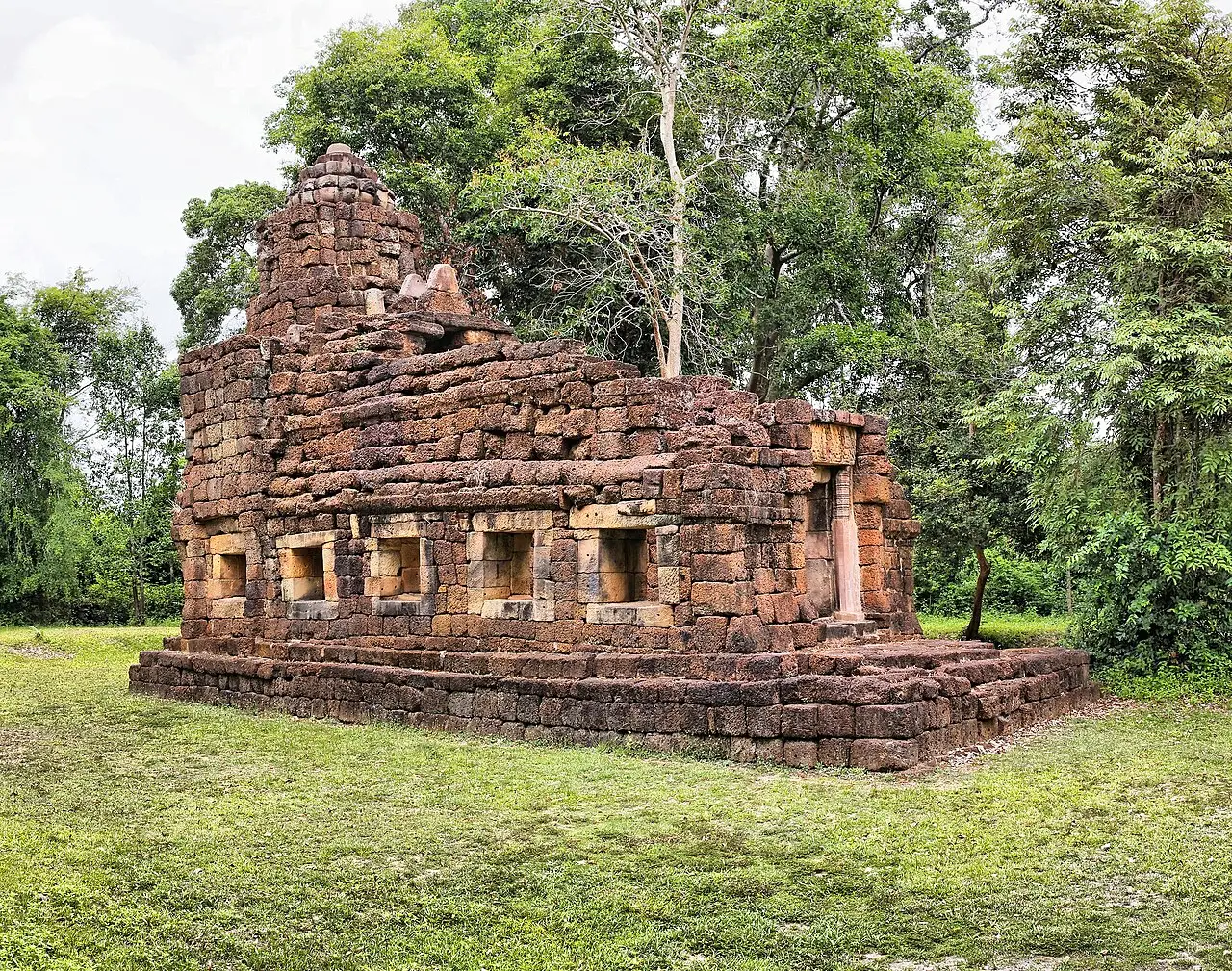
Prasat Ta Muean
Open Days: Access is available only when officially permitted by the authorities
Opening Hours: Access follows the safety measures set by military and site authorities
The Ta Muen Temple Group in Surin Province is one of the most important Khmer heritage complexes on the Phanom Dong Rak mountain range. Located at Ban Nong Khanna, Ta Miang Subdistrict, Phanom Dong Rak District, Surin Province, close to the Thailand-Cambodia border, the group consists of 3 closely related monuments: Prasat Ta Muen, Prasat Ta Muen Tot, and Prasat Ta Muen Thom. Each monument had a different role within the ancient Khmer road system. Prasat Ta Muen was a dharmasala, or travelers’ rest house. Prasat Ta Muen Tot was an arokayasala, or ancient hospital chapel. Prasat Ta Muen Thom was a large Hindu Shaivite sanctuary. Together, they preserve evidence of ancient travel, religious practice, medical care, ritual activity, and the border landscape of Southern Isan.
The Ta Muen Temple Group is more than a cluster of 3 ancient monuments. It represents a functioning system of infrastructure in the ancient Khmer world. Travelers moving along the route from Yasodharapura, the Khmer capital at Angkor, toward Phimai had to cross mountainous terrain, forested land, and strategic passes. The presence of a rest house, a hospital chapel, and a major sanctuary in the same area shows that the Ta Muen Pass was not merely a natural crossing. It was an organized route supported by architecture, religion, public service, and royal authority.
The location of the group on the Phanom Dong Rak mountain range is central to its historical meaning. This range forms a natural divide between the southern part of the Khorat Plateau and the Cambodian lowlands. Mountain passes such as Ta Muen or Ta Miang served as important corridors between regions. The monuments at Ta Muen confirm that people, officials, monks, traders, and ritual communities moved through this area over many centuries. The site stands at a point where geography, travel, power, and belief meet.
From Surin town, the traditional route to the Ta Muen Temple Group follows Highway 214 through Prasat District, then continues on Highway 2121 toward Ban Kruat for about 25 km. From Ban Ta Miang, a side road leads for about 13 km toward Ban Nong Khanna and the temple group. Today, the area is a controlled border zone. Access depends on military and official permission. Visitors must check the current access status before departure, carry identification, remain within permitted areas, and follow all instructions issued by officers on site.
Prasat Ta Muen is the smallest monument in the group, but its function was highly significant. It was built as a dharmasala, or travelers’ rest house, during the reign of King Jayavarman VII. The king was a major patron of Mahayana Buddhism and established public buildings along important routes across the Khmer realm. Prasat Ta Muen belonged to the network of rest houses along the route from Yasodharapura to Phimai. Its presence at the Ta Muen Pass confirms that this mountain crossing was part of a major ancient road.
Prasat Ta Muen was built of laterite and sandstone in the Bayon style associated with the reign of Jayavarman VII. The structure consists of a single tower connected to a long front hall. One side of the wall contains a row of real windows, while the other side has false windows. This design reflects its practical use as a rest house for travelers. It was not intended to impress through monumental scale, but to serve people who needed shelter while traveling across a difficult route through the mountains.
The importance of Prasat Ta Muen lies in its role as physical evidence of the ancient Khmer road system. Jayavarman VII built not only grand temples, but also public structures that supported travel, safety, healing, and religious merit. A dharmasala such as Prasat Ta Muen shows how royal authority, religion, transport, and public welfare were connected. Although the monument is small, it belongs to a much larger network linking Angkor with Phimai.
Prasat Ta Muen Tot stands near Prasat Ta Muen and served as an arokayasala, or ancient hospital chapel. It was built in the 18th Buddhist century during the reign of King Jayavarman VII, together with other hospital chapels found across present-day Thailand and Cambodia. These sites are important evidence of public healthcare in the ancient Khmer world. They show that healing was connected with Mahayana Buddhist belief, official administration, personnel, medicine, ritual practice, and royal support.
Prasat Ta Muen Tot remains comparatively well preserved. It consists of a square main tower with a front porch, built of laterite and sandstone. A library building stands in front of the main sanctuary, slightly offset to the right, and the compound is enclosed by a laterite wall. The main entrance, or gopura, is located on the east side. In front of the enclosure is a pond, a feature commonly associated with arokayasala sites from the reign of Jayavarman VII. The relationship between sanctuary, enclosure, entrance, and water reflects the connection between healing, purity, ritual, and Mahayana Buddhist belief.
An inscription found at the gopura of Prasat Ta Muen Tot is one of the most important pieces of evidence at the site. Written in ancient Khmer script and Sanskrit, it follows the same general pattern as inscriptions found at other arokayasala sites. The text pays homage to the Medicine Buddha, Bhaisajyaguru Vaidurya, and refers to officials assigned to the hospital, including medical personnel and caretakers. This inscription turns the monument into a document of stone, preserving information about healthcare, administration, and religious belief under Jayavarman VII.
The name Prasat Ta Muen Tot appears in several local forms, including Ta Muen Tot, Ta Muen Toch, and Ta Muen Tuj. In local Khmer usage, the word refers to something small, especially when compared with Prasat Ta Muen Thom, the largest sanctuary in the group. These names reflect local language, memory, and the way communities distinguish the monuments by size, function, and position. Understanding the names helps visitors understand the site as a living cultural landscape as well as an archaeological complex.
Prasat Ta Muen Thom is the largest monument in the group. It lies south of Prasat Ta Muen Tot and closest to the border. The word “Thom” in Khmer means large, and the name matches the monument’s scale and importance. Prasat Ta Muen Thom stands on the Phanom Dong Rak range and faces south, toward the ancient approach from the Cambodian lowlands. This south-facing orientation is unusual when compared with many Khmer temples that face east, and it reflects the direct relationship between the sanctuary and the route through the mountain pass.
Prasat Ta Muen Thom consists of 3 towers. The large central tower is the main sanctuary, while 2 subsidiary towers stand behind it to the left and right. The towers were built of sandstone and laterite. Within the sacred compound are 2 library buildings. The major structures are enclosed by a gallery, and the complex has gopuras on all 4 sides. The southern gopura is the largest and serves as the main entrance. A stairway rises from the lower slope on the Cambodian side toward this entrance, showing that the architecture was designed in direct relation to the mountain pass and the ancient approach route.
The sacred center of Prasat Ta Muen Thom is the Shiva linga inside the main sanctuary. The linga represents Shiva, the supreme deity in the Hindu Shaivite tradition. The linga at this site is especially important because it is associated with a natural sandstone outcrop shaped like a linga. The sanctuary was later built over this natural sacred form. Such a linga is known as a svayambhu linga, or self-manifested linga, and is considered highly sacred in Shaivite belief. This shows that the location was already regarded as sacred before the large sanctuary was constructed.
Prasat Ta Muen Thom also preserves important ritual evidence. One key feature is the somasutra, a ritual drainage channel used in the worship of the Shiva linga. Water poured over the linga during worship flowed out through this channel, carrying sacred meaning as it left the sanctuary. The site also includes traces of worked natural stone connected with ritual water flow. These features show how architecture, natural rock, water, and Shaivite worship were integrated in one sacred landscape.
The artistic style of Prasat Ta Muen Thom belongs to the Baphuon period of Khmer art, around the late 16th Buddhist century. This makes it older than Prasat Ta Muen and Prasat Ta Muen Tot, which belong to the period of King Jayavarman VII in the 18th Buddhist century. Decorative carvings on the main sanctuary and other surviving elements still show the refinement of Khmer craftsmanship. Important details include the base, sandstone carving, standing deity figures, lintels, divine figures, and architectural features associated with the Baphuon style.
Inscriptions found at Prasat Ta Muen Thom are important for understanding the role of the sanctuary. Written in ancient Khmer script, Sanskrit, and Khmer, they praise Shiva and refer to servants and officials responsible for maintaining the temple. These inscriptions confirm that Prasat Ta Muen Thom was an organized religious institution with personnel, ritual duties, and official support. It was not simply a stone monument on a mountain, but a functioning sacred center supported by a social and economic system.
The contrast among the three monuments gives the Ta Muen Temple Group exceptional historical value. Prasat Ta Muen Thom was an earlier Hindu Shaivite sanctuary and the largest monument in the group. Prasat Ta Muen Tot was a Mahayana Buddhist hospital chapel. Prasat Ta Muen was a travelers’ rest house. Together, they reveal how the Ta Muen Pass served people through worship, healing, rest, and movement. This combination makes the site important not only as individual monuments, but as an integrated heritage system.
The surrounding landscape is a vital part of the site’s meaning. Forest, mountain terrain, and the border pass explain why the ancient builders placed these monuments here. The pass functioned as a natural gateway between regions. Crossing this terrain required places to rest, receive care, and perform rituals for protection and auspiciousness. The three monuments therefore belong directly to the geography of the route. They were not placed randomly, but served the practical and spiritual needs of movement through the mountain corridor.
Today, the Ta Muen Temple Group is both a valuable national heritage site and a controlled border area. Access to Prasat Ta Muen Thom and nearby zones is subject to permission from military and official authorities. After border clashes, normal public access has not resumed in the same way as ordinary tourist attractions. Visitors must check the current situation before traveling, carry identification, and follow official instructions at every stage. Leaving permitted areas, photographing security-related zones, or violating access rules is strictly prohibited.
When access is officially permitted, a meaningful visit begins at Prasat Ta Muen, the travelers’ rest house, to understand the ancient road system. The next stop is Prasat Ta Muen Tot, where visitors can observe the layout of the hospital chapel, the laterite enclosure, the library, the pond, and the Mahayana Buddhist context of healing. The visit then continues to Prasat Ta Muen Thom, the largest and most complex monument, where the Shaivite sanctuary, southern entrance, gallery, central tower, subsidiary towers, libraries, and ritual evidence can be understood as one connected sacred space.
Prasat Ta Muen Thom requires the most time for careful observation. At the front of the sanctuary, visitors can observe the south-facing orientation, the stairway from the slope, the southern gopura as the main entrance, the enclosing gallery, the central tower, subsidiary towers, libraries, and pond. Each element reflects the role of the sanctuary on the mountain-pass route. Seeing the overall layout first and then studying the details helps reveal the full importance of the monument.
The beauty of the Ta Muen Temple Group is not limited to the stone architecture. It also lies in the relationship between monuments, mountains, forest, route, and border. Each monument was part of an ancient system that served people crossing the Phanom Dong Rak range. History at this site is found not only in walls, galleries, and lintels, but also in direction, terrain, forest, pathways, and the feeling of standing at a historic link between regions.
The Ta Muen Temple Group also reflects the long cultural relationship between the areas now known as Thailand and Cambodia. These monuments were built before the modern national border existed. They belong to an older cultural landscape where people, languages, religions, and routes moved across the region for centuries. Understanding the site requires a historical perspective that recognizes Surin as part of the wider ancient Khmer world connected with Angkor and Phimai.
For learning and research, the Ta Muen Temple Group is valuable to many fields. Archaeologists can study ancient roads, rest houses, hospital chapels, and Shaivite sanctuaries. Art historians can compare the Baphuon and Bayon styles. Geographers can study the Phanom Dong Rak range as a natural corridor. General travelers can learn that ancient Khmer monuments were not only places of worship, but also part of a broader system of public service, healthcare, travel, and ritual life.
During periods when access is officially permitted, the best time to visit is in the morning or late afternoon. Softer light makes sandstone, laterite, and carvings easier to see, and the temperature is more comfortable. Travel in this border area must not be rushed or planned close to dusk. Visitors must allow time for access procedures, return travel, and instructions issued on site. Photography is allowed only within permitted areas.
Preparation for visiting the Ta Muen Temple Group must focus on safety. Travelers need identification, drinking water, a hat, suitable footwear for uneven stone and earth surfaces, and updated information from official authorities before departure. Those traveling with children, elderly visitors, or people with health limitations must consider heat, distance, terrain, and area restrictions. Some sections are forested and mountainous, and the site is far from urban facilities.
Respectful behavior is essential at the Ta Muen Temple Group. Visitors must not climb on the monuments, step on carved surfaces, place belongings on ancient stones, write on any surface, collect stone fragments, or walk outside permitted areas. These monuments have survived for centuries and some parts are fragile. Studying the site with the eyes rather than the hands is the safest and most respectful way to experience the heritage.
A Surin heritage route centered on the Ta Muen Temple Group requires flexibility. If border access is restricted, alternative heritage destinations include Surin National Museum, Prasat Ban Phluang, Prasat Sikhoraphum, Prasat Phum Pon, and Prasat Yai Ngao. Surin has many Khmer and cultural sites, so the province is best understood as a network of heritage destinations rather than a single-location trip.
The Ta Muen Temple Group tells a multilayered story. Prasat Ta Muen Thom expresses the sacred power of Shaivite worship. Prasat Ta Muen Tot preserves the memory of healing and Mahayana Buddhist compassion. Prasat Ta Muen records the ancient system of rest houses for travelers. All three roles are found in one area and connected by the same mountain pass. This makes the site one of the clearest examples of how ancient Khmer society organized cities, roads, religion, and public service.
Foreign visitors entering this area must follow the same official rules as Thai visitors. The Ta Muen Temple Group is located in a border zone with active security measures. Access requires permission and supervision by Thai authorities. The site is a major regional heritage landmark, but it is not a freely accessible tourist attraction like monuments located in city centers or historical parks.
Overall, the Ta Muen Temple Group is one of the most important heritage landscapes in Surin and Southern Isan. It combines evidence of Hindu Shaivite worship, Mahayana Buddhist healing, ancient medical service, travelers’ rest houses, a mountain-pass route, and border geography in one location. Although current access is controlled by safety measures, the historical value of the site remains clear. The Ta Muen Temple Group stands as a major learning site, a landscape of memory, and a powerful piece of evidence for the ancient Khmer network that connected Surin with Angkor, Phimai, and the wider world of mainland Southeast Asia.
| Name | Ta Muen Temple Group |
| Location | Ban Nong Khanna, Ta Miang Subdistrict, Phanom Dong Rak District, Surin Province |
| Address | Ta Muen Pass / Ta Miang Pass, Phanom Dong Rak Range, Ban Nong Khanna, Ta Miang Subdistrict, Phanom Dong Rak District, Surin 32140, Thailand |
| Highlights | A group of 3 Khmer monuments: Prasat Ta Muen, Prasat Ta Muen Tot, and Prasat Ta Muen Thom, located near the Thailand-Cambodia border on an ancient mountain-pass route |
| History / Period | Prasat Ta Muen Thom is a Baphuon-style Shaivite sanctuary from around the late 16th Buddhist century. Prasat Ta Muen and Prasat Ta Muen Tot are associated with King Jayavarman VII in the 18th Buddhist century |
| Distinctive Features | Prasat Ta Muen is a travelers’ rest house, Prasat Ta Muen Tot is an ancient hospital chapel, and Prasat Ta Muen Thom is the largest Hindu Shaivite sanctuary in the group |
| Key Evidence | Natural Shiva linga in Prasat Ta Muen Thom, somasutra ritual drainage channel, ancient Khmer inscriptions, arokayasala inscription at Prasat Ta Muen Tot, and Buddha-in-arch lintel fragments formerly found at Prasat Ta Muen |
| Name Origin | Ta Muen refers to the local name of the pass and heritage area. Thom means large in Khmer, referring to Prasat Ta Muen Thom as the largest sanctuary in the group |
| Travel Information | From Surin town, follow Highway 214 through Prasat District, continue on Highway 2121 toward Ban Kruat for about 25 km, then turn at Ban Ta Miang for about 13 km toward the Ta Muen Temple Group |
| Current Status | Controlled border and military-supervised area. General public access is subject to official permission, and Prasat Ta Muen Thom is not open for normal public tourism after border clashes |
| Open Days | Access is available only when officially permitted by the authorities |
| Opening Hours | Access follows the safety measures set by military and site authorities |
| Fees | No admission fee when access is officially permitted, but visitors must follow all military access requirements |
| Main Areas / Zones | 1. Prasat Ta Muen, the travelers’ rest house 2. Prasat Ta Muen Tot, the ancient hospital chapel 3. Prasat Ta Muen Thom, the largest Shaivite sanctuary 4. Ta Muen Pass / Ta Miang Pass 5. Forested border zone under official supervision |
| Caretaker / Coordinating Agencies | Fine Arts Department, Surin National Museum, 10th Regional Office of Fine Arts Nakhon Ratchasima, and military units responsible for the border area |
| Main Contact Number | Surin National Museum Tel. 044-513274 Tourism Authority of Thailand, Surin Office Tel. 044-514447 |
| Visitor Rules | Carry identification, follow official instructions, stay within permitted areas, do not climb the monuments, do not touch or move ancient stones, and do not photograph security-sensitive areas |
| Part 2: Nearby Attractions, Restaurants, And Accommodations | The following options help travelers plan a route through Phanom Dong Rak, Prasat District, and Surin town. Distances are approximate road distances |
| Nearby Tourist Attractions | 1. Prasat Ta Khwai, about 13 km 2. Chong Chom Border Market, about 38 km 3. Prasat Ban Phluang, about 47 km 4. Prasat Yai Ngao, about 55 km 5. Prasat Phum Pon, about 62 km 6. Surin National Museum, about 84 km, Tel. 044-513274 |
| Nearby Restaurants | 1. Tam Laek Phanom Dong Rak, about 28 km, Tel. 080-078-9333 2. The Pizza Mana Khok Klang Branch, about 32 km, Tel. 097-334-3092 3. Jungle Cafe Phanom Dong Rak Branch, about 33 km 4. Muat Ya Sangkha Restaurant, about 50 km, Tel. 081-579-3898, 082-369-1196 5. Krua Nat Phop Sangkha, about 52 km, Tel. 064-636-6661 6. Map Photchana Lamduan, about 65 km, Tel. 086-866-7869 |
| Nearby Accommodations | 1. 168 Home Resort & Snooker Club Phanom Dong Rak, about 31 km 2. Rachawadee Resort Sangkha, about 50 km, Tel. 081-075-2148 3. Maneesangkha Hotel, about 52 km, Tel. 081-669-8111, 091-887-0666 4. Destino Hotel Surin, about 80 km, Tel. 096-324-7879 5. S-House Hotel Surin, about 82 km, Tel. 081-790-0177 6. Seven Bee Boutique Hotel - Surin, about 85 km, Tel. 089-355-5777 |
Frequently Asked Questions (FAQ)
Q: Where is the Ta Muen Temple Group located?
A: The Ta Muen Temple Group is located at Ban Nong Khanna, Ta Miang Subdistrict, Phanom Dong Rak District, Surin Province, around the Ta Muen Pass on the Phanom Dong Rak mountain range near the Thailand-Cambodia border.
Q: Which monuments are included in the Ta Muen Temple Group?
A: The group includes Prasat Ta Muen, a travelers’ rest house; Prasat Ta Muen Tot, an ancient hospital chapel; and Prasat Ta Muen Thom, the largest Hindu Shaivite sanctuary in the group.
Q: Is Prasat Ta Muen Thom currently open to visitors?
A: General public access is controlled by military and heritage authorities. Prasat Ta Muen Thom is not open for normal public tourism after border clashes, and travelers must confirm access with officials before planning a visit.
Q: Is there an admission fee for the Ta Muen Temple Group?
A: There is no admission fee when access is officially permitted, but visitors must follow all entry conditions set by military and heritage authorities.
Q: Why is Prasat Ta Muen Thom important?
A: Prasat Ta Muen Thom is a large Hindu Shaivite sanctuary from around the late 16th Buddhist century. It contains 3 towers, a natural Shiva linga, a somasutra ritual drainage channel, galleries, gopuras, and inscriptions related to Shiva worship.
Q: What was Prasat Ta Muen Tot used for?
A: Prasat Ta Muen Tot was an arokayasala, or ancient hospital chapel, built during the reign of King Jayavarman VII. It includes a main tower, library, laterite enclosure, gopura, pond, and inscription connected with Mahayana Buddhist healing beliefs.
Q: How can travelers reach the Ta Muen Temple Group?
A: From Surin town, follow Highway 214 through Prasat District, continue along Highway 2121 toward Ban Kruat for about 25 km, then turn at Ban Ta Miang for about 13 km. Access must be confirmed with authorities before departure.
Q: What should visitors avoid at the Ta Muen Temple Group?
A: Visitors must not leave permitted areas, photograph security-sensitive zones, climb the monuments, touch carvings, move stone fragments, or ignore official instructions from military and heritage authorities.
 Category: ●Art, Culture and Heritage
 Group: ●Historical Sites and Monuments
Last Update : 2 MonthAgo
 Last Update : 2 MonthAgo
 Click to Access the Navigation Map GPS
 Historical Sites and Monuments(11)
 Landmarks and Memorials(2)
 Art, Craft Centres, Tradition(5)
 Museums(1)
 Places of Worship
 Temple(15)
 Other Sacred Sites(1)
 Suburban Living
 Village, Community(9)
 Local Market(1)
 Nature and Wildlife
 National Parks and Marine Reserves(2)
 Mountain (Doi)(2)
 Dam, Reservoir, Lake(6)
 Waterfalls(1)
 River, Canal(2)
 Other natural attractions(4)
 Entertainment and Agricultural
 Farms, Parks and Ecotourism(2)


