
lovethailand home >Northeastern Travel Attractions >Surin Travel Attractions >Prasat >Chuea Phloeng > Prasat Ban Phlai
TL;DR: Prasat Ban Phlai is located at Ban Prasat, Chuea Phloeng Subdistrict, Prasat District, Surin Province, open Daily, hours 08.00 – 16.30.
Prasat Ban Phlai
Open Days: Daily
Opening Hours: 08.00 – 16.30
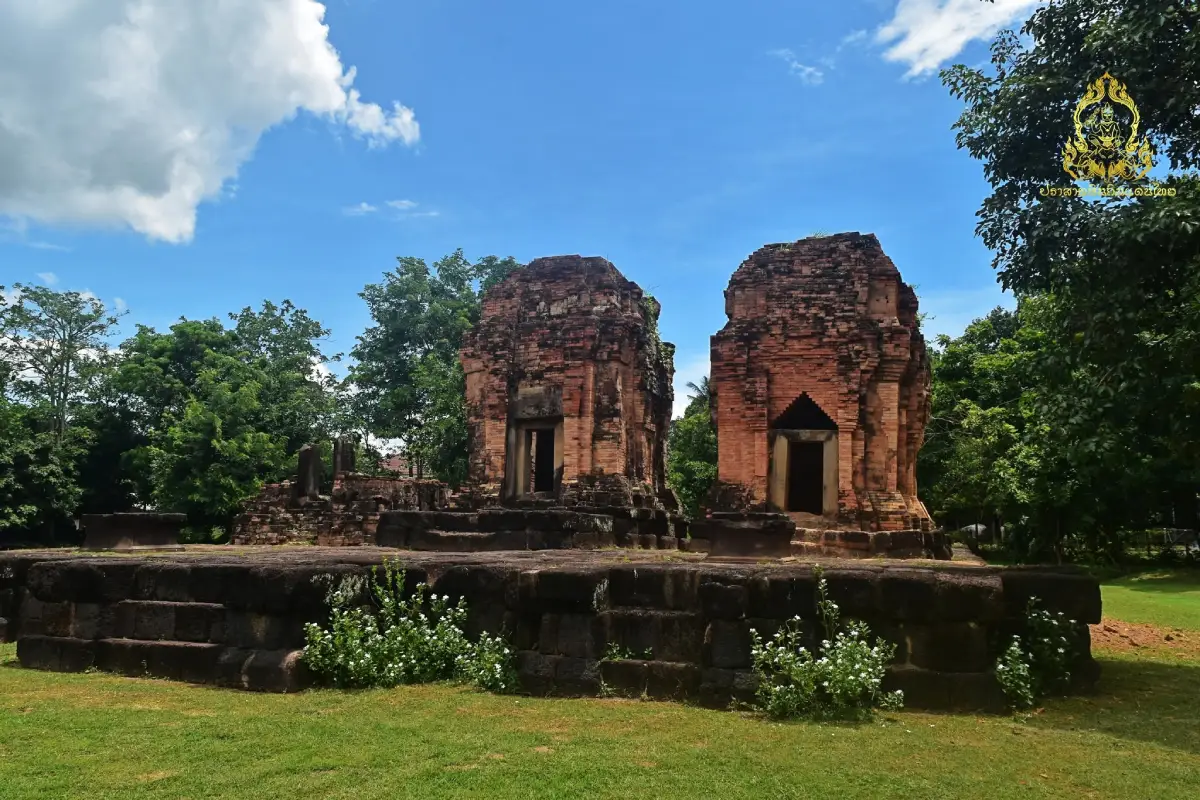
Prasat Ban Phlai in Surin Province is an important Khmer-style ancient monument located in Ban Prasat, Chuea Phloeng Subdistrict, Prasat District. It is a Hindu sanctuary dedicated to Shiva and represents the Shaivite tradition within ancient Khmer culture. The monument is known for its 3 brick towers arranged in a north–south line on a shared laterite base. The towers face east and are surrounded by a moat, except on the eastern side where the entrance is located. Prasat Ban Phlai is open daily, has no admission fee, and is one of the most accessible cultural heritage sites for travelers exploring Khmer history in Surin.
Prasat Ban Phlai is ideal for visitors who want to understand Surin through archaeology, Khmer art, and local community history. It is not simply an old ruin. It is a community sanctuary that reflects the presence of ancient Khmer civilization in the lower Mun River region. The surrounding area of Ban Prasat has long been associated with settlement, ritual, and local memory. Evidence from the monument, including the brick towers, laterite base, moat, baray, lintels, and Khmer-period pottery found in the community, shows that this was once a meaningful ancient settlement rather than an isolated religious structure.
The monument consists of 3 towers made of finely dressed brick. They are similar in size and are aligned from north to south on the same laterite base. Each tower has an indented square plan of approximately 4 m by 4 m and has an entrance only on the eastern side. This east-facing orientation is important in Khmer religious architecture because the east is associated with light, renewal, and entry into sacred space. Standing at the front of the monument, visitors can clearly see the 3 towers arranged in a deliberate architectural order, with 3 stairways leading up from the laterite terrace.
The central tower functions as the main sanctuary. It was built of brick with an indented square plan and an eastern entrance. Its body and tiered upper section still show the form of a Khmer brick tower, even though some parts have deteriorated over time. The northern tower preserves important artistic evidence, especially a lintel showing a kneeling deity within an arch above a kala face disgorging garland bands. The southern tower is more damaged, but it remains essential for understanding the original 3-tower composition of the sanctuary.
Architecturally, Prasat Ban Phlai belongs to the Baphuon style of Khmer art and dates to around the 16th–17th Buddhist centuries, roughly the 11th–12th centuries CE. Baphuon-style art is known for balanced tower forms, decorative lintels, kala motifs, garland bands, and divine figures. This period is an important phase in Khmer art before the full development of Angkor Wat and Bayon styles. Prasat Ban Phlai is therefore highly valuable for studying the development of Khmer art in present-day Thailand, especially in Surin Province, where many Khmer monuments are scattered across the landscape.
The most important evidence associated with Prasat Ban Phlai includes 3 lintels. The lintel from the central tower shows a deity seated with raised knees inside an arch above a kala face disgorging a garland band. The upper part of the garland is decorated with upright foliage motifs, while the lower part features scrolling leaf patterns. The lintel from the northern tower has a similar composition. The lintel from the southern tower depicts Indra riding the elephant Airavata above a kala face. These carvings demonstrate the Hindu religious context of the site and the craftsmanship of Khmer artists during the Baphuon period.
The image of Indra riding Airavata is especially meaningful. In Hindu belief, Indra is a guardian deity associated with the heavens and the eastern direction, while Airavata is his divine elephant mount. The presence of this motif at Prasat Ban Phlai reinforces the monument’s connection with Hindu cosmology. The kala motif disgorging garlands is also a major element of Khmer art, symbolizing protective power and the transition into sacred space. Together with the evidence that the sanctuary was dedicated to Shiva, these carvings confirm Prasat Ban Phlai as a Shaivite Hindu sanctuary with clear artistic and religious identity.
The moat surrounding the monument is another important element. The moat forms a rectangular boundary around the towers, leaving the eastern side open as the entrance. In Khmer sacred landscapes, moats often define the boundary between ordinary and sacred space. They may also represent cosmic waters in Hindu-Buddhist cosmology. At Prasat Ban Phlai, the moat helps organize the monument within its environment, separating the sanctuary from the surrounding settlement while giving the towers a stronger visual presence.
In front of the sanctuary to the east is a large baray, or ancient reservoir. The presence of both moat and baray shows that water played an important role in the landscape of Prasat Ban Phlai. In the ancient Khmer world, water was tied to ritual purity, fertility, prosperity, and community life. The baray may have served both practical and symbolic purposes. When the towers, moat, baray, village, and present-day temple area are considered together, Prasat Ban Phlai becomes a cultural landscape rather than a single isolated ruin.
Prasat Ban Phlai has been registered as a national ancient monument. The Fine Arts Department has marked the ancient monument boundary with fencing, carried out conservation work, and improved the landscape for cultural tourism. Today the site stands among village roads, local houses, temple buildings, fields, and community spaces. On the eastern side are temple structures, while the western side connects with plantation areas and rural settlement. This setting gives Prasat Ban Phlai a living community atmosphere rather than the feeling of a distant archaeological park.
The nearby temple is known locally as Wat Khok Prasat or Wat Ban Prasat Phromkhun. Close to the monument is the Ban Prasat Community Museum, which preserves and presents local artifacts, cultural objects, and Khmer-period pottery found around the village. This museum helps visitors understand the relationship between the ancient sanctuary and the present-day community. History at Ban Phlai is not limited to the brick towers. It also appears in everyday objects, local memory, ritual practice, and the way villagers continue to value the heritage around them.
A visit to Prasat Ban Phlai should begin from the east, the original entrance direction. From there, visitors can see the 3 brick towers aligned on the same base. After viewing the front, walk around the side of the monument to observe the indented plans of the towers, the laterite base, traces of stairways, and the surrounding moat. This route helps visitors understand that the site was carefully designed as a sacred space with a planned sequence of approach, boundary, and ritual center.
Those interested in Khmer art should pay attention to the construction materials. The brickwork of the towers is finely dressed and tightly laid, showing the skill of ancient builders. The laterite base supports the towers and helps protect them from moisture. This combination of laterite and brick is common in Khmer architecture in northeastern Thailand. Laterite was used for strength and foundation, while brick allowed builders to create more refined tower forms.
In terms of religious meaning, Prasat Ban Phlai is connected with Shiva, one of the most important deities in Hinduism. Earlier evidence mentions a Shiva linga, the sacred symbol of Shiva. Although the linga and some lintel fragments have disappeared, the remaining architecture and carvings still reveal the site’s role as a Hindu sanctuary. The location of the sanctuary near a village, together with the moat and baray, shows how devotion to Shiva was linked with community life, fertility, prosperity, and ritual gathering.
The name Ban Prasat itself reflects the long connection between the community and the ancient monument. The word “Prasat” in the village name shows that the sanctuary has long served as a landmark of local memory. The name Ban Phlai and the setting in Chuea Phloeng Subdistrict give the monument a specific community identity. Visitors should therefore see Prasat Ban Phlai not as a generic Khmer ruin, but as a historical place embedded in the life and identity of a local Surin village.
Today, the community continues to play a role in preserving the memory of Prasat Ban Phlai. Cultural heritage activities, site maintenance, and the collection of community artifacts for the local museum show that the monument remains meaningful to local residents. It is not only a destination waiting for outsiders to visit. It is also a place where local people express identity, pride, and responsibility toward their heritage.
For general travelers, Prasat Ban Phlai is easy to visit and does not require much time, yet it offers a surprisingly rich historical experience. From Surin city, take Highway 214 on the Surin–Prasat route. Around the 22 km marker near Ban Ramboe, turn right and continue along a paved road for about 3 km to Ban Prasat. The monument is located in the same area as the local temple. The route is suitable for private cars, rental cars, or hired local transport from Surin city or Prasat town.
From Prasat District town, the site is located before reaching the district office by about 7 km, making it a convenient stop along the Surin–Prasat route. Travelers can combine Prasat Ban Phlai with nearby sites such as Prasat Ban Phluang, Prasat Thanong, Surin National Museum, or Ban Tha Sawang Silk Weaving Village. For those focusing on Khmer heritage in Prasat District, Prasat Ban Phlai and Prasat Ban Phluang make an excellent paired route because both are modest in scale but rich in artistic and community context.
The best time to visit is in the morning or late afternoon, when the light is softer and the brick and laterite surfaces are easier to appreciate. During the rainy season, the moat and surrounding fields create a fresh green atmosphere, but visitors should be careful of slippery ground. During the cool season, the weather is ideal for walking around open-air ancient sites in Surin. In the hot season, visitors should bring drinking water, a hat, or an umbrella.
Visitors should treat Prasat Ban Phlai with respect. Do not climb on the towers, touch or move bricks and laterite blocks, write on the structures, or leave litter around the site. Although the monument is open to the public, every part of the old structure and its surroundings is historical evidence that should remain undisturbed. Good cultural travel means observing, learning, photographing responsibly, and helping preserve the site for future generations.
For photography, the best viewpoints include the eastern front where all 3 towers can be seen in alignment, the side angles that reveal the laterite base and indented tower plans, the surrounding moat, and the community landscape around the sanctuary. Morning light brings out the texture of the brickwork, while late afternoon light creates stronger shadows on the towers and base. A good visual record should include both wide shots of the layout and close details of the construction materials.
Prasat Ban Phlai is also suitable for students and anyone interested in local history. It offers a complete set of learning themes: 3-tower Khmer layout, brick and laterite construction, moat and baray landscape, Baphuon-style lintels, Shaivite belief, and community museum interpretation. Studying the site in person helps visitors understand that history is not only written in books. It is visible in the landscape, materials, environment, and the living memory of local people.
Compared with other Khmer monuments in Surin, Prasat Ban Phlai has its own identity. It differs from Prasat Sikhoraphum, which is famous for elaborate lintels and decorative sculpture. It differs from Prasat Ban Phluang, a small sandstone sanctuary with refined carving. It also differs from Prasat Ta Muean Thom, a larger borderland sanctuary near the Dangrek Mountains. Prasat Ban Phlai helps complete the broader picture of Surin as a province with Khmer heritage at many scales, from community shrines to large monumental sanctuaries.
A practical cultural itinerary can begin in Surin city in the morning, then continue to Prasat Ban Phlai for a 30–60 minute visit. After that, travelers can stop for lunch or coffee in Prasat District before visiting Prasat Ban Phluang. Another option is to return to Surin city to visit Wat Burapharam, Surin City Pillar Shrine, and Surin National Museum. For a full-day Khmer heritage route, Prasat Thanong or Prasat Mueang Thi can also be added depending on available time.
There are local restaurants and cafes in Prasat District where visitors can rest before or after visiting the monument. Options include restaurants along the Surin–Chong Chom route, cafes in Prasat town, and local eateries near the district center. Travelers staying overnight can choose accommodation in Prasat District such as Thong Paeka Hotel or Baan Thung Home Stay, or stay in Surin city for more dining, transport, and hotel options. Staying in Surin city is convenient for travelers planning to visit several attractions across the province.
For international travelers, Prasat Ban Phlai is easy to understand because its key elements clearly communicate the story of the site: east-facing towers, a 3-tower plan, a shared laterite base, a surrounding moat, an eastern baray, and lintel carvings connected with Hindu deities. It connects naturally with topics such as Khmer sanctuary, Hindu temple, Shiva worship, Baphuon style, and Surin cultural heritage. The site is suitable for travelers interested in Khmer civilization in Thailand who prefer quieter destinations away from crowded tourist routes.
The charm of Prasat Ban Phlai lies in its quiet authenticity. The monument has not been turned into an exaggerated tourist attraction. It still preserves the traces of brick, laterite, moat, and village setting in a direct and honest way. The missing Shiva linga and lost lintel fragments do not diminish the value of the site. Instead, they remind visitors of time, change, loss, conservation, and the careful interpretation of archaeological evidence.
Overall, Prasat Ban Phlai is a significant example of Khmer cultural influence in Surin. It connects Baphuon-style art, Shaivite Hindu belief, water landscape, and local community identity in one place. Visiting the site is not only about seeing 3 old brick towers. It is about reading the remains of an ancient community sanctuary that still stands within a living village. For travelers who want to understand Surin more deeply, Prasat Ban Phlai is a quiet but highly valuable stop on the cultural map of southern Isan.
| Name | Prasat Ban Phlai |
| Location | Ban Prasat, Chuea Phloeng Subdistrict, Prasat District, Surin Province |
| Address | Village No. 6, Ban Prasat, Chuea Phloeng Subdistrict, Prasat District, Surin Province 32140, Thailand |
| Highlights | Three brick towers aligned on a shared laterite base, facing east and surrounded by a moat; associated with Hindu Shaivite worship |
| History | Baphuon-style Khmer art, dating to around the 16th–17th Buddhist centuries; a community sanctuary dedicated to Shiva |
| Distinctive Features | Three finely dressed brick towers with indented square plans, eastern entrances, a shared laterite base, and a rectangular moat open on the eastern side |
| Key Evidence | Three lintels, deity figures above kala motifs, Indra riding Airavata, tower-top fragments, sacred image pedestals, and Khmer-period pottery found in the community |
| Travel Information | From Surin city, take Highway 214 on the Surin–Prasat route for about 22 km. Near Ban Ramboe, turn right and continue along a paved road for about 3 km to Ban Prasat |
| Current Status | Open daily as a registered national ancient monument, with a fenced heritage boundary and care by the Fine Arts Department |
| Open Days | Daily |
| Opening Hours | 08.00 – 16.30 |
| Fees | No Admission Fee |
| Facilities | Walking area around the monument, fenced ancient monument boundary, nearby temple grounds, Ban Prasat Community Museum, and parking areas around the village |
| Main Areas / Zones | Central tower, northern tower, southern tower, shared laterite base, front laterite terrace, surrounding moat, eastern baray, and Ban Prasat Community Museum |
| Monument Caretaker | Fine Arts Department through the 10th Regional Office of Fine Arts, Nakhon Ratchasima, and Surin National Museum, together with Ban Prasat community and Chuea Phloeng Subdistrict Administrative Organization |
| Main Contact Number | Chuea Phloeng Subdistrict Administrative Organization, Tel. 044-069-662 Surin National Museum, Tel. 044-513-274 10th Regional Office of Fine Arts, Nakhon Ratchasima, Tel. 044-471-518 |
| Nearby Tourist Attractions | 1. Ban Prasat Community Museum, about 1 km 2. Prasat Ban Phluang, about 14 km 3. Prasat Thanong, about 17 km 4. Surin National Museum, about 25 km 5. Wat Burapharam Royal Temple, about 26 km 6. Surin City Pillar Shrine, about 26 km |
| Nearby Restaurants | 1. Suan Ahan Pornnapha, about 15 km, Tel. 044-532-468 2. Suan Ahan Muat Ya, about 14 km, Tel. 044-551-166 3. Ban Vision Cafe, Prasat Branch, about 13 km 4. PunThai Coffee Prasat, about 13 km 5. Local Restaurants In Prasat Town, about 13 km |
| Nearby Accommodations | 1. Thong Paeka Hotel, Prasat District, about 14 km, Tel. 044-532-555, 093-432-0862 2. Baan Thung Home Stay, Ban Phluang, about 17 km 3. Martina Hotel Surin, about 27 km, Tel. 044-713-555, 044-713-655 4. Thongtarin Hotel Surin, about 26 km, Tel. 044-514-281, 044-514-282, 044-514-283 5. The Wood Surin, about 26 km, Tel. 063-023-7999 |
Frequently Asked Questions (FAQ)
Q: Where is Prasat Ban Phlai located?
A: Prasat Ban Phlai is located in Ban Prasat, Chuea Phloeng Subdistrict, Prasat District, Surin Province.
Q: Is Prasat Ban Phlai open every day?
A: Yes. Prasat Ban Phlai is open daily from 08.00 to 16.30.
Q: Is there an admission fee for Prasat Ban Phlai?
A: No. There is no admission fee to visit Prasat Ban Phlai.
Q: Why was Prasat Ban Phlai built?
A: Prasat Ban Phlai was built as a Hindu Shaivite sanctuary dedicated to Shiva.
Q: What period does Prasat Ban Phlai belong to?
A: The monument belongs to the Baphuon style of Khmer art and dates to around the 16th–17th Buddhist centuries.
Q: What is the main highlight of Prasat Ban Phlai?
A: Its highlight is the group of 3 brick towers on one laterite base, facing east, surrounded by a moat, with important Baphuon-style lintel evidence.
Q: How do I travel from Surin city to Prasat Ban Phlai?
A: Take Highway 214 on the Surin–Prasat route for about 22 km, then turn right onto a paved road and continue about 3 km to Ban Prasat.
Q: How long should I spend at Prasat Ban Phlai?
A: Around 30–60 minutes is suitable for walking around the monument, taking photographs, and studying the 3 towers, moat, and community setting.
 Category: ●Art, Culture and Heritage
 Group: ●Historical Sites and Monuments
Last Update : 2 MonthAgo
 Last Update : 2 MonthAgo
 Click to Access the Navigation Map GPS
Prasat Ban Phlai Map
Recommend
 Historical Sites and Monuments(11)
 Landmarks and Memorials(2)
 Art, Craft Centres, Tradition(5)
 Museums(1)
 Places of Worship
 Temple(15)
 Other Sacred Sites(1)
 Suburban Living
 Village, Community(9)
 Local Market(1)
 Nature and Wildlife
 National Parks and Marine Reserves(2)
 Mountain (Doi)(2)
 Dam, Reservoir, Lake(6)
 Waterfalls(1)
 River, Canal(2)
 Other natural attractions(4)
 Entertainment and Agricultural
 Farms, Parks and Ecotourism(2)


